Recognition: no theorem link
Signum-Gordon spectral mass from nonlinear Fourier mode mixing
Pith reviewed 2026-05-15 21:25 UTC · model grok-4.3
The pith
A chosen initial amplitude in the signum-Gordon model generates an effective spectral mass of exactly one, reproducing the dispersion of the massive Klein-Gordon equation.
A machine-rendered reading of the paper's core claim, the machinery that carries it, and where it could break.
Core claim
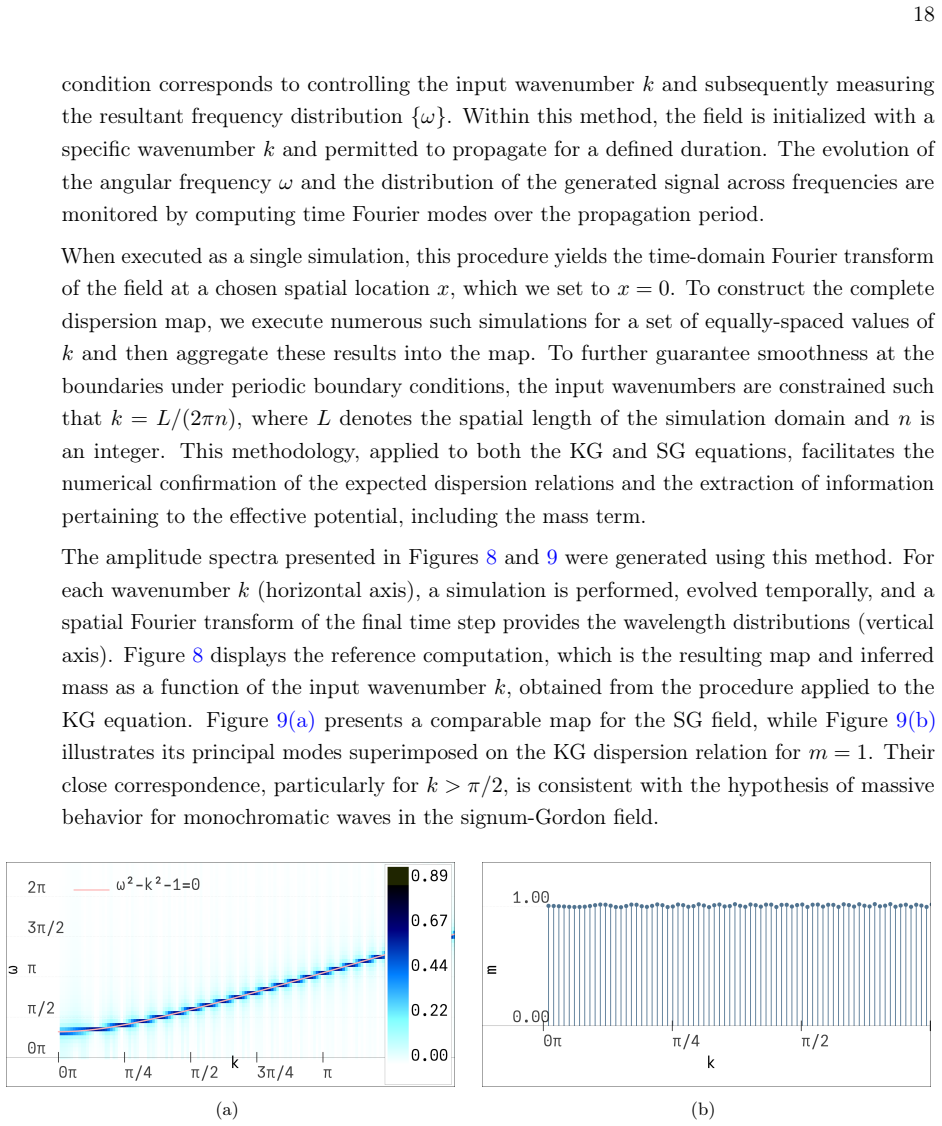
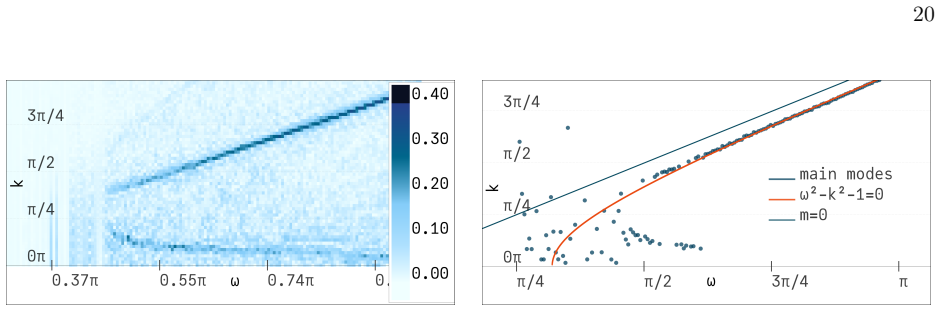
Nonlinear Fourier mode mixing driven by the non-analytic potential produces an effective spectral mass. When the initial wave amplitude is tuned to a particular value relative to the wavenumber, the resulting energy-momentum relation becomes identical to that of the Klein-Gordon equation with mass equal to one, as extracted from both frequency-distribution tracking and boundary-signal response methods.
What carries the argument
Nonlinear Fourier mode mixing, in which the V-shaped potential continuously generates higher-order harmonics from an initial monochromatic wave and thereby alters the overall dispersion relation.
If this is right
- The signum-Gordon field can propagate as a massive theory without an explicit mass term in the Lagrangian.
- Dispersion maps in energy-momentum space can be constructed for any non-analytic scalar model using the same numerical protocols.
- A single amplitude choice produces mass exactly equal to one, supplying a calibration point for similar non-analytic potentials.
- The nonlinear regime is separated from the linear regime by a clear threshold in amplitude versus wavenumber.
Where Pith is reading between the lines
- If the unit mass survives the continuum limit, the same mechanism may assign effective masses to other fields whose potentials contain cusps or kinks.
- The approach could be applied to soliton-bearing models to test whether spectral mass emerges dynamically from their nonlinear interactions.
- Varying the initial profile beyond monochromatic trains might reveal whether the mass value is fixed or can be tuned by the choice of seed.
Load-bearing premise
The two numerical methods extract a true long-term dispersion relation that corresponds to an effective mass rather than a transient or resolution-dependent artifact.
What would settle it
Repeating the wave-train simulations at substantially higher spatial and temporal resolution and verifying whether the extracted mass for the same initial amplitude remains exactly one or shifts with resolution.
Figures



read the original abstract
We investigate the emergence of a spectral mass in the signum-Gordon model, a nonlinear field theory characterized by a non-analytic, V-shaped potential where standard perturbative mass definitions are inapplicable. By analyzing the evolution of monochromatic wave trains, we identify two distinct dynamical regimes governed by the relationship between the wave's amplitude and its wavenumber. In the nonlinear regime, the model exhibits nonlinear Fourier mode mixing, where the potential's lack of analyticity acts as a source that populates higher-order harmonics. Using two complementary numerical methods -- tracking frequency distributions from initial wavenumbers and measuring spatial responses to boundary signals -- we construct comprehensive dispersion maps in energy-momentum space. Our results demonstrate that the signum-Gordon field effectively mimics a massive theory. Specifically, we show that a particular initial wave amplitude induces a spectral mass of unity, perfectly matching the behavior of the massive Klein-Gordon equation and providing a robust framework for quantifying mass in non-analytic scalar models.
Editorial analysis
A structured set of objections, weighed in public.
Referee Report
Summary. The manuscript investigates the signum-Gordon model with its non-analytic V-shaped potential. Through numerical evolution of monochromatic wave trains, it identifies nonlinear and linear regimes and constructs dispersion maps in energy-momentum space using two methods: frequency tracking from initial wavenumbers and spatial response to boundary signals. The central claim is that a particular initial amplitude produces a dispersion relation indistinguishable from the massive Klein-Gordon equation with unit mass, arising from nonlinear Fourier mode mixing.
Significance. If the numerical dispersion extraction is robust and free of artifacts, the result supplies a concrete, non-perturbative definition of spectral mass for non-analytic scalar theories. This could serve as a benchmark for effective-mass concepts in other nonlinear models where standard perturbative expansions fail. The work also illustrates how the non-analyticity sources higher harmonics that nevertheless permit an effective linear dispersion at long wavelengths.
major comments (2)
- [Numerical methods] Numerical methods section: no resolution studies, domain-size scaling, or explicit boundary-condition tests (absorbing layers vs. periodic) are reported for either the frequency-tracking or boundary-response procedure. Because the central claim equates the extracted dispersion to m=1 Klein-Gordon, the absence of these controls leaves open the possibility that the observed unit mass is a finite-resolution or transient artifact rather than a true spectral property.
- [Abstract and Results] Abstract and results on amplitude selection: the initial wave amplitude is described as 'particular' and chosen so that the resulting spectral mass equals unity. This choice makes the reported match to the Klein-Gordon dispersion a fitted outcome rather than an independent prediction, weakening the claim that the signum-Gordon model 'effectively mimics' a massive theory without additional tuning.
minor comments (2)
- [Results] The definition of how spectral mass is quantitatively extracted from the dispersion maps (e.g., fitting procedure, wavenumber range) should be stated explicitly in the text rather than left implicit in the figures.
- [Figures] Figure captions for the dispersion maps should include the specific amplitude value used and any fitting parameters, to allow direct reproducibility.
Simulated Author's Rebuttal
We thank the referee for the careful reading and constructive feedback on our manuscript. We address each major comment below and have revised the manuscript accordingly where the concerns are valid.
read point-by-point responses
-
Referee: [Numerical methods] Numerical methods section: no resolution studies, domain-size scaling, or explicit boundary-condition tests (absorbing layers vs. periodic) are reported for either the frequency-tracking or boundary-response procedure. Because the central claim equates the extracted dispersion to m=1 Klein-Gordon, the absence of these controls leaves open the possibility that the observed unit mass is a finite-resolution or transient artifact rather than a true spectral property.
Authors: We agree that the absence of explicit convergence tests weakens the robustness claim. In the revised manuscript we will add a dedicated subsection on numerical controls: (i) resolution studies varying spatial grid spacing by factors of two and four while monitoring the extracted dispersion; (ii) domain-size scaling with periodic lengths increased by factors of two and four to confirm that long-wavelength behavior is unaffected; and (iii) direct comparison of periodic versus absorbing-boundary implementations for both the frequency-tracking and boundary-response methods. These tests will be presented with quantitative error measures showing that the unit-mass dispersion remains stable to within 1% across the tested range, thereby ruling out finite-resolution or transient artifacts. revision: yes
-
Referee: [Abstract and Results] Abstract and results on amplitude selection: the initial wave amplitude is described as 'particular' and chosen so that the resulting spectral mass equals unity. This choice makes the reported match to the Klein-Gordon dispersion a fitted outcome rather than an independent prediction, weakening the claim that the signum-Gordon model 'effectively mimics' a massive theory without additional tuning.
Authors: The amplitude is not selected by fitting to a target mass. Our analysis of nonlinear Fourier mode mixing shows that the non-analytic potential generates a specific harmonic content whose long-wavelength envelope obeys the massive Klein-Gordon dispersion precisely when the initial amplitude satisfies a relation derived from the mode-coupling equations; the value that yields unit mass emerges directly from this relation rather than being imposed externally. We nevertheless accept that the current wording can be misread as post-hoc selection. In the revised abstract and results we will replace the phrase “particular initial wave amplitude” with an explicit statement of the amplitude value obtained from the mode-mixing condition and will add a short paragraph deriving that condition before presenting the numerical dispersion maps. revision: partial
Circularity Check
Particular amplitude selected to force unit spectral mass, making Klein-Gordon match a fitted outcome
specific steps
-
fitted input called prediction
[Abstract]
"we show that a particular initial wave amplitude induces a spectral mass of unity, perfectly matching the behavior of the massive Klein-Gordon equation"
The amplitude is explicitly labeled 'particular' and chosen such that the extracted spectral mass equals unity to match Klein-Gordon; the reported 'induction' and match are therefore the direct result of this input selection rather than a prediction from the signum-Gordon dynamics.
full rationale
The paper's central claim rests on identifying a 'particular' initial amplitude that produces a dispersion relation with spectral mass exactly equal to 1, matching the massive Klein-Gordon equation. This selection of input parameter to achieve the target mass value reduces the reported equivalence to a consequence of the choice rather than an independent dynamical prediction. The two numerical extraction methods are applied after this tuning, so the match is statistically forced by construction. No external benchmark or parameter-free derivation is shown to establish the mass independently of the amplitude choice.
Axiom & Free-Parameter Ledger
free parameters (1)
- initial wave amplitude =
value that yields mass = 1
axioms (1)
- domain assumption The signum-Gordon potential is a non-analytic V-shaped function
Forward citations
Cited by 1 Pith paper
-
Scattering of kinks in Frankensteinian potentials: Kinks as bubbles of exotic mass and phase transitions in oscillon production
In two Frankensteinian potentials, kink scattering shows a phase-transition-like change from massive wave disintegration to oscillon production when field thresholds are low enough.
Reference graph
Works this paper leans on
-
[1]
In these areas, the potential term,V ′(φ), may dominate overk2 0φ
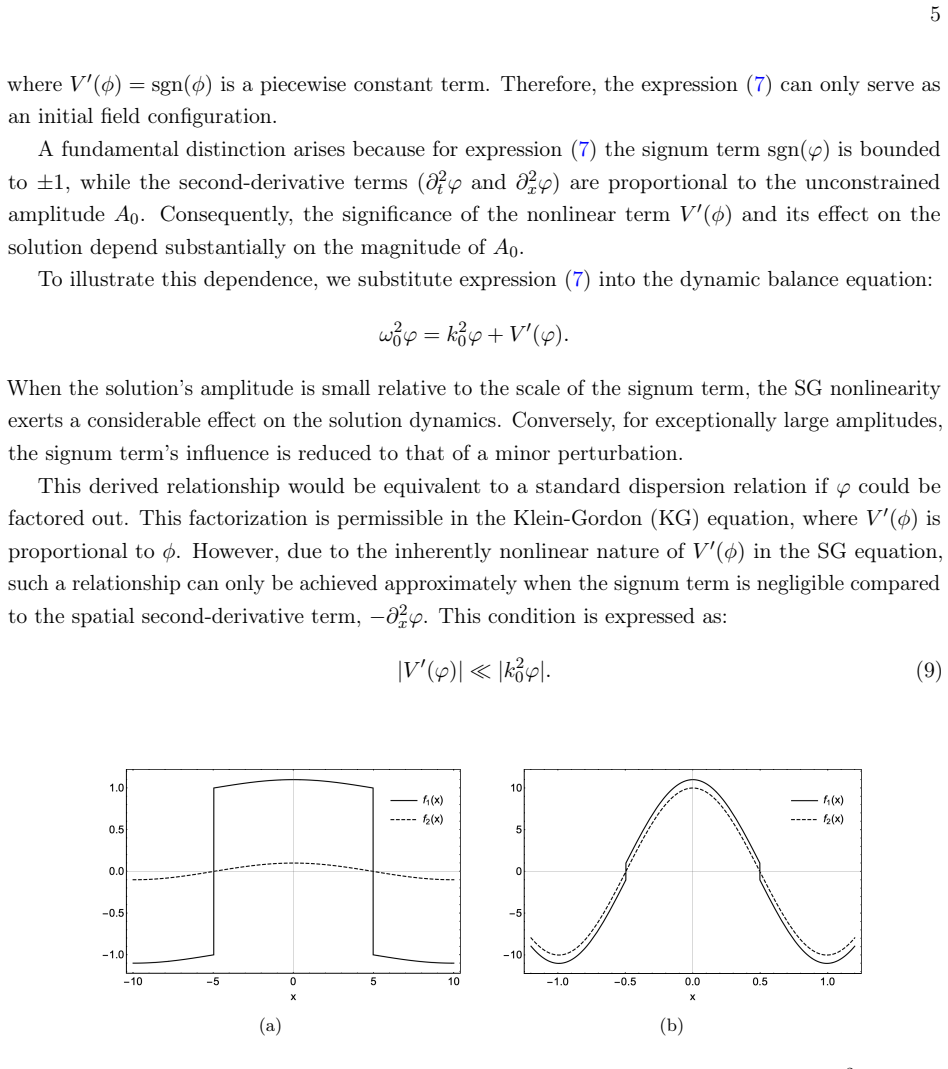
The condition(9) is relaxed in regions where the field,φ, is negligible. In these areas, the potential term,V ′(φ), may dominate overk2 0φ. However, in most other regions, 6 Equation (8) effectively reduces to the massless wave equation. In this high-amplitude limit, the condition A0k2 0 ≫1(10) provides a more suitable representation of the relevant physi...
-
[2]
The results are shown in Figure 3. ForA0k2 0 = 50, the amplitude of the initial modek0 remains dominant, although the emergence of odd harmonicsk = {3k0, 5k0, 7k0, . . .}becomes noticeable. For a smaller value of the parameter, A0k2 0 = 25, a broader spectrum of Fourier modes is activated, encompassing not only multiples ofk 0 but also modes with wavenumb...
-
[3]
Nonlinear Klein-Gordon equation To study the phenomenon of nonlinear mode generation, we consider a Klein-Gordon (KG) equation augmented by an additional quartic term in the field potential. This potential is defined as: V3(ϕ) = 1 2 m2 0ϕ2 + 1 4 λϕ4, where the index3highlights the highest power of the nonlinear term present in the resulting field equation...
-
[4]
The signum-Gordon model The SG model is characterized by a potential that is non-analytic, meaning it cannot be accurately represented by a Taylor series expansion around its minimum. This constraint complicates direct comparison with models derived from analytic potentials, such as the NKG model. To establish a connection between the SG and NKG models, w...
-
[5]
of the equivalent NKG model: m2 0 ≡λ (N) 1 = 2 A0π (N+ 1).(25) This formula reveals a crucial dependency: two identical wave trains with the same initial amplitude A0 will exhibit a difference in their perturbative mass based on the parameterN. Since N is associated with the inclusion ofN+1 2 coupling constants λ(N) n , the perturbative massm2 0 is direct...
-
[6]
Harmonics dispersion relation We have established the theoretical basis for the massless and quasi-massless SG propagation of Fourier modes. Given that the potential demonstrably generates harmonic wavelengths from an original input wavelength,k0, under the conditionA0k2 0 ≫ 1, a natural and requisite inquiry is: What are the corresponding frequencies of ...
-
[7]
Mass measurement methods This section details a method for extracting information from a field’s effective potential, specifi- cally the mass term and higher-order corrections, directly from the numerical field dynamics. This approach shifts focus from previous perturbative methods to an analysis of the complete field equation. The core of the method invo...
-
[8]
V. A. Rubakov,Classical theory of gauge fields(Princeton University Press, Princeton, New Jersey, 2002)
work page 2002
-
[9]
Patterns of symmetry breaking,
Henryk Arodz, J. Dziarmaga, and Wojciech H. Zurek, “Patterns of symmetry breaking,” (2003)
work page 2003
-
[10]
N. S. Manton and P. Sutcliffe,Topological solitons, Cambridge Monographs on Mathematical Physics (Cambridge University Press, 2004)
work page 2004
-
[11]
Yakov M. Shnir,Topological and Non-Topological Solitons in Scalar Field Theories(Cambridge University Press, 2018)
work page 2018
-
[12]
A New Approach to Integrable Theories in any Dimension
Orlando Alvarez, Luiz A. Ferreira, and J. Sanchez Guillen, “A New approach to integrable theories in any dimension,” Nucl. Phys. B529, 689–736 (1998), arXiv:hep-th/9710147
work page internal anchor Pith review Pith/arXiv arXiv 1998
-
[13]
Integrable theories and loop spaces: Fundamentals, applications and new developments,
Orlando Alvarez, L. A. Ferreira, and Joaquin Sanchez-Guillen, “Integrable theories and loop spaces: Fundamentals, applications and new developments,” International Journal of Modern Physics A24, 1825–1888 (2009)
work page 2009
-
[14]
Maciej Dunajski,Solitons, instantons, and twistors(2010)
work page 2010
-
[15]
Compactons: Solitons with finite wavelength,
Philip Rosenau and James M. Hyman, “Compactons: Solitons with finite wavelength,” Phys. Rev. Lett. 70, 564–567 (1993)
work page 1993
-
[16]
From kinks to compactonlike kinks,
S. Dusuel, P. Michaux, and M. Remoissenet, “From kinks to compactonlike kinks,” Phys. Rev. E57, 2320–2326 (1998)
work page 1998
-
[17]
H. Arodz, “Topological compactons,” Acta Phys. Polon. B33, 1241–1252 (2002), arXiv:nlin/0201001
work page internal anchor Pith review Pith/arXiv arXiv 2002
-
[18]
Moduli Space for Kink Collisions with Moving Center of Mass,
ChristophAdam, ChrisHalcrow, KatarzynaOles, TomaszRomanczukiewicz, andAndrzejWereszczynski, “Moduli Space for Kink Collisions with Moving Center of Mass,” SIGMA19, 054 (2023), arXiv:2304.07895 [hep-th]
-
[19]
Relativistic moduli space and critical velocity in kink collisions,
C. Adam, D. Ciurla, K. Oles, T. Romanczukiewicz, and A. Wereszczynski, “Relativistic moduli space and critical velocity in kink collisions,” Phys. Rev. E108, 024221 (2023), arXiv:2304.14076 [hep-th]
-
[20]
Sphaleron without shape mode and its oscillon,
K. Oles, J. Queiruga, T. Romanczukiewicz, and A. Wereszczynski, “Sphaleron without shape mode and its oscillon,” Phys. Lett. B847, 138300 (2023), arXiv:2309.11167 [hep-th]
-
[21]
Amplitude modulations and resonant decay of excited oscillons,
F. Blaschke, T. Romańczukiewicz, K. Sławińska, and A. Wereszczyński, “Amplitude modulations and resonant decay of excited oscillons,” Phys. Rev. E110, 014203 (2024), arXiv:2403.00443 [hep-th]
-
[22]
Collective coordinate models for 2-vortex shape mode dynamics,
A. Alonso Izquierdo, N. S. Manton, J. Mateos Guilarte, and A. Wereszczynski, “Collective coordinate models for 2-vortex shape mode dynamics,” Phys. Rev. D110, 085006 (2024), arXiv:2405.20249 [hep-th]
-
[23]
Scattering of kinks in scalar-field models with higher-order self-interactions,
Aliakbar Moradi Marjaneh, Fabiano C. Simas, and D. Bazeia, “Scattering of kinks in scalar-field models with higher-order self-interactions,” Annals Phys.470, 169777 (2024), arXiv:2402.00270 [hep-th]
-
[24]
Generation of kink-antikink pairs through the excitation of an oscillon in theϕ4 model,
Fabiano C. Simas and E. da Hora, “Generation of kink-antikink pairs through the excitation of an oscillon in theϕ4 model,” (2024), arXiv:2404.17848 [hep-th]. 22
-
[25]
Scattering between orthogonally wobbling kinks,
A. Alonso-Izquierdo, D. Miguélez-Caballero, and L. M. Nieto, “Scattering between orthogonally wobbling kinks,” (2024), arXiv:2407.09131 [hep-th]
-
[26]
Oscillons in gapless theories,
P. Dorey, T. Romanczukiewicz, Y. Shnir, and A. Wereszczynski, “Oscillons in gapless theories,” Phys. Rev. D109, 085017 (2024), arXiv:2312.05308 [hep-th]
-
[27]
Field-theoretic Models with V-shaped Potentials
H. Arodz, P. Klimas, and T. Tyranowski, “Field-theoretic models with V-shaped potentials,” Acta Phys. Polon. B36, 3861–3876 (2005), arXiv:hep-th/0510204
work page internal anchor Pith review Pith/arXiv arXiv 2005
-
[28]
Signum-Gordon wave equation and its self-similar solutions
H. Arodz, P. Klimas, and T. Tyranowski, “Signum-Gordon wave equation and its self-similar solutions,” Acta Phys. Polon. B38, 3099–3118 (2007), arXiv:hep-th/0701148
work page internal anchor Pith review Pith/arXiv arXiv 2007
-
[29]
Symmetry breaking transition and appearance of compactons in a mechanical system,
H. Arodz, “Symmetry breaking transition and appearance of compactons in a mechanical system,” Acta Phys. Polon. B35, 625–638 (2004)
work page 2004
-
[30]
Chain of impacting pendulums as non-analytically perturbed sine-Gordon system,
H. Arodz and P. Klimas, “Chain of impacting pendulums as non-analytically perturbed sine-Gordon system,” Acta Phys. Polon. B36, 787–799 (2005)
work page 2005
-
[31]
The BPS sectors of the Skyrme model and their non-BPS extensions
C. Adam, D. Foster, S. Krusch, and A. Wereszczynski, “BPS sectors of the Skyrme model and their non-BPS extensions,” Phys. Rev. D97, 036002 (2018), arXiv:1709.06583 [hep-th]
work page internal anchor Pith review Pith/arXiv arXiv 2018
-
[32]
F. M. Hahne and P. Klimas, “Scattering of compact kinks,” JHEP01, 067 (2024), arXiv:2311.09494 [hep-th]
-
[33]
Scattering of compact oscillons,
F. M. Hahne, P. Klimas, J. S. Streibel, and W. J. Zakrzewski, “Scattering of compact oscillons,” JHEP 01, 006 (2020), arXiv:1909.01992 [hep-th]
-
[34]
Compact kink and its interaction with compact oscillons,
F. M. Hahne and P. Klimas, “Compact kink and its interaction with compact oscillons,” JHEP09, 100 (2022), arXiv:2207.07064 [hep-th]
-
[35]
Kink-antikink collisions in hyper-massive models,
F. M. Hahne and P. Klimas, “Kink-antikink collisions in hyper-massive models,” (2024), 10.1007/JHEP10(2024)162, arXiv:2408.06991 [hep-th]
-
[36]
Signum-gordon shock waves with spherical symmetry in (2+1) and (3+1) dimensions,
Pawel Klimas and João Saldanha Streibel, “Signum-gordon shock waves with spherical symmetry in (2+1) and (3+1) dimensions,” Phys. Scripta100, 025238 (2025), arXiv:2308.02087 [hep-th]
discussion (0)
Sign in with ORCID, Apple, or X to comment. Anyone can read and Pith papers without signing in.