Recognition: 2 theorem links
· Lean TheoremScattering of kinks in Frankensteinian potentials: Kinks as bubbles of exotic mass and phase transitions in oscillon production
Pith reviewed 2026-05-15 16:41 UTC · model grok-4.3
The pith
Kinks in Frankensteinian potentials act as bubbles of exotic mass, with collisions switching to oscillon production below a field threshold.
A machine-rendered reading of the paper's core claim, the machinery that carries it, and where it could break.
Core claim
The central claim is that Frankensteinian potentials support kinks without skin and core regions and can be interpreted as free massive theories with a built-in particle-pair production mechanism that activates above field-value thresholds. The second model exhibits a phase-transition-like property in which the nature of collisions switches from disintegration into a massive wave to production of oscillons for large segments of initial velocities when the field threshold is low enough.
What carries the argument
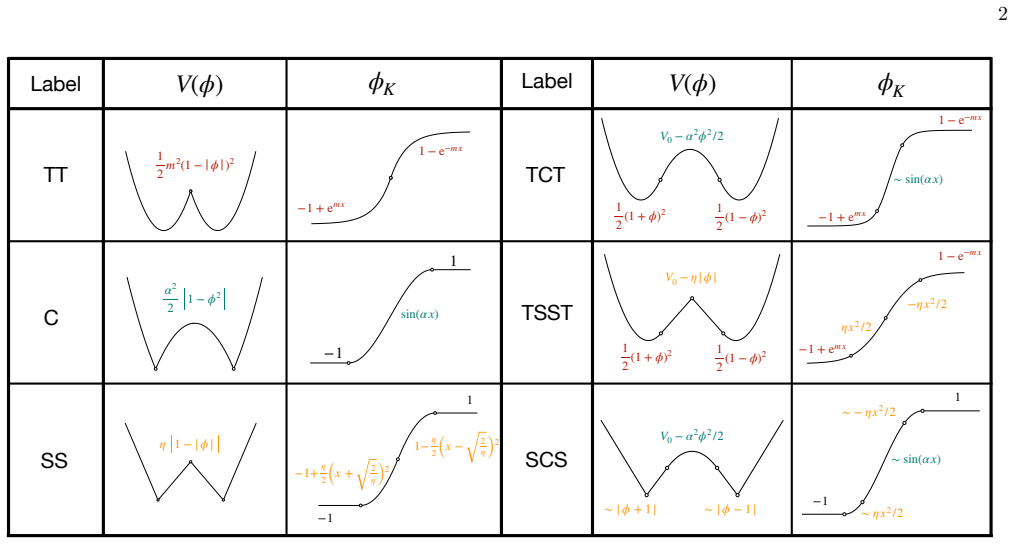
Frankensteinian potentials made of piecewise quadratic and linear segments that support kinks without skin and core regions, functioning as free massive theories with a built-in particle-pair production mechanism above field-value thresholds.
If this is right
- Kink characteristics such as mass and shape change depending on the chosen field-value thresholds.
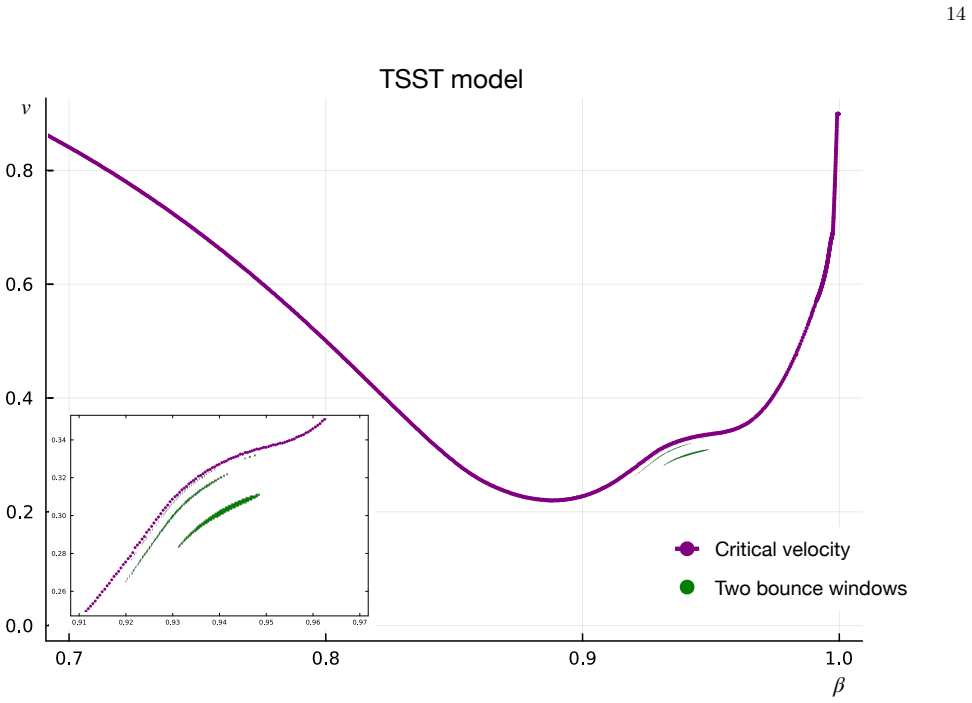
- The distribution of bouncing windows in collisions varies with the thresholds in both models.
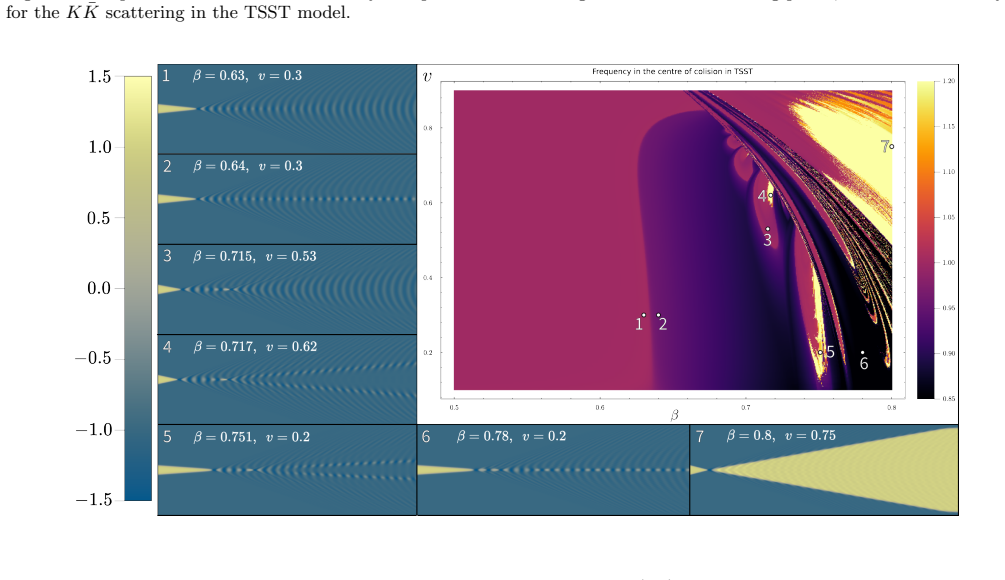
- In the second model, collisions produce oscillons rather than massive waves for wide velocity segments once the threshold drops low enough.
- The collision outcome undergoes a phase-transition-like change tied to the field threshold value.
Where Pith is reading between the lines
- If the free-theory-plus-threshold interpretation holds, it may allow simpler analytic estimates for interaction outcomes in other piecewise soliton models.
- The phase-transition behavior could be tested by varying the threshold continuously in simulations to map the exact velocity ranges where oscillon production begins.
- Similar threshold-activated production mechanisms might appear in other field theories where potentials are defined piecewise.
- The exotic-mass bubble picture could connect to studies of soliton stability in potentials with sharp transitions.
Load-bearing premise
The Frankensteinian potentials support kinks without skin and core regions and can be interpreted as free massive theories with a built-in particle-pair production mechanism that activates above field-value thresholds.
What would settle it
Numerical simulation of kink-antikink collisions in the second model at low field thresholds across a range of velocities, checking whether stable oscillons appear instead of disintegration into massive waves.
Figures








read the original abstract
We present a dynamical picture of kink-anti-kink scattering in a pair of special, Frankensteinian potentials made of piece-wise quadratic and linear pieces. Specifically, we focus on models that support kinks without skin and core regions. We propose an intuitive interpretation for these models as being essentially free massive theories with a built-in particle-pair like production mechanism that enters into the dynamics above certain field-value thresholds. We present results concerning the kink's characteristics depending on these thresholds and the distribution of bouncing windows. We show that the second model exhibits a phase-transition-like property in which the nature of collisions switches from disintegration into a massive wave to production of oscillons for large segments of initial velocities when the field threshold is low enough.
Editorial analysis
A structured set of objections, weighed in public.
Referee Report
Summary. The manuscript examines kink-antikink scattering in two Frankensteinian potentials constructed from piecewise linear and quadratic segments. These potentials support kinks without skin or core regions and are interpreted as free massive scalar theories equipped with a threshold-activated particle-pair production mechanism. Numerical results are reported on kink properties as functions of the field threshold, the distribution of bouncing windows, and a phase-transition-like switch in the second model: for sufficiently low thresholds, collisions change from producing a massive wave to generating oscillons over large intervals of initial velocities.
Significance. If the numerical observations are robust, the work supplies a simplified, intuitive framework for soliton scattering and oscillon formation, with the exotic-mass-bubble interpretation offering potential new intuition for threshold-driven production in nonlinear field theories. The absence of quantitative diagnostics for the reported transition, however, confines its immediate significance to a qualitative illustration rather than a controlled study of criticality.
major comments (1)
- Abstract and section describing the second model: the headline claim of a 'phase-transition-like property' lacks any defined order parameter, critical exponent, or scaling analysis. The switch from massive-wave disintegration to oscillon production is presented only qualitatively for low thresholds and broad velocity segments; no test is given to distinguish a sharp transition from a smooth crossover induced by the non-analytic points of the piecewise potential.
Simulated Author's Rebuttal
We thank the referee for their detailed review and insightful comments on our manuscript arXiv:2603.04101. We address the major comment below and will make revisions to improve the clarity of our claims.
read point-by-point responses
-
Referee: Abstract and section describing the second model: the headline claim of a 'phase-transition-like property' lacks any defined order parameter, critical exponent, or scaling analysis. The switch from massive-wave disintegration to oscillon production is presented only qualitatively for low thresholds and broad velocity segments; no test is given to distinguish a sharp transition from a smooth crossover induced by the non-analytic points of the piecewise potential.
Authors: We acknowledge that the claim is presented qualitatively without a formal order parameter, critical exponents, or scaling analysis. The term 'phase-transition-like' is intended to describe the observed qualitative switch in collision outcomes—from the production of a massive wave to the generation of oscillons over large intervals of initial velocities—when the field threshold is sufficiently low. This behavior is tied to the threshold-activated mechanism in our model. We agree that the piecewise construction introduces non-analytic points, which are central to the threshold effect we aim to model. To address this, we will revise the abstract and the section on the second model to qualify the claim as an observed qualitative transition rather than implying a full critical phenomenon. We will also add a brief discussion noting that distinguishing a sharp transition from a crossover would require additional quantitative diagnostics, which are beyond the scope of the current work but could be explored in future studies. revision: partial
Circularity Check
No significant circularity; results from direct numerical integration of field equations
full rationale
The paper explicitly constructs the Frankensteinian potentials as piecewise quadratic/linear functions, interprets them as free massive theories with threshold-activated pair production, and reports collision outcomes (including the phase-transition-like switch) from numerical integration of the equations of motion. No derivation reduces by construction to a fitted parameter or self-citation chain; the central claims are simulation outputs rather than self-referential predictions. This is the expected non-circular outcome for a numerical study.
Axiom & Free-Parameter Ledger
free parameters (1)
- field threshold
axioms (1)
- domain assumption The chosen piecewise quadratic and linear potentials support kinks without skin and core regions.
invented entities (1)
-
exotic mass bubbles
no independent evidence
Lean theorems connected to this paper
-
IndisputableMonolith/Cost/FunctionalEquation.leanwashburn_uniqueness_aczel unclear?
unclearRelation between the paper passage and the cited Recognition theorem.
We propose an intuitive interpretation for these models as being essentially free massive theories with a built-in particle-pair like production mechanism that enters into the dynamics above certain field-value thresholds.
-
IndisputableMonolith/Foundation/AlphaCoordinateFixation.leanJ_uniquely_calibrated_via_higher_derivative unclear?
unclearRelation between the paper passage and the cited Recognition theorem.
the second model exhibits a phase-transition-like property in which the nature of collisions switches from disintegration into a massive wave to production of oscillons
What do these tags mean?
- matches
- The paper's claim is directly supported by a theorem in the formal canon.
- supports
- The theorem supports part of the paper's argument, but the paper may add assumptions or extra steps.
- extends
- The paper goes beyond the formal theorem; the theorem is a base layer rather than the whole result.
- uses
- The paper appears to rely on the theorem as machinery.
- contradicts
- The paper's claim conflicts with a theorem or certificate in the canon.
- unclear
- Pith found a possible connection, but the passage is too broad, indirect, or ambiguous to say the theorem truly supports the claim.
Reference graph
Works this paper leans on
-
[1]
or Q-balls [29] in (1+1)-dimensions. Relatively re- cently, bouncing has been detected in solitons in higher dimensions as well [30, 31]. The phenomenon of bouncing was studied in the double-well model since 80ties [14–18]. Other potentials that came under detailed scrutiny areϕ 6 potential [19– 21], the Christ-Lee model [22] andϕ 8 potential [23, 24] amo...
work page internal anchor Pith review Pith/arXiv arXiv 2026
-
[2]
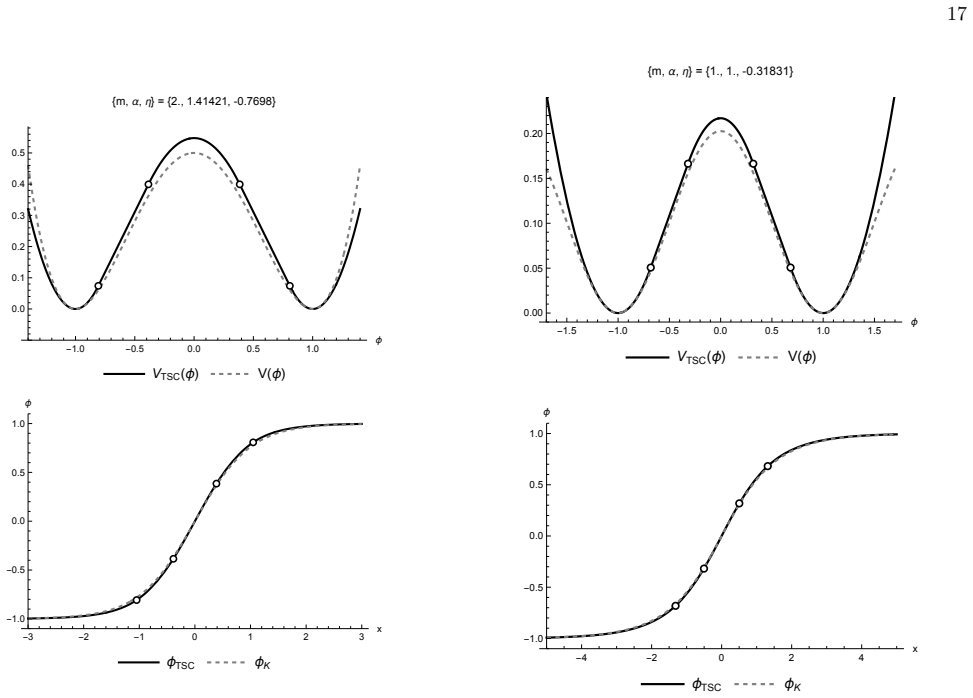
TSC kink and its properties The kink solution consists of two exponential tails, two quadratic skin regions, and a central sine core as illus- trated in Fig. 19 (right). The position of sewing points on thex-axis is denoted asx ±, and they are determined so that theϕ TSC(x) is differentiable everywhere. This gives us x− = 1 αarccot α√−η r 2 + η m2 + 2η α2...
-
[3]
Derrick mode An important property of the kink is its response to the infinitesimal scaling that is captured by the so-called Derrick’s mode. Unlike normal modes, this mode exists independently of the potential and plays an important role in restoring Lorentz covariance in collective coordi- nate models [45]. The associated frequency is defined as a ratio...
-
[4]
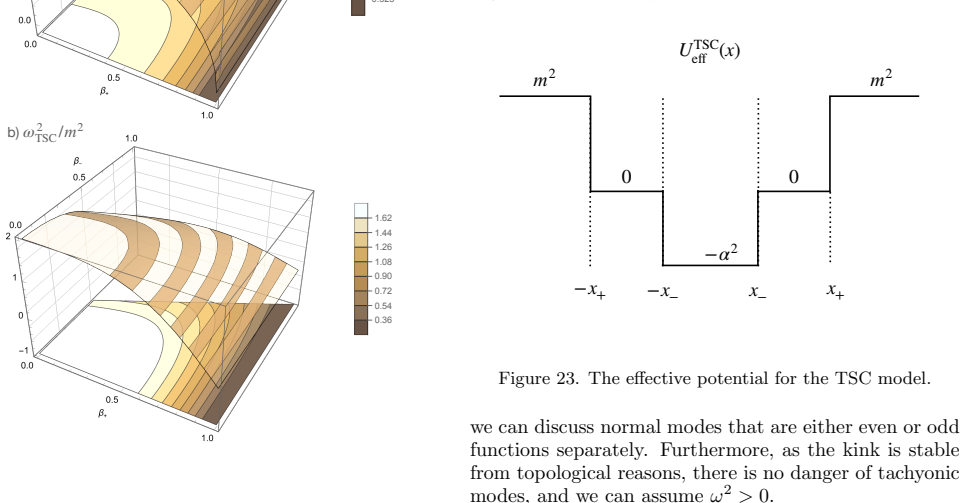
Normal modes The normal modes of a kink are obtained by adding to the static solution a small periodic correction, i.e. ϕ=ϕ K(x) + cos(ωt)b(x),|b(x)| ≪1,(A34) and plugging this into the equation of motion, that for a generic scalar field theory in 1 + 1 dimensions reads ∂2ϕ+V ′(ϕ) = 0.(A35) Retaining only linear terms inb, we obtain an effective Schr¨ odi...
-
[5]
Initial Conditions The initial boosted kink configuration was constructed by numerically integrating the BPS equation dϕ dx = p 2V(ϕ)p 1−v 2 in ,(B5) wherev in is the initial velocity. The static half-kink pro- file was obtained by solving this first-order equation with high precision and then mirrored to construct the full boosted kink profile, ϕK(x) = s...
-
[6]
Time Evolution The resulting initial-value problem was evolved using theDifferentialEquations.jllibrary. Time integra- tion was performed with an explicit adaptive Runge– Kutta method, typically the Bogacki–Shampine 5/4 scheme (BS5()). In the construction of static profiles, theTsit5()method was used for high-accuracy integra- tion. Overall, the procedure...
-
[7]
T. W. B. Kibble, “Topology of Cosmic Domains and Strings,” J. Phys. A9(1976), 1387-1398 doi:10.1088/0305-4470/9/8/029 20
-
[8]
Gravitational Field of Vacuum Domain Walls and Strings,
A. Vilenkin, “Gravitational Field of Vacuum Domain Walls and Strings,” Phys. Rev. D23(1981), 852-857 doi:10.1103/PhysRevD.23.852
-
[9]
The Hierarchy Problem and New Dimensions at a Millimeter
N. Arkani-Hamed, S. Dimopoulos and G. R. Dvali, “The Hierarchy problem and new dimensions at a millime- ter,” Phys. Lett. B429, 263 (1998) doi:10.1016/S0370- 2693(98)00466-3 [hep-ph/9803315]
work page internal anchor Pith review Pith/arXiv arXiv doi:10.1016/s0370- 1998
-
[10]
New Dimensions at a Millimeter to a Fermi and Superstrings at a TeV
I. Antoniadis, N. Arkani-Hamed, S. Dimopoulos and G. R. Dvali, “New dimensions at a millimeter to a Fermi and superstrings at a TeV,” Phys. Lett. B436, 257 (1998) doi:10.1016/S0370-2693(98)00860-0 [hep-ph/9804398]
work page internal anchor Pith review Pith/arXiv arXiv doi:10.1016/s0370-2693(98)00860-0 1998
-
[11]
A Large Mass Hierarchy from a Small Extra Dimension
L. Randall and R. Sundrum, “A Large mass hierar- chy from a small extra dimension,” Phys. Rev. Lett. 83, 3370 (1999) doi:10.1103/PhysRevLett.83.3370 [hep- ph/9905221]
work page internal anchor Pith review doi:10.1103/physrevlett.83.3370 1999
-
[12]
An Alternative to Compactification
L. Randall and R. Sundrum, “An Alternative to compactification,” Phys. Rev. Lett.83, 4690 (1999) doi:10.1103/PhysRevLett.83.4690 [hep-th/9906064]
work page internal anchor Pith review Pith/arXiv arXiv doi:10.1103/physrevlett.83.4690 1999
-
[13]
Do We Live Inside a Domain Wall?,
V. A. Rubakov and M. E. Shaposhnikov, “Do We Live Inside a Domain Wall?,” Phys. Lett.125B, 136 (1983). doi:10.1016/0370-2693(83)91253-4
-
[14]
W. P. Su, J. R. Schrieffer and A. J. Heeger, “Solitons in polyacetylene,” Phys. Rev. Lett.42(1979), 1698-1701 doi:10.1103/PhysRevLett.42.1698
-
[15]
Elastic Kink-Meson scattering,
J. Evslin and H. Liu, “Elastic Kink-Meson scattering,” JHEP04(2024), 072 doi:10.1007/JHEP04(2024)072 [arXiv:2311.14369 [hep-th]]
-
[16]
The domain wall soli- ton’s tension,
J. Evslin, H. Liu and B. Zhang, “The domain wall soli- ton’s tension,” Eur. Phys. J. C85(2025) no.6, 639 doi:10.1140/epjc/s10052-025-14383-8 [arXiv:2412.20814 [hep-th]]
-
[17]
Meson produc- tion from kink-meson scattering,
J. Evslin, H. Liu and B. Zhang, “Meson produc- tion from kink-meson scattering,” Phys. Rev. D107 (2023) no.2, 025012 doi:10.1103/PhysRevD.107.025012 [arXiv:2211.01794 [hep-th]]
-
[18]
N. S. Manton and P. Sutcliffe, “Topological soli- tons,” Cambridge University Press, 2004, ISBN 978-0-521-04096-9, 978-0-521-83836-8, 978-0-511-20783-9 doi:10.1017/CBO9780511617034
-
[19]
Topological and Non-Topological Solitons in Scalar Field Theories,
Y. M. Shnir, “Topological and Non-Topological Solitons in Scalar Field Theories,” Cambridge University Press, 2018, ISBN 978-1-108-63625-4
work page 2018
-
[20]
Kink-antikink collisions in the two- dimensionalϕ 4 model
T. Sugiyama, “Kink-antikink collisions in the two- dimensionalϕ 4 model”, Prog. Theor. Phys.61(1979), 1550-1563 doi:10.1143/PTP.61.1550
-
[21]
Resonance Structure in Kink - Antikink Interactions in ϕ4 Theory,
D. K. Campbell, J. F. Schonfeld and C. A. Wingate, “Resonance Structure in Kink - Antikink Interactions in ϕ4 Theory,” Physica D9(1983), 1 FERMILAB-PUB-82- 051-THY
work page 1983
-
[22]
Soliton - Anti-soliton Scattering and Cap- ture inλϕ 4 Theory,
M. Moshir, “Soliton - Anti-soliton Scattering and Cap- ture inλϕ 4 Theory,” Nucl. Phys. B185(1981), 318-332 doi:10.1016/0550-3213(81)90320-5
-
[23]
QUASIPERIOD- ICAL ORBITS IN THE SCALAR CLASSICAL lambda phi**4 FIELD THEORY,
T. I. Belova and A. E. Kudryavtsev, “QUASIPERIOD- ICAL ORBITS IN THE SCALAR CLASSICAL lambda phi**4 FIELD THEORY,” Physica D32(1988), 18 ITEP-94-1985
work page 1988
-
[24]
Frac- tal structure in the scalar lambda (phi**2-1)**2 theory,
P. Anninos, S. Oliveira and R. A. Matzner, “Frac- tal structure in the scalar lambda (phi**2-1)**2 theory,” Phys. Rev. D44(1991), 1147-1160 doi:10.1103/PhysRevD.44.1147
-
[25]
Kink-antikink collisions in the phi^6 model
P. Dorey, K. Mersh, T. Romanczukiewicz and Y. Shnir, “Kink-antikink collisions in theϕ 6 model,” Phys. Rev. Lett.107(2011), 091602 doi:10.1103/PhysRevLett.107.091602 [arXiv:1101.5951 [hep-th]]
work page internal anchor Pith review Pith/arXiv arXiv doi:10.1103/physrevlett.107.091602 2011
-
[26]
Multikink scattering in theϕ6 model revisited,
C. Adam, P. Dorey, A. Garcia Martin-Caro, M. Huido- bro, K. Oles, T. Romanczukiewicz, Y. Shnir and A. Wereszczynski, “Multikink scattering in theϕ6 model revisited,” Phys. Rev. D106(2022) no.12, 125003 doi:10.1103/PhysRevD.106.125003 [arXiv:2209.08849 [hep-th]]
-
[27]
Kink-Antikink Scattering in \phi^4 and \phi^6 Models
H. Weigel, “Kink-Antikink Scattering inφ 4 andϕ 6 Models,” J. Phys. Conf. Ser.482(2014), 012045 doi:10.1088/1742-6596/482/1/012045 [arXiv:1309.6607 [nlin.PS]]
work page internal anchor Pith review Pith/arXiv arXiv doi:10.1088/1742-6596/482/1/012045 2014
-
[28]
Collisions of weakly-bound kinks in the Christ-Lee model,
P. Dorey, A. Gorina, T. Roma´ nczukiewicz and Y. Shnir, “Collisions of weakly-bound kinks in the Christ-Lee model,” [arXiv:2304.11710 [hep-th]]
-
[29]
Generalizing the coupling between geometry and matter: f (R, Lm, T ) gravity
V. A. Gani, A. M. Marjaneh and K. Javidan, “Exotic final states in theφ 8 multi-kink collisions,” Eur. Phys. J. C81(2021) no.12, 1124 doi:10.1140/epjc/s10052-021- 09935-7 [arXiv:2106.06399 [hep-th]]
-
[30]
Kink excitation spectra in the (1+1)-dimensional $\varphi^8$ model
V. A. Gani, V. Lensky and M. A. Lizunova, “Kink ex- citation spectra in the (1+1)-dimensionalφ 8 model,” JHEP08(2015), 147 doi:10.1007/JHEP08(2015)147 [arXiv:1506.02313 [hep-th]]
work page internal anchor Pith review Pith/arXiv arXiv doi:10.1007/jhep08(2015)147 2015
-
[31]
Collective coordinates method for long-range kink collisions,
J. G. F. Campos, A. Mohammadi and T. Ro- manczukiewicz, “Collective coordinates method for long-range kink collisions,” JHEP01(2025), 166 doi:10.1007/JHEP01(2025)166 [arXiv:2411.12630 [hep- th]]
-
[32]
Resonance with quasinormal modes in long-range kinks’ collisions,
J. G. F. Campos, A. Mohammadi and T. Ro- manczukiewicz, “Resonance with quasinormal modes in long-range kinks’ collisions,” Eur. Phys. J. C86 (2026) no.1, 90 doi:10.1140/epjc/s10052-026-15330-x [arXiv:2510.05311 [hep-th]]
-
[33]
Dynamics of multi-kinks in the presence of wells and barriers
S. W. Goatham, L. E. Mannering, R. Hann and S. Kr- usch, “Dynamics of multi-kinks in the presence of wells and barriers,” Acta Phys. Polon. B42(2011), 2087-2106 doi:10.5506/APhysPolB.42.2087 [arXiv:1007.2641 [hep- th]]
work page internal anchor Pith review Pith/arXiv arXiv doi:10.5506/aphyspolb.42.2087 2011
-
[34]
Amplitude modulations and reso- nant decay of excited oscillons,
F. Blaschke, T. Roma´ nczukiewicz, K. S lawi´ nska and A. Wereszczy´ nski, “Amplitude modulations and reso- nant decay of excited oscillons,” Phys. Rev. E110 (2024) no.1, 014203 doi:10.1103/PhysRevE.110.014203 [arXiv:2403.00443 [hep-th]]
-
[35]
Oscil- lons and bubbles in Q-ball dynamics,
D. C. Mart´ ınez, P. Dorey, T. Rom´ anczukiewicz, P. M. Saffin, K. Slawinska and A. Wereszczy´nski, “Oscil- lons and bubbles in Q-ball dynamics,” JHEP12(2025), 154 doi:10.1007/JHEP12(2025)154 [arXiv:2509.03192 [hep-th]]
-
[36]
Scattering of vor- tices with excited normal modes,
S. Krusch, M. Rees and T. Winyard, “Scattering of vor- tices with excited normal modes,” Phys. Rev. D110 (2024) no.5, 056050 doi:10.1103/PhysRevD.110.056050 [arXiv:2406.04164 [math-ph]]
-
[37]
Resonance phe- nomena in vortex-antivortex collisions,
M. Bachmaier and A. Wereszczynski, “Resonance phe- nomena in vortex-antivortex collisions,”, Physics Let- ters B, 2026, 140324, ISSN 0370-2693, [arXiv:2510.17964 [hep-th]]
-
[38]
E. Belendryasova, V. A. Gani and K. G. Zloshchastiev, “Kink solutions in logarithmic scalar field theory: Excita- tion spectra, scattering, and decay of bions,” Phys. Lett. B823(2021), 136776 doi:10.1016/j.physletb.2021.136776 [arXiv:2111.09096 [hep-th]]
-
[39]
H. Arodz, “Topological compactons,” Acta Phys. Polon. B33(2002), 1241-1252 [arXiv:nlin/0201001 [nlin.PS]]
work page internal anchor Pith review Pith/arXiv arXiv 2002
-
[40]
Compact oscillons in the signum-Gordon model
H. Arodz, P. Klimas and T. Tyranowski, “Compact 21 oscillons in the signum-Gordon model,” Phys. Rev. D77(2008), 047701 doi:10.1103/PhysRevD.77.047701 [arXiv:0710.2244 [hep-th]]
work page internal anchor Pith review Pith/arXiv arXiv doi:10.1103/physrevd.77.047701 2008
-
[41]
Scattering of compact oscillons,
F. M. Hahne, P. Klimas, J. S. Streibel and W. J. Zakrzewski, “Scattering of compact oscillons,” JHEP01(2020), 006 doi:10.1007/JHEP01(2020)006 [arXiv:1909.01992 [hep-th]]
-
[42]
Compact kink and its in- teraction with compact oscillons,
F. M. Hahne and P. Klimas, “Compact kink and its in- teraction with compact oscillons,” JHEP09(2022), 100 doi:10.1007/JHEP09(2022)100 [arXiv:2207.07064 [hep- th]]
-
[43]
F. M. Hahne and P. Klimas, “Scattering of compact kinks,” JHEP01(2024), 067 doi:10.1007/JHEP01(2024)067 [arXiv:2311.09494 [hep- th]]
-
[44]
Signum-Gordon spectral mass from nonlinear Fourier mode mixing
J. S. Streibel and P. Klimas, “Signum-Gordon spec- tral mass from nonlinear Fourier mode mixing,” [arXiv:2602.16971 [hep-th]]
work page internal anchor Pith review Pith/arXiv arXiv
-
[45]
Kink-antikink collisions in hyper-massive models,
F. M. Hahne and P. Klimas, “Kink-antikink colli- sions in hyper-massive models,” JHEP10(2024), 162 doi:10.1007/JHEP10(2024)162 [arXiv:2408.06991 [hep- th]]
-
[46]
D. Bazeia, L. Losano, M. A. Marques and R. Menezes, “From Kinks to Compactons,” Phys. Lett. B736 (2014), 515-521 doi:10.1016/j.physletb.2014.08.015 [arXiv:1407.3478 [hep-th]]
work page internal anchor Pith review Pith/arXiv arXiv doi:10.1016/j.physletb.2014.08.015 2014
-
[47]
Scattering of compactlike struc- tures,
D. Bazeia, T. S. Mendon¸ ca, R. Menezes and H. P. de Oliveira, “Scattering of compactlike struc- tures,” Eur. Phys. J. C79(2019) no.12, 1000 doi:10.1140/epjc/s10052-019-7519-4 [arXiv:1910.05458 [hep-th]]
-
[48]
Quasinor- mal modes in kink excitations and kink–antikink in- teractions: a toy model,
J. G. F. Campos and A. Mohammadi, “Quasinor- mal modes in kink excitations and kink–antikink in- teractions: a toy model,” Eur. Phys. J. C80 (2020) no.5, 352 doi:10.1140/epjc/s10052-020-7856-3 [arXiv:1905.00835 [hep-th]]
-
[49]
Scat- tering of Kinks in Coreless Potentials,
O. N. Karp´ ıˇ sek, L. Rafaj and F. Blaschke, “Scat- tering of Kinks in Coreless Potentials,” PTEP 2024(2024) no.11, 113A01 doi:10.1093/ptep/ptae151 [arXiv:2407.14313 [hep-th]]
-
[50]
Mechanization of scalar field theory in 1+1 dimensions,
F. Blaschke and O. N. Karp´ ıˇ sek, “Mechanization of scalar field theory in 1+1 dimensions,” PTEP 2022(2022) no.10, 103A01 doi:10.1093/ptep/ptac104 [arXiv:2202.05675 [hep-th]]
-
[51]
Relativistic moduli space for kink collisions,
C. Adam, N. S. Manton, K. Oles, T. Romanczukiewicz and A. Wereszczynski, “Relativistic moduli space for kink collisions,” Phys. Rev. D105(2022) no.6, 065012 doi:10.1103/PhysRevD.105.065012 [arXiv:2111.06790 [hep-th]]
-
[52]
Confining kinks. ζ-regularized one-loop kink mass shifts in exotic field the- ories,
L. Inzunza, J. M. Guilarte and P. Pais, “Confining kinks. ζ-regularized one-loop kink mass shifts in exotic field the- ories,” [arXiv:2506.20440 [hep-th]]
-
[53]
PARENT POTEN- TIALS FOR AN INFINITE CLASS OF REFLECTION- LESS KINKS,
S. E. Trullinger and R. J. Flesch, “PARENT POTEN- TIALS FOR AN INFINITE CLASS OF REFLECTION- LESS KINKS,” J. Math. Phys.28(1987), 1683-1690 doi:10.1063/1.527476
discussion (0)
Sign in with ORCID, Apple, or X to comment. Anyone can read and Pith papers without signing in.