Recognition: no theorem link
Extreme-mass ratio inspirals in Schwarzschild - de Sitter spacetime I: Weak-field orbits
Pith reviewed 2026-05-15 21:36 UTC · model grok-4.3
The pith
A positive SdS parameter accelerates eccentricity decay and shortens inspiral timescales for extreme-mass ratio binaries in weak-field regimes.
A machine-rendered reading of the paper's core claim, the machinery that carries it, and where it could break.
Core claim
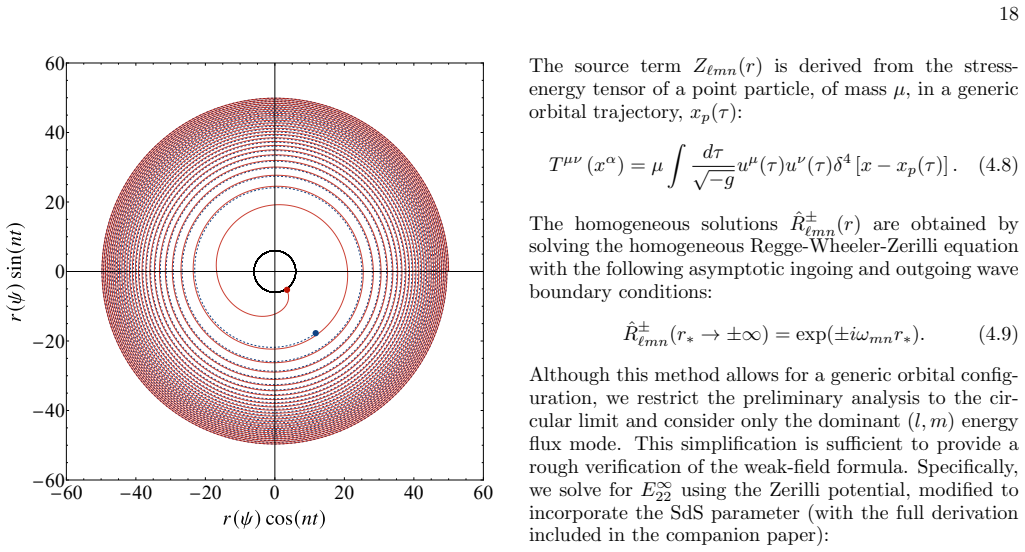
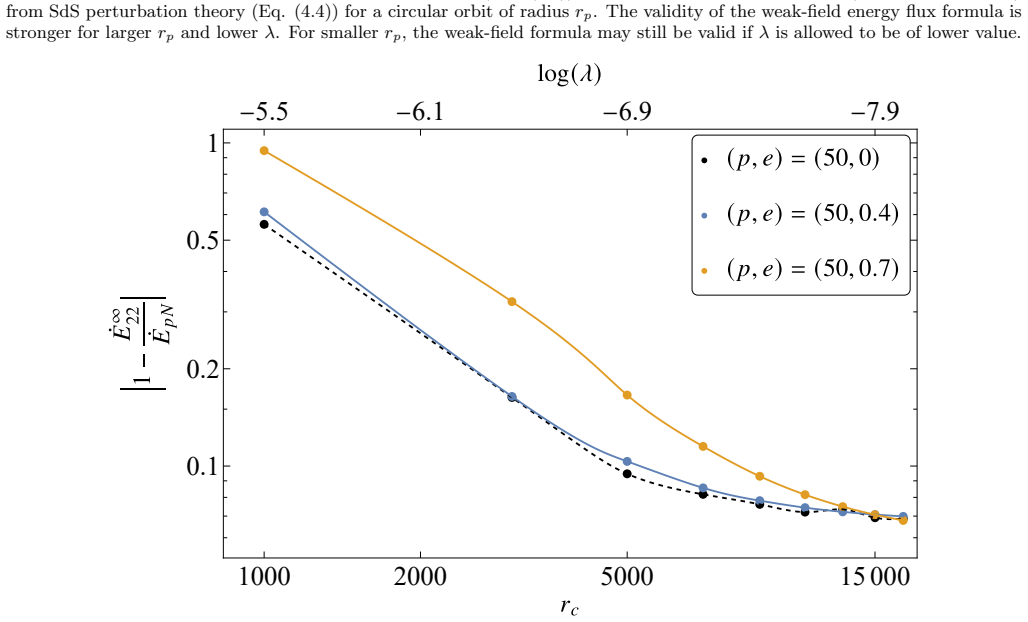
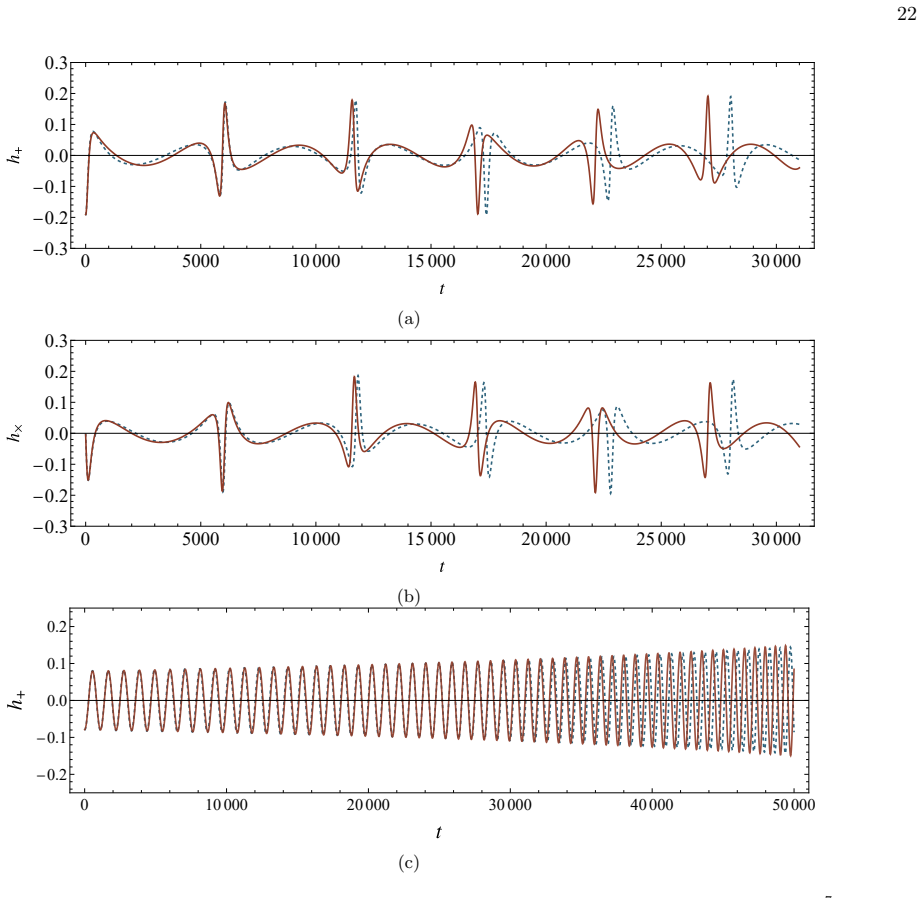
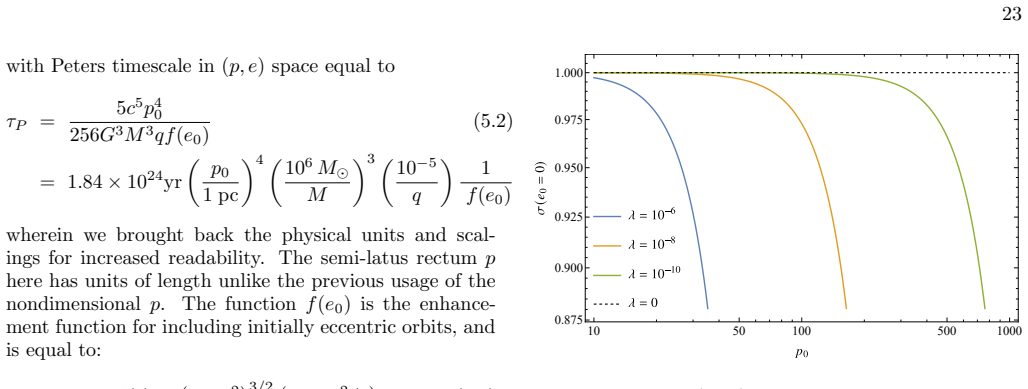
In the weak-field limit of Schwarzschild-de Sitter spacetime, a positive value of the SdS parameter λ accelerates the decay of orbital eccentricity, shortens the time to plunge, and induces an increase in gravitational-wave amplitude along with a cumulative phase advance in the generated adiabatic waveforms.
What carries the argument
The SdS parameter λ, which introduces an r² term in the effective potential and parametrizes non-asymptotically flat corrections, acting through a modified quadrupole formula to drive radiation-reaction evolution of energy, angular momentum, and orbital elements.
Load-bearing premise
That a modified quadrupole formula for gravitational-wave emission remains valid and accurate in the weak-field limit of SdS spacetime.
What would settle it
A direct comparison of observed EMRI waveforms against predictions showing no measurable phase advance or amplitude boost when the inferred λ is positive and of astrophysically relevant size.
Figures





read the original abstract
The inspiral of a compact object into a black hole is a key source of low - frequency gravitational waves for future space-based detectors like LISA. While models of this process have advanced considerably, they typically focus on asymptotically flat spacetimes. In this paper, we investigate how departures from asymptotic flatness, whether driven by cosmic expansion or large-scale galactic environments, alter adiabatic orbital evolution. Using the Schwarzschild - de Sitter (SdS) metric, we parametrize these deviations via an `SdS parameter' ($\lambda$) and analyze its impact on bound orbits. We calculate how $\lambda$ shifts the separatrix between bound and plunging states and modifies the relationship between a binary's energy, angular momentum, and orbital geometry. By applying a modified quadrupole formula in the weak-field limit, we investigate the effect of $\lambda$ on circularization, plunge times, and orbital trajectories. We show that a positive SdS parameter accelerates eccentricity decay and shortens inspiral timescales. We also generate adiabatic waveforms from inspirals evolving under radiation reaction, exhibiting an increase in amplitude and a cumulative phase advance induced by $\lambda$. While these effects are negligible if $\lambda$ is strictly cosmological, they become observationally relevant if the parameter serves as a proxy for astrophysical environments that induce $\sim r^2$ potential corrections. Our results suggest that such environmental coupling could meaningfully bias event rate estimates and waveform templates for space-based gravitational-wave astronomy.
Editorial analysis
A structured set of objections, weighed in public.
Referee Report
Summary. The paper investigates extreme-mass ratio inspirals in Schwarzschild-de Sitter spacetime, parametrizing deviations from asymptotic flatness via an SdS parameter λ. It examines how λ shifts the separatrix between bound and plunging orbits, modifies energy-angular momentum relations, and applies a modified quadrupole formula in the weak-field limit to evolve orbits under radiation reaction. The central claims are that positive λ accelerates eccentricity decay, shortens inspiral timescales, and produces adiabatic waveforms with increased amplitude and cumulative phase advance; these effects are deemed negligible for cosmological λ but potentially relevant as a proxy for astrophysical environments inducing r² corrections.
Significance. If the adapted quadrupole formula holds, the results would meaningfully extend EMRI modeling beyond asymptotically flat spacetimes and highlight possible biases in LISA waveform templates and event rates due to environmental effects. The work provides concrete, falsifiable predictions for orbital evolution and waveforms as functions of λ, which strengthens its potential impact if the radiation-reaction prescription is validated.
major comments (2)
- [Radiation reaction and modified quadrupole formula] The radiation-reaction section applies a modified quadrupole formula by inserting λ-dependent corrections to energy and angular-momentum loss rates, yet provides no derivation of these rates from the linearized Einstein equations on the SdS background (e.g., via Teukolsky or Regge-Wheeler equations or the Isaacson tensor). This is load-bearing for all headline results on accelerated eccentricity decay, shortened plunge times, and waveform amplitude/phase shifts, because curvature-induced propagation or additional terms at O(λ) may be omitted.
- [Weak-field orbits and separatrix] The weak-field orbit analysis treats λ as a free external parameter whose positive values produce the reported effects, but the manuscript does not demonstrate that the standard quadrupole formula remains valid once the cosmological horizon and lack of asymptotic flatness are accounted for; a concrete check against the full wave-zone solution on SdS would be required to support the quantitative shifts.
minor comments (2)
- [Abstract] The abstract states that effects are 'negligible if λ is strictly cosmological' but does not supply the specific numerical threshold or range of λ values used to reach this conclusion.
- Notation for the modified energy and angular-momentum fluxes should be defined explicitly with equation numbers rather than described only in prose.
Simulated Author's Rebuttal
We thank the referee for their careful reading of the manuscript and for the constructive comments. We have revised the paper to address the concerns raised about the radiation-reaction prescription and the validity of the quadrupole formula. Our responses to the major comments are given below.
read point-by-point responses
-
Referee: The radiation-reaction section applies a modified quadrupole formula by inserting λ-dependent corrections to energy and angular-momentum loss rates, yet provides no derivation of these rates from the linearized Einstein equations on the SdS background (e.g., via Teukolsky or Regge-Wheeler equations or the Isaacson tensor). This is load-bearing for all headline results on accelerated eccentricity decay, shortened plunge times, and waveform amplitude/phase shifts, because curvature-induced propagation or additional terms at O(λ) may be omitted.
Authors: We agree that a derivation of the flux corrections directly from the linearized Einstein equations on the SdS background would provide the most rigorous foundation. In the present work we adapt the standard quadrupole formula by inserting the λ-dependent orbital energy and angular-momentum relations that follow from the SdS geodesic equations, which is consistent with the weak-field limit (orbital radius ≪ cosmological horizon). We have added a new paragraph in Section 3.2 that explicitly states this approximation, its expected accuracy at leading order in λ, and the omission of possible curvature-induced propagation effects. We have also inserted a caveat in the conclusions noting that a full calculation via the Teukolsky equation on SdS is left for future work. These changes make the assumptions transparent while preserving the scope of the current paper. revision: yes
-
Referee: The weak-field orbit analysis treats λ as a free external parameter whose positive values produce the reported effects, but the manuscript does not demonstrate that the standard quadrupole formula remains valid once the cosmological horizon and lack of asymptotic flatness are accounted for; a concrete check against the full wave-zone solution on SdS would be required to support the quantitative shifts.
Authors: We acknowledge that a direct comparison with the full wave-zone solution on SdS would be the ideal validation. Our analysis is restricted to the regime in which the binary lies well inside the cosmological horizon (r ≪ λ^{-1/2}), so that the local geometry on the scale of the gravitational wavelength remains approximately flat and the standard quadrupole formula can be applied once the orbital constants have been corrected for λ. We have expanded the discussion in the introduction and in Section 4 to state this restriction explicitly and to emphasize that the reported shifts in eccentricity decay, plunge time, and waveform phase are valid under this weak-field assumption. While we cannot perform the full wave-zone calculation within the present study, we have added a sentence in the conclusions identifying this as a limitation and a direction for subsequent work. revision: partial
Circularity Check
No circularity; derivation uses external λ parameter and adapted quadrupole formula without self-referential reduction
full rationale
The paper parametrizes deviations from asymptotic flatness via the external SdS parameter λ in the metric, computes shifts in separatrix and orbital relations directly from the geodesic equations, and evolves orbits using a modified quadrupole formula applied in the weak-field limit. No parameters are fitted to subsets of data, no predictions reduce to the inputs by construction, and no self-citation chain bears the central claims. The reported effects on eccentricity decay, plunge times, amplitude, and phase are computed consequences of the stated assumptions rather than tautological renamings or fitted inputs.
Axiom & Free-Parameter Ledger
free parameters (1)
- SdS parameter λ
axioms (1)
- domain assumption Modified quadrupole formula applies in the weak-field limit of SdS spacetime
Reference graph
Works this paper leans on
-
[1]
inner” separatrix, and one as an “outer
Plunging separatrix In this part, we show a representation of the plunging separatrix curve, or the location of the last stable orbit (LSO), of marginally bound orbits in (p, e) space to show at which point in the parameter space is the region of orbital plunge. The locus of all parameter values that will create a merged plunge and bound region in the eff...
-
[2]
This amounts to solving for the ex- tremas with the radial distance evaluated at the periap- sis
Scattering separatrix The earlier analysis only applies on marginally bound orbits in relation to the inner unstable extrema, wherein we have analyzed the region of bound orbits merging with the plunge region. This amounts to solving for the ex- tremas with the radial distance evaluated at the periap- sis. We can now examine the locus of parameters that m...
-
[3]
We callP(p, e, λ) as the plunge separatrix since or- bits outside the region it bounds will plunge to the black hole while we callS(p, e, λ) as the scattering separatrix since orbits outside the region it bounds will scatter to the cosmological horizon. The scattering separatrix also has maximum parametersλ= 4/16875∼2.37×10 −4 at (p= 7.5, e= 0) equivalent...
-
[4]
+ 1944λ= 0, leading to the shifted ISCO, pISCO(λ) =r ISCO(λ) = 6 + 1944λ+O(λ 2).(2.35) This means that a compact object orbiting circularly a M= 10 6M⊙ SMBH under aλ= 10 −6 SdS spacetime are unstable and might plunge at an additional distance ofp <O(10 3) km from the black hole. We also derive an outermost stable circular orbit (OSCO),p OSCO from Eq. (2.2...
-
[5]
in the orbital parameters will manifest as an evolv- ing ellipse, or an osculating orbit. We now outline the derivation for the orbital evolution equations. To begin, we observe that the time derivatives of energy and angular momentum can be directly related to time derivatives of the orbital elements, dE dt = ∂E ∂p dp dt + ∂E ∂e de dt , dL dt = ∂L ∂p dp ...
work page 2000
- [6]
-
[7]
M. Branchesi, Multi-messenger astronomy: gravitational waves, neutrinos, photons, and cosmic rays, inJournal of Physics: Conference Series, Vol. 718 (IOP Publishing,
-
[8]
P. M´ esz´ aros, D. B. Fox, C. Hanna, and K. Murase, Multi- messenger astrophysics, Nature Reviews Physics1, 585 (2019)
work page 2019
-
[9]
N. Tamanini, Late time cosmology with lisa: probing the cosmic expansion with massive black hole binary mergers as standard sirens, inJ. Phys. Conf. Ser, Vol. 840 (2017) p. 012029
work page 2017
-
[10]
W. Del Pozzo, A. Sesana, and A. Klein, Stellar binary black holes in the lisa band: a new class of standard sirens, Monthly Notices of the Royal Astronomical Soci- ety475, 3485 (2018)
work page 2018
-
[11]
K. Arun, E. Belgacem, R. Benkel, L. Bernard, E. Berti, G. Bertone, M. Besancon, D. Blas, C. G. B¨ ohmer, R. Brito,et al., New horizons for fundamental physics with lisa, Living Reviews in Relativity25, 4 (2022)
work page 2022
-
[12]
M. Colpi, K. Danzmann, M. Hewitson, K. Holley- Bockelmann, P. Jetzer, G. Nelemans, A. Petiteau, D. Shoemaker, C. Sopuerta, R. Stebbins,et al., Lisa definition study report, arXiv preprint arXiv:2402.07571 https://doi.org/10.48550/arXiv.2402.07571 (2024)
work page internal anchor Pith review Pith/arXiv arXiv doi:10.48550/arxiv.2402.07571 2024
-
[13]
Laser Interferometer Space Antenna
P. Amaro-Seoane, H. Audley, S. Babak, J. Baker, E. Barausse, P. Bender, E. Berti, P. Binetruy, M. Born, D. Bortoluzzi,et al., Laser interferome- ter space antenna, arXiv preprint arXiv:1702.00786 https://doi.org/10.48550/arXiv.1702.00786 (2017)
work page internal anchor Pith review Pith/arXiv arXiv doi:10.48550/arxiv.1702.00786 2017
-
[14]
N. Karnesis, N. Stergioulas, G. Pappas, C. Anastopoulos, J. Antoniadis, T. Apostolatos, S. Basilakos, K. Destou- nis, E. Areti, G. Lukes-Gerakopoulos,et al., The laser interferometer space antenna mission in greece white paper, International Journal of Modern Physics D33, 2450027 (2024)
work page 2024
-
[15]
E. Barausse, E. Berti, T. Hertog, S. A. Hughes, P. Jetzer, P. Pani, T. P. Sotiriou, N. Tamanini, H. Witek, K. Yagi, et al., Prospects for fundamental physics with lisa, Gen- eral Relativity and Gravitation52, 1 (2020)
work page 2020
-
[16]
P. Amaro-Seoane, J. Andrews, M. Arca Sedda, A. Askar, Q. Baghi, R. Balasov, I. Bartos, S. S. Bavera, J. Bellovary, C. P. Berry,et al., Astrophysics with the laser interferometer space antenna, Living Reviews in Relativity26, 2 (2023)
work page 2023
-
[17]
E. Barausse, Relativistic dynamical friction in a colli- sional fluid, Monthly Notices of the Royal Astronomical Society382, 826 (2007)
work page 2007
-
[18]
C. F. Macedo, P. Pani, V. Cardoso, and L. C. Crispino, Into the lair: gravitational-wave signatures of dark mat- ter, The Astrophysical Journal774, 48 (2013)
work page 2013
-
[19]
E. Barausse and L. Rezzolla, Influence of the hydrody- namic drag from an accretion torus on extreme mass- ratio inspirals, Physical Review D77, 104027 (2008)
work page 2008
-
[20]
V. Cardoso and F. Duque, Environmental effects in gravitational-wave physics: Tidal deformability of black holes immersed in matter, Physical Review D101, 064028 (2020)
work page 2020
-
[21]
R. Eatough, H. Falcke, R. Karuppusamy, K. Lee, D. Champion, E. Keane, G. Desvignes, D. Schnitzeler, L. Spitler, M. Kramer,et al., A strong magnetic field around the supermassive black hole at the centre of the galaxy, Nature501, 391 (2013)
work page 2013
-
[22]
V. P. Frolov, Motion of a rotating black hole in a homo- geneous electromagnetic field, Physical Review D109, 064045 (2024)
work page 2024
-
[23]
E. Barausse, V. Cardoso, and P. Pani, Can environmental effects spoil precision gravitational-wave astrophysics?, Physical Review D89, 104059 (2014)
work page 2014
-
[24]
A. Toubiana, L. Sberna, A. Caputo, G. Cusin, S. Marsat, K. Jani, S. Babak, E. Barausse, C. Caprini, P. Pani, et al., Detectable environmental effects in gw190521-like black-hole binaries with lisa, Physical review letters126, 101105 (2021)
work page 2021
- [25]
-
[26]
G. Caneva Santoro, S. Roy, R. Vicente, M. Haney, O. J. Piccinni, W. Del Pozzo, and M. Martinez, First con- straints on compact binary environments from ligo-virgo data, Physical Review Letters132, 251401 (2024)
work page 2024
-
[27]
Kottler, The physical basis of einstein’s theory of grav- itation, Ann
F. Kottler, The physical basis of einstein’s theory of grav- itation, Ann. Phys.(Leipzig)56, 401 (1918)
work page 1918
-
[28]
Barreiroet al., Planck 2018 results-vi
R. Barreiroet al., Planck 2018 results-vi. cosmological parameters, Astronomy & Astrophysics641, A6 (2020)
work page 2018
-
[29]
V. Kagramanova, J. Kunz, and C. L¨ ammerzahl, So- lar system effects in schwarzschild–de sitter space–time, Physics Letters B634, 465 (2006)
work page 2006
-
[30]
A. Ashtekar, B. Bonga, and A. Kesavan, Asymptotics with a positive cosmological constant. iii. the quadrupole formula, Physical Review D92, 104032 (2015)
work page 2015
-
[31]
E. Poisson, Metric of a tidally distorted nonrotating black hole, Physical review letters94, 161103 (2005)
work page 2005
-
[32]
B. Preston and E. Poisson, Light-cone gauge for black- hole perturbation theory, Physical Review D—Particles, Fields, Gravitation, and Cosmology74, 064010 (2006)
work page 2006
-
[33]
R. Konoplya, Particle motion around magnetized black holes: Preston-poisson space-time, Physical Review D—Particles, Fields, Gravitation, and Cosmology74, 124015 (2006)
work page 2006
-
[34]
Z. Kov´ acs, L. ´A. Gergely, and M. Vas´ uth, Accre- tion processes in magnetically and tidally perturbed schwarzschild black holes, Physical Review D—Particles, Fields, Gravitation, and Cosmology84, 024018 (2011)
work page 2011
-
[35]
K. Mehrgan, J. Thomas, R. Saglia, X. Mazzalay, P. Er- win, R. Bender, M. Kluge, and M. Fabricius, A 40 billion solar-mass black hole in the extreme core of holm 15a, the central galaxy of abell 85, The Astrophysical Journal 887, 195 (2019)
work page 2019
-
[36]
E. H. T. Collaboration, K. Akiyama, J. C. Algaba, A. Al- berdi, W. Alef, R. Anantua, K. Asada, R. Azulay, A.-K. Baczko, D. Ball,et al., First m87 event horizon telescope results. viii. magnetic field structure near the event hori- zon, The Astrophysical Journal Letters910, L13 (2021)
work page 2021
-
[37]
V. S. Beskin,MHD flows in compact astrophysical ob- jects: accretion, winds and jets(Springer Science & Busi- ness Media, 2009)
work page 2009
-
[38]
S. J. Hoque and A. Aggarwal, Quadrupolar power radia- tion by a binary system in de sitter background, Interna- tional Journal of Modern Physics D28, 1950025 (2019)
work page 2019
-
[39]
Z. Stuchl´ ık and S. Hled´ ık, Some properties of the schwarzschild–de sitter and schwarzschild–anti-de sitter spacetimes, Physical Review D60, 044006 (1999)
work page 1999
-
[40]
G. C. McVittie, General relativity and cosmology, Inter- national Astrophysics Series (1956)
work page 1956
-
[41]
D. Scolnic, A. G. Riess, Y. S. Murakami, E. R. Peterson, D. Brout, M. Acevedo, B. Carreres, D. O. Jones, K. Said, C. Howlett,et al., The hubble tension in our own back- yard: Desi and the nearness of the coma cluster, The Astrophysical Journal Letters979, L9 (2025)
work page 2025
-
[42]
E. Hackmann and C. L¨ ammerzahl, Complete analytic so- lution of the geodesic equation in schwarzschild–(anti-) de sitter spacetimes, Physical review letters100, 171101 (2008)
work page 2008
-
[43]
O. Yanchyshen and C. L¨ ammerzahl, Gaussian orbital perturbation theory in schwarzschild space-time in terms of elliptic functions, Classical and Quantum Gravity42, 045010 (2025)
work page 2025
- [44]
-
[45]
J. B. Hartle, Gravity: An introduction to einstein’s gen- eral relativity (2003)
work page 2003
-
[46]
S. L. Shapiro and S. A. Teukolsky,Black holes, white dwarfs, and neutron stars: The physics of compact ob- jects(John Wiley & Sons, 2008)
work page 2008
-
[47]
S. M. Carroll,Spacetime and geometry(Cambridge Uni- versity Press, 2019)
work page 2019
-
[48]
P. Amaro-Seoane, C. F. Sopuerta, and M. D. Freitag, The role of the supermassive black hole spin in the es- timation of the emri event rate, Monthly Notices of the Royal Astronomical Society429, 3155 (2013)
work page 2013
-
[49]
S. Suzuki and K.-i. Maeda, Innermost stable circular or- bit of a spinning particle in kerr spacetime, Physical Re- view D58, 023005 (1998)
work page 1998
-
[50]
J. Levin and G. Perez-Giz, Homoclinic orbits around spinning black holes. i. exact solution for the kerr sep- aratrix, Physical Review D79, 124013 (2009)
work page 2009
-
[51]
L. C. Stein and N. Warburton, Location of the last stable orbit in kerr spacetime, Physical Review D101, 064007 (2020)
work page 2020
-
[52]
D. Pugliese, H. Quevedo, and R. Ruffini, Motion of charged test particles in reissner-nordstr¨ om spacetime, Physical Review D83, 104052 (2011)
work page 2011
-
[53]
V. Misra and J. Levin, Rational orbits around charged black holes, Physical Review D82, 083001 (2010)
work page 2010
-
[54]
E. Hackmann and H. Xu, Charged particle motion in kerr-newmann space-times, Physical Review D87, 124030 (2013)
work page 2013
-
[55]
Z. Stuchl´ ık, The motion of test particles in black-hole backgrounds with non-zero cosmological constant, Bul- letin of the Astronomical Institutes of Czechoslovakia34, 129 (1983)
work page 1983
- [56]
-
[57]
Y.-P. Zhang, S.-W. Wei, P. Amaro-Seoane, J. Yang, and Y.-X. Liu, Motion deviation of test body induced by spin and cosmological constant in extreme mass ratio inspiral binary system, The European Physical Journal C79, 856 (2019)
work page 2019
-
[58]
C. M. Bender and S. A. Orszag,Advanced mathematical methods for scientists and engineers I: Asymptotic meth- ods and perturbation theory(Springer Science & Business Media, 2013)
work page 2013
-
[59]
B. Bonga and J. S. Hazboun, Power radiated by a binary system in a de sitter universe, Physical Review D96, 064018 (2017)
work page 2017
-
[60]
S. J. Hoque and A. Virmani, On propagation of energy flux in de sitter spacetime, General Relativity and Grav- itation50, 40 (2018)
work page 2018
-
[61]
A. Ashtekar, B. Bonga, and A. Kesavan, Asymptotics with a positive cosmological constant. ii. linear fields on de sitter spacetime, Physical Review D92, 044011 (2015)
work page 2015
-
[62]
A. Ashtekar, Implications of a positive cosmological constant for general relativity, Reports on Progress in Physics80, 102901 (2017)
work page 2017
-
[63]
S. J. Hoque and A. Aggarwal, Quadrupolar power radia- tion by a binary system in de sitter background, Interna- 28 tional Journal of Modern Physics D28, 1950025 (2019)
work page 2019
-
[64]
Maggiore,Gravitational waves: Volume 1: Theory and experiments, Vol
M. Maggiore,Gravitational waves: Volume 1: Theory and experiments, Vol. 1 (Oxford University Press, 2008)
work page 2008
-
[65]
P. C. Peters, Gravitational radiation and the motion of two point masses, Physical Review136, B1224 (1964)
work page 1964
-
[66]
A. Pound and E. Poisson, Osculating orbits in schwarzschild spacetime, with an application to extreme mass-ratio inspirals, Physical Review D—Particles, Fields, Gravitation, and Cosmology77, 044013 (2008)
work page 2008
-
[67]
E. Poisson and C. M. Will,Gravity: Newtonian, post- newtonian, relativistic(Cambridge University Press, 2014)
work page 2014
-
[68]
K. Martel, Gravitational waveforms from a point particle orbiting a schwarzschild black hole, Physical Review D 69, 044025 (2004)
work page 2004
-
[69]
K. Martel and E. Poisson, Gravitational perturbations of the schwarzschild spacetime: a practical covariant and gauge-invariant formalism, Physical Review D71, 104003 (2005)
work page 2005
-
[70]
S. Hopper and C. R. Evans, Gravitational perturba- tions and metric reconstruction: Method of extended homogeneous solutions applied to eccentric orbits on a schwarzschild black hole, Physical Review D82, 084010 (2010)
work page 2010
-
[71]
L. B. Szabados and P. Tod, A review of total energy– momenta in gr with a positive cosmological constant, In- ternational Journal of Modern Physics D28, 1930003 (2019)
work page 2019
-
[72]
S. J. Hoque, S. P. Kashyap, A. Virmani,et al., de sit- ter teukolsky waves, Classical and Quantum Gravity41, 225011 (2024)
work page 2024
- [73]
-
[74]
G. Comp` ere, S. J. Hoque, and E. S. Kutluk, So (1, 4) flux-balance laws of de sitter spacetime at quadrupolar order, Physical Review D111, 064039 (2025)
work page 2025
-
[75]
S. A. Teukolsky, Linearized quadrupole waves in general relativity and the motion of test particles, Physical Re- view D26, 745 (1982)
work page 1982
-
[76]
G. Date and S. J. Hoque, Gravitational waves from com- pact sources in a de sitter background, Physical Review D94, 064039 (2016)
work page 2016
-
[77]
X. He, J. Jing, and Z. Cao, Relationship between bondi– sachs quantities and source of gravitational radiation in asymptotically de sitter spacetime, International Journal of Modern Physics D27, 1850046 (2018)
work page 2018
- [78]
-
[79]
P. Amaro-Seoane, J. R. Gair, M. Freitag, M. C. Miller, I. Mandel, C. J. Cutler, and S. Babak, Intermediate and extreme mass-ratio inspirals—astrophysics, science appli- cations and detection using lisa, Classical and Quantum Gravity24, R113 (2007)
work page 2007
-
[80]
P. Amaro-Seoane, Relativistic dynamics and extreme mass ratio inspirals, Living reviews in relativity21, 4 (2018)
work page 2018
discussion (0)
Sign in with ORCID, Apple, or X to comment. Anyone can read and Pith papers without signing in.