REVIEW 3 major objections 4 minor 3 cited by
Reward hacking in language-model RL is reduced by penalizing the gradient norm, which steers training to flatter, more accurate reward regions.
Reviewed by Pith at T0; open to challenge. T0 means a machine referee read the full paper against a public rubric. the ladder, T0–T4 →
T0 review · deepseek-v4-flash
2026-08-02 22:01 UTC pith:R6APKS7T
load-bearing objection GR beats KL across the board in sensible experiments; but the flatness-to-accuracy theory is a one-sided lower bound the authors over-interpret, so treat the mechanism as unproven. the 3 major comments →
Gradient Regularization Mitigates Reward Hacking in Reinforcement Learning from Human Feedback and Verifiable Rewards
The pith
A machine-rendered reading of the paper's core claim, the machinery that carries it, and where it could break.
Core claim
The paper sets out to show that a policy update rule of the form maximize expected proxy reward minus a weighted squared norm of the policy gradient—gradient regularization—produces policies that land on flat optima, and that flat optima of a proxy reward are exactly the optima at which the proxy remains accurate. The formal argument has three steps: gradient regularization biases optimization toward flat parameter-space maxima; flat parameter maxima imply policies that rarely sample a pair of near-identical actions whose proxy reward differs sharply; and under a Lipschitz true reward, every such 'sharp pair' forces an excess Bradley-Terry loss, so fewer sharp pairs means the proxy reward is
What carries the argument
The central object is gradient regularization (GR): adding a term proportional to the squared norm of the policy gradient to the RL objective so that updates resist steep reward landscapes. The proposed implementation uses a finite-difference estimate of the gradient of the gradient norm, reusing the same sampled actions for both gradient computations to keep overhead small. The theoretical bridge is a pairwise-robustness definition: a policy is (δ,K,ρ)-robust when near-identical action pairs rarely have proxy-reward gaps larger than K; the paper proves flat parameter maxima imply such robustness, and that non-robustness lower-bounds the excess Bradley-Terry loss of the proxy reward. That ch
Load-bearing premise
The load-bearing premise is the existence of a meaningful distance on the action space in which the true reward is Lipschitz and the proxy reward is smooth; the paper itself notes this is hard to define for discrete token sequences, so if no such distance exists the theoretical guarantee does not cover language models.
What would settle it
A run where the proxy reward is deliberately inaccurate on a broad, flat basin: if the policy's gradient norm stays small while true reward still collapses, the claimed flatness-accuracy link fails. Equivalently, a single trajectory where reward hacking begins while the gradient norm is decreasing would contradict the paper's observed correlation.
If this is right
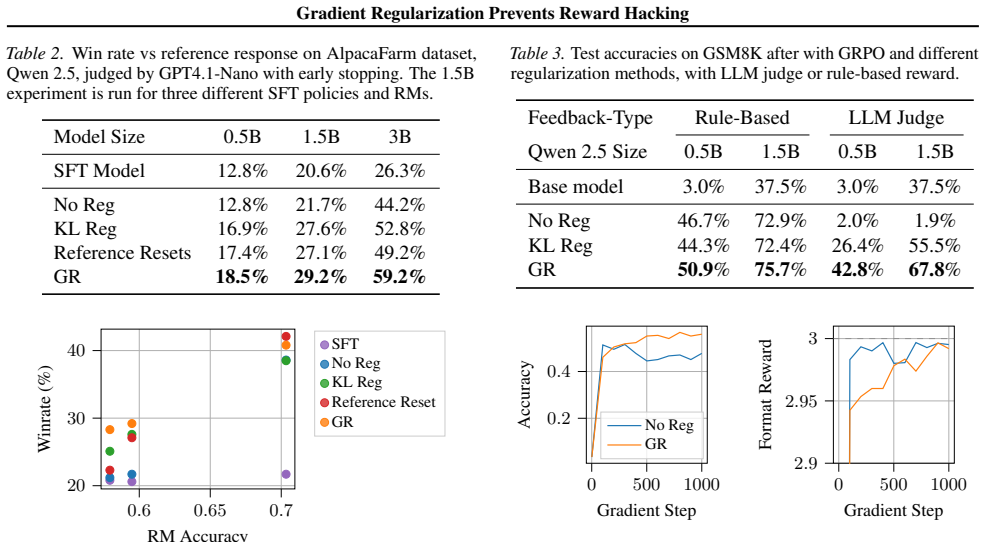
- Training with explicit gradient regularization outperforms a KL penalty on judged win rate in RLHF and can replace the KL term altogether.
- In rule-based math rewards, it stops the policy from overfitting to easier formatting and correctness components, improving final test accuracy.
- With an LLM-as-a-judge reward, it prevents the model from formatting its way to high scores and preserves true accuracy better than KL regularization.
- During training, gradient norm is empirically coupled to both parameter sharpness and reward-model Bradley-Terry loss, giving a practical early signal for reward hacking.
- Resetting the KL reference works because it induces implicit gradient regularization, not simply because it effectively weakens the KL penalty.
Where Pith is reading between the lines
- The argument suggests gradient regularization could also stabilize agentic and code RLVR, where rewards are sparse and noisy and the KL term is often dropped; the paper does not test this.
- A risk left open by the paper is that GR may favor flat but semantically wrong proxy optima; pairing GR with periodic reward-model updates is a natural extension.
- Because the finite-difference implementation reuses actions, it biases the gradient estimate; an importance-sampling-corrected version is a direct testable refinement.
- If a semantic distance on token sequences can be defined, for instance in the LM's hidden representation, the theoretical chain would extend to discrete actions; that is the key open theoretical target.
Editorial analysis
A structured set of objections, weighed in public.
Referee Report
Summary. The paper proposes gradient regularization (GR) as an alternative to KL penalties for preventing reward hacking in RLHF/RLVR. It argues that flat maxima of the proxy reward correspond to regions where the proxy reward is more accurate, and that adding a gradient-norm penalty to the policy objective biases optimization toward such flat regions. The theoretical argument proceeds in three steps: GR favors flat parameter-space optima, flat parameter optima imply action-space pairwise robustness under a Gaussian policy, and pairwise robustness implies a lower bound on excess Bradley-Terry loss. The paper then interprets Reference Resets as implicit GR, proposes an explicit finite-difference GR implementation, and reports experiments on TL;DR, AlpacaFarm, GSM8K, MATH, and LLM-as-a-Judge settings, concluding that GR can match or outperform KL penalties and in some cases replace them.
Significance. If the empirical findings are reproducible, this is a practically useful contribution: it offers a simple, low-overhead regularizer that may reduce reward hacking and relax the need for KL constraints in RL post-training. The empirical breadth is a genuine strength, especially the controlled gold-reward evaluation on TL;DR and the rule-based/LLM-judge math experiments. However, the theoretical contribution as currently stated is not established. The central flatness-to-accuracy mechanism rests on a one-sided lower bound that does not imply the directional claim made in the paper, and the formal assumptions exclude the discrete token-level action space of the actual LMs. The paper's value would be materially increased by scaling back the theoretical claims and by reporting seed/error-bar information for the headline tables.
major comments (3)
- [Section 3, Proposition 3.4 (Eq. 10)] The step from Eq. (10) to the claim that reducing P(S_K,δ) or K 'obtain[s] a policy that induces a smaller excess BT loss' is not valid. Eq. (10) is a lower bound: L_BT(R̃) − L_BT(R*) ≥ 2(σ(K) − σ(Lδ))² P(S_K,δ). Shrinking the right-hand side does not constrain the left-hand side. A constant proxy reward has P(S_K,δ)=0 yet can incur arbitrarily large excess BT loss; conversely, large P(S_K,δ) need not imply large excess loss if the bound is loose. The limitation stated in Section 3 ('we do not show whether or not GR prevents convergence to flat but incorrect regions') is narrower than this issue: even the sharpness component of the mechanism is not established. Consequently, the abstract's and Section 6's claim that GR 'maintains reward accuracy' through flatness is unsupported by the derivation as written.
- [Section 3 / Assumptions B.2–B.4, Appendix B] Propositions 3.3 and 3.4 rely on a Gaussian policy with fixed covariance, a metric on the action space, and L-Lipschitz/β-smooth rewards in that metric. The paper itself acknowledges, at the end of Section 3, that 'our theoretical argument assumes a Gaussian policy and requires a distance function, which is difficult to define for LMs.' Since the empirical method is applied to autoregressive LMs generating discrete token sequences, the theoretical derivation does not cover the actual setting. The correlations in Section 4 and Figure 3 are suggestive, but they do not supply the missing parameter-space-to-action-space link for LMs. Without a meaningful action metric, the flatness-to-accuracy mechanism remains unverified in the domain where the method is recommended.
- [Tables 1, 2, and 3] The headline empirical claim that 'GR consistently performs best' and 'can replace the KL penalty' is reported without variance information. Tables 1–3 show single runs per configuration; Figure 5 provides three seeds only for the 1.5B AlpacaFarm setting, where the GR advantage over KL is small in some RM-accuracy regimes. Given the modest margins in several comparisons (e.g., 29.2% vs 27.6% in Table 2 for 1.5B; 50.9% vs 44.3% in Table 3 for rule-based GSM8K at 0.5B), the consistency claim needs error bars or additional seeds. I am not asking for large-scale multi-seed runs across every cell, but the paper should quantify run-to-run variance for the main comparisons, or explicitly state which numbers are single runs and temper the strength of the claim accordingly.
minor comments (4)
- [Table 3 heading] 'Test accuracies on GSM8K after with GRPO' is ungrammatical; should read 'after training with GRPO'.
- [Eq. (4)] The notation Δϕ∥∇ϕL(ϕ)∥² is ambiguous. Suggest writing the finite-difference operator explicitly, e.g., (∇L(ϕ+ε∇L(ϕ))−∇L(ϕ))/ε, and reserving Δ for the parameter update.
- [Section 4] The claim that Reference Resets 'implicitly regularize the gradient' is supported by an empirical correlation rather than a derivation. Please mark this as a hypothesis or provide the derivation; as written, it reads as a stronger statement than the evidence supports.
- [Figure 4] The x-axis label uses θ for the policy parameters while the text uses ϕ; please unify the notation.
Circularity Check
No circularity: the flatness-to-accuracy chain is a formal bound plus independently measured correlations; the acknowledged inference gap is a correctness concern, not a reduction to inputs.
full rationale
I find no equation-level circularity. The claimed derivation is: (i) GR biases optimization toward flat parameter-space optima (cited to external work: Zhao et al. 2022; Karakida et al. 2023); (ii) flat parameter optima imply action-space pairwise robustness (Prop. 3.3, built on Lee & Yoon 2025); and (iii) sharp action pairs incur excess BT loss (Prop. 3.4). None of these steps defines its conclusion into its premise: Eq. (7) penalizes the gradient norm of the policy return, while reward accuracy is measured as the BT loss L_BT(θ,φ); the gradient norm is not constructed from L_BT. The empirical correlations in Figures 3, 8, and 11 are measurements of independently obtained quantities, not fitted parameters renamed as predictions. The one genuinely load-bearing gap is logical rather than circular: Prop. 3.4 (Eq. 10) is only a lower bound, yet Section 3 asserts, 'By changing the policy φ to decrease the ratio of violating pairs P(S_K,δ) or the magnitude of the violations K, we obtain a policy that induces a smaller excess BT loss.' Decreasing a lower bound does not force the left-hand side down. The paper's own Limitations admit this scope: 'we only address excess BT loss incurred by overly sharp maxima... We do not show whether or not GR prevents convergence to flat but incorrect regions.' That under-support is a correctness risk, not a circularity. The only overlapping-author citation (Ackermann et al. 2025) is used for a historical note and dataset filtering, not to justify the central claim; per the rules it does not raise the circularity score.
Axiom & Free-Parameter Ledger
free parameters (4)
- GR strength γ =
1e-3 (math tasks); 1e-2–0.1 (RLHF, after grid search)
- Finite-difference perturbation ε =
1e-3
- KL penalty strength β (baseline) =
0.03–0.4 across experiments
- Reference-reset interval R =
200 gradient steps (default)
axioms (5)
- domain assumption Gaussian policy with fixed covariance and full row-rank Jacobian (Assumption B.2)
- domain assumption Proxy reward is β-smooth in action space (Assumption B.3)
- domain assumption True reward is L-Lipschitz in a meaningful action-space distance (Assumption B.4)
- standard math GR biases optimization toward flat minima in parameter space
- domain assumption Flat minima generalize better and, by extension, correlate with proxy-reward accuracy
read the original abstract
Reinforcement Learning from Human Feedback (RLHF) or Verifiable Rewards (RLVR) are two key steps in the post-training of modern Language Models (LMs). A common problem is reward hacking, where the policy may exploit inaccuracies of the reward and learn an unintended behavior. Most previous works address this by limiting the policy update with a Kullback-Leibler (KL) penalty towards a reference model. We propose a different framing: Train the LM in a way that biases policy updates towards regions in which the reward is more accurate. First, we derive a theoretical connection between the accuracy of a reward model and the flatness of an optimum at convergence. Gradient regularization (GR) can then be used to bias training to flatter regions and thereby maintain reward model accuracy. We confirm these results by showing that the gradient norm and reward accuracy are empirically correlated in RLHF. We then empirically show that Reference Resets of the KL penalty find flatter regions with a higher reward accuracy. We further improve on this by proposing to use explicit GR with an efficient finite-difference estimate. Empirically, GR performs better than a KL penalty across a diverse set of RL experiments with LMs. GR achieves a higher GPT-judged win-rate in RLHF, avoids overly focusing on the format in rule-based math rewards, and prevents hacking the judge in LLM-as-a-Judge math tasks.
Figures




Forward citations
Cited by 3 Pith papers
-
Multimodal Reward Hacking in Reinforcement Learning
Imperfect multimodal RL rewards systematically create new failures (NRFR > RHR); scaling and answer-aware rewards help but do not eliminate hacking, and unreliable visual verifiers actively increase it.
-
Beyond One-Size-Fits-All: Diagnosis-Driven Online Reinforcement Learning with Offline Priors
Argues for shifting to diagnosis-driven tension management of offline priors in online RL, supported by a framework on prior roles, experiments showing help-or-hurt reversals, and cross-domain evidence.
-
Directional Alignment Mitigates Reward Hacking in Reinforcement Learning for Language Models
Trusted-direction projection constrains RL gradient updates in language models to a low-dimensional clean subspace, reducing reward hacking on mathematical reasoning tasks.
Reference graph
Works this paper leans on
-
[1]
Proxy and gold reward for no resets (blue, β = 0.06) and resets (orange, β = 0.3)
Given values: \\[ 23 Gradient Regularization Prevents Reward Hacking 0 500 1000 1500 2000 Gradient Steps 0 1 2 3 4RM Model Score GRPO GRPO+Reset 0 500 1000 1500 2000 Gradient Steps 14 13 12 11 10 9 8 7 Gold Model Score 0 500 1000 1500 2000 Gradient Steps 0.58 0.60 0.62 0.64 0.66 0.68 0.70RM BT Loss 0.60 0.65 0.70 RM BT Loss 14 13 12 11 10 9 8 7 Gold Model...
2000
-
[4]
URLhttps://proceedings.mlr.press/ v202/karakida23a.html. Kimi Team, Bai, Y ., Bao, Y ., Chen, G., Chen, J., Chen, N., Chen, R., Chen, Y ., Chen, Y ., Chen, Y ., Chen, Z., Cui, J., Ding, H., Dong, M., Du, A., Du, C., Du, D., Du, Y ., Fan, Y ., Feng, Y ., Fu, K., Gao, B., Gao, H., Gao, P., Gao, T., Gu, X., Guan, L., Guo, H., Guo, J., Hu, H., Hao, X., He, T....
Pith/arXiv arXiv 2025
-
[6]
URLhttps://proceedings.mlr.press/ v162/nikishin22a.html. Noukhovitch, M., Lavoie, S., Strub, F., and Courville, A. Language Model Alignment with Elastic Reset. In NeurIPS, 2023. URL https://openreview.net/ forum?id=6lgugutkin. Olmo Team, Ettinger, A., Bertsch, A., Kuehl, B., Gra- ham, D., Heineman, D., Groeneveld, D., Brahman, F., Timbers, F., Ivison, H.,...
Pith/arXiv arXiv 2023
-
[2021]
flat maximum
has been shown to correspond to gradient regularization with a specific choice of hyper-parameters (Karakida et al., 2023). (Bahri et al., 2022; Zhang et al., 2022) apply SAM to transformer pre-training in order to improve generalization. SAM has also been used in RL, particularly by Lee et al. (2023) to improve sample efficiency when training a policy fo...
2023
-
[2022]
URL https://aclanthology.org/2022. acl-long.508/. Barrett, D. G. T. and Dherin, B. Implicit Gradient Regular- ization. In ICLR, 2021. URL http://arxiv.org/ abs/2009.11162. Biderman, S., Schoelkopf, H., Anthony, Q., Bradley, H., O’Brien, K., Hallahan, E., Khan, M. A., Purohit, S., Prashanth, U. S., Raff, E., Skowron, A., Sutawika, L., and Wal, O. v. d. Pyt...
Pith/arXiv arXiv 2022
-
[2023]
URLhttps://proceedings.mlr.press/ v202/gao23h/gao23h.pdf. GLM-4.5 Team, Zeng, A., Lv, X., Zheng, Q., Hou, Z., Chen, B., Xie, C., Wang, C., Yin, D., Zeng, H., Zhang, J., Wang, K., Zhong, L., Liu, M., Lu, R., Cao, S., Zhang, X., Huang, X., Wei, Y ., Cheng, Y ., An, Y ., Niu, Y ., Wen, Y ., Bai, Y ., Du, Z., Wang, Z., Zhu, Z., Zhang, B., Wen, B., Wu, B., Xu,...
Pith/arXiv arXiv 2025
-
[2024]
acl-long.662.pdf
URL https://aclanthology.org/2024. acl-long.662.pdf. Bahri, D., Mobahi, H., and Tay, Y . Sharpness-Aware Minimization Improves Language Model Generaliza- tion. In ACL, pp. 7360–7371, Dublin, Ireland,
2024
-
[2025]
URL https://openreview.net/forum? id=4OaO3GjP7k. Liu, C. Y ., Zeng, L., Liu, J., Yan, R., He, J., Wang, C., Yan, S., Liu, Y ., and Zhou, Y . Skywork-Reward: Bag of Tricks for Reward Modeling in LLMs, 2024. URL http://arxiv.org/abs/2410.18451. Liu, M., Diao, S., Lu, X., Hu, J., Dong, X., Choi, Y ., Kautz, J., and Dong, Y . ProRL: Prolonged Reinforcement Le...
Pith/arXiv arXiv 2024
discussion (0)
Sign in with ORCID, Apple, or X to comment. Anyone can read and Pith papers without signing in.