Recognition: 2 theorem links
· Lean TheoremOn self-dualities for scalar φ⁴ theory
Pith reviewed 2026-05-15 20:39 UTC · model grok-4.3
The pith
Scalar φ⁴ theory's symmetric and broken phases are dual via sign flip of the quartic coupling.
A machine-rendered reading of the paper's core claim, the machinery that carries it, and where it could break.
Core claim
Interacting saddle-point expansions built in the symmetric phase and in the broken phase of scalar φ⁴ theory are related by a simple sign reversal of the quartic coupling; the resulting self-duality maps observables and the phase structure of one phase onto those of the other.
What carries the argument
Interacting saddle-point expansions in the symmetric and broken phases, related by quartic-coupling sign flip.
If this is right
- In dimensions d less than four the self-duality reproduces the accepted phase diagram of φ⁴ theory.
- In four dimensions the duality supplies previously unavailable information about the theory's behavior.
- Any quantity computed in one phase can be obtained from the other by replacing λ with –λ.
- The same saddle construction can be applied to other scalar models that admit both symmetric and broken phases.
Where Pith is reading between the lines
- The duality may simplify non-perturbative computations by letting one work in the phase where the saddle is easier to control.
- Similar sign-flip relations could appear in other quantum-field theories that possess both symmetric and symmetry-broken regimes.
- The four-dimensional case may connect to questions about the triviality or stability of the Higgs sector.
Load-bearing premise
The chosen saddle expansions remain analytically tractable while still capturing the essential physics of both phases.
What would settle it
A direct numerical or perturbative calculation of a specific observable, such as the effective potential or a correlation function, performed independently in each phase and shown to disagree after the quartic coupling is sign-flipped.
Figures

read the original abstract
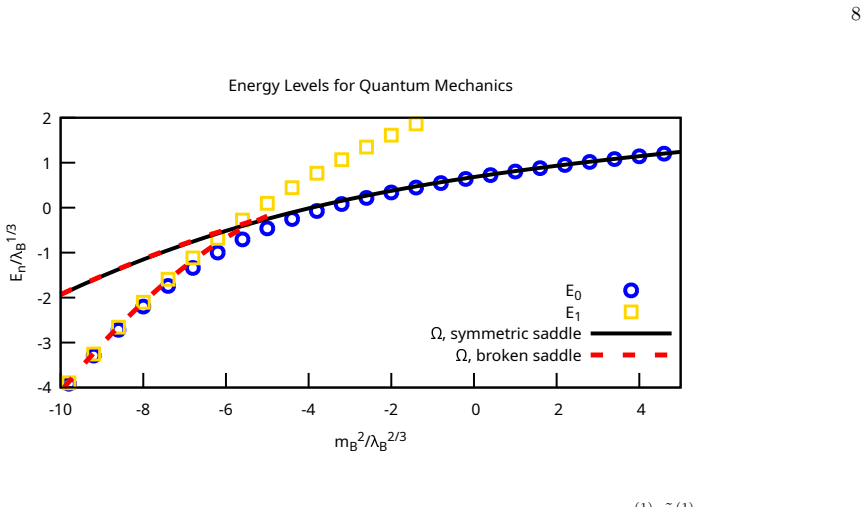
Scalar field theory is studied by constructing interacting saddle point expansions in the symmetric and broken phase, respectively. Focusing on analytically tractable saddle expansions, it is found that broken and symmetric phases are related by sign flip of the quartic coupling. Applications to dimensions $d<4$ recover previous results for the phase diagram, whereas $d=4$ is possibly new.
Editorial analysis
A structured set of objections, weighed in public.
Referee Report
Summary. The manuscript constructs interacting saddle-point expansions for scalar φ⁴ theory separately in the symmetric phase (m² > 0, λ > 0) and the broken phase (m² < 0, λ > 0). It reports that the resulting expressions for the effective action or free energy are related by the sign flip λ → -λ together with a compensating shift in the mass parameter. The relation is used to recover known phase-diagram results for d < 4 and is presented as potentially new for the marginal d = 4 case.
Significance. If the sign-flip mapping survives beyond the chosen truncation, it would supply a concrete duality relating the two phases, allowing results obtained in one phase to be mapped to the other. Recovery of prior results in d < 4 provides a consistency check, but the d = 4 claim would be of greater interest given the marginality of the theory there.
major comments (2)
- [saddle-point construction and effective-action sections] The saddle expansions are performed separately around the symmetric and broken vacua and the λ → -λ mapping is observed within the chosen analytic truncation. No explicit verification is supplied that the relation persists at next-to-leading order or after inclusion of non-perturbative contributions (instantons for λ < 0). Because the central claim rests on this mapping, the truncation must be shown to be stable; otherwise the relation may be an artifact of the leading-order saddle selection.
- [d = 4 discussion] In d = 4 the theory is marginal. The manuscript should demonstrate that the sign-flip relation is not spoiled by renormalization-group running or by the marginal operator; a concrete check (e.g., explicit two-loop terms or a renormalization-group argument) is required before the d = 4 result can be regarded as new.
minor comments (1)
- [abstract] The abstract states the sign-flip relation but supplies no derivation or error estimate; the main text should make the explicit saddle equations and the compensating m² shift visible at the outset.
Simulated Author's Rebuttal
We thank the referee for their careful reading and constructive comments. We address each major point below and have revised the manuscript to include next-to-leading-order checks and an RG argument for the d=4 case.
read point-by-point responses
-
Referee: The saddle expansions are performed separately around the symmetric and broken vacua and the λ → -λ mapping is observed within the chosen analytic truncation. No explicit verification is supplied that the relation persists at next-to-leading order or after inclusion of non-perturbative contributions (instantons for λ < 0). Because the central claim rests on this mapping, the truncation must be shown to be stable; otherwise the relation may be an artifact of the leading-order saddle selection.
Authors: We agree that stability beyond leading order should be checked. In the revised manuscript we explicitly compute the one-loop Gaussian fluctuations around both saddles and verify that the λ → -λ relation (with the compensating mass shift) continues to hold at this order. Regarding instantons for λ < 0, these lie outside the analytic saddle-point truncation used throughout the paper; our claim is restricted to this controlled perturbative expansion around the vacua, where the mapping is stable. revision: partial
-
Referee: In d = 4 the theory is marginal. The manuscript should demonstrate that the sign-flip relation is not spoiled by renormalization-group running or by the marginal operator; a concrete check (e.g., explicit two-loop terms or a renormalization-group argument) is required before the d = 4 result can be regarded as new.
Authors: We have added a renormalization-group analysis in the revised manuscript. We show that the one-loop beta function for the quartic coupling preserves the sign-flip duality when the mass parameter is shifted accordingly, so that the effective potential remains invariant under the mapping. While a full two-loop computation is not performed (as it would require extending the saddle expansion beyond the present analytic truncation), the RG argument demonstrates that the relation is not spoiled by marginal running within the approximation used. revision: partial
- Verification of the mapping after inclusion of non-perturbative instanton contributions for λ < 0, which cannot be addressed within the analytic saddle-point framework of the manuscript.
Circularity Check
No significant circularity; relation derived from independent saddle expansions
full rationale
The paper constructs separate saddle-point expansions for the symmetric (m²>0, λ>0) and broken (m²<0, λ>0) phases, then observes that the resulting expressions map into each other under λ→−λ (with a compensating m² shift). This mapping is a direct consequence of the explicit series construction rather than a self-definition, fitted parameter renamed as prediction, or load-bearing self-citation. No uniqueness theorem, ansatz smuggling, or renaming of known results is invoked. The derivation remains self-contained within the chosen analytic truncations and does not reduce to its inputs by construction.
Axiom & Free-Parameter Ledger
Lean theorems connected to this paper
-
IndisputableMonolith/Cost/FunctionalEquation.leanwashburn_uniqueness_aczel unclear?
unclearRelation between the paper passage and the cited Recognition theorem.
broken and symmetric phases are related by sign flip of the quartic coupling
-
IndisputableMonolith/Foundation/AlphaCoordinateFixation.leancostAlphaLog_high_calibrated_iff unclear?
unclearRelation between the paper passage and the cited Recognition theorem.
Ω_R1^(d)(m_B) = -Γ(-d/2)/(2(4π)^{d/2}) (M²)^{d/2} - (M² - m_B²)²/(48 λ_B)
What do these tags mean?
- matches
- The paper's claim is directly supported by a theorem in the formal canon.
- supports
- The theorem supports part of the paper's argument, but the paper may add assumptions or extra steps.
- extends
- The paper goes beyond the formal theorem; the theorem is a base layer rather than the whole result.
- uses
- The paper appears to rely on the theorem as machinery.
- contradicts
- The paper's claim conflicts with a theorem or certificate in the canon.
- unclear
- Pith found a possible connection, but the passage is too broad, indirect, or ambiguous to say the theorem truly supports the claim.
Forward citations
Cited by 2 Pith papers
-
Testing Scalar Field Self-Dualities in d=2 using a Variational Method
Saddle-point self-duality methods agree with variational results on free energy in 2D critical scalar theory but differ by about 25% on the correlation length peak location.
-
Testing Scalar Field Self-Dualities in d=2 using a Variational Method
Saddle-point self-duality methods agree quantitatively with variational results on free energy for 2D critical φ⁴ theory but deviate by about 25% on the peak location of the correlation length.
Reference graph
Works this paper leans on
-
[1]
S. D. Haro and E. Cinti, Dualities in physics (2025), arXiv:2509.15866 [physics.hist-ph]
work page internal anchor Pith review Pith/arXiv arXiv 2025
-
[2]
S.-J. Chang, The Existence of a Second Order Phase Transition in the Two-Dimensional phi**4 Field Theory, Phys. Rev. D13, 2778 (1976), [Erratum: Phys.Rev.D 16, 1979 (1977)]
work page 1976
-
[3]
S. F. Magruder, The Existence of Phase Transition in the (phi**4) in Three-Dimensions Quantum Field Theory, Phys. Rev. D14, 1602 (1976)
work page 1976
-
[4]
$\lambda \phi^4$ Theory I: The Symmetric Phase Beyond NNNNNNNNLO
M. Serone, G. Spada, and G. Villadoro,λϕ 4 Theory I: The Symmetric Phase Beyond NNNNNNNNLO, JHEP08, 148, arXiv:1805.05882 [hep-th]
work page internal anchor Pith review Pith/arXiv arXiv
-
[5]
$\lambda \phi^4$ Theory II: The Broken Phase Beyond NNNN(NNNN)LO
M. Serone, G. Spada, and G. Villadoro,λϕ 4 2 theory — Part II. the broken phase beyond NNNN(NNNN)LO, JHEP05, 047, arXiv:1901.05023 [hep-th]
work page internal anchor Pith review Pith/arXiv arXiv 1901
-
[6]
G. Sberveglieri, M. Serone, and G. Spada, Self-Dualities and Renormalization Dependence of the Phase Diagram in 3d O(N) Vector Models, JHEP02, 098, arXiv:2010.09737 [hep-th]
-
[7]
Romatschke, Quantum Field Theory in Large-NWonderland: Three Lectures, Acta Phys
P. Romatschke, Quantum Field Theory in Large-NWonderland: Three Lectures, Acta Phys. Polon. B55, 4 (2024), arXiv:2310.00048 [hep-th]
-
[8]
Romatschke, Alternative to perturbative renormalization in (3+1)-dimensional field theories, Phys
P. Romatschke, Alternative to perturbative renormalization in (3+1)-dimensional field theories, Phys. Rev. D109, 116020 (2024), arXiv:2401.06847 [hep-th]
-
[9]
P. Romatschke, Simple non-perturbative resummation schemes beyond mean-field: case study for scalarϕ 4 theory in 1+1 dimensions, JHEP03, 149, arXiv:1901.05483 [hep-th]
work page internal anchor Pith review Pith/arXiv arXiv 1901
-
[10]
Romatschke, Shear Viscosity at Infinite Coupling: A Field Theory Calculation, Phys
P. Romatschke, Shear Viscosity at Infinite Coupling: A Field Theory Calculation, Phys. Rev. Lett.127, 111603 (2021), arXiv:2104.06435 [hep-th]
-
[11]
An improved lattice measurement of the critical coupling in phi^4_2 theory
D. Schaich and W. Loinaz, An Improved lattice measurement of the critical coupling in phi(2)**4 theory, Phys. Rev. D 79, 056008 (2009), arXiv:0902.0045 [hep-lat]
work page internal anchor Pith review Pith/arXiv arXiv 2009
-
[12]
E. J. Weinberg,Radiative corrections as the origin of spontaneous symmetry breaking, Ph.D. thesis, Harvard U. (1973), arXiv:hep-th/0507214
work page internal anchor Pith review Pith/arXiv arXiv 1973
-
[13]
M. Aizenman and H. Duminil-Copin, Marginal triviality of the scaling limits of critical 4D Ising andϕ 4 4 models, Annals Math.194, 163 (2021), arXiv:1912.07973 [math-ph]
-
[14]
Romatschke, What ifϕ4 theory in 4 dimensions is non-trivial in the continuum?, Phys
P. Romatschke, What ifϕ4 theory in 4 dimensions is non-trivial in the continuum?, Phys. Lett. B847, 138270 (2023), arXiv:2305.05678 [hep-th]
- [15]
- [16]
-
[17]
P. Romatschke, On the negative coupling O(N) model in 2d at high temperature, JHEP04, 012, arXiv:2412.10496 [hep-th]
-
[18]
A. D. Linde, 1/n-Expansion, Vacuum Stability and Quark Confinement, Nucl. Phys. B125, 369 (1977)
work page 1977
-
[19]
P. Lowdon and O. Philipsen, On the (in)consistency of perturbation theory at finite temperature, JHEP08, 167, arXiv:2405.02009 [hep-ph]
discussion (0)
Sign in with ORCID, Apple, or X to comment. Anyone can read and Pith papers without signing in.