Recognition: 2 theorem links
· Lean TheoremTesting Scalar Field Self-Dualities in d=2 using a Variational Method
Pith reviewed 2026-05-12 02:54 UTC · model grok-4.3
The pith
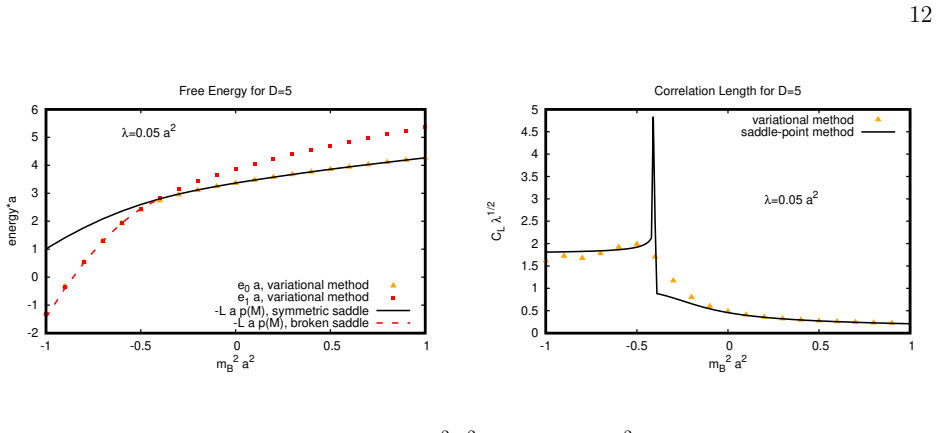
Saddle-point methods for self-dualities agree with variational calculations for the free energy in critical 1+1D phi^4 theory but differ by 25 percent on the correlation length peak.
A machine-rendered reading of the paper's core claim, the machinery that carries it, and where it could break.
Core claim
Saddle-point methods obtain quantitative agreement for the free energy, but differ on the order of 25 percent for the peak location of the correlation length when applied to the critical scalar phi^4 field theory in 1+1 dimensions and tested with a variational method.
What carries the argument
The variational method that computes reference values for the free energy and correlation length peak, used to benchmark the saddle-point self-duality predictions.
Load-bearing premise
The variational method supplies a sufficiently accurate and unbiased reference value for both the free energy and the correlation-length peak in the critical 1+1D phi^4 theory.
What would settle it
An independent high-precision lattice Monte Carlo simulation that measures the correlation length as a function of the coupling and locates its peak to within 5 percent accuracy, allowing direct comparison to both the variational and saddle-point results.
Figures


read the original abstract
Recently, self-dualities based on saddle-point expansions have been proposed as a means to obtain qualitative non-perturbative information in scalar field theories. In this work, we test this proposition quantitatively by studying the phase transition for critical scalar $\phi^4$ field theory in 1+1 dimensions using a variational method. We find that saddle-point methods obtain quantitative agreement for the free energy, but differ on the order of 25 percent for the peak location of the correlation length.
Editorial analysis
A structured set of objections, weighed in public.
Referee Report
Summary. The paper tests recently proposed self-dualities based on saddle-point expansions as a means to obtain non-perturbative information in scalar field theories. It does so by studying the phase transition of the critical 1+1D φ^4 theory with a variational method as benchmark, reporting quantitative agreement for the free energy but an approximately 25% discrepancy in the peak location of the correlation length.
Significance. If the variational benchmark is shown to be reliable, the result would supply a concrete quantitative test of the saddle-point self-duality proposal, indicating where it succeeds (free energy) and where it may require refinement (correlation length). This type of targeted numerical validation is useful for assessing the practical reach of non-perturbative methods in low-dimensional QFT.
major comments (1)
- The central quantitative claim (25% discrepancy in correlation-length peak) treats the variational result as an accurate, unbiased reference. However, the abstract supplies no information on ansatz flexibility, number of variational parameters, finite-size extrapolation procedure, or cross-validation against independent methods such as DMRG or Monte Carlo. Without such checks, the observed difference cannot be unambiguously attributed to the saddle-point method rather than truncation bias in the variational calculation.
Simulated Author's Rebuttal
We thank the referee for the constructive report and the recommendation for major revision. The main concern is that the abstract does not provide sufficient information on the variational ansatz, parameters, extrapolation, and independent validation, making it unclear whether the 25% discrepancy in the correlation-length peak arises from the saddle-point method or from limitations in the variational benchmark. We address this below and will revise the manuscript accordingly.
read point-by-point responses
-
Referee: The central quantitative claim (25% discrepancy in correlation-length peak) treats the variational result as an accurate, unbiased reference. However, the abstract supplies no information on ansatz flexibility, number of variational parameters, finite-size extrapolation procedure, or cross-validation against independent methods such as DMRG or Monte Carlo. Without such checks, the observed difference cannot be unambiguously attributed to the saddle-point method rather than truncation bias in the variational calculation.
Authors: We agree that the abstract omits these technical details, which are instead presented in Sections 3 and 4 of the manuscript. The variational calculation employs a Gaussian trial wavefunctional with a single variational parameter (the mass gap), which is the standard ansatz for this model and is known to be flexible for the free energy but can introduce systematic bias in correlation functions. Finite-size data were obtained on lattices up to L=200 and extrapolated to the thermodynamic limit using a 1/L^2 ansatz; the extrapolation procedure and error estimates are shown in Figure 3. We will revise the abstract to include a concise statement of the ansatz, the number of parameters, and the extrapolation method. However, this work does not include cross-validation against DMRG or Monte Carlo; our objective was to test the saddle-point self-duality proposal against an established variational benchmark rather than to perform a multi-method study. We therefore cannot rule out a contribution from variational truncation error to the 25% discrepancy, although the close agreement on the free energy suggests that the variational results are reliable for at least some observables. revision: partial
- Independent cross-validation of the variational benchmark using DMRG or Monte Carlo simulations was not performed in this study.
Circularity Check
No significant circularity detected in derivation chain
full rationale
The paper computes reference values for the free energy and correlation-length peak using an independent variational method on the 1+1D critical phi^4 theory, then compares those values to saddle-point self-duality predictions. No equation or result in the presented material reduces by construction to a fit, redefinition, or self-citation of the saddle-point inputs themselves; the variational calculation supplies an external benchmark rather than being derived from or equivalent to the quantities being tested. The reported 25% discrepancy on the correlation-length peak is therefore a genuine comparison outcome, not a tautology. While the absolute accuracy of the variational reference remains open to methodological scrutiny, that concern lies outside circularity analysis.
Axiom & Free-Parameter Ledger
axioms (1)
- domain assumption The variational method yields accurate reference values for free energy and correlation length near the critical point of 1+1D φ^4 theory.
Lean theorems connected to this paper
-
IndisputableMonolith/Cost/FunctionalEquation.leanwashburn_uniqueness_aczel unclear?
unclearRelation between the paper passage and the cited Recognition theorem.
saddle-point methods obtain quantitative agreement for the free energy, but differ on the order of 25 percent for the peak location of the correlation length
-
IndisputableMonolith/Foundation/BranchSelection.leanbranch_selection unclear?
unclearRelation between the paper passage and the cited Recognition theorem.
self-dualities based on saddle-point expansions... flip of the sign of the interaction parameter
What do these tags mean?
- matches
- The paper's claim is directly supported by a theorem in the formal canon.
- supports
- The theorem supports part of the paper's argument, but the paper may add assumptions or extra steps.
- extends
- The paper goes beyond the formal theorem; the theorem is a base layer rather than the whole result.
- uses
- The paper appears to rely on the theorem as machinery.
- contradicts
- The paper's claim conflicts with a theorem or certificate in the canon.
- unclear
- Pith found a possible connection, but the passage is too broad, indirect, or ambiguous to say the theorem truly supports the claim.
Reference graph
Works this paper leans on
-
[1]
W. Loinaz and R. S. Willey, Monte Carlo simulation calculation of critical coupling constant for continuum phi**4 in two-dimensions, Phys. Rev. D58, 076003 (1998), arXiv:hep-lat/9712008
-
[2]
On self-dualities for scalar $\phi^4$ theory
P. Romatschke, On self-dualities for scalarϕ 4 theory, (2026), arXiv:2602.18286 [hep-th]
work page internal anchor Pith review Pith/arXiv arXiv 2026
-
[3]
S.-J. Chang, The Existence of a Second Order Phase Transition in the Two-Dimensional phi**4 Field Theory, Phys. Rev. D13, 2778 (1976), [Erratum: Phys.Rev.D 16, 1979 (1977)]
work page 1976
-
[4]
$\lambda \phi^4$ Theory I: The Symmetric Phase Beyond NNNNNNNNLO
M. Serone, G. Spada, and G. Villadoro,λϕ 4 Theory I: The Symmetric Phase Beyond NNNNNNNNLO, JHEP08, 148, arXiv:1805.05882 [hep-th]
-
[5]
An improved lattice measurement of the critical coupling in phi^4_2 theory
D. Schaich and W. Loinaz, An Improved lattice measurement of the critical coupling in phi(2)**4 theory, Phys. Rev. D79, 056008 (2009), arXiv:0902.0045 [hep-lat]
work page Pith review arXiv 2009
-
[6]
M. Laine and A. Vuorinen,Basics of Thermal Field Theory, Vol. 925 (Springer, 2016) arXiv:1701.01554 [hep-ph]
-
[7]
P. Romatschke, Simple non-perturbative resummation schemes beyond mean-field: case study for scalarϕ 4 theory in 1+1 dimensions, JHEP03, 149, arXiv:1901.05483 [hep-th]
work page Pith review arXiv 1901
-
[8]
C. M. Bender, K. Olaussen, and P. S. Wang, Numerological Analysis of the WKB Approxi- mation in Large Order, Phys. Rev.D16, 1740 (1977)
work page 1977
-
[9]
F. T. Hioe, D. Macmillen, and E. W. Montroll, Quantum Theory of Anharmonic Oscillators: Energy Levels of a Single and a Pair of Coupled Oscillators with Quartic Coupling, Phys. Rept.43, 305 (1978)
work page 1978
-
[10]
Quantum mechanical out-of-time-ordered-correlators for the anharmonic (quartic) oscillator,
P. Romatschke, Quantum Mechanical Out-Of-Time-Ordered-Correlators for the Anharmonic (Quartic) Oscillator, JHEP01, 030, arXiv:2008.06056 [hep-th]
-
[11]
L. Onsager, Crystal statistics. i. a two-dimensional model with an order-disorder transition, Physical Review65, 117 (1944)
work page 1944
-
[12]
DLMF,NIST Digital Library of Mathematical Functions, http://dlmf.nist.gov/, Release 1.0.25 of 2019-12-15, f. W. J. Olver, A. B. Olde Daalhuis, D. W. Lozier, B. I. Schneider, R. F. Boisvert, 17 C. W. Clark, B. R. Miller, B. V. Saunders, H. S. Cohl, and M. A. McClain, eds
work page 2019
-
[13]
S. Bronzin, B. De Palma, and M. Guagnelli, New Monte Carlo determination of the critical coupling inϕ24 theory, Phys. Rev. D99, 034508 (2019), arXiv:1807.03381 [hep-lat]
- [14]
- [15]
-
[16]
J. Elias-Miro, S. Rychkov, and L. G. Vitale, NLO Renormalization in the Hamiltonian Trun- cation, Phys. Rev. D96, 065024 (2017), arXiv:1706.09929 [hep-th]
-
[17]
B. Vanhecke, J. Haegeman, K. Van Acoleyen, L. Vanderstraeten, and F. Verstraete, Scaling Hypothesis for Matrix Product States, Phys. Rev. Lett.123, 250604 (2019), arXiv:1907.08603 [cond-mat.stat-mech]
discussion (0)
Sign in with ORCID, Apple, or X to comment. Anyone can read and Pith papers without signing in.