Recognition: unknown
Single- and double-headed odd radio circles in the LOFAR surveys
Pith reviewed 2026-05-15 20:40 UTC · model grok-4.3
The pith
The LOFAR Two Metre Sky Survey reveals eighteen odd radio circles, four of them double-headed, expanding the known population and linking most to large elliptical galaxies.
A machine-rendered reading of the paper's core claim, the machinery that carries it, and where it could break.
Core claim
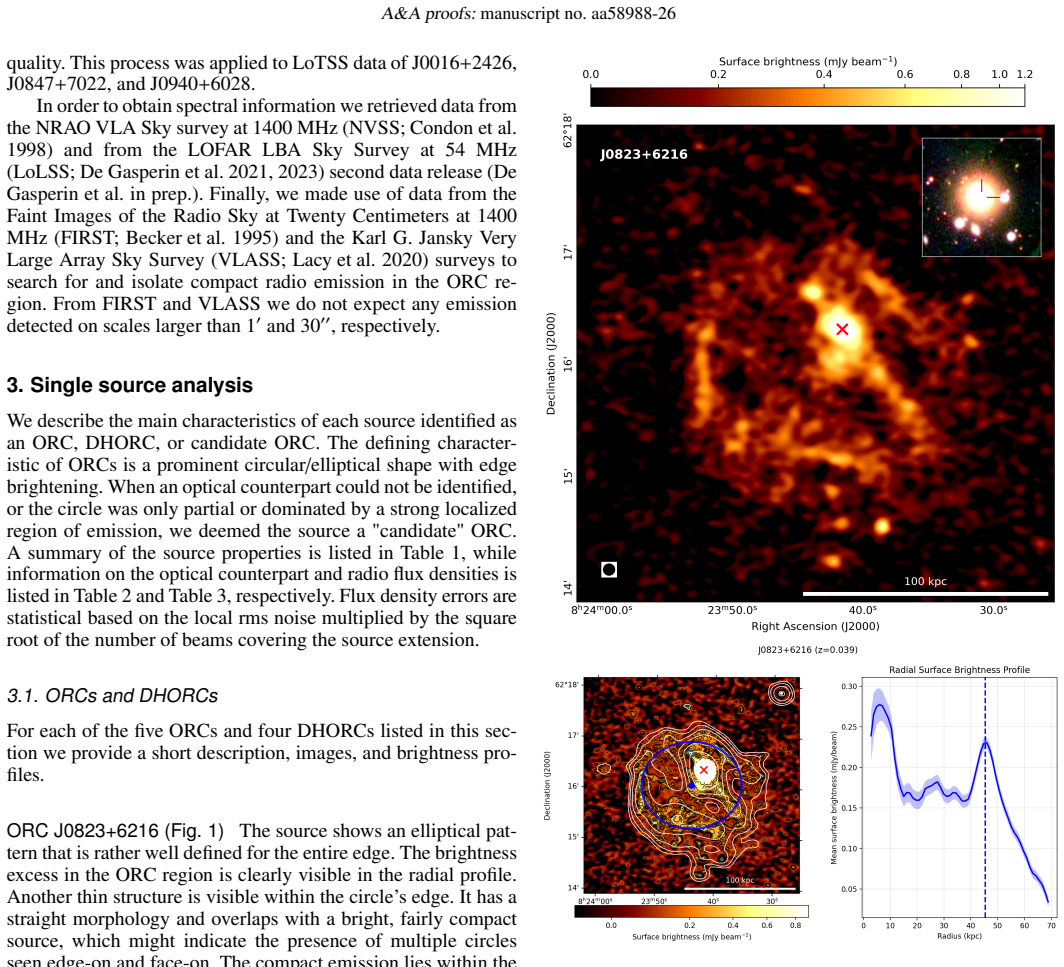
We isolated 18 sources with ORC structures. Four of these are double-headed ORCs, and two are new discoveries. We also found five new single-headed ORCs and nine candidate ORCs. Our findings confirm that ORCs are a rare and heterogenous population of radio sources. We confirm the association with large ellipticals in most cases, and we note a relation between the ORCs' physical sizes and their integrated spectral indexes, with small ORCs avoiding steep spectra.
What carries the argument
A hybrid detection method that applies parameter filters to radio catalog entries followed by visual inspection of survey images to select circular, edge-brightened sources.
If this is right
- ORCs represent a heterogeneous class that may have multiple formation channels rather than a single mechanism.
- The association with large elliptical galaxies points to a connection with massive galaxy evolution or active galactic nuclei activity.
- Smaller ORCs having flatter spectra suggests differences in age, environment, or energy injection compared to larger ones.
- Double-headed ORCs form a distinct morphological subclass that may require separate physical models.
- With more examples now known, statistical studies of their properties become feasible to test origin hypotheses.
Where Pith is reading between the lines
- The size-spectral index relation could serve as a diagnostic tool to identify new ORC candidates in future surveys even without redshift information.
- High-resolution observations of the double-headed sources might reveal whether they result from symmetric jets or binary galaxy interactions.
- The rarity implies that ORCs could be short-lived phases in galaxy life cycles, so targeted searches in other wavelengths may uncover related phenomena.
- Extending the search to higher frequencies or different surveys could test if the reported trends persist across the radio spectrum.
Load-bearing premise
The combination of catalog filtering and visual inspection captures a clean and reasonably complete set of ORCs without substantial contamination from other source types.
What would settle it
Discovery of a large number of ORCs in a new survey that show no preference for elliptical galaxy hosts or no correlation between their sizes and spectral indices would falsify the reported population characteristics.
Figures


read the original abstract
Deep radio surveys are now producing catalogs with millions of radio sources. Radio sources can have complex morphologies that depend on both the production mechanisms and the local environment. Recently, an unusual class of circular radio sources named "odd radio circles" (ORCs) were identified. They have sizes of about 1 arcmin, a circular/elliptical shape and appear edge-brightened. Subsequent observations have suggested that this class may comprise a variety of sources. Despite various attempts to explain them, their origin remains unclear. The main goal of this work is to increase the number of known ORCs and derive common characteristics that can help identify the origin of these sources. We searched the LOFAR Two Metre Sky Survey (LoTSS) Data Release 3 (DR3) at 144 MHz for ORCs using a combination of parameter filtering on catalog entries and visual inspection. We then identified possible optical counterparts and derived information such as redshift, physical size, and spectral index using further radio data at 54 and 1400 MHz. We isolated 18 sources with ORC structures. Four of these are double-headed ORCs (ORCs with two rings), and two are new discoveries. We also found five new single-headed ORCs and nine candidate ORCs. With this work we significantly expand the population of known ORCs. Our findings confirm that ORCs are a rare and heterogenous population of radio sources. We confirm the association with large ellipticals in most cases, and we note a relation between the ORCs' physical sizes and their integrated spectral indexes, with small ORCs avoiding steep spectra.
Editorial analysis
A structured set of objections, weighed in public.
Referee Report
Summary. This manuscript reports a search for odd radio circles (ORCs) in the LOFAR Two Metre Sky Survey (LoTSS) Data Release 3 at 144 MHz. Using catalog parameter filtering followed by visual inspection, the authors isolate 18 sources with ORC morphologies, including four double-headed ORCs (two new discoveries), five new single-headed ORCs, and nine candidates. Optical counterparts are identified for most sources, yielding redshifts, physical sizes, and spectral indices from additional data at 54 and 1400 MHz. The work confirms the association of ORCs with large elliptical galaxies in most cases and reports a relation in which small ORCs avoid steep integrated spectra.
Significance. If the sample selection proves robust, the expanded catalog of 18 ORCs (with new double- and single-headed examples) would meaningfully increase the known population of this rare class and reinforce its heterogeneity. The reported size-spectral index trend, together with the elliptical-galaxy association, could help discriminate among proposed origins such as galactic winds or merger-driven activity. Multi-frequency follow-up adds concrete characterization that future theoretical models can be tested against.
major comments (2)
- [Search strategy and sample selection] Search strategy and sample selection: The identification procedure combines catalog cuts with subjective visual inspection, yet no injection-recovery simulations, completeness curves as a function of size or spectral index, purity estimates, or inter-inspector agreement metrics are presented. Because the headline size-spectral index relation is derived directly from this visually vetted sample, any differential detectability (e.g., steep-spectrum rings appearing less circular or falling below visual thresholds) would produce the observed trend as a selection artifact rather than an intrinsic property.
- [Results on the size-spectral index relation] Results on the size-spectral index relation: The statement that small ORCs avoid steep spectra is presented without a quantitative statistical test (e.g., Spearman rank or survival analysis accounting for upper limits), measurement uncertainties on physical size and spectral index, or a control sample of non-ORC sources. This weakens the claim that the relation is a genuine population property.
minor comments (2)
- [Abstract and Table 1] The distinction between the 18 confirmed ORC structures and the nine candidates should be stated explicitly in the abstract and reinforced with a clear table summarizing selection criteria and classification confidence for each source.
- [Figures] Radio images in the figures would benefit from uniform contour levels, explicit scale bars in arcminutes, and labels indicating which features are interpreted as the ORC rings versus background sources.
Simulated Author's Rebuttal
We thank the referee for their constructive and detailed comments on our manuscript. We have carefully considered each point and revised the paper to address the concerns about sample selection biases and the statistical robustness of the size-spectral index relation. Below we respond point by point.
read point-by-point responses
-
Referee: [Search strategy and sample selection] Search strategy and sample selection: The identification procedure combines catalog cuts with subjective visual inspection, yet no injection-recovery simulations, completeness curves as a function of size or spectral index, purity estimates, or inter-inspector agreement metrics are presented. Because the headline size-spectral index relation is derived directly from this visually vetted sample, any differential detectability (e.g., steep-spectrum rings appearing less circular or falling below visual thresholds) would produce the observed trend as a selection artifact rather than an intrinsic property.
Authors: We acknowledge the subjectivity inherent in visual inspection following catalog filtering and agree that this could introduce biases. In the revised manuscript we have added an expanded discussion of selection effects, including a description of the rejection criteria applied during visual inspection and a rough purity estimate based on the fraction of initial candidates discarded. We have also tempered the language around the size-spectral index relation, presenting it explicitly as an observed trend within the current sample rather than a definitively intrinsic property. However, comprehensive injection-recovery simulations would require the development of realistic mock ORC populations with controlled sizes, spectral indices, and morphologies inserted into the actual LOFAR DR3 noise and source fields; this is a substantial computational effort that lies beyond the scope of the present work. revision: partial
-
Referee: [Results on the size-spectral index relation] Results on the size-spectral index relation: The statement that small ORCs avoid steep spectra is presented without a quantitative statistical test (e.g., Spearman rank or survival analysis accounting for upper limits), measurement uncertainties on physical size and spectral index, or a control sample of non-ORC sources. This weakens the claim that the relation is a genuine population property.
Authors: We have incorporated the requested quantitative analysis in the revised version. A Spearman rank correlation test has been performed and reported, including the coefficient and p-value, with a note on the small sample size. Measurement uncertainties on physical sizes (propagated from redshift and angular-size errors) and spectral indices (from the 54 MHz, 144 MHz, and 1400 MHz data) are now shown explicitly in the relevant figure and table. While constructing an ideal control sample of non-ORC sources matched in every respect is challenging given the distinctive morphology, we have added a comparison to a flux- and size-selected sample of extended radio galaxies from the same LoTSS DR3 catalog and discussed the differences. These additions strengthen the presentation of the observed trend. revision: yes
- Full injection-recovery simulations, completeness curves as a function of size and spectral index, and inter-inspector agreement metrics for the visual search strategy
Circularity Check
No circularity in observational sample expansion and correlation reporting
full rationale
The paper reports an observational search in the LoTSS DR3 catalog at 144 MHz, applying parameter filtering followed by visual inspection to isolate 18 ORC sources (including new single- and double-headed cases), cross-matching with optical data for redshifts and sizes, and noting an empirical trend between physical size and spectral index. No equations, model derivations, fitted parameters, or predictions appear; the central claims are direct counts and a data-derived correlation with no reduction to inputs by construction. Self-citations to prior ORC work are present but serve only as background and do not load-bear any uniqueness theorem or ansatz. The identification method is acknowledged as partly subjective, yet this does not trigger any of the enumerated circularity patterns.
Axiom & Free-Parameter Ledger
axioms (1)
- domain assumption Standard assumptions of radio source detection and morphological classification in interferometric surveys apply without significant bias
Forward citations
Cited by 1 Pith paper
-
A Compact Radio Ring with a Diffuse Envelope in LOFAR: Odd Radio Circle or Distinct Phenomenon?
J1248+4826 is a newly identified compact ORC candidate with a ~30 kpc ring radius and ~200 kpc total extent at assumed z=0.2, consistent with the ORC population but with the host galaxy on the ring edge and no ongoing...
Reference graph
Works this paper leans on
-
[1]
2020, ApJS, 249, 3
Ahumada, R., Allende Prieto, C., Almeida, A., et al. 2020, ApJS, 249, 3
2020
-
[2]
S., & Csabai, I
Beck, R., Dobos, L., Budavári, T., Szalay, A. S., & Csabai, I. 2016, MNRAS, 460, 1371
2016
-
[3]
C., & Szapudi, I
Beck, R., Dodds, S. C., & Szapudi, I. 2022, MNRAS, 515, 4711
2022
-
[4]
2021, MNRAS, 500, 1633
Beck, R., Szapudi, I., Flewelling, H., et al. 2021, MNRAS, 500, 1633
2021
-
[5]
H., White, R
Becker, R. H., White, R. L., & Helfand, D. J. 1995, ApJ, 450, 559
1995
-
[6]
A., Jarrett, T
Bilicki, M., Peacock, J. A., Jarrett, T. H., et al. 2016, ApJS, 225, 5
2016
-
[7]
2025, MNRAS, 543, 3708
Bordiu, C., Bufano, F., Umana, G., et al. 2025, MNRAS, 543, 3708
2025
-
[8]
2014, A&A, 568, A126
Brescia, M., Cavuoti, S., Longo, G., & De Stefano, V . 2014, A&A, 568, A126
2014
-
[9]
2024, A&A, 685, L2
Bulbul, E., Zhang, X., Kluge, M., et al. 2024, A&A, 685, L2
2024
-
[10]
L., Perrotta, S., Rupke, D
Coil, A. L., Perrotta, S., Rupke, D. S., et al. 2024, Nature, 625, 459
2024
-
[11]
J., Cotton, W
Condon, J. J., Cotton, W. D., Greisen, E. W., et al. 1998, Astron. J., 8065, 1693 De Gasperin, F., Edler, H. W., Williams, W. L., et al. 2023, A&A, 673, A165 De Gasperin, F., Williams, W. L., Best, P., et al. 2021, A&A, 648, A104
1998
-
[12]
Delchambre, L., Bailer-Jones, C. A. L., Bellas-Velidis, I., et al. 2023, A&A, 674, A31
2023
-
[13]
M., Koribalski, B
Dolag, K., Böss, L. M., Koribalski, B. S., Steinwandel, U. P., & Valentini, M. 2023, ApJ, 945, 74
2023
-
[14]
Duncan, K. J. 2022, MNRAS, 512, 3662
2022
-
[15]
E., Kurtz, M
Falco, E. E., Kurtz, M. J., Geller, M. J., et al. 1999, PASP, 111, 438
1999
-
[16]
Flesch, E. W. 2024, The Open Journal of Astrophysics, 7, 6
2024
-
[17]
2024, Publ
Fujita, Y ., Kawanaka, N., & Inoue, S. 2024, Publ. Astron. Soc. Japan, 76, 765
2024
-
[18]
P., et al
Gupta, N., Huynh, M., Norris, R. P., et al. 2022, Publ. Astron. Soc. Aust., 39, e051
2022
-
[19]
P., Hayder, Z., et al
Gupta, N., Norris, R. P., Hayder, Z., et al. 2025, Publ. Astron. Soc. Aust., 42, 1
2025
-
[20]
2025, MNRAS, 543, 1048
Hota, A., Dabhade, P., Machado, P., et al. 2025, MNRAS, 543, 1048
2025
-
[21]
M., Dolag, K., Koribalski, B
Ivleva, A., Böss, L. M., Dolag, K., Koribalski, B. S., & Khabibullin, I. 2025, A&A, 706, A80
2025
-
[22]
S., Dolag, K., Khabibullin, I., et al
Koribalski, B. S., Dolag, K., Khabibullin, I., et al. 2025, arXiv:2507.11781, 1
-
[23]
S., Norris, R
Koribalski, B. S., Norris, R. P., Andernach, H., et al. 2021, Mon. Not. R. Astron. Soc. Lett., 505, L11
2021
-
[24]
A., Chandler, C
Lacy, M., Baum, S. A., Chandler, C. J., et al. 2020, Publ. Astron. Soc. Pacific, 132, 035001
2020
-
[25]
2013, Space Sci
Meneghetti, M., Bartelmann, M., Dahle, H., & Limousin, M. 2013, Space Sci. Rev., 177, 31
2013
-
[26]
F., Frenk, C
Navarro, J. F., Frenk, C. S., & White, S. D. M. 1996, ApJ, 462, 563
1996
-
[27]
Nolting, C., Ball, J., & Nguyen, T. M. 2023, ApJ, 948, 25
2023
-
[28]
P., Collier, J
Norris, R. P., Collier, J. D., Crocker, R. M., et al. 2022, MNRAS, 513, 1300
2022
-
[29]
P., Hopkins, A
Norris, R. P., Hopkins, A. M., Afonso, J., et al. 2011, Publ. Astron. Soc. Aust., 28, 215
2011
-
[30]
P., Koribalski, B
Norris, R. P., Koribalski, B. S., Hale, C. L., et al. 2025, Mon. Not. R. Astron. Soc. Lett., 537, L42 Planck Collaboration, P., Aghanim, N., Akrami, Y ., et al. 2020, A&A, 641, A6
2025
-
[31]
J., Bonafede, A., Bruno, L., et al
Riseley, C. J., Bonafede, A., Bruno, L., et al. 2024, A&A, 686, A44
2024
-
[32]
J., et al
Ross, K., Hurley-Walker, N., Galvin, T. J., et al. 2024, Publ. Astron. Soc. Aust., 41, e054
2024
-
[33]
Rupke, D. S. N., Coil, A. L., Whalen, K. E., et al. 2024, ApJ, 967, 51
2024
-
[34]
S., Yates-Jones, P
Shabala, S. S., Yates-Jones, P. M., Jerrim, L. A., et al. 2024, Publ. Astron. Soc. Aust., 41, e024
2024
-
[35]
W., Hardcastle, M
Shimwell, T. W., Hardcastle, M. J., Tasse, C., et al. 2022, A&A, 659, A1
2022
-
[36]
W., Hardcastle, M
Shimwell, T. W., Hardcastle, M. J., Tasse, C., et al. 2026, A&A, 707, A198
2026
-
[37]
R., Bolton, A
Shu, Y ., Brownstein, J. R., Bolton, A. S., et al. 2017, ApJ, 851, 48
2017
-
[38]
2011, ApJ, 736, 21
Szabo, T., Pierpaoli, E., Dong, F., Pipino, A., & Gunn, J. 2011, ApJ, 736, 21
2011
-
[39]
J., Riseley, C
Taziaux, S., Bomans, D. J., Riseley, C. J., et al. 2025, A&A, 702, A219 van Weeren, R. J., Shimwell, T. W., Botteon, A., et al. 2021, A&A, 651, A115
2025
-
[40]
2017, A&A, 603, A125
Venturi, T., Rossetti, M., Brunetti, G., et al. 2017, A&A, 603, A125
2017
- [41]
-
[42]
Wen, Z. L. & Han, J. L. 2024, ApJS, 272, 39
2024
-
[43]
C., & Li, Z
Yamasaki, S., Sarkar, K. C., & Li, Z. 2024, MNRAS, 528, 3854
2024
-
[44]
2018, ApJ, 857, 50
Yuan, C., Mészáros, P., Murase, K., & Jeong, D. 2018, ApJ, 857, 50
2018
-
[45]
A., Mao, Y .-Y ., et al
Zhou, R., Newman, J. A., Mao, Y .-Y ., et al. 2021, MNRAS, 501, 3309
2021
-
[46]
2025, MNRAS, 536, 2260
Zhou, X., Li, N., Zou, H., et al. 2025, MNRAS, 536, 2260
2025
-
[47]
2022, Research in Astronomy and Astrophysics, 22, 065001 Article number, page 11 A&A proofs:manuscript no
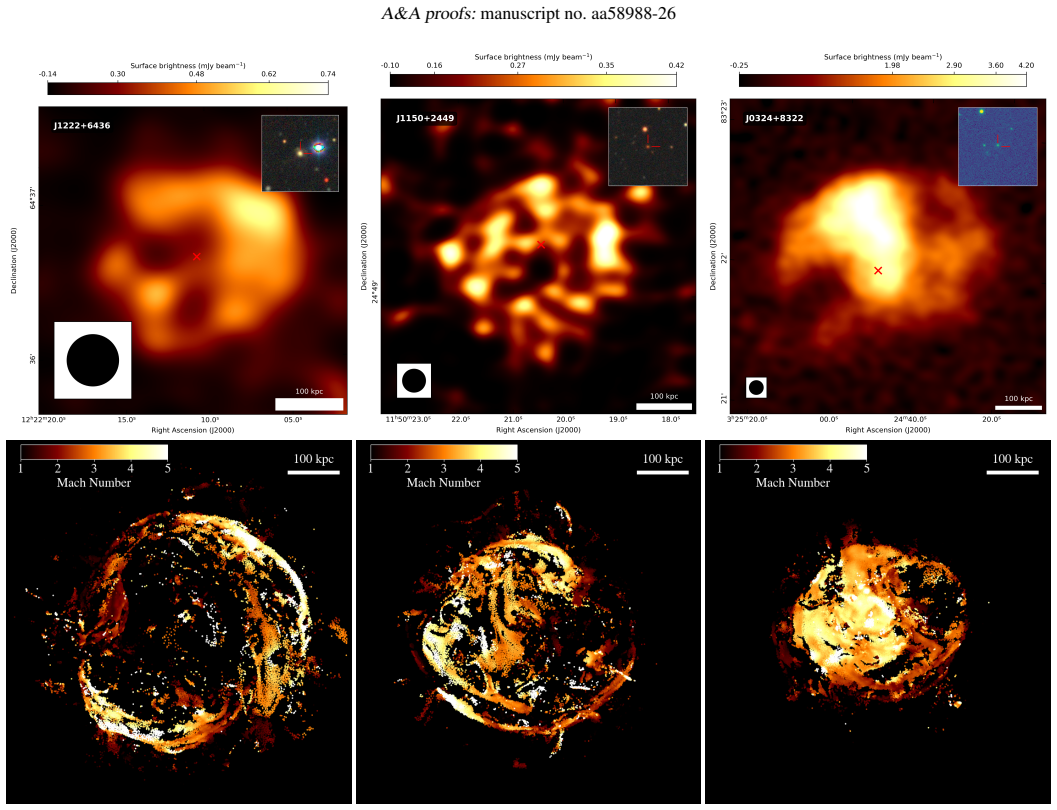
Zou, H., Sui, J., Xue, S., et al. 2022, Research in Astronomy and Astrophysics, 22, 065001 Article number, page 11 A&A proofs:manuscript no. aa58988-26 Fig. 12: Morphological comparison between a set of targets presented in this paper (top row) with a simulation by Ivleva et al. (2025, bottom row). The red cross in the observed objects marks the position ...
2022
discussion (0)
Sign in with ORCID, Apple, or X to comment. Anyone can read and Pith papers without signing in.