Recognition: no theorem link
Mitigating Shortcut Learning via Feature Disentanglement in Medical Imaging: A Benchmark Study
Pith reviewed 2026-05-15 21:55 UTC · model grok-4.3
The pith
Combining feature disentanglement with data rebalancing mitigates shortcut learning more robustly than rebalancing alone in medical imaging.
A machine-rendered reading of the paper's core claim, the machinery that carries it, and where it could break.
Core claim
The study establishes that the best-performing models integrate data-centric rebalancing with model-centric disentanglement to achieve stronger and more robust shortcut mitigation than rebalancing alone, while preserving similar computational efficiency. This outcome holds across datasets that vary in confounding strength, with latent space metrics showing that each disentanglement technique produces distinct representation qualities not captured by accuracy scores.
What carries the argument
Feature disentanglement through adversarial learning and dependence-minimizing latent space splitting, which isolates task-relevant information from confounder-related features in the model's latent representations.
If this is right
- Classification performance improves under strong spurious correlations in the training data.
- Latent space analyses reveal representation quality differences not visible from classification metrics alone.
- Model reliance on shortcuts increases as the degree of confounding in training data rises.
- The combined approach maintains computational efficiency comparable to rebalancing alone.
Where Pith is reading between the lines
- The methods could extend to other imaging domains such as radiology or digital pathology where similar acquisition confounders appear.
- Larger multi-center clinical validation would test whether the isolated features remain causal outside the studied datasets.
- Standardizing the latent space metrics used here could enable direct comparisons of shortcut mitigation techniques across future studies.
Load-bearing premise
The chosen disentanglement methods and latent space metrics reliably isolate causally relevant features from non-causal confounders.
What would settle it
A new clinical dataset where the combined rebalancing-plus-disentanglement models show no gain in out-of-distribution accuracy or robustness over rebalancing alone would falsify the central claim.
Figures



read the original abstract
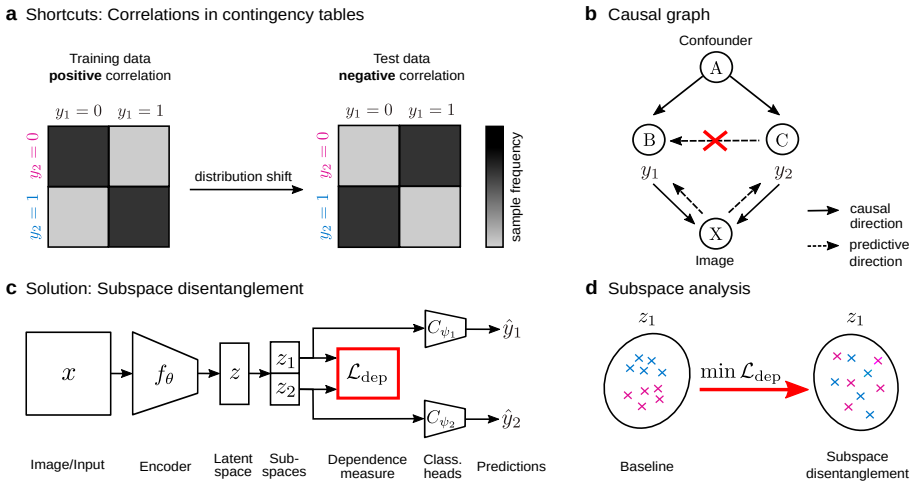
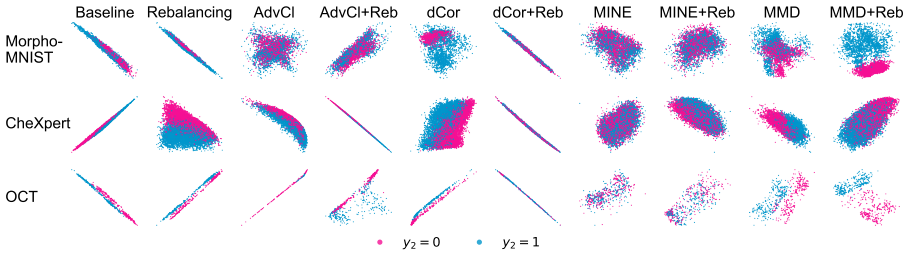
Although deep learning models in medical imaging often achieve excellent classification performance, they can rely on shortcut learning, exploiting spurious correlations or confounding factors that are not causally related to the target task. This poses risks in clinical settings, where models must generalize across institutions, populations, and acquisition conditions. Feature disentanglement is a promising approach to mitigate shortcut learning by separating task-relevant information from confounder-related features in latent representations. In this study, we systematically evaluated feature disentanglement methods for mitigating shortcuts in medical imaging, including adversarial learning and latent space splitting based on dependence minimization. We assessed classification performance and disentanglement quality using latent space analyses across one artificial and two medical datasets with natural and synthetic confounders. We also examined robustness under varying levels of confounding and compared computational efficiency across methods. We found that shortcut mitigation methods improved classification performance under strong spurious correlations during training. Latent space analyses revealed differences in representation quality not captured by classification metrics, highlighting the strengths and limitations of each method. Model reliance on shortcuts depended on the degree of confounding in the training data. The best-performing models combine data-centric rebalancing with model-centric disentanglement, achieving stronger and more robust shortcut mitigation than rebalancing alone while maintaining similar computational efficiency. The project code is publicly available at https://github.com/berenslab/medical-shortcut-mitigation.
Editorial analysis
A structured set of objections, weighed in public.
Referee Report
Summary. The manuscript reports a benchmark study evaluating feature disentanglement methods (adversarial learning and latent-space splitting via dependence minimization) for mitigating shortcut learning in medical image classification. On one artificial and two medical datasets with natural and synthetic confounders, the authors measure classification accuracy, latent-space quality metrics, robustness across confounding strengths, and runtime. They conclude that hybrid data-rebalancing plus disentanglement outperforms rebalancing alone while preserving efficiency, with code released publicly.
Significance. If the empirical findings hold under rigorous validation, the work supplies a practical benchmark showing that hybrid data-centric and model-centric interventions can improve robustness to spurious correlations in medical imaging without added computational cost. Public code supports reproducibility. The contribution is tempered by the absence of direct causal-feature recovery tests, limiting claims that observed gains reflect true isolation of causally relevant features rather than dataset-specific correlations.
major comments (2)
- Abstract and Results sections: The central claim that combining rebalancing with disentanglement yields stronger, more robust shortcut mitigation depends on the adversarial and dependence-minimization methods actually isolating causally relevant features from confounders. The evaluation relies on proxy metrics (dependence scores, latent-space quality) without ground-truth causal structure or direct recovery validation, leaving open the possibility that robustness gains reflect dataset-specific correlations instead of generalizable disentanglement.
- Experimental Setup (implied in Abstract): No details are supplied on statistical testing procedures, exact train/validation/test splits, or controls for selection effects in the benchmark datasets. These omissions are load-bearing for interpreting whether reported performance differences under varying confounding levels are statistically reliable.
minor comments (1)
- The description of latent-space analyses would benefit from explicit equations for the dependence-minimization objective and clearer notation distinguishing the different disentanglement losses.
Simulated Author's Rebuttal
We thank the referee for the detailed and constructive review of our manuscript on mitigating shortcut learning via feature disentanglement in medical imaging. We address each major comment below and describe the revisions we plan to implement.
read point-by-point responses
-
Referee: [—] Abstract and Results sections: The central claim that combining rebalancing with disentanglement yields stronger, more robust shortcut mitigation depends on the adversarial and dependence-minimization methods actually isolating causally relevant features from confounders. The evaluation relies on proxy metrics (dependence scores, latent-space quality) without ground-truth causal structure or direct recovery validation, leaving open the possibility that robustness gains reflect dataset-specific correlations instead of generalizable disentanglement.
Authors: We agree that proxy metrics do not constitute direct causal validation, which is a known challenge in real-world medical datasets lacking ground-truth causal graphs. Our benchmark demonstrates empirical improvements in robustness and performance under controlled confounding variations, supported by latent space analyses. To address this, we will expand the Discussion section to explicitly discuss the limitations of proxy-based evaluation and the possibility of dataset-specific effects, while highlighting that the hybrid method's advantages hold across multiple datasets and confounding strengths. No direct causal recovery experiments will be added as they fall outside the scope of this benchmark study. revision: partial
-
Referee: [—] Experimental Setup (implied in Abstract): No details are supplied on statistical testing procedures, exact train/validation/test splits, or controls for selection effects in the benchmark datasets. These omissions are load-bearing for interpreting whether reported performance differences under varying confounding levels are statistically reliable.
Authors: We regret that these details were not sufficiently prominent in the main text. The full experimental protocol, including 5-fold cross-validation with stratified splits (70% train, 15% validation, 15% test), multiple random seeds for reproducibility, and statistical significance testing via paired t-tests (p < 0.05) with Bonferroni correction, is documented in the supplementary material and the released code. We will add a new subsection 'Experimental Details' in the Methods section to include this information explicitly, along with descriptions of how selection effects were controlled through balanced sampling and repeated experiments. revision: yes
Circularity Check
No circularity: purely empirical benchmark with no derivation chain
full rationale
This paper reports experimental results from training and evaluating disentanglement methods on three datasets, measuring classification accuracy, latent-space metrics, and robustness to confounding levels. No equations, fitted parameters presented as predictions, uniqueness theorems, or self-citation chains appear in the provided text. All central claims rest on observed performance differences rather than reducing to inputs by construction.
Axiom & Free-Parameter Ledger
axioms (1)
- domain assumption Feature disentanglement methods can separate task-relevant information from confounder-related features in latent representations
Reference graph
Works this paper leans on
-
[1]
Monish Ahluwalia, Mohamed Abdalla, James Sanayei, Laleh Seyyed-Kalantari, Mohannad Hussain, Amna Ali, and Benjamin Fine. The subgroup imperative: chest radiograph classifier generalization gaps in patient, setting, and pathology subgroups.Radiology: Artificial Intelligence, 5(5):e220270, 2023
work page 2023
-
[2]
Kaoutar Ben Ahmed, Lawrence O Hall, Dmitry B Goldgof, and Ryan Fogarty. Achieving multisite generalizationforCNN-baseddiseasediagnosismodelsbymitigatingshortcutlearning.IEEE Access, 10:78726–78738, 2022
work page 2022
-
[3]
Christopher J Anders, Leander Weber, David Neumann, Wojciech Samek, Klaus-Robert Müller, and Sebastian Lapuschkin. Finding and removing clever hans: Using explanation methods to debug and improve deep models.Information Fusion, 77:261–295, 2022
work page 2022
-
[4]
Martin Arjovsky, Léon Bottou, Ishaan Gulrajani, and David Lopez-Paz. Invariant risk minimization. arXiv preprint arXiv:1907.02893, 2019
work page internal anchor Pith review Pith/arXiv arXiv 1907
-
[5]
Saeid Asgari, Aliasghar Khani, Fereshte Khani, Ali Gholami, Linh Tran, Ali Mahdavi Amiri, and Ghassan Hamarneh. Masktune: Mitigating spurious correlations by forcing to explore.Advances in Neural Information Processing Systems, 35:23284–23296, 2022
work page 2022
-
[6]
Pedro RAS Bassi, Andrea Cavalli, and Sergio Decherchi. Explanation is all you need in distillation: Mitigating bias and shortcut learning.arXiv preprint arXiv:2407.09788, 2024
-
[7]
Mutual Information Neural Estimation
Mohamed Ishmael Belghazi, Aristide Baratin, Sai Rajeshwar, Sherjil Ozair, Yoshua Bengio, Aaron Courville, and Devon Hjelm. Mutual Information Neural Estimation. InProceedings of the 35th International Conference on Machine Learning, volume 80 ofProceedings of Machine Learning Research, pages 531–540. PMLR, 2018
work page 2018
-
[8]
All you need is a guiding hand: Mitigating shortcut bias in deep learning models for medical imaging
Christopher Boland, Owen Anderson, Keith A Goatman, John Hipwell, Sotirios A Tsaftaris, and Sonia Dahdouh. All you need is a guiding hand: Mitigating shortcut bias in deep learning models for medical imaging. InMICCAI Workshop on Fairness of AI in Medical Imaging, pages 67–77. Springer, 2024
work page 2024
-
[9]
Christopher Boland, Sotirios Tsaftaris, and Sonia Dahdouh. Preventing shortcut learning in medical image analysis through intermediate layer knowledge distillation from specialist teachers.arXiv preprint arXiv:2511.17421, 2025
-
[10]
Alexander Brown, Nenad Tomasev, Jan Freyberg, Yuan Liu, Alan Karthikesalingam, and Jessica Schrouff. Detecting shortcut learning for fair medical ai using shortcut testing.Nature communica- tions, 14(1):4314, 2023
work page 2023
-
[11]
Castro, Jeremy Tan, Bernhard Kainz, Ender Konukoglu, and Ben Glocker
Daniel C. Castro, Jeremy Tan, Bernhard Kainz, Ender Konukoglu, and Ben Glocker. Morpho- mnist: Quantitative Assessment and Diagnostics for Representation Learning.Journal of Machine Learning Research, 20(178):1–29, 2019. URLhttp://jmlr.org/papers/v20/19-033.html
work page 2019
-
[12]
Castro, Ian Walker, and Ben Glocker
Daniel C. Castro, Ian Walker, and Ben Glocker. Causality matters in medical imaging.Nature Communications, 11(1), 2020. doi: 10.1038/s41467-020-17478-w
-
[13]
Domain generalization by mutual- information regularization with pre-trained models
Junbum Cha, Kyungjae Lee, Sungrae Park, and Sanghyuk Chun. Domain generalization by mutual- information regularization with pre-trained models. InEuropean conference on computer vision, pages 440–457. Springer, 2022
work page 2022
-
[14]
Emma Chen, Agustina Saenz, Oishi Banerjee, Henrik Marklund, Xiaoman Zhang, Shreya Johri, Hong-Yu Zhou, Luyang Luo, Subathra Adithan, Kay Wu, et al. International retrospective obser- vational study of continual learning for ai on endotracheal tube placement from chest radiographs. NEJM AI, 3(1):AIoa2500522, 2025
work page 2025
-
[15]
Yimeng Chen, Ruibin Xiong, Zhi-Ming Ma, and Yanyan Lan. When does group invariant learning survive spurious correlations?Advances in Neural Information Processing Systems, 35:7038–7051, 2022. 15
work page 2022
-
[16]
Ai act | shaping europe’s digital future.https://digital-strategy.ec
European Commission. Ai act | shaping europe’s digital future.https://digital-strategy.ec. europa.eu/en/policies/regulatory-framework-ai, 2024. Accessed January 2026
work page 2024
-
[17]
Alex J DeGrave, Joseph D Janizek, and Su-In Lee. Ai for radiographic covid-19 detection selects shortcuts over signal.Nature Machine Intelligence, 3(7):610–619, 2021
work page 2021
-
[18]
William Falcon and The PyTorch Lightning team. PyTorch Lightning, March 2019. URLhttps: //github.com/Lightning-AI/lightning
work page 2019
-
[19]
Louisa Fay, Erick Cobos, Bin Yang, Sergios Gatidis, and Thomas Küstner. Avoiding Shortcut- Learning by Mutual Information Minimization in Deep Learning-Based Image Processing.IEEE Access, 11:64070–64086, 2023. doi: 10.1109/ACCESS.2023.3289397
-
[20]
Mimm-x: Disentan- gling spurious correlations for medical image analysis
Louisa Fay, Hajer Reguigui, Bin Yang, Sergios Gatidis, and Thomas Küstner. Mimm-x: Disentan- gling spurious correlations for medical image analysis. InMICCAI Workshop on Fairness of AI in Medical Imaging, pages 94–103. Springer, 2025
work page 2025
-
[21]
U.S. Food and Drug Administration. Artificial intelligence in software as a medi- cal device.https://www.fda.gov/medical-devices/software-medical-device-samd/ artificial-intelligence-software-medical-device, 2026. Accessed January 2026
work page 2026
-
[22]
Unsupervised domain adaptation by backpropagation
Yaroslav Ganin and Victor Lempitsky. Unsupervised domain adaptation by backpropagation. In Proceedings of the 32nd International Conference on International Conference on Machine Learning - Volume 37, pages 1180–1189, 2015
work page 2015
-
[23]
Shortcut learning in deep neural networks.Nature Machine Intelligence, 2(11):665–673, 2020
Robert Geirhos, Jörn-Henrik Jacobsen, Claudio Michaelis, Richard Zemel, Wieland Brendel, Matthias Bethge, and Felix A Wichmann. Shortcut learning in deep neural networks.Nature Machine Intelligence, 2(11):665–673, 2020
work page 2020
-
[24]
Arthur Gretton, Karsten M. Borgwardt, Malte J. Rasch, Bernhard Schölkopf, and Alexander Smola. A kernel two-sample test.Journal of Machine Learning Research, 13(25):723–773, 2012. URL http://jmlr.org/papers/v13/gretton12a.html
work page 2012
-
[25]
Chunmei He, Shunmin Wang, Hongyu Kang, Lanqing Zheng, Taifeng Tan, and Xianjun Fan. Adver- sarial domain adaptation network for tumor image diagnosis.International Journal of Approximate Reasoning, 135:38–52, 2021
work page 2021
-
[26]
Distilling the Knowledge in a Neural Network
Geoffrey Hinton, Oriol Vinyals, and Jeff Dean. Distilling the knowledge in a neural network.arXiv preprint arXiv:1503.02531, 2015
work page internal anchor Pith review Pith/arXiv arXiv 2015
-
[27]
Simple data balancing achieves competitive worst-group-accuracy
Badr Youbi Idrissi, Martin Arjovsky, Mohammad Pezeshki, and David Lopez-Paz. Simple data balancing achieves competitive worst-group-accuracy. InConference on Causal Learning and Rea- soning, pages 336–351. PMLR, 2022
work page 2022
-
[28]
Jeremy Irvin, Pranav Rajpurkar, Michael Ko, Yifan Yu, Silviana Ciurea-Ilcus, Chris Chute, Hen- rik Marklund, Behzad Haghgoo, Robyn Ball, Katie Shpanskaya, Jayne Seekins, David A. Mong, Safwan S. Halabi, Jesse K. Sandberg, Ricky Jones, David B. Larson, Curtis P. Langlotz, Bhavik N. Patel, Matthew P. Lungren, and Andrew Y. Ng. Chexpert: A Large Chest Radiog...
work page 2019
-
[29]
Pavel Izmailov, Polina Kirichenko, Nate Gruver, and Andrew G Wilson. On feature learning in the presence of spurious correlations.Advances in Neural Information Processing Systems, 35:38516– 38532, 2022
work page 2022
-
[30]
Unsupervised domain adaptation in brain lesion segmentation with adversarial networks
Konstantinos Kamnitsas, Christian Baumgartner, Christian Ledig, Virginia Newcombe, Joanna Simpson, Andrew Kane, David Menon, Aditya Nori, Antonio Criminisi, Daniel Rueckert, et al. Unsupervised domain adaptation in brain lesion segmentation with adversarial networks. InInter- national conference on information processing in medical imaging, pages 597–609....
work page 2017
-
[31]
Adaptive group robust ensemble knowledge distillation.arXiv preprint arXiv:2411.14984, 2024
Patrik Kenfack, Ulrich Aïvodji, and Samira Ebrahimi Kahou. Adaptive group robust ensemble knowledge distillation.arXiv preprint arXiv:2411.14984, 2024
-
[32]
Labeled Optical Coherence Tomography (OCT) and Chest X-Ray Images for Classification, 2018
Daniel Kermany, Kang Zhang, and Michael Goldbaum. Labeled Optical Coherence Tomography (OCT) and Chest X-Ray Images for Classification, 2018. URLhttps://data.mendeley.com/ datasets/rscbjbr9sj/2. 16
work page 2018
-
[33]
Polina Kirichenko, Pavel Izmailov, and Andrew Gordon Wilson. Last layer re-training is sufficient for robustness to spurious correlations.arXiv preprint arXiv:2204.02937, 2022
-
[34]
Gene Kitamura and Christopher Deible. Retraining an open-source pneumothorax detecting ma- chine learning algorithm for improved performance to medical images.Clinical imaging, 61:15–19, 2020
work page 2020
-
[35]
Lisa M Koch, Christian F Baumgartner, and Philipp Berens. Distribution shift detection for the postmarket surveillance of medical ai algorithms: a retrospective simulation study.npj Digital Medicine, 2024. doi: 10.1038/s41746-024-01085-w
-
[36]
Pang Wei Koh, Thao Nguyen, Yew Siang Tang, Stephen Mussmann, Emma Pierson, Been Kim, and Percy Liang. Concept bottleneck models. InInternational conference on machine learning, pages 5338–5348. PMLR, 2020
work page 2020
-
[37]
Wilds: A benchmark of in-the-wild distribution shifts
Pang Wei Koh, Shiori Sagawa, Henrik Marklund, Sang Michael Xie, Marvin Zhang, Akshay Bal- subramani, Weihua Hu, Michihiro Yasunaga, Richard Lanas Phillips, Irena Gao, et al. Wilds: A benchmark of in-the-wild distribution shifts. InInternational conference on machine learning, pages 5637–5664. PMLR, 2021
work page 2021
-
[38]
Learning to detour: Short- cut mitigating augmentation for weakly supervised semantic segmentation
JuneHyoung Kwon, Eunju Lee, Yunsung Cho, and YoungBin Kim. Learning to detour: Short- cut mitigating augmentation for weakly supervised semantic segmentation. InProceedings of the IEEE/CVF Winter Conference on Applications of Computer Vision, pages 819–828, 2024
work page 2024
-
[39]
Jungsoo Lee, Eungyeup Kim, Juyoung Lee, Jihyeon Lee, and Jaegul Choo. Learning debiased representation via disentangled feature augmentation.Advances in Neural Information Processing Systems, 34:25123–25133, 2021
work page 2021
-
[40]
Repair: Removing representation bias by dataset resampling
Yi Li and Nuno Vasconcelos. Repair: Removing representation bias by dataset resampling. In Proceedings of the IEEE/CVF conference on computer vision and pattern recognition, pages 9572– 9581, 2019
work page 2019
-
[41]
Just train twice: Improving group robustness without training group information
Evan Z Liu, Behzad Haghgoo, Annie S Chen, Aditi Raghunathan, Pang Wei Koh, Shiori Sagawa, Percy Liang, and Chelsea Finn. Just train twice: Improving group robustness without training group information. InInternational Conference on Machine Learning, pages 6781–6792. PMLR, 2021
work page 2021
-
[42]
The Variational Fair Autoencoder
Christos Louizos, Kevin Swersky, Yujia Li, Max Welling, and Richard Zemel. The variational fair autoencoder.arXiv preprint arXiv:1511.00830, 2015
work page internal anchor Pith review Pith/arXiv arXiv 2015
-
[43]
Pseudo bias-balanced learning for debiased chest x-ray classification
Luyang Luo, Dunyuan Xu, Hao Chen, Tien-Tsin Wong, and Pheng-Ann Heng. Pseudo bias-balanced learning for debiased chest x-ray classification. InInternational conference on medical image com- puting and computer-assisted intervention, pages 621–631. Springer, 2022
work page 2022
-
[44]
Gen- erative interventions for causal learning
Chengzhi Mao, Augustine Cha, Amogh Gupta, Hao Wang, Junfeng Yang, and Carl Vondrick. Gen- erative interventions for causal learning. InProceedings of the IEEE/CVF Conference on Computer Vision and Pattern Recognition, pages 3947–3956, 2021
work page 2021
-
[45]
Koch, Sergios Gatidis, Thomas Küstner, and Philipp Berens
Sarah Müller, Louisa Fay, Lisa M. Koch, Sergios Gatidis, Thomas Küstner, and Philipp Berens. Benchmarking Dependence Measures to Prevent Shortcut Learning in Medical Imaging. InMachine Learning in Medical Imaging, pages 53–62. Springer Nature Switzerland, 2025. ISBN 978-3-031- 73290-4
work page 2025
-
[46]
Sarah Müller, Lisa M Koch, Hendrik PA Lensch, and Philipp Berens. Disentangling representations of retinal images with generative models.Medical Image Analysis, 105:103628, 2025
work page 2025
-
[47]
Meike Nauta, Ricky Walsh, Adam Dubowski, and Christin Seifert. Uncovering and correcting shortcut learning in machine learning models for skin cancer diagnosis.Diagnostics, 12(1):40, 2021
work page 2021
-
[48]
Simple disentan- glement of style and content in visual representations
Lilian Ngweta, Subha Maity, Alex Gittens, Yuekai Sun, and Mikhail Yurochkin. Simple disentan- glement of style and content in visual representations. InInternational Conference on Machine Learning, pages 26063–26086. PMLR, 2023. 17
work page 2023
-
[49]
Decompose-and-compose: A compositional approach to miti- gating spurious correlation
Fahimeh Hosseini Noohdani, Parsa Hosseini, Aryan Yazdan Parast, Hamidreza Yaghoubi Araghi, and Mahdieh Soleymani Baghshah. Decompose-and-compose: A compositional approach to miti- gating spurious correlation. InProceedings of the IEEE/CVF Conference on Computer Vision and Pattern Recognition, pages 27662–27671, 2024
work page 2024
-
[50]
Ethicsandgovernanceofartificialintelligenceforhealth: Whoguidance
WorldHealthOrganization. Ethicsandgovernanceofartificialintelligenceforhealth: Whoguidance. https://www.who.int/publications/i/item/9789240037403, 2025. Accessed January 2026
-
[51]
Finding and fixing spurious patterns with explanations.arXiv preprint arXiv:2106.02112, 2021
Gregory Plumb, Marco Tulio Ribeiro, and Ameet Talwalkar. Finding and fixing spurious patterns with explanations.arXiv preprint arXiv:2106.02112, 2021
-
[52]
Jorge A Portal-Diaz, Orlando Lovelle-Enríquez, Marlen Perez-Diaz, José D Lopez-Cabrera, Osmany Reyes-Cardoso, and Ruben Orozco-Morales. New patch-based strategy for COVID-19 automatic identification using chest x-ray images.Health and Technology, 12(6):1117–1132, 2022
work page 2022
-
[53]
Right for the Right Reasons: Training Differentiable Models by Constraining their Explanations
Andrew Slavin Ross, Michael C Hughes, and Finale Doshi-Velez. Right for the right reasons: Training differentiable models by constraining their explanations.arXiv preprint arXiv:1703.03717, 2017
work page internal anchor Pith review Pith/arXiv arXiv 2017
-
[54]
Shiori Sagawa, Pang Wei Koh, Tatsunori B Hashimoto, and Percy Liang. Distributionally robust neural networks for group shifts: On the importance of regularization for worst-case generalization. arXiv preprint arXiv:1911.08731, 2019
work page internal anchor Pith review Pith/arXiv arXiv 1911
-
[55]
An investigation of why overparameterization exacerbates spurious correlations
Shiori Sagawa, Aditi Raghunathan, Pang Wei Koh, and Percy Liang. An investigation of why overparameterization exacerbates spurious correlations. InInternational Conference on Machine Learning, pages 8346–8356. PMLR, 2020
work page 2020
-
[56]
Patrick Schramowski, Wolfgang Stammer, Stefano Teso, Anna Brugger, Franziska Herbert, Xiaoting Shao, Hans-Georg Luigs, Anne-Katrin Mahlein, and Kristian Kersting. Making deep neural net- works right for the right scientific reasons by interacting with their explanations.Nature Machine Intelligence, 2(8):476–486, 2020
work page 2020
-
[57]
Information-theoretic bias reduction via causal view of spurious correlation
Seonguk Seo, Joon-Young Lee, and Bohyung Han. Information-theoretic bias reduction via causal view of spurious correlation. InProceedings of the AAAI Conference on Artificial Intelligence, volume 36, pages 2180–2188, 2022
work page 2022
-
[58]
Right for better reasons: Training differentiable models by constraining their influence functions
Xiaoting Shao, Arseny Skryagin, Wolfgang Stammer, Patrick Schramowski, and Kristian Kersting. Right for better reasons: Training differentiable models by constraining their influence functions. In Proceedings of the AAAI Conference on Artificial Intelligence, volume 35, pages 9533–9540, 2021
work page 2021
-
[59]
Harvineet Singh, Vishwali Mhasawade, and Rumi Chunara. Generalizability challenges of mortality risk prediction models: A retrospective analysis on a multi-center database.PLOS digital health, 1 (4):e0000023, 2022
work page 2022
-
[60]
Wolfgang Stammer, Antonia Wüst, David Steinmann, and Kristian Kersting. Neural concept binder. Advances in Neural Information Processing Systems, 37:71792–71830, 2024
work page 2024
-
[61]
David Steinmann, Felix Divo, Maurice Kraus, Antonia Wüst, Lukas Struppek, Felix Friedrich, and Kristian Kersting. Navigating shortcuts, spurious correlations, and confounders: From origins via detection to mitigation.arXiv preprint arXiv:2412.05152, 2024
-
[62]
Lever- aging diffusion-based image variations for robust training on poisoned data
LukasStruppek, MartinHentschel, CliftonPoth, DominikHintersdorf, andKristianKersting. Lever- aging diffusion-based image variations for robust training on poisoned data. InNeurIPS 2023 Work- shop on Backdoors in Deep Learning-The Good, the Bad, and the Ugly
work page 2023
-
[63]
Gábor J. Székely, Maria L. Rizzo, and Nail K. Bakirov. Measuring and testing dependence by correlation of distances.The Annals of Statistics, 35(6), 2007. doi: 10.1214/009053607000000505
-
[64]
Explanatory interactive machine learning
Stefano Teso and Kristian Kersting. Explanatory interactive machine learning. InProceedings of the 2019 AAAI/ACM Conference on AI, Ethics, and Society, pages 239–245, 2019
work page 2019
-
[65]
Distilling fair representations from fair teachers.IEEE Transactions on Big Data, 2024
Huan Tian, Bo Liu, Tianqing Zhu, Wanlei Zhou, and Philip S Yu. Distilling fair representations from fair teachers.IEEE Transactions on Big Data, 2024. 18
work page 2024
-
[66]
Xiaoqin Wang, Gongbo Liang, Yu Zhang, Hunter Blanton, Zachary Bessinger, and Nathan Jacobs. Inconsistent performance of deep learning models on mammogram classification.Journal of the American College of Radiology, 17(6):796–803, 2020
work page 2020
-
[67]
Navigate beyond shortcuts: Debiased learning through the lens of neural collapse
Yining Wang, Junjie Sun, Chenyue Wang, Mi Zhang, and Min Yang. Navigate beyond shortcuts: Debiased learning through the lens of neural collapse. InProceedings of the IEEE/CVF Conference on Computer Vision and Pattern Recognition, pages 12322–12331, 2024
work page 2024
-
[68]
On the effect of key factors in spurious correlation: A theoretical perspective
Yipei Wang and Xiaoqian Wang. On the effect of key factors in spurious correlation: A theoretical perspective. InInternational Conference on Artificial Intelligence and Statistics, pages 3745–3753. PMLR, 2024
work page 2024
-
[69]
Discover and cure: Concept-aware mitigation of spurious correlation
Shirley Wu, Mert Yuksekgonul, Linjun Zhang, and James Zou. Discover and cure: Concept-aware mitigation of spurious correlation. InInternational Conference on Machine Learning, pages 37765– 37786. PMLR, 2023
work page 2023
-
[70]
FairPrune: Achieving Fairness Through Pruning for Dermatological Disease Diagnosis
Yawen Wu, Dewen Zeng, Xiaowei Xu, Yiyu Shi, and Jingtong Hu. FairPrune: Achieving Fairness Through Pruning for Dermatological Disease Diagnosis. InMedical Image Computing and Computer Assisted Intervention – MICCAI 2022, pages 743–753. Springer Nature Switzerland, 2022. ISBN 978-3-031-16431-6
work page 2022
-
[71]
Xinpeng Xie, Jiawei Chen, Yuexiang Li, Linlin Shen, Kai Ma, and Yefeng Zheng. Mi 2 gan: Gen- erative adversarial network for medical image domain adaptation using mutual information con- straint. InInternational Conference on Medical Image Computing and Computer-Assisted Interven- tion, pages 516–525. Springer, 2020
work page 2020
-
[72]
Yuyang Xue, Junyu Yan, Raman Dutt, Fasih Haider, Jingshuai Liu, Steven McDonagh, and Sotirios A. Tsaftaris. BMFT: Achieving Fairness via Bias-Based Weight Masking Fine-Tuning. InEthics and Fairness in Medical Imaging, pages 98–108. Springer Nature Switzerland, 2025. ISBN 978-3-031-72787-0
work page 2025
-
[73]
Jenny Yang, Andrew AS Soltan, and David A Clifton. Machine learning generalizability across healthcare settings: insights from multi-site covid-19 screening.NPJ digital medicine, 5(1):69, 2022
work page 2022
-
[74]
Wanqian Yang, Polina Kirichenko, Micah Goldblum, and Andrew G Wilson. Chroma-vae: Mit- igating shortcut learning with generative classifiers.Advances in Neural Information Processing Systems, 35:20351–20365, 2022
work page 2022
-
[75]
Identifying spurious biases early in training through the lens of simplicity bias
Yu Yang, Eric Gan, Gintare Karolina Dziugaite, and Baharan Mirzasoleiman. Identifying spurious biases early in training through the lens of simplicity bias. InInternational conference on artificial intelligence and statistics, pages 2953–2961. PMLR, 2024
work page 2024
-
[76]
Improving out-of-distribution robustness via selective augmentation
HuaxiuYao, YuWang, SaiLi, LinjunZhang, WeixinLiang, JamesZou, andChelseaFinn. Improving out-of-distribution robustness via selective augmentation. InInternational Conference on Machine Learning, pages 25407–25437. PMLR, 2022
work page 2022
-
[77]
Cutmix: Regularization strategy to train strong classifiers with localizable features
Sangdoo Yun, Dongyoon Han, Seong Joon Oh, Sanghyuk Chun, Junsuk Choe, and Youngjoon Yoo. Cutmix: Regularization strategy to train strong classifiers with localizable features. InProceedings of the IEEE/CVF international conference on computer vision, pages 6023–6032, 2019
work page 2019
-
[78]
Removal of confounders via invariant risk minimization for medical diagnosis
Samira Zare and Hien Van Nguyen. Removal of confounders via invariant risk minimization for medical diagnosis. InInternational Conference on Medical Image Computing and Computer-Assisted Intervention, pages 578–587. Springer, 2022
work page 2022
-
[79]
mixup: Beyond Empirical Risk Minimization
Hongyi Zhang, Moustapha Cisse, Yann N Dauphin, and David Lopez-Paz. mixup: Beyond empirical risk minimization.arXiv preprint arXiv:1710.09412, 2017
work page internal anchor Pith review Pith/arXiv arXiv 2017
-
[80]
Adversarial hospital-invariant feature learning for WSI patch classification
Mengliang Zhang. Adversarial hospital-invariant feature learning for WSI patch classification. In Submitted to Medical Imaging with Deep Learning, 2025. URLhttps://openreview.net/forum? id=R8k4P4IV14. under review
work page 2025
discussion (0)
Sign in with ORCID, Apple, or X to comment. Anyone can read and Pith papers without signing in.