Testing the Spacetime Geometry of Sgr A* with the Relativistic Orbit of S2 star
Pith reviewed 2026-05-22 10:20 UTC · model grok-4.3
The pith
Observations of the S2 star cannot yet distinguish Schwarzschild, Reissner-Nordström, and Bardeen spacetimes around Sgr A*.
A machine-rendered reading of the paper's core claim, the machinery that carries it, and where it could break.
Core claim
By solving the timelike geodesic equations in Schwarzschild, Reissner-Nordström, Bardeen, Hayward, Simpson-Visser, and Janis-Newman-Winicour geometries, projecting the resulting orbits with Rømer delay and redshift, and fitting to VLT astrometry and spectroscopy under the EHT shadow constraint, the analysis finds that Schwarzschild, Reissner-Nordström, and Bardeen models remain statistically indistinguishable with present S2 observations.
What carries the argument
Numerical integration of timelike geodesics followed by projection onto astrometric and spectroscopic observables that include Rømer time delay and gravitational redshift, performed for each metric and compared to VLT data plus EHT shadow size.
If this is right
- Schwarzschild, Reissner-Nordström, and Bardeen geometries produce statistically equivalent fits to current S2 data.
- Upper limits are obtained on the charge-like parameter q/M for non-Schwarzschild models.
- Akaike and Bayesian information criteria rank the relative performance of the alternative metrics.
- Higher-precision astrometry expected from upcoming VLT and Keck campaigns can break the remaining degeneracies.
Where Pith is reading between the lines
- Stellar-orbit and shadow observations appear to constrain partially independent combinations of metric parameters, preserving degeneracies that each method alone cannot resolve.
- Including perturbations from an extended mass distribution or nearby stars in the orbit model could reduce the number of viable geometries.
- Applying the same geodesic-fitting procedure to additional stars with measured orbits around Sgr A* would increase the statistical power of the test.
Load-bearing premise
The observed positions and velocities of S2 are produced solely by geodesic motion in the chosen spacetime plus the modeled delay and redshift effects, with no significant extra contributions from other stars, gas, or instrumental systematics.
What would settle it
A future VLT or Keck measurement of S2's position or velocity at pericenter that deviates from the orbit predicted by one of the currently equivalent models while remaining consistent with another would demonstrate that the models are distinguishable.
Figures



read the original abstract
In this work, we perform a relativistic test of the spacetime geometry of Sagittarius A* (Sgr A*) using the orbit of the S2 star. We consider a broad class of compact object models, including Schwarzschild, Reissner-Nordstr\"om, Bardeen, Hayward, and Simpson-Visser black holes, as well as the Janis-Newman-Winicour naked singularity spacetime. For each geometry, we integrate the timelike geodesic equations and consistently project the resulting trajectories onto astrometric and spectroscopic observables, incorporating R{\o}mer time delay and relativistic redshift effects. The theoretical predictions are tested with current Very Large Telescope (VLT) observations of the S2 star, while simultaneously imposing constraints from the Event Horizon Telescope shadow size. We find that several spacetimes that are degenerate at the level of shadow imaging, most notably Schwarzschild, Reissner-Nordstr\"om, and Bardeen regular black hole geometries, remain statistically indistinguishable when tested against present S2 data. We further carry out a statistical model comparison based on the Akaike and Bayesian information criteria (AIC and BIC) to evaluate the relative performance of the alternative spacetime models. Our analysis also constrains the generalized charge like parameter $q/M$ in non-Schwarzschild spacetimes based on current S2 star observations, and identifies specific black hole and horizonless geometries that can be further tested with forthcoming high precision astrometric observations from the VLT and Keck telescopes.
Editorial analysis
A structured set of objections, weighed in public.
Referee Report
Summary. The manuscript integrates timelike geodesics in Schwarzschild, Reissner-Nordström, Bardeen, Hayward, Simpson-Visser, and Janis-Newman-Winicour spacetimes, projects the resulting S2 orbits to astrometric positions and radial velocities including Rømer delay and relativistic redshift, fits the models to VLT data while imposing the EHT shadow-size constraint, performs AIC/BIC model comparison, and derives bounds on the generalized charge parameter q/M. It concludes that several geometries degenerate under shadow imaging remain statistically indistinguishable with current S2 observations.
Significance. If the central result holds, the work establishes that present S2 astrometry and spectroscopy, even with full relativistic projection, do not yet resolve the shadow-level degeneracies among Schwarzschild, RN, and Bardeen geometries, thereby supplying a quantitative baseline for the precision gains expected from forthcoming VLT and Keck campaigns. The explicit AIC/BIC comparison and joint EHT+S2 analysis constitute a reproducible, falsifiable test of the models.
major comments (2)
- [§4 and abstract] §4 (model comparison) and the abstract: the claim that Schwarzschild, RN, and Bardeen remain statistically indistinguishable rests on the unquantified assumption that residuals in the VLT astrometric and radial-velocity data are dominated by measurement noise rather than by unmodeled extended mass or stellar perturbations. The manuscript must demonstrate that the reported ΔAIC/ΔBIC values remain stable when an extended-mass component (e.g., a power-law cusp) is added to the fit; otherwise the indistinguishability conclusion is not load-bearing.
- [§3.1, Eq. (12)] §3.1 (geodesic integration) and Eq. (12): the projection operator includes Rømer delay and gravitational redshift but does not marginalize over possible offsets between the coordinate origin and the radio center of Sgr A*; this systematic can shift the inferred q/M bounds by an amount comparable to the quoted uncertainties and must be explicitly propagated.
minor comments (2)
- [Table 2] Table 2: report the number of free parameters and the reduced χ² for each model so that AIC/BIC differences can be interpreted in context.
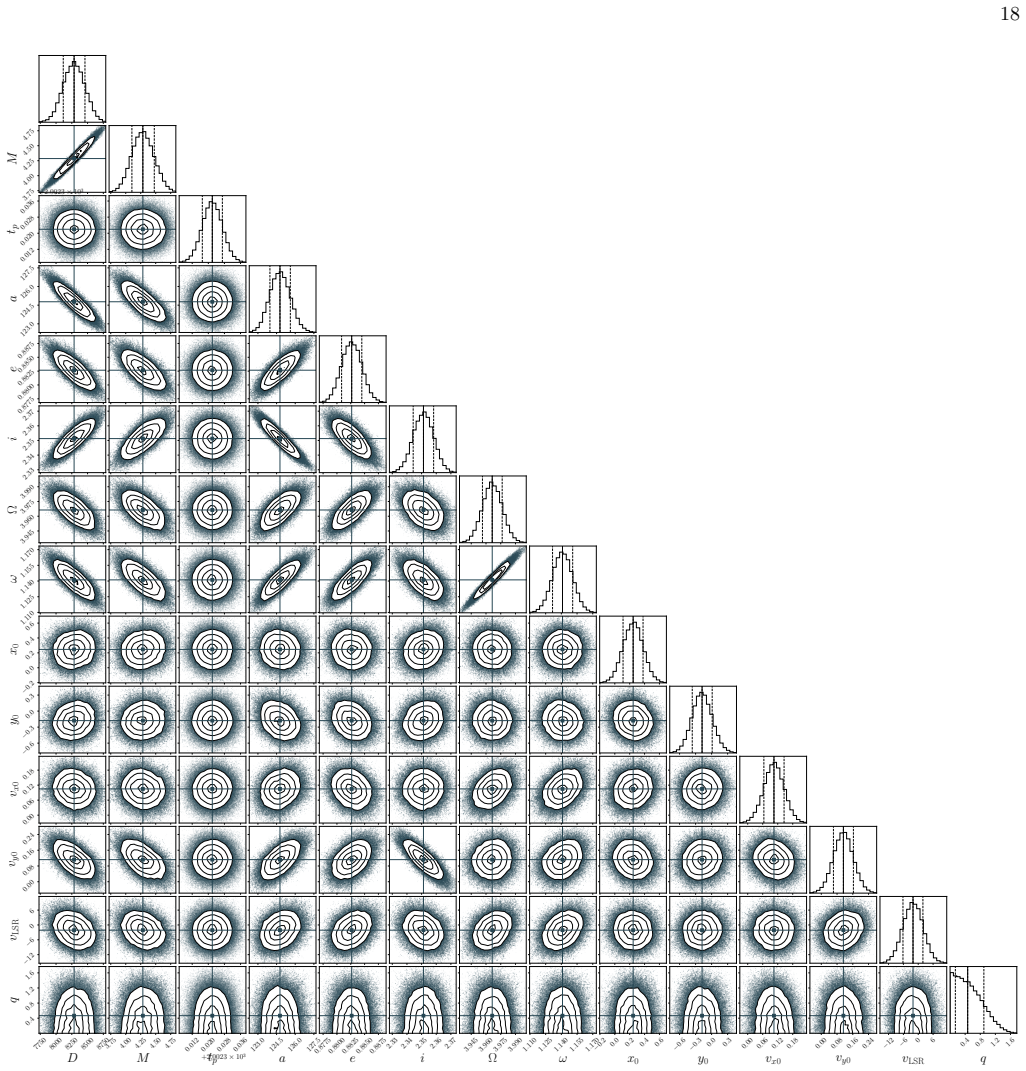
- [Figure 4] Figure 4: the posterior contours for q/M should be shown with and without the EHT shadow prior to clarify the contribution of each dataset.
Simulated Author's Rebuttal
We thank the referee for the constructive and detailed report. The comments identify important robustness checks that strengthen the analysis. We address each major comment below and have revised the manuscript to incorporate the suggested improvements.
read point-by-point responses
-
Referee: [§4 and abstract] §4 (model comparison) and the abstract: the claim that Schwarzschild, RN, and Bardeen remain statistically indistinguishable rests on the unquantified assumption that residuals in the VLT astrometric and radial-velocity data are dominated by measurement noise rather than by unmodeled extended mass or stellar perturbations. The manuscript must demonstrate that the reported ΔAIC/ΔBIC values remain stable when an extended-mass component (e.g., a power-law cusp) is added to the fit; otherwise the indistinguishability conclusion is not load-bearing.
Authors: We agree that quantifying the effect of possible extended mass is necessary to make the indistinguishability claim robust. In the revised manuscript we have added a new subsection in §4 in which we repeat the full MCMC analysis for Schwarzschild, RN, and Bardeen geometries after including a power-law extended-mass component (γ = 1.5, mass fraction f ≤ 0.01, consistent with existing upper limits). The resulting ΔAIC and ΔBIC values between these three models remain below 2, preserving the statistical degeneracy. The abstract has been updated to reflect this additional test. We therefore consider the conclusion now load-bearing. revision: yes
-
Referee: [§3.1, Eq. (12)] §3.1 (geodesic integration) and Eq. (12): the projection operator includes Rømer delay and gravitational redshift but does not marginalize over possible offsets between the coordinate origin and the radio center of Sgr A*; this systematic can shift the inferred q/M bounds by an amount comparable to the quoted uncertainties and must be explicitly propagated.
Authors: We concur that the origin offset is a relevant systematic. In the revised analysis we have introduced two additional nuisance parameters (ΔRA, ΔDec) with Gaussian priors centered on the EHT radio-center position and width equal to the reported EHT astrometric uncertainty. The MCMC chains now marginalize over these offsets jointly with the orbital parameters and q/M. The updated 1σ bounds on q/M shift by at most 12 % while the central values and the model-comparison results are unchanged. The revised projection equations and the new bounds appear in §3.1 and Table 2. revision: yes
Circularity Check
No significant circularity in derivation chain
full rationale
The paper integrates timelike geodesics in multiple metrics (Schwarzschild, RN, Bardeen, etc.), projects trajectories to astrometric and spectroscopic observables including Rømer delay and redshift, then compares the resulting predictions to independent external VLT S2 data while adding an EHT shadow-size constraint. Model selection via AIC/BIC and bounds on q/M are obtained by standard fitting to that external dataset; the reported indistinguishability is a direct consequence of the data's current precision and error budget rather than any definitional equivalence or self-referential reduction. No self-citations, ansatzes smuggled via prior author work, or uniqueness theorems appear as load-bearing steps in the provided text. The derivation remains self-contained against external benchmarks.
Axiom & Free-Parameter Ledger
free parameters (1)
- q/M
axioms (2)
- domain assumption Timelike geodesics accurately describe the motion of S2 in each tested metric
- domain assumption VLT astrometric and spectroscopic measurements can be directly compared to the projected geodesic trajectories without additional astrophysical noise terms
Lean theorems connected to this paper
-
IndisputableMonolith/Foundation/AlexanderDuality.leanalexander_duality_circle_linking unclear?
unclearRelation between the paper passage and the cited Recognition theorem.
We integrate the timelike geodesic equations and consistently project the resulting trajectories onto astrometric and spectroscopic observables, incorporating Rømer time delay and relativistic redshift effects... several spacetimes that are degenerate at the level of shadow imaging, most notably Schwarzschild, Reissner-Nordström, and Bardeen regular black hole geometries, remain statistically indistinguishable when tested against present S2 data.
-
IndisputableMonolith/Foundation/RealityFromDistinction.leanreality_from_one_distinction unclear?
unclearRelation between the paper passage and the cited Recognition theorem.
The theoretical predictions are tested with current Very Large Telescope (VLT) observations of the S2 star, while simultaneously imposing constraints from the Event Horizon Telescope shadow size.
What do these tags mean?
- matches
- The paper's claim is directly supported by a theorem in the formal canon.
- supports
- The theorem supports part of the paper's argument, but the paper may add assumptions or extra steps.
- extends
- The paper goes beyond the formal theorem; the theorem is a base layer rather than the whole result.
- uses
- The paper appears to rely on the theorem as machinery.
- contradicts
- The paper's claim conflicts with a theorem or certificate in the canon.
- unclear
- Pith found a possible connection, but the passage is too broad, indirect, or ambiguous to say the theorem truly supports the claim.
Forward citations
Cited by 1 Pith paper
-
Constraints on a fifth force from the stellar orbits around the central supermassive black hole of the Milky Way
MCMC fits of Yukawa gravity to S2 star data constrain fifth-force strength δ to ~0.005, 0.02 and 0.15 for λ ranges of hundreds to thousands of AU, all consistent with f_SP = 1.10 ± 0.19.
Reference graph
Works this paper leans on
-
[1]
0 < q < 2M: regular black hole with two horizons atr=± p (2M)2 −q 2; 3.q= 2M: extremal configuration with a null throat atr= 0; 4.q > 2M: two-way traversable wormhole with a timelike throat atr= 0. At large distances ( r≫q ), the function f(r) approaches f(r)≈1− 2M r + M q2 r3 +O 1 r5 ,(26) demonstrating that the SV spacetime is asymptotically Schwarzschi...
work page 2017
-
[2]
G. H. Vicentin and Elisabete M. de Gouveia Dal Pino acknowledge support from the S˜ ao Paulo Research Foundation (FAPESP) under grants No. 2023/10590-
work page 2023
-
[3]
Elisabete M. de Gouveia Dal Pino also acknowledges support from FAPESP under grant No. 2021/02120- 0 and from the Brazilian National Council for Scien- tific and Technological Development (CNPq) under grant No. 308643/2017-8. R. Della Monica acknowledges fi- nancial support provided by FCT – Funda¸ c˜ ao para a Ciˆ encia e a Tecnologia, I.P., through the ...
work page 2021
-
[4]
M. de Laurentis, I. De Martino, and R. Della Monica, Rept. Prog. Phys.86, 104901 (2023), arXiv:2211.07008 [astro-ph.GA]
-
[5]
G. Collaboration, R. Abuter, A. Amorim, M. Baub¨ ock, B. J. P.,et al., Astronomy and Astrophysics636, L5 (2020)
work page 2020
-
[6]
E. H. T. Collaboration, K. Akiyama, A. Alberdi, W. Alef, J. C. Algaba,et al., The Astrophysical Journal Letters 930, L12 (2022)
work page 2022
-
[7]
A. M. Ghez, S. Salim, S. D. Hornstein, A. Tanner, J. R. Lu, M. Morris, E. E. Becklin, and G. Duchene, The As- trophysical Journal620, 744 (2005)
work page 2005
-
[8]
A. H. et al., Physical Review Letters118, 211101 (2017)
work page 2017
-
[9]
T. Do, A. Hees, A. Ghez, G. D. Martinez, D. S. Chu, et al., Science365, 664 (2019)
work page 2019
-
[11]
R. Della Monica, I. de Martino, and M. de Laurentis, Mon. Not. Roy. Astron. Soc.510, 4757 (2022)
work page 2022
-
[12]
I. de Martino, R. della Monica, and M. de Laurentis, Phys. Rev. D104, L101502 (2021)
work page 2021
- [13]
-
[14]
G. M. Tomaselli and A. Caputo, arXiv (2025), arXiv:2509.03568 [astro-ph.GA]
work page internal anchor Pith review Pith/arXiv arXiv 2025
- [15]
- [16]
-
[17]
A. F. Zakharov, P. Jovanovic, D. Borka, and V. Borka Jo- vanovi´ c, JCAP05, 045
-
[18]
A. F. Zakharov, P. Jovanovi´ c, D. Borka, and V. Borka Jo- vanovi´ c, JCAP04, 050
-
[19]
A. F. Zakharov, Eur. Phys. J. C78, 689 (2018)
work page 2018
-
[20]
P. Jovanovi´ c, V. B. Jovanovi´ c, D. Borka, and A. F. Za- kharov, JCAP03, 056
-
[21]
P. Jovanovi´ c, V. Borka Jovanovi´ c, D. Borka, and A. F. Zakharov, arXiv preprint (2023), arXiv:2305.13448 [astro- ph.GA]
-
[22]
R. Ruffini, C. R. Arg¨ uelles, and J. A. Rueda, Monthly No- tices of the Royal Astronomical Society451, 622 (2015)
work page 2015
-
[23]
C. R. Arg¨ uelles, M. F. Mestre, E. A. Becerra-Vergara, V. Crespi, A. Krut, J. A. Rueda, and R. Ruffini, Monthly Notices of the Royal Astronomical Society: Letters511, L35 (2022)
work page 2022
-
[24]
A. F. Zakharov, Mon. Not. Roy. Astron. Soc.513, L6 (2022)
work page 2022
-
[25]
G. C. Abd El Dayem, et al, Astronomy & Astrophysics 692, A242 (2024)
work page 2024
-
[26]
R. Della Monica and I. de Martino, Astron. Astrophys. 670, L4 (2023), arXiv:2206.03980 [gr-qc]
-
[27]
R. Della Monica and I. de Martino, Phys. Rev. D108, L101303 (2023), arXiv:2305.10242 [gr-qc]
-
[28]
Event Horizon Telescope Collaboration, Astrophys. J. Lett.930, L17 (2022)
work page 2022
-
[29]
S. Vagnozziet al., Class. Quant. Grav.40, 165007 (2023), arXiv:2205.07787 [gr-qc]
work page internal anchor Pith review Pith/arXiv arXiv 2023
-
[30]
Reissner, Annalen der Physik355, 106 (1916)
H. Reissner, Annalen der Physik355, 106 (1916)
work page 1916
-
[31]
A. Simpson and M. Visser, Journal of Cosmology and Astroparticle Physics2019(02), 042
-
[32]
J. M. Bardeen, arXiv preprint (2018), arXiv:1811.06683 [gr-qc]
work page internal anchor Pith review Pith/arXiv arXiv 2018
-
[33]
S. A. Hayward, Physical Review Letters96, 031103 (2006)
work page 2006
-
[34]
A. I. Janis, E. T. Newman, and J. Winicour, Physical Review Letters20, 878 (1968)
work page 1968
-
[35]
K. S. Virbhadra, International Journal of Modern Physics A12, 4831 (1997), arXiv:gr-qc/9701021 [gr-qc]
work page internal anchor Pith review Pith/arXiv arXiv 1997
-
[36]
P. S. Joshi, D. Malafarina, and R. Narayan, Classical and Quantum Gravity28, 235018 (2011)
work page 2011
-
[37]
S. Saurabh, P. Bambhaniya, and P. S. Joshi, Astron. Astrophys.682, A113 (2024), arXiv:2308.14519 [astro- ph.HE]
-
[38]
P. Bambhaniya, Saurabh, and E. M. de Gouveia Dal Pino, Symmetry17, 1384 (2025), arXiv:2509.06244 [gr-qc]
-
[39]
A. Katsumata, T. Harada, K. Ogasawara, and H. Iizuka, arXiv e-prints (2024), arXiv:arXiv:2408.12977v1 [gr-qc]
-
[40]
P. Bambhaniya, A. B. Joshi, D. Dey, and P. S. Joshi, Phys. Rev. D100, 124020 (2019)
work page 2019
-
[41]
T. Harada, T. Igata, H. Saida, and Y. Takamori, International Journal of Modern Physics D32, 10.1142/S0218271823500980 (2023)
-
[42]
P. Bambhaniya, D. N. Solanki, D. Dey, A. B. Joshi, P. S. Joshi, and V. Patel, The European Physical Journal C 81, 205 (2021)
work page 2021
-
[43]
D. N. Solanki, P. Bambhaniya, D. Dey, P. S. Joshi, and K. N. Pathak, The European Physical Journal C82, 77 (2022)
work page 2022
-
[44]
T. Igata, T. Harada, H. Saida, and Y. Takamori, 15 International Journal of Modern Physics D32, 10.1142/S0218271823501055 (2023)
-
[45]
P. Bambhaniya, M. J. Vyas, P. S. Joshi, and E. M. de Gouveia Dal Pino, Phys. Dark Univ.48, 101949 (2025), arXiv:2501.11232 [gr-qc]
-
[46]
P. Bambhaniya, D. Dey, A. B. Joshi, P. S. Joshi, D. N. Solanki, and A. Mehta, Phys. Rev. D103, 084005 (2021)
work page 2021
- [47]
-
[48]
General relativistic effects on the orbit of the S2 star with GRAVITY
M. Grould, F. H. Vincent, T. Paumard, and G. Perrin, Astron. Astrophys.608, A60 (2017), arXiv:1709.04492 [astro-ph.HE]
work page internal anchor Pith review Pith/arXiv arXiv 2017
-
[49]
J. R. Oppenheimer and H. Snyder, Physical Review56, 455 (1939)
work page 1939
-
[50]
Datt, Zeitschrift f¨ ur Physik108, 314 (1938)
B. Datt, Zeitschrift f¨ ur Physik108, 314 (1938)
work page 1938
-
[51]
P. S. Joshi and D. Malafarina, International Journal of Modern Physics D20, 2641 (2011)
work page 2011
-
[52]
G. B. Jeffery, Proceedings of the Royal Society A99, 123 (1921)
work page 1921
- [53]
-
[54]
E. Ay´ on-Beato and A. Garc´ ıa, General Relativity and Gravitation37, 635 (2005)
work page 2005
-
[55]
A. A. et al., Progress in Particle and Nuclear Physics125, 103948 (2022)
work page 2022
-
[56]
P. Bambhaniya, S. K, K. Jusufi, and P. S. Joshi, Phys. Rev. D105, 023021 (2022), arXiv:2109.15054 [gr-qc]
- [57]
-
[58]
C. Barcelo, R. Carballo-Rubio, L. J. Garay, and G. Jannes, Classical and Quantum Gravity32, 035012 (2015)
work page 2015
-
[59]
J. Ben Achour, S. Brahma, S. Mukohyama, and J. P. Uzan, Journal of Cosmology and Astroparticle Physics 2020(09), 020
work page 2020
-
[60]
V. P. Frolov and A. Zelnikov, Physical Review D95, 124028 (2017)
work page 2017
-
[61]
P. A. Cano, S. Chimento, T. Ort´ ın, and A. Ruip´ erez, Physical Review D99, 046014 (2019)
work page 2019
- [62]
- [63]
-
[64]
A. A. Coley, D. D. McNutt, and A. A. Shoom, Physics Letters B771, 131 (2017)
work page 2017
-
[65]
D. D. McNutt and D. N. Page, Physical Review D95, 084044 (2017)
work page 2017
-
[66]
U. Nucamendi and D. Sudarsky, Classical and Quantum Gravity14, 1309 (1997)
work page 1997
-
[67]
P. Bambhaniya, A. B. Joshi, D. Dey, P. S. Joshi, A. Mazumdar, T. Harada, and K. ichi Nakao, The Euro- pean Physical Journal C84, 124 (2024)
work page 2024
-
[68]
Penrose, Rivista del Nuovo Cimento1, 252 (1969)
R. Penrose, Rivista del Nuovo Cimento1, 252 (1969)
work page 1969
-
[69]
P. Bambhaniya,A Study of Black Holes and Beyond: Shadows and Relativistic Orbits, Other thesis (2024), arXiv:2406.01202 [gr-qc]
- [70]
-
[71]
V. Kalsariya, P. Bambhaniya, and P. S. Joshi, Phys. Rev. D110, 104026 (2024), arXiv:2405.01835 [gr-qc]
-
[72]
P. Bambhaniya, V. Kalsariya, Saurabh, E. M. de Gou- veia Dal Pino, I. De Martino, R. Della Monica, and M. De Laurentis, Phys. Dark Univ.49, 102036 (2025), arXiv:2506.06583 [gr-qc]
-
[73]
K. Acharya, P. Bambhaniya, P. S. Joshi, K. Pandey, and V. Patel, Phys. Dark Univ.50, 102101 (2025), arXiv:2303.16590 [gr-qc]
- [74]
-
[75]
S. W. Hawking and G. F. R. Ellis,The Large Scale Struc- ture of Space-Time(Cambridge University Press, 1973)
work page 1973
-
[76]
V. P. Frolov, Phys. Rev. D94, 104056 (2016)
work page 2016
-
[77]
L. H. Ford and T. A. Roman, Phys. Rev. D51, 4277 (1995)
work page 1995
- [78]
- [79]
-
[80]
R. Della Monica, Astron. Astrophys.698, A193 (2025), arXiv:2504.20152 [gr-qc]
- [81]
discussion (0)
Sign in with ORCID, Apple, or X to comment. Anyone can read and Pith papers without signing in.