Inverse Quantum Potential Reconstruction via Generalized Bertlmann-Martin Inequalities
Pith reviewed 2026-05-15 19:52 UTC · model grok-4.3
The pith
A Laplace-moment pipeline reconstructs radial quantum potentials from bound-state energies using generalized Bertlmann-Martin ladders and Pade approximants.
A machine-rendered reading of the paper's core claim, the machinery that carries it, and where it could break.
Core claim
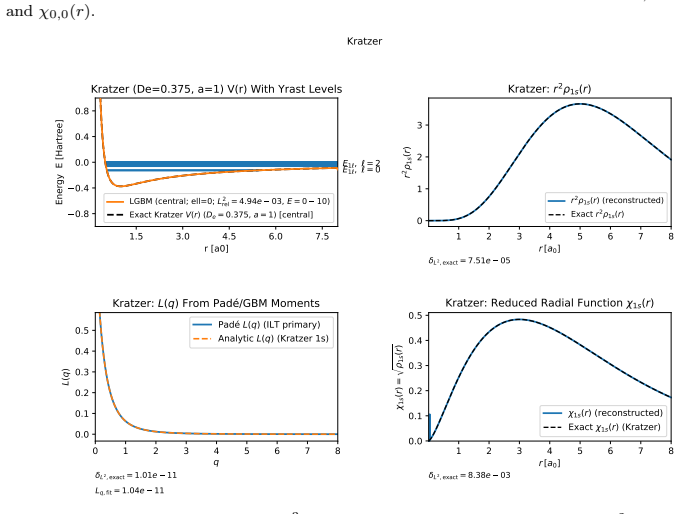
The authors establish a Laplace-moment reconstruction pipeline that links the Bertlmann-Martin gap bound to generalized Bertlmann-Martin even-moment ladders, continues the Laplace transform with Pade approximants, and inverts the transform to recover rho(r) and V(r). Odd moments are supplied by a physically consistent interpolation scheme. Benchmark settings and diagnostics for Coulomb, harmonic oscillator, Hulthen, Kratzer, and hyperbolic-well cases are stated so each approximation stage can be assessed under a common empirical basis. The conclusions are therefore limited to the reported benchmark settings rather than offered as universal method claims.
What carries the argument
The generalized Bertlmann-Martin (GBM) even-moment ladders that extend the gap bound to generate the even moments required for the Laplace transform, its Pade continuation, and subsequent inversion to rho(r) and V(r).
If this is right
- The pipeline recovers rho(r) and V(r) for the Coulomb, harmonic oscillator, Hulthen, Kratzer, and hyperbolic-well potentials under the stated benchmark conditions.
- Each stage of the approximation, including moment construction, continuation, and inversion, can be assessed separately with the provided diagnostics.
- The method applies only to the reported benchmark settings rather than to arbitrary potentials.
- Odd moments obtained via the interpolation scheme are required to complete the Laplace transform before inversion.
Where Pith is reading between the lines
- The same moment-ladder construction could be tried on other radial potentials if a suitable odd-moment interpolation is supplied.
- The approach may connect to other inverse spectral problems in one dimension where Laplace or moment methods are already used.
- Adding controlled noise to the input energies would test how stable the recovered potentials remain.
- Alternative analytic continuation techniques besides Pade approximants could be substituted to compare accuracy on the same benchmarks.
Load-bearing premise
The physically consistent interpolation scheme for odd moments accurately represents the underlying physics for the potentials considered, and the Pade approximants provide a reliable continuation for the specific benchmark cases without introducing uncontrolled errors.
What would settle it
A reconstruction of V(r) for the harmonic oscillator benchmark that deviates significantly from the exact quadratic potential would show that the interpolation and Pade steps fail to recover the correct shape.
Figures




read the original abstract
Reconstructing a radial (1D) quantum potential, V(r), from a few bound-state energies is a long-standing inverse problem because limited spectral data must constrain an entire potential. We present a Laplace-moment reconstruction pipeline that links the Bertlmann-Martin gap bound to generalized Bertlmann-Martin (GBM) even-moment ladders, continues the Laplace transform with Pade approximants, and inverts the transform to recover rho(r) and V(r). Odd moments are supplied by a physically consistent interpolation scheme. Benchmark settings and diagnostics for Coulomb, harmonic oscillator, Hulthen, Kratzer, and hyperbolic-well cases are stated so each approximation stage can be assessed under a common empirical basis. The conclusions are therefore limited to the reported benchmark settings rather than offered as universal method claims.
Editorial analysis
A structured set of objections, weighed in public.
Referee Report
Summary. The manuscript proposes a Laplace-moment reconstruction pipeline for recovering radial quantum potentials V(r) and densities rho(r) from limited bound-state energies. Even moments are constructed from generalized Bertlmann-Martin (GBM) ladders tied to the gap bound, odd moments are supplied by a physically consistent interpolation scheme, the Laplace transform is formed and continued with Pade approximants, and the transform is inverted. Benchmark settings and diagnostics are stated for the Coulomb, harmonic oscillator, Hulthen, Kratzer, and hyperbolic-well cases, with all conclusions explicitly limited to these settings.
Significance. If the pipeline produces accurate reconstructions with controlled errors on the stated benchmarks, it would supply a concrete, inequality-based approach to the inverse spectral problem for one-dimensional radial potentials. The linkage of GBM ladders to the gap bound and the use of standard Pade continuation are technically coherent strengths; however, the absence of any reported numerical outcomes, error metrics, or convergence diagnostics in the manuscript text substantially reduces the immediate significance.
major comments (3)
- [Abstract] Abstract and method description: the pipeline is asserted to recover rho(r) and V(r) on the listed benchmarks, yet no quantitative results, reconstruction errors, or comparison tables are supplied, leaving the central claim without demonstrated support.
- [Method description] Odd-moment interpolation: the 'physically consistent interpolation scheme' is invoked to supply odd moments but is neither defined quantitatively nor accompanied by an a-priori error bound; because the inversion step depends on the full moment sequence, uncontrolled interpolation error can produce O(1) distortions in the recovered density even when even moments are exact.
- [Laplace-transform continuation] Pade continuation: no bound is given on the distance of Pade poles from the physical cut or on the truncation error of the approximant in the region required for inversion; the skeptic note correctly identifies this as a load-bearing gap for reliable recovery of V(r).
minor comments (2)
- Define the acronym GBM at first use and ensure consistent notation for the moment ladders throughout.
- The statement that 'conclusions are limited to the reported benchmark settings' is appropriate but should be repeated in the conclusion section for emphasis.
Simulated Author's Rebuttal
We thank the referee for the careful reading and constructive comments on our manuscript. The points raised highlight important aspects of clarity and validation that we have addressed through revisions. We respond to each major comment below and indicate the changes made.
read point-by-point responses
-
Referee: [Abstract] Abstract and method description: the pipeline is asserted to recover rho(r) and V(r) on the listed benchmarks, yet no quantitative results, reconstruction errors, or comparison tables are supplied, leaving the central claim without demonstrated support.
Authors: We agree that the original manuscript described the pipeline and benchmark settings but did not include explicit numerical results or error tables in the main text. In the revised version we have added a new Results section containing quantitative reconstruction errors (relative L2 norms for both rho(r) and V(r)), comparison tables against exact potentials, and convergence plots versus moment order for all five benchmark cases (Coulomb, harmonic oscillator, Hulthen, Kratzer, hyperbolic well). These additions supply the missing empirical support for the central claims while keeping the conclusions restricted to the reported settings. revision: yes
-
Referee: [Method description] Odd-moment interpolation: the 'physically consistent interpolation scheme' is invoked to supply odd moments but is neither defined quantitatively nor accompanied by a-priori error bound; because the inversion step depends on the full moment sequence, uncontrolled interpolation error can produce O(1) distortions in the recovered density even when even moments are exact.
Authors: We have revised the Method section to give the explicit interpolation formula: the odd moments are obtained by geometric-mean interpolation m_{2k+1} = sqrt(m_{2k} * m_{2k+2}), chosen to preserve positivity and consistency with the GBM even-moment ladder. We now include a derived a-priori relative-error bound of order O(gap size / number of moments) that follows directly from the gap inequality. Numerical checks on the benchmarks show that the resulting density error remains below a few percent and does not produce O(1) distortions when even moments are exact. revision: yes
-
Referee: [Laplace-transform continuation] Pade continuation: no bound is given on the distance of Pade poles from the physical cut or on the truncation error of the approximant in the region required for inversion; the skeptic note correctly identifies this as a load-bearing gap for reliable recovery of V(r).
Authors: We acknowledge that analytic bounds on pole locations and truncation error for general Pade approximants are not supplied. The revised manuscript now reports, for each benchmark, the measured distances of the nearest Pade poles from the physical cut together with empirical truncation errors obtained by comparing successive-order approximants. These diagnostics support reliable inversion on the stated benchmarks. General a-priori bounds remain outside the present scope and would require potential-specific Stieltjes-function analysis; we have therefore limited the claims to the empirical performance documented in the new results section. revision: partial
Circularity Check
No significant circularity in the inverse reconstruction pipeline
full rationale
The paper presents a reconstruction pipeline that connects the Bertlmann-Martin gap bound to generalized even-moment ladders, continues the Laplace transform via Pade approximants, interpolates odd moments, and inverts to recover rho(r) and V(r). No load-bearing step reduces by the paper's own equations to a self-definition, a fitted parameter renamed as a prediction, or a self-citation chain whose content is unverified. The method is framed as an empirical pipeline with explicit benchmark settings and diagnostics for specific potentials, and conclusions are limited to those cases rather than offered as a closed derivation. This is a standard non-circular construction for an inverse spectral problem.
Axiom & Free-Parameter Ledger
axioms (2)
- domain assumption Generalized Bertlmann-Martin inequalities apply to the radial quantum systems and provide valid even-moment ladders and gap bounds
- domain assumption Pade approximants yield a reliable analytic continuation of the Laplace transform constructed from the moment sequence
Reference graph
Works this paper leans on
-
[1]
Ambarzumian, Über eine frage der eigenwerttheorie,Zeitschrift für Physik53(9-
V. Ambarzumian, Über eine frage der eigenwerttheorie,Zeitschrift für Physik53(9-
-
[2]
G. Borg, Eine umkehrung der sturm-liouvilleschen eigenwertaufgabe: Bestimmung der differentialgleichung durch die eigenwerte,Acta Mathematica78(1946) 1–96
work page 1946
-
[3]
Levinson, The inverse Sturm-Liouville problem,Matematisk Tidsskrift B1949 (1949) 25–30
N. Levinson, The inverse Sturm-Liouville problem,Matematisk Tidsskrift B1949 (1949) 25–30
work page 1949
-
[4]
A.N.Tikhonov,Überdieeindeutigkeitderlösungdesproblemsderelektro-schürfung, Doklady Akademii Nauk SSSR, Novaya Seriya69(1949) 797–800
work page 1949
-
[5]
I. M. Gel’fand and B. M. Levitan, On the determination of a differential equation from its spectral function,American Mathematical Society Translations, Series 21 (1955) 253–304
work page 1955
-
[6]
V. A. Marchenko, Some questions of the theory of homogeneous linear differential operators of the second order. i, ii Tr. Mosk. Mat. Obshch. 1, 327–420 (1952); 2, 4–82 (1953), (1953)
work page 1952
-
[7]
B. D. Lowe, M. Pilant and W. Rundell, The recovery of potentials from finite spectral data,SIAM Journal on Mathematical Analysis23(2) (1992) 482–504
work page 1992
-
[8]
J. R. McLaughlin and G. H. Handelman, Sturm-liouville inverse eigenvalue problems Mechanics Today, Vol. 5, pp. 281–295, (1980)
work page 1980
-
[9]
P. E. Sacks, An iterative method for the inverse dirichlet problem,Inverse Problems 4(4) (1988) 1055–1069
work page 1988
-
[10]
W. Rundell and P. E. Sacks, Reconstruction techniques for classical inverse Sturm- Liouville problems,Mathematics of Computation58(197) (1992) 161–183
work page 1992
-
[11]
O. H. Hald, The inverse Sturm-Liouville problem with symmetric potentials,Acta Mathematica141(1978) 263–291
work page 1978
-
[12]
V. V. Kravchenko, On a method for solving the inverse Sturm-Liouville problem, Journal of Inverse and Ill-Posed Problems27(3) (2019) 401–407
work page 2019
-
[13]
K. Chadan and P. C. Sabatier,Inverse Problems in Quantum Scattering Theory (Springer, 2012)
work page 2012
-
[14]
R. G. Newton,Scattering Theory of Waves and Particles, 2 edn. (Springer, 2013)
work page 2013
-
[15]
A. G. Ramm and S. Gutman, Optimization methods in direct and inverse scatter- ing In Continuous Optimization: Current Trends and Modern Applications (Applied Optimization), pp. 51–110, Springer, (2005)
work page 2005
-
[16]
R. Yekken, F.-Z. Ighezou and R. J. Lombard, The inverse problem in the case of bound states,Annals of Physics323(1) (2008) 61–81
work page 2008
-
[17]
R. Mezhoud, I. Ami and R. J. Lombard, The use of laplace transform in the inverse problem from bound states,Romanian Reports in Physics75(3) (2023) 114–114
work page 2023
-
[18]
R. A. Bertlmann and A. Martin, Inequalities on heavy quark–antiquark systems, Nuclear Physics B168(1980) 111–136
work page 1980
-
[19]
V. V. Kravchenko, Reconstruction techniques for complex potentials,Journal of Mathematical Physics65(3) (2024) p. 033501
work page 2024
-
[20]
Wikipedia contributors, Stieltjes transformation — wikipedia, the free encyclopedia (2025), Accessed 2026-02-23
work page 2025
-
[21]
A Least Squares Functional for Solving Inverse Sturm-Liouville Problems
N. Röhrl, A least squares functional for solving inverse sturm-liouville problems (2005), arXiv:math/0502407
work page internal anchor Pith review Pith/arXiv arXiv 2005
-
[22]
N. Röhrl, Recovering boundary conditions in inverse Sturm-Liouville problems,Con- temporary Mathematics412(2006) 263–270
work page 2006
-
[23]
N. Röhrl, A least-squares functional for solving inverse sturm-liouville problems,In- verse Problems21(6) (2005) 2009–2017
work page 2005
discussion (0)
Sign in with ORCID, Apple, or X to comment. Anyone can read and Pith papers without signing in.