pith. machine review for the scientific record. sign in

math.SP

Spectral Theory

Schrodinger operators, operators on manifolds, general differential operators, numerical studies, integral operators, discrete models, resonances, non-self-adjoint operators, random operators/matrices

0
math.SP 2026-05-12 2 theorems

Real eigenfunctions still produce non-trivial Berry phase

Berry's phase under topology change

Continuous families of metric graph Laplacians change topology while eigenfunctions remain real, yielding a geometric phase tied to the loop

Figure from the paper full image
abstract click to expand
Laplacians on metric graphs are used to construct continuous families of Hamiltonians with different topological structure. One such family is used to demonstrate that Hamiltonians with real-valued eigenfunctions may possess non-trivial geometric Berry's phase. Connections between non-trivial Berry's phase and topology change are discussed.
0
0
math.SP 2026-05-11 2 theorems

Quantum variance vanishes for operators on large hyperbolic surfaces

Quantum Ergodicity on large hyperbolic surfaces for local and pseudolocal operators

Extends ergodicity from scalar functions to differential and finite-propagation operators under injectivity and gap assumptions.

abstract click to expand
We prove a quantum ergodicity theorem for sequences of closed hyperbolic surfaces converging to the Poincar\'e disc in the Benjamini-Schramm sense. Assuming a uniform lower bound on the injectivity radius and a spectral gap, we establish vanishing of quantum variance on fixed spectral windows for a class of observables that contains differential operators and finite-propagation smooth operators. This generalises a result of Le Masson and Sahlsten from scalar observables to both local and 'pseudolocal' operator settings.
0
0
math.SP 2026-05-08 2 theorems

4-cycle stochastic matrices have their eigenvalues fully mapped

On the Spectral Region of 4-Cycle Stochastic Matrices

Real eigenvalues occupy [-1,1]; complex ones lie inside or on an explicitly described boundary that is attained by interior constructions.

Figure from the paper full image
abstract click to expand
We study the spectrum of 4-cycle row-stochastic matrices. For real eigenvalues the spectral region is [-1,1]. For nonreal eigenvalues a+ib we derive necessary conditions in terms of the real and imaginary parts, including the inequality a+|b| <= 1 and the condition (b^2+a^2+a)^2+2a^2-b^2 >= 0. We also prove conversely that every point in the corresponding interior region occurs as an eigenvalue of a 4-cycle matrix. The proof is organized through a reformulation of the characteristic equation, an argument parametrization, a convex-analytic criterion, and explicit boundary constructions. Hence, the spectral region for the 4-cycle row-stochastic matrices is exactly and explicitly determined.
0
0
math.SP 2026-05-08 Recognition

Weighted log integrability forces Verblunsky coefficients into ℓ^{2m+2}

Necessary Conditions for Single-Critical-Point Higher-Order SzegH{o} Sum Rules in OPUC

For weights vanishing like (1-cos θ)^m at one point, the finite weighted integral of log w implies square-summable m-th differences and the

abstract click to expand
We prove the necessity part of the higher-order Szeg\H{o} theorem on the unit circle for the single-critical-point weights $H_m(e^{i\theta})=(1-\cos\theta)^m$, $m\ge1$. If $\{\alpha_n\}_{n\ge0}$ are the Verblunsky coefficients of a nontrivial probability measure $d\mu=w(\theta)d\theta/(2\pi)+d\mu_{\mathrm s}$, then the weighted Szeg\H{o} condition $\int_0^{2\pi} (1-\cos\theta)^m\log w(\theta)\frac{d\theta}{2\pi}>-\infty$ implies $\Delta^m\alpha\in\ell^2, \,\, \alpha\in\ell^{2m+2}.$ The proof uses a finite-volume version of Yan's higher-order sum rule. The quadratic part yields the $m$-th difference energy, and the logarithmic tail yields the $\ell^{2m+2}$-control. The non-sign-definite critical terms are treated in two steps. First, the quartic principal critical block is isolated using the Yan quotient-algebra normal representative and shown to have a positive semidefinite Gram representation. Second, the remaining non-principal critical terms are controlled by the diagonal-vanishing property $\mathcal Y_{k,\mathrm{crit}}^{(m)} \in \mathfrak I_k^{\,m+1-k}, \,\, 2\le k\le m,$ together with the Breuer--Simon--Zeitouni normal form, discrete interpolation, and Young's inequality. These estimates yield a uniform finite-volume coercive bound, from which the necessity theorem follows for all $m\ge1$.
0
0
math.SP 2026-05-08

Asymptotics locate all eigenvalues of perturbed Toeplitz matrices to O(1/n^3)

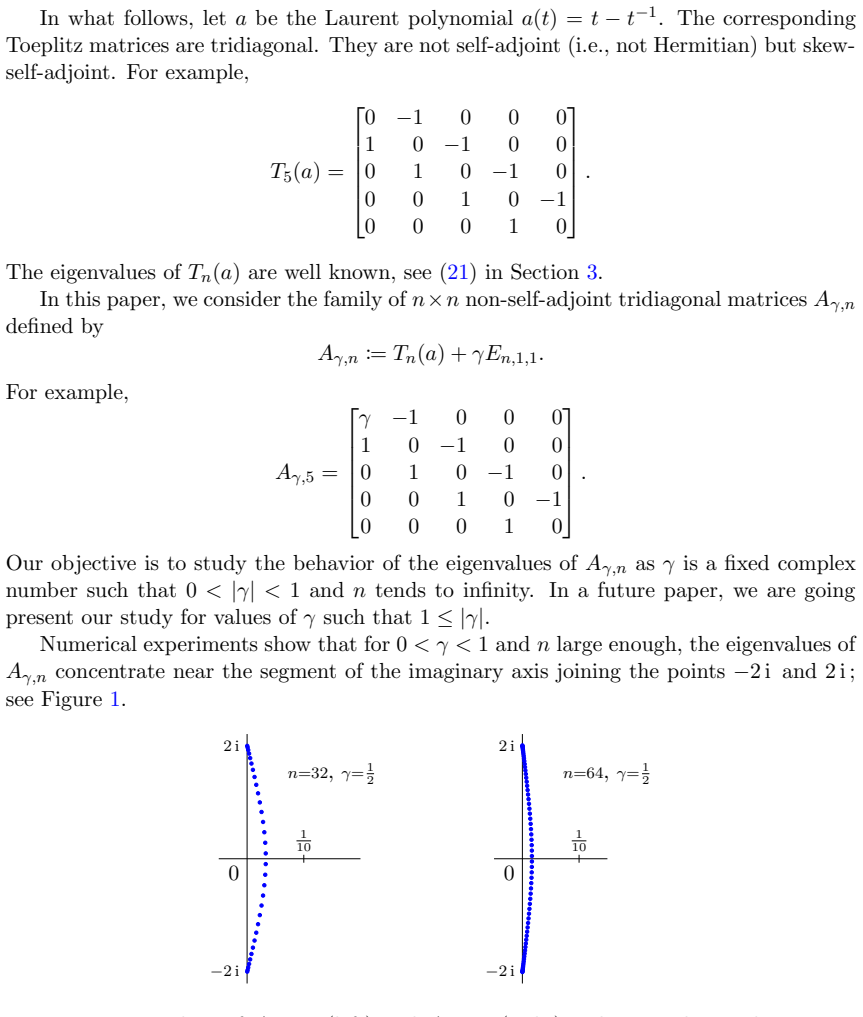
Eigenvalues of one family of tridiagonal skew-self-adjoint Toeplitz matrices with complex perturbations on the corner

The corner perturbation allows an explicit high-order expansion for each eigenvalue around the unperturbed curve 2i sin(x).

Figure from the paper full image
abstract click to expand
In this paper, we study the eigenvalues of the matrices $T_n(a)+\gamma E_{n,1,1}$ where $T_n(a)$ is the Toeplitz matrix with generating symbol $a(t)=t-t^{-1}$, $E_{n,1,1}$ is the $n\times n$ matrix whose upper left component is $1$ and the other components are zero, and $\gamma$ is a fixed complex number such that $0<|\gamma|<1$. As $n\to\infty$, the eigenvalues of these matrices are asymptotically distributed as the function $2 i \sin(x)$, $x\in[0,2\pi]$. Our main result is an asymptotic formula for every eigenvalue with a residue of the order $O(1/n^3)$.
0
0
math.SP 2026-05-07

Riesz property holds for L^r perturbations of degenerate oscillators

Riesz property in the case of multiple eigenvalues

Complex potentials in L^r with r > d/2 keep spectral projections bounded even when eigenvalues have infinite multiplicity.

abstract click to expand
We analyze spectra and the Riesz property of spectral projections of non-symmetric perturbations of self-adjoint operators with eigenvalues having arbitrary multiplicities, including infinite ones. In particular, we establish the Riesz property for perturbations of the multi-dimensional harmonic oscillator, Landau Hamiltonian and Laplace-Beltrami operator on a sphere by complex-valued $L^r$-potentials if $d/2 < r < \infty$.
0
0
math.SP 2026-05-06 3 theorems

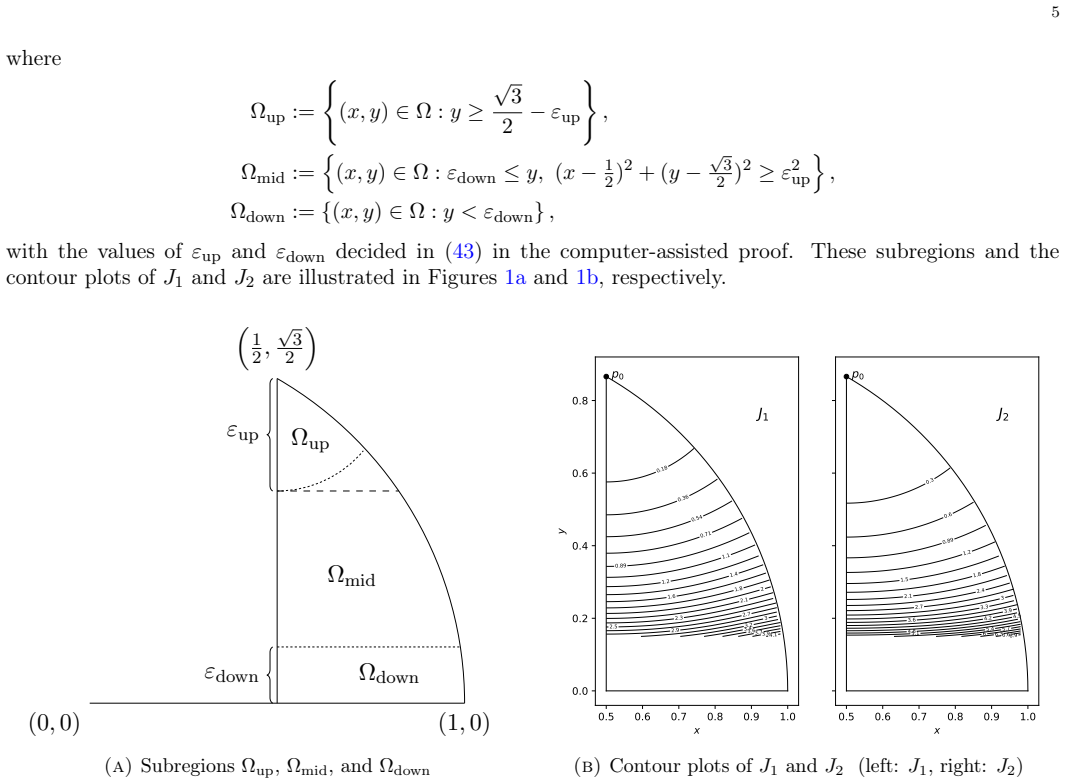
Equilateral triangle uniquely minimizes eigenvalue functional

Sharp Dirichlet eigenvalue inequalities on triangles

New derivative bounds settle conjecture and deliver sharp two-term eigenvalue estimate using area and perimeter.

Figure from the paper full image
abstract click to expand
We prove sharp Dirichlet eigenvalue inequalities for planar triangles. We settle a conjecture of Laugesen and Siudeja by showing that the equilateral triangle uniquely minimizes a scale-invariant functional of the first Dirichlet eigenvalue, area, and perimeter. Consequences include an optimal two-term lower bound for the first Dirichlet eigenvalue in terms of area and perimeter. We also prove a Cheeger-type inequality with an explicit best constant considered by Parini. To prove these conjectures we propose a new method for proving Dirichlet eigenvalue inequalities on triangles. Our method is based on a new computable lower bound for second-order directional shape derivatives under vertex perturbations. It also uses validated finite-element error estimates and recently developed analytic estimates for eigenvalues of nearly degenerate triangles. The method is not specific to the functionals considered in this paper and it can be used to prove various other eigenvalue inequalities on triangles.
0
0
math.SP 2026-05-04

Bloch variety irreducible iff quotient graph connected for generic parameters

Generic Irreducibility of Bloch Varieties for Periodic Graph Operators

This gives a complete characterization for dispersion polynomials of periodic graph operators and reduces the problem to connected cases.

abstract click to expand
We give a complete characterization of generic irreducibility for dispersion polynomials and Bloch varieties of periodic graph operators. More precisely, we prove that for a generic choice of edge weights and potentials, the dispersion polynomial/Bloch variety of a nontrivial periodic graph is irreducible if and only if the quotient graph is connected. Our proof uses a strong dichotomy for parameterized Laurent polynomials: reducibility either occurs for every parameter or fails on a nonempty Zariski-open set. After establishing this dichotomy, we reduce the problem to minimally connected periodic graphs.
0
0
math.SP 2026-05-01

Negative periodic perturbations shift non-local spectra left

Negative spectrum of non-local operators with periodic potential

Leading to extinction in any dimension for birth-death models with suppression forces.

abstract click to expand
The paper deals with spectral analysis of non-local operators arising in population dynamics models. We consider negative periodic perturbations of non-local operators of the convolution type. Such operators describe evolutions of the first correlation function in the stochastic birth and death dynamcis in the presence of suppression forces that increase mortality. We consider the case when the birth kernel can be non-symmetric and spatially heterogeneous. It has been proven that any negative periodic perturbation of the equilibrium dynamics generator shifts the spectrum to the left half-plane and, consequently, such a perturbation of mortality leads to the population extinction in any dimension.
0
0
math.SP 2026-04-30

All eigenvalue sets described for genus 3 graph Laplacians

Flexibility of eigenvalues for graph Laplacians arising from genus 3 surfaces

Complete list covers every four-vertex graph from valid pants decompositions of genus 3 surfaces

Figure from the paper full image
abstract click to expand
It is known that the small eigenvalues of the Laplacian of a Riemann surface close to the boundary of the modular space can be well approximated by the eigenvalues of the discrete Laplacian on a certain graph coming from the pair of pants decomposition of the surface. In this paper, we provide a complete description of the sets of eigenvalues of the weighted graph Laplacian for all graphs on four vertices that correspond to a valid pair of pants decomposition of a surface of genus 3.
0
0
math.SP 2026-04-27

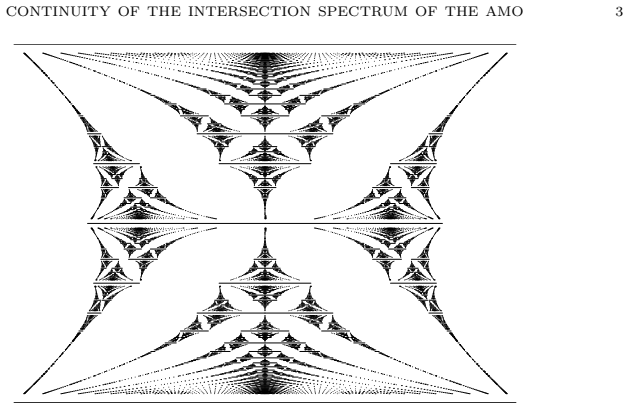
Moments of AMO intersection spectrum measure are polynomials in λ

Generalized Aubry-Andr\'e formula and continuity of the intersection spectrum of the Almost Mathieu operator

Generalized Aubry-André result gives continuous and smooth dependence on parameters for the restricted Lebesgue measure away from λ=1.

Figure from the paper full image
abstract click to expand
We consider the spectrum of the Almost Mathieu operator (AMO) and show that the moments of the restriction of the Lebesgue measure to the intersection spectrum $\text{Leb}|_{\Sigma_{\alpha,\lambda}}$ are polynomials in coupling $\lambda$ with coefficients that are trigonometric polynomials in frequency $\alpha$. The statement can be considered as a generalization of the Aubry-Andr\'e formula for the measure of the spectrum of AMO. As a corollary, we obtain that the restriction of the Lebesgue measure to the intersection spectrum that we denote by $\mu^{-}_{\alpha, \lambda}$ depends continuously on the parameters (frequency $\alpha$ and coupling $\lambda$) in weak-* topology. Moreover, we prove that the dependence is not just continuous but analytic in $\lambda$ and $C^{\infty}$ in $\alpha$ in a sense that an integral of an analytic test function $\varphi(x)$ with respect to $\mu^{-}_{\alpha, \lambda}$ has the same kind of dependence. In particular, this implies that the Lebesgue measure of the part of the spectrum $\Sigma_{\alpha,\lambda}$ that lies between two gaps depends analytically on the coupling constant $\lambda$ and $C^{\infty}$ on the frequency $\alpha$ in an open domain (away from the critical coupling $\lambda=1$) where these gaps do not bifurcate.
0
0
math.SP 2026-04-24

Eigenfunctions mix on BS-converging hyperbolic surfaces

Quantum Mixing for Schr\"odinger eigenfunctions in Benjamini-Schramm limit

Quantum mixing proven in large spectral windows for sequences with uniform gap using Duhamel formula and geodesic flow mixing.

abstract click to expand
Let $-\Delta_{\mathbb{H}}+V$ be the Schr\"odinger operator on $\mathbb{H}$ where $V \in L^p(\mathbb{H}) \cap L^\infty(\mathbb{H})$ for some $p > 0$. If $(X_n)$ is a uniformly discrete sequence of compact hyperbolic surfaces with a uniform spectral gap that Benjamini-Schramm converges to $\mathbb{H}$, we prove quantum mixing for the eigenfunctions of $-\Delta_{X_n}+V_n$ in any sufficiently large spectral window $I$, where $V_n$ is the potential on $X_n$ induced by $V$. These apply to large degree lifts of a potential on a base surface such as congruence covers of arithmetic surfaces, with high probability to random hyperbolic surfaces in the Weil-Petersson model of large genus, and to Hartree one-particle operators arising in thermodynamic limit of many-body Bose gas on hyperbolic surfaces. The proof uses the Duhamel formula for the hyperbolic wave equation together with exponential mixing of the geodesic flow on $T^1 X_n$.
0
0
math.SP 2026-04-23

Symbol submatrix eigenvalues fix lattice interface modes

Topologically protected interface modes in multi-band damped lattice models

Coburn's lemma supplies an explicit test for protected states in damped and disordered chains

Figure from the paper full image
abstract click to expand
Tridiagonal $k$-Toeplitz operators provide a natural framework for modelling one-dimensional $k$-periodic lattice systems. A fundamental connection is obtained between Coburn's lemma for tridiagonal $k$-Toeplitz operators and the existence of edge modes. We reveal that topological edge modes are characterised by the eigenvalues of the leading principal submatrix of the symbol function. A complete analysis of tridiagonal interface operators satisfying global inversion symmetry is then presented. These results are applied to finite one-dimensional $k$-periodic chains of damped resonators that satisfy both local and global inversion symmetry. Additionally, disordered tight-binding interface operators are shown to support a topologically robust zero-energy interface state. Numerical simulations are conducted to illustrate the theoretical findings.
0
0
math.SP 2026-04-22

Normalized Evans function bounds distance to spectrum

The Evans function as a lower bound on the spectral distance function

Its magnitude at a resolvent point certifies a disk free of eigenvalues for ODE boundary-value problems

Figure from the paper full image
abstract click to expand
The Evans function is an analytic function that encodes information about the intersection of certain subspaces in ODE boundary value problems. As such it is a useful tool for computing the spectrum of boundary value problems arising in the stability of coherent structures. In typical applications one is interested in the roots of the Evans function, but the overall normalization is somewhat arbitrary. We present a natural normalization of the Evans function on compact domains such that the magnitude of the Evans function provides a lower bound on the distance to the nearest point in the spectrum. In other words the magnitude of the Evans function at a point in the resolvent set implies that a ball about the point in question lies in the resolvent set. Thus, when appropriately normalized, not only does the Evans function $E(\lambda)$ vanish if and only if $\lambda$ lies in the spectrum of the operator in question, but a non-zero value for the Evans function guarantees that a disk of radius $|E(\lambda^*)|$ about the point $\lambda^*$ lies in the resolvent set. We present some calculations for some common sets of boundary conditions on a compact interval, and present some numerical experiments for 2nd and 4th order self-adjoint operators and for a linearized modified Korteweg-De Vries equation.
0
0
math.SP 2026-04-22

Negative eigenvalues emerge for wider 2D potentials

Revisiting the Weak Coupling Phenomenon for Two-Dimensional Schr\"odinger Operators

Extending Simon's 1976 result allows stronger singularities and slower decay, though uniqueness may fail

abstract click to expand
We study the existence of negative eigenvalues for two-dimensional Schr\"odinger operators with real-valued potentials in the weak coupling regime. In his pioneering paper [Simon 1976] from half a century ago, Simon was the first to describe the unique negative eigenvalue emerging from the threshold of the essential spectrum of one- and two-dimensional Schr\"odinger operators. The aim of this paper is to extend Simon's results in two dimensions to a broader class of potentials, allowing for both stronger singularities and slower decay at infinity, at the cost of losing uniqueness of weakly coupled eigenvalues.
0
0
math.SP 2026-04-21

Wave operators exist and are complete for Szegő Jacobi matrices

Wave operators for Jacobi matrices

A mild condition on Verblunsky coefficients ensures the operators fully connect the Jacobi matrix to the free discrete Laplacian.

abstract click to expand
We study the wave operators for a Jacobi matrix whose spectral measure satisfies the Szeg\"o condition. We prove existence and completeness of wave operators under a mild additional assumption on the Verblunsky coefficients of the associated measure on the unit circle.
0
0
math.SP 2026-04-21

Riesz means of eigenvalues minimized by ball in limit

An asymptotic shape optimization problem for Riesz means of Laplacian eigenvalues

Convex optimizing sets converge to the ball for certain Riesz exponents as cutoff grows large, with new results for unions of sets.

abstract click to expand
We review our recent results on the problem of optimizing Riesz means of Laplace eigenvalues among convex sets of given measure in the regime where the cut-off parameter in the definition of the Riesz means tends to infinity. We show that for a certain range of Riesz exponents, the optimizing sets converge to a ball. We also present some new results where we optimize over disjoint unions of convex sets.
0
0
math.SP 2026-04-17

Witness motifs saturate Weyl bounds on Laplacian perturbations

Spectral Effects Of Heavy-Tailed Vertex Noise In Geometric Graphs

Small local subgraphs in constrained embeddings dominate spectral shifts under heavy-tailed vertex displacements.

Figure from the paper full image
abstract click to expand
We characterize which local matrix structures saturate Weyl's eigenvalue perturbation bound for graph Laplacians under geometrically constrained vertex displacements. Geometric graphs with heavy-tailed vertex noise arise across sensor networks, biological imaging, and spatial omics, yet tractable predictions for noise-induced spectral error remain limited. We study geometric graphs abstracted from biophysical systems, incorporating clearance, planarity, and identifiability constraints that govern physically realizable embeddings. Within this constrained setting, we identify witness motifs, small subgraphs in maximally noise-sensitive geometric configurations, that dominate weighted-degree and graph Laplacian spectral perturbations under tempered power-law vertex displacements. This motif decomposition reduces global spectral sensitivity to a finite catalog of local extremal structures and identifies configurations that attain Weyl-tight bounds. We then lift these constrained-graph results to general straight-line embedded graphs in arbitrary dimension via local repair operations producing a constrained surrogate graph that preserves sensitivity-relevant structure. To quantify noise-induced spectral variation in both strong-oracle and weak-oracle regimes, we introduce stochastic co-spectrality (SC) and the stochastic spectral separation index (S3I), which characterize when observed spectral distances are noise-driven and when noise parameters are separable. Together, these results provide a principled pathway from local geometric noise to global spectral error in graph Laplacian matrices, enabling estimation of spectral fragility from graph structure without exhaustive eigenvalue computation or restrictive distributional assumptions beyond moment bounds.
1 0
0
math.SP 2026-04-17

The paper describes a recursive delete/zero algorithm that builds a binary tree of…

Recursive determinantal framework for testing D-stability. I

A recursive algorithm generates a hierarchy of sufficient conditions for matrix D-stability via recurrence relations on principal minors.

abstract click to expand
The concept of matrix $D$-stability, introduced in 1958 by Arrow and McManus is of major importance due to the variety of its applications. However, characterization of matrix $D$-stability for dimensions $n > 4$ is considered as a hard open problem. In this paper, we propose a recursive delete/zero algorithm for testing matrix $D$-stability. The algorithm generates a binary tree of parameter-dependent matrices ${\mathbf A}_s$ and yields recurrence relations for the real and imaginary parts of $\det({\mathbf A}_s)$. These relations lead to a hierarchy of sufficient for $D$-stability conditions, expressed in terms of principal minors. Numerical experiments confirm the practical feasibility of the approach.
0
0
math.SP 2026-04-15

Magnetic field stabilizes waveguide spectrum against deformations

Magnetic Dirichlet Laplacian on deformed waveguides

Compactly supported field prevents new eigenvalues from forming below essential spectrum even for non-local boundary changes.

abstract click to expand
It is well known that the spectrum of the Dirichlet Laplacian for a two-dimensional waveguide, which is a local deformation of a straight strip, is unstable with respect to waveguide boundary deformations. This means that, when the waveguide is a straight strip, the spectrum of the Dirichlet Laplacian is purely essential. On the other hand, local boundary perturbations of the straight strip produce eigenvalues below the essential spectrum. This paper considers the Dirichlet-Laplace operator with a compactly supported magnetic field. Furthermore, we omit the condition that the boundary perturbation is local. We prove that, in this case, the spectrum of the magnetic Laplacian is stable under small deformations of the waveguide boundary.
0
0
math.SP 2026-04-15

Higher-dimensional substitutions suffer spectral pollution

Spectral pollution in substitution systems

Periodic approximations change essential spectrum and Lebesgue measure, unlike in 1D

Figure from the paper full image
abstract click to expand
We study spectral properties of Schr\"odinger operators associated with substitution dynamical systems in higher dimensions. Focusing on periodic approximations generated by iterating substitutions on initial configurations, we analyze how structural defects influence the limiting spectral behavior. In contrast to the one-dimensional setting, we show that such approximations may exhibit significant spectral pollution, including changes in the essential spectrum and the Lebesgue measure.
0
0
math.SP 2026-04-14

Magnetic eigenvalue largest for centered disk on sphere

Isoperimetric inequalities and sharp upper bounds for Aharonov-Bohm eigenvalues on surfaces

Among simply connected spherical domains of fixed area, the first Aharonov-Bohm eigenvalue is maximized by the geodesic disk with the pole (

Figure from the paper full image
abstract click to expand
We consider the first eigenvalue of the magnetic Laplacian with zero magnetic field on simply connected compact surfaces and we establish isoperimetric inequalities and upper bounds in terms of a bound on the gaussian curvature. As a corollary, we prove that among all simply connected spherical domains of fixed area, the first eigenvalue is maximal for a geodesic disk with the pole of the magnetic potential at its center; also, for the sphere punctured at two points, the first eigenvalue is maximal when the punctures are antipodal.
0
0
math.SP 2026-04-14

Nonzero Helmholtz parameter changes Dirichlet-to-Neumann spectrum

Spectral properties of the Dirichlet-to-Neumann map for the Helmholtz equation

Eigenvalue inequalities, asymptotics and nodal patterns diverge from the Laplace case, affecting wave modeling and numerics.

Figure from the paper full image
abstract click to expand
The study of the Dirichlet-to-Neumann map and the associated Steklov problem for the Laplace equation has been a central topic in spectral geometry over the past decade. In this survey, we consider a more general framework in which the Laplace equation is replaced by the Helmholtz equation. We examine how the properties of the Dirichlet-to-Neumann eigenvalues and eigenfunctions depend on the parameter in the Helmholtz equation and describe new phenomena arising when this parameter is nonzero, as opposed to the Laplace case. In particular, we present various eigenvalue inequalities, analyse spectral asymptotics in different regimes, and investigate nodal domains and other features of eigenfunctions. We also discuss applications where the Helmholtz parameter plays an essential role, as well as challenges encountered in the numerical computation of the Dirichlet-to-Neumann spectrum.
1 0
0
math.SP 2026-04-14

Cuboid Riesz mean maximizers converge to cube or diverge at critical ratio

Optimizing Riesz means of Robin Laplace operators on cuboids in a semiclassical limit

The transition ratio for optimal shapes differs from the sign-change point of the second asymptotic term, so fixed-domain heuristics fail to

Figure from the paper full image
abstract click to expand
We study asymptotic shape optimization for Riesz means of Robin Laplacian eigenvalues among cuboids of fixed measure. Our focus is the regime where the Robin parameter is proportional to the square root of the spectral parameter defining the Riesz means. Here, a transition emerges based on the precise ratio between the two parameters: as the spectral parameter tends to infinity, sequences of maximizers shift from converging to the unit cube to lacking convergent subsequences entirely. Key tools include two-term spectral asymptotics and uniform inequalities for the Riesz means. Notably, the transition point governing the behavior of optimizers may differ from the point at which the second asymptotic term changes sign. This shows that heuristics based solely on asymptotics for a fixed domain fail to accurately predict the asymptotic behavior of maximizers.
0
0
math.SP 2026-04-13

Sturm-Liouville asymptotics fixed solely by resolvent Schatten index

Complex analytic theory of Sturm-Liouville operators with Schatten p-class resolvents

Largest p where resolvents escape the class controls blowup rates and yields minimal-order characteristic functions plus zeta integrals.

Figure from the paper full image
abstract click to expand
We use the theory of entire functions of finite order to prove a universal spectral dependence of the blowup/decay rate of solutions of the Sturm-Liouville eigenvalue equation for problems with Schatten $p$-class resolvents. The general form of the asymptotics turns out to depend exclusively on the largest integer $\mathfrak{p}$ such that the underlying resolvents fail to be in the Schatten $\mathfrak{p}$-class. We then use the above result to construct a characteristic function of minimal order for Sturm-Liouville problems with Schatten $p$-class resolvents. This immediately yields contour integral representations of spectral $\zeta$-functions that were previously only known for quasi-regular problems (except for a few examples). We also demonstrate how our methods lead to new results in connection to important classic topics of Liouville-Green (or WKB) asymptotics and the approximation of the spectrum of singular problems via underlying truncated regular problems. All our applications are accompanied by illustrative examples, including the Airy differential equation, harmonic oscillator (and general power potentials), and the Laguerre differential equation.
0
0
math.SP 2026-04-13

Banded matrices recovered explicitly from matrix spectral measures

Banded Hermitian Matrices, Matrix Orthogonal Polynomials, and the Toda Lattice

Orthogonal polynomials give the reconstruction map and tie the structure to Toda lattice dynamics.

abstract click to expand
We study the direct and inverse spectral theory for a class of finite Hermitian banded matrices. Using the theory of matrix orthogonal polynomials, we provide an explicit procedure for reconstructing a banded matrix from a matrix-valued measure that encodes its spectral data. We establish necessary and sufficient conditions for a measure to be the spectral measure of a matrix in the examined class. We further analyze the connections between this spectral analysis, block tridiagonalization algorithms, and the Toda lattice evolution on banded matrices.
0
0
math.SP 2026-04-13

Empirical operators converge spectrally with discontinuous kernels

Spectral convergence of empirical integral operators with discontinuous kernels

Non-negative symmetric kernels on compact spaces give explicit convergence rates to continuous operators as samples increase.

abstract click to expand
We study the spectral behavior as the sample size $n \to +\infty$ of integral operators defined by convolution of a non-negative symmetric kernel k with respect to empirical measures $\mu_n = \frac{1}{n} \sum_{i=1}^n \delta_{X_i}$, where $\{X_i\}_{i=1}^n$ are independent uniform samples from a compact probability metric space $(\mathcal{X},d,\mu)$. Relaxing the usual positivity and continuity assumptions on k, we prove the convergence of these empirical operators to their continuous counterparts, and provide explicit convergence rates.
0
0
math.SP 2026-04-10 2 theorems

Johnson-Schwartzman labels apply to gaps on decorated graphs

Johnson-Schwartzman Gap Labelling for Metric and Discrete Decorated Graphs

The integrated density of states at spectral gaps is fixed by the one-dimensional dynamics even when the graphs contain cycles.

Figure from the paper full image
abstract click to expand
We study Schr\"odinger operators on metric and discrete decorated graphs. The values taken by the integrated density of states (IDS) on spectral gaps are called gap labels. A natural question is which gap labels can occur. We answer this for graphs arising from uniquely ergodic one-dimensional dynamical systems by proving Johnson-Schwartzman gap-labelling theorems in both the metric and discrete settings. Our results extend Johnson-Schwartzman gap labelling beyond the standard one-dimensional setting. Unlike in one dimension, these graphs may contain cycles, which prevent the use of Sturm oscillation theory and require different spectral methods. We also analyze discontinuities of the IDS for certain graph families and show that not every admissible label corresponds to an open spectral gap. This reveals a mechanism of gap closing driven by graph geometry rather than by the underlying dynamics.
0
0
math.SP 2026-04-09 2 theorems

Random hyperbolic surfaces exceed spectral gap of 2/9

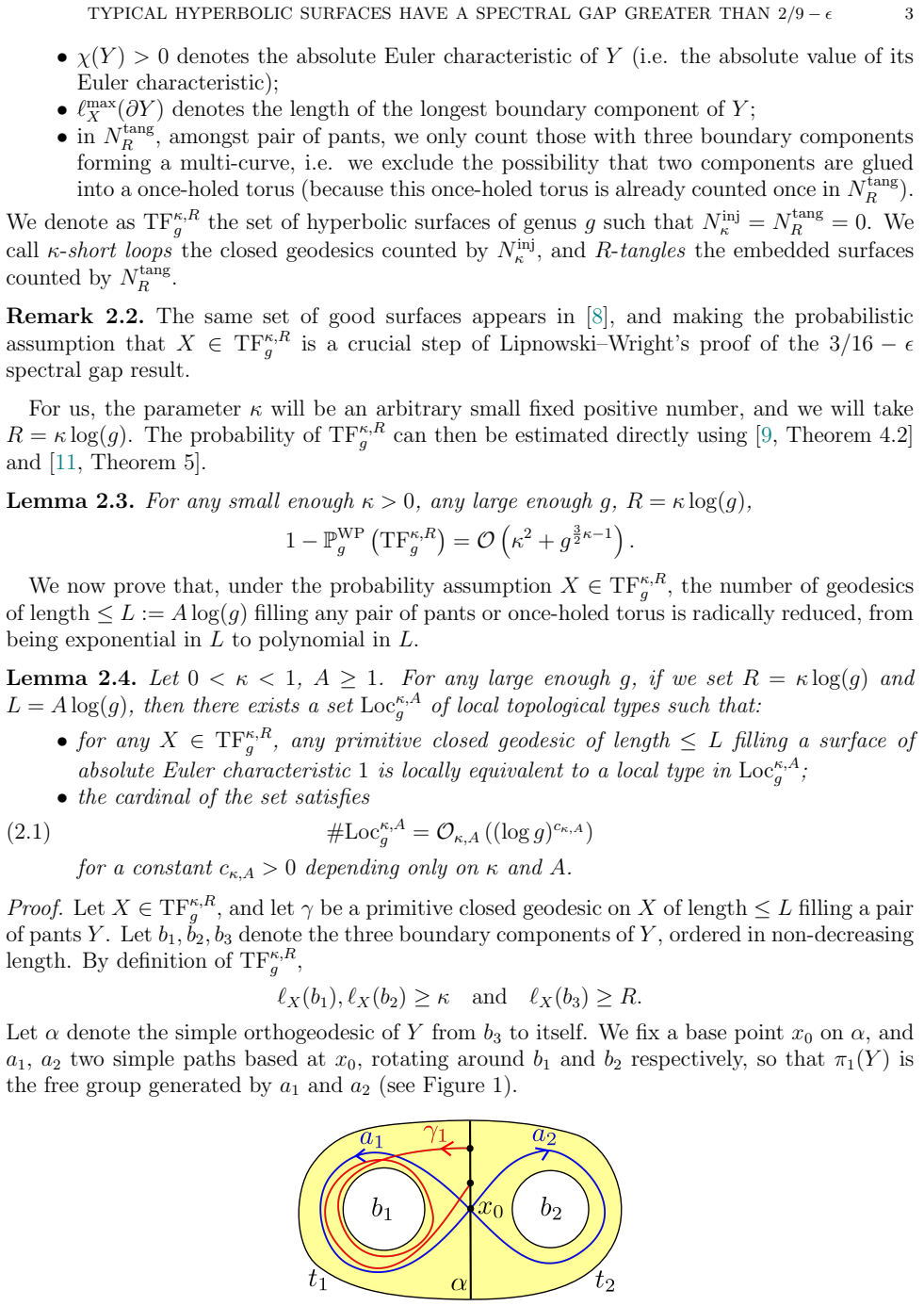
Typical hyperbolic surfaces have a spectral gap greater than 2/9 - ε

Weil-Petersson sampling shows most surfaces avoid tangles that would push the gap below this threshold, as an intermediate step toward 1/4 -

Figure from the paper full image
abstract click to expand
In this article, we prove that typical hyperbolic surfaces, sampled with the Weil-Petersson probability measure, have a spectral gap at least $2/9 - \epsilon$. This is an intermediate result on the way to our proof of the optimal spectral gap $1/4 - \epsilon$, building on the results of the first part of this series. A significant part of the proof is an explicit inclusion-exclusion argument to exclude tangles at the level of precision $1/g$.
0
0
math.SP 2026-04-09

Eigenvalue collisions allow exotic spectrum preservers

Eigenvalue collision and exotic preservers on semisimple operators

Normal matrices with connected spectra admit only conjugations, while semisimple and general matrices permit further forms fixed by the size

abstract click to expand
We classify $n\times n$-matrix-valued continuous commutativity and spectrum preservers defined on spaces of (a) normal, (b) semisimple and (c) arbitrary $n\times n$ matrices with spectra contained in sufficiently connected subsets $\mathcal{X}\subseteq \mathbb{C}$, generalizing a number of results due to \v{S}emrl, Gogi\'{c}, Toma\v{s}evi\'c and the author among others. In case (a) these are always conjugations or transpose conjugations, while in cases (b) and (c) qualitatively distinct possibilities arise depending on the local regularity of the complex-conjugation map close to coincident-eigenvalue loci of $\mathcal{X}^n$.
0
0
math.SP 2026-04-08 Recognition

Toda flow extended to unbounded sequences with power growth under 1

Toda flow with unbounded initial data

Eta-ensembles from random matrix theory serve as initial data that yield invariant measures.

abstract click to expand
A Toda flow is constructed starting from a certain class of unbounded initial conditions including sequences growing with power order of less than 1. Unbounded ergodic sequences are allowed, and especially \b{eta}-ensembles matrix models in random matrix theory can be an initial data and they yiled invariant measures for the flow.
0
0
math.SP 2026-04-06 1 theorem

Sharp Steklov bounds obtained for domains in dimension 7 and up

Geometric bounds for Steklov and weighted Neumann eigenvalues on Euclidean domains

The limits follow from the optimal domains and weights that maximize the first two weighted Neumann eigenvalues under volume-boundary normal

abstract click to expand
We obtain sharp upper bounds for the first two nonzero Steklov eigenvalues among bounded domains in Euclidean spaces of dimension $d \geq 7$ under a natural normalization involving volume and boundary measure. These bounds are derived from a characterization of optimal domains and weights for the first two nonzero weighted Neumann eigenvalues. In dimensions $3 \leq d \leq 6$, we obtain upper bounds that are not sharp. We further establish strict upper bounds for all higher Steklov eigenvalues on planar simply connected domains with continuous boundary, extending previous results which, beyond the second nonzero eigenvalue, were known only for smooth planar domains.
0
0
math.SP 2026-04-06 2 theorems

Doubling-map potentials localize Schrödinger operators almost everywhere

Anderson Localization for Schr\"{o}dinger Operators with Monotone Potentials Generated by the Doubling Map

Anderson localization holds for almost every phase at large coupling and, when the potential has zero mean, also at small coupling.

abstract click to expand
In this paper, we consider the Schr\"{o}dinger operators on $ \ell^{2}(\N) $, defined for all $ x\in\mathbb{T} $ by \begin{equation} (H(x)u)_n = u_{n+1} + u_{n-1} + \lambda f(2^{n} x) u_n, \quad \text{for } n \geq 0,\notag \end{equation} with the Dirichlet boundary condition $ u_{-1}=0 $. Building on Zhang's recent breakthrough work [Comm.Math.Phys.405:231(2024)] that resolved Damanik's open problem [Proc.Sympos. Pure Math.76,Amer.Math.Soc.(2007)] on the uniform positivity of the Lyapunov exponent, for the potential $ f \in C^{1}(0,1)$ with $ \|f\|_{C^{1}(0,1)} < C $ and $ \inf_{x \in (0,1)} |f^{\prime}(x)| > c>0 $, we obtain the large deviation estimate and prove that for a.e. $ x \in \mathbb{T} $ and sufficiently large $ \lambda > \lambda_{0} $, the operators $ H(x) $ display Anderson localization. Furthermore, if the potentials also have zero mean, our analysis reveals that the doubling map models can exhibit localization behavior for both small and large coupling constants $ \lambda $.
0
0
math.SP 2026-04-03 2 theorems

Weighted Dirac spectrum varies continuously with elliptic weight

Continuity of Weighted Dirac Spectra

The two-sided spectrum changes continuously under deformations that keep the weight bounded above and below by positive constants, with a ar

Figure from the paper full image
abstract click to expand
For the weighted Dirac eigenvalue problem, we show that the two-sided weighted spectrum depends continuously on the weight under continuous deformations within a uniformly elliptic class. Moreover, for differentiable families of weights we obtain a quantitative Lipschitz estimate for the full spectrum in the arsinh--metric, based on a weighted Hellmann--Feynman variational identity.
0

browse all of math.SP → full archive · search · sub-categories