Recognition: 2 theorem links
· Lean TheoremCylindrical cosmological simulations with StePS
Pith reviewed 2026-05-15 20:03 UTC · model grok-4.3
The pith
Cylindrical cosmological simulations adopt S¹×ℝ² topology to eliminate cubic periodic boundary artefacts for symmetric targets.
A machine-rendered reading of the paper's core claim, the machinery that carries it, and where it could break.
Core claim
By mapping comoving space via inverse stereographic projection onto a periodic cylinder and evolving particles under Newtonian dynamics with radially varying resolution, fully self-consistent simulations become possible in the S¹×ℝ² manifold, mitigating periodic-image artefacts for targets whose symmetries do not match a cubic box.
What carries the argument
Inverse stereographic projection along the radial direction of a periodic cylinder, which compactifies the infinite perpendicular directions while maintaining isotropic boundary conditions.
If this is right
- Cylindrical symmetries in large-scale structures such as filaments can be simulated without mismatch-induced biases.
- Anisotropic cosmological models become directly simulable in their native geometry.
- Large-scale statistics sensitive to long-range forces gain accuracy by removing three-torus artefacts.
- New analysis pipelines are needed to account for the radially dependent resolution in extracted statistics.
Where Pith is reading between the lines
- The method could be adapted to test other non-trivial topologies like those with toroidal or spherical boundaries.
- Varying resolution might enable efficient zoom simulations focused on central regions of interest.
- Direct comparison with cubic codes on identical initial conditions would quantify the reduction in boundary systematics for specific observables.
Load-bearing premise
A smoothly varying spatial and mass resolution with radius can suppress edge artefacts at the free outer boundary without introducing new systematic biases into cosmological statistics.
What would settle it
A direct comparison of the same initial conditions evolved in both the cylindrical StePS code and a standard periodic cubic code, checking for differences in the large-scale power spectrum or halo abundance at scales comparable to the box size.
Figures


read the original abstract
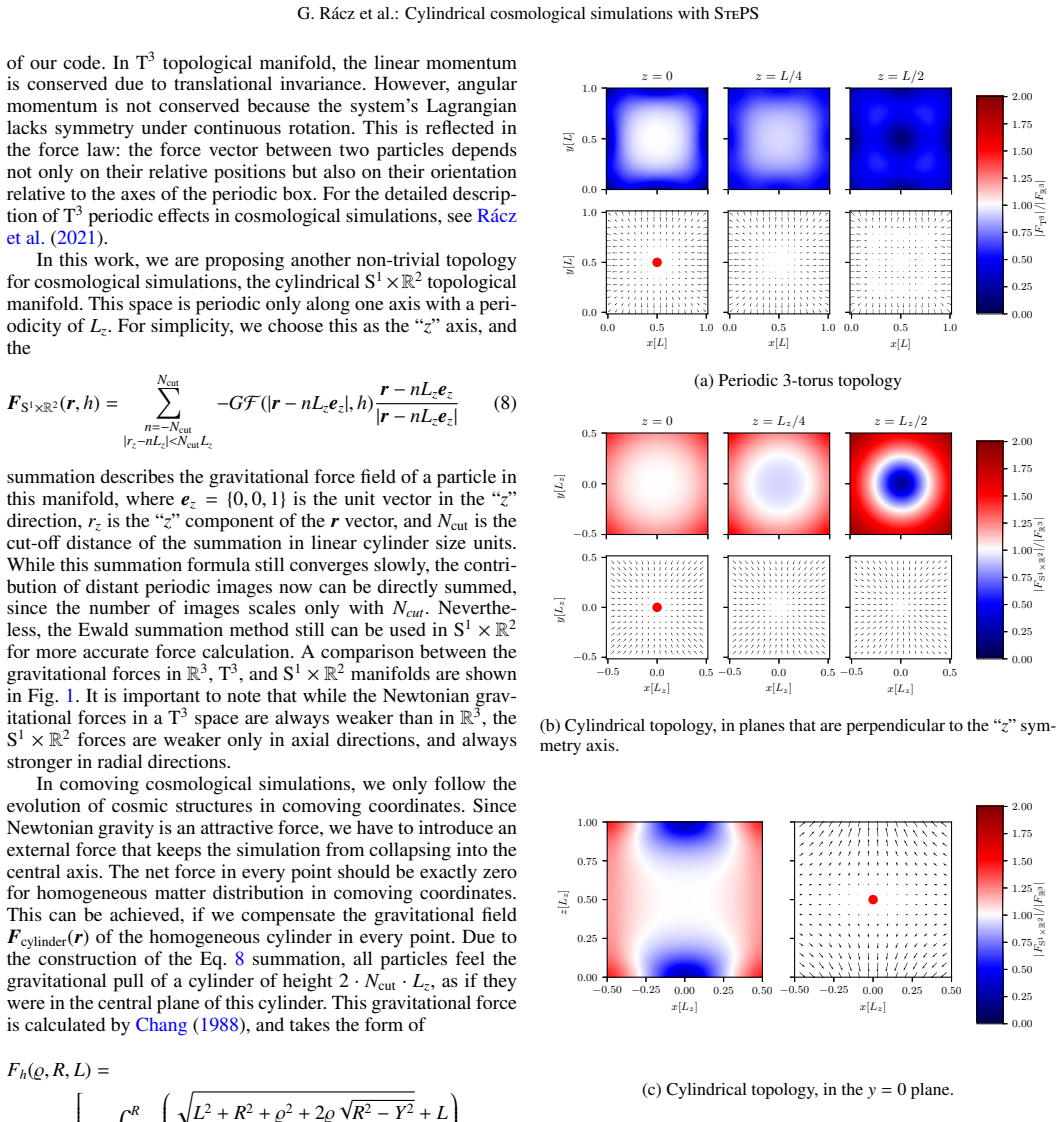
The global topology of the Universe can affect long-range gravitational forces via boundary conditions. Detailed studies of non-trivial topologies require simulations that natively adopt such geometries. Cosmological $N$-body simulations typically evolve matter in a periodic cubic box. While numerically convenient, this imposes a non-trivial three-torus topology that affects long-range gravitational forces, potentially biasing large-scale statistics. We introduce a compactified simulation framework that is only periodic along a single axis, characterised by an infinite topology with isotropic boundary conditions towards the perpendicular directions, namely, a $\mathrm{S}^1\times\mathbb{R}^2$ (slab) topology. This new simulation geometry is ideal for simulating systems with cylindrical symmetries such as filaments or certain anisotropic cosmological models. We compactified the comoving space via an inverse stereographic projection along the radial direction of a periodic cylinder. Then, we evolved the particles based on Newtonian dynamics. A smoothly varying spatial and mass resolution with radius suppresses edge artefacts at the free outer boundary. Our implementation in the StePS (STEreographically Projected cosmological Simulations) framework uses a direct force calculation that maps efficiently to GPUs, as well as an Octree force calculation for use on large CPU clusters. The cylindrical domain's topology enables fully self-consistent simulations to be run in the $\mathrm{S}^1\times\mathbb{R}^2$ manifold, while mitigating any periodic-image artefacts with respect to targets whose symmetries are mismatched to a cubic box. The main trade-off is a radially varying resolution with distinct systematics and analysis requirements. Finally, we demonstrate the accuracy of the new simulation method via a standard lambda cold dark matter cosmological simulation.
Editorial analysis
A structured set of objections, weighed in public.
Referee Report
Summary. The paper introduces StePS, a cosmological N-body simulation framework for the S¹×ℝ² (cylindrical slab) topology. It compactifies the infinite radial directions via inverse stereographic projection, evolves particles under Newtonian gravity, and uses radially varying spatial and mass resolution to suppress artefacts at the free outer boundary. Two force solvers are implemented (GPU direct summation and Octree), and the method is demonstrated on a standard ΛCDM run. The central claim is that this geometry enables self-consistent simulations of cylindrically symmetric systems while avoiding periodic-image artefacts inherent to cubic boxes.
Significance. If the central claim holds, the work would be significant for targeted studies of filaments, walls, and anisotropic cosmologies where cubic periodic boundaries introduce mismatched symmetries. The GPU-mapped direct force solver is a clear implementation strength. The radially adaptive resolution is a pragmatic engineering choice, but its impact on statistics must be quantified before the method can be adopted as a standard tool.
major comments (2)
- [Abstract] Abstract and demonstration section: the accuracy claim rests on a single ΛCDM run, yet no quantitative validation metrics (power-spectrum ratio, halo mass function, or correlation-function comparison to a matched periodic-box reference) are reported. Without these, it is impossible to confirm that the radially varying softening and particle masses do not introduce scale-dependent biases in the high-resolution core.
- [Method] Method description (projection and resolution): the statement that a smoothly varying spatial/mass resolution 'suppresses edge artefacts without introducing new systematic biases' is load-bearing for the central claim. Explicit tests are required showing that the position-dependent force law and sampling density do not distort the power spectrum or mode coupling relative to a uniform-resolution reference run in the same topology.
minor comments (2)
- Notation: define the precise mapping from cylindrical to stereographically projected coordinates (including the radial coordinate transformation) in an equation, rather than describing it only in prose.
- Figure clarity: ensure any resolution profile plot includes both the spatial softening length and the mass-resolution curve as functions of radius, with explicit units.
Simulated Author's Rebuttal
We thank the referee for their thoughtful and constructive report. The comments correctly identify areas where additional quantitative validation will strengthen the manuscript. We address each major comment below and will revise the paper to incorporate the requested tests and metrics.
read point-by-point responses
-
Referee: [Abstract] Abstract and demonstration section: the accuracy claim rests on a single ΛCDM run, yet no quantitative validation metrics (power-spectrum ratio, halo mass function, or correlation-function comparison to a matched periodic-box reference) are reported. Without these, it is impossible to confirm that the radially varying softening and particle masses do not introduce scale-dependent biases in the high-resolution core.
Authors: We agree that the current demonstration section would benefit from explicit quantitative comparisons. In the revised manuscript we will add power-spectrum ratios, halo mass function comparisons, and two-point correlation function measurements between the StePS run and a matched periodic-box reference simulation with identical initial conditions and cosmology. These metrics will be shown both globally and restricted to the high-resolution core to quantify any scale-dependent biases introduced by the radially varying softening and particle masses. revision: yes
-
Referee: [Method] Method description (projection and resolution): the statement that a smoothly varying spatial/mass resolution 'suppresses edge artefacts without introducing new systematic biases' is load-bearing for the central claim. Explicit tests are required showing that the position-dependent force law and sampling density do not distort the power spectrum or mode coupling relative to a uniform-resolution reference run in the same topology.
Authors: We acknowledge that the claim requires direct supporting evidence. We will add a dedicated subsection presenting side-by-side comparisons of the power spectrum and bispectrum (as a proxy for mode coupling) between the radially varying resolution run and an otherwise identical uniform-resolution simulation performed in the same S¹×ℝ² topology. These tests will isolate the effect of the position-dependent force law and sampling density. revision: yes
Circularity Check
No circularity in the cylindrical simulation derivation chain
full rationale
The paper presents a direct implementation of Newtonian dynamics on the S¹×ℝ² manifold via inverse stereographic projection for compactification of a periodic cylinder, with radially varying spatial and mass resolution introduced explicitly to suppress free-boundary artifacts. No equations, predictions, or central claims reduce by construction to fitted inputs, self-definitions, or load-bearing self-citations. The framework is described as a straightforward mapping of standard dynamics onto the new topology, with the demonstration consisting of a standard ΛCDM run rather than any renaming of known results or smuggling of ansatzes. The derivation remains independent and self-contained against external benchmarks.
Axiom & Free-Parameter Ledger
axioms (2)
- domain assumption Newtonian dynamics govern particle evolution in the simulation
- ad hoc to paper Inverse stereographic projection accurately compactifies the infinite directions of the cylinder
Lean theorems connected to this paper
-
IndisputableMonolith/Foundation/AlexanderDuality.leanalexander_duality_circle_linking unclear?
unclearRelation between the paper passage and the cited Recognition theorem.
We compactify comoving space via inverse stereographic projection along the radial direction of a periodic cylinder... FS1×R2 (r, h) summation... radially varying spatial and mass resolution with radius suppresses edge artefacts.
-
IndisputableMonolith/Foundation/RealityFromDistinction.leanreality_from_one_distinction unclear?
unclearRelation between the paper passage and the cited Recognition theorem.
The cylindrical domain's topology enables fully self-consistent simulations to be run in the S¹×ℝ² manifold... demonstrate the accuracy... via a standard lambda cold dark matter cosmological simulation.
What do these tags mean?
- matches
- The paper's claim is directly supported by a theorem in the formal canon.
- supports
- The theorem supports part of the paper's argument, but the paper may add assumptions or extra steps.
- extends
- The paper goes beyond the formal theorem; the theorem is a base layer rather than the whole result.
- uses
- The paper appears to rely on the theorem as machinery.
- contradicts
- The paper's claim conflicts with a theorem or certificate in the canon.
- unclear
- Pith found a possible connection, but the passage is too broad, indirect, or ambiguous to say the theorem truly supports the claim.
Forward citations
Cited by 1 Pith paper
-
STEPSIC: Initial condition generator for stereographic cosmological simulations
STEPSIC is an open-source code that produces first- and second-order LPT initial conditions for stereographic, cylindrical, and arbitrary-aspect-ratio cuboid domains, achieving sub-percent power spectrum accuracy agai...
Reference graph
Works this paper leans on
-
[1]
Aarseth, S. J., Gott, III, J. R., & Turner, E. L. 1979, ApJ, 228, 664
work page 1979
- [2]
-
[3]
Broadhurst, T. J., Ellis, R. S., Koo, D. C., & Szalay, A. S. 1990, Nature, 343, 726
work page 1990
-
[4]
Bryan, G. L. & Norman, M. L. 1998, ApJ, 495, 80
work page 1998
- [5]
-
[6]
Bullock, J. S., Dekel, A., Kolatt, T. S., et al. 2001, ApJ, 555, 240
work page 2001
-
[7]
Chang, H. Y . 1988, Classical and Quantum Gravity, 5, 507
work page 1988
-
[8]
Chevallier, M. & Polarski, D. 2001, International Journal of Modern Physics D, 10, 213
work page 2001
-
[9]
Cooley, J. W. & Tukey, J. W. 1965, Math. Comput., 19, 297
work page 1965
- [10]
-
[11]
1997, Nature, 385, 139 Euclid Collaboration, Castander, F
Einasto, J., Einasto, M., Gottlöber, S., et al. 1997, Nature, 385, 139 Euclid Collaboration, Castander, F. J., Fosalba, P ., et al. 2025, A&A, 697, A5
work page 1997
-
[12]
Ewald, P . P . 1921, Annalen der Physik, 369, 253
work page 1921
-
[13]
Feldman, H. A., Kaiser, N., & Peacock, J. A. 1994, ApJ, 426, 23
work page 1994
- [14]
-
[15]
Genel, S., V ogelsberger, M., Springel, V ., et al. 2014, MNRAS, 445, 175
work page 2014
- [16]
-
[17]
Hawkins, E., Maddox, S. J., & Merrifield, M. R. 2002, MNRAS, 336, L13
work page 2002
- [18]
-
[19]
Hockney, R. W. & Eastwood, J. W. 1988, Computer simulation using particles
work page 1988
- [20]
-
[21]
Klypin, A. A. & Shandarin, S. F. 1983, MNRAS, 204, 891
work page 1983
-
[22]
A., Trujillo-Gomez, S., & Primack, J
Klypin, A. A., Trujillo-Gomez, S., & Primack, J. 2011, ApJ, 740, 102
work page 2011
-
[23]
Lewis, A. & Challinor, A. 2011, CAMB: Code for Anisotropies in the Microwave
work page 2011
- [24]
-
[25]
Linder, E. V . 2003, Phys. Rev. Lett., 90, 091301
work page 2003
- [26]
-
[27]
J., Brieden, S., Tröster, T., & Heymans, C
Mead, A. J., Brieden, S., Tröster, T., & Heymans, C. 2021, MNRAS, 502, 1401
work page 2021
-
[28]
Monaghan, J. J. & Lattanzio, J. C. 1985, A&A, 149, 135
work page 1985
-
[29]
Peacock, J. A. 1999, Cosmological Physics (Cambridge University Press)
work page 1999
-
[30]
Peebles, P . J. E. 1970, AJ, 75, 13 Planck Collaboration, Ade, P . A. R., Aghanim, N., et al. 2016, A&A, 594, A18 Planck Collaboration, Aghanim, N., Akrami, Y ., et al. 2020, A&A, 641, A6
work page 1970
-
[31]
2017, Computational Astrophysics and Cos- mology, 4, 2
Potter, D., Stadel, J., & Teyssier, R. 2017, Computational Astrophysics and Cos- mology, 4, 2
work page 2017
-
[32]
Press, W. H. & Schechter, P . 1974, ApJ, 187, 425 Rácz, G., Szapudi, I., Csabai, I., & Dobos, L. 2018, MNRAS, 477, 1949 Rácz, G., Szapudi, I., Csabai, I., & Dobos, L. 2021, MNRAS, 503, 5638 Rácz, G., Szapudi, I., Dobos, L., Csabai, I., & Szalay, A. S. 2019, Astronomy and Computing, 28, 100303
work page 1974
-
[33]
Roukema, B. F. & Edge, A. C. 1997, MNRAS, 292, 105 Saffar Shamshirgar, D. & Tornberg, A.-K. 2017, Journal of Computational Physics, 347, 341
work page 1997
- [34]
-
[35]
Springel, V ., Pakmor, R., Zier, O., & Reinecke, M. 2022, GADGET-4: Paral- lel cosmological N-body and SPH code, Astrophysics Source Code Library, record ascl:2204.014
work page 2022
-
[36]
Springel, V ., White, S. D. M., Jenkins, A., et al. 2005, Nature, 435, 629
work page 2005
- [37]
-
[38]
2015, Advances in Computational Mathematics, 42, 227248 (2016)
Tornberg, A.-K. 2015, Advances in Computational Mathematics, 42, 227248 (2016)
work page 2015
-
[39]
Wechsler, R. H. & Tinker, J. L. 2018, ARA&A, 56, 435
work page 2018
- [40]
-
[41]
White, S. D. M. 1976, MNRAS, 177, 717
work page 1976
-
[42]
White, S. D. M. 1994, arXiv e-prints, astro
work page 1994
-
[43]
Zeldovich, Y . B. & Starobinskij, A. A. 1984, Pisma v Astronomicheskii Zhurnal, 10, 323 4 https://github.com/eltevo/StePS/ Article number, page 10 of 10
work page 1984
discussion (0)
Sign in with ORCID, Apple, or X to comment. Anyone can read and Pith papers without signing in.