Recognition: 2 theorem links
· Lean TheoremSTEPSIC: Initial condition generator for stereographic cosmological simulations
Pith reviewed 2026-05-12 05:16 UTC · model grok-4.3
The pith
STEPSIC generates initial conditions for stereographic and cylindrical cosmological volumes using extended Lagrangian perturbation theory.
A machine-rendered reading of the paper's core claim, the machinery that carries it, and where it could break.
Core claim
STEPSIC constructs Gaussian random density fields on anisotropy-free Fourier grids with cubic voxels, applies first- and second-order LPT to obtain displacement and velocity fields, interpolates these onto particles via B-spline mass-assignment kernels with Fourier-space deconvolution, and for stereographic geometries employs a multiresolution scheme to map displacement fields across the radially varying particle mass resolution. In periodic cubic boxes the recovered matter power spectrum agrees with the input linear theory prediction to better than 0.5% up to half the Nyquist wavenumber independent of box aspect ratio, and full N-body evolution of matched cylindrical StePS runs confirms the
What carries the argument
Multiresolution mapping scheme that transfers displacement fields across radially varying particle mass resolution in stereographic projections, combined with B-spline interpolation after LPT.
If this is right
- Power spectrum recovery matches linear theory to better than 0.5% up to half Nyquist wavenumber and holds independent of box aspect ratio up to 10:1.
- Second-order LPT suppresses the 2-3% transient power excess that appears when first-order initial conditions are evolved.
- Paired-and-fixed variance-reduced realizations are generated with the same accuracy as standard ones.
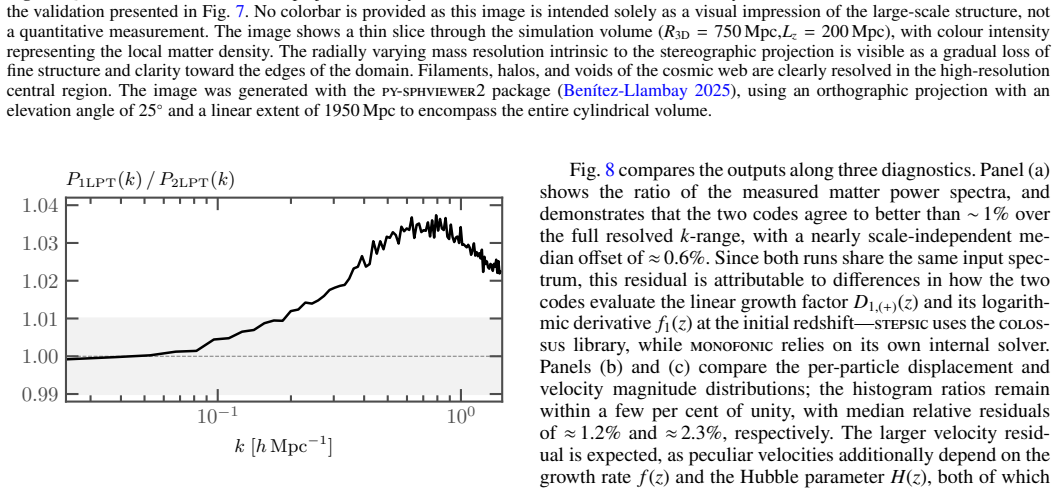
- Identical white-noise fields produce sub-percent power-spectrum agreement with independent generators such as monofonic.
Where Pith is reading between the lines
- This method opens the door to observer-centric simulations that avoid periodic boundary artifacts when studying large-scale structure around a chosen location.
- The same multiresolution approach could be tested in full spherical StePS volumes to verify performance beyond the periodic validation cases.
- Higher-order perturbation schemes or different mass-assignment kernels could be added to further reduce small-scale transients in non-cubic domains.
Load-bearing premise
The multiresolution scheme for mapping displacement fields across radially varying particle mass resolution in stereographic geometries introduces no significant artifacts or biases.
What would settle it
Compare the early-time power spectrum measured in an N-body run started from STEPSIC cylindrical initial conditions against the linear theory input and check whether any deviation exceeds 0.5% below half the Nyquist scale.
Figures



read the original abstract
Conventional cosmological initial condition generators are designed exclusively for fully periodic cubic domains and cannot produce the non-periodic, observer-centric configurations required by stereographically projected N-body codes such as StePS. We present STEPSIC, an open-source initial condition generator that extends Lagrangian perturbation theory-based initial conditions to the spherical and cylindrical geometries used by StePS, while also supporting cuboid domains with arbitrary aspect ratios. The code constructs Gaussian random density fields on anisotropy-free Fourier grids with cubic voxels, applies first- and second-order LPT to obtain displacement and velocity fields, and interpolates these onto particles via B-spline mass-assignment kernels with Fourier-space deconvolution. For stereographic geometries, a multiresolution scheme maps displacement fields across the radially varying particle mass resolution intrinsic to the projection. Both standard and paired-and-fixed variance-reduced realizations are supported. In periodic cubic boxes, the recovered matter power spectrum agrees with the input linear theory prediction to better than 0.5% up to half the Nyquist wavenumber, independent of box aspect ratio (tested up to 10:1). Cross-validation against monofonic using identical white noise fields yields sub-percent power spectrum agreement, with a small residual offset consistent with differences between two independent implementations. Full N-body evolution of matched cylindrical StePS runs confirms that second-order LPT correctly suppresses the 2-3% transient power excess present in first-order initial conditions.
Editorial analysis
A structured set of objections, weighed in public.
Referee Report
Summary. The manuscript introduces STEPSIC, an open-source initial condition generator extending Lagrangian perturbation theory (first- and second-order) to non-periodic stereographic and cylindrical geometries required by StePS N-body codes, while also supporting cuboid domains of arbitrary aspect ratio. It constructs Gaussian random fields on cubic-voxel Fourier grids, applies LPT, interpolates displacements/velocities via B-spline kernels with Fourier deconvolution, and uses a multiresolution scheme to handle radially varying particle masses in stereographic projections. Reported results include matter power spectrum recovery to better than 0.5% versus linear theory up to k_Nyq/2 in periodic cubic boxes (independent of aspect ratio up to 10:1), sub-percent agreement with monofonic on identical white-noise fields, and N-body confirmation that 2LPT suppresses the 2-3% transient excess seen in 1LPT for cylindrical StePS runs. Both standard and paired-and-fixed realizations are supported.
Significance. If the multiresolution mapping performs as intended, STEPSIC would provide a needed capability for accurate initial conditions in observer-centric stereographic simulations, which are otherwise unsupported by standard cubic periodic generators. The cubic-box power-spectrum recovery and monofonic cross-check supply quantitative evidence of correctness for periodic cases, while the cylindrical N-body test directly demonstrates the benefit of 2LPT for transient control. These elements strengthen the paper's contribution for the supported geometries.
major comments (1)
- [Abstract and validation results] The multiresolution displacement-mapping scheme for stereographic geometries (described in the abstract as mapping LPT fields across radially varying particle mass resolution) is central to the code's purpose yet receives no direct validation. All quantitative tests (power-spectrum recovery to <0.5%, monofonic comparison, and cylindrical N-body evolution) are performed on periodic cubic or uniform-resolution cylindrical domains and therefore do not exercise the radial shell transitions or B-spline interpolation across resolution boundaries. Any mismatch in deconvolution or mass assignment at these interfaces could introduce localized density biases or spurious power that would not appear in the reported tests.
Simulated Author's Rebuttal
We thank the referee for their careful reading of the manuscript and for the constructive comment on validation. We address the major comment below and agree that strengthening the validation for the multiresolution scheme is warranted. The revised manuscript will incorporate additional tests.
read point-by-point responses
-
Referee: [Abstract and validation results] The multiresolution displacement-mapping scheme for stereographic geometries (described in the abstract as mapping LPT fields across radially varying particle mass resolution) is central to the code's purpose yet receives no direct validation. All quantitative tests (power-spectrum recovery to <0.5%, monofonic comparison, and cylindrical N-body evolution) are performed on periodic cubic or uniform-resolution cylindrical domains and therefore do not exercise the radial shell transitions or B-spline interpolation across resolution boundaries. Any mismatch in deconvolution or mass assignment at these interfaces could introduce localized density biases or spurious power that would not appear in the reported tests.
Authors: We agree with the referee that the quantitative tests reported in the manuscript are performed on periodic cubic boxes and uniform-resolution cylindrical domains, which do not directly exercise the radial resolution transitions in the stereographic multiresolution scheme. The core B-spline interpolation with Fourier deconvolution is validated through the power-spectrum recovery and monofonic cross-check in uniform cases, and the multiresolution mapping applies the same kernels across shells. However, we acknowledge that explicit checks for interface consistency (e.g., density continuity or absence of spurious power at shell boundaries) are not presented. We will revise the manuscript to include a dedicated validation subsection for stereographic geometries. This will consist of (i) generating matched initial conditions in a stereographic domain and a high-resolution equivalent uniform grid, (ii) measuring the matter power spectrum in thin radial shells to verify sub-percent agreement with linear theory across transitions, and (iii) confirming that mass assignment and deconvolution remain consistent at resolution boundaries. These additions will be placed in Section 4 or a new appendix, with corresponding updates to the abstract and conclusions if needed. revision: yes
Circularity Check
No circularity: validations use external linear theory and independent code cross-checks
full rationale
The paper extends standard LPT IC generation to stereographic/cylindrical geometries via explicit B-spline interpolation and a multiresolution displacement mapping. All reported results compare the generated fields to external linear theory power spectra or to monofonic outputs on shared white noise; the N-body test confirms the known 2LPT transient suppression. No equation or claim reduces by construction to a fitted parameter, self-citation, or renamed input. The multiresolution scheme is described procedurally without any self-referential validation loop.
Axiom & Free-Parameter Ledger
axioms (2)
- domain assumption Initial density fluctuations form a Gaussian random field drawn from linear theory power spectrum
- domain assumption Lagrangian perturbation theory at first and second order provides accurate displacements and velocities at early times
Lean theorems connected to this paper
-
IndisputableMonolith/Foundation/AlexanderDuality.leanalexander_duality_circle_linking unclear?
unclearRelation between the paper passage and the cited Recognition theorem.
The code constructs Gaussian random density fields on anisotropy-free Fourier grids with cubic voxels, applies first- and second-order LPT... For stereographic geometries, a multiresolution scheme maps displacement fields across the radially varying particle mass resolution
-
IndisputableMonolith/Cost/FunctionalEquation.leanwashburn_uniqueness_aczel unclear?
unclearRelation between the paper passage and the cited Recognition theorem.
In periodic cubic boxes, the recovered matter power spectrum agrees with the input linear theory prediction to better than 0.5% up to half the Nyquist wavenumber
What do these tags mean?
- matches
- The paper's claim is directly supported by a theorem in the formal canon.
- supports
- The theorem supports part of the paper's argument, but the paper may add assumptions or extra steps.
- extends
- The paper goes beyond the formal theorem; the theorem is a base layer rather than the whole result.
- uses
- The paper appears to rely on the theorem as machinery.
- contradicts
- The paper's claim conflicts with a theorem or certificate in the canon.
- unclear
- Pith found a possible connection, but the passage is too broad, indirect, or ambiguous to say the theorem truly supports the claim.
Reference graph
Works this paper leans on
-
[1]
Angulo, R. E. & Pontzen, A. 2016, MNRAS, 462, L1
work page 2016
-
[2]
Bagla, J. S. & Padmanabhan, T. 1997, Pramana, 49, 161 Benítez-Llambay, A. 2025, Research Notes of the AAS, 9, 122
work page 1997
-
[3]
Bernardeau, F., Colombi, S., Gaztañaga, E., & Scoccimarro, R. 2002, Phys. Rep., 367, 1
work page 2002
-
[4]
R., Colombi, S., Hivon, E., & Juszkiewicz, R
Bouchet, F. R., Colombi, S., Hivon, E., & Juszkiewicz, R. 1995, A&A, 296, 575
work page 1995
-
[5]
Bouchet, F. R. & Hernquist, L. 1992, ApJ, 400, 25
work page 1992
-
[6]
Crocce, M., Pueblas, S., & Scoccimarro, R. 2006, MNRAS, 373, 369
work page 2006
-
[7]
Davis, M., Efstathiou, G., Frenk, C. S., & White, S. D. M. 1985, Astrophysical Journal, 292, 371
work page 1985
- [8]
-
[9]
Eisenstein, D. J. & Hu, W. 1998, ApJ, 496, 605 Euclid Collaboration, Castander, F. J., Fosalba, P., et al. 2025, A&A, 697, A5
work page 1998
- [10]
-
[11]
Hahn, O., List, F., & Porqueres, N. 2024, J. Cosmology Astropart. Phys., 2024, 063
work page 2024
- [12]
-
[13]
Hockney, R. W. & Eastwood, J. W. 1988, Computer simulation using particles (Bristol and Philadelphia: Institute of Physics Publishing)
work page 1988
-
[14]
Jing, Y . P. 2005, ApJ, 620, 559
work page 2005
- [15]
- [16]
- [17]
-
[18]
2017, arXiv e-prints, arXiv:1709.04703
Llinares, C. 2017, arXiv e-prints, arXiv:1709.04703
-
[19]
Michaux, M., Hahn, O., Rampf, C., & Angulo, R. E. 2021, MNRAS, 500, 663
work page 2021
-
[20]
Moutarde, F., Alimi, J.-M., Bouchet, F. R., Pellat, R., & Ramani, A. 1991, ApJ, 382, 377
work page 1991
-
[21]
Peebles, P. J. E. 1980, The large-scale structure of the universe (Princeton, NJ: Princeton University Press)
work page 1980
-
[22]
Pontzen, A., Slosar, A., Roth, N., & Peiris, H. V . 2016, Phys. Rev. D, 93, 103519
work page 2016
-
[23]
Press, W. H., Teukolsky, S. A., Vetterling, W. T., & Flannery, B. P. 2007, Nu- merical Recipes: The Art of Scientific Computing, 3rd edn. (Cambridge, UK: Cambridge University Press) Rácz, G., Szapudi, I., Csabai, I., & Dobos, L. 2018, Monthly Notices of the Royal Astronomical Society, 477, 1949 Rácz, G., Szapudi, I., Csabai, I., & Dobos, L. 2021, MNRAS, 5...
work page internal anchor Pith review arXiv 2007
-
[24]
Springel, V ., White, S. D. M., Jenkins, A., et al. 2005, Nature, 435, 629
work page 2005
- [25]
- [26]
discussion (0)
Sign in with ORCID, Apple, or X to comment. Anyone can read and Pith papers without signing in.