Recognition: no theorem link
Granular aluminum induced superconductivity in germanium for hole spin-based hybrid devices
Pith reviewed 2026-05-15 19:37 UTC · model grok-4.3
The pith
Depositing granular aluminum on germanium heterostructures induces a hard superconducting gap resilient to magnetic fields in all directions.
A machine-rendered reading of the paper's core claim, the machinery that carries it, and where it could break.
Core claim
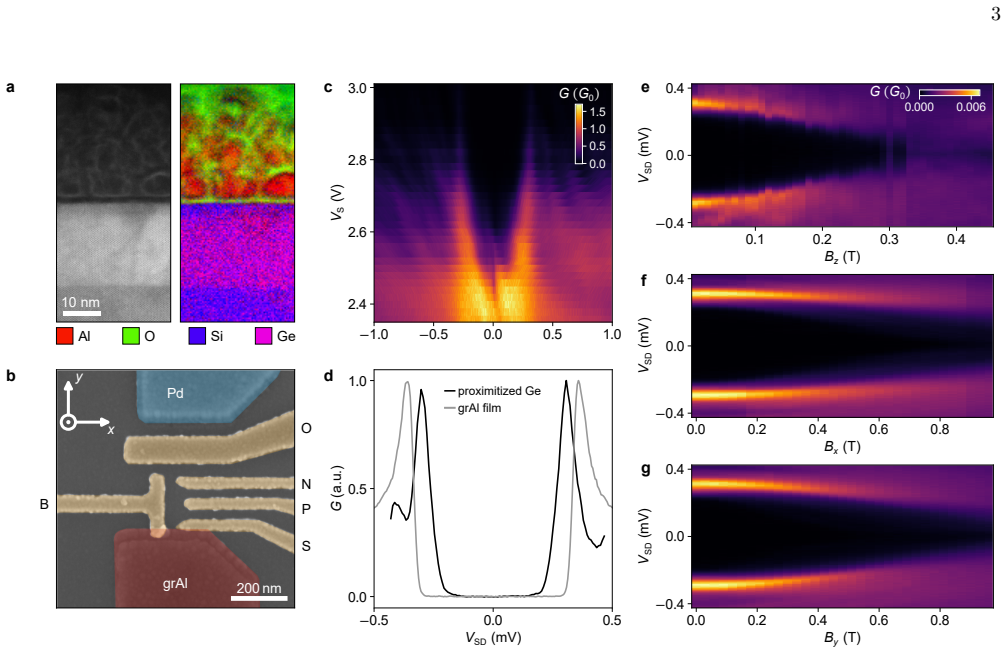
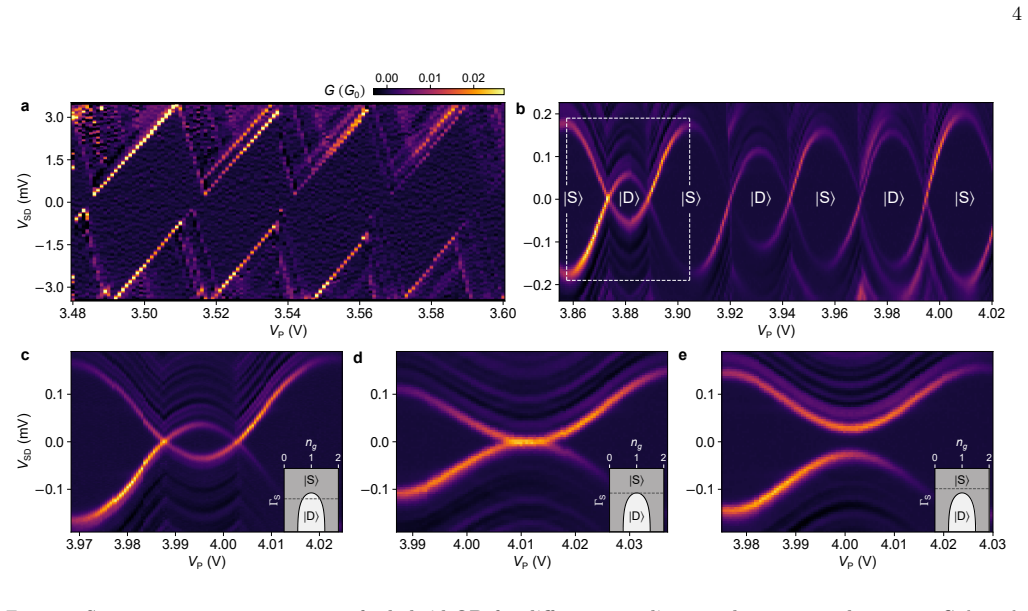
Granular aluminum films deposited on Ge/SiGe heterostructures induce a hard superconducting gap characterized by BCS coherence peaks at 305 μeV. The gap exhibits magnetic field resilience in both in-plane and out-of-plane orientations, enabling Zeeman splitting of Yu-Shiba-Rusinov states exceeding 50 μeV corresponding to 12 GHz. This allows observation of hole physics signatures and demonstration of g-tensor tunability in the hybrid structure.
What carries the argument
The granular aluminum film, consisting of aluminum nanograins in an oxide matrix, serves as the source of induced superconductivity via the proximity effect in the germanium channel.
If this is right
- Zeeman splitting of YSR states reaches beyond 50 μeV
- Signatures of hole physics become observable in the superconducting state
- The g-tensor can be tuned in these hybrid devices
- Magnetic field resilience supports both in-plane and out-of-plane field applications
Where Pith is reading between the lines
- This approach may facilitate the development of Andreev spin qubits using hole carriers in germanium
- The method could be applied to other low-dimensional semiconductor systems to achieve similar field-resilient hybrids
- Potential for exploring topological states like Majorana zero modes in germanium-based platforms
Load-bearing premise
The induced hard gap and the observed YSR state splitting must arise from proximity-induced superconductivity within the germanium layer itself.
What would settle it
Direct measurement of the density of states in the germanium channel showing no superconducting gap when the granular aluminum is not in contact would falsify the claim of induced superconductivity.
Figures


read the original abstract
In superconductor-semiconductor hybrid structures, superconductivity and spin polarization are competing effects because magnetic fields break Cooper pairs. They can be combined using thin films and in-plane magnetic fields, an approach that enabled the pursuit of Majorana zero modes, Kitaev chains, and Andreev spin qubits (ASQs), but remains challenging for materials with small in-plane g-factors. Here we show that granular aluminum (grAl), composed of nanometer-scale aluminum grains embedded in an amorphous oxide matrix, can overcome this limitation. By depositing grAl on Ge/SiGe heterostructures, we induce a hard superconducting gap with BCS peaks at 305 $\mu$eV and magnetic-field resilience for both the in-plane and out-of-plane directions, allowing Zeeman splitting of Yu-Shiba-Rusinov (YSR) states beyond 50 $\mu$eV (12 GHz). Leveraging this robustness, we reveal signatures of hole physics and demonstrate g-tensor tunability.
Editorial analysis
A structured set of objections, weighed in public.
Referee Report
Summary. The manuscript reports that depositing granular aluminum (grAl) on Ge/SiGe heterostructures induces a hard superconducting gap in the germanium 2D hole gas, with BCS coherence peaks at 305 μeV. The induced superconductivity shows resilience to magnetic fields applied both in-plane and out-of-plane, enabling Zeeman splitting of Yu-Shiba-Rusinov (YSR) states exceeding 50 μeV (12 GHz). This platform is used to reveal signatures of hole physics and demonstrate g-tensor tunability for hole spin-based hybrid devices.
Significance. If the location of the induced gap in the Ge channel is confirmed, the work would provide a valuable route to combine robust superconductivity with spin physics in germanium hole systems, which are attractive for spin qubits due to their strong spin-orbit interaction. The reported field resilience in both orientations addresses a key materials challenge for hybrid devices and could enable new experiments on Andreev spin qubits or related structures.
major comments (2)
- [Abstract and tunneling spectroscopy results] Abstract and results on tunneling spectroscopy: the claim that the hard gap (BCS peaks at 305 μeV) and YSR splitting (>50 μeV) occur inside the Ge/SiGe 2D hole gas rather than in the grAl film or at the interface is not supported by differential control measurements. Spectra from grAl on bare SiGe or insulating substrates are needed to rule out intrinsic grAl superconductivity as the origin.
- [Magnetic-field dependence] Magnetic-field dependence section: while resilience to both in-plane and out-of-plane fields is reported, the manuscript does not quantify the critical field values or provide direct comparison to standalone grAl films, leaving the induction mechanism and its attribution to the Ge channel ambiguous.
minor comments (2)
- [Abstract and figures] The abstract states numerical values (305 μeV gap, >50 μeV splitting) without accompanying error bars or fitting details; these should be added to the main text and figures for clarity.
- [Discussion of g-tensor tunability] Notation for the g-tensor components and YSR state energies should be defined consistently when first introduced.
Simulated Author's Rebuttal
We thank the referee for the constructive and positive review of our manuscript. We address each major comment point by point below and have revised the manuscript to incorporate the suggested clarifications and additional data.
read point-by-point responses
-
Referee: [Abstract and tunneling spectroscopy results] Abstract and results on tunneling spectroscopy: the claim that the hard gap (BCS peaks at 305 μeV) and YSR splitting (>50 μeV) occur inside the Ge/SiGe 2D hole gas rather than in the grAl film or at the interface is not supported by differential control measurements. Spectra from grAl on bare SiGe or insulating substrates are needed to rule out intrinsic grAl superconductivity as the origin.
Authors: We appreciate the referee's emphasis on the need for control measurements to confirm the location of the induced gap. In the revised manuscript, we have added differential conductance spectra from grAl deposited on bare SiGe substrates (lacking the 2D hole gas) and on insulating substrates. These controls show either absent or significantly softer gaps compared to the Ge/SiGe devices, supporting that the hard gap at 305 μeV arises from proximity induction in the 2D hole gas rather than intrinsic grAl superconductivity. We have updated the abstract and tunneling spectroscopy results section to explicitly reference these controls and clarify the attribution. revision: yes
-
Referee: [Magnetic-field dependence] Magnetic-field dependence section: while resilience to both in-plane and out-of-plane fields is reported, the manuscript does not quantify the critical field values or provide direct comparison to standalone grAl films, leaving the induction mechanism and its attribution to the Ge channel ambiguous.
Authors: We agree that quantifying critical fields and including direct comparisons to standalone grAl films would strengthen the attribution. In the revision, we have extracted and reported the critical magnetic field values for both in-plane and out-of-plane orientations from the field-dependent data. We have also added comparative measurements on standalone grAl films, which exhibit lower critical fields than the hybrid devices. This enhancement is consistent with the proximity-induced superconductivity in the Ge 2D hole gas and helps resolve the induction mechanism. The magnetic-field dependence section has been updated accordingly. revision: yes
Circularity Check
No circularity: direct experimental measurements with no derivations or self-referential reductions
full rationale
The manuscript is a pure experimental report describing deposition of granular aluminum on Ge/SiGe heterostructures and subsequent tunneling spectroscopy measurements. No equations, ansatzes, fitted parameters, or predictive derivations appear in the provided text. Reported quantities (BCS gap of 305 μeV, YSR splitting >50 μeV, g-tensor tunability) are presented as raw observables rather than outputs of any model that could reduce to its own inputs. The location of the induced gap (Ge channel vs. grAl vs. interface) is an interpretive claim resting on the experimental design, not on any self-definitional loop or self-citation chain. No load-bearing steps match any of the enumerated circularity patterns; the work is self-contained against external benchmarks of device fabrication and spectroscopy.
Axiom & Free-Parameter Ledger
Forward citations
Cited by 2 Pith papers
-
Strain engineering of Andreev spin qubits in Germanium
Compressive strain suppresses spin splitting in germanium Josephson junctions while tensile or unstrained heterostructures enable GHz-scale splittings for Andreev spin qubits via enhanced spin-orbit effects.
-
Tailoring Germanium Heterostructures for Quantum Devices with Machine Learning
Localized strained silicon spikes in unstrained Ge channels, optimized via multi-objective Bayesian optimization, enhance spin-orbit interaction by up to three orders of magnitude and improve quantum-dot spin qubit qu...
Reference graph
Works this paper leans on
-
[1]
for|VSD|<180µeV. Upon applying magnetic field, we measure conductance below6×10−5G0 (noise level) at zero bias up to 160 mT in the out-of-plane direction and 800 mT in-plane (Fig. 1e-g) for a 500 nm wide and 20 nm thick grAl contact. Similar results have been obtained in multiple devices, with contacts up to 3µm wide. More details and extended tunneling s...
-
[2]
G. Burkard, T. D. Ladd, A. Pan, J. M. Nichol, and J. R. Petta, Semiconductor spin qubits, Rev. Mod. Phys.95, 025003 (2023)
work page 2023
-
[3]
G. Scappucci, C. Kloeffel, F. A. Zwanenburg, D. Loss, M. Myronov, J.-J. Zhang, S. De Franceschi, G. Katsaros, and M. Veldhorst, The germanium quantum information route, Nature Reviews Materials6, 926 (2021)
work page 2021
-
[4]
T. Dvir, G. Wang, N. van Loo, C.-X. Liu, G. P. Mazur, A. Bordin, S. L. Ten Haaf, J.-Y. Wang, D. van Driel, F. Zatelli,et al., Realization of a minimal kitaev chain in coupled quantum dots, Nature614, 445 (2023)
work page 2023
-
[5]
S. L. Ten Haaf, Q. Wang, A. M. Bozkurt, C.-X. Liu, I. Kulesh, P. Kim, D. Xiao, C. Thomas, M. J. Man- fra, T. Dvir,et al., A two-site kitaev chain in a two- dimensional electron gas, Nature630, 329 (2024)
work page 2024
-
[6]
L.Hofstetter, S.Csonka, J.Nygård,andC.Schönenberger, Cooper pair splitter realized in a two-quantum-dot y- junction, Nature461, 960 (2009). 8
work page 2009
-
[7]
L. G. Herrmann, F. Portier, P. Roche, A. L. Yeyati, T. Kontos, and C. Strunk, Carbon nanotubes as cooper- pair beam splitters, Phys. Rev. Lett.104, 026801 (2010)
work page 2010
-
[8]
A. Bordoloi, V. Zannier, L. Sorba, C. Schönenberger, and A. Baumgartner, Spin cross-correlation experiments in an electron entangler, Nature612, 454 (2022)
work page 2022
-
[9]
G. Wang, T. Dvir, G. P. Mazur, C.-X. Liu, N. van Loo, S. L. Ten Haaf, A. Bordin, S. Gazibegovic, G. Badawy, E. P. Bakkers,et al., Singlet and triplet cooper pair split- ting in hybrid superconducting nanowires, Nature612, 448 (2022)
work page 2022
-
[10]
Q. Wang, S. L. Ten Haaf, I. Kulesh, D. Xiao, C. Thomas, M. J. Manfra, and S. Goswami, Triplet correlations in cooper pair splitters realized in a two-dimensional electron gas, Nature Communications14, 4876 (2023)
work page 2023
-
[11]
M. Hays, V. Fatemi, D. Bouman, J. Cerrillo, S. Diamond, K. Serniak, T. Connolly, P. Krogstrup, J. Nygård, A. L. Yeyati, A. Geresdi, and M. H. Devoret, Coherent ma- nipulation of an andreev spin qubit, Science373, 430 (2021)
work page 2021
-
[12]
M. Pita-Vidal, A. Bargerbos, R. Žitko, L. J. Splitthoff, L. Grünhaupt, J. J. Wesdorp, Y. Liu, L. P. Kouwenhoven, R. Aguado, B. van Heck,et al., Direct manipulation of a superconducting spin qubit strongly coupled to a transmon qubit, Nature Physics19, 1110 (2023)
work page 2023
-
[13]
S. Hoffman and C. Tahan, Resolving andreev spin qubits in germanium-based josephson junctions (2025), arXiv:2506.13988 [cond-mat.mes-hall]
-
[14]
W. M. van Huffelen, M. J. de Boer, and T. M. Klap- wijk, Ultrathin silicon membranes to study supercurrent transport in crystalline semiconductors, Applied Physics Letters58, 2438 (1991)
work page 1991
-
[15]
E. Bustarret, C. Marcenat, P. Achatz, J. Kačmarčik, F. Lévy, A. Huxley, L. Ortéga, E. Bourgeois, X. Blase, D. Débarre,et al., Superconductivity in doped cubic silicon, Nature444, 465 (2006)
work page 2006
-
[16]
F. Chiodi, J.-E. Duvauchelle, C. Marcenat, D. Débarre, and F. Lefloch, Proximity-induced superconductivity in all-silicon superconductor/normal-metal junctions, Physi- cal Review B96, 024503 (2017)
work page 2017
-
[17]
J. A. Steele, P. J. Strohbeen, C. Verdi, A. Baktash, A. Danilenko, Y.-H. Chen, J. van Dijk, F. H. Knudsen, A. Leblanc, D. Perconte, L. Wang, E. Demler, S. Salmani- Rezaie, P. Jacobson, and J. Shabani, Superconductivity in substitutional ga-hyperdoped ge epitaxial thin films, Nature Nanotechnology20, 1757 (2025)
work page 2025
-
[18]
M. Pita-Vidal, R. S. Souto, S. Goswami, C. K. An- dersen, G. Katsaros, J. Shabani, and R. Aguado, Novel qubits in hybrid semiconductor-superconductor nanostructures, arXiv preprint arXiv:2512.23336 https://doi.org/10.48550/arXiv.2512.23336 (2025), arXiv:2512.23336 [cond-mat.mes-hall]
-
[19]
C. Adelsberger, H. F. Legg, D. Loss, and J. Klinovaja, Mi- croscopic analysis of proximity-induced superconductivity and metallization effects in superconductor-germanium hole nanowires, Physical Review B108, 155433 (2023)
work page 2023
-
[20]
D. M. Pino, R. S. Souto, M. J. Calderón, R. Aguado, and J. C. Abadillo-Uriel, Theory of superconducting proximity effect in hole-based hybrid semiconductor-superconductor devices, Physical Review B111, 235443 (2025)
work page 2025
-
[21]
S. S. Babkin, B. Joecker, K. Flensberg, M. Serbyn, and J. Danon, Superconducting proximity effect in two- dimensional hole gases, Physical Review B111, 214518 (2025)
work page 2025
- [22]
-
[23]
G. Katsaros, P. Spathis, M. Stoffel, F. Fournel, M. Mongillo, V. Bouchiat, F. Lefloch, A. Rastelli, O. G. Schmidt, and S. De Franceschi, Hybrid superconductor– semiconductor devices made from self-assembled sige nanocrystals on silicon, Nature nanotechnology5, 458 (2010)
work page 2010
-
[24]
F. K. De Vries, J. Shen, R. J. Skolasinski, M. P. Nowak, D. Varjas, L. Wang, M. Wimmer, J. Ridderbos, F. A. Zwanenburg, A. Li,et al., Spin–orbit interaction and induced superconductivity in a one-dimensional hole gas, Nano letters18, 6483 (2018)
work page 2018
-
[25]
F. Vigneau, R. Mizokuchi, D. C. Zanuz, X. Huang, S. Tan, R. Maurand, S. Frolov, A. Sammak, G. Scappucci, F. Lefloch,et al., Germanium quantum-well josephson field-effect transistors and interferometers, Nano letters 19, 1023 (2019)
work page 2019
-
[26]
J. Ridderbos, M. Brauns, J. Shen, F. K. de Vries, A. Li, E. P. A. M. Bakkers, A. Brinkman, and F. A. Zwanenburg, Josephson effect in a few-hole quantum dot, Advanced Materials30, 1802257 (2018)
work page 2018
-
[27]
K. Aggarwal, A. Hofmann, D. Jirovec, I. Prieto, A. Sam- mak, M. Botifoll, S. Martí-Sánchez, M. Veldhorst, J. Ar- biol, G. Scappucci,et al., Enhancement of proximity- induced superconductivity in a planar ge hole gas, Physi- cal Review Research3, L022005 (2021)
work page 2021
-
[28]
N. Hendrickx, D. Franke, A. Sammak, M. Kouwenhoven, D. Sabbagh, L. Yeoh, R. Li, M. Tagliaferri, M. Virgilio, G. Capellini,et al., Gate-controlled quantum dots and superconductivity in planar germanium, Nature commu- nications9, 2835 (2018)
work page 2018
- [29]
-
[30]
M.Valentini, O.Sagi, L.Baghumyan, T.deGijsel, J.Jung, S. Calcaterra, A. Ballabio, J. Aguilera Servin, K. Ag- garwal, M. Janik,et al., Parity-conserving cooper-pair transport and ideal superconducting diode in planar ger- manium, Nature Communications15, 169 (2024)
work page 2024
-
[31]
A. Leblanc, C. Tangchingchai, Z. Sadre Momtaz, E. Kiy- ooka, J.-M. Hartmann, F. Gustavo, J.-L. Thomassin, B.Brun, V.Schmitt, S.Zihlmann, R.Maurand, É.Dumur, S. De Franceschi, and F. Lefloch, Gate- and flux-tunable sin(2ϕ) josephson element with planar-ge junctions, Na- ture Communications16, 1010 (2025)
work page 2025
-
[32]
D. Jirovec, P. M. Mutter, A. Hofmann, A. Crippa, M. Rychetsky, D. L. Craig, J. Kukucka, F. Martins, A. Ballabio, N. Ares,et al., Dynamics of hole singlet- triplet qubits with large g-factor differences, Physical review letters128, 126803 (2022)
work page 2022
-
[33]
N. Hendrickx, L. Massai, M. Mergenthaler, F. J. Schupp, S. Paredes, S. Bedell, G. Salis, and A. Fuhrer, Sweet-spot operation of a germanium hole spin qubit with highly anisotropic noise sensitivity, Nature Materials23, 920 (2024)
work page 2024
-
[34]
I. Seidler, B. Hetényi, L. Sommer, L. Massai, K. Tsoukalas, E. G. Kelly, A. Orekhov, M. Aldeghi, S. W. Bedell, S. Paredes,et al., Spatial unifor- mity of g-tensor and spin-orbit interaction in germa- nium hole spin qubits, arXiv preprint arXiv:2510.03125 https://doi.org/10.48550/arXiv.2510.03125 (2025). 9
-
[35]
A. J. Miller, W. J. Hardy, D. R. Luhman, M. Brickson, A. Baczewski, C.-Y. Liu, J.-Y. Li, M. P. Lilly, and T.- M. Lu, Effective out-of-planeg factor in strained-ge/sige quantum dots, Phys. Rev. B106, L121402 (2022)
work page 2022
-
[36]
W. Lawrie,Spin Qubits in Silicon and Germanium, Dis- sertation (tu delft), Delft University of Technology (2022)
work page 2022
-
[37]
J. Saez-Mollejo, D. Jirovec, Y. Schell, J. Kukucka, S. Calcaterra, D. Chrastina, G. Isella, M. Rimbach-Russ, S. Bosco, and G. Katsaros, Exchange anisotropies in microwave-driven singlet-triplet qubits, Nature Commu- nications16, 3862 (2025)
work page 2025
- [38]
-
[39]
R.W.CohenandB.Abeles,Superconductivityingranular aluminum films, Physical Review168, 444 (1968)
work page 1968
-
[40]
G. Deutscher, H. Fenichel, M. Gershenson, E. Grünbaum, and Z. Ovadyahu, Transition to zero dimensionality in granular aluminum superconducting films, Journal of Low Temperature Physics10, 231 (1973)
work page 1973
-
[41]
F. Levy-Bertrand, T. Klein, T. Grenet, O. Dupré, A. Benoît, A. Bideaud, O. Bourrion, M. Calvo, A. Cata- lano, A. Gomez, J. Goupy, L. Grünhaupt, U. v. Luepke, N. Maleeva, F. Valenti, I. M. Pop, and A. Monfardini, Electrodynamics of granular aluminum from superconduc- tor to insulator: Observation of collective superconducting modes, Phys. Rev. B99, 094506 (2019)
work page 2019
-
[42]
A. Glezer Moshe, E. Farber, and G. Deutscher, Granular superconductors for high kinetic inductance and low loss quantum devices, Applied Physics Letters117, 062601 (2020)
work page 2020
-
[43]
N. Maleeva, L. Grünhaupt, T. Klein, F. Levy-Bertrand, O. Dupre, M. Calvo, F. Valenti, P. Winkel, F. Friedrich, W. Wernsdorfer,et al., Circuit quantum electrodynamics of granular aluminum resonators, Nature communications 9, 3889 (2018)
work page 2018
-
[44]
L. Grünhaupt, M. Spiecker, D. Gusenkova, N. Maleeva, S. T. Skacel, I. Takmakov, F. Valenti, P. Winkel, H. Rotzinger, W. Wernsdorfer,et al., Granular aluminium as a superconducting material for high-impedance quan- tum circuits, Nature materials18, 816 (2019)
work page 2019
-
[45]
H. Rotzinger, S. T. Skacel, M. Pfirrmann, J. N. Voss, J. Münzberg, S. Probst, P. Bushev, M. P. Weides, A. V. Ustinov, and J. E. Mooij, Aluminium-oxide wires for superconducting high kinetic inductance circuits, Super- conductor Science and Technology30, 025002 (2016)
work page 2016
-
[46]
E. J. Lee, X. Jiang, M. Houzet, R. Aguado, C. M. Lieber, and S. De Franceschi, Spin-resolved andreev levels and parity crossings in hybrid superconductor–semiconductor nanostructures, Nature nanotechnology9, 79 (2014)
work page 2014
- [47]
-
[48]
M. Kjaergaard, F. Nichele, H. J. Suominen, M. P. Nowak, M. Wimmer, A. R. Akhmerov, J. A. Folk, K. Flens- berg, J. Shabani, C. J. Palmstrøm, and C. M. Marcus, Quantized conductance doubling and hard gap in a two- dimensional semiconductor–superconductor heterostruc- ture, Nature Communications7(2016)
work page 2016
-
[49]
J. Shabani, M. Kjaergaard, H. J. Suominen, Y. Kim, F. Nichele, K. Pakrouski, T. Stankevic, R. M. Lutchyn, P. Krogstrup, R. Feidenhans’l, S. Kraemer, C. Nayak, M. Troyer, C. M. Marcus, and C. J. Palmstrøm, Two- dimensional epitaxial superconductor-semiconductor het- erostructures: A platform for topological superconducting networks, Phys. Rev. B93, 155402 (2016)
work page 2016
-
[50]
C. M. Moehle, C. T. Ke, Q. Wang, C. Thomas, D. Xiao, S. Karwal, M. Lodari, V. van de Kerkhof, R. Ter- maat, G. C. Gardner, G. Scappucci, M. J. Manfra, and S. Goswami, Insbas two-dimensional electron gases as a platform for topological superconductivity, Nano Letters 21, 9990 (2021)
work page 2021
-
[51]
C. W. J. Beenakker, Quantum transport in semiconductor- superconductor microjunctions, Phys. Rev. B46, 12841 (1992)
work page 1992
-
[52]
J. C. Cuevas, A. Martín-Rodero, and A. L. Yeyati, Hamil- tonian approach to the transport properties of supercon- ducting quantum point contacts, Phys. Rev. B54, 7366 (1996)
work page 1996
-
[53]
A. Martín-Rodero and A. L. Yeyati, Josephson and an- dreev transport through quantum dots, Advances in Physics60, 899 (2011)
work page 2011
-
[54]
Pillet,Tunneling spectroscopy of the Andreev bound states in a carbon nanotube, Ph.D
J.-D. Pillet,Tunneling spectroscopy of the Andreev bound states in a carbon nanotube, Ph.D. thesis, CEA-Saclay, Paris, France (2011)
work page 2011
-
[55]
A. Jellinggaard, K. Grove-Rasmussen, M. H. Madsen, and J. Nygård, Tuning yu-shiba-rusinov states in a quantum dot, Physical Review B94, 064520 (2016)
work page 2016
-
[56]
N. Piot, B. Brun, V. Schmitt, S. Zihlmann, V. Michal, A. Apra, J. Abadillo-Uriel, X. Jehl, B. Bertrand, H. Niebo- jewski,et al., A single hole spin with enhanced coherence in natural silicon, Nature Nanotechnology17, 1072 (2022)
work page 2022
-
[57]
E. A. Rodríguez-Mena, B. Martínez, A. F. Kalo, Y.- M. Niquet, and J. C. Abadillo-Uriel, Sweet-spot protec- tion of hole spins in sparse arrays via spin-dependent magneto-tunneling, arXiv preprint arXiv:2510.25857 https://doi.org/10.48550/arXiv.2510.25857 (2025)
work page internal anchor Pith review Pith/arXiv arXiv doi:10.48550/arxiv.2510.25857 2025
-
[58]
F. Yang, T. Gozlinski, T. Storbeck, L. Grünhaupt, I. M. Pop, and W. Wulfhekel, Microscopic charging and in-gap states in superconducting granular aluminum, Physical Review B102, 104502 (2020)
work page 2020
-
[59]
A. Glezer Moshe, E. Farber, and G. Deutscher, From orbital to pauli-limited critical fields in granular aluminum films, Physical Review Research2, 043354 (2020)
work page 2020
-
[60]
R. Dynes and J. Garno, Metal-insulator transition in gran- ular aluminum, Physical Review Letters46, 137 (1981)
work page 1981
-
[61]
A. Deshpande, J. Pusskeiler, C. Prange, U. Rogge, M. Dressel, and M. Scheffler, Tuning the superconducting dome in granular aluminum thin films, Journal of Applied Physics137, https://doi.org/10.1063/5.0250146 (2025)
-
[62]
K. Borisov, D. Rieger, P. Winkel, F. Henriques, F. Valenti, A. Ionita, M. Wessbecher, M. Spiecker, D. Gusenkova, I. Pop,et al., Superconducting granular aluminum res- onators resilient to magnetic fields up to 1 tesla, Applied Physics Letters117, https://doi.org/10.1063/5.0018012 (2020)
-
[63]
M. Janík, K. Roux, C. Borja-Espinosa, O. Sagi, A. Bagh- dadi, T. Adletzberger, S. Calcaterra, M. Botifoll, A. Garzón Manjón, J. Arbiol,et al., Strong charge-photon coupling in planar germanium enabled by granular alu- minium superinductors, Nature Communications16, 2103 (2025)
work page 2025
-
[64]
M. Borovkov, Y. Schell, D. Sokolova, K. Roux, P. Falthansl-Scheinecker, G. Fabris, A. Bubis, D. Shah, J. Saez-Mollejo, R. Previdi, I. Taha, A. Genç, J. Ar- biol, S. Calcaterra, A. D. C. Oliveira, D. Chrastina, 10 G. Isella, and G. Katsaros, Low-noise quantum dots in ultra-shallow ge/sige heterostructures for prototyping hybrid semiconducting-superconducti...
-
[65]
S. Q. Developers, Second quantization, https:// second-quantization.readthedocs.io/(2025)
work page 2025
-
[66]
We have approximated the middle of each region byng = 3/2for region I andn g = 3/2for region II
-
[67]
T. Schmidt, R. J. Haug, V. I. Fal’Ko, K. v. Klitzing, A. Förster, and H. Lüth, Observation of the local structure of landau bands in a disordered conductor [phys. rev. lett. 78, 1540 (1997)], Physical review letters78, 4137 (1997)
work page 1997
-
[68]
T. Schmidt, P. König, E. McCann, V. I. Fal’Ko, and R. J. Haug, Energy dependence of quasiparticle relaxation in a disordered fermi liquid, Physical Review Letters86, 276 (2001)
work page 2001
-
[69]
R. Winkler, S. Papadakis, E. De Poortere, and M. Shayegan,Spin-orbit coupling in two-dimensional elec- tron and hole systems, Vol. 41 (Springer, 2003)
work page 2003
-
[70]
K. Gawarecki and M. Zieliński, Electron g-factor in nanos- tructures: continuum media and atomistic approach, Sci. Rep. https://doi.org/10.1038/s41598-020-79133-0 (2020)
-
[71]
A. Crippa, R. Maurand, L. Bourdet, D. Kotekar-Patil, A. Amisse, X. Jehl, M. Sanquer, R. Laviéville, H. Bo- huslavskyi, L. Hutin, S. Barraud, M. Vinet, Y.-M. Niquet, and S. De Franceschi, Electrical spin driving byg-matrix modulation in spin-orbit qubits, Phys. Rev. Lett.120, 137702 (2018). METHODS Sample fabrication The Ge/SiGe heterostructure was grown v...
work page 2018
-
[72]
Physical origin of the magneto-tunneling term In the Ge hole device considered here (and in particular in the many-body regime), the relevant bound states are generically not pure heavy-hole (HH) or light-hole (LH) states, but HH-LH hybrids. This hybridization is primarily kinetic in origin and is naturally captured by the Kohn–Luttinger Hamiltonian. In a...
-
[73]
Connection with continuum superconducting models The previous description is based on a ZBW model, where the superconductor is approximated as an orbital level and, therefore, the parameters of such model must only be considered as qualitative rather than quantitative. To connect the ZBW description with a realistic superconducting continuum, we integrate...
-
[74]
We make here a qualitative comparison between the conductance measurements and the model in Eq
Model-experiment comparison at finite magnetic fields By applying a magnetic field, the YSR states are spin split, leading to a doubling of the conductance peaks when the excited states are doublets. We make here a qualitative comparison between the conductance measurements and the model in Eq. S1 including the magneto-tunneling Hamiltonian from Eq. S3, f...
discussion (0)
Sign in with ORCID, Apple, or X to comment. Anyone can read and Pith papers without signing in.