Recognition: unknown
Strain engineering of Andreev spin qubits in Germanium
Pith reviewed 2026-05-08 10:14 UTC · model grok-4.3
The pith
Compressive strain suppresses spin splitting in germanium Josephson junctions, while unstrained and tensile-strained structures produce GHz-scale splittings and enable fast all-electric gates.
A machine-rendered reading of the paper's core claim, the machinery that carries it, and where it could break.
Core claim
Compressive strain is the key mechanism suppressing spin splitting in current germanium Josephson junctions, and unstrained or tensile-strained heterostructures enhance the strain-dependent spin-orbit effect to yield resolvable GHz-scale splittings and all-electric quantum gates.
What carries the argument
The strain dependence of the spin-orbit interaction, which sets the energy splitting between Andreev bound states of opposite spin in the ballistic Josephson junction.
Load-bearing premise
The numerical simulations of ideal ballistic junctions fully capture the real-device spin-orbit response to strain without extra suppression from disorder or interfaces.
What would settle it
Fabricating a tensile-strained germanium Josephson junction and measuring a spin splitting below 100 MHz in microwave spectroscopy would contradict the predicted enhancement.
Figures



read the original abstract
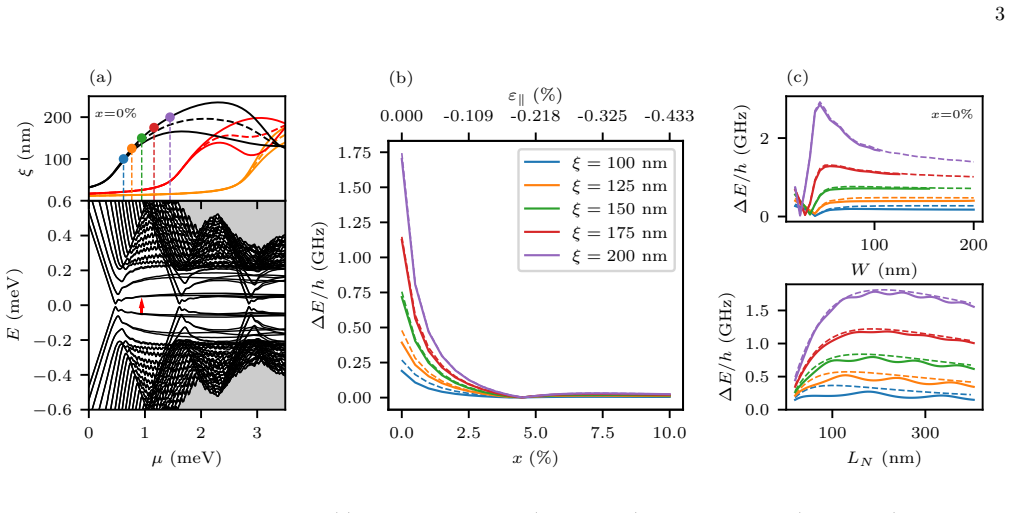
Planar germanium heterostructures are promising hosts for hybrid quantum devices due to their compatibility with superconductors, low material disorder, and relaxed fabrication constraints. Also, the potentially low density of nuclear spins and strong spin-orbit interaction make germanium attractive for coherent spin physics. However, recent microwave spectroscopy experiments were unable to resolve a spin-splitting of bound states in germanium Josephson junctions, the prerequisite for defining and controlling Andreev spin qubits. Here, we argue that compressive strain is the key mechanism suppressing spin splitting in current devices. Furthermore, we propose unstrained and tensile-strained heterostructures, fully compatible with state-of-the-art growth technology, that significantly enhance the relevant spin-orbit effect. By numerically simulating ballistic Josephson junctions, we predict spin splittings comfortably in the GHz range, more than 2 orders of magnitude larger than compressively strained cases, and all-electric quantum gates in a hundred nanoseconds. Our results establish strain engineering as a key design principle for realizing Andreev spin qubits in germanium-based devices.
Editorial analysis
A structured set of objections, weighed in public.
Referee Report
Summary. The manuscript argues that compressive strain in planar Ge heterostructures suppresses the spin-orbit interaction and thus the spin splitting of Andreev bound states in Josephson junctions, explaining why recent experiments have not resolved such splittings. It proposes unstrained and tensile-strained Ge devices (compatible with existing growth) as a solution, and uses numerical simulations of ballistic Josephson junctions to predict spin splittings in the GHz range—more than two orders of magnitude larger than in compressively strained cases—along with all-electric quantum gates operating in ~100 ns. Strain engineering is presented as the central design principle for realizing Andreev spin qubits in Ge.
Significance. If the numerical predictions hold under realistic conditions, the work would establish a practical, fabrication-compatible route to GHz-scale Andreev spin splittings and fast gates in Ge, advancing hybrid superconductor-semiconductor quantum devices. The quantitative targets (GHz splittings, 100 ns gates) and identification of strain as the controlling parameter provide clear guidance for experiment, though the result's strength is tied to the fidelity of the ballistic model.
major comments (2)
- [Numerical Simulations / Results] The headline prediction of >2-order-of-magnitude enhancement in spin splitting (and the associated 100 ns gate times) is obtained exclusively from numerical simulations of ballistic Josephson junctions that incorporate a strain-dependent spin-orbit term. No analysis is provided of how residual disorder, interface roughness, or scattering—known to be present in planar Ge heterostructures—would modify the effective spin-orbit strength or suppress the splitting, leaving the quantitative claim vulnerable to the idealization.
- [Introduction and Results] The manuscript contrasts compressive strain (which suppresses splitting) with unstrained/tensile cases but does not report a direct comparison of the simulated spin splittings against the experimental upper bounds from the cited microwave spectroscopy measurements on compressively strained devices. Such a calibration would be required to establish that the model parameters are not overestimating the enhancement.
minor comments (2)
- [Methods] Notation for the strain-dependent spin-orbit coupling strength and the definition of the Andreev bound-state spectrum should be made fully explicit in the main text (or a dedicated methods subsection) rather than relying on supplementary material.
- [Figures] Figure captions and axis labels should explicitly state the strain values (compressive, zero, tensile) and the corresponding simulated splitting energies for each curve.
Simulated Author's Rebuttal
We thank the referee for their constructive and detailed review of our manuscript. We appreciate the positive assessment of the significance of strain engineering for Andreev spin qubits in germanium. We address each major comment below and have revised the manuscript to incorporate additional analysis and comparisons as suggested.
read point-by-point responses
-
Referee: The headline prediction of >2-order-of-magnitude enhancement in spin splitting (and the associated 100 ns gate times) is obtained exclusively from numerical simulations of ballistic Josephson junctions that incorporate a strain-dependent spin-orbit term. No analysis is provided of how residual disorder, interface roughness, or scattering—known to be present in planar Ge heterostructures—would modify the effective spin-orbit strength or suppress the splitting, leaving the quantitative claim vulnerable to the idealization.
Authors: We agree that the ballistic approximation represents an idealization and that a discussion of disorder effects is warranted. Planar Ge heterostructures are characterized by long mean free paths (typically exceeding the junction lengths considered here), which supports the ballistic model as a reasonable starting point for isolating the strain dependence. In the revised manuscript, we have added a dedicated paragraph and supporting estimate demonstrating that weak disorder and interface roughness do not qualitatively suppress the strain-induced enhancement of the spin-orbit interaction or reduce the predicted splittings below the GHz range for realistic disorder strengths in these systems. revision: yes
-
Referee: The manuscript contrasts compressive strain (which suppresses splitting) with unstrained/tensile cases but does not report a direct comparison of the simulated spin splittings against the experimental upper bounds from the cited microwave spectroscopy measurements on compressively strained devices. Such a calibration would be required to establish that the model parameters are not overestimating the enhancement.
Authors: We thank the referee for highlighting this point. We have revised the manuscript to include a direct, quantitative comparison between the simulated spin splittings in the compressively strained regime and the experimental upper bounds reported in the cited microwave spectroscopy works. This calibration confirms that our model parameters produce splittings below the experimental resolution threshold for compressive strain, thereby validating that the predicted enhancement for unstrained and tensile-strained cases is not overestimated. revision: yes
Circularity Check
No significant circularity: forward numerical predictions from ballistic model
full rationale
The paper's central claims (GHz-scale spin splittings and 100 ns gates in unstrained/tensile Ge) are generated as outputs of numerical simulations of ballistic Josephson junctions that incorporate a strain-dependent spin-orbit term. These are forward computations from a stated Hamiltonian rather than parameter fits to the target quantities, self-definitions, or load-bearing self-citations that reduce the result to its inputs by construction. No equations or steps in the provided abstract and description exhibit the enumerated circular patterns; the derivation remains self-contained as an independent simulation whose validity rests on model assumptions that can be checked externally.
Axiom & Free-Parameter Ledger
axioms (1)
- domain assumption Ballistic transport regime in Josephson junctions
Reference graph
Works this paper leans on
-
[1]
N. M. Chtchelkatchev and Y. V. Nazarov, Andreev quan- tum dots for spin manipulation, Phys. Rev. Lett.90, 226806 (2003)
2003
-
[2]
Padurariu and Y
C. Padurariu and Y. V. Nazarov, Theoretical proposal for superconducting spin qubits, Phys. Rev. B81, 144519 (2010)
2010
-
[3]
Park and A
S. Park and A. L. Yeyati, Andreev spin qubits in mul- tichannel Rashba nanowires, Phys. Rev. B96, 125416 (2017)
2017
-
[4]
Burkard, T
G. Burkard, T. D. Ladd, A. Pan, J. M. Nichol, and J. R. Petta, Semiconductor spin qubits, Rev. Mod. Phys.95, 025003 (2023)
2023
-
[5]
Blais, A
A. Blais, A. L. Grimsmo, S. M. Girvin, and A. Wallraff, Circuit quantum electrodynamics, Rev. Mod. Phys.93, 025005 (2021)
2021
-
[6]
B. Béri, J. H. Bardarson, and C. W. J. Beenakker, Split- ting of Andreev levels in a Josephson junction by spin- orbit coupling, Phys. Rev. B77, 045311 (2008)
2008
-
[7]
Dell’Anna, A
L. Dell’Anna, A. Zazunov, R. Egger, and T. Martin, Josephsoncurrentthroughaquantumdotwithspin-orbit coupling, Phys. Rev. B75, 085305 (2007)
2007
-
[8]
Michelsen, V
J. Michelsen, V. S. Shumeiko, and G. Wendin, Manip- ulation with Andreev states in spin active mesoscopic Josephson junctions, Phys. Rev. B77, 184506 (2008)
2008
-
[9]
A. A. Reynoso, G. Usaj, C. A. Balseiro, D. Feinberg, and M. Avignon, Spin-orbit-induced chirality of Andreev states in Josephson junctions, Phys. Rev. B86, 214519 (2012)
2012
-
[10]
L. Tosi, C. Metzger, M. F. Goffman, C. Urbina, H. Poth- ier, S. Park, A. L. Yeyati, J. Nygård, and P. Krogstrup, Spin-orbit splitting of Andreev states revealed by mi- crowave spectroscopy, Phys. Rev. X9, 011010 (2019)
2019
-
[11]
Hoffman, M
S. Hoffman, M. Hays, K. Serniak, T. Hazard, and C. Tahan, Decoherence in Andreev spin qubits, Phys. Rev. B111, 045304 (2025)
2025
-
[12]
M. Hays, V. Fatemi, K. Serniak, D. Bouman, S. Dia- mond, G. de Lange, P. Krogstrup, J. Nygård, A. Geresdi, and M. Devoret, Continuous monitoring of a trapped su- perconducting spin, Nature Physics16, 1103 (2020)
2020
-
[13]
M. Hays, V. Fatemi, D. Bouman, J. Cerrillo, S. Diamond, K. Serniak, T. Connolly, P. Krogstrup, J. Nygård, A. L. Yeyati, A. Geresdi, and M. H. Devoret, Coherent ma- nipulation of an Andreev spin qubit, Science373, 430 (2021)
2021
-
[14]
Pita-Vidal, A
M. Pita-Vidal, A. Bargerbos, R. Žitko, L. J. Splitthoff, L.Grünhaupt, J.J.Wesdorp, Y.Liu, L.P.Kouwenhoven, R. Aguado, B. van Heck,et al., Direct manipulation of a 6 superconducting spin qubit strongly coupled to a trans- mon qubit, Nature Physics19, 1110 (2023)
2023
-
[15]
Bargerbos, M
A. Bargerbos, M. Pita-Vidal, R. Žitko, L. J. Splitthoff, L.Grünhaupt, J.J.Wesdorp, Y.Liu, L.P.Kouwenhoven, R. Aguado, C. K. Andersen, A. Kou, and B. van Heck, Spectroscopy of spin-split Andreev levels in a quantum dot with superconducting leads, Phys. Rev. Lett.131, 097001 (2023)
2023
-
[16]
Pita-Vidal, J
M. Pita-Vidal, J. J. Wesdorp, L. J. Splitthoff, A. Barg- erbos, Y. Liu, L. P. Kouwenhoven, and C. K. Andersen, Strong tunable coupling between two distant supercon- ducting spin qubits, Nature Physics , 1 (2024)
2024
-
[17]
Stano and D
P. Stano and D. Loss, Review of performance metrics of spin qubits in gated semiconducting nanostructures, Nature Reviews Physics4, 672 (2022)
2022
-
[18]
Moutanabbir, S
O. Moutanabbir, S. Assali, A. Attiaoui, G. Daligou, P. Daoust, P. D. Vecchio, S. Koelling, L. Luo, and N. Rotaru, Nuclear spin-depleted, isotopically enriched 70ge/28si70ge quantum wells, Advanced Materials36, 2305703 (2024)
2024
-
[19]
Fischer, W
J. Fischer, W. A. Coish, D. V. Bulaev, and D. Loss, Spin decoherence of a heavy hole coupled to nuclear spins in a quantum dot, Phys. Rev. B78, 155329 (2008)
2008
-
[20]
Philippopoulos, S
P. Philippopoulos, S. Chesi, and W. A. Coish, First- principleshyperfinetensorsforelectronsandholesingaas and silicon, Phys. Rev. B101, 115302 (2020)
2020
-
[21]
S.BoscoandD.Loss,Fullytunablehyperfineinteractions of hole spin qubits in si and ge quantum dots, Phys. Rev. Lett.127, 190501 (2021)
2021
-
[22]
Scappucci, C
G. Scappucci, C. Kloeffel, F. A. Zwanenburg, D. Loss, M. Myronov, J.-J. Zhang, S. De Franceschi, G. Katsaros, and M. Veldhorst, The germanium quantum information route, Nature Reviews Materials6, 926 (2021)
2021
-
[23]
Borsoi, N
F. Borsoi, N. W. Hendrickx, V. John, M. Meyer, S. Motz, F. van Riggelen, A. Sammak, S. L. de Snoo, G. Scappucci, and M. Veldhorst, Shared control of a 16semiconductor quantum dot crossbar array, Nature Nanotechnology19, 21 (2024)
2024
-
[24]
V. John, C. X. Yu, B. van Straaten, E. A. Rodríguez- Mena, M. Rodríguez, S. D. Oosterhout, L. E. A. Ste- houwer, G. Scappucci, M. Rimbach-Russ, S. Bosco, F. Borsoi, Y.-M. Niquet, and M. Veldhorst, Robust and localised control of a 10-spin qubit array in germanium, Nature Communications16, 10560 (2025)
2025
-
[25]
N. W. Hendrickx, W. I. L. Lawrie, M. Russ, F. van Rigge- len, S. L. de Snoo, R. N. Schouten, A. Sammak, G. Scap- pucci, and M. Veldhorst, A four-qubit germanium quan- tum processor, Nature591, 580 (2021)
2021
- [26]
-
[27]
Zhang, E
X. Zhang, E. Morozova, M. Rimbach-Russ, D. Jirovec, T.-K. Hsiao, P. C. Fariña, C.-A. Wang, S. D. Oost- erhout, A. Sammak, G. Scappucci, M. Veldhorst, and L. M. K. Vandersypen, Universal control of four singlet– triplet qubits, Nature Nanotechnology20, 209 (2025)
2025
-
[28]
S. Hoffman and C. Tahan, Resolving Andreev spin qubits in germanium-based Josephson junctions (2025), arXiv:2506.13988 [cond-mat.mes-hall]
-
[29]
N. W. Hendrickx, D. P. Franke, A. Sammak, M. Kouwen- hoven, D. Sabbagh, L. Yeoh, R. Li, M. L. V. Tagliaferri, M. Virgilio, G. Capellini, G. Scappucci, and M. Veld- horst, Gate-controlled quantum dots and superconduc- tivity in planar germanium, Nature Communications9, 2835 (2018)
2018
-
[30]
O. Sagi, A. Crippa, M. Valentini, M. Janik, L.Baghumyan, G.Fabris, L.Kapoor, F.Hassani, J.Fink, S. Calcaterra, D. Chrastina, G. Isella, and G. Katsaros, A gate tunable transmon qubit in planar ge, Nature Com- munications15, 6400 (2024)
2024
-
[31]
E. Kiyooka, C. Tangchingchai, G. T. Fernandez-Bada, B. Brun-Barriere, S. Zihlmann, R. Maurand, F. Lefloch, V. Schmitt, J.-M. Hartmann, M. Houzet,et al., Andreev-enhanced conductance quantization and gate- tunable induced superconducting gap in germanium, arXiv:2604.00755 (2026)
-
[32]
Kiyooka, C
E. Kiyooka, C. Tangchingchai, L. Noirot, A. Leblanc, B. Brun, S. Zihlmann, R. Maurand, V. Schmitt, É. Du- mur, J.-M. Hartmann, F. Lefloch, and S. De Franceschi, Gatemon qubit on a germanium quantum-well het- erostructure, Nano Letters25, 562 (2025)
2025
-
[33]
Leblanc, C
A. Leblanc, C. Tangchingchai, Z. Sadre Momtaz, E. Kiy- ooka, J.-M. Hartmann, F. Gustavo, J.-L. Thomassin, B. Brun, V. Schmitt, S. Zihlmann, R. Maurand, É. Du- mur, S. De Franceschi, and F. Lefloch, Gate- and flux- tunable sin(2ϕ) josephson element with planar-ge junc- tions, Nature Communications16, 1010 (2025)
2025
-
[34]
Granular aluminum induced superconductivity in germanium for hole spin-based hybrid devices
G. Fabris, P. Falthansl-Scheinecker, D. Shah, D. M. Pino, M. Borovkov, A. Bubis, K. Roux, D. Sokolova, A. A. Juanes, T. Costanzo,et al., Granular aluminum induced superconductivity in germanium for hole spin-based hy- brid devices, arXiv:2602.21364 (2026)
work page internal anchor Pith review Pith/arXiv arXiv 2026
-
[35]
Lakic, W
L. Lakic, W. I. L. Lawrie, D. van Driel, L. E. A. Ste- houwer, Y. Su, M. Veldhorst, G. Scappucci, F. Kuem- meth, and A. Chatterjee, A quantum dot in germanium proximitized by a superconductor, Nature Materials24, 552 (2025)
2025
-
[36]
Tosato, V
A. Tosato, V. Levajac, J.-Y. Wang, C. J. Boor, F. Bor- soi, M. Botifoll, C. N. Borja, S. Martí-Sánchez, J. Arbiol, A. Sammak, M. Veldhorst, and G. Scappucci, Hard su- perconducting gap in germanium, Communications Ma- terials4, 23 (2023)
2023
-
[37]
Aggarwal, A
K. Aggarwal, A. Hofmann, D. Jirovec, I. Prieto, A. Sam- mak, M. Botifoll, S. Martí-Sánchez, M. Veldhorst, J. Ar- biol, G. Scappucci, J. Danon, and G. Katsaros, Enhance- ment of proximity-induced superconductivity in a planar ge hole gas, Phys. Rev. Res.3, L022005 (2021)
2021
-
[38]
Hinderling, S
M. Hinderling, S. C. ten Kate, M. Coraiola, D. Hax- ell, M. Stiefel, M. Mergenthaler, S. Paredes, S. Be- dell, D. Sabonis, and F. Nichele, Direct microwave spec- troscopy of Andreev bound states in planar Ge Josephson junctions, PRX Quantum5, 030357 (2024)
2024
-
[39]
ten Kate, D
S. ten Kate, D. Ohnmacht, M. Coraiola, T. An- tonelli, S. Paredes, F. Schupp, M. Hinderling, S. Bedell, W. Belzig, J. Cuevas, A. Svetogorov, F. Nichele, and D.Sabonis,Finite-lengtheffectsandCoulombinteraction in Josephson junctions based on Ge quantum wells and probed with microwave spectroscopy, Phys. Rev. Appl. 24, 064005 (2025)
2025
-
[40]
J. A. Steele, P. J. Strohbeen, C. Verdi, A. Baktash, A. Danilenko, Y.-H. Chen, J. van Dijk, F. H. Knud- sen, A. Leblanc, D. Perconte, L. Wang, E. Demler, S. Salmani-Rezaie, P. Jacobson, and J. Shabani, Super- conductivity in substitutional ga-hyperdoped ge epitaxial thin films, Nature Nanotechnology20, 1757 (2025). 7
2025
-
[41]
Buried unstrained germanium channels: a lattice-matched platform for quantum technology
D. Costa, P. D. Vecchio, K. Hudson, L. E. A. Stehouwer, A. Tosato, D. D. Esposti, M. Lodari, S. Bosco, and G. Scappucci, Buried unstrained germanium channels: a lattice-matched platform for quantum technology (2025), arXiv:2506.04724 [cond-mat.mes-hall]
work page internal anchor Pith review Pith/arXiv arXiv 2025
-
[42]
P. Kaul, J. Karthein, J. Buchhorn, T. Kawano, T. Usub- uchi, J. Ishihara, N. Rotaru, P. Del Vecchio, O. Concep- cion, Z. Ikonic, D. Grützmacher, Q.-T. Zhao, O. Moutan- abbir, M. Kohda, T. Schäpers, and D. Buca, Gesn quan- tum wells as a platform for spin-resolved hole transport, Communications Materials6, 216 (2025)
2025
-
[43]
Eißfeller and P
T. Eißfeller and P. Vogl, Real-space multiband envelope- function approach without spurious solutions, Phys. Rev. B84, 195122 (2011)
2011
-
[44]
Winkler,Spin-orbit Coupling Effects in Two- Dimensional Electron and Hole Systems, Vol
R. Winkler,Spin-orbit Coupling Effects in Two- Dimensional Electron and Hole Systems, Vol. 191 (Springer, 2003)
2003
-
[45]
Bir and G
G. Bir and G. Pikus,Symmetry and Strain-induced Ef- fects in Semiconductors(Wiley, New York, 1974)
1974
-
[46]
SupplementalMaterialcontainingdetailsonthek·peffec- tive Hamiltonian, on the material parametrization, and on the model of the ASQ
-
[47]
C. G. Van de Walle and R. M. Martin, Theoretical cal- culations of heterojunction discontinuities in the Si/Ge system, Phys. Rev. B34, 5621 (1986)
1986
-
[48]
C. G. Van de Walle, Band lineups and deformation po- tentials in the model-solid theory, Phys. Rev. B39, 1871 (1989)
1989
-
[49]
R. R. Reeber and K. Wang, Thermal expansion and lat- tice parameters of group IV semiconductors, Materials Chemistry and Physics46, 259 (1996)
1996
-
[50]
M. P. Polak, P. Scharoch, and R. Kudrawiec, The elec- tronicbandstructureofGe 1−xSnx inthefullcomposition range: indirect, direct, and inverted gaps regimes, band offsets, and the Burstein–Moss effect, Journal of Physics D: Applied Physics50, 195103 (2017)
2017
-
[51]
Lawaetz, Valence-Band Parameters in Cubic Semicon- ductors, Phys
P. Lawaetz, Valence-Band Parameters in Cubic Semicon- ductors, Phys. Rev. B4, 3460 (1971)
1971
-
[52]
Madelung, ed.,Semiconductors, Group IV Elements and III-V Compounds(Springer-Verlag Berlin Heidel- berg, 1991)
O. Madelung, ed.,Semiconductors, Group IV Elements and III-V Compounds(Springer-Verlag Berlin Heidel- berg, 1991)
1991
-
[53]
Lu Low, Y
K. Lu Low, Y. Yang, G. Han, W. Fan, and Y.-C. Yeo, Electronic band structure and effective mass parame- ters of Ge1-xSnx alloys, Journal of Applied Physics112, 103715 (2012)
2012
-
[54]
Del Vecchio and O
P. Del Vecchio and O. Moutanabbir, Light-hole spin con- fined in germanium, Phys. Rev. B110, 045409 (2024)
2024
-
[55]
P. Del Vecchio, S. Bosco, D. Loss, and O. Moutanabbir, Fully tunable strong spin-orbit interactions in light hole germanium quantum channels, arXiv:2506.14759 (2025)
-
[56]
Del Vecchio and O
P. Del Vecchio and O. Moutanabbir, Light-hole gate- defined spin-orbit qubit, Phys. Rev. B107, L161406 (2023)
2023
-
[57]
L. A. Terrazos, E. Marcellina, Z. Wang, S. N. Copper- smith, M. Friesen, A. R. Hamilton, X. Hu, B. Koiller, A. L. Saraiva, D. Culcer, and R. B. Capaz, Theory of hole-spin qubits in strained germanium quantum dots, Phys. Rev. B103, 125201 (2021)
2021
-
[58]
Bosco, M
S. Bosco, M. Benito, C. Adelsberger, and D. Loss, Squeezed hole spin qubits in ge quantum dots with ul- trafast gates at low power, Phys. Rev. B104, 115425 (2021)
2021
-
[59]
Mauro, M
L. Mauro, M. J. Rodríguez, E. A. Rodríguez-Mena, and Y.-M. Niquet, Hole spin qubits in unstrained germanium layers, npj Quantum Information11, 167 (2025)
2025
-
[60]
Bravyi, D
S. Bravyi, D. P. DiVincenzo, and D. Loss, Schrief- fer–Wolff transformation for quantum many-body sys- tems, Annals of Physics326, 2793 (2011)
2011
-
[61]
D. M. Pino, R. S. Souto, M. J. Calderón, R. Aguado, and J. C. Abadillo-Uriel, Theory of superconducting proximity effect in hole-based hybrid semiconductor- superconductor devices, Phys. Rev. B111, 235443 (2025)
2025
-
[62]
S. S. Babkin, B. Joecker, K. Flensberg, M. Serbyn, and J. Danon, Superconducting proximity effect in two- dimensional hole gases, Phys. Rev. B111, 214518 (2025)
2025
-
[63]
A. G. Moghaddam, T. Kernreiter, M. Governale, and U. Zülicke, Exporting superconductivity across the gap: Proximity effect for semiconductor valence-band states duetocontactwithasimple-metalsuperconductor,Phys. Rev. B89, 184507 (2014)
2014
-
[64]
P. D. Johannsen, H. F. Legg, S. Bosco, D. Loss, and J. Klinovaja, Atypical josephson effect in hybrid superconductor-hole systems, Phys. Rev. Res.8, 013289 (2026)
2026
-
[65]
Adelsberger, H
C. Adelsberger, H. F. Legg, D. Loss, and J. Klino- vaja, Microscopic analysis of proximity-induced super- conductivity and metallization effects in superconductor- germanium hole nanowires, Phys. Rev. B108, 155433 (2023)
2023
-
[66]
C. W. Groth, M. Wimmer, A. R. Akhmerov, and X. Waintal, Kwant: a software package for quantum transport, New Journal of Physics16, 063065 (2014)
2014
-
[67]
H. Lu, D. F. Bofill, Z. Sun, T. Kanne, J. Nygård, M. Kjaergaard, and V. Fatemi, Andreev spin relaxation time in a shadow-evaporated InAs weak link, Phys. Rev. Appl.24, 024046 (2025)
2025
-
[68]
Metzger, S
C. Metzger, S. Park, L. Tosi, C. Janvier, A. A. Reynoso, M. F. Goffman, C. Urbina, A. Levy Yeyati, and H. Poth- ier, Circuit-qed with phase-biased josephson weak links, Phys. Rev. Res.3, 013036 (2021)
2021
-
[69]
Adelsberger, M
C. Adelsberger, M. Benito, S. Bosco, J. Klinovaja, and D. Loss, Hole-spin qubits in ge nanowire quantum dots: Interplay of orbital magnetic field, strain, and growth direction, Phys. Rev. B105, 075308 (2022)
2022
-
[70]
Adelsberger, S
C. Adelsberger, S. Bosco, J. Klinovaja, and D. Loss, En- hanced orbital magnetic field effects in ge hole nanowires, Phys. Rev. B106, 235408 (2022)
2022
-
[71]
Laubscher, J
K. Laubscher, J. D. Sau, and S. Das Sarma, Germanium- based hybrid semiconductor-superconductor topological quantum computing platforms: Disorder effects, Phys. Rev. B110, 155431 (2024)
2024
-
[72]
Y. V. Nazarov and Y. M. Blanter,Quantum transport: introduction to nanoscience(Cambridge university press, 2009)
2009
-
[73]
Luethi, K
M. Luethi, K. Laubscher, S. Bosco, D. Loss, and J. Kli- novaja, Planar josephson junctions in germanium: Effect of cubic spin-orbit interaction, Phys. Rev. B107, 035435 (2023)
2023
-
[74]
D. V. Bulaev and D. Loss, Electric dipole spin resonance for heavy holes in quantum dots, Phys. Rev. Lett.98, 097202 (2007)
2007
-
[75]
J. A. Sauls, Andreev bound states and their signa- tures, Philosophical Transactions of the Royal Society A: Mathematical, Physical and Engineering Sciences376, 20180140 (2018)
2018
-
[76]
V.N.Golovach, M.Borhani,andD.Loss,Electric-dipole- induced spin resonance in quantum dots, Phys. Rev. B 8 74, 165319 (2006)
2006
-
[77]
J. C. Abadillo-Uriel, E. A. Rodríguez-Mena, B. Mar- tinez, and Y.-M. Niquet, Hole-spin driving by strain- induced spin-orbit interactions, Phys. Rev. Lett.131, 097002 (2023)
2023
-
[78]
P.DelVecchio, K.Rossi, G.Scappucci,andS.Bosco,Tai- loring germanium heterostructures for quantum devices with machine learning, arXiv:2604.21732 (2026)
work page internal anchor Pith review Pith/arXiv arXiv 2026
-
[79]
M. Jakob, K. Laubscher, P. Del Vecchio, A. Chatterjee, V. Fatemi, and S. Bosco, Fast readout of quantum dot spin qubits via andreev spins, arXiv:2506.19762 (2025). Supplemental Material: Strain engineering of Andreev spin qubits in Germanium Vittorio Coppini,1,∗ Patrick Del Vecchio,2,† Antonio L. R. Manesco,3, 4 Anton Akhmerov,3 Valla Fatemi,5 Bernard van...
-
[80]
+ sw2(M† 1,M 1) i ,(39a) M2 =P[M 2]−α 0P[sw 2(M1,M 1)],(39b) (39c) and for completeness: E0 =P[E 0],(40a) M1 =P[M 1].(40b) In the Ge1−ySny material system, we apply perturbation theory up to1st order. In this case the states belonging to theBset are simply discarded from the Hamiltonian, which becomes Heff(k∥) =P[E 0] +P[W 1] +P[W 2],(41) 7 Figure 2.E(k ∥...
discussion (0)
Sign in with ORCID, Apple, or X to comment. Anyone can read and Pith papers without signing in.