Recognition: no theorem link
MultiAnimate: Pose-Guided Image Animation Made Extensible
Pith reviewed 2026-05-15 19:17 UTC · model grok-4.3
The pith
A mask-driven framework with Identifier Assigner and Adapter lets diffusion models animate multiple characters after training on only two.
A machine-rendered reading of the paper's core claim, the machinery that carries it, and where it could break.
Core claim
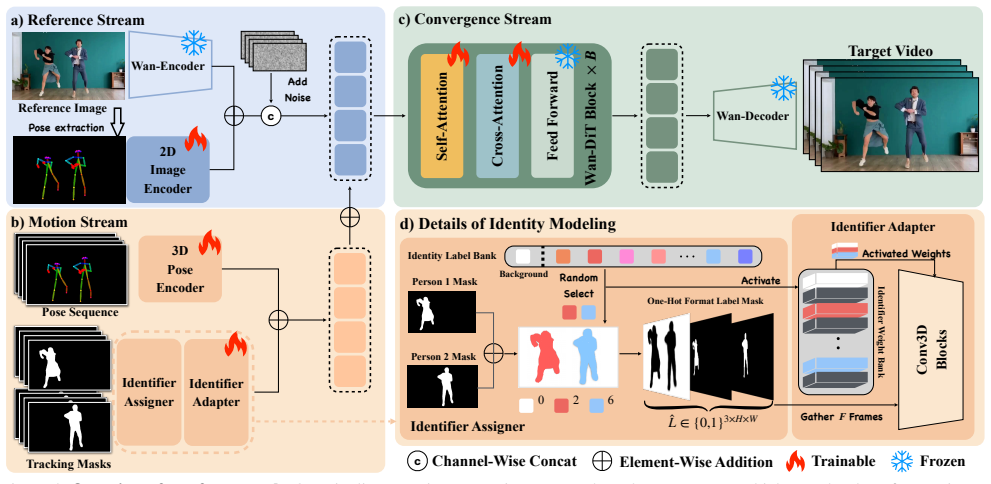
The framework introduces Identifier Assigner and Identifier Adapter that collaboratively capture per-person positional cues and inter-person spatial relationships in a mask-driven scheme, enabling generalization to more characters than seen in training while remaining compatible with single-character animation.
What carries the argument
Identifier Assigner and Identifier Adapter, which together provide per-person positional cues and inter-person spatial relationships via a mask-driven scheme on Diffusion Transformers.
If this is right
- Trained only on two-character data, the model handles arbitrary numbers of characters.
- Maintains compatibility with single-character animation cases.
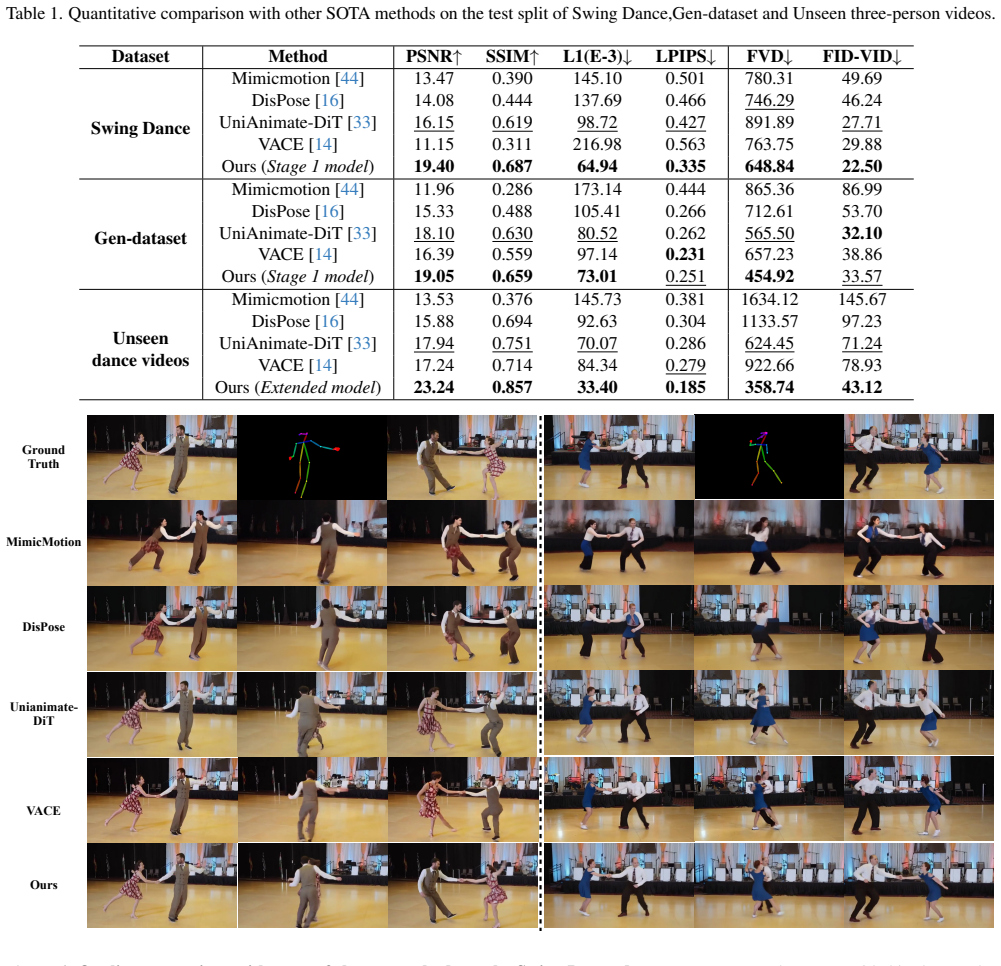
- Surpasses existing diffusion-based methods in multi-character image animation quality.
- Provides a scalable training strategy for extensible animation.
Where Pith is reading between the lines
- Similar identifier mechanisms could help other multi-object video synthesis tasks.
- Reducing training data needs for complex scenes by leveraging generalization from small datasets.
Load-bearing premise
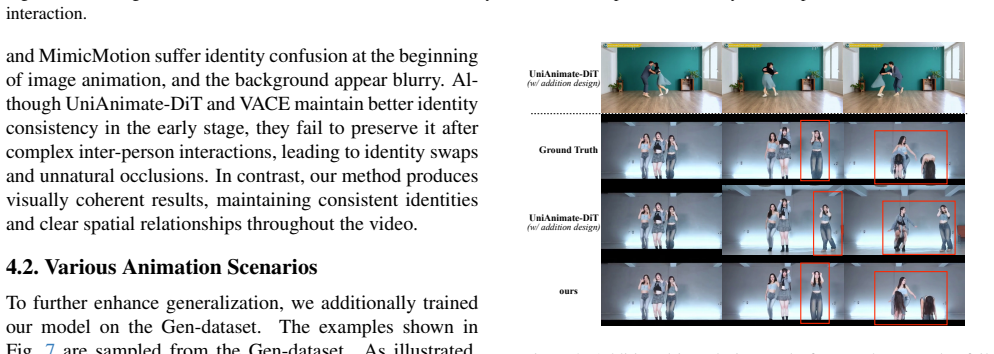
The mask-driven scheme with the Identifier Assigner and Identifier Adapter will continue to prevent identity confusion and implausible occlusions when the number of characters exceeds the two seen in training.
What would settle it
Testing the model on sequences with three or more characters and checking whether identity confusion or implausible occlusions appear in the output.
Figures






read the original abstract
Pose-guided human image animation aims to synthesize realistic videos of a reference character driven by a sequence of poses. While diffusion-based methods have achieved remarkable success, most existing approaches are limited to single-character animation. We observe that naively extending these methods to multi-character scenarios often leads to identity confusion and implausible occlusions between characters. To address these challenges, in this paper, we propose an extensible multi-character image animation framework built upon modern Diffusion Transformers (DiTs) for video generation. At its core, our framework introduces two novel components-Identifier Assigner and Identifier Adapter - which collaboratively capture per-person positional cues and inter-person spatial relationships. This mask-driven scheme, along with a scalable training strategy, not only enhances flexibility but also enables generalization to scenarios with more characters than those seen during training. Remarkably, trained on only a two-character dataset, our model generalizes to multi-character animation while maintaining compatibility with single-character cases. Extensive experiments demonstrate that our approach achieves state-of-the-art performance in multi-character image animation, surpassing existing diffusion-based baselines.
Editorial analysis
A structured set of objections, weighed in public.
Referee Report
Summary. The paper proposes MultiAnimate, an extensible framework for pose-guided multi-character human image animation built on Diffusion Transformers (DiTs). It introduces two novel components, the Identifier Assigner and Identifier Adapter, that operate via a mask-driven scheme to capture per-person positional cues and inter-person spatial relationships. The model is trained exclusively on a two-character dataset yet claims to generalize to scenarios with more characters while remaining compatible with single-character cases, addressing identity confusion and implausible occlusions that arise when naively extending single-character methods. Extensive experiments are said to demonstrate state-of-the-art performance over existing diffusion-based baselines.
Significance. If the generalization claims hold, the work would be significant for the field of pose-guided video synthesis by providing a scalable, mask-driven approach that extends DiT-based animation to multi-character settings without requiring retraining for higher character counts. The explicit handling of inter-person spatial relationships via the new modules could reduce a key failure mode in current methods. However, the absence of any quantitative metrics, ablation results, or implementation details in the manuscript makes it impossible to assess whether these contributions deliver measurable improvements in identity consistency or occlusion plausibility.
major comments (2)
- [Abstract] Abstract: The central claim that training on only a two-character dataset enables generalization to multi-character animation (while preserving single-character compatibility) is load-bearing for the entire contribution, yet the manuscript supplies no quantitative metrics (e.g., identity-consistency scores, FID, or occlusion-error rates), no ablation isolating the Identifier Assigner/Adapter from the DiT backbone, and no description of the maximum number of characters tested on held-out sequences. Without these, the extrapolation from the training distribution cannot be verified.
- [Abstract] Abstract: The mask-driven scheme is asserted to prevent identity confusion and implausible occlusions via per-person positional cues and inter-person spatial relationships, but no equations, architectural diagrams, or pseudocode are provided for the Identifier Assigner or Identifier Adapter. This leaves the mechanism for disentangling identities when character count exceeds the training distribution unspecified and untestable.
Simulated Author's Rebuttal
We thank the referee for their thorough review and constructive feedback. We address the major comments below and will revise the manuscript to incorporate clarifications and additional details as needed.
read point-by-point responses
-
Referee: [Abstract] Abstract: The central claim that training on only a two-character dataset enables generalization to multi-character animation (while preserving single-character compatibility) is load-bearing for the entire contribution, yet the manuscript supplies no quantitative metrics (e.g., identity-consistency scores, FID, or occlusion-error rates), no ablation isolating the Identifier Assigner/Adapter from the DiT backbone, and no description of the maximum number of characters tested on held-out sequences. Without these, the extrapolation from the training distribution cannot be verified.
Authors: We agree that the abstract would benefit from including key quantitative results to support the generalization claim. The full manuscript provides these in the experiments section, including identity consistency metrics, FID scores, and evaluations on sequences with more than two characters. We will revise the abstract to briefly mention these metrics and the maximum number of characters tested on held-out sequences. Ablation studies for the Identifier Assigner and Adapter are also included in the paper and will be referenced. revision: yes
-
Referee: [Abstract] Abstract: The mask-driven scheme is asserted to prevent identity confusion and implausible occlusions via per-person positional cues and inter-person spatial relationships, but no equations, architectural diagrams, or pseudocode are provided for the Identifier Assigner or Identifier Adapter. This leaves the mechanism for disentangling identities when character count exceeds the training distribution unspecified and untestable.
Authors: The architectural details, equations, and diagrams for the Identifier Assigner and Identifier Adapter are presented in Sections 3.2 and 3.3 of the manuscript, with Figure 2 showing the overall structure. To make this more accessible from the abstract, we will add a reference to these sections in the revised abstract. Additionally, we will include pseudocode in the supplementary material to explicitly describe the mask-driven scheme. revision: partial
Circularity Check
No circularity: new modules and generalization claim are architectural and empirical, not self-referential
full rationale
The paper describes an extensible framework built on Diffusion Transformers with two added components (Identifier Assigner and Identifier Adapter) that operate on mask-driven positional cues. The central claim—that training on a two-character dataset enables generalization to more characters while remaining compatible with single-character cases—is presented as an empirical outcome of a scalable training strategy and extensive experiments, not as a mathematical derivation that reduces to fitted parameters or prior self-citations by construction. No equations, uniqueness theorems, or ansatzes are invoked that equate outputs to inputs; the load-bearing elements are the novel modules themselves, whose effectiveness is asserted via experimental results rather than definitional closure. This is a standard descriptive architecture paper with no detectable self-definitional or fitted-input circularity.
Axiom & Free-Parameter Ledger
axioms (1)
- domain assumption Diffusion Transformers can be extended with mask-driven positional and relational modules to handle multiple identities without confusion.
invented entities (2)
-
Identifier Assigner
no independent evidence
-
Identifier Adapter
no independent evidence
Reference graph
Works this paper leans on
-
[1]
Conditional gan with discrimi- native filter generation for text-to-video synthesis
Yogesh Balaji, Martin Renqiang Min, Bing Bai, Rama Chel- lappa, and Hans Peter Graf. Conditional gan with discrimi- native filter generation for text-to-video synthesis. InIJCAI, page 2, 2019. 5
work page 2019
-
[2]
Stable Video Diffusion: Scaling Latent Video Diffusion Models to Large Datasets
Andreas Blattmann, Tim Dockhorn, Sumith Kulal, Daniel Mendelevitch, Maciej Kilian, Dominik Lorenz, Yam Levi, Zion English, Vikram V oleti, Adam Letts, et al. Stable video diffusion: Scaling latent video diffusion models to large datasets.arXiv preprint arXiv:2311.15127, 2023. 1, 3
work page internal anchor Pith review Pith/arXiv arXiv 2023
-
[3]
Realtime multi-person 2d pose estimation using part affinity fields
Zhe Cao, Tomas Simon, Shih-En Wei, and Yaser Sheikh. Realtime multi-person 2d pose estimation using part affinity fields. InProceedings of the IEEE conference on computer vision and pattern recognition, pages 7291–7299, 2017. 3
work page 2017
-
[4]
Dance- together! identity-preserving multi-person interactive video generation
Junhao Chen, Mingjin Chen, Jianjin Xu, Xiang Li, Junt- ing Dong, Mingze Sun, Puhua Jiang, Hongxiang Li, Yuhang Yang, Hao Zhao, Xiaoxiao Long, and Ruqi Huang. Dance- together! identity-preserving multi-person interactive video generation. 2025. 3
work page 2025
-
[5]
Gentron: Diffusion trans- formers for image and video generation
Shoufa Chen, Mengmeng Xu, Jiawei Ren, Yuren Cong, Sen He, Yanping Xie, Animesh Sinha, Ping Luo, Tao Xiang, and Juan-Manuel Perez-Rua. Gentron: Diffusion trans- formers for image and video generation. InProceedings of the IEEE/CVF Conference on Computer Vision and Pattern Recognition, pages 6441–6451, 2024. 3
work page 2024
-
[6]
Prafulla Dhariwal and Alexander Nichol. Diffusion models beat gans on image synthesis.Advances in neural informa- tion processing systems, 34:8780–8794, 2021. 3
work page 2021
-
[7]
AnimateDiff: Animate Your Personalized Text-to-Image Diffusion Models without Specific Tuning
Yuwei Guo, Ceyuan Yang, Anyi Rao, Zhengyang Liang, Yaohui Wang, Yu Qiao, Maneesh Agrawala, Dahua Lin, and Bo Dai. Animatediff: Animate your personalized text- to-image diffusion models without specific tuning.arXiv preprint arXiv:2307.04725, 2023. 1, 3
work page internal anchor Pith review Pith/arXiv arXiv 2023
-
[8]
Classifier-Free Diffusion Guidance
Jonathan Ho and Tim Salimans. Classifier-free diffusion guidance.arXiv preprint arXiv:2207.12598, 2022. 3
work page internal anchor Pith review Pith/arXiv arXiv 2022
-
[9]
Jonathan Ho, Ajay Jain, and Pieter Abbeel. Denoising dif- fusion probabilistic models.Advances in neural information processing systems, 33:6840–6851, 2020. 3
work page 2020
-
[10]
Jonathan Ho, Chitwan Saharia, William Chan, David J Fleet, Mohammad Norouzi, and Tim Salimans. Cascaded diffu- sion models for high fidelity image generation.Journal of Machine Learning Research, 23(47):1–33, 2022. 3
work page 2022
-
[11]
Video dif- fusion models.Advances in neural information processing systems, 35:8633–8646, 2022
Jonathan Ho, Tim Salimans, Alexey Gritsenko, William Chan, Mohammad Norouzi, and David J Fleet. Video dif- fusion models.Advances in neural information processing systems, 35:8633–8646, 2022. 1, 3
work page 2022
-
[12]
Image quality metrics: Psnr vs
Alain Hore and Djemel Ziou. Image quality metrics: Psnr vs. ssim. In2010 20th international conference on pattern recognition, pages 2366–2369. IEEE, 2010. 5
work page 2010
-
[13]
Learning high fi- delity depths of dressed humans by watching social media dance videos
Yasamin Jafarian and Hyun Soo Park. Learning high fi- delity depths of dressed humans by watching social media dance videos. InProceedings of the IEEE/CVF Conference on Computer Vision and Pattern Recognition (CVPR), pages 12753–12762, 2021. 5, 8
work page 2021
-
[14]
Vace: All-in-one video creation and editing
Zeyinzi Jiang, Zhen Han, Chaojie Mao, Jingfeng Zhang, Yulin Pan, and Yu Liu. Vace: All-in-one video creation and editing. InProceedings of the IEEE/CVF International Con- ference on Computer Vision, pages 17191–17202, 2025. 2, 5, 6
work page 2025
-
[15]
HunyuanVideo: A Systematic Framework For Large Video Generative Models
Weijie Kong, Qi Tian, Zijian Zhang, Rox Min, Zuozhuo Dai, Jin Zhou, Jiangfeng Xiong, Xin Li, Bo Wu, Jianwei Zhang, et al. Hunyuanvideo: A systematic framework for large video generative models.arXiv preprint arXiv:2412.03603, 2024. 1, 3
work page internal anchor Pith review Pith/arXiv arXiv 2024
-
[16]
Hongxiang Li, Yaowei Li, Yuhang Yang, Junjie Cao, Zhi- hong Zhu, Xuxin Cheng, and Chen Long. Dispose: Disen- tangling pose guidance for controllable human image anima- tion.arXiv preprint arXiv:2412.09349, 2024. 2, 5, 6, 8
-
[17]
Open-sora plan: Open-source large video generation model.arXiv preprint arXiv:2412.00131, 2024
Bin Lin, Yunyang Ge, Xinhua Cheng, Zongjian Li, Bin Zhu, Shaodong Wang, Xianyi He, Yang Ye, Shenghai Yuan, Li- uhan Chen, et al. Open-sora plan: Open-source large video generation model.arXiv preprint arXiv:2412.00131, 2024. 3
-
[18]
Latte: Latent Diffusion Transformer for Video Generation
Xin Ma, Yaohui Wang, Gengyun Jia, Xinyuan Chen, Zi- wei Liu, Yuan-Fang Li, Cunjian Chen, and Yu Qiao. Latte: Latent diffusion transformer for video generation.arXiv preprint arXiv:2401.03048, 2024. 3
work page internal anchor Pith review Pith/arXiv arXiv 2024
-
[19]
Synergy and synchrony in couple dances
V ongani H Maluleke, Lea M ¨uller, Jathushan Rajasegaran, Georgios Pavlakos, Shiry Ginosar, Angjoo Kanazawa, and Jitendra Malik. Synergy and synchrony in couple dances. arXiv preprint arXiv:2409.04440, 2024. 5, 7
-
[20]
Improved denoising diffusion probabilistic models
Alexander Quinn Nichol and Prafulla Dhariwal. Improved denoising diffusion probabilistic models. InInternational conference on machine learning, pages 8162–8171. PMLR,
-
[21]
Scalable diffusion models with transformers
William Peebles and Saining Xie. Scalable diffusion models with transformers. InProceedings of the IEEE/CVF inter- national conference on computer vision, pages 4195–4205,
-
[22]
DreamFusion: Text-to-3D using 2D Diffusion
Ben Poole, Ajay Jain, Jonathan T Barron, and Ben Milden- hall. Dreamfusion: Text-to-3d using 2d diffusion.arXiv preprint arXiv:2209.14988, 2022. 3
work page internal anchor Pith review Pith/arXiv arXiv 2022
-
[23]
Hierarchical Text-Conditional Image Generation with CLIP Latents
Aditya Ramesh, Prafulla Dhariwal, Alex Nichol, Casey Chu, and Mark Chen. Hierarchical text-conditional image gener- ation with clip latents.arXiv preprint arXiv:2204.06125, 1 (2):3, 2022. 3
work page internal anchor Pith review Pith/arXiv arXiv 2022
-
[24]
High-resolution image synthesis with latent diffusion models
Robin Rombach, Andreas Blattmann, Dominik Lorenz, Patrick Esser, and Bj ¨orn Ommer. High-resolution image synthesis with latent diffusion models. InProceedings of the IEEE/CVF conference on computer vision and pattern recognition, pages 10684–10695, 2022. 3
work page 2022
-
[25]
U- net: Convolutional networks for biomedical image segmen- tation
Olaf Ronneberger, Philipp Fischer, and Thomas Brox. U- net: Convolutional networks for biomedical image segmen- tation. InInternational Conference on Medical image com- puting and computer-assisted intervention, pages 234–241. Springer, 2015. 3
work page 2015
-
[26]
Chitwan Saharia, William Chan, Saurabh Saxena, Lala Li, Jay Whang, Emily L Denton, Kamyar Ghasemipour, Raphael Gontijo Lopes, Burcu Karagol Ayan, Tim Salimans, et al. Photorealistic text-to-image diffusion models with deep language understanding.Advances in neural information processing systems, 35:36479–36494, 2022. 3
work page 2022
-
[27]
Denoising Diffusion Implicit Models
Jiaming Song, Chenlin Meng, and Stefano Ermon. Denoising diffusion implicit models.arXiv preprint arXiv:2010.02502, 2020. 3
work page internal anchor Pith review Pith/arXiv arXiv 2010
-
[28]
Score-Based Generative Modeling through Stochastic Differential Equations
Yang Song, Jascha Sohl-Dickstein, Diederik P Kingma, Ab- hishek Kumar, Stefano Ermon, and Ben Poole. Score-based generative modeling through stochastic differential equa- tions.arXiv preprint arXiv:2011.13456, 2020. 3
work page internal anchor Pith review Pith/arXiv arXiv 2011
-
[29]
Stableanimator: High- quality identity-preserving human image animation
Shuyuan Tu, Zhen Xing, Xintong Han, Zhi-Qi Cheng, Qi Dai, Chong Luo, and Zuxuan Wu. Stableanimator: High- quality identity-preserving human image animation. InPro- ceedings of the Computer Vision and Pattern Recognition Conference, pages 21096–21106, 2025. 3
work page 2025
-
[30]
Towards Accurate Generative Models of Video: A New Metric & Challenges
Thomas Unterthiner, Sjoerd Van Steenkiste, Karol Kurach, Raphael Marinier, Marcin Michalski, and Sylvain Gelly. To- wards accurate generative models of video: A new metric & challenges.arXiv preprint arXiv:1812.01717, 2018. 5
work page internal anchor Pith review Pith/arXiv arXiv 2018
-
[31]
Wan: Open and Advanced Large-Scale Video Generative Models
Team Wan, Ang Wang, Baole Ai, Bin Wen, Chaojie Mao, Chen-Wei Xie, Di Chen, Feiwu Yu, Haiming Zhao, Jianx- iao Yang, Jianyuan Zeng, Jiayu Wang, Jingfeng Zhang, Jin- gren Zhou, Jinkai Wang, Jixuan Chen, Kai Zhu, Kang Zhao, Keyu Yan, Lianghua Huang, Mengyang Feng, Ningyi Zhang, Pandeng Li, Pingyu Wu, Ruihang Chu, Ruili Feng, Shiwei Zhang, Siyang Sun, Tao Fan...
work page internal anchor Pith review Pith/arXiv arXiv 2025
-
[32]
Vividpose: Advancing stable video diffusion for realistic human image animation
Qilin Wang, Zhengkai Jiang, Chengming Xu, Jiangning Zhang, Yabiao Wang, Xinyi Zhang, Yun Cao, Weijian Cao, Chengjie Wang, and Yanwei Fu. Vividpose: Advancing stable video diffusion for realistic human image animation. arXiv preprint arXiv:2405.18156, 2024. 3
-
[33]
Xiang Wang, Shiwei Zhang, Changxin Gao, Jiayu Wang, Xi- aoqiang Zhou, Yingya Zhang, Luxin Yan, and Nong Sang. Unianimate: Taming unified video diffusion models for con- sistent human image animation.Science China Information Sciences, 2025. 2, 4, 5, 6, 8
work page 2025
-
[34]
Zhou Wang, Alan C Bovik, Hamid R Sheikh, and Eero P Si- moncelli. Image quality assessment: from error visibility to structural similarity.IEEE transactions on image processing, 13(4):600–612, 2004. 5
work page 2004
-
[35]
Moviebench: A hierarchical movie level dataset for long video generation
Weijia Wu, Mingyu Liu, Zeyu Zhu, Xi Xia, Haoen Feng, Wen Wang, Kevin Qinghong Lin, Chunhua Shen, and Mike Zheng Shou. Moviebench: A hierarchical movie level dataset for long video generation. InProceedings of the Computer Vision and Pattern Recognition Conference, pages 28984–28994, 2025. 2
work page 2025
-
[36]
Zunnan Xu, Yukang Lin, Haonan Han, Sicheng Yang, Ronghui Li, Yachao Zhang, and Xiu Li. Mambatalk: Ef- ficient holistic gesture synthesis with selective state space models.Advances in Neural Information Processing Sys- tems, 37:20055–20080, 2024. 2
work page 2024
-
[37]
Jingyun Xue, Hongfa Wang, Qi Tian, Yue Ma, Andong Wang, Zhiyuan Zhao, Shaobo Min, Wenzhe Zhao, Kai- hao Zhang, Heung-Yeung Shum, et al. Follow-your-pose v2: Multiple-condition guided character image animation for stable pose control.arXiv e-prints, pages arXiv–2406, 2024. 3
work page 2024
-
[38]
Multi-party col- laborative attention control for image customization, 2025
Han Yang, Chuanguang Yang, Qiuli Wang, Zhulin An, Weilun Feng, Libo Huang, and Yongjun Xu. Multi-party col- laborative attention control for image customization, 2025. 2
work page 2025
-
[39]
Effec- tive whole-body pose estimation with two-stages distillation
Zhendong Yang, Ailing Zeng, Chun Yuan, and Yu Li. Effec- tive whole-body pose estimation with two-stages distillation. InProceedings of the IEEE/CVF International Conference on Computer Vision, pages 4210–4220, 2023. 5
work page 2023
-
[40]
Sa2va: Marrying sam2 with llava for dense grounded understanding of images and videos.arXiv,
Haobo Yuan, Xiangtai Li, Tao Zhang, Zilong Huang, Shilin Xu, Shunping Ji, Yunhai Tong, Lu Qi, Jiashi Feng, and Ming-Hsuan Yang. Sa2va: Marrying sam2 with llava for dense grounded understanding of images and videos.arXiv,
-
[41]
Fan Zhang, Shulin Tian, Ziqi Huang, Yu Qiao, and Ziwei Liu. Evaluation agent: Efficient and promptable evalua- tion framework for visual generative models.arXiv preprint arXiv:2412.09645, 2024. 3
-
[42]
Adding conditional control to text-to-image diffusion models
Lvmin Zhang, Anyi Rao, and Maneesh Agrawala. Adding conditional control to text-to-image diffusion models. In Proceedings of the IEEE/CVF international conference on computer vision, pages 3836–3847, 2023. 2
work page 2023
-
[43]
The unreasonable effectiveness of deep features as a perceptual metric
Richard Zhang, Phillip Isola, Alexei A Efros, Eli Shecht- man, and Oliver Wang. The unreasonable effectiveness of deep features as a perceptual metric. InProceedings of the IEEE conference on computer vision and pattern recogni- tion, pages 586–595, 2018. 5
work page 2018
-
[44]
Mimicmo- tion: High-quality human motion video generation with confidence-aware pose guidance
Yuang Zhang, Jiaxi Gu, Li-Wen Wang, Han Wang, Junqi Cheng, Yuefeng Zhu, and Fangyuan Zou. Mimicmo- tion: High-quality human motion video generation with confidence-aware pose guidance. InInternational Confer- ence on Machine Learning, 2025. 2, 5, 6
work page 2025
-
[45]
Champ: Controllable and consistent human image an- imation with 3d parametric guidance
Shenhao Zhu, Junming Leo Chen, Zuozhuo Dai, Zilong Dong, Yinghui Xu, Xun Cao, Yao Yao, Hao Zhu, and Siyu Zhu. Champ: Controllable and consistent human image an- imation with 3d parametric guidance. InEuropean Confer- ence on Computer Vision, pages 145–162. Springer, 2024. 3
work page 2024
discussion (0)
Sign in with ORCID, Apple, or X to comment. Anyone can read and Pith papers without signing in.