Recognition: 1 theorem link
· Lean TheoremMetacognitive Behavioral Tuning of Large Language Models for Multi-Hop Question Answering
Pith reviewed 2026-05-15 19:33 UTC · model grok-4.3
The pith
Metacognitive Behavioral Tuning injects a five-phase self-regulation structure into LLM reasoning traces to raise accuracy while shortening them in multi-hop question answering.
A machine-rendered reading of the paper's core claim, the machinery that carries it, and where it could break.
Core claim
Metacognitive Behavioral Tuning (MBT) imposes a five-phase metacognitive structure—understanding and filtering, planning, execution and monitoring, self-correction, and verification—on reasoning traces for multi-hop QA. MBT-S synthesizes new traces from scratch while MBT-R rewrites the student's traces into this form. The method raises task accuracy, keeps traces short and stable, and records the highest Accuracy-Efficiency Score across model scales on HotpotQA, MuSiQue, and 2WikiMultiHopQA, with mean response length on MuSiQue reduced by roughly an order of magnitude and degeneration counts lowered by a similar factor.
What carries the argument
The five-phase metacognitive structure of understanding and filtering, planning, execution and monitoring, self-correction, and verification, which supplies explicit self-regulation to prevent valid intermediate conclusions from being overridden.
If this is right
- MBT raises accuracy while reducing mean response length by an order of magnitude on MuSiQue compared with baselines.
- Degeneration counts drop by roughly the same margin as the length reduction.
- Traces reach the answer earlier and contain less redundancy according to the Reach-Redundancy Profile.
- Metacognitive Quality Index scores increase, indicating richer presence of all five phases.
- The accuracy-efficiency advantage holds across model scales and the three tested benchmarks.
Where Pith is reading between the lines
- The same five-phase structure could be tested on single-hop QA or arithmetic reasoning to check whether self-regulation benefits transfer beyond multi-hop settings.
- If the structural prior works by limiting unnecessary exploration, it might also reduce hallucination rates in open-ended generation tasks.
- Smaller models might close more of the performance gap with larger ones when equipped with this explicit phase sequence.
- The matched-control result suggests that future trace-tuning methods should isolate structural priors from content-generation techniques.
Load-bearing premise
The observed gains in accuracy and efficiency arise specifically from enforcing the five-phase metacognitive structure rather than from other aspects of trace synthesis or rewriting.
What would settle it
A follow-up experiment that applies identical trace synthesis and rewriting procedures but removes the five-phase structure, showing no improvement in accuracy or response length.
Figures


read the original abstract
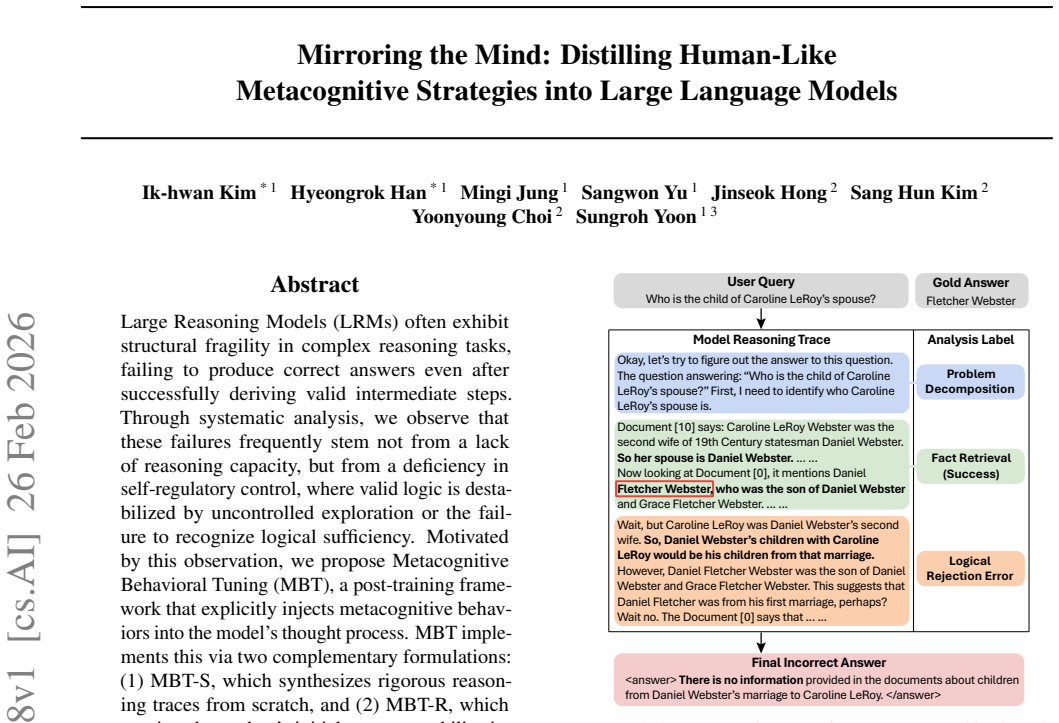
Large Language Models (LLMs) often produce incorrect answers on multi-hop question answering even when the reasoning trace already contains a correct intermediate conclusion. We attribute this gap to weak self-regulation rather than insufficient reasoning capacity. Without explicit regulation, valid intermediate conclusions are overridden by continued exploration or left unrecognized as logically sufficient. We propose Metacognitive Behavioral Tuning (MBT), a post-training framework that injects a five-phase metacognitive structure into reasoning traces. The five phases are understanding and filtering, planning, execution and monitoring, self-correction, and verification. MBT has two formulations. MBT-S synthesizes new metacognitive traces from scratch, while MBT-R rewrites the student's own traces into a metacognitive form. Across HotpotQA, MuSiQue, and 2WikiMultiHopQA, MBT attains the highest Accuracy-Efficiency Score (AES) across model scales. MBT lifts task accuracy while keeping traces short and stable, with mean response length on MuSiQue an order of magnitude shorter than baseline methods and degeneration counts reduced by a similar margin. A matched-control study further confirms that the gain stems from the five-phase structural prior itself. To qualitatively assess the regulatory behavior of reasoning traces, we introduce two new metrics, the Reach-Redundancy Profile (RRP) and the length-aware Metacognitive Quality Index (MQI). RRP captures when the answer is reached and how much of the trace is redundant, and MQI quantifies how richly the five phases appear. Under both metrics, MBT achieves the earliest answer arrival, the lowest redundancy, and the richest phase-level behavior across model scales.
Editorial analysis
A structured set of objections, weighed in public.
Referee Report
Summary. The paper proposes Metacognitive Behavioral Tuning (MBT), a post-training framework that structures LLM reasoning traces for multi-hop QA into five explicit metacognitive phases (understanding/filtering, planning, execution/monitoring, self-correction, verification). It offers two variants—MBT-S (synthesis from scratch) and MBT-R (rewriting student traces)—and reports that MBT achieves the highest Accuracy-Efficiency Score (AES) on HotpotQA, MuSiQue, and 2WikiMultiHopQA across scales, while producing shorter, more stable traces with fewer degenerations. New metrics Reach-Redundancy Profile (RRP) and length-aware Metacognitive Quality Index (MQI) are introduced to quantify answer arrival timing, redundancy, and phase richness; a matched-control study is presented as confirming that gains arise specifically from the five-phase structural prior.
Significance. If the causal attribution to the five-phase prior holds after tighter controls, MBT would supply a lightweight, post-training route to improved multi-hop accuracy and efficiency without full fine-tuning. The RRP and MQI metrics could become useful diagnostic tools for evaluating reasoning trace quality in future work on self-regulation and metacognition in LLMs.
major comments (3)
- [Abstract / matched-control study] The matched-control study is asserted to isolate the five-phase structural prior from synthesis/rewriting confounds, yet the manuscript supplies no matching criteria, ablation tables, or controls for trace length distribution, prompt scaffolding, synthesis model, or phase ordering. Without these, observed differences in AES, trace length, and degeneration counts could arise from generic rewriting coherence rather than the specific phase structure.
- [Experimental results] The abstract reports consistent accuracy and AES gains but provides no statistical significance tests, exact train/test splits, hyperparameter schedules, or full experimental controls. These omissions make it impossible to judge whether the reported lifts (including order-of-magnitude shorter MuSiQue traces) are robust or reproducible.
- [Metrics section] RRP and MQI are introduced to quantify regulatory behavior, but their formal definitions, exact computation procedures, and any supporting equations or pseudocode are absent from the manuscript. This prevents independent verification of the claims that MBT achieves earliest answer arrival, lowest redundancy, and richest phase behavior.
minor comments (1)
- [Abstract] The abstract states that mean response length on MuSiQue is 'an order of magnitude shorter' than baselines; the main text should report the precise numerical values and baseline methods for this comparison.
Simulated Author's Rebuttal
We thank the referee for the constructive and detailed feedback. We address each major comment below and will revise the manuscript to incorporate additional details where the current draft is insufficient.
read point-by-point responses
-
Referee: [Abstract / matched-control study] The matched-control study is asserted to isolate the five-phase structural prior from synthesis/rewriting confounds, yet the manuscript supplies no matching criteria, ablation tables, or controls for trace length distribution, prompt scaffolding, synthesis model, or phase ordering. Without these, observed differences in AES, trace length, and degeneration counts could arise from generic rewriting coherence rather than the specific phase structure.
Authors: We agree that the manuscript does not currently supply the requested details on matching criteria, ablation tables, or controls for trace length, prompt scaffolding, synthesis model, and phase ordering. In the revision we will add these elements, including explicit matching criteria, ablation results comparing the five-phase structure against generic rewriting, and controls that isolate the phase ordering and scaffolding effects. revision: yes
-
Referee: [Experimental results] The abstract reports consistent accuracy and AES gains but provides no statistical significance tests, exact train/test splits, hyperparameter schedules, or full experimental controls. These omissions make it impossible to judge whether the reported lifts (including order-of-magnitude shorter MuSiQue traces) are robust or reproducible.
Authors: The current manuscript omits statistical significance tests, exact data splits, hyperparameter schedules, and comprehensive experimental controls. We will revise the experimental section to include appropriate statistical tests (e.g., paired significance tests on accuracy and AES), the precise train/test splits for HotpotQA, MuSiQue, and 2WikiMultiHopQA, full hyperparameter details, and expanded controls to support reproducibility. revision: yes
-
Referee: [Metrics section] RRP and MQI are introduced to quantify regulatory behavior, but their formal definitions, exact computation procedures, and any supporting equations or pseudocode are absent from the manuscript. This prevents independent verification of the claims that MBT achieves earliest answer arrival, lowest redundancy, and richest phase behavior.
Authors: We acknowledge that the formal definitions, computation procedures, equations, and pseudocode for RRP and MQI are absent from the current draft. In the revision we will insert a dedicated metrics subsection containing the mathematical formulations, step-by-step computation procedures, and pseudocode for both metrics. revision: yes
Circularity Check
No significant circularity; claims rest on external benchmarks and matched-control experiment
full rationale
The paper defines MBT as a post-training method that injects an explicit five-phase metacognitive structure (understanding/filtering, planning, execution/monitoring, self-correction, verification) into reasoning traces via synthesis (MBT-S) or rewriting (MBT-R). Performance claims (highest AES, order-of-magnitude shorter traces on MuSiQue, lower degeneration) are tied to direct measurements on the standard benchmarks HotpotQA, MuSiQue, and 2WikiMultiHopQA, plus two newly introduced metrics (RRP and MQI) that quantify answer arrival, redundancy, and phase richness. The matched-control study is presented as an independent empirical test isolating the phase ordering and labels. No equations, fitted parameters, or self-citations are shown that reduce any central prediction to the input data or prior results by construction. The derivation chain therefore remains externally falsifiable and does not collapse into self-definition or renaming.
Axiom & Free-Parameter Ledger
axioms (1)
- domain assumption LLMs possess sufficient underlying capacity for multi-hop reasoning but lack explicit self-regulation mechanisms
invented entities (3)
-
Metacognitive Behavioral Tuning (MBT)
no independent evidence
-
Reach-Redundancy Profile (RRP)
no independent evidence
-
Metacognitive Quality Index (MQI)
no independent evidence
Reference graph
Works this paper leans on
-
[1]
URL https://aclanthology.org/2025. emnlp-main.165/. Xiang, V ., Snell, C., Gandhi, K., Albalak, A., Singh, A., Blagden, C., Phung, D., Rafailov, R., Lile, N., Mahan, D., et al. Towards system 2 reasoning in llms: Learning how to think with meta chain-of-thought.arXiv preprint arXiv:2501.04682, 2025. Xiao, Y ., Wang, J., Yuan, R., Xu, C., Xu, K., Li, W., a...
-
[2]
Towards Large Reasoning Models: A Survey of Reinforced Reasoning with Large Language Models
URL https://openreview.net/forum? id=W9Y0jtf45v. Xu, F., Hao, Q., Zong, Z., Wang, J., Zhang, Y ., Wang, J., Lan, X., Gong, J., Ouyang, T., Meng, F., et al. To- wards large reasoning models: A survey of reinforced reasoning with large language models.arXiv preprint arXiv:2501.09686, 2025. Yang, A., Li, A., Yang, B., Zhang, B., Hui, B., Zheng, B., Yu, B., G...
work page internal anchor Pith review arXiv 2025
-
[4]
Structure and Metacognitive Flow: - Phase 1: Understanding and Filtering (System 2 Attention). Start by explicitly re-stating the core goal of the problem and filtering out any irrelevant information or distractions. Ensure we fully grasp the requirements before moving forward. - Phase 2: Planning (Plan-and-Solve). Before calculating or deducing, outline ...
-
[5]
Formatting Constraints: - Do not use any Markdown formatting. Do not use bold, italics, headers, or bullet points. - Use clear paragraph breaks to indicate shifts in thought or new steps in the reasoning process. - Do not mention the existence of the provided “correct answer” or that you were given the answer beforehand. The output must read as a single, ...
-
[6]
Output Objective: The final result should be a rich, error-free, and logically robust solution that demonstrates not just the answer, but the careful, self-correcting journey of getting there. <question> Answer the following question based on the given documents. Documents:{context} Question:{question} </question> <correct answer> {answer} </correct answe...
-
[7]
The tone should be introspective, analytical, and deliberate, mimicking a stream of consciousness
Perspective and Tone: Write in the first-person plural (We). The tone should be introspective, analytical, and deliberate, mimicking a stream of consciousness
-
[8]
Wait, let us double-check that,
Structure and Metacognitive Flow: - Phase 1: Understanding and Filtering (System 2 Attention). Start by explicitly re-stating the core goal of the problem and filtering out any irrelevant information or distractions. Ensure we fully grasp the requirements before moving forward. - Phase 2: Planning (Plan-and-Solve). Before calculating or deducing, outline ...
-
[9]
Formatting Constraints: - Do not use any Markdown formatting. Do not use bold, italics, headers, or bullet points. - Use clear paragraph breaks to indicate shifts in thought or new steps in the reasoning process. - Do not mention the existence of the “draft solution” or the “correct answer.” The output must read as a single, authentic, independent thought process
-
[10]
Output Objective: The final result should be a rich, error-free, and logically robust solution that demonstrates not just the answer, but the careful, self-correcting journey of getting there. <draft solution> {reasoning trace} </draft solution> ”””.strip(), } Figure A6.Prompt for rewriting metacognitive reasoning traces (MBT-R). This prompt directs the t...
-
[11]
Read the question and the correct answer to confirm that the draft solution eventually reaches the correct conclusion
-
[12]
Read the draft solution carefully
-
[13]
Monitor the reasoning flow. Identify the point where the correct answer is established and valid verification (including edge-case testing or alternative method checking) is complete
-
[14]
Look for the specific moment where the model begins to engage in unproductive overthinking, as defined above
-
[15]
If the draft solution concludes naturally after the answer and valid verification, or if the continued text provides meaningful new insights, output the entire draft solution
-
[16]
If you identify a point where the reasoning descends into overthinking, cut the text immediately before that specific behavior begins. You must return the exact text of the draft solution from the start up to that cut-off point. Do not include any explanations, labels, or formatting in your output. Output only the resulting text segment from the draft sol...
-
[17]
Read the question and the correct answer to understand the context and the goal
-
[18]
Read the draft solution carefully from the beginning
-
[19]
Monitor the reasoning flow. Look for the first instance where the model begins to repeat thoughts, asks the same questions repeatedly without moving forward, or gets stuck in a cycle of unproductive reasoning
-
[20]
If the draft solution maintains a progressive flow (even if the reasoning is flawed or leads to a wrong answer, as long as it is not looping or stagnating), output the entire draft solution
-
[21]
If you identify a point where the reasoning stagnates, cut the text immediately before that stagnation begins. You must return the exact text of the draft solution from the start up to that cut-off point. Do not include any explanations, labels, or formatting in your output. Output only the resulting text segment from the draft solution. <draft solution> ...
-
[22]
Understanding and Filtering (System 2 Attention): Explicitly restating the core goal and filtering out irrelevant noise or distractions before starting
-
[23]
Planning (Plan-and-Solve): Outlining a high-level strategy or roadmap before diving into specific execution or calculations
-
[24]
Execution and Monitoring: Executing the plan while actively checking the logic (e.g., asking internal questions such as “Is this step valid?”)
-
[25]
Self-Correction (Reflexion): Simulating doubt or identifying a potential error during the process, and explicitly correcting the logical path
-
[26]
Verification (Chain-of-Verification): Conducting a final review of the result against the initial constraints to ensure accuracy. Scoring rubric: Score 0 (Intuitive / System 1): The trace provides a direct answer or a shallow justification with no visible step-by-step reasoning, planning, or self-reflection. Score 1 (Linear Chain-of-Thought): The trace sh...
-
[27]
Understanding and Filtering (System 2 Attention). Start by explicitly re-stating the core goal of the problem and filtering out any irrelevant information or distractions. Ensure you fully grasp the requirements before moving forward
-
[28]
Before calculating or deducing, outline a high-level strategy or roadmap
Planning (Plan-and-Solve). Before calculating or deducing, outline a high-level strategy or roadmap. Break the problem into manageable sub-tasks
-
[29]
Execution and Monitoring. Proceed through the steps. At each transition, engage in active monitoring. Ask internal questions like “Is this step logically sound?” or “Does this align with our previous findings?” Incorporate thinking steps, but if they appear illogical, pause and critique them
-
[30]
Wait, let me re-evaluate this,
Self-Correction (Reflexion). During execution, remain critical of your own logic. If a derived conclusion contradicts previous steps, physical intuition, or the problem constraints, trigger a pause. Use phrases like “Wait, let me re-evaluate this,” or “This outcome seems inconsistent.” Explicitly identify the potential flaw or oversight in the reasoning p...
-
[31]
Verification (Chain-of-Verification). Before concluding, review the final result against the initial constraints to ensure meaningful consistency and high confidence. ”””.strip(), }, { “role”: “user”, “content”: “““ Answer the following question based on the given documents. Provide your final answer between <answer> and </answer> tags. Documents:{context...
discussion (0)
Sign in with ORCID, Apple, or X to comment. Anyone can read and Pith papers without signing in.