Recognition: 2 theorem links
· Lean TheoremSpatially inhomogeneous confinement-deconfinement phase transition in rotating QGP
Pith reviewed 2026-05-15 19:08 UTC · model grok-4.3
The pith
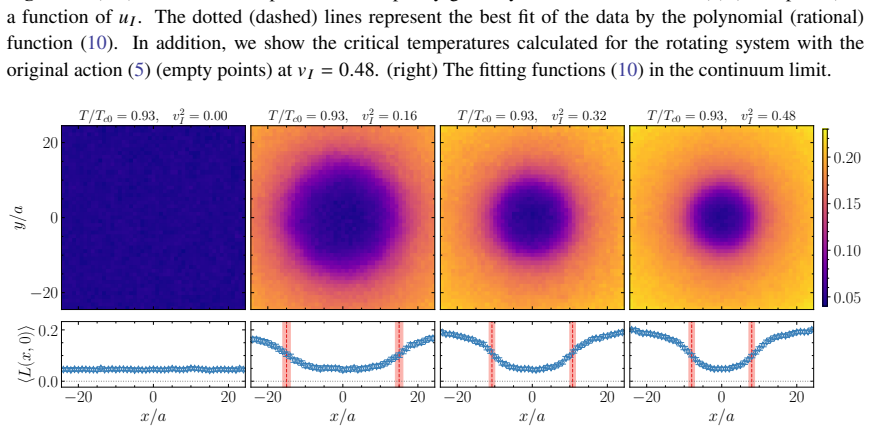
Rotating gluon plasma develops a spatially mixed phase with confinement at the periphery and deconfinement near the axis.
A machine-rendered reading of the paper's core claim, the machinery that carries it, and where it could break.
Core claim
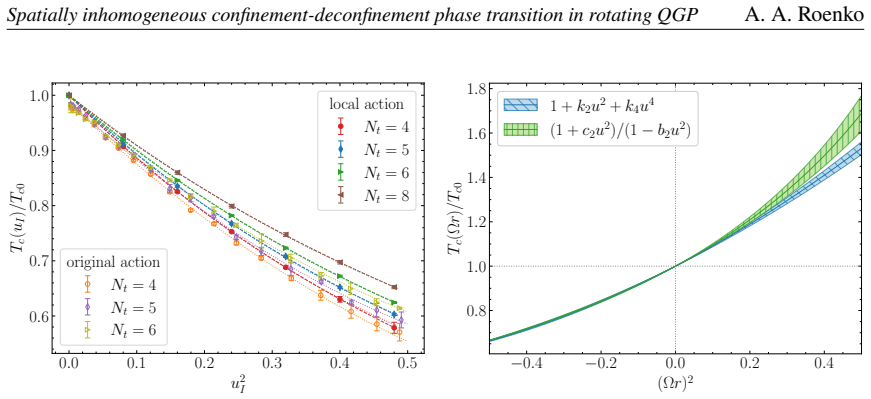
Using first-principles numerical simulations, we find a new spatially inhomogeneous phase in a rotating gluon plasma. This mixed phase simultaneously contains regions of both confining and deconfining states in thermal equilibrium, separated by a spatial transition. The position of the boundary between the two phases is determined by the local critical temperature. We calculate the critical temperature of the local transition as a function of angular velocity and radius for a full (imaginary) rotating system and within a local thermalization approximation, and find an excellent agreement between these approaches. An analytic continuation of the results to the domain of real angular frequenci
What carries the argument
the local critical temperature as a function of angular velocity and radius, extracted from lattice simulations of the imaginary rotating system and continued analytically to real frequencies
If this is right
- The confinement phase localizes at the periphery while the deconfinement phase appears closer to the rotation axis.
- The spatial structure of the mixed phase deviates from the straightforward Tolman-Ehrenfest law because of anisotropy in the gluon action.
- A similar inhomogeneous phase with the same radial ordering is expected in rotating QCD with two dynamical quark flavors.
Where Pith is reading between the lines
- The mixed phase may produce observable radial variations in particle spectra or flow in heavy-ion collisions carrying angular momentum.
- The local thermalization approximation could be tested against other curved-background lattice calculations in gauge theories.
- Adding a nonzero baryon chemical potential might shift the location of the spatial boundary or introduce additional inhomogeneous structures.
Load-bearing premise
Analytic continuation from imaginary to real angular frequencies accurately represents the physical behavior of the rotating gluon plasma.
What would settle it
A lattice simulation or experimental measurement at real angular velocity showing the deconfinement region at larger radii instead of near the axis would falsify the predicted spatial structure.
Figures


read the original abstract
Using first-principles numerical simulations, we find a new spatially inhomogeneous phase in a rotating gluon plasma. This mixed phase simultaneously contains regions of both confining and deconfining states in thermal equilibrium, separated by a spatial transition. The position of the boundary between the two phases is determined by the local critical temperature. We calculate the critical temperature of the local transition as a function of angular velocity and radius for a full (imaginary) rotating system and within a local thermalization approximation, and find an excellent agreement between these approaches. An analytic continuation of the results to the domain of real angular frequencies indicates that the confinement phase localizes at the periphery of the rotating system and the deconfinement phase appears closer to the rotation axis. We argue that the anisotropy of the gluon action in the curved co-rotating background can quantitatively explain the remarkable property that the spatial structure of this inhomogeneous phase disobeys the picture based on a straightforward implementation of the Tolman-Ehrenfest law. We also perform the first lattice simulation of rotating $N_f=2$ QCD which confirms that a similar picture is expected for theory with dynamical quarks.
Editorial analysis
A structured set of objections, weighed in public.
Referee Report
Summary. The manuscript reports first-principles lattice simulations of a rotating gluon plasma performed at imaginary angular velocity. It identifies a spatially inhomogeneous mixed phase containing both confining and deconfining regions in thermal equilibrium, with the phase boundary set by a local critical temperature T_c(ω,r). Excellent numerical agreement is found between full co-rotating simulations and a local thermalization approximation. Analytic continuation of these results to real angular velocity is used to conclude that the confining phase localizes at the periphery while deconfinement appears near the axis; the deviation from the Tolman-Ehrenfest law is attributed to anisotropy in the gluon action. The work also presents the first lattice simulation of rotating N_f=2 QCD with dynamical quarks.
Significance. If the analytic continuation is reliable, the result would establish a novel inhomogeneous confinement-deconfinement phase in rotating QGP, with potential relevance to heavy-ion phenomenology. Strengths include the direct comparison of full simulations against the local approximation and the extension to dynamical quarks. The quantitative explanation via gluon-action anisotropy is a notable technical point.
major comments (2)
- [Results and analytic continuation discussion] The central claim concerning the phase structure at physical (real) angular velocity rests on analytic continuation from imaginary ω. No explicit checks—such as radius of convergence, Padé approximants, or comparison against small-real-ω effective models—are described to confirm the absence of singularities or phase boundaries crossed during continuation. This step is load-bearing for the reported spatial structure at real rotation.
- [Comparison of full simulation and local approximation] The abstract and main text assert excellent agreement between full simulations and the local thermalization approximation, yet no error bars, lattice spacing values, volume parameters, or systematic uncertainty quantification are supplied. Without these, the robustness of the agreement cannot be assessed quantitatively.
minor comments (2)
- [Methods] Clarify the precise functional form used for the local critical temperature T_c(ω,r) and the procedure for its extraction from the Polyakov loop or other order parameters.
- [Discussion] Add a brief discussion of possible non-analyticities in the imaginary-to-real continuation, even if only to state that they are assumed absent within the studied range.
Simulated Author's Rebuttal
We thank the referee for the careful reading of our manuscript and the constructive comments. We address the major comments point by point below.
read point-by-point responses
-
Referee: [Results and analytic continuation discussion] The central claim concerning the phase structure at physical (real) angular velocity rests on analytic continuation from imaginary ω. No explicit checks—such as radius of convergence, Padé approximants, or comparison against small-real-ω effective models—are described to confirm the absence of singularities or phase boundaries crossed during continuation. This step is load-bearing for the reported spatial structure at real rotation.
Authors: We agree that the analytic continuation is a crucial step and that additional validation would strengthen the claim. In the revised manuscript, we will include a discussion of the radius of convergence based on the range of imaginary ω explored and argue that no phase boundaries are crossed, drawing on known results from effective models for rotating QCD. We will also add a brief comparison with perturbative expectations for small real ω where applicable. revision: partial
-
Referee: [Comparison of full simulation and local approximation] The abstract and main text assert excellent agreement between full simulations and the local thermalization approximation, yet no error bars, lattice spacing values, volume parameters, or systematic uncertainty quantification are supplied. Without these, the robustness of the agreement cannot be assessed quantitatively.
Authors: The referee is correct that quantitative details on the agreement are missing. In the revised version, we will include error bars on the relevant plots, specify the lattice spacings and volumes used, and provide a quantitative measure of the agreement, such as the relative difference between the two approaches. revision: yes
Circularity Check
No significant circularity; results from direct lattice simulations with analytic continuation
full rationale
The derivation relies on first-principles lattice simulations at imaginary angular velocity, direct comparison to a local thermalization approximation, and standard analytic continuation to real frequencies. No steps reduce by construction to fitted inputs, self-definitions, or load-bearing self-citations. The anisotropy argument is presented as an explanation derived from the gluon action in the co-rotating frame rather than imported via unverified self-citation. Minor score accounts for typical self-references in the field without load-bearing reduction.
Axiom & Free-Parameter Ledger
free parameters (1)
- angular velocity values
axioms (2)
- domain assumption Lattice discretization of the rotating gluon action faithfully represents the continuum theory
- domain assumption Analytic continuation from imaginary to real angular frequency preserves the physical phase structure
Lean theorems connected to this paper
-
IndisputableMonolith/Foundation/AlexanderDuality.leanalexander_duality_circle_linking unclear?
unclearRelation between the paper passage and the cited Recognition theorem.
We perform the simulations at imaginary angular velocity, Ω_I = … and then analytically continue the results to the domain of Ω² > 0.
-
IndisputableMonolith/Cost/FunctionalEquation.leanwashburn_uniqueness_aczel unclear?
unclearRelation between the paper passage and the cited Recognition theorem.
The critical temperature T_c(r) … fitted by … T_c(r)/T_c0 = 1 − (Ω_I r)² (κ₂ − κ₄ (r/R)²)
What do these tags mean?
- matches
- The paper's claim is directly supported by a theorem in the formal canon.
- supports
- The theorem supports part of the paper's argument, but the paper may add assumptions or extra steps.
- extends
- The paper goes beyond the formal theorem; the theorem is a base layer rather than the whole result.
- uses
- The paper appears to rely on the theorem as machinery.
- contradicts
- The paper's claim conflicts with a theorem or certificate in the canon.
- unclear
- Pith found a possible connection, but the passage is too broad, indirect, or ambiguous to say the theorem truly supports the claim.
Reference graph
Works this paper leans on
-
[1]
Helicity separation in Heavy-Ion Collisions
M. Baznat, K. Gudima, A. Sorin and O. Teryaev,Helicity separation in Heavy-Ion Collisions,Phys. Rev. C88(2013) 061901 [1301.7003]
work page internal anchor Pith review Pith/arXiv arXiv 2013
-
[2]
Rotating quark-gluon plasma in relativistic heavy ion collisions
Y. Jiang, Z.-W. Lin and J. Liao,Rotating quark-gluon plasma in relativistic heavy ion collisions,Phys. Rev. C94(2016) 044910 [1602.06580]. [3]STARcollaboration,GlobalΛhyperon polarization in nuclear collisions: evidence for the most vortical fluid,Nature548(2017) 62 [1701.06657]
work page internal anchor Pith review Pith/arXiv arXiv 2016
-
[3]
Lattice QCD in rotating frames
A. Yamamoto and Y. Hirono,Lattice QCD in rotating frames,Phys. Rev. Lett.111(2013) 081601 [1303.6292]
work page internal anchor Pith review Pith/arXiv arXiv 2013
-
[4]
V.V. Braguta, A.Y. Kotov, D.D. Kuznedelev and A.A. Roenko,Study of the Confinement/Deconfinement Phase Transition in Rotating Lattice SU(3) Gluodynamics, JETP Lett.112(2020) 6
work page 2020
-
[5]
V.V. Braguta, A.Y. Kotov, D.D. Kuznedelev and A.A. Roenko,Influence of relativistic rotation on the confinement-deconfinement transition in gluodynamics,Phys. Rev. D103 (2021) 094515 [2102.05084]
-
[6]
V.V. Braguta, A. Kotov, A. Roenko and D. Sychev,Thermal phase transitions in rotating QCD with dynamical quarks,PoSLATTICE2022(2023) 190 [2212.03224]. 9 Spatially inhomogeneous confinement-deconfinement phase transition in rotating QGPA. A. Roenko
-
[7]
J.-C. Yang and X.-G. Huang,QCD on Rotating Lattice with Staggered Fermions, 2307.05755
-
[8]
V.V. Braguta, I.E. Kudrov, A.A. Roenko, D.A. Sychev and M.N. Chernodub,Lattice Study of the Equation of State of a Rotating Gluon Plasma,JETP Lett.117(2023) 639
work page 2023
-
[9]
V.V. Braguta, M.N. Chernodub, A.A. Roenko and D.A. Sychev,Negative moment of inertia and rotational instability of gluon plasma,Phys. Lett. B852(2024) 138604 [2303.03147]
-
[10]
V.V. Braguta, M.N. Chernodub, I.E. Kudrov, A.A. Roenko and D.A. Sychev,Negative Barnett effect, negative moment of inertia of the gluon plasma, and thermal evaporation of the chromomagnetic condensate,Phys. Rev. D110(2024) 014511 [2310.16036]
-
[11]
V.V. Braguta, M.N. Chernodub and A.A. Roenko,New mixed inhomogeneous phase in vortical gluon plasma: First-principle results from rotating SU(3) lattice gauge theory,Phys. Lett. B855(2024) 138783 [2312.13994]
-
[12]
V.V. Braguta, M.N. Chernodub, Y.A. Gershtein and A.A. Roenko,On the origin of mixed inhomogeneous phase in vortical gluon plasma,JHEP09(2025) 079 [2411.15085]
-
[13]
V.Braguta, M. Chernodub, E.Eremeev, I. Kudrov, A.Roenko andD.Sychev,On theangular momentum and free energy of rotating gluon plasma,2512.04070
-
[14]
Chernodub,Inhomogeneous confining-deconfining phases in rotating plasmas,Phys
M.N. Chernodub,Inhomogeneous confining-deconfining phases in rotating plasmas,Phys. Rev. D103(2021) 054027 [2012.04924]
-
[15]
S. Chen, K. Fukushima and Y. Shimada,Inhomogeneous confinement and chiral symmetry breaking induced by imaginary angular velocity,Phys. Lett. B859(2024) 139107
work page 2024
-
[16]
Jiang,Inhomogeneous SU(2) gluon matter under rotation,Phys
Y. Jiang,Inhomogeneous SU(2) gluon matter under rotation,Phys. Rev. D110(2024) 054047 [2406.03311]
-
[17]
N.R.F. Braga and O.C. Junqueira,Inhomogeneity of a rotating quark-gluon plasma from holography,Phys. Lett. B848(2024) 138330 [2306.08653]
-
[18]
S. Wang, J.-X. Chen, D. Hou and H.-C. Ren,Strong Coupling Expansion of Gluodynamics on a Lattice under Rotation,2505.15487
-
[19]
Spatial confinement-deconfinement transition in accelerated gluodynamics within lattice simulation
V. Braguta, V. Goy, J. Dey and A. Roenko,Spatial confinement-deconfinement transition in accelerated gluodynamics within lattice simulation,2602.20970
work page internal anchor Pith review Pith/arXiv arXiv
-
[20]
Karsch,SU(N) Gauge Theory Couplings on Asymmetric Lattices,Nucl
F. Karsch,SU(N) Gauge Theory Couplings on Asymmetric Lattices,Nucl. Phys. B205 (1982) 285
work page 1982
- [21]
-
[22]
P. Singha, V.E. Ambrus and M.N. Chernodub,Inhibition of the splitting of the chiral and deconfinement transition due to rotation in QCD: The phase diagram of the linear sigma model coupled to Polyakov loops,Phys. Rev. D110(2024) 094053 [2407.07828]. 10
discussion (0)
Sign in with ORCID, Apple, or X to comment. Anyone can read and Pith papers without signing in.