Recognition: 2 theorem links
· Lean TheoremSpatial confinement-deconfinement transition in accelerated gluodynamics within lattice simulation
Pith reviewed 2026-05-15 19:42 UTC · model grok-4.3
The pith
In Rindler spacetime the confinement-deconfinement transition in gluodynamics becomes a spatial crossover rather than a uniform phase change.
A machine-rendered reading of the paper's core claim, the machinery that carries it, and where it could break.
Core claim
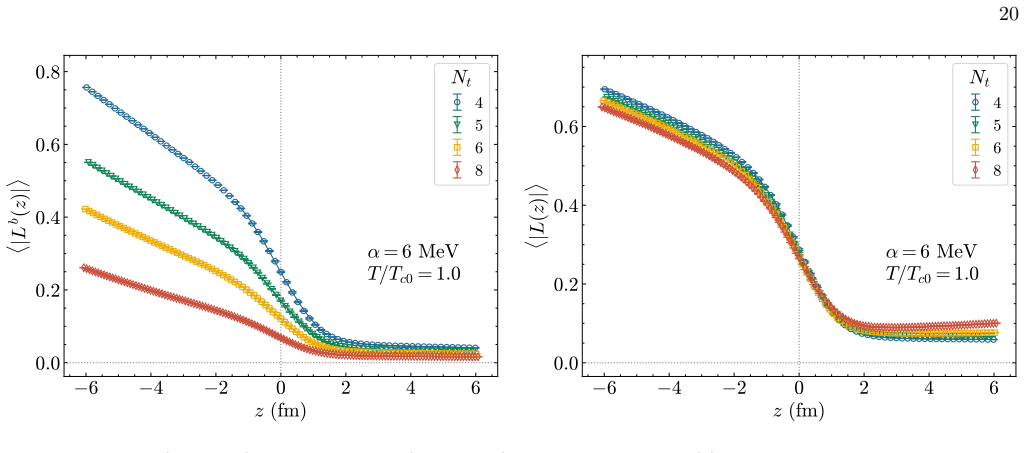
The finite temperature confinement-deconfinement phase transition turns into spatial crossover in the Rindler spacetime. In other words, spatially separated confinement and deconfinement phases can coexist in the Rindler spacetime within certain intervals of temperature and acceleration. The position of the boundary between the phases can be described by the Tolman-Ehrenfest law with rather good accuracy although a minor deviation takes place. The critical temperature of the system in the weak acceleration regime is found to remain unchanged as that of the standard homogeneous gluodynamics.
What carries the argument
Lattice gauge theory simulations formulated directly in Rindler coordinates, with the Polyakov loop used as the order parameter to locate the spatial boundary between confined and deconfined regions.
If this is right
- The boundary between confined and deconfined regions follows the Tolman-Ehrenfest law for several values of acceleration and temperature.
- The critical temperature stays identical to that of homogeneous gluodynamics when acceleration is weak.
- Confined and deconfined phases coexist spatially inside finite intervals of temperature and acceleration.
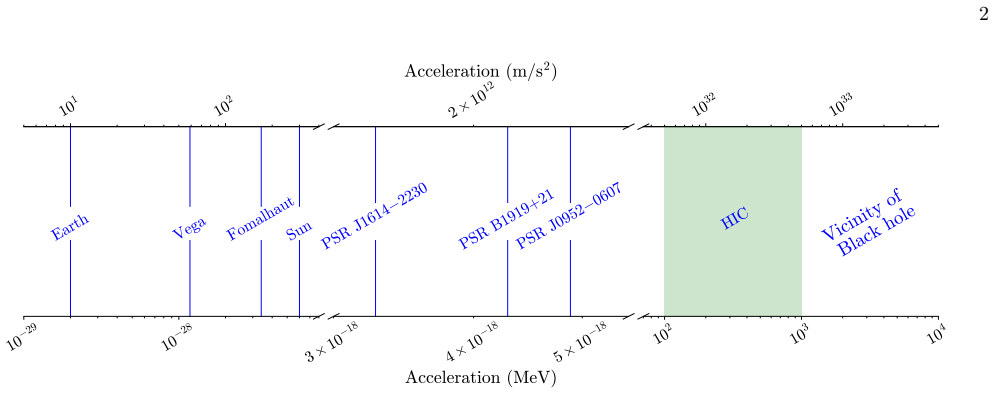
- An analogous spatial confinement-deconfinement transition can occur near the horizon of a Schwarzschild black hole.
Where Pith is reading between the lines
- The same spatial-phase structure may appear in other accelerated or curved backgrounds beyond Rindler geometry.
- The small observed deviation from the Tolman-Ehrenfest law could be studied further to separate lattice artifacts from genuine physical corrections.
- Analog gravity experiments in condensed-matter systems might be able to realize a comparable spatial crossover.
- The result supplies a concrete lattice-based model for how strong gravity can organize quark-gluon matter near compact objects.
Load-bearing premise
Lattice discretization and Polyakov-loop measurements remain reliable when written in Rindler coordinates and are not qualitatively altered by finite-volume or discretization artifacts.
What would settle it
A simulation performed at significantly finer lattice spacing or larger spatial volume that finds either no spatial crossover or a boundary position that deviates strongly from the Tolman-Ehrenfest prediction would disprove the central claim.
Figures





read the original abstract
In this work we investigate the influence of weak acceleration on the confinement-deconfinement phase transition in gluodynamics. Our study is carried out within lattice simulation in the comoving reference frame of accelerated observer which is parameterized by the Rindler coordinates. We find that finite temperature confinement-deconfinement phase transition turns into spatial crossover in the Rindler spacetime. In other words, spatially separated confinement and deconfinement phases can coexist in the Rindler spacetime within certain intervals of temperature and acceleration. We determine the position of the boundary between the phases as a function of temperature for several accelerations and find that it can be described by the Tolman-Ehrenfest law with rather good accuracy although a minor deviation takes place. Moreover, the critical temperature of the system in the weak acceleration regime is found to remain unchanged as that of the standard homogeneous gluodynamics. Our results imply that the spatial confinement-deconfinement transition might take place in the vicinity of the Schwarzschild black hole horizon.
Editorial analysis
A structured set of objections, weighed in public.
Referee Report
Summary. The paper presents lattice simulations of SU(3) gluodynamics formulated in Rindler coordinates to study the effect of weak acceleration on the confinement-deconfinement transition. It claims that the usual finite-temperature phase transition is replaced by a spatial crossover separating confined and deconfined regions, that the location of this boundary follows the Tolman-Ehrenfest law to good accuracy (with a small deviation), and that the critical temperature remains unchanged from the homogeneous case in the weak-acceleration regime.
Significance. If the central numerical results survive systematic checks, the work supplies direct lattice evidence that a position-dependent local temperature can induce coexisting confined and deconfined phases in a non-Abelian gauge theory. This constitutes a non-trivial test of the Tolman-Ehrenfest relation outside equilibrium thermodynamics and carries implications for the vicinity of black-hole horizons. The use of an order parameter measured on the lattice is a concrete strength.
major comments (2)
- [Lattice formulation] Lattice formulation (presumably §2–3): the Wilson action is discretized on a uniform coordinate grid without explicit inclusion of the Rindler metric factor sqrt(-g) = 1 + a x in the plaquette weights or local rescaling of the Polyakov-loop temporal extent by sqrt(g_tt(x)). Because the observed spatial crossover tracks the Tolman-Ehrenfest prediction, this omission is load-bearing; an artificial gradient in the effective coupling or temperature could reproduce the reported behavior by construction rather than by dynamics.
- [Results] Results section (presumably §4): no information is given on the number of independent configurations, autocorrelation times, statistical uncertainties on the crossover location, finite-volume scaling, or any continuum extrapolation. Without these controls the quantitative agreement with the Tolman-Ehrenfest law and the claim of an unchanged critical temperature cannot be evaluated at the level required for the central conclusions.
minor comments (2)
- [Abstract] The abstract states that the critical temperature 'remains unchanged' but does not specify the acceleration range over which this statement holds or quote a numerical value for the deviation from the homogeneous T_c.
- [Figures and text] Figure captions and text should explicitly define the precise definition of the Polyakov loop used (e.g., whether it is normalized by the local proper time) and the criterion adopted to locate the crossover position.
Simulated Author's Rebuttal
We thank the referee for the thorough review and insightful comments on our manuscript. We address each major comment below and will incorporate revisions to strengthen the presentation of our lattice formulation and statistical analysis.
read point-by-point responses
-
Referee: [Lattice formulation] Lattice formulation (presumably §2–3): the Wilson action is discretized on a uniform coordinate grid without explicit inclusion of the Rindler metric factor sqrt(-g) = 1 + a x in the plaquette weights or local rescaling of the Polyakov-loop temporal extent by sqrt(g_tt(x)). Because the observed spatial crossover tracks the Tolman-Ehrenfest prediction, this omission is load-bearing; an artificial gradient in the effective coupling or temperature could reproduce the reported behavior by construction rather than by dynamics.
Authors: We appreciate this important observation. In our lattice setup, the Rindler metric is incorporated through the local definition of the temperature via the Tolman-Ehrenfest relation, where the effective temperature varies with position. The Wilson action is discretized on the coordinate lattice, and for weak accelerations, the metric factor introduces only higher-order corrections. To address the concern rigorously, we will revise the manuscript to include an explicit derivation of the discretized action including the volume factor and demonstrate that it does not induce an artificial crossover. We will also add a numerical check by comparing with and without the factor in the weak limit. revision: yes
-
Referee: [Results] Results section (presumably §4): no information is given on the number of independent configurations, autocorrelation times, statistical uncertainties on the crossover location, finite-volume scaling, or any continuum extrapolation. Without these controls the quantitative agreement with the Tolman-Ehrenfest law and the claim of an unchanged critical temperature cannot be evaluated at the level required for the central conclusions.
Authors: We agree that these statistical and systematic details are essential for assessing the reliability of our results. In the revised manuscript, we will expand the results section to include the number of independent Monte Carlo configurations, estimates of autocorrelation times, bootstrap errors on the crossover positions, a discussion of finite-volume effects, and justification for the lattice spacing used. These additions will allow better evaluation of the agreement with the Tolman-Ehrenfest law and the unchanged critical temperature. revision: yes
Circularity Check
Lattice simulation results are independent of Tolman-Ehrenfest comparison
full rationale
The paper obtains its central claims through direct lattice Monte Carlo measurements of the Polyakov loop on a discretized Rindler grid. The location of the spatial crossover is extracted from these measurements as a function of the acceleration coordinate. The subsequent comparison to the Tolman-Ehrenfest law is performed after the data are generated and functions only as an external consistency check; the law is not used to define the action, the order parameter, or the fitting procedure. No self-citations, ansatzes, or fitted parameters are invoked to force the observed spatial structure or the reported invariance of the critical temperature. The derivation chain therefore remains self-contained against the lattice data and does not reduce to its inputs by construction.
Axiom & Free-Parameter Ledger
free parameters (2)
- acceleration parameter a
- lattice spacing and volume
axioms (2)
- domain assumption Rindler coordinates provide a faithful description of the comoving frame of a uniformly accelerated observer in flat spacetime.
- domain assumption The Polyakov loop or equivalent order parameter remains a valid diagnostic of confinement when the theory is discretized on a Rindler lattice.
Lean theorems connected to this paper
-
IndisputableMonolith/Foundation/RealityFromDistinction.leanreality_from_one_distinction unclear?
unclearRelation between the paper passage and the cited Recognition theorem.
We multiply the chromoelectric and chromomagnetic lattice plaquettes/rectangles by the factors 1/(1+αlz) and (1+αlz), respectively... the lattice version of the action (27) reads SE=β∑x[...]
-
IndisputableMonolith/Foundation/AlexanderDuality.leanalexander_duality_circle_linking unclear?
unclearRelation between the paper passage and the cited Recognition theorem.
the confinement-deconfinement phase transition turns into spatial crossover... described by the Tolman-Ehrenfest law
What do these tags mean?
- matches
- The paper's claim is directly supported by a theorem in the formal canon.
- supports
- The theorem supports part of the paper's argument, but the paper may add assumptions or extra steps.
- extends
- The paper goes beyond the formal theorem; the theorem is a base layer rather than the whole result.
- uses
- The paper appears to rely on the theorem as machinery.
- contradicts
- The paper's claim conflicts with a theorem or certificate in the canon.
- unclear
- Pith found a possible connection, but the passage is too broad, indirect, or ambiguous to say the theorem truly supports the claim.
Forward citations
Cited by 2 Pith papers
-
Spatially inhomogeneous confinement-deconfinement phase transition in rotating QGP
First-principles lattice simulations identify a spatially inhomogeneous confinement-deconfinement transition in rotating gluon plasma, with confinement localizing at the periphery for real angular velocities.
-
Spatially inhomogeneous confinement-deconfinement phase transition in accelerated gluodynamics
Lattice simulations find spatially inhomogeneous confinement-deconfinement transition in weakly accelerated SU(3) gluodynamics, with phase boundary following TE prediction and unchanged critical temperature.
Reference graph
Works this paper leans on
-
[1]
The observer in this reference frame is at rest in the spatial coordinate originη 1 =0
-
[2]
The temporal coordinate for the observer coincides with the proper timeη 0 =τ
-
[3]
The coordinates(η 0, η1)determine the conformally flat metric ds2 =Ω 2(η0, η1)((dη0)2−(dη1)2) ,(10) where Ω(η 0, η1)is a function of the coordinates, which will be specified below. Similarly to the previous section, instead of the(η 0, η1)coordinates it is convenient to use lightcone coordinates ˜u=η0−η1 ,˜v=η 0+η 1 .(11) Evidently, at the observer’s worl...
- [4]
-
[5]
From Color Glass Condensate to Quark Gluon Plasma through the event horizon
D. Kharzeev and K. Tuchin, Nucl. Phys. A753, 316 (2005), arXiv:hep-ph/0501234
work page internal anchor Pith review Pith/arXiv arXiv 2005
-
[6]
L. C. B. Crispino, A. Higuchi, and G. E. A. Matsas, Rev. Mod. Phys.80, 787 (2008), arXiv:0710.5373 [gr-qc]
work page internal anchor Pith review Pith/arXiv arXiv 2008
-
[7]
V. Mukhanov and S. Winitzki,Introduction to quantum effects in gravity(Cambridge University Press, 2007)
work page 2007
- [8]
-
[9]
W. G. Unruh, Phys. Rev. D14, 870 (1976)
work page 1976
-
[10]
Quantum corrections to the stress-energy tensor in thermodynamic equilibrium with acceleration
F. Becattini and E. Grossi, Phys. Rev. D92, 045037 (2015), arXiv:1505.07760 [gr-qc]
work page internal anchor Pith review Pith/arXiv arXiv 2015
- [11]
- [12]
- [13]
- [14]
- [15]
- [16]
- [17]
- [18]
- [19]
-
[20]
The Static Heavy Quark-Antiquark Potential within String Theory in Arbitrary Stationary Backgrounds
N. Tsegelnik, (2026), arXiv:2601.10668 [hep-th]
work page internal anchor Pith review Pith/arXiv arXiv 2026
-
[21]
M. Bordag and D. N. Voskresensky, (2025), arXiv:2510.07438 [hep-ph]
-
[22]
Thermodynamic equilibrium with acceleration and the Unruh effect
F. Becattini, Phys. Rev. D97, 085013 (2018), arXiv:1712.08031 [gr-qc]
work page internal anchor Pith review Pith/arXiv arXiv 2018
-
[23]
F. Becattini, M. Buzzegoli, and A. Palermo, JHEP02, 101, arXiv:2007.08249 [hep-th]
-
[24]
A. Palermo, M. Buzzegoli, and F. Becattini, JHEP10, 077, arXiv:2106.08340 [hep-th]
-
[25]
Dynamical Chiral Symmetry Breaking and its Restoration for an Accelerated Observer
T. Ohsaku, Phys. Lett. B599, 102 (2004), arXiv:hep-th/0407067
work page internal anchor Pith review Pith/arXiv arXiv 2004
-
[26]
Restoration of Dynamically Broken Chiral and Color Symmetries for an Accelerated Observer
D. Ebert and V. C. Zhukovsky, Phys. Lett. B645, 267 (2007), arXiv:hep-th/0612009
work page internal anchor Pith review Pith/arXiv arXiv 2007
-
[27]
Symmetry Restoration By Acceleration
P. Castorina and M. Finocchiaro, J. Mod. Phys.3, 1703 (2012), arXiv:1207.3677 [hep-th]
work page internal anchor Pith review Pith/arXiv arXiv 2012
-
[28]
S. Takeuchi, Phys. Lett. B750, 209 (2015), arXiv:1501.07471 [hep-th]
-
[29]
Unruh effect and condensate in and out of an accelerated vacuum
S. Benic and K. Fukushima, (2015), arXiv:1503.05790 [hep-th]
work page internal anchor Pith review Pith/arXiv arXiv 2015
-
[30]
Brout-Englert-Higgs mechanism for accelerating observers
A. Dobado, Phys. Rev. D96, 085009 (2017), arXiv:1710.01564 [gr-qc]
work page internal anchor Pith review Pith/arXiv arXiv 2017
-
[31]
A. Casado-Turri´ on and A. Dobado, Phys. Rev. D99, 125018 (2019), arXiv:1905.11179 [hep-ph]
work page internal anchor Pith review Pith/arXiv arXiv 2019
- [32]
- [33]
- [34]
-
[35]
W. G. Unruh and N. Weiss, Phys. Rev. D29, 1656 (1984)
work page 1984
- [36]
-
[37]
Properties and uses of the Wilson flow in lattice QCD
M. L¨ uscher, JHEP08, 071, [Erratum: JHEP 03, 092 (2014)], arXiv:1006.4518 [hep-lat]
work page internal anchor Pith review Pith/arXiv arXiv 2014
- [38]
-
[39]
Lattice QCD in rotating frames
A. Yamamoto and Y. Hirono, Phys. Rev. Lett.111, 081601 (2013), arXiv:1303.6292 [hep-lat]
work page internal anchor Pith review Pith/arXiv arXiv 2013
-
[40]
V. V. Braguta, A. Y. Kotov, D. D. Kuznedelev, and A. A. Roenko, JETP Lett.112, 6 (2020)
work page 2020
- [41]
- [42]
- [43]
-
[44]
V. V. Braguta, I. E. Kudrov, A. A. Roenko, D. A. Sychev, and M. N. Chernodub, JETP Lett.117, 639 (2023)
work page 2023
- [45]
- [46]
-
[47]
Quantum Monte Carlo simulation with a black hole
S. Beni´ c and A. Yamamoto, Phys. Rev. D93, 094505 (2016), arXiv:1603.00716 [hep-lat]
work page internal anchor Pith review Pith/arXiv arXiv 2016
- [48]
- [49]
-
[50]
String Tension and Thermodynamics with Tree Level and Tadpole Improved Actions
B. Beinlich, F. Karsch, E. Laermann, and A. Peikert, Eur. Phys. J. C6, 133 (1999), arXiv:hep-lat/9707023
work page internal anchor Pith review Pith/arXiv arXiv 1999
-
[51]
S. Borsanyi, R. Kara, Z. Fodor, D. A. Godzieba, P. Parotto, and D. Sexty, Phys. Rev. D105, 074513 (2022), arXiv:2202.05234 [hep-lat]
-
[52]
Heavy Quark Anti-Quark Free Energy and the Renormalized Polyakov Loop
O. Kaczmarek, F. Karsch, P. Petreczky, and F. Zantow, Phys. Lett. B543, 41 (2002), arXiv:hep-lat/0207002
work page internal anchor Pith review Pith/arXiv arXiv 2002
-
[53]
Renormalized Polyakov loops in many representations
S. Gupta, K. Huebner, and O. Kaczmarek, Phys. Rev. D77, 034503 (2008), arXiv:0711.2251 [hep-lat]
work page internal anchor Pith review Pith/arXiv arXiv 2008
- [54]
- [55]
- [56]
-
[57]
Critical behaviour of SU(2) lattice gauge theory. A complete analysis with the $\chi^2$-method
J. Engels, S. Mashkevich, T. Scheideler, and G. Zinovev, Phys. Lett. B365, 219 (1996), arXiv:hep-lat/9509091
work page internal anchor Pith review Pith/arXiv arXiv 1996
-
[58]
J.-C. Yang, W.-W. Li, and C.-X. Yue, Phys. Rev. D110, 054509 (2024), arXiv:2401.03826 [hep-lat]
-
[59]
S. W. Hawking, Commun. Math. Phys.80, 421 (1981)
work page 1981
-
[60]
A. Anikina, D. Belyakov, T. Bezhanyan, M. Kirakosyan, A. Kokorev, M. Lyubimova, M. Matveev, D. Podgainy, A. Rah- monova, S. Shadmehri, O. Streltsova, S. Torosyan, M. Vala, and M. Zuev, inDistributed Computer and Communication Networks, edited by V. M. Vishnevsky, K. E. Samouylov, and D. V. Kozyrev (Springer Nature Switzerland, Cham, 2025) pp. 444–457
work page 2025
-
[61]
J. M. Luttinger, Phys. Rev.135, A1505 (1964)
work page 1964
-
[62]
P. M. Lo, B. Friman, O. Kaczmarek, K. Redlich, and C. Sasaki, Phys. Rev. D88, 074502 (2013), arXiv:1307.5958 [hep-lat]
work page internal anchor Pith review Pith/arXiv arXiv 2013
discussion (0)
Sign in with ORCID, Apple, or X to comment. Anyone can read and Pith papers without signing in.