A traffic analysis attack against Introduction Protocol and Onion Services
Pith reviewed 2026-05-15 19:28 UTC · model grok-4.3
The pith
An adversary observing one relay can identify every hop in a Tor onion service introduction circuit through repeated timed probes and intersections.
A machine-rendered reading of the paper's core claim, the machinery that carries it, and where it could break.
Core claim
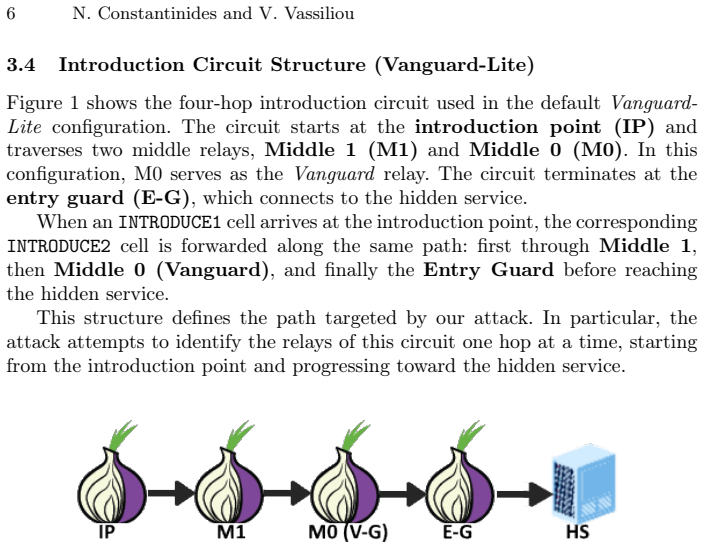
We present a practical intersection attack against Tor introduction circuits that over repeated interactions can identify each hop from the introduction point toward the onion service while requiring observation at only one relay per stage. The attack repeatedly probes the target service and intersects sets of destination IP addresses observed within narrowly bounded INTRODUCE1-RENDEZVOUS2 intervals, without assuming global visibility or access to packet payloads. Our traffic-analysis technique identifies with certainty the next relay in the path to target at each stage, thereby revealing a gap in Tor's privacy model.
What carries the argument
Intersection of destination-IP sets observed inside narrowly bounded INTRODUCE1-RENDEZVOUS2 timing intervals at a single relay, which isolates traffic belonging to the next hop in the introduction circuit.
If this is right
- Each successive relay toward the onion service can be identified with certainty once the prior hop is known.
- Observation at only one relay per stage suffices to reveal the full path.
- The attack works without global network visibility or decryption of payloads.
- Convergence occurs in live-network tests and is affected by relay consensus weight and background traffic volume.
- The attack remains feasible for a partial-global adversary who controls or observes relays in limited locations.
Where Pith is reading between the lines
- Cooperating observers in high-weight jurisdictions could map many onion services faster because relay selection concentrates weight geographically.
- The minimal-storage intersection plugin lowers the cost of running the attack at scale while satisfying data-minimization constraints.
- Similar timing windows in other Tor message sequences might allow analogous intersection attacks on additional circuit types.
Load-bearing premise
Narrow timing windows around the protocol messages reliably separate the service's traffic from unrelated background flows so that repeated intersections converge on the true next relay.
What would settle it
After many probes the intersection sets at any stage fail to shrink to a single consistent relay address that matches the actual circuit path.
Figures


read the original abstract
Tor onion services rely on long-lived introduction circuits to support anonymous rendezvous between clients and services. Although Tor incorporates defenses against traffic analysis, the introduction protocol retains deterministic routing structure that can be exploited by an adversary. We present a practical intersection attack against Tor introduction circuits that over repeated interactions can identify each hop from the introduction point toward the onion service while requiring observation at only one relay per stage. The attack repeatedly probes the target service and intersects sets of destination IP addresses observed within narrowly bounded INTRODUCE1-RENDEZVOUS2 intervals, without assuming global visibility or access to packet payloads. Our traffic-analysis technique identifies with certainty the next relay in the path to target at each stage, thereby revealing a gap in Tor's privacy model, which is intended to resist traffic-analysis attacks in which an adversary uses traffic patterns to determine which points in the network to observe or attack. We evaluate the attack's feasibility through live-network experiments using a self-operated onion service and relays. To support data minimization, we implement a Tor-compatible plugin that computes intersections online over pseudonymized data retained only in volatile memory. Our experiments show reliable convergence in practice, with convergence rate influenced by relay consensus weight and time-varying background traffic. We further assess practicality under a partial-global adversary model and discuss the implications of geographic concentration in Tor relay selection weight across cooperating jurisdictions.
Editorial analysis
A structured set of objections, weighed in public.
Referee Report
Summary. The manuscript presents a practical intersection attack on Tor onion service introduction circuits. By repeatedly probing a target service and intersecting sets of destination IP addresses observed within narrowly bounded INTRODUCE1-RENDEZVOUS2 timing intervals at a single relay, the attack reconstructs successive hops toward the onion service without global visibility or payload access. Live-network experiments with a self-operated service and relays are claimed to show reliable convergence, with rate influenced by consensus weight and background traffic. A Tor-compatible plugin is implemented to perform online intersections over pseudonymized data retained only in volatile memory. The work argues this reveals a gap in Tor's traffic-analysis resistance for the introduction protocol.
Significance. If the empirical results hold, the attack demonstrates that partial observation at one relay per stage can suffice to identify introduction-circuit hops, challenging Tor's design assumptions about traffic-analysis resistance. The data-minimizing plugin and live-network evaluation are strengths that support reproducible and ethical assessment of the vulnerability. The findings could motivate protocol changes to the introduction and rendezvous mechanisms.
major comments (1)
- [Evaluation section] Evaluation section: The central claim that the technique 'identifies with certainty' the next relay (abstract and §5) is load-bearing yet unsupported by quantitative metrics. No false-positive rates, error rates, sensitivity analysis on timing-window width, or controls for background traffic are reported, despite the explicit statement that convergence is 'influenced by' time-varying background traffic. This leaves open whether narrow INTRODUCE1-RENDEZVOUS2 windows reliably isolate target flows from concurrent circuits under realistic load.
minor comments (1)
- [Abstract] Abstract: The strong phrasing 'identifies with certainty' is later qualified by the influence of background traffic; a more precise statement of observed success rates would improve clarity.
Simulated Author's Rebuttal
We thank the referee for the constructive feedback. We respond to the major comment below and plan to revise the manuscript accordingly to strengthen the evaluation.
read point-by-point responses
-
Referee: [Evaluation section] Evaluation section: The central claim that the technique 'identifies with certainty' the next relay (abstract and §5) is load-bearing yet unsupported by quantitative metrics. No false-positive rates, error rates, sensitivity analysis on timing-window width, or controls for background traffic are reported, despite the explicit statement that convergence is 'influenced by' time-varying background traffic. This leaves open whether narrow INTRODUCE1-RENDEZVOUS2 windows reliably isolate target flows from concurrent circuits under realistic load.
Authors: We agree that additional quantitative metrics would strengthen the claims. In the experiments described in §5, the attack achieved reliable convergence to the correct relay in all tested cases, with no false positives observed. To provide rigorous support, we will revise the evaluation section to include: false-positive rates from multiple independent runs, sensitivity analysis on the timing window width (e.g., varying from 1s to 5s), and controls for background traffic by measuring convergence under different load conditions. This will better substantiate the 'identifies with certainty' claim under realistic conditions. revision: yes
Circularity Check
No circularity: empirical intersection attack with no fitted parameters or self-referential derivations
full rationale
The manuscript presents a traffic-analysis attack based on repeated live-network probes and set intersection over observed destination IPs within timing windows. No equations, parameters, or uniqueness theorems are derived; the central claim rests on experimental convergence rates under real Tor traffic rather than any reduction of a prediction to prior fitted inputs or self-citations. The attack description and evaluation contain no self-definitional loops, fitted-input predictions, or load-bearing self-citations that would force the result by construction. The derivation chain is therefore self-contained against external benchmarks.
Axiom & Free-Parameter Ledger
axioms (2)
- domain assumption Tor introduction circuits maintain deterministic routing structure that produces observable timing correlations at intermediate relays
- domain assumption Narrowly bounded INTRODUCE1-RENDEZVOUS2 intervals isolate relevant destination traffic from background noise sufficiently for intersection to succeed
Lean theorems connected to this paper
-
IndisputableMonolith/Cost/FunctionalEquation.leanwashburn_uniqueness_aczel unclear?
unclearRelation between the paper passage and the cited Recognition theorem.
intersects sets of destination IP addresses observed within narrowly bounded INTRODUCE1–RENDEZVOUS2 intervals... computes I_t = ∩ A_j ... |I_t|=1
-
IndisputableMonolith/Foundation/ArithmeticFromLogic.leanLogicNat recovery unclear?
unclearRelation between the paper passage and the cited Recognition theorem.
long-lived introduction circuits... 18–24 hours... short execution time 0.5–1.5 s
What do these tags mean?
- matches
- The paper's claim is directly supported by a theorem in the formal canon.
- supports
- The theorem supports part of the paper's argument, but the paper may add assumptions or extra steps.
- extends
- The paper goes beyond the formal theorem; the theorem is a base layer rather than the whole result.
- uses
- The paper appears to rely on the theorem as machinery.
- contradicts
- The paper's claim conflicts with a theorem or certificate in the canon.
- unclear
- Pith found a possible connection, but the passage is too broad, indirect, or ambiguous to say the theorem truly supports the claim.
Reference graph
Works this paper leans on
-
[1]
https://www.tcpdump.org/, official website of the tcpdump packet analyzer
tcpdump.org. https://www.tcpdump.org/, official website of the tcpdump packet analyzer
-
[2]
Structure and Content of the Visible Darknet
Avarikioti, G., Brunner, R., Kiayias, A., Wattenhofer, R., Zindros, D.: Structure and content of the visible darknet. arXiv preprint arXiv:1811.01348 (2018)
work page internal anchor Pith review Pith/arXiv arXiv 2018
-
[3]
In: 2013 IEEE Symposium on Security and Privacy
Biryukov, A., Pustogarov, I., Weinmann, R.P.: Trawling for tor hidden services: Detection, measurement, deanonymization. In: 2013 IEEE Symposium on Security and Privacy. pp. 80–94. IEEE (2013)
work page 2013
-
[4]
Brophy, S.: Should the united states collect intelligence on its close allies? (2020)
work page 2020
-
[5]
In: International Workshop on Information Hiding
Danezis, G., Serjantov, A.: Statistical disclosure or intersection attacks on anonymity systems. In: International Workshop on Information Hiding. pp. 293–
-
[6]
Diaz, C., Halpin, H., Kiayias, A.: The nym network (2021)
work page 2021
-
[7]
In: International Workshop on Privacy Enhancing Technologies
Diaz, C., Seys, S., Claessens, J., Preneel, B.: Towards measuring anonymity. In: International Workshop on Privacy Enhancing Technologies. pp. 54–68. Springer (2002)
work page 2002
-
[8]
Dingledine, R., Mathewson, N., Syverson, P.: Tor: The second-generation onion router (2004)
work page 2004
-
[9]
IEEE Communications Surveys & Tutorials17(4), 2296– 2316 (2015)
Erdin, E., Zachor, C., Gunes, M.H.: How to find hidden users: A survey of attacks on anonymity networks. IEEE Communications Surveys & Tutorials17(4), 2296– 2316 (2015)
work page 2015
-
[10]
Hayes, J., Danezis, G.: k-fingerprinting: A robust scalable website fingerprinting technique.In:25thUSENIXSecuritySymposium(USENIXSecurity16).pp.1187– 1203 (2016)
work page 2016
-
[11]
Journal of Cybersecurity and Privacy1(3), 496–518 (2021)
Huete Trujillo, D.L., Ruiz-Martínez, A.: Tor hidden services: A systematic litera- ture review. Journal of Cybersecurity and Privacy1(3), 496–518 (2021)
work page 2021
-
[12]
In: 22nd International Symposium on Research in Attacks, Intrusions and Defenses (RAID 2019)
Iacovazzi, A., Frassinelli, D., Elovici, Y.: The{DUSTER}attack: Tor onion service attribution based on flow watermarking with track hiding. In: 22nd International Symposium on Research in Attacks, Intrusions and Defenses (RAID 2019). pp. 213–225 (2019)
work page 2019
-
[13]
In: Proceedings of the 2016 ACM SIGSAC Conference on Computer and Communications Security
Jansen, R., Johnson, A.: Safely measuring tor. In: Proceedings of the 2016 ACM SIGSAC Conference on Computer and Communications Security. pp. 1553–1567 (2016)
work page 2016
-
[14]
Karunanayake, I., Ahmed, N., Malaney, R., Islam, R., Jha, S.K.: De-anonymisation attacks on tor: A survey (2021)
work page 2021
-
[15]
In: 24th USENIX Security Symposium (USENIX Security 15)
Kwon, A., AlSabah, M., Lazar, D., Dacier, M., Devadas, S.: Circuit fingerprinting attacks: Passive deanonymization of tor hidden services. In: 24th USENIX Security Symposium (USENIX Security 15). pp. 287–302 (2015)
work page 2015
-
[16]
TorPolice: Towards Enforcing Service-Defined Access Policies in Anonymous Systems
Liu, Z., Liu, Y., Winter, P., Mittal, P., Hu, Y.C.: Torpolice: Towards en- forcing service-defined access policies in anonymous systems. arXiv preprint arXiv:1708.08162 (2017) A traffic analysis attack against Introduction Protocol and Onion Services 21
work page internal anchor Pith review Pith/arXiv arXiv 2017
-
[17]
Reference and User Services Quarterly54(4), 17–20 (2015)
Macrina, A., Phetteplace, E.: The tor browser and intellectual freedom in the digital age. Reference and User Services Quarterly54(4), 17–20 (2015)
work page 2015
-
[18]
In: International Workshop on Data Privacy Management
Murdoch, S.J.: Quantifying and measuring anonymity. In: International Workshop on Data Privacy Management. pp. 3–13. Springer (2013)
work page 2013
-
[19]
In: 2005 IEEE Sym- posium on Security and Privacy (S&P’05)
Murdoch, S.J., Danezis, G.: Low-cost traffic analysis of tor. In: 2005 IEEE Sym- posium on Security and Privacy (S&P’05). pp. 183–195. IEEE (2005)
work page 2005
-
[20]
In: Proceedings of the 2018 ACM SIGSAC con- ference on computer and communications security
Nasr, M., Bahramali, A., Houmansadr, A.: Deepcorr: Strong flow correlation at- tacks on tor using deep learning. In: Proceedings of the 2018 ACM SIGSAC con- ference on computer and communications security. pp. 1962–1976 (2018)
work page 2018
-
[21]
In: 2006 IEEE Symposium on Security and Privacy (S&P’06)
Overlier, L., Syverson, P.: Locating hidden servers. In: 2006 IEEE Symposium on Security and Privacy (S&P’06). pp. 15–pp. IEEE (2006)
work page 2006
-
[22]
In:Proceedingsofthe15thInternationalConferenceonAvailability,Reliabilityand Security
Platzer, F., Schäfer, M., Steinebach, M.: Critical traffic analysis on the tor network. In:Proceedingsofthe15thInternationalConferenceonAvailability,Reliabilityand Security. pp. 1–10 (2020)
work page 2020
-
[23]
IEEE Journal on Selected areas in Communications16(4), 482–494 (2002)
Reed, M.G., Syverson, P.F., Goldschlag, D.M.: Anonymous connections and onion routing. IEEE Journal on Selected areas in Communications16(4), 482–494 (2002)
work page 2002
-
[24]
Proceed- ings on Privacy Enhancing Technologies (2024)
Sasy, S., Goldberg, I.: Sok: Metadata-protecting communication systems. Proceed- ings on Privacy Enhancing Technologies (2024)
work page 2024
-
[25]
In: 2015 IEEE Security and Privacy Workshops
Shirazi, F., Goehring, M., Diaz, C.: Tor experimentation tools. In: 2015 IEEE Security and Privacy Workshops. pp. 206–213. IEEE (2015)
work page 2015
-
[26]
https://onionoo.torproject.org/ (2025), accessed: 2025-12-18
The Tor Project: Onionoo: Tor relay and bridge information service. https://onionoo.torproject.org/ (2025), accessed: 2025-12-18
work page 2025
-
[27]
https://research.torproject.org/safetyboard.html (2025), accessed: 2025-12-18
The Tor Project: Safety board. https://research.torproject.org/safetyboard.html (2025), accessed: 2025-12-18
work page 2025
-
[28]
https://spec.torproject.org/vanguards-spec/index.html (2025), accessed: 2025-12- 18
The Tor Project: Tor vanguards specification. https://spec.torproject.org/vanguards-spec/index.html (2025), accessed: 2025-12- 18
work page 2025
-
[29]
https://metrics.torproject.org/hidserv-dir-v3-onions-seen.html (2026), accessed: 2026-01-04
The Tor Project: Onion services – unique .onion addresses (version 3 only). https://metrics.torproject.org/hidserv-dir-v3-onions-seen.html (2026), accessed: 2026-01-04
work page 2026
-
[30]
https://spec.torproject.org/param-spec.html (2026), accessed: 2026-04-01
The Tor Project: Tor network parameters specification. https://spec.torproject.org/param-spec.html (2026), accessed: 2026-04-01
work page 2026
-
[31]
https://spec.torproject.org/path-spec/path-selection-constraints.html (2026), accessed: 2026-04-01
The Tor Project: Tor path selection and constraints specification. https://spec.torproject.org/path-spec/path-selection-constraints.html (2026), accessed: 2026-04-01
work page 2026
-
[32]
https://spec.torproject.org/guard- spec/index.html (nd), accessed: 2026-04-01
The Tor Project: Tor guard specification. https://spec.torproject.org/guard- spec/index.html (nd), accessed: 2026-04-01
work page 2026
-
[33]
GNNShap: Scalable and Accurate
Zhang, Q., Teng, Z., Wang, X., Gao, Y., Liu, Q., Shi, J.: Hsdirsniper: A new attack exploiting vulnerabilities in tor’s hidden service directories. In: Proceedings of the ACM Web Conference 2024. p. 1812–1823. WWW ’24, Association for Computing Machinery,NewYork,NY,USA(2024).https://doi.org/10.1145/3589334.3645591, https://doi.org/10.1145/3589334.3645591
discussion (0)
Sign in with ORCID, Apple, or X to comment. Anyone can read and Pith papers without signing in.