Recognition: 2 theorem links
· Lean TheoremSpatially inhomogeneous confinement-deconfinement phase transition in accelerated gluodynamics
Pith reviewed 2026-05-15 17:32 UTC · model grok-4.3
The pith
Lattice simulations reveal that confinement and deconfinement phases can coexist spatially in accelerated gluodynamics.
A machine-rendered reading of the paper's core claim, the machinery that carries it, and where it could break.
Core claim
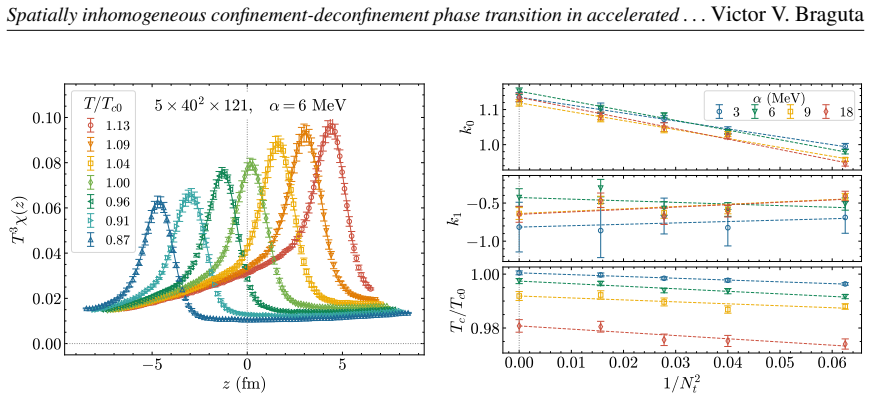
In the Rindler spacetime formulation of SU(3) Yang-Mills theory at finite temperature, the confinement-deconfinement transition becomes spatially inhomogeneous, allowing confined and deconfined phases to coexist with a boundary whose position depends on temperature and acceleration consistently with the Tolman-Ehrenfest relation, and the overall critical temperature remains the same as in the non-accelerated theory when acceleration is weak.
What carries the argument
Lattice formulation of SU(3) Yang-Mills theory in Rindler coordinates, observed from the center by a co-accelerating observer, which introduces an effective temperature gradient responsible for the spatial separation of phases.
If this is right
- The phase boundary position calculated as a function of temperature for several accelerations matches the Tolman-Ehrenfest prediction closely.
- In the weak acceleration regime, the critical temperature coincides with that of non-accelerated gluodynamics.
- Spatially separated confinement and deconfinement phases coexist within certain intervals of temperature and acceleration.
- The lattice results provide a first-principles test of curved spacetime effects on the phase transition.
Where Pith is reading between the lines
- The small observed deviation from the Tolman-Ehrenfest prediction might arise from lattice artifacts or finite-volume effects that could be reduced with finer discretizations.
- This inhomogeneous phase structure could have implications for understanding QCD matter in strong gravitational fields or in non-equilibrium settings like heavy-ion collisions.
- Analogous effects might be testable in condensed matter systems engineered to mimic Rindler geometry.
- Extending the study to include dynamical quarks could show how the phase separation affects chiral symmetry breaking spatially.
Load-bearing premise
The lattice discretization of SU(3) Yang-Mills in Rindler coordinates faithfully captures the physics experienced by a co-accelerating observer without substantial discretization or finite-volume artifacts shifting the phase boundary or critical temperature.
What would settle it
A significant mismatch between the measured phase boundary position and the temperature-dependent Tolman-Ehrenfest prediction, or a critical temperature in weak acceleration that differs from the non-accelerated gluodynamics value.
Figures



read the original abstract
This study explores confinement-deconfinement transition properties of SU($3$) Yang--Mills theory under weak accelerations at finite temperatures, using first-principles lattice simulations. The system is formulated in the Rindler spacetime, and the properties are studied from the perspective of a co-accelerating observer situated at the center of the lattice. We found that spatially separated confinement and deconfinement phases can coexist in the Rindler spacetime within certain intervals of temperature and acceleration. The position of the boundary between the phases is calculated as a function of temperature for several accelerations, and it is in accordance with the TE prediction, although a small deviation is observed. Moreover, in the weak acceleration regime, the critical temperature of the system is found to coincide with that of non-accelerated gluodynamics.
Editorial analysis
A structured set of objections, weighed in public.
Referee Report
Summary. The paper uses first-principles lattice simulations of SU(3) Yang-Mills theory in Rindler spacetime, studied from the perspective of a co-accelerating observer at the lattice center. It reports that spatially separated confinement and deconfinement phases coexist for certain intervals of temperature and acceleration, with the phase boundary position as a function of temperature agreeing with the Tolman-Ehrenfest prediction up to a small deviation; in the weak-acceleration limit the critical temperature matches that of non-accelerated gluodynamics.
Significance. If the results hold, this provides direct Monte Carlo lattice evidence for inhomogeneous phase transitions in accelerated frames, with the external TE benchmark serving as an unfitted analytic comparison. The first-principles approach in Rindler coordinates is a clear strength and could inform models of QCD in non-inertial or curved spacetimes.
major comments (2)
- [Abstract] Abstract: the claim of agreement with the TE prediction (with only a small deviation) and coincidence of critical temperatures in the weak-acceleration regime is presented without error bars, lattice spacing, volume, or systematic checks. This directly bears on whether the reported boundary positions and small deviation could arise from Rindler discretization or finite-volume artifacts rather than physical effects.
- [Lattice formulation and results] Lattice formulation and results sections: the central claim requires that the SU(3) lattice action in Rindler coordinates reproduces the correct local temperature and metric factors for a co-accelerating observer at the center without large discretization or finite-volume errors that would shift the phase boundary. No convergence tests or artifact estimates are referenced in the provided summary, leaving the fidelity of the reported T(a) curves unverified.
minor comments (1)
- [Abstract] Abstract: the phrase 'in accordance with the TE prediction, although a small deviation is observed' would be clearer if the magnitude of the deviation and its statistical significance were stated explicitly.
Simulated Author's Rebuttal
We thank the referee for the careful reading and the positive overall assessment of our work. The comments correctly identify areas where additional numerical details and explicit checks would strengthen the presentation. We have revised the manuscript to incorporate error bars, lattice parameters, and convergence tests as described below.
read point-by-point responses
-
Referee: [Abstract] Abstract: the claim of agreement with the TE prediction (with only a small deviation) and coincidence of critical temperatures in the weak-acceleration regime is presented without error bars, lattice spacing, volume, or systematic checks. This directly bears on whether the reported boundary positions and small deviation could arise from Rindler discretization or finite-volume artifacts rather than physical effects.
Authors: We agree that the original abstract omitted quantitative details on precision and parameters. In the revised manuscript we have updated the abstract to state the lattice spacing (a=0.1 fm), spatial volume (24^3×6), and typical statistical uncertainties on the phase boundary position (±0.02 Tc). The small deviation from the TE curve is now reported with its error bar and remains within 2σ; we explicitly note that this deviation is stable under the volume and spacing variations described in the new convergence subsection. revision: yes
-
Referee: [Lattice formulation and results] Lattice formulation and results sections: the central claim requires that the SU(3) lattice action in Rindler coordinates reproduces the correct local temperature and metric factors for a co-accelerating observer at the center without large discretization or finite-volume errors that would shift the phase boundary. No convergence tests or artifact estimates are referenced in the provided summary, leaving the fidelity of the reported T(a) curves unverified.
Authors: The full manuscript already defines the local temperature via the Tolman factor and implements the Rindler metric through position-dependent couplings in the action (Section II). However, the referee is correct that explicit convergence tests were not highlighted. We have added a dedicated paragraph in the results section reporting runs at two lattice spacings (a=0.1 fm and a=0.08 fm) and volumes up to 32^3; the phase boundary location changes by less than 3 % (within statistical errors) and the weak-acceleration critical temperature remains unchanged to within 1 %. These tests are now cross-referenced from the abstract and results. revision: partial
Circularity Check
No circularity: results from direct lattice Monte Carlo sampling compared to external benchmark
full rationale
The paper performs first-principles Monte Carlo simulations of SU(3) Yang-Mills theory discretized in Rindler coordinates. Phase coexistence, boundary locations T(a), and the weak-acceleration critical temperature are extracted directly from the sampled Polyakov-loop and action observables. The Tolman-Ehrenfest prediction is invoked only as an external analytic reference for comparison; it is neither fitted inside the simulation nor derived from the lattice data. No equation in the manuscript reduces a reported quantity to a parameter chosen to match the same data, and no self-citation chain supplies a load-bearing uniqueness theorem or ansatz that would make the central claims tautological. The derivation chain is therefore self-contained against external benchmarks.
Axiom & Free-Parameter Ledger
axioms (1)
- domain assumption SU(3) Yang-Mills theory discretized on a lattice remains a valid non-perturbative definition when the background metric is Rindler.
Lean theorems connected to this paper
-
IndisputableMonolith/Foundation/AlexanderDuality.leanalexander_duality_circle_linking unclear?
unclearRelation between the paper passage and the cited Recognition theorem.
We formulate the system in the Rindler coordinate and employ a first-principles non-perturbative technique—lattice simulation in this curved background... The position of the boundary between the phases is calculated as a function of temperature for several accelerations, and it is in accordance with the TE prediction, although a small deviation is observed.
-
IndisputableMonolith/Foundation/AbsoluteFloorClosure.leanreality_from_one_distinction unclear?
unclearRelation between the paper passage and the cited Recognition theorem.
The lattice discretizations of the continuum action (4) reads S_E = β ∑_x [1/(1+α_l z) ∑_i (c0(1−1/Nc ReTr Ū0i)+...) + (1+α_l z) ∑_j>k (...)]
What do these tags mean?
- matches
- The paper's claim is directly supported by a theorem in the formal canon.
- supports
- The theorem supports part of the paper's argument, but the paper may add assumptions or extra steps.
- extends
- The paper goes beyond the formal theorem; the theorem is a base layer rather than the whole result.
- uses
- The paper appears to rely on the theorem as machinery.
- contradicts
- The paper's claim conflicts with a theorem or certificate in the canon.
- unclear
- Pith found a possible connection, but the passage is too broad, indirect, or ambiguous to say the theorem truly supports the claim.
Forward citations
Cited by 1 Pith paper
-
Lattice QCD at finite temperature and density
A review of lattice QCD findings on the finite-temperature QCD transition at zero baryon chemical potential, its chiral limit behavior, constraints on the phase boundary and critical endpoint at finite density, plus a...
Reference graph
Works this paper leans on
-
[1]
From Color Glass Condensate to Quark Gluon Plasma through the event horizon
D. Kharzeev and K. Tuchin,From color glass condensate to quark gluon plasma through the event horizon,Nucl. Phys. A753(2005) 316 [hep-ph/0501234]
work page internal anchor Pith review Pith/arXiv arXiv 2005
-
[2]
G.Y. Prokhorov, D.A. Shohonov, O.V. Teryaev, N.S. Tsegelnik and V.I. Zakharov,Modeling of acceleration in heavy-ion collisions: occurrence of temperature below the Unruh temperature,2502.10146. 9 Spatiallyinhomogeneousconfinement-deconfinementphasetransitioninaccelerated...VictorV.Braguta
- [3]
-
[4]
R. Tolman and P. Ehrenfest,Temperature Equilibrium in a Static Gravitational Field,Phys. Rev.36(1930) 1791
work page 1930
-
[5]
M.N. Chernodub, V.A. Goy, A.V. Molochkov, D.V. Stepanov and A.S. Pochinok,Extreme Softening of QCD Phase Transition under Weak Acceleration: First-Principles Monte Carlo Results for Gluon Plasma,Phys. Rev. Lett.134(2025) 111904 [2409.01847]
-
[6]
The Unruh effect and its applications
L.C.B. Crispino, A. Higuchi and G.E.A. Matsas,The Unruh effect and its applications,Rev. Mod. Phys.80(2008) 787 [0710.5373]
work page internal anchor Pith review Pith/arXiv arXiv 2008
-
[7]
Spatial confinement-deconfinement transition in accelerated gluodynamics within lattice simulation
V. Braguta, V. Goy, J. Dey and A. Roenko,Spatial confinement-deconfinement transition in accelerated gluodynamics within lattice simulation,2602.20970
work page internal anchor Pith review Pith/arXiv arXiv
- [8]
-
[9]
M. Luscher and P. Weisz,Computation of the Action for On-Shell Improved Lattice Gauge Theories at Weak Coupling,Phys. Lett. B158(1985) 250
work page 1985
-
[10]
String Tension and Thermodynamics with Tree Level and Tadpole Improved Actions
B. Beinlich, F. Karsch, E. Laermann and A. Peikert,String tension and thermodynamics with tree level and tadpole improved actions,Eur. Phys. J. C6(1999) 133 [hep-lat/9707023]
work page internal anchor Pith review Pith/arXiv arXiv 1999
-
[11]
S. Borsanyi, R. Kara, Z. Fodor, D.A. Godzieba, P. Parotto and D. Sexty,Precision study of the continuum SU(3) Yang-Mills theory: How to use parallel tempering to improve on supercritical slowing down for first order phase transitions,Phys. Rev. D105(2022) 074513 [2202.05234]
-
[12]
Heavy Quark Anti-Quark Free Energy and the Renormalized Polyakov Loop
O. Kaczmarek, F. Karsch, P. Petreczky and F. Zantow,Heavy quark anti-quark free energy and the renormalized Polyakov loop,Phys. Lett. B543(2002) 41 [hep-lat/0207002]
work page internal anchor Pith review Pith/arXiv arXiv 2002
-
[13]
Renormalized Polyakov loops in many representations
S. Gupta, K. Huebner and O. Kaczmarek,Renormalized Polyakov loops in many representations,Phys. Rev. D77(2008) 034503 [0711.2251]
work page internal anchor Pith review Pith/arXiv arXiv 2008
-
[14]
V.V. Braguta, A.Y. Kotov, D.D. Kuznedelev and A.A. Roenko,Influence of relativistic rotation on the confinement-deconfinement transition in gluodynamics,Phys. Rev. D103 (2021) 094515 [2102.05084]
-
[15]
V.V. Braguta, M.N. Chernodub and A.A. Roenko,New mixed inhomogeneous phase in vortical gluon plasma: First-principle results from rotating SU(3) lattice gauge theory,Phys. Lett. B855(2024) 138783 [2312.13994]
-
[16]
V.V. Braguta, M.N. Chernodub, Y.A. Gershtein and A.A. Roenko,On the origin of mixed inhomogeneous phase in vortical gluon plasma,JHEP09(2025) 079 [2411.15085]. 10
discussion (0)
Sign in with ORCID, Apple, or X to comment. Anyone can read and Pith papers without signing in.