Recognition: 2 theorem links
· Lean TheoremEnhancing entanglement asymmetry in fragmented quantum systems
Pith reviewed 2026-05-15 16:29 UTC · model grok-4.3
The pith
Fragmented quantum systems show extensively scaling entanglement asymmetry for multipole charges, bounded by a universal fraction of the maximum.
A machine-rendered reading of the paper's core claim, the machinery that carries it, and where it could break.
Core claim
Using the commutant algebra formalism, we generalize entanglement asymmetry to fragmented systems with inhomogeneous U(1) charges. We show that the typical asymmetry is bounded by a universal fraction of its maximal value, and that it can scale extensively in fragmented systems, in contrast to the logarithmic growth for conventional symmetries, thereby distinguishing classical from quantum fragmentation.
What carries the argument
The commutant algebra formalism that captures the disconnected symmetry sectors in fragmented Hilbert spaces, combined with the ensemble of random matrix product states where bond dimension acts as effective time.
If this is right
- Asymmetry distinguishes classical from quantum fragmentation in many-body systems.
- General upper bounds for asymmetry are derived with saturating states identified.
- Dynamics of asymmetry in random quantum circuits are qualitatively reproduced.
- Typical behavior suggests universal scaling for U(1) charges in local ergodic systems.
Where Pith is reading between the lines
- This could enable experimental detection of fragmentation types using asymmetry measurements in quantum simulators.
- The approach may apply to other charge types or symmetries in fragmented models.
- Extensive scaling implies asymmetry can quantify the degree of fragmentation in large systems.
Load-bearing premise
The commutant algebra formalism correctly captures the symmetry sectors in fragmented systems and the random matrix-product-state ensemble reproduces the dynamics when bond dimension is treated as effective time.
What would settle it
Numerical or experimental observation of only logarithmic scaling of asymmetry with system size in a fragmented quantum system would disprove the extensive scaling and universal bound claims.
Figures


read the original abstract
Entanglement asymmetry provides a quantitative measure of symmetry breaking in many-body quantum states. Focusing on inhomogeneous $U(1)$ charges, such as dipole and multipole moments, we show that the typical asymmetry is bounded by a universal fraction of its maximal value. Multipole charges naturally arise in systems with Hilbert-space fragmentation, where the dynamics splits into exponentially many disconnected sectors. Using the commutant algebra formalism, we generalize entanglement asymmetry to account for fragmentation. While the asymmetry grows logarithmically for conventional symmetries, it can scale extensively in fragmented systems and distinguish classical from quantum fragmentation. We derive general upper bounds for the asymmetry and identify states that saturate them. To study the typical behavior of the asymmetry, we consider the ensemble of random matrix product states. By identifying the bond dimension with an effective time parameter, we qualitatively reproduce recent results on asymmetry dynamics in random quantum circuits, suggesting a universal behavior for the asymmetry of $U(1)$ charges in local ergodic systems.
Editorial analysis
A structured set of objections, weighed in public.
Referee Report
Summary. The manuscript generalizes entanglement asymmetry to systems with Hilbert-space fragmentation for inhomogeneous U(1) charges (dipoles, multipoles) via the commutant algebra formalism. It derives universal upper bounds on the typical asymmetry (a fixed fraction of the maximum), shows that asymmetry scales extensively in fragmented systems (contrasting logarithmic growth for conventional symmetries), and claims this scaling distinguishes classical from quantum fragmentation. Saturating states are identified, and typical behavior is studied with a random matrix-product-state ensemble in which bond dimension acts as an effective time parameter, qualitatively reproducing asymmetry dynamics from random quantum circuits.
Significance. If the central claims hold, the work supplies a new quantitative diagnostic for distinguishing fragmentation types and a set of universal bounds that could be applied to constrained many-body dynamics. The random-MPS construction offers a practical route to explore typical asymmetry without full circuit simulations, and the identification of saturating states provides concrete benchmarks.
major comments (2)
- [§3] §3 (commutant algebra generalization): the derivation of extensive scaling and the distinction between classical and quantum fragmentation assumes that the commutant algebra encodes all disconnected sectors and conserved quantities. However, fragmentation often involves additional kinematic constraints (e.g., dipole or multipole moments) that are not automatically generated by operators commuting with the Hamiltonian; if the projected states lie outside the physical subspaces, the reported bounds and scaling results may be artifacts of an overcounted ensemble.
- [§5] §5 (random MPS ensemble): identifying bond dimension with effective time is used to reproduce random-circuit asymmetry dynamics, but the construction does not explicitly enforce the fragmentation projectors. Generic random tensors can populate unphysical sectors, undermining the claim that the ensemble captures the typical behavior of fragmented systems and the distinction between fragmentation types.
minor comments (2)
- [§2] The notation for the inhomogeneous charges (dipole vs. multipole) is introduced without a compact summary table; adding one would clarify the subsequent bounds.
- [§5] Figure captions for the MPS scaling plots should explicitly state the system sizes and number of samples used to extract the extensive scaling.
Simulated Author's Rebuttal
We thank the referee for the thorough reading and insightful comments on our manuscript. We address each major concern point by point below, providing clarifications based on the commutant algebra construction and the random MPS ensemble as presented. We believe these responses resolve the issues raised while preserving the core results on entanglement asymmetry in fragmented systems.
read point-by-point responses
-
Referee: [§3] §3 (commutant algebra generalization): the derivation of extensive scaling and the distinction between classical and quantum fragmentation assumes that the commutant algebra encodes all disconnected sectors and conserved quantities. However, fragmentation often involves additional kinematic constraints (e.g., dipole or multipole moments) that are not automatically generated by operators commuting with the Hamiltonian; if the projected states lie outside the physical subspaces, the reported bounds and scaling results may be artifacts of an overcounted ensemble.
Authors: The commutant algebra is constructed directly from the set of operators that commute with the Hamiltonian, which by definition generates all conserved quantities—including the inhomogeneous U(1) charges such as dipoles and multipoles that define the fragmentation sectors. Kinematic constraints are therefore not external but are encoded in the specific algebra for fragmented Hamiltonians; the sectors are the irreducible representations of this algebra, and all states considered are projected onto these physical subspaces by construction. Consequently, the ensemble does not overcount, and the derived extensive scaling together with the universal bounds remain valid within the physical Hilbert space. We will add a short clarifying paragraph in §3 that explicitly states how the algebra incorporates the kinematic constraints and restricts the states to physical sectors. revision: partial
-
Referee: [§5] §5 (random MPS ensemble): identifying bond dimension with effective time is used to reproduce random-circuit asymmetry dynamics, but the construction does not explicitly enforce the fragmentation projectors. Generic random tensors can populate unphysical sectors, undermining the claim that the ensemble captures the typical behavior of fragmented systems and the distinction between fragmentation types.
Authors: The random MPS ensemble is defined on the local Hilbert spaces whose dimensions are chosen to match the fragmented sectors, so that the generated states automatically lie within the physical subspaces compatible with the commutant algebra. The bond dimension then controls the entanglement growth inside those sectors, serving as an effective time parameter that reproduces the qualitative dynamics observed in random circuits restricted to the same fragmentation. While the tensors are drawn randomly, the overall contraction respects the sector projectors by the choice of local dimensions. To make this enforcement fully explicit and to address the concern directly, we will revise the definition of the ensemble in §5 to include an explicit projection step onto the physical sectors and add a brief numerical check confirming that unphysical components remain negligible. revision: yes
Circularity Check
No significant circularity; derivations rely on external commutant algebra and random-MPS modeling without self-referential reduction of bounds or scaling claims.
full rationale
The paper applies the commutant algebra formalism to generalize entanglement asymmetry for fragmented systems and employs a random matrix-product-state ensemble (with bond dimension as effective time) to probe typical behavior. These are presented as established external tools that enable the derivation of universal bounds and the distinction between classical and quantum fragmentation scaling. No equations reduce the reported bounds or extensive scaling to fitted parameters by construction, nor do self-citations form a load-bearing chain that forces the central results. The random-MPS construction qualitatively reproduces circuit dynamics as a modeling choice rather than a tautological prediction. The derivation chain remains self-contained against the stated assumptions.
Axiom & Free-Parameter Ledger
axioms (2)
- domain assumption Commutant algebra formalism correctly encodes the symmetry sectors arising from multipole charges in fragmented Hilbert spaces
- domain assumption Random matrix-product states with bond dimension as effective time reproduce the asymmetry dynamics of local ergodic quantum circuits
Lean theorems connected to this paper
-
IndisputableMonolith/Foundation/AbsoluteFloorClosure.leanreality_from_one_distinction unclear?
unclearRelation between the paper passage and the cited Recognition theorem.
Using the commutant algebra formalism, we generalize entanglement asymmetry to account for fragmentation... the asymmetry can scale extensively in fragmented systems
-
IndisputableMonolith/Cost/FunctionalEquation.leanwashburn_uniqueness_aczel unclear?
unclearRelation between the paper passage and the cited Recognition theorem.
We derive general upper bounds for the asymmetry... saturating states of the form uniform superposition over Krylov subspaces
What do these tags mean?
- matches
- The paper's claim is directly supported by a theorem in the formal canon.
- supports
- The theorem supports part of the paper's argument, but the paper may add assumptions or extra steps.
- extends
- The paper goes beyond the formal theorem; the theorem is a base layer rather than the whole result.
- uses
- The paper appears to rely on the theorem as machinery.
- contradicts
- The paper's claim conflicts with a theorem or certificate in the canon.
- unclear
- Pith found a possible connection, but the passage is too broad, indirect, or ambiguous to say the theorem truly supports the claim.
Forward citations
Cited by 1 Pith paper
-
A Gaussian asymmetry measure
A new Gaussian asymmetry measure is defined that quantifies the minimal distance from a Gaussian state to the manifold of symmetric Gaussian states while capturing established dynamical signatures of entanglement asymmetry.
Reference graph
Works this paper leans on
-
[1]
On the other hand, applying Eqs
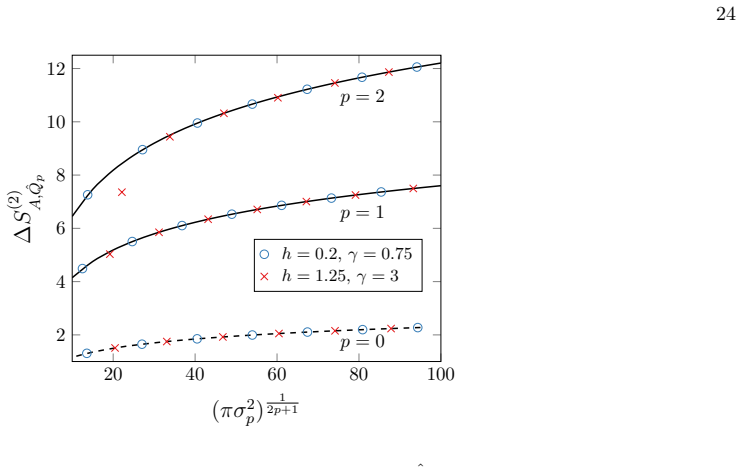
One can directly see thatS (n)(ˆρA) = 0, since|ψ⟩is a product state. On the other hand, applying Eqs. (4)-(5), it is easy to obtain that Zn(α) = Y j∈Λe " nY m=1 cos αm −α m+1 2 j # .(11) Let us focus on the casen= 2 for simplicity. Inserting Eq. (11) in the integral (4), we have ∆S(2) A, ˆQ1 =−ln Z π −π dα 2π e P j∈Λe ln cos2( jα 2 ).(12) We can obtain th...
-
[2]
M. Goldstein and E. Sela, Symmetry-Resolved Entan- glement in Many-Body Systems, Phys. Rev. Lett.120, 200602 (2018)
work page 2018
-
[3]
J. C. Xavier, F. C. Alcaraz, and G. Sierra, Equipartition of the Entanglement Entropy, Phys. Rev. B98, 041106 (2018)
work page 2018
-
[4]
J. M. Deutsch, Quantum statistical mechanics in a closed system, Phys. Rev. A43, 2046 (1991)
work page 2046
-
[5]
Srednicki, Chaos and quantum thermalization, Phys
M. Srednicki, Chaos and quantum thermalization, Phys. Rev. E50, 888 (1994)
work page 1994
- [6]
- [7]
-
[8]
S. Pai, M. Pretko, and R. M. Nandkishore, Localization in fractonic random circuits, Phys. Rev. X9, 021003 (2019)
work page 2019
-
[9]
P. Sala, T. Rakovszky, R. Verresen, M. Knap, and F. Pollmann, Ergodicity Breaking Arising from Hilbert Space Fragmentation in Dipole-Conserving Hamiltoni- ans, Phys. Rev. X10, 011047 (2020)
work page 2020
-
[10]
V. Khemani, M. Hermele, and R. Nandkishore, Local- ization from Hilbert space shattering: From theory to physical realizations, Phys. Rev. B101, 174204 (2020)
work page 2020
-
[11]
S. Moudgalya, A. Prem, R. Nandkishore, N. Regnault, and B. A. Bernevig, Thermalization and its absence within Krylov sub- spaces of a constrained Hamiltonian, in Memorial Volume for Shoucheng Zhang (World Sci- entific, Singapore, 2021) , Chap. 7, pp. 147–209
work page 2021
- [12]
- [13]
-
[14]
Y.-Y. Wang, Y.-H. Shi, Z.-H. Sun,et al., Exploring Hilbert-space fragmentation on a superconducting pro- cessor, PRX Quantum6, 010325 (2025)
work page 2025
-
[15]
H. L. Q. Guo, C. Chenget al., Stark Many-Body Lo- calization on a Superconducting Quantum Processor, Phys. Rev. Lett.127, 240502 (2021)
work page 2021
-
[16]
L. Zhao, P. R. Datla, W. Tian, M. M. Aliyu, and H. Loh, Observation of Quantum Thermalization Restricted to Hilbert Space Fragments andZ 2k Scars, Phys. Rev. X 15, 011035 (2025)
work page 2025
-
[17]
S. Moudgalya and O. I. Motrunich, Hilbert Space Frag- mentation and Commutant Algebras, Phys. Rev. X12, 011050 (2022)
work page 2022
-
[18]
Y. Li, P. Sala, and F. Pollmann, Hilbert space fragmen- tation in open quantum systems, Phys. Rev. Res.5, 043239 (2023)
work page 2023
-
[19]
Y. Li, F. Pollmann, N. Read, and P. Sala, Highly en- tangled stationary states from strong symmetries, Phys. Rev. X15, 011068 (2025)
work page 2025
-
[20]
F. Ares, S. Murciano, and P. Calabrese, Entanglement asymmetry as a probe of symmetry breaking, Nat. Com- mun.14, 2036 (2023)
work page 2036
-
[21]
L. K. Joshi, J. Franke, A. Rath, F. Ares, S. Mur- ciano, F. Kranzl, R. Blatt, P. Zoller, B. Vermersch, P. Calabrese, C. F. Roos, and M. K. Joshi, Observing the Quantum Mpemba Effect in Quantum Simulations, Phys. Rev. Lett.133, 010402 (2024)
work page 2024
-
[22]
C. Rylands, K. Klobas, F. Ares, P. Calabrese, S. Mur- ciano, and B. Bertini, Microscopic Origin of the Quan- tum Mpemba Effect in Integrable Systems, Phys. Rev. Lett.133, 010401 (2024)
work page 2024
-
[23]
F. Ares, P. Calabrese, and S. Murciano, The quantum Mpemba effects, Nat. Rev. Phys.7, 451 (2025)
work page 2025
-
[24]
G. Teza, J. Bechhoefer, A. Lasanta, O. Raz, and M. Vucelja, Speedups in nonequilibrium thermal relax- ation: Mpemba and related effects, Phys. Rep.1164, 1 (2026)
work page 2026
-
[25]
S. D. Bartlett, T. Rudolph, and R. W. Spekkens, Ref- erence frames, superselection rules, and quantum infor- mation, Rev. Mod. Phys.79, 555 (2007)
work page 2007
-
[26]
J. A. Vaccaro, F. Anselmi, H. M. Wiseman, and K. Ja- cobs, Tradeoff between extractable mechanical work, ac- cessible entanglement, and ability to act as a reference system, under arbitrary superselection rules, Phys. Rev. A77, 032114 (2008)
work page 2008
-
[27]
G. Gour, I. Marvian, and R. W. Spekkens, Measuring the quality of a quantum reference frame: The relative entropy of frameness, Phys. Rev. A80, 012307 (2009)
work page 2009
-
[28]
I. Marvian and R. W. Spekkens, Extending Noether’s theorem by quantifying the asymmetry of quantum states, Nature Comm.5, 3821 (2014)
work page 2014
-
[29]
E. Chitambar and G. Gour, Quantum resource theories, Rev. Mod. Phys.91, 025001 (2019)
work page 2019
-
[30]
P. S. Tarabunga, M. Frau, T. Haug, E. Tirrito, and L. Piroli, A nonstabilizerness monotone from stabiliz- erness asymmetry, Quantum Sci. Technol.10, 045026 (2025). 14
work page 2025
- [31]
-
[32]
M. Mazzoni, L. Capizzi, and L. Piroli, Breaking global symmetries with locality-preserving operations, arXiv:2508.15892
-
[33]
S. Garnerone, T. R. de Oliveira, and P. Zanardi, Typ- icality in random matrix product states, Phys. Rev. A 81, 032336 (2010)
work page 2010
-
[34]
S. Garnerone, T. R. de Oliveira, S. Haas, and P. Zanardi, Statistical properties of random matrix product states, Phys. Rev. A82, 052312 (2010)
work page 2010
-
[36]
J. Haferkamp, C. Bertoni, I. Roth, and J. Eisert, Emer- gent Statistical Mechanics from Properties of Disor- dered Random Matrix Product States, PRX Quantum 2, 040308 (2021)
work page 2021
-
[37]
G. Lami, T. Haug, and J. De Nardis, Quantum State Designs with Clifford-Enhanced Matrix Product States, PRX Quantum6, 010345 (2025)
work page 2025
-
[38]
C. Lancien and D. P´ erez-Garc´ ıa, Correlation Length in Random MPS and PEPS, Annales Henri Poincar´ e23, 141–222 (2021)
work page 2021
-
[39]
G. Lami, J. De Nardis, and X. Turkeshi, Anticoncen- tration and State Design of Random Tensor Networks, Phys. Rev. Lett.134, 010401 (2025)
work page 2025
-
[40]
N. Dowling, J. De Nardis, M. Heinrich, X. Turkeshi, and S. Pappalardi, Free independence and uni- tary design from random matrix product unitaries, arXiv:2508.00051
- [41]
-
[42]
P. Sierant, P. Stornati, and X. Turkeshi, Fermionic magic resources of quantum many-body systems, PRX Quantum7, 010302 (2026)
work page 2026
- [43]
- [44]
-
[45]
A. Sauliere, G. Lami, C. Boyer, J. De Nardis, and A. De Luca, Universality in the Anticoncentra- tion of Noisy Quantum Circuits at Finite Depths, arXiv:2508.14975
-
[46]
F. Ares, S. Murciano, P. Calabrese, and L. Piroli, En- tanglement asymmetry dynamics in random quantum circuits, Phys. Rev. Res.7, 033135 (2025)
work page 2025
- [47]
-
[48]
S. Moudgalya and O. I. Motrunich, From symmetries to commutant algebras in standard Hamiltonians, Annals of Physics455, 169384 (2023)
work page 2023
-
[49]
S. Moudgalya and O. I. Motrunich, Exhaustive charac- terization of quantum many-body scars using commu- tant algebras, Phys. Rev. X14, 041069 (2024)
work page 2024
-
[50]
S. Moudgalya and O. I. Motrunich, Symmetries as ground states of local superoperators: Hydrodynamic implications, PRX Quantum5, 040330 (2024)
work page 2024
-
[51]
S. Moudgalya and O. I. Motrunich, Numerical meth- ods for detecting symmetries and commutant algebras, Phys. Rev. B107, 224312 (2023)
work page 2023
- [52]
-
[53]
A. March´ e, G. Morettini, L. Mazza, L. Gotta, and L. Capizzi, Exceptional stationary state in a dephas- ing many-body open quantum system, Phys. Rev. Lett. 135, 020406 (2025)
work page 2025
-
[54]
Gotta, Open-system quantum many-body scars: a theory, arXiv:2509.18023
L. Gotta, Open-system quantum many-body scars: a theory, arXiv:2509.18023
-
[55]
L. Pezz´ e and A. Smerzi, Entanglement, Nonlinear Dy- namics, and the Heisenberg Limit, Phys. Rev. Lett.102, 100401 (2009)
work page 2009
-
[56]
T´ oth, Multipartite entanglement and high-precision metrology, Phys
G. T´ oth, Multipartite entanglement and high-precision metrology, Phys. Rev. A85, 022322 (2012)
work page 2012
- [57]
-
[58]
F. Ferro, Breaking of clustering and macroscopic co- herence under the lens of asymmetry measures, arXiv:2602.15969
-
[59]
F. Ferro and M. Fagotti, Kicking Quantum Fisher In- formation out of Equilibrium, arXiv:2503.21905
-
[60]
S. Yamashika, S. Endo, and H. Tajima, Quantum Fisher Information as a Measure of Symmetry Breaking in Quantum Many-Body Systems, arXiv:2509.07468
-
[61]
M. Chen and H.-H. Chen, R´ enyi entanglement asymme- try in (1+1)-dimensional conformal field theories, Phys. Rev. D109, 065009 (2024)
work page 2024
-
[62]
M. Fossati, F. Ares, J. Dubail, and P. Calabrese, En- tanglement asymmetry in CFT and its relation to non- topological defects, JHEP05, 059 (2024)
work page 2024
- [63]
-
[64]
M. Fossati, C. Rylands, and P. Calabrese, Entanglement asymmetry in CFT with boundary symmetry breaking, JHEP06, 089 (2025)
work page 2025
-
[65]
M. Lastres, S. Murciano, F. Ares, and P. Calabrese, En- tanglement asymmetry in the critical XXZ spin chain, J. Stat. Mech. , 013107 (2025)
work page 2025
- [66]
-
[67]
L. Capizzi and V. Vitale, A universal formula for the entanglement asymmetry of matrix product states, J. Phys. A: Math. Theor.57, 45LT01 (2024)
work page 2024
-
[68]
F. Ares, S. Murciano, L. Piroli, and P. Calabrese, En- tanglement asymmetry study of black hole radiation, Phys. Rev. D110, L061901 (2024)
work page 2024
-
[69]
A. Russotto, F. Ares, and P. Calabrese, Non-Abelian entanglement asymmetry in random states, JHEP06, 149 (2025)
work page 2025
-
[70]
H.-H. Chen and Z.-J. Tang, Entanglement asymmetry in the Hayden-Preskill protocol, Phys. Rev. D111, 066003 (2025)
work page 2025
-
[71]
A. Russotto, F. Ares, and P. Calabrese, Symmetry breaking in chaotic many-body quantum systems at fi- nite temperature, Phys. Rev. E112, L032101 (2025). 15
work page 2025
-
[72]
F. Ares, S. Murciano, E. Vernier, and P. Calabrese, Lack of symmetry restoration after a quantum quench: An entanglement asymmetry study, SciPost Phys.15, 089 (2023)
work page 2023
-
[73]
S. Murciano, F. Ares, I. Klich, and P. Calabrese, En- tanglement asymmetry and quantum Mpemba effect in the XY spin chain, J. Stat. Mech. , 013103 (2024)
work page 2024
-
[74]
F. Caceffo, S. Murciano, and V. Alba, Entangled multi- plets, asymmetry, and quantum Mpemba effect in dis- sipative systems, J. Stat. Mech. , 063103 (2024)
work page 2024
-
[75]
F. Ares, V. Vitale, and S. Murciano, The quantum Mpemba effect in free-fermionic mixed states, Phys. Rev. B111, 104312 (2025)
work page 2025
- [76]
-
[77]
B. Bertini, K. Klobas, M. Collura, P. Calabrese, and C. Rylands, Dynamics of charge fluctuations from asym- metric initial states, Phys. Rev. B109, 184312 (2024)
work page 2024
-
[78]
C. Rylands, E. Vernier, and P. Calabrese, Dynamical symmetry restoration in the Heisenberg spin chain, J. Stat. Mech. , 123102 (2024)
work page 2024
-
[79]
S. Yamashika, F. Ares, and P. Calabrese, Entangle- ment asymmetry and quantum Mpemba effect in two- dimensional free-fermion systems, Phys. Rev. B110, 085126 (2024)
work page 2024
-
[80]
S. Yamashika, P. Calabrese, and F. Ares, Quenching from superfluid to free bosons in two dimensions: en- tanglement, symmetries, and quantum Mpemba effect, Phys. Rev. A111, 043304 (2025)
work page 2025
-
[81]
K. Klobas, Non-equilibrium dynamics of symmetry- resolved entanglement and entanglement asymmetry: exact asymptotics in Rule 54, J. Phys A: Math Theor 57, 505001 (2024)
work page 2024
discussion (0)
Sign in with ORCID, Apple, or X to comment. Anyone can read and Pith papers without signing in.