Recognition: unknown
A Gaussian asymmetry measure
Pith reviewed 2026-05-07 10:43 UTC · model grok-4.3
The pith
A Gaussian asymmetry measure equals the minimal distance to symmetric Gaussian states.
A machine-rendered reading of the paper's core claim, the machinery that carries it, and where it could break.
Core claim
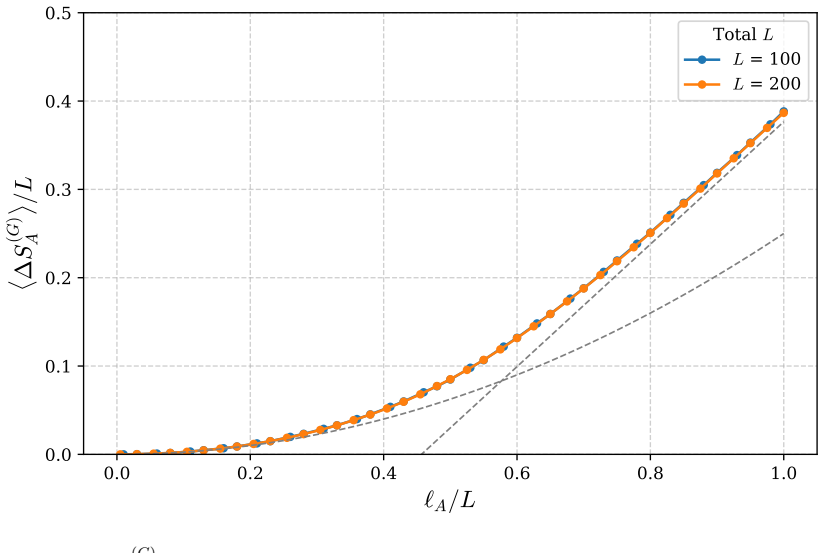
The authors define a Gaussian asymmetry measure and show that it quantifies the minimal distance between a Gaussian state and the manifold of symmetric Gaussian states. They demonstrate that this measure captures the established dynamical signatures of entanglement asymmetry, such as the Mpemba effect, symmetry restoration, and the lack thereof. The Gaussian structure permits exact computation via correlation-matrix methods and asymptotic description through the quasiparticle picture, while also allowing charge fluctuations to serve as a characterisation tool.
What carries the argument
The Gaussian asymmetry measure, defined as the minimal distance from a given Gaussian state to the manifold of states symmetric under the charge operator.
Load-bearing premise
That restricting the asymmetry measure to the Gaussian manifold preserves the essential physical signatures of standard entanglement asymmetry without losing key dynamical information.
What would settle it
A concrete free-fermion chain in which the Gaussian measure fails to exhibit the Mpemba effect or symmetry restoration while the full non-Gaussian entanglement asymmetry does exhibit them.
Figures



read the original abstract
The study of Entanglement Asymmetry has emerged in recent years as a powerful tool to characterise the symmetry properties of quantum states in relation to a given charge operator through the lens of entanglement. While extremely powerful and general, the standard definition of asymmetry introduces significant non-Gaussian features in free-fermionic systems, leading to certain analytical limitations. In this work, we introduce an asymmetry measure that remains strictly within the Gaussian manifold and analyse its properties. In particular, we show that it quantifies the minimal distance between a Gaussian state and the manifold of symmetric Gaussian states. We further demonstrate that this measure captures the established dynamical signatures of entanglement asymmetry, such as the Mpemba effect, symmetry restoration, and the lack thereof. The Gaussian structure allows these novel asymmetry measures to be computed exactly using correlation matrix techniques, and to be described asymptotically through the quasiparticle picture. We also comment on the possibility of using charge fluctuations to characterise the asymmetry of a Gaussian state.
Editorial analysis
A structured set of objections, weighed in public.
Referee Report
Summary. The paper introduces a Gaussian-restricted asymmetry measure for free-fermionic systems that avoids the non-Gaussian features of the standard entanglement asymmetry. It claims this measure equals the minimal distance from a given Gaussian state to the manifold of symmetric Gaussian states, and demonstrates that it reproduces key dynamical signatures of entanglement asymmetry including the Mpemba effect, symmetry restoration, and the absence of restoration. The Gaussian structure permits exact computation via correlation matrices and asymptotic analysis via the quasiparticle picture; the paper also comments on characterizing asymmetry via charge fluctuations.
Significance. If the central claims hold, the work supplies an analytically tractable tool for studying symmetry properties in Gaussian states, leveraging correlation-matrix techniques and the quasiparticle picture to obtain exact and asymptotic results. This could streamline investigations of symmetry breaking and restoration in free-fermion models while retaining the qualitative dynamical features of the broader entanglement-asymmetry framework.
major comments (2)
- [dynamical signatures / quasiparticle analysis] The central claim that the Gaussian measure captures the Mpemba effect, symmetry restoration, and lack thereof (stated in the abstract and demonstrated in the dynamical sections) rests on the assumption that restricting to the Gaussian manifold preserves essential signatures without loss from non-Gaussian contributions generated by the charge operator. The demonstrations appear confined to Gaussian states and correlation-matrix evolution; without an explicit comparison or counter-example check against the full non-Gaussian entanglement asymmetry in at least one free-fermion evolution where non-Gaussianity is known to matter, it is unclear whether restoration times or Mpemba crossings are preserved.
- [definition / properties section] The statement that the measure 'quantifies the minimal distance between a Gaussian state and the manifold of symmetric Gaussian states' is presented as a key property. The supporting derivation (presumably in the definition or properties section) must be checked for whether the distance is taken with respect to a specific metric on the Gaussian manifold (e.g., Hilbert-Schmidt or Bures) and whether the minimum is achieved uniquely at the symmetrized state; any dependence on the choice of metric would affect the interpretation as a canonical asymmetry quantifier.
minor comments (2)
- [final comments] The abstract mentions 'we also comment on the possibility of using charge fluctuations to characterise the asymmetry'; if this is developed only briefly, consider expanding it into a short dedicated subsection with an explicit formula relating fluctuations to the new measure.
- [throughout] Notation for the new asymmetry measure and the symmetric manifold should be introduced with a clear symbol (e.g., A_G or similar) and distinguished from the standard entanglement asymmetry throughout the text and figures.
Simulated Author's Rebuttal
We thank the referee for their careful reading and constructive comments on our manuscript. We address each major comment below.
read point-by-point responses
-
Referee: [dynamical signatures / quasiparticle analysis] The central claim that the Gaussian measure captures the Mpemba effect, symmetry restoration, and lack thereof (stated in the abstract and demonstrated in the dynamical sections) rests on the assumption that restricting to the Gaussian manifold preserves essential signatures without loss from non-Gaussian contributions generated by the charge operator. The demonstrations appear confined to Gaussian states and correlation-matrix evolution; without an explicit comparison or counter-example check against the full non-Gaussian entanglement asymmetry in at least one free-fermion evolution where non-Gaussianity is known to matter, it is unclear whether restoration times or Mpemba crossings are preserved.
Authors: Our work introduces a Gaussian-restricted measure specifically for free-fermionic systems to enable exact correlation-matrix computations and quasiparticle analysis. All dynamical demonstrations, including the Mpemba effect and symmetry restoration (or its absence), are performed within Gaussian states and their exact evolution under quadratic Hamiltonians. We agree that non-Gaussian contributions arising from the charge operator could quantitatively affect results in certain evolutions, and our manuscript does not include a direct numerical comparison to the full entanglement asymmetry in regimes where non-Gaussianity is known to be significant. We will add a clarifying paragraph in the discussion section stating that the Gaussian measure is intended as an analytically tractable proxy that reproduces the key qualitative signatures, while noting the absence of such a benchmark as a limitation. revision: partial
-
Referee: [definition / properties section] The statement that the measure 'quantifies the minimal distance between a Gaussian state and the manifold of symmetric Gaussian states' is presented as a key property. The supporting derivation (presumably in the definition or properties section) must be checked for whether the distance is taken with respect to a specific metric on the Gaussian manifold (e.g., Hilbert-Schmidt or Bures) and whether the minimum is achieved uniquely at the symmetrized state; any dependence on the choice of metric would affect the interpretation as a canonical asymmetry quantifier.
Authors: In the definition and properties section we derive the measure explicitly as the minimal distance to the manifold of symmetric Gaussian states, where the distance is the Hilbert-Schmidt distance between density operators (restricted to the Gaussian submanifold). We prove that the minimum is achieved uniquely at the Gaussian state obtained by symmetrizing the original state with respect to the charge operator. The Hilbert-Schmidt metric is chosen because it is compatible with the correlation-matrix representation used throughout the paper. We will revise the text to state the metric explicitly and to include the uniqueness argument in a dedicated lemma. revision: yes
- Lack of explicit comparison between the Gaussian measure and the full non-Gaussian entanglement asymmetry in at least one free-fermion evolution where non-Gaussianity is known to matter.
Circularity Check
No circularity: Gaussian asymmetry measure defined independently with derived properties
full rationale
The paper introduces a new asymmetry measure restricted to the Gaussian manifold, motivated by analytical limitations of the standard (non-Gaussian) definition. It then shows via explicit construction that this measure equals the minimal distance to the manifold of symmetric Gaussian states, and demonstrates capture of dynamical signatures (Mpemba effect, symmetry restoration) through correlation-matrix and quasiparticle computations. No step reduces by construction to a fitted parameter, self-citation chain, or tautological renaming; the distance identification and dynamical demonstrations are presented as independent results rather than presupposed inputs. The derivation remains self-contained against external benchmarks without load-bearing self-referential elements.
Axiom & Free-Parameter Ledger
axioms (1)
- domain assumption Free-fermionic systems are described by Gaussian states fully characterized by two-point correlation matrices.
invented entities (1)
-
Gaussian asymmetry measure
no independent evidence
Reference graph
Works this paper leans on
-
[1]
J. M. Deutsch,Quantum statistical mechanics in a closed system,Phys. Rev. A43 (1991) 2046
1991
-
[2]
Srednicki,Chaos and quantum thermalization,Phys
M. Srednicki,Chaos and quantum thermalization,Phys. Rev. E50(1994) 888
1994
-
[3]
Rigol, V
M. Rigol, V. Dunjko, and M. Olshanii,Thermalization and its mechanism for generic isolated quantum systems,Nature452(2008) 854
2008
-
[4]
D’Alessio, Y
L. D’Alessio, Y. Kafri, A. Polkovnikov, and M. Rigol,From quantum chaos and eigenstate thermalization to statistical mechanics and thermodynamics,Adv. Phys. 65(2016) 239
2016
-
[5]
J. M. Deutsch,Eigenstate thermalization hypothesis,Rep. Prog. Phys81(2018) 082001
2018
-
[6]
D. A. Abanin, E. Altman, I. Bloch, and M. Serbyn,Colloquium: Many-body localization, thermalization, and entanglement,Rev. Mod. Phys.91(2019) 021001
2019
-
[7]
A. M. Kaufman, M. E. Tai, A. Lukin, M. Rispoli, R. Schittko, P. M. Preiss, and M. Greiner,Quantum thermalization through entanglement in an isolated many-body system,Science353(2016) 794
2016
-
[8]
Parez, R
G. Parez, R. Bonsignori, and P. Calabrese,Quasiparticle dynamics of symmetry- resolved entanglement after a quench: Examples of conformal field theories and free fermions,Phys. Rev. B103(2021) L041104
2021
-
[9]
Bertini, P
B. Bertini, P. Calabrese, M. Collura, K. Klobas, and C. Rylands,Nonequilibrium full counting statistics and symmetry-resolved entanglement from space-time duality, Phys. Rev. Lett.131(2023) 140401. 19
2023
-
[10]
G. Gour, I. Marvian, and R. W. Spekkens,Measuring the quality of a quantum reference frame: The relative entropy of frameness,Phys. Rev. A80(2009) 012307
2009
-
[11]
Marvian and R
I. Marvian and R. W. Spekkens,Extending Noether’s theorem by quantifying the asymmetry of quantum states,Nature Commun.5(2014) 3821
2014
-
[12]
Casini, M
H. Casini, M. Huerta, J. M. Magan, and D. Pontello,Entropic order parameters for the phases of QFT,J. High Energy Phys.04(2021) 277
2021
-
[13]
F. Ares, S. Murciano, and P. Calabrese,Entanglement asymmetry as a probe of symmetry breaking,Nat. Commun.14(2023) 2036
2023
-
[14]
F. Ares, P. Calabrese, and S. Murciano,The quantum Mpemba effects,Nat. Rev. Phys.7(2025) 451
2025
-
[15]
G. Teza, J. Bechhoefer, A. Lasanta, O. Raz, and M. Vucelja,Speedups in nonequi- librium thermal relaxation: Mpemba and related effects,Physics Reports1164 (2026) 1
2026
-
[16]
Calabrese,The quantum Mpemba effect in closed systems: from theory to experiment,J
P. Calabrese,The quantum Mpemba effect in closed systems: from theory to experiment,J. Stat. Mech.(2026) 034002
2026
-
[17]
Summer, M
A. Summer, M. Moroder, L. P. Bettmann, X. Turkeshi, I. Marvian, and J. Goold, Resource-theoretical unification of Mpemba effects: Classical and quantum,Phys. Rev. X16(2026) 011065
2026
-
[18]
E. B. Mpemba and D. G. Osborne,Cool?,Physics Education4(1969) 172
1969
-
[19]
Murciano, F
S. Murciano, F. Ares, I. Klich, and P. Calabrese,Entanglement asymmetry and quantum Mpemba effect in the XY spin chain,J. Stat. Mech.(2024) 013103
2024
-
[20]
Rylands, K
C. Rylands, K. Klobas, F. Ares, P. Calabrese, S. Murciano, and B. Bertini,Micro- scopic origin of the quantum Mpemba effect in integrable systems,Phys. Rev. Lett. 133(2024) 010401
2024
-
[21]
F. Ares, C. Rylands, and P. Calabrese,A simpler probe of the quantum Mpemba effect in closed systems,J. Phys. A58(2025) 445302
2025
-
[22]
Chalas, F
K. Chalas, F. Ares, C. Rylands, and P. Calabrese,Multiple crossings during dynamical symmetry restoration and implications for the quantum Mpemba effect, J. Stat. Mech.(2024) 103101
2024
-
[23]
Rylands, E
C. Rylands, E. Vernier, and P. Calabrese,Dynamical symmetry restoration in the Heisenberg spin chain,J. Stat. Mech.(2024) 123102
2024
-
[24]
Yamashika, F
S. Yamashika, F. Ares, and P. Calabrese,Entanglement asymmetry and quantum Mpemba effect in two-dimensional free-fermion systems,Phys. Rev. B110(2024) 085126
2024
-
[25]
Banerjee, S
T. Banerjee, S. Das, and K. Sengupta,Entanglement asymmetry in periodically driven quantum systems,SciPost Phys.19(2025) 051
2025
-
[26]
Yamashika, P
S. Yamashika, P. Calabrese, and F. Ares,Quenching from superfluid to free bosons in two dimensions: Entanglement, symmetries, and the quantum Mpemba effect, Phys. Rev. A111(2025) 043304
2025
-
[27]
Gibbins, A
M. Gibbins, A. Gammon-Smith, and B. Bertini,Translation symmetry restoration in integrable systems: The noninteracting case,Phys. Rev, B112(2025) L180307. 20
2025
-
[28]
F. Ares, V. Vitale, and S. Murciano,Quantum Mpemba effect in free-fermionic mixed states,Phys. Rev. B111(2025) 104312
2025
-
[29]
Klobas,Non-equilibrium dynamics of symmetry-resolved entanglement and entanglement asymmetry: exact asymptotics in rule 54,J
K. Klobas,Non-equilibrium dynamics of symmetry-resolved entanglement and entanglement asymmetry: exact asymptotics in rule 54,J. Phys. A57(2024) 505001
2024
-
[30]
Caceffo, S
F. Caceffo, S. Murciano, and V. Alba,Entangled multiplets, asymmetry, and quantum Mpemba effect in dissipative systems,J. Stat. Mech.(2024) 063103
2024
-
[31]
Di Giulio, X
G. Di Giulio, X. Turkeshi, and S. Murciano,Measurement-induced symmetry restoration and quantum Mpemba effect,Entropy27(2025)
2025
-
[32]
Liu, H.-K
S. Liu, H.-K. Zhang, S. Yin, and S.-X. Zhang,Symmetry restoration and quantum Mpemba effect in symmetric random circuits,Phys. Rev. Lett.133(2024) 140405
2024
-
[33]
Turkeshi, P
X. Turkeshi, P. Calabrese, and A. De Luca,Quantum Mpemba effect in random circuits,Phys. Rev. Lett.135(2025) 040403
2025
-
[34]
F. Ares, S. Murciano, P. Calabrese, and L. Piroli,Entanglement asymmetry dy- namics in random quantum circuits,Phys. Rev. Res.7(2025) 033135
2025
-
[35]
Klobas, C
K. Klobas, C. Rylands, and B. Bertini,Translation symmetry restoration under random unitary dynamics,Phys. Rev. B111(2025) L140304
2025
-
[36]
Foligno, P
A. Foligno, P. Calabrese, and B. Bertini,Nonequilibrium dynamics of charged dual-unitary circuits,PRX Quantum6(2025) 010324
2025
- [37]
-
[38]
Yu, Z.-X
H. Yu, Z.-X. Li, and S.-X. Zhang,Symmetry breaking dynamics in quantum many-body systems,Chin. Phys. Lett.42(2025) 110602
2025
- [39]
-
[40]
H.-Z. Li, C. H. Lee, S. Liu, S.-X. Zhang, and J.-X. Zhong,Quantum Mpemba effect in long-ranged U(1)-symmetric random circuits,Phys. Rev. B113(2026) 134310
2026
-
[41]
Liu, H.-K
S. Liu, H.-K. Zhang, S. Yin, S.-X. Zhang, and H. Yao,Symmetry restoration and quantum Mpemba effect in many-body localization systems,Science Bulletin70 (2025) 3991
2025
-
[42]
Dynamics of entanglement fluctuations and quantum Mpemba effect in the $\nu=1$ QSSEP model
A. Russotto, F. Ares, P. Calabrese, and V. Alba,Dynamics of entanglement fluctu- ations and quantum Mpemba effect in the ν = 1QSSEP model,arXiv:2510.25519
work page internal anchor Pith review arXiv
-
[43]
L. K. Joshi, J. Franke, A. Rath, F. Ares, S. Murciano, F. Kranzl, R. Blatt, P. Zoller, B. Vermersch, P. Calabrese, C. F. Roos, and M. K. Joshi,Observing the quantum Mpemba effect in quantum simulations,Phys. Rev. Lett.133(2024) 010402
2024
-
[44]
Yamashika and F
S. Yamashika and F. Ares,Quantum Mpemba effect in long-range spin systems, Phys. Rev. Lett.136(2026)
2026
- [45]
-
[46]
Bhore, L
T. Bhore, L. Su, I. Martin, A. A. Clerk, and Z. Papi´ c,Quantum Mpemba effect without global symmetries,Phys. Rev. B112(2025) L121109
2025
- [47]
-
[48]
S. Yamashika and R. Hamazaki,Quantum many-body Mpemba effect through resonances,arXiv:2603.11788
-
[49]
T. M. M¨ uller, S. Pappalardi, and R. Fazio,Quantum Mpemba effect in chaotic systems with conservation laws,arXiv:2604.11876
work page internal anchor Pith review Pith/arXiv arXiv
-
[50]
H. Yu, J. Hu, and S.-X. Zhang,Quantum pontus-Mpemba effects in real- and imaginary-time dynamics,Phys. Rev. B113(2026) 134304
2026
- [51]
-
[52]
Capizzi and M
L. Capizzi and M. Mazzoni,Entanglement asymmetry in the ordered phase of many-body systems: the Ising field theory,J. High Energ. Phys.12(2023) 144
2023
-
[53]
Ferro, F
F. Ferro, F. Ares, and P. Calabrese,Non-equilibrium entanglement asymmetry for discrete groups: the example of the XY spin chain,J. Stat. Mech.(2024) 023101
2024
-
[54]
B. J. J. Khor, D. M. K¨ urk¸ c¨ uoglu, T. J. Hobbs, G. N. Perdue, and I. Klich, Confinement and kink entanglement asymmetry on a quantum Ising chain,Quantum 8(2024) 1462
2024
-
[55]
Mari´ c, F
V. Mari´ c, F. Ferro, and M. Fagotti,Disorder-order interface propagating over the ferromagnetic ground state in the transverse field Ising chain,Phys. Rev. B111 (2025) 205118
2025
-
[56]
F. Ferro,Breaking of clustering and macroscopic coherence under the lens of asymmetry measures,arXiv:2602.15969
-
[57]
Casini, J
H. Casini, J. M. Mag´ an, and P. J. Mart´ ınez,Entropic order parameters in weakly coupled gauge theories,J. High Energy Phys.2022(2022)
2022
-
[58]
Kusuki, S
Y. Kusuki, S. Murciano, H. Ooguri, and S. Pal,Entanglement asymmetry and symmetry defects in boundary conformal field theory,J. High Energ. Phys.01 (2025) 057
2025
-
[59]
Fossati, F
M. Fossati, F. Ares, J. Dubail, and P. Calabrese,Entanglement asymmetry in CFT and its relation to non-topological defects,J. High Energ. Phys.05(2024) 59
2024
-
[60]
Chen and H.-H
M. Chen and H.-H. Chen,R´ enyi entanglement asymmetry in (1 + 1)-dimensional conformal field theories,Phys. Rev. D109(2024) 065009
2024
-
[61]
Lastres, S
M. Lastres, S. Murciano, F. Ares, and P. Calabrese,Entanglement asymmetry in the critical XXZ spin chain,J. Stat. Mech.(2025) 013107
2025
-
[62]
Chen and Z.-J
H.-H. Chen and Z.-J. Tang,Entanglement asymmetry in the Hayden-Preskill protocol,Phys. Rev. D111(2025) 066003
2025
-
[63]
Benini, V
F. Benini, V. Godet, and A. H. Singh,Entanglement asymmetry in conformal field theory and holography,Progr. Theor. Exp. Phys.(2025) 063B05
2025
-
[64]
Fossati, C
M. Fossati, C. Rylands, and P. Calabrese,Entanglement asymmetry in CFT with 22 boundary symmetry breaking,J. High Energ. Phys.06(2025) 089
2025
- [65]
-
[66]
A. G. Lamas, J. Gliozzi, and T. L. Hughes,Higher-form entanglement asymmetry and topological order,arXiv:2510.03967
work page internal anchor Pith review Pith/arXiv arXiv
- [67]
-
[68]
A. Florio and S. Murciano,Entanglement asymmetry in gauge theories: chiral anomaly in the finite temperature massless schwinger model,arXiv:2511.01966
- [69]
-
[70]
Capizzi and V
L. Capizzi and V. Vitale,A universal formula for the entanglement asymmetry of matrix product states,J. Phys. A57(2024) 45LT01
2024
-
[71]
Mazzoni, L
M. Mazzoni, L. Capizzi, and L. Piroli,Breaking global symmetries with locality- preserving operations,Phys. Rev. Res.8(2026) L012056
2026
-
[72]
Enhancing entanglement asymmetry in fragmented quantum systems
L. Gotta, F. Ares, and S. Murciano,Enhancing entanglement asymmetry in frag- mented quantum systems,arXiv:2603.02338
work page internal anchor Pith review Pith/arXiv arXiv
-
[73]
F. Ares, S. Murciano, L. Piroli, and P. Calabrese,Entanglement asymmetry study of black hole radiation,Phys. Rev. D110(2024) L061901
2024
-
[74]
Russotto, F
A. Russotto, F. Ares, and P. Calabrese,Non-abelian entanglement asymmetry in random states,J. High Energ. Phys.06(2025) 149
2025
-
[75]
Russotto, F
A. Russotto, F. Ares, and P. Calabrese,Symmetry breaking in chaotic many-body quantum systems at finite temperature,Phys. Rev. E112(2025) L032101
2025
-
[76]
Fujimura and S
H. Fujimura and S. Shimamori,Entanglement asymmetry and quantum Mpemba effect for non-Abelian global symmetry,J. High Energ. Phys.03(2026) 244
2026
- [77]
-
[78]
F. Ares, S. Murciano, E. Vernier, and P. Calabrese,Lack of symmetry restoration after a quantum quench: An entanglement asymmetry study,SciPost Phys.15 (2023) 089
2023
-
[79]
R. Hara, S. Endo, and S. Yamashika,Dynamics of entanglement asymmetry for space-inversion symmetry of free fermions on honeycomb lattices,Phys. Rev. B113 (2026) 144313
2026
-
[80]
Peschel,Calculation of reduced density matrices from correlation functions,J
I. Peschel,Calculation of reduced density matrices from correlation functions,J. Phys. A36(2003) L205
2003
discussion (0)
Sign in with ORCID, Apple, or X to comment. Anyone can read and Pith papers without signing in.