Graph Disjointness with Applications to Reversible Markov Chains
Pith reviewed 2026-05-15 17:22 UTC · model grok-4.3
The pith
Two graphs without self-loops are strongly disjoint exactly when they are weakly disjoint and one of them is a tree.
A machine-rendered reading of the paper's core claim, the machinery that carries it, and where it could break.
Core claim
Two graphs G and H without self-loops are strongly disjoint if and only if they are weakly disjoint and exactly one of them is a tree. Weak disjointness is equivalent to the absence of nontrivial spectral overlap between the Markov transition matrices. Both forms of disjointness are determined solely by the underlying unweighted graphs.
What carries the argument
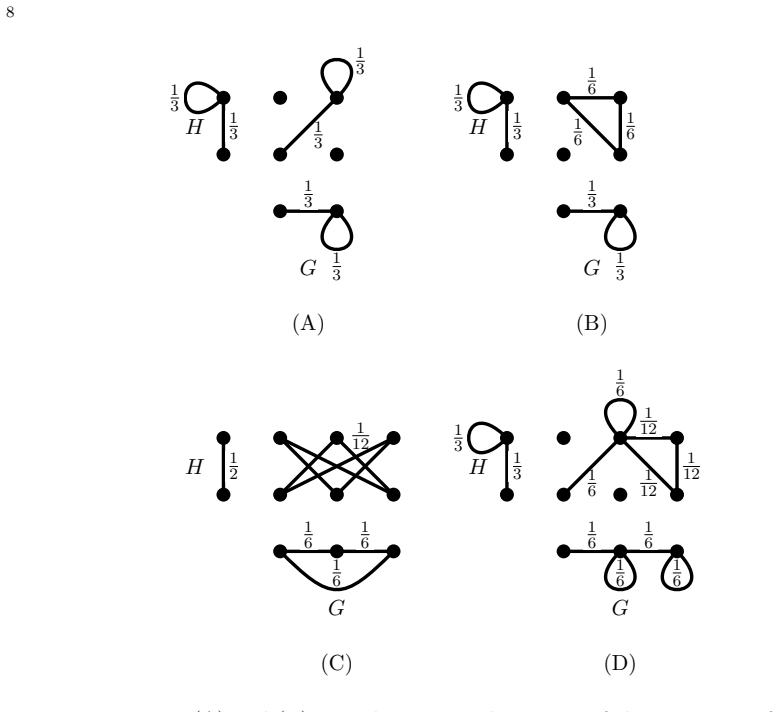
Graph joinings, which are graphs on the product of the vertex sets whose random walks realize couplings of the original chains; strong disjointness means the only such joining is the tensor product.
If this is right
- Weak disjointness of graphs translates directly into rigidity of reversible couplings of the associated Markov chains.
- The tree condition distinguishes cases where spectral non-overlap alone forces the product coupling.
- Edge weights can be varied arbitrarily without changing whether two graphs are strongly or weakly disjoint.
- Graph factors and joinings become tools for classifying when Markov chain couplings are forced to be independent.
Where Pith is reading between the lines
- The characterization may let researchers test coupling rigidity by computing eigenvalues and checking for trees rather than searching over all possible couplings.
- The result suggests that most pairs of graphs admit non-product reversible couplings unless spectral separation or tree structure intervenes.
- Extending the spectral criterion to infinite graphs or directed graphs would require new joining theory but could follow the same outline.
Load-bearing premise
The standard bijection between weighted undirected graphs and reversible Markov chains via vertex random walks holds, and the graphs are finite and loop-free.
What would settle it
Exhibit two non-tree graphs whose transition matrices have no spectral overlap yet admit a joining whose degree function differs from the tensor product, or two graphs with spectral overlap that admit no such non-tensor joining.
Figures

read the original abstract
The correspondence between weighted undirected graphs and reversible Markov chains via vertex random walks is simple and well known. Leveraging this correspondence and ideas from the theory of dynamical systems, we study the structural discordance of graphs and Markov chains by means of graph joinings. Informally, a joining of graphs $G$ and $H$ is a graph on the product of their vertex sets giving rise to a coupling of their random walks. Graphs $G$ and $H$ are strongly disjoint if their only joining is the tensor product, and they are weakly disjoint if the degree function of every joining is equal to the degree function of the tensor product. We establish close connections between graph joinings, disjointness, and graph factors. Our first principal result characterizes weak disjointness of graphs in terms of the spectral overlap of their Markov transition matrices. The second establishes that two graphs without self loops are strongly disjoint if and only if they are weakly disjoint and exactly one of the graphs is a tree. The third shows that the strong or weak disjointness of graphs is essentially determined by their vertex and edge sets, without regard to edge weights. Translating these results into the language of Markov chains yields new insights into the rigidity and structure of reversible couplings of reversible Markov chains.
Editorial analysis
A structured set of objections, weighed in public.
Referee Report
Summary. The paper leverages the standard bijection between positive edge weights on finite undirected graphs without self-loops and reversible Markov chains via vertex random walks. It defines a joining of graphs G and H as a graph on the product vertex set that induces a coupling of the associated random walks. Strong disjointness means the only joining is the tensor product; weak disjointness means every joining has the same degree function as the tensor product. The three principal results are: (i) weak disjointness is equivalent to zero spectral overlap between the Markov transition matrices; (ii) for graphs without self-loops, strong disjointness holds if and only if the graphs are weakly disjoint and exactly one is a tree; (iii) both notions of disjointness depend only on the vertex and edge sets, independent of the specific positive edge weights. These are translated back to statements about the rigidity of reversible couplings of reversible Markov chains.
Significance. If the characterizations hold, the work supplies a clean structural criterion for when two reversible Markov chains admit only the independent coupling (up to the tree condition), expressed in terms of spectral overlap and graph-theoretic properties. The independence from edge weights is a notable strength, as is the explicit link to joinings from dynamical systems. The results are parameter-free once the vertex/edge sets are fixed and rest on a well-known correspondence, which strengthens their applicability to questions of coupling rigidity.
major comments (2)
- [§4, Theorem 3.2] §4, Theorem 3.2 (strong-disjointness characterization): the 'only if' direction invokes that the graphs are finite and without self-loops to rule out non-tensor joinings; the manuscript should explicitly state whether the finiteness hypothesis can be relaxed to locally finite graphs or whether a counter-example exists in the infinite case.
- [§3.1, Definition 2.4] §3.1, Definition 2.4 and Proposition 3.1: the spectral-overlap characterization of weak disjointness is stated for the normalized Laplacian or the transition matrix; the proof sketch should clarify whether the overlap is measured in the L2 inner product with respect to the stationary measure or the counting measure, as this affects the precise statement of the equivalence.
minor comments (3)
- [Abstract, §1] The abstract and introduction use 'tensor product' without a forward reference to its definition in §2; add an explicit cross-reference.
- [§2, §3] Notation for the degree function of a joining (e.g., d_{G⊗H}) is introduced in §2 but used without reminder in the statements of Theorems 3.1 and 3.2; a short notational table or consistent reminder would improve readability.
- [§5] The translation to Markov-chain language in §5 would benefit from one concrete numerical example (two small graphs, their transition matrices, and the resulting coupling) to illustrate the spectral-overlap condition.
Simulated Author's Rebuttal
We thank the referee for the careful review and the positive recommendation for minor revision. We address each of the major comments below and have incorporated the suggested clarifications into the revised manuscript.
read point-by-point responses
-
Referee: [§4, Theorem 3.2] §4, Theorem 3.2 (strong-disjointness characterization): the 'only if' direction invokes that the graphs are finite and without self-loops to rule out non-tensor joinings; the manuscript should explicitly state whether the finiteness hypothesis can be relaxed to locally finite graphs or whether a counter-example exists in the infinite case.
Authors: We thank the referee for this observation. The proof indeed relies on finiteness to exclude certain pathological joinings in the infinite setting. In the revised version, we have added an explicit statement in the discussion following Theorem 3.2 noting that the characterization is established under the assumption of finite graphs, and that the question of extension to locally finite graphs remains open, with no counterexamples currently known. This addresses the request for clarification without altering the main results. revision: partial
-
Referee: [§3.1, Definition 2.4] §3.1, Definition 2.4 and Proposition 3.1: the spectral-overlap characterization of weak disjointness is stated for the normalized Laplacian or the transition matrix; the proof sketch should clarify whether the overlap is measured in the L2 inner product with respect to the stationary measure or the counting measure, as this affects the precise statement of the equivalence.
Authors: We appreciate this request for precision. The spectral overlap is defined using the L² inner product with respect to the stationary probability measure (corresponding to the normalized Laplacian). We have revised the proof sketch in Section 3.1 to explicitly specify this, ensuring the equivalence is stated clearly with respect to the appropriate measure. This does not change the mathematical content but improves clarity. revision: yes
Circularity Check
No significant circularity detected
full rationale
The paper's derivations of weak and strong disjointness characterizations proceed directly from the standard bijection between finite weighted undirected graphs without self-loops and reversible Markov chains (via vertex random walks) together with the definition of graph joinings. The first principal result equates weak disjointness to spectral overlap of transition matrices; the second equates strong disjointness to weak disjointness plus exactly one graph being a tree; the third shows independence from specific edge weights. All three follow from the joining definition and standard spectral graph theory without any fitted parameters renamed as predictions, self-citation load-bearing steps, or ansatzes smuggled via prior work by the same authors. The derivation chain is therefore self-contained against external benchmarks.
Axiom & Free-Parameter Ledger
axioms (1)
- domain assumption Weighted undirected graphs correspond to reversible Markov chains via vertex random walks
invented entities (3)
-
graph joining
no independent evidence
-
strong disjointness
no independent evidence
-
weak disjointness
no independent evidence
Reference graph
Works this paper leans on
-
[1]
David J Aldous. Lower bounds for covering times for reversible Markov chains and random walks on graphs.Journal of Theoretical Probability, 2(1):91–100, 1989
work page 1989
-
[2]
Frank Ball and Geoffrey F Yeo. Lumpability and marginalisability for continuous-time Markov chains.Journal of Applied Probability, 30(3):518–528, 1993
work page 1993
-
[3]
An eigenvector condition for Markov chain lumpa- bility.Operations Research, 25(6):1028–1031, 1977
Donald R Barr and Marlin U Thomas. An eigenvector condition for Markov chain lumpa- bility.Operations Research, 25(6):1028–1031, 1977
work page 1977
-
[4]
Richard H Bartels and George W Stewart. Algorithm 432 [c2]: Solution of the matrix equation AX+ XB= C [f4].Communications of the ACM, 15(9):820–826, 1972
work page 1972
-
[5]
Rajendra Bhatia and Peter Rosenthal. How and why to solve the operator equation AX- XB= Y.Bulletin of the London Mathematical Society, 29(1):1–21, 1997
work page 1997
-
[6]
Niloy Biswas, Pierre E Jacob, and Paul Vanetti. Estimating convergence of Markov chains with l-lag couplings.Advances in neural information processing systems, 32, 2019
work page 2019
-
[7]
Symmetry analysis of re- versible Markov chains.Internet Mathematics, 2(1):31–71, 2005
Stephen Boyd, Persi Diaconis, Pablo Parrilo, and Lin Xiao. Symmetry analysis of re- versible Markov chains.Internet Mathematics, 2(1):31–71, 2005
work page 2005
-
[8]
Fastest mixing Markov chain on a graph
Stephen Boyd, Persi Diaconis, and Lin Xiao. Fastest mixing Markov chain on a graph. SIAM review, 46(4):667–689, 2004. 53
work page 2004
-
[9]
A Markovian function of a Markov chain.The Annals of Mathematical Statistics, 29(4):1112–1122, 1958
Cletus J Burke and Murray Rosenblatt. A Markovian function of a Markov chain.The Annals of Mathematical Statistics, 29(4):1112–1122, 1958
work page 1958
-
[10]
American Mathematical Soc., 1997
Fan RK Chung.Spectral graph theory, volume 92. American Mathematical Soc., 1997
work page 1997
-
[11]
An introduction to joinings in ergodic theory
Thierry De La Rue. An introduction to joinings in ergodic theory.arXiv preprint math/0507429, 2005
work page internal anchor Pith review Pith/arXiv arXiv 2005
-
[12]
Thierry De La Rue. Joinings in ergodic theory. InErgodic Theory, pages 149–168. Springer, 2023
work page 2023
-
[13]
Persi Diaconis. The cutoff phenomenon in finite Markov chains.Proceedings of the National Academy of Sciences, 93(4):1659–1664, 1996
work page 1996
-
[14]
Analysis of a nonreversible Markov chain sampler.Annals of Applied Probability, pages 726–752, 2000
Persi Diaconis, Susan Holmes, and Radford M Neal. Analysis of a nonreversible Markov chain sampler.Annals of Applied Probability, pages 726–752, 2000
work page 2000
-
[15]
On a Markov construction of couplings.arXiv preprint arXiv:2305.02580, 2023
Persi Diaconis and Laurent Miclo. On a Markov construction of couplings.arXiv preprint arXiv:2305.02580, 2023
-
[16]
Geometric bounds for eigenvalues of Markov chains
Persi Diaconis and Daniel Stroock. Geometric bounds for eigenvalues of Markov chains. The annals of applied probability, pages 36–61, 1991
work page 1991
- [17]
-
[18]
Paul Erd˝ os and Gabor N Sarkozy. On cycles in the coprime graph of integers.the electronic journal of combinatorics, pages R8–R8, 1997
work page 1997
-
[19]
Lumping complex networks.Lectures and Gallery of Madeira Math Encounters XXXV, 2008
R Filliger and MO Hongler. Lumping complex networks.Lectures and Gallery of Madeira Math Encounters XXXV, 2008
work page 2008
-
[20]
Harry Furstenberg. Disjointness in ergodic theory, minimal sets, and a problem in dio- phantine approximation.Mathematical systems theory, 1(1):1–49, 1967
work page 1967
-
[21]
Shmuel Glasner and Benjamin Weiss. Minimal transformations with no common factor need not be disjoint.Israel Journal of Mathematics, 45:1–8, 1983
work page 1983
-
[22]
Robert M Gray, David L Neuhoff, and Paul C Shields. A generalization of Ornstein’s d distance with applications to information theory.The Annals of Probability, pages 315–328, 1975
work page 1975
-
[23]
Phuong N Ho` ang, Kevin McGoff, Andrew B Nobel, Yang Xiang, and Bongsoo Yi. Opti- mal graph joining with applications to isomorphism detection and identification.arXiv preprint arXiv:2511.14862, 2025
-
[24]
Jeffrey J Hunter. Coupling and mixing times in a Markov chain.Linear algebra and its applications, 430(10):2607–2621, 2009
work page 2009
-
[25]
Gregory F Lawler and Alan D Sokal. Bounds on thel 2 spectrum for Markov chains and Markov processes: a generalization of Cheeger’s inequality.Transactions of the American mathematical society, 309(2):557–580, 1988
work page 1988
-
[26]
American Mathematical Soc., 2017
David A Levin and Yuval Peres.Markov chains and mixing times, volume 107. American Mathematical Soc., 2017
work page 2017
-
[27]
FGOT: Graph distances based on filters and optimal transport
Hermina Petric Maretic, Mireille El Gheche, Giovanni Chierchia, and Pascal Frossard. FGOT: Graph distances based on filters and optimal transport. InProceedings of the AAAI Conference on Artificial Intelligence, volume 36, pages 7710–7718, 2022
work page 2022
-
[28]
B. S. Mityagin. The zero set of a real analytic function.Mathematical Notes, 107(3- 4):529–530, 2020. 54
work page 2020
-
[29]
Ravi Montenegro, Prasad Tetali, et al. Mathematical aspects of mixing times in Markov chains.Foundations and Trends®in Theoretical Computer Science, 1(3):237–354, 2006
work page 2006
-
[30]
Kevin O’Connor, Kevin McGoff, and Andrew B Nobel. Optimal transport for stationary Markov chains via policy iteration.Journal of Machine Learning Research, 23(45):1–52, 2022
work page 2022
-
[31]
Bernoulli shifts with the same entropy are isomorphic.Advances in Mathematics, 4(3):337–352, 1970
Donald Ornstein. Bernoulli shifts with the same entropy are isomorphic.Advances in Mathematics, 4(3):337–352, 1970
work page 1970
-
[32]
Markov chain Monte Carlo and irreversibility.Reports on Mathematical Physics, 77(3):267–292, 2016
Michela Ottobre. Markov chain Monte Carlo and irreversibility.Reports on Mathematical Physics, 77(3):267–292, 2016
work page 2016
-
[33]
Hermina Petric Maretic, Mireille El Gheche, Giovanni Chierchia, and Pascal Frossard. Got: an optimal transport framework for graph comparison.Advances in Neural Infor- mation Processing Systems, 32, 2019
work page 2019
-
[34]
Graph factors and factorization: 1985–2003: a survey.Discrete Mathematics, 307(7-8):791–821, 2007
Michael D Plummer. Graph factors and factorization: 1985–2003: a survey.Discrete Mathematics, 307(7-8):791–821, 2007
work page 1985
-
[35]
James Gary Propp and David Bruce Wilson. Exact sampling with coupled Markov chains and applications to statistical mechanics.Random Structures & Algorithms, 9(1-2):223– 252, 1996
work page 1996
-
[36]
Christian P Robert, George Casella, and George Casella.Monte Carlo statistical methods, volume 2. Springer, 1999
work page 1999
-
[37]
Oscar Rojo and H´ ector Rojo. Some results on symmetric circulant matrices and on symmetric centrosymmetric matrices.Linear algebra and its applications, 392:211–233, 2004
work page 2004
-
[38]
Gordon F Royle and Chris Godsil.Algebraic graph theory, volume 207. New York: Springer, 2001
work page 2001
-
[39]
Luke Tierney. Markov chains for exploring posterior distributions.the Annals of Statis- tics, pages 1701–1728, 1994
work page 1994
-
[40]
Luke Tierney. A note on Metropolis-Hastings kernels for general state spaces.Annals of applied probability, pages 1–9, 1998
work page 1998
-
[41]
The factors of graphs.Canadian Journal of Mathematics, 4:314– 328, 1952
William Thomas Tutte. The factors of graphs.Canadian Journal of Mathematics, 4:314– 328, 1952
work page 1952
-
[42]
Fused Gromov-Wasserstein distance for structured objects.Algorithms, 13(9):212, 2020
Titouan Vayer, Laetitia Chapel, R´ emi Flamary, Romain Tavenard, and Nicolas Courty. Fused Gromov-Wasserstein distance for structured objects.Algorithms, 13(9):212, 2020
work page 2020
-
[43]
Subgraph pooling: Tack- ling negative transfer on graphs.arXiv preprint arXiv:2402.08907, 2024
Zehong Wang, Zheyuan Zhang, Chuxu Zhang, and Yanfang Ye. Subgraph pooling: Tack- ling negative transfer on graphs.arXiv preprint arXiv:2402.08907, 2024
-
[44]
Karl Weiss, Taghi M Khoshgoftaar, and DingDing Wang. A survey of transfer learning. Journal of Big data, 3(1):9, 2016
work page 2016
-
[45]
Prentice hall Upper Saddle River, 2001
Douglas Brent West et al.Introduction to graph theory, volume 2. Prentice hall Upper Saddle River, 2001
work page 2001
-
[46]
J Jw # . If rank(J) = rank(
Bongsoo Yi, Kevin O’Connor, Kevin McGoff, and Andrew B Nobel. Alignment and comparison of directed networks via transition couplings of random walks.Journal of the Royal Statistical Society Series B: Statistical Methodology, 87(1):186–210, 2025. 55 AppendixA.Additional Proofs A.1.Proposition 2.5. Proposition 2.5.LetG= (U, α)andH= (V, β)be graphs with degr...
work page 2025
discussion (0)
Sign in with ORCID, Apple, or X to comment. Anyone can read and Pith papers without signing in.