Recognition: 1 theorem link
· Lean TheoremRadiative decays of hadronic molecules: From confusion to inspiration
Pith reviewed 2026-05-15 17:33 UTC · model grok-4.3
The pith
Accounting for scale hierarchies resolves confusion in radiative decays of hadronic molecules.
A machine-rendered reading of the paper's core claim, the machinery that carries it, and where it could break.
Core claim
The authors argue that radiative decays of hadronic molecules can be understood consistently once the hierarchy of relevant scales is properly accounted for, and that the confusion in the existing literature largely arises from approaches that do not respect this hierarchy.
What carries the argument
The hierarchy of scales separating the molecular binding energy from other hadronic scales, together with theoretical methods that respect this separation when computing radiative transitions.
If this is right
- Radiative decay rates become predictable in a controlled way for specific molecular candidates.
- Decay data can be used to distinguish molecular states from more compact configurations with greater reliability.
- The same scale considerations apply to other decay channels and production processes involving exotic hadrons.
- Reanalysis of existing measurements with scale-respecting methods can remove apparent contradictions in the literature.
Where Pith is reading between the lines
- The approach could guide selection of which decay channels to measure first for newly observed states.
- It suggests that lattice calculations of these decays should be designed to preserve the same scale separations.
- Similar scale hierarchy logic may clarify non-radiative transitions in the same systems.
Load-bearing premise
The main source of confusion in the literature on these decays is improper handling of scale hierarchies rather than incomplete data or fundamentally different model assumptions.
What would settle it
A precise measurement of a radiative decay width for a known molecular candidate that agrees with data only when scale hierarchies are respected and disagrees when they are ignored would test the claim directly.
Figures




read the original abstract
Radiative decays of hadronic states provide an essential source of information that can facilitate deciphering their nature and properties. However, a lot of confusion concerning radiative decays of hadronic molecules and their interpretation can be found in the literature. In this paper, we briefly review several types of such decays and pinpoint similarities and essential differences between them. In particular, we emphasise the crucial role played by the hierarchy of the scales relevant to the studied system and the resulting necessity of employing an approach that considers them appropriately. We illustrate the situation with several instructive examples.
Editorial analysis
A structured set of objections, weighed in public.
Referee Report
Summary. The paper reviews radiative decays of hadronic molecules, classifying several types of such decays and highlighting similarities and differences among them. Its central claim is that much of the confusion in the literature arises from inadequate treatment of the hierarchy of relevant scales, and that an approach properly accounting for these scales is necessary; this is illustrated through specific instructive examples.
Significance. If the conceptual emphasis on scale hierarchies holds, the review could provide a useful organizing principle for interpreting radiative decay data on hadronic states, helping to clarify the nature of molecular candidates in hadron spectroscopy. As a focused review rather than a new calculation, its value lies in synthesis and clarification rather than novel predictions.
major comments (2)
- [Introduction] Introduction: The claim that improper handling of scale hierarchies is the primary source of confusion would be strengthened by citing 2-3 specific examples from the literature where neglecting a particular scale (e.g., binding momentum vs. pion mass) led to incorrect conclusions about a decay width or branching ratio.
- [Illustrative examples] Illustrative examples section: While examples are used to illustrate the point, the manuscript should include at least one explicit comparison (e.g., a numerical estimate or ratio) showing how results change when the scale hierarchy is properly versus improperly incorporated, to make the necessity concrete rather than purely conceptual.
minor comments (3)
- [Abstract] Abstract: The phrase 'a lot of confusion' is vague; replace with a more precise statement such as 'persistent inconsistencies in interpreting branching ratios' and tie it directly to the scale-hierarchy issue.
- [Throughout] Throughout: Ensure consistent notation for scales (e.g., binding momentum, pion mass, photon energy) and define them at first use to aid readers unfamiliar with the specific systems.
- [References] References: Verify that recent experimental results on radiative decays of states like X(3872) or Zc(3900) are cited to keep the review current.
Simulated Author's Rebuttal
We thank the referee for the positive assessment and the recommendation for minor revision. We address the major comments below and will incorporate the suggested improvements.
read point-by-point responses
-
Referee: [Introduction] Introduction: The claim that improper handling of scale hierarchies is the primary source of confusion would be strengthened by citing 2-3 specific examples from the literature where neglecting a particular scale (e.g., binding momentum vs. pion mass) led to incorrect conclusions about a decay width or branching ratio.
Authors: We agree that citing specific examples from the literature would strengthen the motivation. In the revised manuscript we will add 2-3 concrete cases in the introduction (for instance, erroneous width estimates for the X(3872) and related states when the binding momentum is not properly separated from the pion mass), showing how the neglect of the hierarchy produced incorrect conclusions. revision: yes
-
Referee: [Illustrative examples] Illustrative examples section: While examples are used to illustrate the point, the manuscript should include at least one explicit comparison (e.g., a numerical estimate or ratio) showing how results change when the scale hierarchy is properly versus improperly incorporated, to make the necessity concrete rather than purely conceptual.
Authors: We appreciate the suggestion to make the argument quantitative. We will add, in the illustrative-examples section, an explicit numerical comparison for one decay channel: the width (or branching-ratio ratio) obtained with the proper effective-theory treatment of the scale hierarchy versus the result of a naive approach that ignores it. This will demonstrate the concrete impact. revision: yes
Circularity Check
No significant circularity
full rationale
The paper is a conceptual review of radiative decays of hadronic molecules that illustrates the role of scale hierarchies through selected examples from the literature. No quantitative derivations, model fits, predictions, or ansatzes are advanced whose validity reduces to the paper's own inputs or to a self-citation chain. The central claim remains an independent conceptual point supported by external references and illustrative cases rather than by construction from fitted parameters or author-specific prior results.
Axiom & Free-Parameter Ledger
Reference graph
Works this paper leans on
-
[1]
Radiative decays of hadronic molecules: From confusion to inspiration
Introduction The emission of photons is governed by Quantum Electrodynamics (QED), which is the simplest and most studied field theory within the Standard Model (SM). For this reason, radiative decays of hadronic states are considered a promising tool to investigate the hadrons in the initial and final states of the reaction and shed light on their nature...
work page internal anchor Pith review Pith/arXiv arXiv 2026
-
[2]
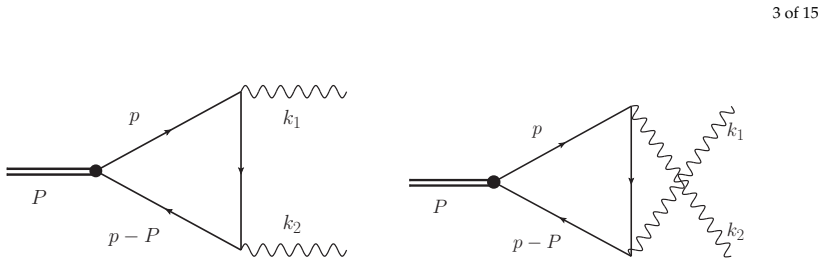
Positronium versus a point-like molecule We start from two-photon decays of parapositronium as the most prominent example of the radiative decay of a compound state. Parapositronium is a bound state of the electron-positron pair with the quantum numbers 1S0. In what follows we also refer to it as Ps(1S0) or simply “positronium”. Given its positive C-parit...
-
[3]
Radiative decays ofϕ(1020) The processes ϕ(1020)→γa 0/f 0(980) constitute yet another example of radiative decays involv- ing the scalar mesons a0/f 0(980). They are studied in Refs. [7,8] and a conclusion is made that, for the 6 of 15 /A1 /AD Ꜷ /C3 /A0 /C3 /B7 /CP /BC /BP/CU /BC /A1 /C3 /A0 /AD Ꜷ /C3 /B7 /CP /BC /BP/CU /BC /A1 /AD Ꜷ /C3 /B7 /C3 /A0 /CP /...
-
[4]
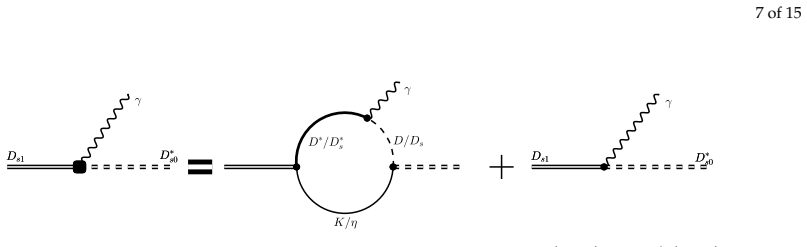
Radiative decays ofD s1(2460) In this section, we review the radiative decays of the Ds1(2460). We start from the two-body decay Ds1(2460)→γD ∗ s0(2317) assuming dominating molecular components in the wave functions of both DsJ mesons involved [14–21]. The effective Lagrangian describing this decay takes the form Leff =κε µναβ Fµν vβDs1α D∗† s0 +h.c., (23...
-
[5]
Radiative decays of theX(3872) In this section, we discuss the radiative decays X(3872)→γψ( 2S) and X(3872)→γJ/ψ that, in recent years, attracted a lot of attention of both experimentalists and theorists. An interest to these decays was recently catalysed by the improved analysis performed by the LHCb Collaboration. In particular, it provided the most pre...
work page 2008
-
[6]
Conclusions In this paper, we reviewed various radiative decays involving hadronic molecules and stressed that information on such decays can provide valuable insight into their nature. However, one has to bear in mind that (i) the hierarchy of the scales relevant to the studied hadron plays a crucial role — sticking to a wrong hierarchy will result in a ...
-
[7]
Guo, F.K.; Hanhart, C.; Meißner, U.G.; Wang, Q.; Zhao, Q.; Zou, B.S. Hadronic molecules.Rev. Mod. Phys.2018,90, 015004, [arXiv:hep-ph/1705.00141]. [Erratum: Rev.Mod.Phys. 94, 029901 (2022)], https: //doi.org/10.1103/RevModPhys.90.015004
-
[8]
Two Photon Decays Support the (K anti-K) Molecule Picture of the S* (975) and Delta (980).Phys
Barnes, T. Two Photon Decays Support the (K anti-K) Molecule Picture of the S* (975) and Delta (980).Phys. Lett. B1985,165, 434–440. https://doi.org/10.1016/0370-2693(85)91261-4
-
[9]
Krewald, S.; Lemmer, R.H.; Sassen, F.P . Lifetime of kaonium.Phys. Rev. D2004,69, 016003, [hep-ph/0307288]. https://doi.org/10.1103/PhysRevD.69.016003
work page internal anchor Pith review Pith/arXiv arXiv doi:10.1103/physrevd.69.016003
-
[10]
Two-photon decays of hadronic molecules
Hanhart, C.; Kalashnikova, Y.S.; Kudryavtsev, A.E.; Nefediev, A.V . Two-photon decays of hadronic molecules. Phys. Rev. D2007,75, 074015, [hep-ph/0701214]. https://doi.org/10.1103/PhysRevD.75.074015
work page internal anchor Pith review Pith/arXiv arXiv doi:10.1103/physrevd.75.074015
-
[11]
Can one extract the pi-neutron scattering length from pi-deuteron scattering?
Nogga, A.; Hanhart, C. Can one extract the pi-neutron scattering length from pi-deuteron scattering?Phys. Lett. B2006,634, 210–213, [nucl-th/0511011]. https://doi.org/10.1016/j.physletb.2005.12.071
work page internal anchor Pith review Pith/arXiv arXiv doi:10.1016/j.physletb.2005.12.071 2005
-
[12]
High statistics study of f_0(980) resonance in gamma gamma --> pi^+ pi^- production
Mori, T.; et al. High statistics study of f0(980) resonance in γγ→π +π− production.Phys. Rev. D2007, 75, 051101, [hep-ex/0610038]. https://doi.org/10.1103/PhysRevD.75.051101
work page internal anchor Pith review Pith/arXiv arXiv doi:10.1103/physrevd.75.051101
-
[13]
Close, F.E.; Isgur, N.; Kumano, S. Scalar mesons in phi radiative decay: Their implications for spectroscopy and for studies of CP violation at phi factories.Nucl. Phys. B1993,389, 513–533, [hep-ph/9301253]. https://doi.org/10.1016/0550-3213(93)90329-N
work page internal anchor Pith review Pith/arXiv arXiv doi:10.1016/0550-3213(93)90329-n
-
[14]
Production of scalar $K\bar K$ molecules in $\phi$ radiative decays
Achasov, N.N.; Gubin, V .V .; Shevchenko, V .I. Production of scalar K anti-K molecules in phi radiative decays. Phys. Rev. D1997,56, 203–211, [hep-ph/9605245]. https://doi.org/10.1103/PhysRevD.56.203
work page internal anchor Pith review Pith/arXiv arXiv doi:10.1103/physrevd.56.203
-
[15]
Once more about the K\bar K molecule approach to the light scalars
Achasov, N.N.; Kiselev, A.V . Once more about the K anti-K molecule approach to the light scalars.Phys. Rev. D2007,76, 077501, [hep-ph/0606268]. https://doi.org/10.1103/PhysRevD.76.077501
work page internal anchor Pith review Pith/arXiv arXiv doi:10.1103/physrevd.76.077501
-
[16]
The radiative decays $\phi\to\gamma a_0/f_0$ in the molecular model for the scalar mesons
Kalashnikova, Y.S.; Kudryavtsev, A.E.; Nefediev, A.V .; Hanhart, C.; Haidenbauer, J. The Radiative decays ϕ→γa 0/f 0 in the molecular model for the scalar mesons.Eur. Phys. J. A2005,24, 437–443, [hep-ph/0412340]. https://doi.org/10.1140/epja/i2005-10008-4
work page internal anchor Pith review Pith/arXiv arXiv doi:10.1140/epja/i2005-10008-4
-
[17]
Comment on "Once more about the KK molecule approach to the light scalars"
Kalashnikova, Y.S.; Kudryavtsev, A.E.; Nefediev, A.V .; Haidenbauer, J.; Hanhart, C. Comment on ‘Once more about the K ¯K molecule approach to the light scalars’.Phys. Rev. D2008,78, 058501, [arXiv:hep-ph/0711.2902]. https://doi.org/10.1103/PhysRevD.78.058501
work page internal anchor Pith review Pith/arXiv arXiv doi:10.1103/physrevd.78.058501
-
[18]
Evidence That the Deuteron Is Not an Elementary Particle.Phys
Weinberg, S. Evidence That the Deuteron Is Not an Elementary Particle.Phys. Rev.1965,137, B672–B678. https://doi.org/10.1103/PhysRev.137.B672. 14 of 15
-
[19]
On a Search for Four Quark States in Radiative Decays of phi Meson.Nucl
Achasov, N.N.; Ivanchenko, V .N. On a Search for Four Quark States in Radiative Decays of phi Meson.Nucl. Phys. B1989,315, 465–476. https://doi.org/10.1016/0550-3213(89)90364-7
-
[20]
Implications of a DK Molecule at 2.32 GeV
Barnes, T.; Close, F.E.; Lipkin, H.J. Implications of a DK molecule at 2.32-GeV.Phys. Rev. D2003,68, 054006, [hep-ph/0305025]. https://doi.org/10.1103/PhysRevD.68.054006
work page internal anchor Pith review Pith/arXiv arXiv doi:10.1103/physrevd.68.054006
-
[21]
On heavy-light meson resonances and chiral symmetry
Kolomeitsev, E.E.; Lutz, M.F.M. On Heavy light meson resonances and chiral symmetry.Phys. Lett. B2004, 582, 39–48, [hep-ph/0307133]. https://doi.org/10.1016/j.physletb.2003.10.118
work page internal anchor Pith review Pith/arXiv arXiv doi:10.1016/j.physletb.2003.10.118 2003
-
[22]
A Comprehensive Four-Quark Interpretation of D_s(2317), D_s(2457) and D_s(2632)
Chen, Y.Q.; Li, X.Q. A Comprehensive four-quark interpretation of Ds(2317), Ds(2457) and Ds(2632).Phys. Rev. Lett.2004,93, 232001, [hep-ph/0407062]. https://doi.org/10.1103/PhysRevLett.93.232001
work page internal anchor Pith review Pith/arXiv arXiv doi:10.1103/physrevlett.93.232001 2004
-
[23]
Dynamically generated 0^+ heavy mesons in a heavy chiral unitary approach
Guo, F.K.; Shen, P .N.; Chiang, H.C.; Ping, R.G.; Zou, B.S. Dynamically generated 0+ heavy mesons in a heavy chiral unitary approach.Phys. Lett. B2006,641, 278–285, [hep-ph/0603072]. https://doi.org/10.1016/j. physletb.2006.08.064
work page internal anchor Pith review Pith/arXiv arXiv doi:10.1016/j 2006
-
[24]
Dynamically generated 1^+ heavy mesons
Guo, F.K.; Shen, P .N.; Chiang, H.C. Dynamically generated 1+ heavy mesons.Phys. Lett. B2007,647, 133–139, [hep-ph/0610008]. https://doi.org/10.1016/j.physletb.2007.01.050
work page internal anchor Pith review Pith/arXiv arXiv doi:10.1016/j.physletb.2007.01.050 2007
-
[25]
Dynamically Generated Open and Hidden Charm Meson Systems
Gamermann, D.; Oset, E.; Strottman, D.; Vicente Vacas, M.J. Dynamically generated open and hidden charm meson systems.Phys. Rev. D2007,76, 074016, [hep-ph/0612179]. https://doi.org/10.1103/PhysRevD.76.074 016
work page internal anchor Pith review Pith/arXiv arXiv doi:10.1103/physrevd.76.074
-
[26]
Radiative and isospin-violating decays of Ds mesons in the hadrogenesis conjecture
Lutz, M.F.M.; Soyeur, M. Radiative and isospin-violating decays of Ds-mesons in the hadrogenesis conjecture. Nucl. Phys. A2008,813, 14–95, [arXiv:hep-ph/0710.1545]. https://doi.org/10.1016/j.nuclphysa.2008.09.003
work page internal anchor Pith review Pith/arXiv arXiv doi:10.1016/j.nuclphysa.2008.09.003 2008
-
[27]
Strong and radiative decays of the Ds0*(2317) meson in the DK-molecule picture
Faessler, A.; Gutsche, T.; Lyubovitskij, V .E.; Ma, Y.L. Strong and radiative decays of theD∗ s0(2317) meson in the DK-molecule picture.Phys. Rev. D2007,76, 014005, [arXiv:hep-ph/0705.0254]. https://doi.org/10.1103/ PhysRevD.76.014005
work page internal anchor Pith review Pith/arXiv arXiv
-
[28]
What can we learn from the radiative decays of the $D_{s1}(2460)$ meson?
Fu, H.L.; Guo, F.K.; Hanhart, C.; Nefediev, A. What can we learn from the radiative decays of the Ds1(2460) meson?2025. [arXiv:hep-ph/2512.05476]
work page internal anchor Pith review Pith/arXiv arXiv 2025
-
[29]
Update on strong and radiative decays of the D∗ s0(2317) and Ds1(2460) and their bottom cousins.Eur
Fu, H.L.; Grießhammer, H.W.; Guo, F.K.; Hanhart, C.; Meißner, U.G. Update on strong and radiative decays of the D∗ s0(2317) and Ds1(2460) and their bottom cousins.Eur. Phys. J. A2022,58, 70, [arXiv:hep-ph/2111.09481]. https://doi.org/10.1140/epja/s10050-022-00724-8
-
[30]
Chiral Multiplets of Heavy-Light Mesons
Bardeen, W.A.; Eichten, E.J.; Hill, C.T. Chiral Multiplets of Heavy–Light Mesons.Phys. Rev. D2003,68, 054024, [hep-ph/0305049]. https://doi.org/10.1103/PhysRevD.68.054024
work page internal anchor Pith review Pith/arXiv arXiv doi:10.1103/physrevd.68.054024
-
[31]
Review of particle physics.Phys
Navas, S.; et al. Review of particle physics.Phys. Rev. D2024,110, 030001. https://doi.org/10.1103/ PhysRevD.110.030001
-
[32]
Strong and radiative decays of the $D_{s0}^*(2317)$ and $D_{s1}(2460)$
Cleven, M.; Grießhammer, H.W.; Guo, F.K.; Hanhart, C.; Meißner, U.G. Strong and radiative decays of the D∗ s0(2317)andD s1(2460).Eur. Phys. J. A2014,50, 149, [arXiv:hep-ph/1405.2242]. https://doi.org/10.1140/ epja/i2014-14149-y
work page internal anchor Pith review Pith/arXiv arXiv
-
[33]
Systematic Study of Hadronic Molecules in the Heavy-Quark Sector
Cleven, M. Systematic Study of Hadronic Molecules in the Heavy-Quark Sector. PhD thesis, Bonn U., 2013, [arXiv:hep-ph/1405.4195]
work page internal anchor Pith review Pith/arXiv arXiv 2013
-
[34]
Aaij, R.; et al. Probing the nature of the χc1(3872) state using radiative decays.JHEP2024,11, 121, [arXiv:hep-ex/2406.17006]. https://doi.org/10.1007/JHEP11(2024)121
-
[35]
Evidence for the decay $X(3872)\rightarrow\psi(2S)\gamma$
Aaij, R.; et al. Evidence for the decay X(3872)→ψ( 2S)γ.Nucl. Phys. B2014,886, 665–680, [arXiv:hep- ex/1404.0275]. https://doi.org/10.1016/j.nuclphysb.2014.06.011
work page internal anchor Pith review Pith/arXiv arXiv doi:10.1016/j.nuclphysb.2014.06.011 2014
-
[36]
Aubert, B.; et al. Evidence for X(3872)→ψ 2Sγ in B± →X 3872K± decays, and a study of B→c ¯cγK.Phys. Rev. Lett.2009,102, 132001, [arXiv:hep-ex/0809.0042]. https://doi.org/10.1103/PhysRevLett.102.132001
work page internal anchor Pith review Pith/arXiv arXiv doi:10.1103/physrevlett.102.132001 2009
-
[37]
Observation of a narrow charmonium-like state in exclusive B+ -> K+ pi+pi- J/psi decays
Choi, S.K.; et al. Observation of a narrow charmonium-like state in exclusive B± →K ±π+π− J/ψ decays. Phys. Rev. Lett.2003,91, 262001, [hep-ex/0309032]. https://doi.org/10.1103/PhysRevLett.91.262001
work page internal anchor Pith review Pith/arXiv arXiv doi:10.1103/physrevlett.91.262001 2003
-
[38]
Diagnostic Decays of the X(3872)
Swanson, E.S. Diagnostic decays of the X(3872).Phys. Lett. B2004,598, 197–202, [hep-ph/0406080]. https://doi.org/10.1016/j.physletb.2004.07.059
work page internal anchor Pith review Pith/arXiv arXiv doi:10.1016/j.physletb.2004.07.059 2004
-
[39]
Grinstein, B.; Maiani, L.; Polosa, A.D. Radiative decays of X(3872) discriminate between the molecular and compact interpretations.Phys. Rev. D2024,109, 074009, [arXiv:hep-ph/2401.11623]. https://doi.org/10.110 3/PhysRevD.109.074009
-
[40]
Observation of $X(3872)\to J/\psi \gamma$ and search for $X(3872)\to\psi'\gamma$ in B decays
Bhardwaj, V .; et al. Observation ofX(3872)→J/ψγ and search for X(3872)→ψ ′γ in B decays.Phys. Rev. Lett.2011,107, 091803, [arXiv:hep-ex/1105.0177]. https://doi.org/10.1103/PhysRevLett.107.091803
work page internal anchor Pith review Pith/arXiv arXiv doi:10.1103/physrevlett.107.091803 2011
-
[41]
Study of Open-Charm Decays and Radiative Transitions of the X(3872).Phys
Ablikim, M.; et al. Study of Open-Charm Decays and Radiative Transitions of the X(3872).Phys. Rev. Lett. 2020,124, 242001, [arXiv:hep-ex/2001.01156]. https://doi.org/10.1103/PhysRevLett.124.242001
-
[42]
Determination of the X(3872) meson quantum numbers
Aaij, R.; et al. Determination of the X(3872) meson quantum numbers.Phys. Rev. Lett.2013,110, 222001, [arXiv:hep-ex/1302.6269]. https://doi.org/10.1103/PhysRevLett.110.222001. 15 of 15
work page internal anchor Pith review Pith/arXiv arXiv doi:10.1103/physrevlett.110.222001 2013
-
[43]
Quantum numbers of the $X(3872)$ state and orbital angular momentum in its $\rho^0 J\psi$ decay
Aaij, R.; et al. Quantum numbers of the X(3872) state and orbital angular momentum in its ρ0 Jψ decay.Phys. Rev. D2015,92, 011102, [arXiv:hep-ex/1504.06339]. https://doi.org/10.1103/PhysRevD.92.011102
work page internal anchor Pith review Pith/arXiv arXiv doi:10.1103/physrevd.92.011102
-
[44]
Precise determination of the properties ofX(3872) and of its isovector partnerW c1 2025
Ji, T.; Dong, X.K.; Guo, F.K.; Hanhart, C.; Meißner, U.G. Precise determination of the properties ofX(3872) and of its isovector partnerW c1 2025. [arXiv:hep-ph/2502.04458]
-
[45]
Three-body $D\bar{D}\pi$ dynamics for the X(3872)
Baru, V .; Filin, A.A.; Hanhart, C.; Kalashnikova, Y.S.; Kudryavtsev, A.E.; Nefediev, A.V . Three-bodyD ¯Dπ dynamics for the X(3872).Phys. Rev. D2011,84, 074029, [arXiv:hep-ph/1108.5644]. https://doi.org/10.110 3/PhysRevD.84.074029
work page internal anchor Pith review Pith/arXiv arXiv
-
[46]
From the Deuteron to Deusons, an Analysis of Deuteronlike Meson-Meson Bound States
Tornqvist, N.A. From the deuteron to deusons, an analysis of deuteron-like meson meson bound states.Z. Phys. C1994,61, 525–537, [hep-ph/9310247]. https://doi.org/10.1007/BF01413192
work page internal anchor Pith review Pith/arXiv arXiv doi:10.1007/bf01413192
-
[47]
Short Range Structure in the X(3872)
Swanson, E.S. Short range structure in the X(3872).Phys. Lett. B2004,588, 189–195, [hep-ph/0311229]. https://doi.org/10.1016/j.physletb.2004.03.033
work page internal anchor Pith review Pith/arXiv arXiv doi:10.1016/j.physletb.2004.03.033 2004
-
[48]
The X(3872) boson: Molecule or charmonium
Suzuki, M. The X(3872) boson: Molecule or charmonium.Phys. Rev. D2005,72, 114013, [hep-ph/0508258]. https://doi.org/10.1103/PhysRevD.72.114013
work page internal anchor Pith review Pith/arXiv arXiv doi:10.1103/physrevd.72.114013
-
[49]
Remarks on the study of the X(3872) from Effective Field Theory with Pion-Exchange Interaction
Baru, V .; Epelbaum, E.; Filin, A.A.; Guo, F.K.; Hammer, H.W.; Hanhart, C.; Meißner, U.G.; Nefediev, A.V . Remarks on study of X(3872) from effective field theory with pion-exchange interaction.Phys. Rev. D2015, 91, 034002, [arXiv:hep-ph/1501.02924]. https://doi.org/10.1103/PhysRevD.91.034002
work page internal anchor Pith review Pith/arXiv arXiv doi:10.1103/physrevd.91.034002
-
[50]
What can radiative decays of the X(3872) teach us about its nature?
Guo, F.K.; Hanhart, C.; Kalashnikova, Y.S.; Meißner, U.G.; Nefediev, A.V . What can radiative decays of the X(3872) teach us about its nature?Phys. Lett. B2015,742, 394–398, [arXiv:hep-ph/1410.6712]. https://doi.org/10.1016/j.physletb.2015.02.013
work page internal anchor Pith review Pith/arXiv arXiv doi:10.1016/j.physletb.2015.02.013 2015
-
[51]
Radiative decays of the spin-2 partner ofX(3872).Phys
Shi, P .P .; Dias, J.M.; Guo, F.K. Radiative decays of the spin-2 partner ofX(3872).Phys. Lett. B2023,843, 137987, [arXiv:hep-ph/2302.13017]. https://doi.org/10.1016/j.physletb.2023.137987
-
[52]
Short-distance RG-analysis of $X(3872)$ radiative decays
Molnar, D.A.S.; Luiz, R.F.; Higa, R. Short-distance RG-analysis of X(3872) radiative decays2016. [arXiv:hep- ph/1601.03366]
work page internal anchor Pith review Pith/arXiv arXiv
-
[53]
Nature of χc1(3872) and T+cc (3875).Phys
Brambilla, N.; Mohapatra, A.; Scirpa, T.; Vairo, A. Nature of χc1(3872) and T+cc (3875).Phys. Rev. Lett.2025, 135, 131902, [arXiv:hep-ph/2411.14306]. https://doi.org/10.1103/pdy7-hvg7
-
[54]
Production of the X(3872) in charmonia radiative decays
Guo, F.K.; Hanhart, C.; Meißner, U.G.; Wang, Q.; Zhao, Q. Production of the X(3872) in charmonia radiative decays.Phys. Lett. B2013,725, 127–133, [arXiv:hep-ph/1306.3096]. https://doi.org/10.1016/j.physletb.2013 .06.053
work page internal anchor Pith review Pith/arXiv arXiv doi:10.1016/j.physletb.2013 2013
discussion (0)
Sign in with ORCID, Apple, or X to comment. Anyone can read and Pith papers without signing in.