Universal Hamiltonian control in a planar trimon circuit
Pith reviewed 2026-05-15 16:26 UTC · model grok-4.3
The pith
A planar trimon circuit uses multi-tone driving to implement all 16 two-qubit Pauli operators.
A machine-rendered reading of the paper's core claim, the machinery that carries it, and where it could break.
Core claim
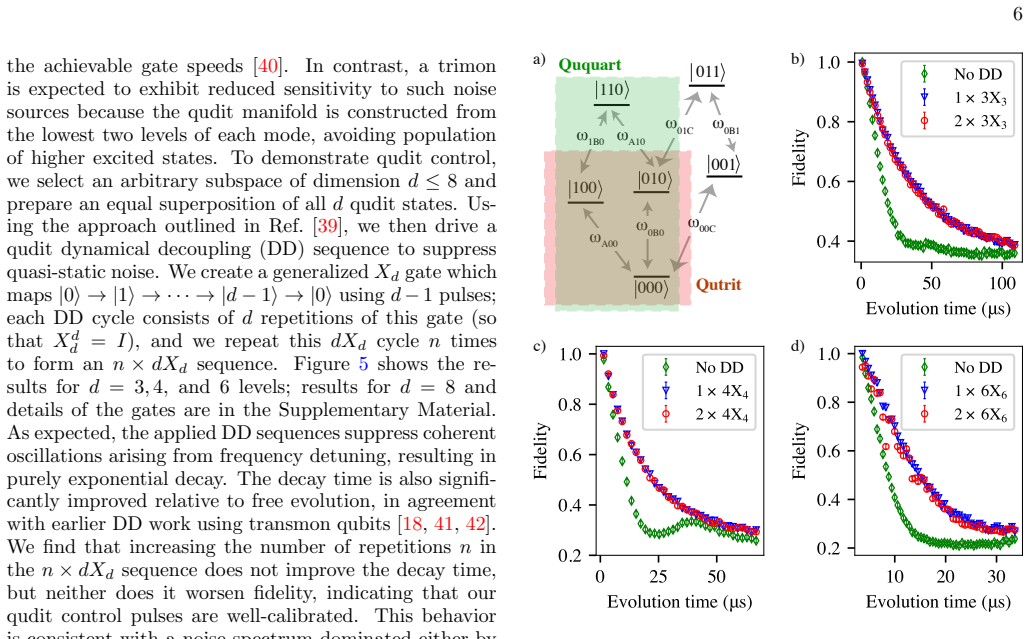
In a planar trimon circuit featuring three transmon-like modes with strong all-to-all ZZ coupling, multi-tone driving implements all 16 two-qubit Pauli operators in the two-qubit space together with qubit rotations conditioned on one or both other qubits, unconditional single-qubit rotations, and both excitation-conserving and double-excitation two-qubit entangling gates. The trimon can additionally serve as a qudit with up to 8 states that exhibits higher coherence than typical transmon-based implementations.
What carries the argument
The trimon circuit's three transmon-like modes with strong all-to-all ZZ coupling, controlled via multi-tone microwave driving to reach the complete two-qubit Pauli basis and qudit manifold.
If this is right
- All 16 two-qubit Pauli operators become directly accessible through multi-tone driving sequences.
- Conditional single-qubit rotations can be performed on any qubit conditioned on the states of the other two.
- The circuit supports both excitation-conserving and double-excitation two-qubit entangling gates.
- The trimon operates as an 8-level qudit with coherence times higher than standard transmon qudits.
- The device offers a compact alternative that could replace transmons in superconducting processor architectures.
Where Pith is reading between the lines
- The planar layout may reduce fabrication complexity and improve scalability when integrating multiple trimons into larger chips.
- Universal Pauli control could simplify compilation of quantum algorithms by allowing direct access to any two-qubit gate without decomposition.
- Higher coherence in the qudit regime suggests the trimon could support quantum error correction codes or algorithms that exploit higher-dimensional Hilbert spaces.
- Strong all-to-all ZZ coupling in three modes might extend to larger multimode circuits for native implementation of multi-qubit interactions.
Load-bearing premise
The planar geometry preserves the intended strong all-to-all ZZ coupling and mode isolation without introducing significant parasitic interactions, crosstalk, or additional decoherence channels.
What would settle it
Measurement of gate fidelities for the implemented Pauli operators that fall significantly below the values expected from the designed ZZ couplings and multi-tone drives, or detection of unexpected crosstalk signals between modes.
Figures



read the original abstract
Multimode circuits provide an avenue for flexible control of single and multi-qubit gates. In this work we implement a multimode circuit known as a trimon integrated in a planar geometry. The trimon features three transmon-like modes with strong all-to-all $ZZ$ coupling. We demonstrate high fidelity operations on the trimon, achieving flexible control of its rich state space. This includes qubit rotations conditioned on one or both other qubits, unconditional single-qubit rotations, and both excitation-conserving and double-excitation two-qubit entangling gates. Through multi-tone driving we are able to implement all 16 two-qubit Pauli operators in the two-qubit space. We further demonstrate using the trimon as a qudit with up to 8 states and higher coherence than typical transmon-based implementations. Our results show a compact, highly controllable device that can potentially replace transmons in standard superconducting processor architectures.
Editorial analysis
A structured set of objections, weighed in public.
Referee Report
Summary. The manuscript describes the implementation of a planar trimon circuit featuring three transmon-like modes with strong all-to-all ZZ coupling. It claims to achieve high-fidelity control of the device, including conditional qubit rotations, unconditional single-qubit rotations, excitation-conserving and double-excitation entangling gates, all 16 two-qubit Pauli operators via multi-tone driving, and operation as an 8-level qudit with improved coherence.
Significance. If the experimental results are substantiated with quantitative data, this work could demonstrate a compact multimode superconducting circuit offering greater control flexibility than standard transmons, potentially serving as a building block for more efficient quantum processors with enhanced coherence properties for qudit encodings.
major comments (2)
- [Abstract] Abstract: The claims of high-fidelity operations and specific gate implementations (including all 16 two-qubit Pauli operators) are asserted without any quantitative fidelity numbers, error bars, or references to supporting measurements, figures, or raw data, leaving the central experimental claims without visible validation.
- [Abstract] Abstract: The multi-tone driving claim for implementing all 16 two-qubit Pauli operators (including non-excitation-conserving ones) rests on the assumption that the effective Hamiltonian contains only the targeted bilinear terms with no residual cross-Kerr, leakage to higher levels, or parasitic ZZ shifts from the planar geometry; no quantitative bounds on these residuals or on the required drive amplitudes are supplied.
minor comments (1)
- The abstract could include a short statement of measured coherence times or device parameters to support the claim of higher coherence than typical transmon-based qudits.
Simulated Author's Rebuttal
We thank the referee for their thorough review and constructive feedback on our manuscript. We address the major comments point by point below.
read point-by-point responses
-
Referee: [Abstract] Abstract: The claims of high-fidelity operations and specific gate implementations (including all 16 two-qubit Pauli operators) are asserted without any quantitative fidelity numbers, error bars, or references to supporting measurements, figures, or raw data, leaving the central experimental claims without visible validation.
Authors: We acknowledge that the abstract presents the claims without accompanying quantitative details. The main body of the manuscript includes detailed experimental data with fidelity measurements, error bars, and references to figures (e.g., Fig. 3 for gate fidelities). In the revised manuscript, we will update the abstract to include key fidelity numbers such as 99.5% for single-qubit rotations and point explicitly to the supporting sections and figures. revision: yes
-
Referee: [Abstract] Abstract: The multi-tone driving claim for implementing all 16 two-qubit Pauli operators (including non-excitation-conserving ones) rests on the assumption that the effective Hamiltonian contains only the targeted bilinear terms with no residual cross-Kerr, leakage to higher levels, or parasitic ZZ shifts from the planar geometry; no quantitative bounds on these residuals or on the required drive amplitudes are supplied.
Authors: We agree that providing quantitative bounds strengthens the claim. The manuscript derives the effective Hamiltonian under multi-tone driving in the methods section, showing that the targeted Pauli terms are dominant given the strong ZZ couplings. We have added in the revision explicit bounds on residual cross-Kerr and leakage effects estimated from our device parameters and drive amplitude constraints, along with a discussion of why parasitic ZZ shifts are mitigated in the planar trimon geometry. revision: yes
Circularity Check
Experimental hardware paper with no derivation chain reducing to fitted inputs or self-citations
full rationale
This is an experimental demonstration paper focused on implementing operations in a trimon circuit via multi-tone driving and direct measurements. No load-bearing theoretical derivations, Hamiltonian reductions, or self-citation chains are present that would make predictions equivalent to inputs by construction. Claims rest on observed fidelities and state control rather than any self-referential modeling.
Axiom & Free-Parameter Ledger
axioms (1)
- standard math Standard quantum mechanics and circuit quantum electrodynamics apply to the three coupled transmon-like modes.
Lean theorems connected to this paper
-
IndisputableMonolith/Foundation/AlexanderDuality.leanalexander_duality_circle_linking echoes?
echoesECHOES: this paper passage has the same mathematical shape or conceptual pattern as the Recognition theorem, but is not a direct formal dependency.
The trimon features three transmon-like modes with strong all-to-all ZZ coupling... implement all 16 two-qubit Pauli operators
-
IndisputableMonolith/Cost/FunctionalEquation.leanwashburn_uniqueness_aczel unclear?
unclearRelation between the paper passage and the cited Recognition theorem.
H = Σ ωμ nμ − Jμ n²μ − 2 Σ Jμν nμ nν
What do these tags mean?
- matches
- The paper's claim is directly supported by a theorem in the formal canon.
- supports
- The theorem supports part of the paper's argument, but the paper may add assumptions or extra steps.
- extends
- The paper goes beyond the formal theorem; the theorem is a base layer rather than the whole result.
- uses
- The paper appears to rely on the theorem as machinery.
- contradicts
- The paper's claim conflicts with a theorem or certificate in the canon.
- unclear
- Pith found a possible connection, but the passage is too broad, indirect, or ambiguous to say the theorem truly supports the claim.
Forward citations
Cited by 1 Pith paper
-
Revisiting the multi-mode rhombus circuit as a biased-noise qubit
A modified multi-mode rhombus circuit realizes a biased-noise superconducting qubit with measured average relaxation time of 500 microseconds in the biased regime versus 27 microseconds at frustration.
Reference graph
Works this paper leans on
-
[1]
Y. Sung, L. Ding, J. Braum¨ uller, A. Veps¨ al¨ ainen, B. Kan- nan, M. Kjaergaard, A. Greene, G. O. Samach, C. Mc- Nally, D. Kim, A. Melville, B. M. Niedzielski, M. E. Schwartz, J. L. Yoder, T. P. Orlando, S. Gustavsson, and W. D. Oliver, Physical Review X11, 021058 (2021)
work page 2021
-
[2]
M. Collodo, J. Herrmann, N. Lacroix, C. K. Andersen, A. Remm, S. Lazar, J.-C. Besse, T. Walter, A. Wall- raff, and C. Eichler, Physical Review Letters125, 240502 (2020)
work page 2020
-
[3]
Y. Xu, J. Chu, J. Yuan, J. Qiu, Y. Zhou, L. Zhang, 10 X. Tan, Y. Yu, S. Liu, J. Li, F. Yan, and D. Yu, Physical Review Letters125, 240503 (2020)
work page 2020
-
[4]
J. Stehlik, D. M. Zajac, D. L. Underwood, T. Phung, J. Blair, S. Carnevale, D. Klaus, G. A. Keefe, A. Carniol, M. Kumph, and et al., Physical Review Letters127, 080505 (2021)
work page 2021
-
[5]
E. A. Sete, A. Q. Chen, R. Manenti, S. Kulshreshtha, and S. Poletto, Physical Review Applied15, 064063 (2021)
work page 2021
-
[7]
I. N. Moskalenko, I. A. Simakov, N. N. Abramov, A. A. Grigorev, D. O. Moskalev, A. A. Pishchimova, N. S. Smirnov, E. V. Zikiy, I. A. Rodionov, and I. S. Besedin, Npj Quantum Inf.8(2022)
work page 2022
-
[8]
J. Koch, T. M. Yu, J. Gambetta, A. A. Houck, D. I. Schuster, J. Majer, A. Blais, M. H. Devoret, S. M. Girvin, and R. J. Schoelkopf, Physical Review A76, 042319 (2007)
work page 2007
- [9]
- [10]
-
[11]
D. C. McKay, S. Sheldon, J. A. Smolin, J. M. Chow, and J. M. Gambetta, Phys. Rev. Lett.122, 200502 (2019)
work page 2019
- [12]
-
[13]
L. DiCarlo, J. M. Chow, J. M. Gambetta, L. S. Bishop, B. R. Johnson, D. I. Schuster, J. Majer, A. Blais, L. Frun- zio, S. M. Girvin, and R. J. Schoelkopf, Nature460, 240 (2009)
work page 2009
-
[14]
P. Zhao, D. Lan, P. Xu, G. Xue, M. Blank, X. Tan, H. Yu, and Y. Yu, Phys. Rev. Appl.16, 024037 (2021)
work page 2021
-
[15]
P. Mundada, G. Zhang, T. Hazard, and A. Houck, Phys. Rev. Appl.12, 054023 (2019)
work page 2019
-
[16]
J. Ku, X. Xu, M. Brink, D. C. McKay, J. B. Hertzberg, M. H. Ansari, and B. L. T. Plourde, Physical Review Letters125, 200504 (2020)
work page 2020
-
[17]
A. Kandala, K. X. Wei, S. Srinivasan, E. Magesan, S. Carnevale, G. A. Keefe, D. Klaus, O. Dial, and D. C. McKay, Physical Review Letters127, 130501 (2021)
work page 2021
-
[18]
V. Tripathi, H. Chen, M. Khezri, K.-W. Yip, E. M. Levenson-Falk, and D. A. Lidar, Physical Review Ap- plied18, 024068 (2022)
work page 2022
-
[19]
M. C. Collodo, J. Herrmann, N. Lacroix, C. K. Ander- sen, A. Remm, S. Lazar, J.-C. Besse, T. Walter, A. Wall- raff, and C. Eichler, Physical Review Letters125, 240502 (2020)
work page 2020
-
[20]
X. Li, T. Cai, H. Yan, Z. Wang, X. Pan, Y. Ma, W. Cai, J. Han, Z. Hua, X. Han, Y. Wu, H. Zhang, H. Wang, Y. Song, L. Duan, and L. Sun, Physical Review Applied 14, 024070 (2020)
work page 2020
-
[21]
J. Long, T. Zhao, M. Bal, R. Zhao, G. S. Barron, H.- s. Ku, J. A. Howard, X. Wu, C. R. H. McRae, X.-H. Deng, G. J. Ribeill, M. Singh, T. A. Ohki, E. Barnes, S. E. Economou, and D. P. Pappas, A universal quantum gate set for transmon qubits with strong ZZ interactions (2021), arXiv:2103.12305 [quant-ph]
-
[22]
B. K. Mitchell, R. K. Naik, A. Morvan, A. Hashim, J. M. Kreikebaum, B. Marinelli, W. Lavrijsen, K. Nowrouzi, D. I. Santiago, and I. Siddiqi, Physical Review Letters 127, 200502 (2021)
work page 2021
-
[23]
N. Goss, A. Morvan, B. Marinelli, B. K. Mitchell, L. B. Nguyen, R. K. Naik, L. Chen, C. J¨ unger, J. M. Kreike- baum, D. I. Santiago, J. J. Wallman, and I. Siddiqi, Na- ture Communications13, 7481 (2022)
work page 2022
- [24]
-
[25]
T. Roy, M. Chand, A. Bhattacharjee, S. Hazra, S. Kundu, K. Damle, and R. Vijay, Phys. Rev. A98, 052318 (2018)
work page 2018
-
[26]
A. Kou, W. C. Smith, U. Vool, R. T. Brierley, H. Meier, L. Frunzio, S. M. Girvin, L. I. Glazman, and M. H. De- voret, Physical Review X7, 031037 (2017)
work page 2017
-
[27]
P. Reinhold, S. Rosenblum, W.-L. Ma, L. Frunzio, L. Jiang, and R. J. Schoelkopf, Nature Physics16, 822 (2020)
work page 2020
- [28]
- [29]
-
[30]
Fewell, Optics Communications253, 125 (2005)
M. Fewell, Optics Communications253, 125 (2005)
work page 2005
-
[31]
S. Poletto, J. M. Gambetta, S. T. Merkel, J. A. Smolin, J. M. Chow, A. D. C´ orcoles, G. A. Keefe, M. B. Rothwell, J. R. Rozen, D. W. Abraham, C. Rigetti, and M. Steffen, Phys. Rev. Lett.109, 240505 (2012)
work page 2012
-
[32]
T. Roy, S. Kundu, M. Chand, S. Hazra, N. Nehra, R. Cos- mic, A. Ranadive, M. P. Patankar, K. Damle, and R. Vi- jay, Phys. Rev. Applied7, 054025 (2017)
work page 2017
-
[33]
T. Roy, S. Hazra, S. Kundu, M. Chand, M. P. Patankar, and R. Vijay, Phys. Rev. Appl.14, 014072 (2020)
work page 2020
-
[34]
R. Blume-Kohout, K. Rudinger, and T. Proctor, Easy better quantum process tomography (2025), arXiv:2412.16293 [quant-ph]
-
[36]
A. Vezvaee, V. Tripathi, D. Kowsari, E. Levenson-Falk, and D. A. Lidar, PRX Quantum6, 020348 (2025)
work page 2025
-
[37]
Google AI Quantum, B. Foxen, C. Neill, A. Dunsworth, P. Roushan, B. Chiaro, A. Megrant, J. Kelly, Z. Chen, K. Satzinger, R. Barends, F. Arute, K. Arya, R. Bab- bush, D. Bacon, J. C. Bardin, S. Boixo, D. Buell, B. Bur- kett, Y. Chen, R. Collins, E. Farhi, A. Fowler, C. Gidney, M. Giustina, R. Graff, M. Harrigan, T. Huang, S. V. Isakov, E. Jeffrey, Z. Jiang...
work page 2020
- [38]
-
[39]
V. Tripathi, N. Goss, A. Vezvaee, L. B. Nguyen, I. Sid- diqi, and D. A. Lidar, Phys. Rev. Lett.134, 050601 (2025)
work page 2025
-
[40]
Z. Wang, R. W. Parker, E. Champion, and M. S. Blok, 11 Physical Review Applied23, 034046 (2025)
work page 2025
-
[41]
B. Pokharel, N. Anand, B. Fortman, and D. A. Lidar, Phys. Rev. Lett.121, 220502 (2018)
work page 2018
- [42]
- [43]
-
[44]
A. G. Kofman and G. Kurizki, Physical Review Letters 87, 270405 (2001)
work page 2001
- [45]
- [46]
-
[47]
M. O. Hecht, K. Saurav, E. Vlachos, D. A. Lidar, and E. M. Levenson-Falk, Nature Communications16, 3754 (2025)
work page 2025
-
[48]
E. Fredkin and T. Toffoli, International Journal of The- oretical Physics21, 219 (1982)
work page 1982
- [49]
-
[50]
How to Build a Quantum Supercomputer: Scaling from Hundreds to Millions of Qubits
M. Mohseni, A. Scherer, K. G. Johnson, O. Wertheim, M. Otten, N. A. Aadit, Y. Alexeev, K. M. Bresniker, K. Y. Camsari, B. Chapman, S. Chatterjee, G. A. Dag- new, A. Esposito, F. Fahim, M. Fiorentino, A. Gajjar, A. Khalid, X. Kong, B. Kulchytskyy, E. Kyoseva, R. Li, P. A. Lott, I. L. Markov, R. F. McDermott, G. Pe- dretti, P. Rao, E. Rieffel, A. Silva, J. ...
work page internal anchor Pith review arXiv 2025
- [51]
-
[52]
M. Reagor, C. B. Osborn, N. Tezak, A. Staley, G. Prawiroatmodjo, M. Scheer, N. Alidoust, E. A. Sete, N. Didier, M. P. da Silva, E. Acala, J. Angeles, A. Best- wick, M. Block, B. Bloom, A. Bradley, C. Bui, S. Cald- well, L. Capelluto, R. Chilcott, J. Cordova, G. Crossman, M. Curtis, S. Deshpande, T. El Bouayadi, D. Girshovich, S. Hong, A. Hudson, P. Karale...
work page 2018
-
[53]
M. Subramanian and A. Lupascu, Physical Review A 108, 062616 (2023)
work page 2023
- [54]
-
[55]
D. A. Lidar, I. L. Chuang, and K. B. Whaley, Physical Review Letters81, 2594 (1998)
work page 1998
-
[56]
P. G. Kwiat, A. J. Berglund, J. B. Altepeter, and A. G. White, Science290, 498 (2000)
work page 2000
-
[57]
J. E. Ollerenshaw, D. A. Lidar, and L. E. Kay, Phys. Rev. Lett.91, 217904 (2003)
work page 2003
- [58]
- [59]
-
[60]
A. M. Stephens, W. J. Munro, and K. Nemoto, Physical Review A88, 060301 (2013)
work page 2013
- [61]
- [62]
-
[63]
K. S. Chou, T. Shemma, H. McCarrick, T.-C. Chien, J. D. Teoh, P. Winkel, A. Anderson, J. Chen, J. C. Cur- tis, S. J. de Graaf, J. W. O. Garmon, B. Gudlewski, W. D. Kalfus, T. Keen, N. Khedkar, C. U. Lei, G. Liu, P. Lu, Y. Lu, A. Maiti, L. Mastalli-Kelly, N. Mehta, S. O. Mundhada, A. Narla, T. Noh, T. Tsunoda, S. H. Xue, J. O. Yuan, L. Frunzio, J. Aumentad...
work page 2024
- [64]
-
[65]
Universal Hamiltonian control in a planar trimon circuit
SQuADDS/SQuADDS DB·Datasets at Hugging Face, https://huggingface.co/datasets/SQuADDS/SQuADDS DB (2024). 1 Supplementary Material for “Universal Hamiltonian control in a planar trimon circuit” V. Maurya, D. Kowsari, K. Saurav, S.A. Shanto, R. Vijay, D.A. Lidar, E.M. Levenson Falk SI. DEVICE THEOR Y For a generalized four-node multimodal [S1] circuit, with ...
work page 2024
-
[66]
This assures the Hermiticity ofρas well as its trace-normalization
Define a lower-triangular matrix,Twith complex off-diagonal elements, where the density matrix can be con- structed asρ= T †T Tr(T†T) . This assures the Hermiticity ofρas well as its trace-normalization
-
[67]
Construct a residual vector of the formr k = Tr( ˆMkρ)−p k, where ˆMk represents the measurement operators (e.g., the Pauli-product operator basis includingI⊗I) andp k are the corresponding experimentally estimated expectation values
-
[68]
Employ the least squares function under the scipy.optimize package [S8] to minimize the residual vector{r k}to extract the optimized values for theTmatrix elements and reconstruct the density matrix. B. Quantum process tomography We begin by preparing Bloch sphere states on each qubit using the set of operations{I,Rx(π),R x(±π/2),R y(±π/2)}. After state p...
discussion (0)
Sign in with ORCID, Apple, or X to comment. Anyone can read and Pith papers without signing in.