Revisiting the multi-mode rhombus circuit as a biased-noise qubit
Pith reviewed 2026-05-08 11:03 UTC · model grok-4.3
The pith
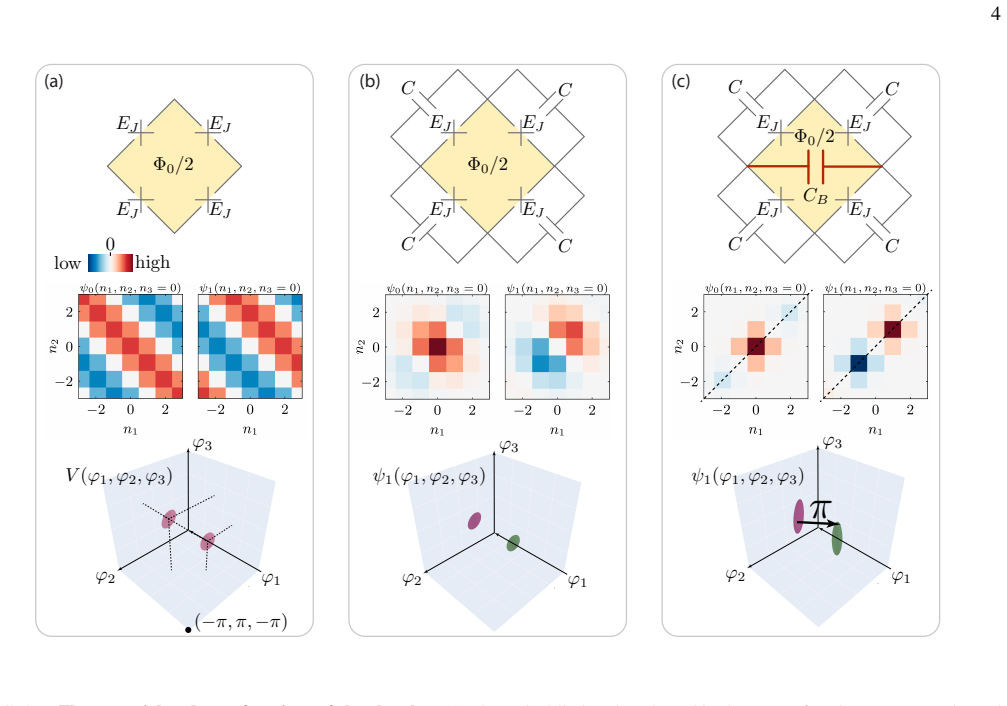
A modified rhombus circuit of Josephson junctions functions as a biased-noise qubit when operated away from half-flux frustration.
A machine-rendered reading of the paper's core claim, the machinery that carries it, and where it could break.
Core claim
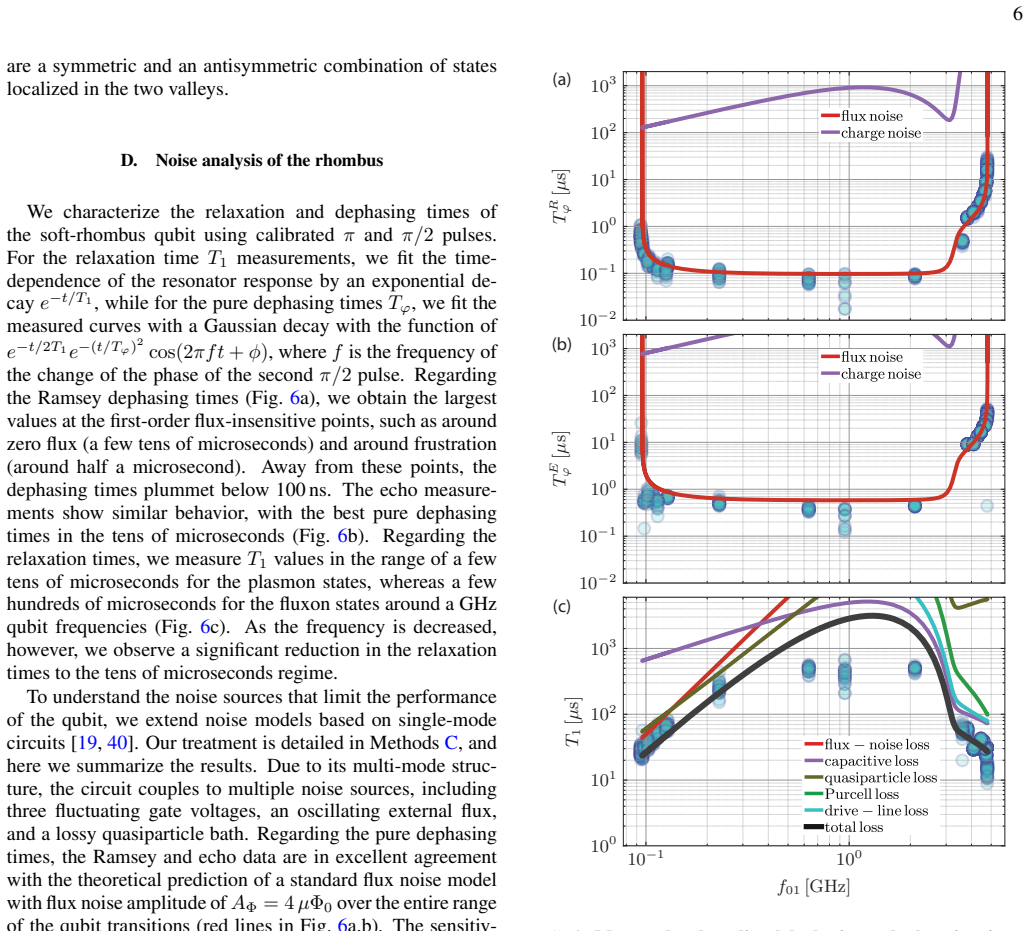
Away from a half flux quantum external field, the large shunting capacitors of the circuit ensure localized qubit states in different phase valleys, leading to a biased-noise qubit. In the realized circuit, we measure an average T1 of approximately 500 microseconds relaxation time in the biased-noise regime, while an average T1 of approximately 27 microseconds at frustration. The loss analysis indicates that at low frequencies, flux noise and quasiparticle tunneling limit the relaxation times, pointing toward an optimal operating regime of around a few GHz.
What carries the argument
The multi-mode rhombus circuit with one intentionally altered Josephson junction energy, where shunting capacitors localize the qubit wavefunctions in distinct phase valleys to produce biased noise.
If this is right
- The qubit shows significantly longer relaxation times away from the half-flux point than at frustration.
- Dephasing times are shorter in the biased-noise regime but relaxation dominates the coherence.
- Flux noise and quasiparticle tunneling are identified as the main loss sources at low frequencies.
- An optimal operating frequency exists around a few GHz for this circuit.
Where Pith is reading between the lines
- Biased-noise qubits of this type could be integrated into quantum error correction schemes that tolerate asymmetric noise better than symmetric noise.
- Further experiments varying the junction energy difference might optimize the trade-off between protection and direct accessibility.
- Extending this design to arrays could test whether the biased noise persists in multi-qubit interactions.
Load-bearing premise
The modification to one junction energy creates no new unaccounted loss channels and the localization of states truly produces the biased noise behavior observed.
What would settle it
Observing that the relaxation time does not increase substantially when moving away from the half-flux point, or remains below 100 microseconds in the supposed biased regime, would contradict the localization mechanism.
Figures





read the original abstract
In this work, we revisit the idea of using an interferometer of pairs of Josephson junctions as a protected rhombus qubit. Unlike in the original proposal, where the qubit states are encoded into odd and even parity charge states, here, we intentionally alter the energy of one of the junctions to investigate the soft version of the rhombus qubit. This approach allows us to directly probe the qubit transitions over several GHz and reduce the potential drawbacks of the interferometer-based protection. Away from a half flux quantum external field, the large shunting capacitors of the circuit ensure localized qubit states in different phase valleys, leading to a biased-noise qubit. In the realized circuit, we measure an average $T_1\approx500\,\mu$s relaxation time in the biased-noise regime (with a Ramsey dephasing time of $T^{R}_\varphi\approx90\,$ns), while an average $T_1\approx27\,\mu$s relaxation time at frustration (with $T^{R}_\varphi\approx670\,$ns). Our loss analysis on this multi-mode circuit indicates that at low frequencies, flux noise and quasiparticle tunneling limit the relaxation times, pointing toward the presence of an optimal operating regime of around a few GHz.
Editorial analysis
A structured set of objections, weighed in public.
Referee Report
Summary. The manuscript revisits the multi-mode rhombus circuit as a biased-noise qubit by intentionally altering the energy of one Josephson junction to create a 'soft' version. This allows direct probing of transitions over several GHz while the large shunting capacitors localize states in distinct phase valleys away from half-flux, yielding a biased-noise qubit. Experimental results report average T1 ≈ 500 μs (with Ramsey Tφ^R ≈ 90 ns) in the biased regime versus T1 ≈ 27 μs (Tφ^R ≈ 670 ns) at frustration. Loss analysis on the multi-mode circuit attributes low-frequency relaxation limits to flux noise and quasiparticle tunneling, indicating an optimal regime around a few GHz.
Significance. If the loss attribution holds, the work demonstrates a viable experimental path to biased-noise qubits with substantially improved T1 via capacitor-induced localization and junction softening, which could aid error-corrected quantum computing by reducing certain noise channels. The concrete T1/Tφ contrast and multi-mode circuit realization are strengths, providing falsifiable predictions for optimal frequency. However, the result's impact is limited by incomplete verification of the mechanism, as gaps in quantitative loss modeling leave open whether the T1 improvement fully stems from the intended localization without new channels.
major comments (1)
- Loss analysis (abstract and results section): The claim that low-frequency T1 is limited only by flux noise and quasiparticle tunneling (rather than dielectric loss from large shunting capacitors, junction asymmetry, or higher-mode couplings) lacks quantitative modeling or participation ratio calculations. Without explicit comparison of expected dielectric loss rates or multi-mode effects to the measured T1 ≈ 500 μs, the attribution remains incomplete and the central claim that no new loss channels are introduced is not fully supported by the data presented.
minor comments (2)
- The abstract and results report average T1 and Tφ values without error bars, standard deviations, number of devices/measurements, or device-specific parameters (e.g., exact junction energies, capacitor values), which would improve clarity and allow independent assessment of the biased-noise regime.
- Figure captions or methods should explicitly state the full circuit parameters and loss model assumptions to support reproducibility of the multi-mode analysis.
Simulated Author's Rebuttal
We thank the referee for their careful reading of the manuscript and for the constructive feedback on the loss analysis. We address the major comment point by point below and have prepared revisions to strengthen the presentation of the supporting calculations and discussion.
read point-by-point responses
-
Referee: Loss analysis (abstract and results section): The claim that low-frequency T1 is limited only by flux noise and quasiparticle tunneling (rather than dielectric loss from large shunting capacitors, junction asymmetry, or higher-mode couplings) lacks quantitative modeling or participation ratio calculations. Without explicit comparison of expected dielectric loss rates or multi-mode effects to the measured T1 ≈ 500 μs, the attribution remains incomplete and the central claim that no new loss channels are introduced is not fully supported by the data presented.
Authors: We agree that additional quantitative detail would make the loss attribution more robust. The original manuscript based the attribution on the measured frequency dependence of T1 (showing the expected 1/f-like increase toward lower frequencies consistent with flux noise and quasiparticle tunneling) together with the observed contrast between biased and frustrated regimes. However, we acknowledge the absence of explicit participation-ratio estimates and direct numerical comparisons to dielectric loss. In the revised manuscript we have added (i) participation-ratio calculations for the large shunting capacitors using the circuit parameters and electromagnetic simulations, (ii) an estimate of the dielectric-loss-limited T1 using a conservative loss tangent of 5×10^{-7} typical for the capacitor dielectrics, yielding an expected T1 > 1 ms—well above the measured 500 μs—and (iii) a brief circuit-simulation analysis showing that junction asymmetry and higher-mode couplings do not open additional relaxation channels at the operating frequencies of a few GHz. These additions support the original claim that the observed T1 is not limited by the shunting capacitors or new circuit-induced mechanisms, while preserving the conclusion that flux noise and quasiparticle tunneling set the low-frequency limit. revision: yes
Circularity Check
No significant circularity; claims rest on direct measurements and standard loss attribution.
full rationale
The paper presents an experimental realization and characterization of a modified rhombus circuit. The central claims concern measured relaxation times (T1 ≈ 500 μs away from frustration, T1 ≈ 27 μs at frustration) and the attribution of low-frequency limits to flux noise and quasiparticle tunneling via standard loss analysis. No derivation chain, fitted parameter renamed as prediction, self-definitional equation, or load-bearing self-citation is present in the provided text or abstract. The localization of states in phase valleys follows from the circuit topology and large shunting capacitors, which is a direct consequence of the design rather than a self-referential result. The loss analysis is an empirical attribution, not a mathematical reduction to inputs. This is a self-contained experimental report with no circular steps.
Axiom & Free-Parameter Ledger
axioms (2)
- standard math Standard circuit quantum electrodynamics and Josephson junction models correctly describe the multi-mode rhombus circuit and its phase valleys.
- domain assumption Flux noise and quasiparticle tunneling are the dominant loss mechanisms at low frequencies in this device.
Reference graph
Works this paper leans on
-
[1]
Kitaev, Fault-tolerant quantum computation by anyons, An- nals of Physics303, 2 (2003)
A. Kitaev, Fault-tolerant quantum computation by anyons, An- nals of Physics303, 2 (2003)
2003
-
[2]
L. B. Ioffe, V . B. Geshkenbein, M. V . Feigel’man, A. L. Fauch`ere, and G. Blatter, Environmentally decoupled sds -wave Josephson junctions for quantum computing, Nature398, 679 (1999)
1999
-
[3]
L. B. Ioffe, M. V . Feigel’man, A. Ioselevich, D. Ivanov, M. Troyer, and G. Blatter, Topologically protected quantum bits using Josephson junction arrays, Nature415, 503 (2002)
2002
-
[4]
L. B. Ioffe and M. V . Feigel’man, Possible realization of an ideal quantum computer in Josephson junction array, Phys. Rev. B66, 224503 (2002)
2002
-
[5]
Douc ¸ot, M
B. Douc ¸ot, M. V . Feigel’man, and L. B. Ioffe, Topological Or- der in the Insulating Josephson Junction Array, Phys. Rev. Lett. 90, 107003 (2003)
2003
-
[6]
Douc ¸ot, M
B. Douc ¸ot, M. V . Feigel’man, L. B. Ioffe, and A. S. Ioselevich, Protected qubits and Chern-Simons theories in Josephson junc- tion arrays, Phys. Rev. B71, 024505 (2005)
2005
-
[7]
Douc ¸ot and L
B. Douc ¸ot and L. B. Ioffe, Physical implementation of protected qubits, Reports on Progress in Physics75, 072001 (2012)
2012
-
[8]
Gyenis, A
A. Gyenis, A. Di Paolo, J. Koch, A. Blais, A. A. Houck, and D. I. Schuster, Moving beyond the Transmon: Noise-Protected Superconducting Quantum Circuits, PRX Quantum2, 030101 (2021)
2021
-
[9]
Brooks, A
P. Brooks, A. Kitaev, and J. Preskill, Protected gates for super- conducting qubits, Phys. Rev. A87, 052306 (2013)
2013
-
[10]
Douc ¸ot and J
B. Douc ¸ot and J. Vidal, Pairing of Cooper Pairs in a Fully Frus- trated Josephson-Junction Chain, Phys. Rev. Lett.88, 227005 (2002)
2002
-
[11]
Gladchenko, D
S. Gladchenko, D. Olaya, E. Dupont-Ferrier, B. Douc ¸ot, L. B. Ioffe, and M. E. Gershenson, Superconducting nanocircuits for topologically protected qubits, Nature Phys5, 48 (2009)
2009
-
[12]
M. T. Bell, J. Paramanandam, L. B. Ioffe, and M. E. Gershen- son, Protected Josephson Rhombus Chains, Phys. Rev. Lett. 112, 167001 (2014)
2014
-
[13]
Schrade, C
C. Schrade, C. M. Marcus, and A. Gyenis, Protected hybrid su- perconducting qubit in an array of gate-tunable josephson inter- ferometers, PRX Quantum3, 030303 (2022)
2022
-
[14]
Dodge, Y
K. Dodge, Y . Liu, A. R. Klots, B. Cole, A. Shearrow, M. Sen- atore, S. Zhu, L. B. Ioffe, R. McDermott, and B. L. T. Plourde, Hardware implementation of quantum stabilizers in supercon- ducting circuits, Phys. Rev. Lett.131, 150602 (2023)
2023
-
[15]
Blatter, V
G. Blatter, V . B. Geshkenbein, and L. B. Ioffe, Design aspects of superconducting-phase quantum bits, Phys. Rev. B63, 174511 (2001)
2001
-
[16]
I. V . Protopopov and M. V . Feigel’man, Anomalous periodicity of supercurrent in long frustrated Josephson-junction rhombi chains, Phys. Rev. B70, 184519 (2004)
2004
-
[17]
I. M. Pop, K. Hasselbach, O. Buisson, W. Guichard, B. Pan- netier, and I. Protopopov, Measurement of the current-phase re- lation in Josephson junction rhombi chains, Phys. Rev. B78, 104504 (2008)
2008
-
[18]
Banszerus, C
L. Banszerus, C. W. Andersson, W. Marshall, T. Lindemann, M. J. Manfra, C. M. Marcus, and S. Vaitiek ˙enas, Hybrid Josephson Rhombus: A Superconducting Element with Tai- lored Current-Phase Relation, Phys. Rev. X15, 011021 (2025)
2025
-
[19]
W. C. Smith, A. Kou, X. Xiao, U. V ool, and M. H. Devoret, Su- perconducting circuit protected by two-Cooper-pair tunneling, npj Quantum Inf6, 1 (2020)
2020
-
[20]
W. C. Smith, M. Villiers, A. Marquet, J. Palomo, M. R. Del- becq, T. Kontos, P. Campagne-Ibarcq, B. Douc ¸ot, and Z. Legh- tas, Magnifying Quantum Phase Fluctuations with Cooper-Pair Pairing, Phys. Rev. X12, 021002 (2022)
2022
-
[21]
Protected qubit based on a superconducting current mirror
A. Kitaev, Protected qubit based on a superconducting current mirror (2006), arXiv:cond-mat/0609441
work page Pith review arXiv 2006
-
[22]
D. K. Weiss, A. C. Y . Li, D. G. Ferguson, and J. Koch, Spectrum and coherence properties of the current-mirror qubit, Phys. Rev. B100, 224507 (2019)
2019
-
[23]
Gyenis, P
A. Gyenis, P. S. Mundada, A. Di Paolo, T. M. Hazard, X. You, D. I. Schuster, J. Koch, A. Blais, and A. A. Houck, Experimen- tal realization of a protected superconducting circuit derived from the0–πqubit, PRX Quantum2, 010339 (2021)
2021
-
[24]
T. W. Larsen, M. E. Gershenson, L. Casparis, A. Kringhøj, N. J. Pearson, R. P. G. McNeil, F. Kuemmeth, P. Krogstrup, K. D. Petersson, and C. M. Marcus, Parity-protected superconductor- semiconductor qubit, Phys. Rev. Lett.125, 056801 (2020)
2020
-
[25]
D. Feldstein-Bofill, L. U. Jacobsen, K. Shagalov, Z. Sun, C. Wied, S. Singh, A. Kringhøj, J. Hastrup, A. Gyenis, K. Flensberg, S. Krøjer, and M. Kjaergaard, Controlled Parity of Cooper Pair Tunneling in a Hybrid Superconducting Qubit (2026), arXiv:2601.11303
-
[26]
Kalashnikov, W
K. Kalashnikov, W. T. Hsieh, W. Zhang, W.-S. Lu, P. Kamenov, A. Di Paolo, A. Blais, M. E. Gershenson, and M. Bell, Bifluxon: Fluxon-parity-protected superconducting qubit, PRX Quantum 1, 010307 (2020)
2020
-
[27]
M. Hays, J. Kim, and W. D. Oliver, Nondegenerate noise- resilient superconducting qubit, PRX Quantum6, 040321 (2025)
2025
-
[28]
E. Roverc’h, A. Borgognoni, M. Villiers, K. Gerashchenko, W. C. Smith, C. Wilson, B. Douc ¸ot, A. Petrescu, P. Campagne- Ibarcq, and Z. Leghtas, Experimental realization of acos(2φ) transmon qubit (2026), arXiv:2603.13114 [quant-ph]
-
[29]
S. Messelot, A. Leblanc, J. S. Tettekpoe, F. Lefloch, Q. Ficheux, J. Renard, and E. Dumur, Coherence limits in interference- 12 based cos(2φ) qubits (2026), arXiv:2601.10209 [quant-ph]
-
[30]
S. Puri, L. St-Jean, J. A. Gross, A. Grimm, N. E. Frattini, P. S. Iyer, A. Krishna, S. Touzard, L. Jiang, A. Blais, S. T. Flam- mia, and S. M. Girvin, Bias-preserving gates with stabilized cat qubits, Science Advances6, eaay5901 (2020)
2020
-
[31]
D. K. Tuckett, S. D. Bartlett, and S. T. Flammia, Ultrahigh error threshold for surface codes with biased noise, Phys. Rev. Lett. 120, 050505 (2018)
2018
-
[32]
K. K. Likharev, Superconducting weak links, Reviews of Mod- ern Physics51, 101 (1979)
1979
-
[33]
Willsch, D
D. Willsch, D. Rieger, P. Winkel, M. Willsch, C. Dickel, J. Krause, Y . Ando, R. Lescanne, Z. Leghtas, N. T. Bronn, P. Deb, O. Lanes, Z. K. Minev, B. Dennig, S. Geisert, S. G ¨unzler, S. Ihssen, P. Paluch, T. Reisinger, R. Hanna, J. H. Bae, P. Sch¨uffelgen, D. Gr¨utzmacher, L. Buimaga-Iarinca, C. Morari, W. Wernsdorfer, D. P. DiVincenzo, K. Michielsen, G....
2024
-
[34]
J. Kim, M. Hays, I. T. Rosen, J. An, H. Zhang, A. Goswami, K. Azar, J. M. Gertler, B. M. Niedzielski, M. E. Schwartz, T. P. Orlando, J. A. Grover, K. Serniak, and W. D. Oliver, Emergent Harmonics in Josephson Tunnel Junctions Due to Series Induc- tance, arXiv:2507.08171 [cond-mat.supr-con]
-
[35]
A. M. Bozkurt, J. Brookman, V . Fatemi, and A. R. Akhmerov, Double-Fourier engineering of Josephson energy-phase rela- tionships applied to diodes, SciPost Phys.15, 204 (2023)
2023
-
[36]
Leblanc, C
A. Leblanc, C. Tangchingchai, Z. Sadre Momtaz, E. Kiy- ooka, J.-M. Hartmann, F. Gustavo, J.-L. Thomassin, B. Brun, V . Schmitt, S. Zihlmann, R. Maurand, E. Du- mur, S. De Franceschi, and F. Lefloch, Gate- and flux-tunable sin(2ϕ) Josephson element with planar-Ge junctions, Nat Commun16, 1010 (2025)
2025
-
[37]
Messelot, N
S. Messelot, N. Aparicio, E. de Seze, E. Eyraud, J. Coraux, K. Watanabe, T. Taniguchi, and J. Renard, Direct measurement of asin(2φ)current phase relation in a graphene superconduct- ing quantum interference device, Phys. Rev. Lett.133, 106001 (2024)
2024
-
[38]
T. Roy, S. Kundu, M. Chand, S. Hazra, N. Nehra, R. Cosmic, A. Ranadive, M. P. Patankar, K. Damle, and R. Vijay, Imple- mentation of pairwise longitudinal coupling in a three-qubit su- perconducting circuit, Phys. Rev. Appl.7, 054025 (2017)
2017
-
[39]
Universal Hamiltonian control in a planar trimon circuit
V . Maurya, D. Kowsari, K. Saurav, S. A. Shanto, R. Vijay, D. A. Lidar, and E. M. Levenson-Falk, Universal hamiltonian control in a planar trimon circuit (2026), arXiv:2603.04566 [quant-ph]
work page internal anchor Pith review arXiv 2026
-
[40]
R. J. Schoelkopf, A. A. Clerk, S. M. Girvin, K. W. Lehnert, and M. H. Devoret, Qubits as spectrometers of quantum noise, in Quantum Noise in Mesoscopic Physics, edited by Y . V . Nazarov (Springer Netherlands, Dordrecht, 2003) pp. 175–203
2003
-
[41]
Zhang, S
H. Zhang, S. Chakram, T. Roy, N. Earnest, Y . Lu, Z. Huang, D. K. Weiss, J. Koch, and D. I. Schuster, Universal fast-flux control of a coherent, low-frequency qubit, Phys. Rev. X11, 011010 (2021)
2021
-
[42]
N. K. Zhurbina, S. Singh, L. J. Splitthoff, E. Y . Huang, F. Yil- maz, M. A. Bozkurt, and C. K. Andersen, Coherence limita- tions of a Fourier-engineeredcos 2φtransmon qubit, (to ap- pear) (2026)
2026
-
[43]
A. P. McFadden, T. F. Q. Larson, S. Gill, A. V . Dixit, R. Sim- monds, F. Lecocq, J. Oh, and L. Zhou, Interface-sensitive mi- crowave loss in superconducting tantalum films sputtered on c-plane sapphire, Phys. Rev. Mater.9, 096201 (2025)
2025
-
[44]
Ithier, E
G. Ithier, E. Collin, P. Joyez, P. J. Meeson, D. Vion, D. Es- teve, F. Chiarello, A. Shnirman, Y . Makhlin, J. Schriefl, and G. Sch ¨on, Decoherence in a superconducting quantum bit cir- cuit, Phys. Rev. B72, 134519 (2005)
2005
-
[45]
Bylander, S
J. Bylander, S. Gustavsson, F. Yan, F. Yoshihara, K. Harrabi, G. Fitch, D. G. Cory, Y . Nakamura, J.-S. Tsai, and W. D. Oliver, Noise spectroscopy through dynamical decoupling with a su- perconducting flux qubit, Nature Physics7, 565 (2011)
2011
-
[46]
M. T. Randeria, T. M. Hazard, A. Di Paolo, K. Azar, M. Hays, L. Ding, J. An, M. Gingras, B. M. Niedzielski, H. Stickler, J. A. Grover, J. L. Yoder, M. E. Schwartz, W. D. Oliver, and K. Ser- niak, Dephasing in fluxonium qubits from coherent quantum phase slips, PRX Quantum5, 030341 (2024)
2024
-
[47]
A. B. Zorin, F.-J. Ahlers, J. Niemeyer, T. Weimann, H. Wolf, V . A. Krupenin, and S. V . Lotkhov, Background charge noise in metallic single-electron tunneling devices, Phys. Rev. B53, 13682 (1996)
1996
-
[48]
A. A. Houck, J. A. Schreier, B. R. Johnson, J. M. Chow, J. Koch, J. M. Gambetta, D. I. Schuster, L. Frunzio, M. H. De- voret, S. M. Girvin, and R. J. Schoelkopf, Controlling the spon- taneous emission of a superconducting transmon qubit, Phys. Rev. Lett.101, 080502 (2008)
2008
-
[49]
Braum ¨uller, L
J. Braum ¨uller, L. Ding, A. P. Veps¨al¨ainen, Y . Sung, M. Kjaer- gaard, T. Menke, R. Winik, D. Kim, B. M. Niedzielski, A. Melville, J. L. Yoder, C. F. Hirjibehedin, T. P. Orlando, S. Gustavsson, and W. D. Oliver, Characterizing and Optimiz- ing Qubit Coherence Based on SQUID Geometry, Phys. Rev. Appl.13, 054079 (2020)
2020
-
[50]
Catelani, J
G. Catelani, J. Koch, L. Frunzio, R. J. Schoelkopf, M. H. De- voret, and L. I. Glazman, Quasiparticle relaxation of supercon- ducting qubits in the presence of flux, Phys. Rev. Lett.106, 077002 (2011)
2011
-
[51]
Catelani, R
G. Catelani, R. J. Schoelkopf, M. H. Devoret, and L. I. Glaz- man, Relaxation and frequency shifts induced by quasiparticles in superconducting qubits, Phys. Rev. B84, 064517 (2011)
2011
-
[52]
I. M. Pop, K. Geerlings, G. Catelani, R. J. Schoelkopf, L. I. Glazman, and M. H. Devoret, Coherent suppression of elec- tromagnetic dissipation due to superconducting quasiparticles, Nature508, 369 (2014)
2014
-
[53]
T. F. Q. Larson, S. G. Jones, T. Kalm ´ar, P. A. Sanchez, S. P. Chitta, V . Verma, K. L. Genter, S. T. Gill, K. Cicak, S. W. Nam, G. F ¨ul¨op, J. Koch, R. W. Simmonds, and A. Gyenis, Local- ized quasiparticles in a fluxonium with quasi-two-dimensional amorphous kinetic inductors, Nature Communications17, 3022 (2026)
2026
discussion (0)
Sign in with ORCID, Apple, or X to comment. Anyone can read and Pith papers without signing in.