HACHIMI: Scalable and Controllable Student Persona Generation via Orchestrated Agents
Pith reviewed 2026-05-15 16:38 UTC · model grok-4.3
The pith
HACHIMI generates one million theory-aligned student personas for grades 1-12 by orchestrating agents to enforce educational schemas and constraints.
A machine-rendered reading of the paper's core claim, the machinery that carries it, and where it could break.
Core claim
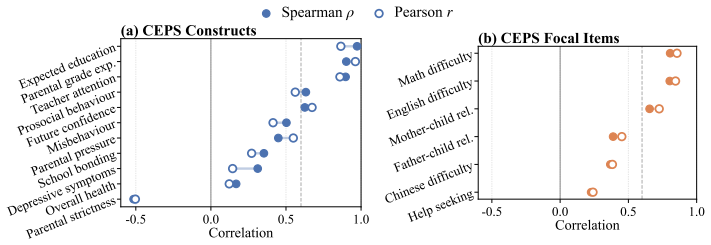
HACHIMI factorizes each persona into a theory-anchored educational schema, enforces developmental and psychological constraints via a neuro-symbolic validator, and combines stratified sampling with semantic deduplication to reduce mode collapse. The resulting HACHIMI-1M corpus comprises 1 million personas for Grades 1-12 with near-perfect schema validity, accurate quotas, and substantial diversity. When instantiated as agents, the personas produce responses to CEPS and PISA 2022 surveys that align strongly with human data on math and curiosity/growth constructs across 16 cohorts, while classroom-climate and well-being constructs show only moderate alignment.
What carries the argument
The neuro-symbolic validator that checks generated personas against developmental and psychological constraints derived from the theory-anchored educational schema.
If this is right
- Provides a standardized synthetic student population for group-level benchmarking of educational LLMs.
- Enables controllable social-science simulations by allowing quota-based adjustments to persona distributions.
- Reduces dependence on ad-hoc prompting or hand-crafted profiles for creating student agents.
- Reveals a fidelity gradient across survey constructs that can guide future validation priorities.
Where Pith is reading between the lines
- The same schema-plus-validator pattern could be adapted to generate personas in adjacent domains such as patients or employees.
- Stronger alignment on cognitive constructs suggests the framework is best suited for tasks that emphasize academic performance and growth mindsets.
- Releasing the full 1M corpus invites direct tests of whether these personas improve downstream learning outcomes when used in tutoring simulations.
Load-bearing premise
The selected educational schemas and the neuro-symbolic validator accurately reflect real developmental and psychological constraints that matter for student behavior.
What would settle it
A new set of surveys or classroom observations where personas instantiated as agents show large, consistent mismatches with human responses on constructs beyond math and curiosity, or where the synthetic population produces unreliable results in actual educational LLM evaluations.
Figures



read the original abstract
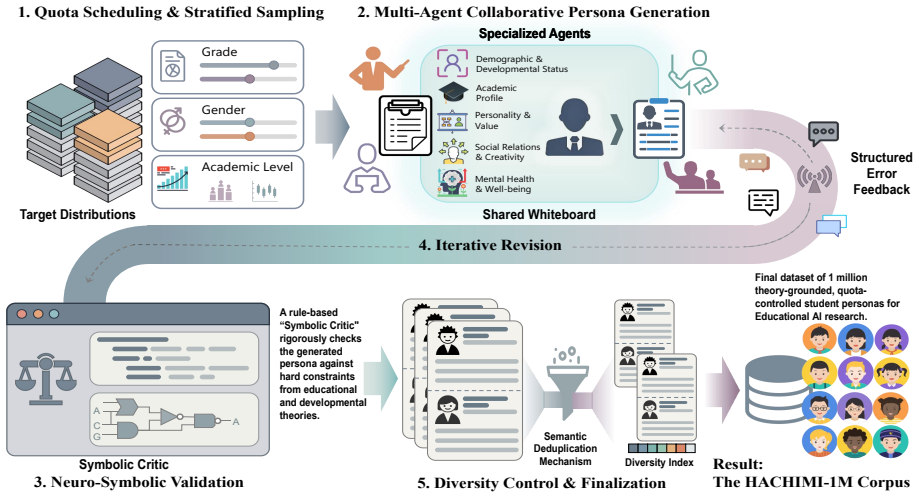
Student Personas (SPs) are emerging as infrastructure for educational LLMs, yet prior work often relies on ad-hoc prompting or hand-crafted profiles with limited control over educational theory and population distributions. We formalize this as Theory-Aligned and Distribution-Controllable Persona Generation (TAD-PG) and introduce HACHIMI, a multi-agent Propose-Validate-Revise framework that generates theory-aligned, quota-controlled personas. HACHIMI factorizes each persona into a theory-anchored educational schema, enforces developmental and psychological constraints via a neuro-symbolic validator, and combines stratified sampling with semantic deduplication to reduce mode collapse. The resulting HACHIMI-1M corpus comprises 1 million personas for Grades 1-12. Intrinsic evaluation shows near-perfect schema validity, accurate quotas, and substantial diversity, while external evaluation instantiates personas as student agents answering CEPS and PISA 2022 surveys; across 16 cohorts, math and curiosity/growth constructs align strongly between humans and agents, whereas classroom-climate and well-being constructs are only moderately aligned, revealing a fidelity gradient. All personas are generated with Qwen2.5-72B, and HACHIMI provides a standardized synthetic student population for group-level benchmarking and social-science simulations. Resources available at https://github.com/ZeroLoss-Lab/HACHIMI
Editorial analysis
A structured set of objections, weighed in public.
Referee Report
Summary. The paper introduces HACHIMI, a multi-agent Propose-Validate-Revise framework for Theory-Aligned and Distribution-Controllable Persona Generation (TAD-PG). It factorizes each student persona into a theory-anchored educational schema, enforces developmental and psychological constraints with a neuro-symbolic validator, and uses stratified sampling plus semantic deduplication to produce a 1M corpus for grades 1-12. Intrinsic evaluation reports near-perfect schema validity, accurate quotas, and diversity; external evaluation instantiates personas as agents on CEPS and PISA 2022 surveys, showing strong alignment on math and curiosity/growth constructs but only moderate alignment on classroom-climate and well-being.
Significance. If the validator's constraints prove independently grounded and the partial survey alignments generalize, HACHIMI would supply a large, standardized, reproducible synthetic student population useful for educational LLM benchmarking and social-science simulations. The open release of the 1M corpus and code at the provided GitHub link is a concrete strength that supports reproducibility.
major comments (3)
- [Abstract, §4 (Validator description)] The neuro-symbolic validator is load-bearing for the central claim that HACHIMI enforces real developmental and psychological constraints (abstract and §4). The manuscript must specify the exact symbolic rules, demonstrate they are not derived tautologically from the same educational schemas, and provide either an ablation study or external grounding against independent psychological datasets; without this, the reported near-perfect validity does not establish capture of real-world constraints.
- [§5 (External evaluation)] External evaluation (§5) shows strong alignment only on math and curiosity/growth while classroom-climate and well-being are only moderately aligned, revealing a clear fidelity gradient. The paper should include detailed error analysis, cohort-level breakdowns, and explicit discussion of whether this gradient limits claims of overall persona fidelity for downstream educational applications.
- [§3 (Framework), §6 (Experiments)] No baseline comparisons are presented against simpler prompting methods or non-orchestrated generation approaches referenced in the introduction. This omission makes it difficult to quantify the incremental contribution of the multi-agent orchestration, stratified sampling, and neuro-symbolic validator to the reported validity and alignment metrics.
minor comments (2)
- [§4] Clarify the precise mapping from schema components to validator inputs and outputs, including any thresholds or decision procedures used in the neuro-symbolic component.
- [§5 (Intrinsic evaluation figures)] Add statistical significance tests or confidence intervals to the quota-accuracy and diversity figures to support the 'near-perfect' and 'substantial' claims.
Simulated Author's Rebuttal
We thank the referee for the constructive and detailed feedback. We address each major comment point-by-point below, indicating where revisions will be made to improve clarity and rigor.
read point-by-point responses
-
Referee: [Abstract, §4 (Validator description)] The neuro-symbolic validator is load-bearing for the central claim that HACHIMI enforces real developmental and psychological constraints (abstract and §4). The manuscript must specify the exact symbolic rules, demonstrate they are not derived tautologically from the same educational schemas, and provide either an ablation study or external grounding against independent psychological datasets; without this, the reported near-perfect validity does not establish capture of real-world constraints.
Authors: We agree that the validator requires more explicit documentation to substantiate the central claims. In the revised version we will expand §4 to list every symbolic rule verbatim, cite independent sources (Piagetian developmental stages and self-determination theory literature) showing the rules are not tautological with the schemas, and add an ablation that removes the symbolic component while keeping the neural proposer to quantify its contribution to schema validity. revision: yes
-
Referee: [§5 (External evaluation)] External evaluation (§5) shows strong alignment only on math and curiosity/growth while classroom-climate and well-being are only moderately aligned, revealing a clear fidelity gradient. The paper should include detailed error analysis, cohort-level breakdowns, and explicit discussion of whether this gradient limits claims of overall persona fidelity for downstream educational applications.
Authors: We accept that the fidelity gradient must be analyzed more thoroughly. We will augment §5 with a dedicated error-analysis subsection, report per-cohort breakdowns (by grade band and demographic strata), and add an explicit discussion of the gradient’s implications, noting that HACHIMI personas are most reliable for math and motivational constructs while downstream users should apply caution for classroom-climate and well-being simulations. revision: yes
-
Referee: [§3 (Framework), §6 (Experiments)] No baseline comparisons are presented against simpler prompting methods or non-orchestrated generation approaches referenced in the introduction. This omission makes it difficult to quantify the incremental contribution of the multi-agent orchestration, stratified sampling, and neuro-symbolic validator to the reported validity and alignment metrics.
Authors: We acknowledge the absence of direct baselines. Because generating the full 1 M corpus is computationally expensive, we will add a new subsection in §6 that reports a controlled 50 k-persona comparison against (i) direct prompting and (ii) single-agent generation, measuring schema validity, quota accuracy, and survey alignment to isolate the contribution of orchestration and the validator. revision: yes
Circularity Check
No significant circularity; pipeline independent of evaluation data
full rationale
The HACHIMI framework generates personas via theory-anchored schemas, a neuro-symbolic validator, stratified sampling, and semantic deduplication, with all steps described as operating on external educational theory and population quotas. External evaluation against CEPS and PISA 2022 surveys functions as an independent alignment check rather than a fitted target or input to generation. No equations reduce outputs to parameters defined by the same data, no self-citations serve as load-bearing premises for the central claims, and the derivation chain remains self-contained against external benchmarks without reductions by construction.
Axiom & Free-Parameter Ledger
axioms (2)
- domain assumption Educational theories supply valid, factorizable schemas for student personas
- domain assumption Neuro-symbolic rules can enforce realistic developmental and psychological constraints
Lean theorems connected to this paper
-
IndisputableMonolith/Cost/FunctionalEquation.leanwashburn_uniqueness_aczel unclear?
unclearRelation between the paper passage and the cited Recognition theorem.
HACHIMI factorizes each persona into a theory-anchored educational schema, enforces developmental and psychological constraints via a neuro-symbolic validator, and combines stratified sampling with semantic deduplication
What do these tags mean?
- matches
- The paper's claim is directly supported by a theorem in the formal canon.
- supports
- The theorem supports part of the paper's argument, but the paper may add assumptions or extra steps.
- extends
- The paper goes beyond the formal theorem; the theorem is a base layer rather than the whole result.
- uses
- The paper appears to rely on the theorem as machinery.
- contradicts
- The paper's claim conflicts with a theorem or certificate in the canon.
- unclear
- Pith found a possible connection, but the passage is too broad, indirect, or ambiguous to say the theorem truly supports the claim.
Reference graph
Works this paper leans on
-
[1]
Ednet: A large-scale hierarchical dataset in education.Lecture Notes in Computer Science, pages 69–73. Alan Cooper. 1999. The inmates are running the asylum. In Uwe Arend, Eckhard Eberleh, and Klaus Pitschke, editors,Software-Ergonomie ’99: Design von Infor- mationswelten, volume 53 ofBerichte des German Chapter of the ACM, pages 17–17. Vieweg+Teubner Ver...
work page 1999
-
[2]
The impact of enhancing students’ social and emotional learning: A meta-analysis of school- based universal interventions.Child development, 82(1):405–432. Erik H Erikson. 1963.Childhood and society, volume
work page 1963
-
[3]
Norton. Ali Farooq, Amani Alabed, Pilira Stella Msefula, Re- ham Al Tamime, Joni Salminen, Soon-gyo Jung, and Bernard J. Jansen. 2025. Representing groups of stu- dents as personas: A systematic review of persona creation, application, and trends in the educational domain.Computers and Education Open, 8:100242. Bernard J. Jansen, Joni Salminen, Soon-gyo J...
work page 2025
-
[4]
Will i sound like me? improving persona consistency in dialogues through pragmatic self- consciousness. InProceedings of the 2020 Confer- ence on Empirical Methods in Natural Language Processing (EMNLP), pages 904–916, Online. Asso- ciation for Computational Linguistics. Ren´e F. Kizilcec, Chris Piech, and Emily Schnei- der. 2013. Deconstructing disengage...
work page 2020
-
[5]
Open university learning analytics dataset. Scientific Data, 4:170171. 11 Daniel K Lapsley and Darcia Narvaez. 2006. Character education.Handbook of child psychology, 4(1):696– 749. Patrick Lewis, Ethan Perez, Aleksandra Piktus, Fabio Petroni, Vladimir Karpukhin, Naman Goyal, Hein- rich K ¨uttler, Mike Lewis, Wen-tau Yih, Tim Rockt¨aschel, and 1 others. 2...
work page 2006
-
[6]
Cima: A large open access dialogue dataset for tutoring. InProceedings of the Fifteenth Workshop on Innovative Use of NLP for Building Educational Applications, pages 52–64. Abhijit Suresh, Jennifer Jacobs, Charis Harty, Margaret Perkoff, James H Martin, and Tamara Sumner. 2022. The talkmoves dataset: K-12 mathematics lesson transcripts annotated for teac...
work page 2022
-
[7]
Book2dial: Generating teacher student interactions from textbooks for cost-effective development of educational chatbots. InFindings of the Association for Computational Linguistics: ACL 2024, pages 9707–9731. Katherine Weare and Melanie Nind. 2011. Mental health promotion and problem prevention in schools: what does the evidence say?Health promotion inte...
work page internal anchor Pith review Pith/arXiv arXiv 2024
-
[8]
Data-driven personas: Constructing archety- pal users with clickstreams and user telemetry. In Proceedings of the 2016 CHI Conference on Human Factors in Computing Systems (CHI ’16), pages 5350– 5359, New York, NY , USA. Association for Comput- ing Machinery. Zheyuan Zhang, Daniel Zhang-Li, Jifan Yu, Linlu Gong, Jinchang Zhou, Zhanxin Hao, Jianxiao Jiang,...
work page 2016
- [9]
- [10]
-
[11]
“Poor: bottom 50%”. Achievement levels are used as hard anchors in quota scheduling and as conditioning signals for other agents, thus linking macro-level distribution control with micro-level content. 15 B.3.3 Personality & Value Orientation The VALUESagent is responsible for: • Personality: a short narrative description of personality traits (e.g., intr...
-
[12]
physical and mental health,
-
[13]
rule-of-law awareness,
-
[14]
social responsibility,
-
[15]
family orientation. Heuristics in the prompts and post-hoc filters prevent uniformly optimistic profiles by requiring a minimum count of “medium / low” level indicators for personas anchored to lower achievement tiers, thus tying value descriptions to the overall distributional design. B.3.4 Social Relations & Creativity The SOCIAL-CREATIVEagent produces:...
work page 2004
-
[16]
solution generation,
-
[17]
Each dimension must be associated with a level word and a brief justification
solution refinement. Each dimension must be associated with a level word and a brief justification. Internal consistency constraints (e.g., low feasibility cannot co-occur with very high solution generation) are enforced by the validator and light filters. As with values, creativity levels adapt to the academic-level anchor to suppress overly optimistic p...
-
[18]
an overall summary of psychological functioning
-
[19]
at least two salient personality or temperament features
-
[20]
coarse indicators of overall mental state and subjective well-being (e.g., “overall mental status” and “happiness index”); 16
-
[21]
risk descriptions for depression and anxiety (non-diagnostic, using educational language)
-
[22]
background stressors and protective factors (e.g., family, peers, school)
-
[23]
current supports and coping strategies. Prompts explicitly require non-diagnostic language and coherence with the value dimension “physical and mental health”, while filters prevent unrealistic combinations (e.g., very low achievement anchors with uniformly low risk and very high happiness). B.4 Sampling Constraints and Distribution Control For each perso...
-
[24]
Quota scheduling & stratified sampling.Given target distributions overgrade,gender, and academic level, the scheduler allocates explicit quotas for each stratum and draws stratified samples of abstract “slots”. Each slot encodes the macro-level variables required by the TAD-PG task (e.g., Grade 8, female, low-achievement, high-risk) and serves as a condit...
-
[25]
Multi-agent cooperative persona generation.For each scheduled slot, a society of specialized agents jointly constructs a holistic student persona on a shared whiteboard. Different agents are responsible for the four major components of the persona schema:academic profile,personality & values,social relations & creativity, andmental health & well-being. Th...
-
[26]
Neuro-symbolic validation.The draft persona is then passed to a rule-basedSymbolic Critic, which implements the neuro-symbolic constraints defined in the main text. The critic checks hard constraints derived from educational psychology and developmental theories (e.g., consistency between age and developmental stage, coherence between academic tier and se...
-
[27]
Iterative revision with structured error feedback.Whenever a violation is detected, the Symbolic Critic emits structured error messages that point to the offending components and the violated rules. These feedback signals are fed back to the relevant generators via the shared whiteboard, prompting targeted revision rather than unconditional regeneration. ...
-
[28]
Diversity control & finalization.In the final stage, the system applies semantic diversity control over the pool of validated personas. A semantic deduplication mechanism (e.g., SimHash-based or other locality-sensitive hashing) flags near-duplicate narratives within the same stratum, and redundant entries are pruned or rewritten. Diversity indices at bot...
-
[29]
"Name" (string, English name)
-
[30]
"Age" (integer, e.g., 12)
- [31]
- [32]
- [33]
-
[34]
"Agent Name" (string, conforming to given regex) - "Developmental Stage" must be an object and can only contain these three subkeys: - "Piaget Cognitive Development Stage" - "Erikson Psychosocial Development Stage" - "Kohlberg Moral Development Stage" - Absolutely prohibited from adding "id", "Student Info", or other keys; no additional wrapper layer. - D...
- [35]
- [36]
- [37]
-
[38]
Poor: Bottom 50% school ranking
"Poor: Bottom 50% school ranking" - [Subject preference hint if present] - [Target Academic Level constraint if present: "This sample’s ’Academic Level’ must strictly equal: {level}"] [Output Format Hard Constraints]: - You can only output one JSON object, and top-level can only contain the following 3 keys:
-
[39]
"Academic Level" - These 3 keys must all appear, cannot be missing, cannot add any other keys. - Absolutely prohibited from using "Student Info", "id", or other extra wrapper objects. - Do not use ‘‘‘json or ‘‘‘ to wrap output. [Qualified Example]: [$case of JSON with Strong Subjects array, Weak Subjects array, and Academic Level string] Please follow the...
-
[40]
"Values" - Not allowed to have "Student Info", "id", "Evaluation", or any other top-level keys. - "Values" must be single-paragraph text, no blank lines, no list symbols (e.g., "-", "1.", etc.) or Markdown in the middle. - Do not use ‘‘‘json or ‘‘‘ to wrap output. [Qualified Example]: [$case of JSON with Personality description and Values single-paragraph...
- [41]
-
[42]
"Creativity" - Not allowed to have "Student Info", "id", "Description", or any other keys. - Both "Social Relationships" and "Creativity" must be single-paragraph text, cannot contain list symbols, numbering, Markdown, etc. - Do not use ‘‘‘json or ‘‘‘ to wrap output. [Qualified Example]: [$case of JSON with Social Relationships paragraph and Creativity pa...
-
[43]
Overview of overall mental state
-
[44]
At least two personality traits related to psychological adaptation
-
[45]
Give clear level or degree descriptions for: Overall Mental State, Happiness Index, Depression Risk, Anxiety Risk
-
[46]
Insufficient information or no significant symptoms
If no clear mental illness, include "Insufficient information or no significant symptoms" non -diagnostic description; if risks or tendencies exist, use "May have... tendency", "Mild... experience", "Recommend further assessment"
-
[47]
Brief background story (e.g., academic pressure, interpersonal conflicts, family events)
-
[48]
Current support and coping methods (family, teachers, peers, school resources). [Conditional Adaptive Constraints, appended only when Target Academic Level is Low/Poor]: - [Psychological Index Distribution (strongly bound to filters)] - Please explicitly give levels or degrees for four items in the text: Overall Mental State, Happiness Index, Depression R...
-
[49]
"Mental Health" - Not allowed to have "Student Info", "id", "Evaluation", or other keys. - "Mental Health" must be single-paragraph text, cannot contain blank lines, list symbols, Markdown code blocks. - Do not use ‘‘‘json or ‘‘‘ to wrap output. [Qualified Example]: [$case of JSON with Mental Health single-paragraph containing overview, traits, 4 metrics,...
work page 2024
-
[50]
Descriptions follow official PISA 2022 variable definitions
Constructs are grouped by family.Boldindicates strong alignment ( r≥0.80 ); gray indicates negative alignment. Descriptions follow official PISA 2022 variable definitions. Construct Description East Asia S. Europe Lat. Am. Mid. East W. Europe Math Effort & Efficacy MATHEFF Mathematics self-efficacy: formal and applied mathe- matics - response options reve...
discussion (0)
Sign in with ORCID, Apple, or X to comment. Anyone can read and Pith papers without signing in.