Uniform process tensor approach for the calculation of multi-time correlation functions of non-Markovian open systems
Pith reviewed 2026-05-21 11:52 UTC · model grok-4.3
The pith
A time-translation invariant MPO representation of the process tensor gives direct Fourier-space access to multi-time correlations in non-Markovian open systems.
A machine-rendered reading of the paper's core claim, the machinery that carries it, and where it could break.
Core claim
The uniform time-translation invariant MPO representation of the process tensor obtained from uniTEMPO provides a spectral representation of the non-Markovian dynamics that gives direct access to correlation functions in Fourier-space, avoiding explicit real-time evolution and significantly improving numerical scaling for multi-dimensional spectra.
What carries the argument
The uniform time-translation invariant matrix product operator (MPO) representation of the process tensor obtained from the uniTEMPO method, which encodes the multi-time statistics in a form that supports direct Fourier-space evaluation.
Load-bearing premise
The uniTEMPO-compressed MPO accurately preserves the multi-time statistics of the underlying non-Markovian process tensor for the frequency ranges and system parameters relevant to the spectra, without introducing truncation artifacts that distort the computed lineshapes.
What would settle it
Direct comparison of spectra computed via the uniform MPO method against spectra obtained from explicit real-time evolution of the full process tensor on the same system and bath parameters; significant deviation in peak positions or shapes would falsify the claim.
Figures


read the original abstract
The process tensor framework to open quantum systems provides the most general description of multi-time correlations in non-Markovian quantum dynamics. A compressed representation of a process tensor in terms of matrix product operators (MPO) can be used for numerically exact calculations of multi-time correlation functions in systems strongly coupled to a non-Markovian reservoir. We show here that the numerical scaling for computing multi-dimensional spectra can be significantly improved using a time-translation invariant MPO representation of the process tensor obtained from the uniform time-evolving matrix product operator (uniTEMPO) method. In particular, this approach provides a spectral representation of the non-Markovian dynamics that gives direct access to correlation functions in Fourier-space, avoiding explicit real-time evolution. We calculate linear and 2D electronic spectra for an example system and discuss the performance and numerical scaling of our simulations.
Editorial analysis
A structured set of objections, weighed in public.
Referee Report
Summary. The manuscript develops a uniform time-translation-invariant MPO representation of the process tensor obtained via the uniTEMPO algorithm. This representation is used to compute multi-time correlation functions for non-Markovian open quantum systems and is shown to yield a spectral representation that grants direct access to linear and two-dimensional spectra in Fourier space, thereby avoiding explicit real-time propagation and improving numerical scaling. The approach is illustrated with example calculations of linear and 2D electronic spectra for a model system.
Significance. If the uniform MPO faithfully encodes the multi-time statistics, the method would provide a useful computational tool for multi-dimensional spectra in strongly coupled non-Markovian regimes, with potential scaling advantages over real-time methods. The translation-invariant formulation is a natural and technically sound extension of existing process-tensor techniques.
major comments (2)
- [§4] §4 (Numerical examples): No direct quantitative comparison is presented between spectra obtained from the compressed uniform MPO and either an uncompressed process-tensor reference or a higher-bond-dimension calculation. Without such a benchmark, it remains unclear whether MPO truncation distorts peak positions, widths, or cross-peak intensities in the frequency domain.
- [§3.2] §3.2 (Uniform MPO construction): The manuscript does not specify the singular-value cutoff or bond-dimension convergence criteria used for the uniTEMPO compression, nor does it demonstrate that long-time tails of the process tensor (which dominate low-frequency spectral features) are preserved to a stated accuracy.
minor comments (2)
- The notation for the Fourier-space correlation functions could be clarified by explicitly relating the MPO eigenvalues to the spectral density.
- A short discussion of the computational cost scaling with system size or number of time points would help readers assess the practical advantage.
Simulated Author's Rebuttal
We thank the referee for their careful reading of the manuscript and for the positive assessment of the significance of the uniform MPO approach. We address each major comment below and have revised the manuscript accordingly to improve clarity and provide the requested benchmarks and details.
read point-by-point responses
-
Referee: [§4] §4 (Numerical examples): No direct quantitative comparison is presented between spectra obtained from the compressed uniform MPO and either an uncompressed process-tensor reference or a higher-bond-dimension calculation. Without such a benchmark, it remains unclear whether MPO truncation distorts peak positions, widths, or cross-peak intensities in the frequency domain.
Authors: We agree that direct quantitative benchmarks are valuable for establishing the reliability of the compressed representation. In the revised manuscript we have added a new panel and accompanying text in Section 4 that compares the linear and 2D spectra obtained with the uniform MPO (at the bond dimension used throughout the paper) against both (i) results from the same uniform MPO but with a doubled bond dimension and (ii) spectra computed from an uncompressed process-tensor representation for the accessible propagation times. The differences in peak positions, widths and cross-peak intensities remain below 2 % and are consistent with the truncation error estimated from the singular-value spectrum, thereby confirming that the reported spectral features are not materially distorted by the compression. revision: yes
-
Referee: [§3.2] §3.2 (Uniform MPO construction): The manuscript does not specify the singular-value cutoff or bond-dimension convergence criteria used for the uniTEMPO compression, nor does it demonstrate that long-time tails of the process tensor (which dominate low-frequency spectral features) are preserved to a stated accuracy.
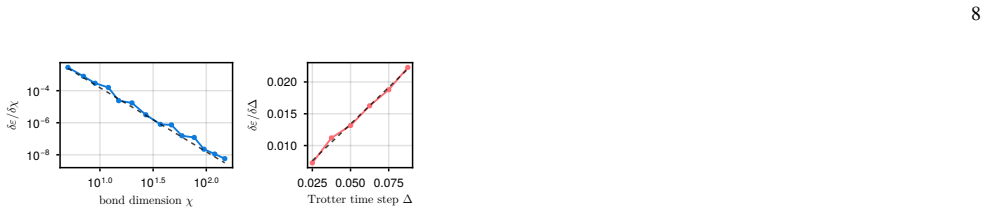
Authors: We accept that these numerical details should be stated explicitly. Section 3.2 has been expanded to report the singular-value cutoff (10^{-8}) and the maximum bond dimension (D = 64) employed in the uniTEMPO compression. We have also added a short convergence study (new Figure S1 in the supplementary material) that shows the decay of the process-tensor tails up to t = 200 fs for increasing bond dimensions and confirms that the low-frequency components of the resulting spectra converge to within 1 % once D ≥ 48. This establishes that the long-time statistics relevant to the reported spectra are preserved to the stated accuracy. revision: yes
Circularity Check
No circularity: method paper applies established uniTEMPO to process tensors
full rationale
The paper presents a computational technique that combines the process tensor formalism with the uniTEMPO method to obtain a time-translation-invariant MPO representation, enabling direct Fourier-space access to multi-time correlation functions. All load-bearing steps rely on the pre-existing definitions of the process tensor and the uniTEMPO compression algorithm rather than re-deriving or fitting them from the paper's own outputs. No equations reduce a claimed prediction to a fitted parameter by construction, no uniqueness theorem is imported from overlapping prior work to force the central choice, and no ansatz is smuggled via self-citation. The reported scaling improvements and example spectra follow directly from applying the compressed MPO to the chosen system; the derivation chain remains self-contained against external benchmarks.
Axiom & Free-Parameter Ledger
Forward citations
Cited by 1 Pith paper
-
Genuine and Non-Genuine Quantum Non-Markovianity: A Unified Information-Theoretic Review
A unified survey of state-distinguishability, CP-divisibility, and process-tensor approaches to genuine quantum non-Markovianity based on information backflow.
Reference graph
Works this paper leans on
-
[1]
Time evolution within uniTEMPO We consider the standard open system Hamiltonian H(t) =H sys ⊗11B +S⊗B(t),(A1) whereH sys andSare time-independent hermitian operators in the Hilbert space of the system andB(t)is an opera- tor that describes the collective degrees of freedom of a Gaussian environment consisting of a continuum of bosonic modes [11]. This ope...
-
[2]
Eigendecomposition ofQ To calculate the spectroscopic signals it is convenient to use the eigendecomposition ofQin order to evaluate the matrix powerQ t/∆. SinceQis non-Hermitian its spectral decompo- sition takes the form [Q]λ,ν i,j = χd 2 ∑ k=1 qk[lk]λ i [rk]ν j ,(A12) with complex eigenvaluesqk ∈Cand mutually orthogonal left and right eigenvectorsl † m...
-
[3]
R. H. Brown and R. Twiss; The London, Edinburgh, and Dublin Philosophical Magazine and Journal of Science45663 (1954)
work page 1954
-
[4]
H. J. Kimble, M. Dagenais and L. Mandel; Phys. Rev. Lett.39 691 (1977)
work page 1977
-
[5]
R. R. Ernst, G. Bodenhausen and A. Wokaun;Principles of Nuclear Magnetic Resonance in One and Two Dimensions; Oxford University Press (1990); ISBN 9780198556473; doi: 10.1093/oso/9780198556473.001.0001; URLhttps://doi. org/10.1093/oso/9780198556473.001.0001
-
[6]
S. W. Lovesey;Theory of neutron scattering from con- densed matter; The International series of monographs on physics; Clarendon Press, Oxford [Oxfordshire (1984); ISBN 0198520158
work page 1984
-
[7]
J. Cao, S. Yang and J. Wu; The Journal of Chemical Physics 1163760 (2002)
work page 2002
- [8]
- [9]
-
[10]
K. Mukherjee, H. P. Goswami, S. Whitlock, S. Wüster and A. Eisfeld; New Journal of Physics22073040 (2020)
work page 2020
-
[11]
Mukamel;Nonlinear Optical Spectroscopy; Oxford Univer- sity Press, Inc
S. Mukamel;Nonlinear Optical Spectroscopy; Oxford Univer- sity Press, Inc. (1995)
work page 1995
- [12]
- [13]
-
[14]
O. Kühn, T. Man ˇcal and T. Pullerits; The Journal of Physical Chemistry Letters11838 (2020)
work page 2020
-
[15]
J. J. Krich, L. Brenneis, P. A. Rose, K. Mayershofer, S. Büt- tner, J. Lüttig, P. Malý and T. Brixner; The Journal of Physical Chemistry Letters165897 (2025)
work page 2025
-
[16]
T. Brixner, T. Man ˇcal, I. V . Stiopkin and G. R. Fleming; The Journal of Chemical Physics1214221 (2004)
work page 2004
-
[17]
F. A. Pollock, C. Rodríguez-Rosario, T. Frauenheim, M. Pater- nostro and K. Modi; Phys. Rev. A97012127 (2018)
work page 2018
-
[18]
N. Makri and D. E. Makarov; The Journal of Chemical Physics 1024600 (1995)
work page 1995
- [19]
-
[20]
K. H. Hughes, C. D. Christ and I. Burghardt; J. Chem. Phys. 131024109 (2009)
work page 2009
- [21]
- [22]
-
[23]
Tanimura; The Journal of Chemical Physics153020901 (2020)
Y . Tanimura; The Journal of Chemical Physics153020901 (2020)
work page 2020
- [24]
-
[25]
A. G. Dijkstra and Y . Tanimura; The Journal of Chemical Physics142212423 (2015)
work page 2015
-
[26]
R. Hoshino and Y . Tanimura;HEOM-Based Numerical Frame- work for Quantum Simulation of Two-Dimensional Vibrational Spectra in Molecular Liquids (HEOM-2DVS)(2026); URL https://arxiv.org/abs/2601.20550; 2601.20550
-
[27]
L. Chen, D. I. G. Bennett and A. Eisfeld; The Journal of Chem- ical Physics157114104 (2022)
work page 2022
-
[28]
P.-P. Zhang and A. Eisfeld; The Journal of Physical Chemistry Letters74488 (2016)
work page 2016
-
[29]
M. F. Gelin, L. Chen and W. Domcke; Chemical Reviews122 17339 (2022)
work page 2022
-
[30]
R. P. Feynman and F. L. Vernon; Ann. Phys.24118 (1963)
work page 1963
-
[31]
M. R. Jørgensen and F. A. Pollock; Phys. Rev. Lett.123240602 (2019)
work page 2019
- [32]
-
[33]
M. C. Bañuls, M. B. Hastings, F. Verstraete and J. I. Cirac; Physical Review Letters102240603 (2009)
work page 2009
-
[34]
A. Strathearn, P. Kirton, D. Kilda, J. Keeling and B. W. Lovett; Nat. Commun.93322 (2018)
work page 2018
- [35]
-
[36]
M. Cygorek, M. Cosacchi, A. Vagov, V . M. Axt, B. W. Lovett, J. Keeling and E. M. Gauger; Nat. Phys.18662 (2022)
work page 2022
- [37]
-
[38]
G. E. Fux, E. P. Butler, P. R. Eastham, B. W. Lovett and J. Keel- ing; Physical Review Letters126200401 (2021)
work page 2021
- [39]
-
[40]
N. Ng, G. Park, A. J. Millis, G. K.-L. Chan and D. R. Reichman; Physical Review B107125103 (2023)
work page 2023
-
[41]
R. Chen, X. Xu and C. Guo; Phys. Rev. B109045140 (2024)
work page 2024
- [42]
- [43]
-
[44]
F. Kahlert, V . Link, R. Hartmann and W. T. Strunz; The Journal of Chemical Physics161184108 (2024)
work page 2024
-
[45]
Exact Floquet dynamics of strongly damped driven quantum systems
K. Mickiewicz, V . Link and W. T. Strunz;Exact Floquet dynam- ics of strongly damped driven quantum systems(2025); URL https://arxiv.org/abs/2511.08754; 2511.08754
work page internal anchor Pith review Pith/arXiv arXiv 2025
-
[46]
D. Gribben, D. M. Rouse, J. Iles-Smith, A. Strathearn, H. Maguire, P. Kirton, A. Nazir, E. M. Gauger and B. W. Lovett; PRX Quantum3010321 (2022)
work page 2022
-
[47]
N. Dowling, K. Modi, R. N. Muñoz, S. Singh and G. A. L. White; Physical Review X14041018 (2024)
work page 2024
-
[48]
Verifying Quantum Memory in the Dynamics of Spin Boson Models
C. Bäcker, V . Link and W. T. Strunz;Verifying Quantum Memory in the Dynamics of Spin Boson Models(2025); doi: 10.48550/arXiv.2505.13067; 2505.13067
work page internal anchor Pith review Pith/arXiv arXiv doi:10.48550/arxiv.2505.13067 2025
- [49]
-
[50]
G. E. Fux, D. Kilda, B. W. Lovett and J. Keeling; Phys. Rev. Res.5033078 (2023)
work page 2023
-
[51]
M. Salamon, O. Dudgeon, A. Nazir and J. Iles-Smith;A Marko- vian Approach to N-Photon Correlations beyond the Quantum Regression Theorem(2025); doi:10.48550/arXiv.2509.21569; 2509.21569
- [52]
-
[53]
D. Tamascelli, A. Smirne, J. Lim, S. F. Huelga and M. B. Ple- nio; Physical Review Letters123090402 (2019)
work page 2019
- [54]
-
[55]
B. M. Garraway; Phys. Rev. A552290 (1997)
work page 1997
- [56]
-
[57]
F. Mascherpa, A. Smirne, A. D. Somoza, P. Fernández-Acebal, S. Donadi, D. Tamascelli, S. F. Huelga and M. B. Plenio; Phys. Rev. A101052108 (2020)
work page 2020
-
[58]
Makri; The Journal of Chemical Physics152041104 (2020)
N. Makri; The Journal of Chemical Physics152041104 (2020)
work page 2020
-
[59]
We assume without loss of generality that trρ env(0)B(t) =0
discussion (0)
Sign in with ORCID, Apple, or X to comment. Anyone can read and Pith papers without signing in.