Genuine and Non-Genuine Quantum Non-Markovianity: A Unified Information-Theoretic Review
Pith reviewed 2026-05-14 21:58 UTC · model grok-4.3
The pith
Different information-theoretic frameworks can be compared to separate genuine quantum non-Markovianity from classical memory effects in open dynamics.
A machine-rendered reading of the paper's core claim, the machinery that carries it, and where it could break.
Core claim
No single definition yet isolates genuinely quantum memory effects; instead, each framework supplies its own operational test based on information backflow, and these tests can be placed side by side to reveal which observed memory phenomena survive when classical or non-genuine contributions are subtracted.
What carries the argument
Information backflow, defined as the revival of distinguishability or coherence that cannot be explained by classical stochastic processes alone.
If this is right
- Experimental protocols can be chosen according to which framework best matches the available control and measurement resources.
- Quantum devices that rely on memory effects can be certified as using genuine quantum resources rather than classical simulation.
- Theoretical models of open-system dynamics can be classified by whether their memory is robust under the stricter genuine-quantum tests.
- Resource theories of quantum memory can be built by adopting the strongest common criterion across the surveyed frameworks.
Where Pith is reading between the lines
- The review's comparison may help identify dynamics in which non-Markovianity is useful for quantum error correction or sensing even if it fails stricter genuine-quantum tests.
- Process-tensor methods appear most flexible for multi-time correlations, suggesting they could serve as a reference standard when the other two frameworks disagree.
- Future work could test whether the distinctions drawn here remain stable when the open system is coupled to a finite rather than infinite environment.
Load-bearing premise
Existing frameworks for detecting memory effects can be compared directly without introducing new conceptual inconsistencies.
What would settle it
A concrete open-system dynamics for which one framework reports genuine quantum non-Markovianity while another reports only classical or non-genuine contributions, with an agreed-upon experimental protocol that can decide between the two reports.
Figures


read the original abstract
Understanding whether the features of open quantum dynamics are genuinely quantum remains a central challenge in quantum dynamics. Even though the non-Markovian behavior of quantum dynamics has been widely investigated across different settings, there is still no consensus on which properties of a dynamics reflect genuine quantum features and which arise from classical or non-genuine quantum sources. In this review, we provide detailed information on recent developments in characterizing quantum non-Markovianity based on information backflow and the nature of its origin. We also present a survey on how various approaches separate classical and quantum contributions, as well as how they define operational tasks that reveal genuine quantum non-Markovianity. We analyze several frameworks, including state-distinguishability -based, channel-based (``CP-divisibility''), and process-tensor methods. For each framework, we outline the underlying physical motivation, the criteria proposed to distinguish genuine quantum non-Markovianity from practical or apparent memory effects. We further compare different approaches and their strengths and limitations. The review aims to clarify the conceptual and operational aspects of quantum non-Markovian processes based on their nature and to provide a foundation for future research on quantum non-Markovianity and its role in advancing quantum information science and technology.
Editorial analysis
A structured set of objections, weighed in public.
Referee Report
Summary. The manuscript is a review surveying frameworks for distinguishing genuine quantum non-Markovianity from classical or apparent effects in open quantum dynamics. It examines state-distinguishability-based methods, CP-divisibility (channel-based approaches), and process-tensor techniques, outlining for each the physical motivations, proposed criteria, operational tasks, strengths, and limitations before providing side-by-side comparisons. The central aim is to clarify conceptual and operational distinctions and supply a foundation for future work on quantum memory effects.
Significance. If the comparisons are accurate and balanced, the review could meaningfully address the acknowledged lack of consensus by synthesizing information-theoretic perspectives across frameworks. It may serve as a useful reference for identifying operational signatures of genuine quantum backflow, thereby supporting progress in quantum information processing and technologies that rely on controlled non-Markovian dynamics.
minor comments (2)
- [Abstract and concluding section] The abstract states the goal of unification but the manuscript presents the frameworks largely in parallel; a concluding synthesis section or summary table explicitly mapping agreement and disagreement on benchmark dynamics would strengthen the 'unified' aspect of the title.
- [Process-tensor methods subsection] Ensure that all cited references in the process-tensor discussion include the most recent operational characterizations (post-2022) to avoid any perception of incomplete coverage.
Simulated Author's Rebuttal
We thank the referee for the positive assessment of our manuscript, the clear summary of its scope, and the recommendation for minor revision. No specific major comments were provided in the report, so we interpret this as an endorsement of the overall structure, comparisons, and information-theoretic focus. We will use the revision to incorporate any minor editorial or presentational suggestions that may arise during the process.
Circularity Check
Review of external frameworks with no internal derivations or self-referential reductions
full rationale
This is a survey paper that outlines motivations, criteria, strengths, and limitations of existing frameworks (state-distinguishability, CP-divisibility, process-tensor) drawn from prior literature. No new equations, theorems, or unification derivations are introduced whose validity depends on self-citations, fitted parameters, or ansatzes from the authors' own prior work. The central claims are clarifications and comparisons of established approaches, remaining self-contained against external benchmarks without any load-bearing step that reduces to its own inputs by construction.
Axiom & Free-Parameter Ledger
axioms (1)
- standard math Standard axioms of quantum mechanics and completely positive trace-preserving maps for open-system dynamics
Lean theorems connected to this paper
-
IndisputableMonolith/Foundation/Cost/FunctionalEquation.leanwashburn_uniqueness_aczel unclear?
unclearRelation between the paper passage and the cited Recognition theorem.
We analyze several frameworks, including state-distinguishability-based, channel-based (CP-divisibility), and process-tensor methods... clarify the conceptual and operational aspects of quantum non-Markovian processes
What do these tags mean?
- matches
- The paper's claim is directly supported by a theorem in the formal canon.
- supports
- The theorem supports part of the paper's argument, but the paper may add assumptions or extra steps.
- extends
- The paper goes beyond the formal theorem; the theorem is a base layer rather than the whole result.
- uses
- The paper appears to rely on the theorem as machinery.
- contradicts
- The paper's claim conflicts with a theorem or certificate in the canon.
- unclear
- Pith found a possible connection, but the passage is too broad, indirect, or ambiguous to say the theorem truly supports the claim.
Reference graph
Works this paper leans on
-
[1]
P-DIVISIBILITY VS INFORMATION BACKFLOW Divisibility-based and information-backflow-based ap- proaches to quantum non-Markovianity are often discussed in tandem, yet they probe distinct structural and operational aspects of open quantum dynamics. While divisibility charac- terizes the intrinsic properties of the dynamical map itself, in- formation backflow...
-
[2]
GENUINE VS NON-GENUINE BACKFLOW OF INFORMATION Despite the diversity and sophistication of the measures and definitions discussed in section 3, a common limitation remains: none of these approaches distinguishes the nature of the information backflow or memory responsible for non- Markovian behavior in dynamics. In particular, CP indivis- ibility, informa...
-
[3]
PROCESS TENSORS VS. DYNAMICAL MAPS In this review, A sharp and practically important ques- tion in the study of genuine quantum non-Markovianity is whether the memory sustaining non-Markovian dynamics is itself quantum, or whether a classical stochastic process suf- fices to reproduce it. Bäcker, Link, and Strunz [71, 72] address this directly for the spi...
-
[4]
SUMMARY In this review, we presented a comprehensive and unified account of non-Markovian dynamical systems, with a partic- ular focus on the nature of the backflow behavior. While non- Markovianity is often associated with information backflow or the violation of divisibility conditions, an emerging question occurring from recent research is that such si...
-
[5]
For this example, it is convenient to start from the sim- plest structure qubit channel
Example: RHP vs BLP non-Markovianity Here, we will show that both approaches, BLP and RHP, capture different things and do not show equivalence to each other. For this example, it is convenient to start from the sim- plest structure qubit channel. Any such channel can be written as a probabilistic mixture of Pauli operators, Λt(ρ)= 3X i=0 pi(t)σ iρσi,(B1)...
-
[6]
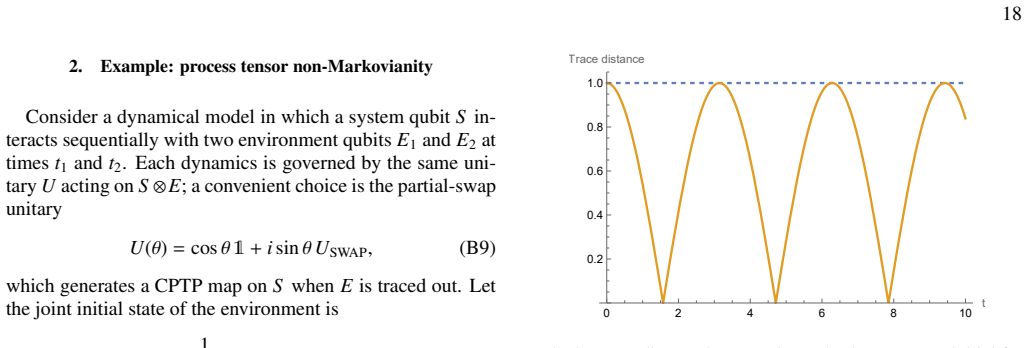
Example: process tensor non-Markovianity Consider a dynamical model in which a system qubitSin- teracts sequentially with two environment qubitsE 1 andE 2 at timest 1 andt 2. Each dynamics is governed by the same uni- taryUacting onS⊗E; a convenient choice is the partial-swap unitary U(θ)=cosθ1+isinθU SW AP,(B9) which generates a CPTP map onSwhenEis trace...
-
[7]
Example: classical mixing induce non-genuine non-Markovianity We explicitly analyze the evolution of the state under a sin- gle Markovian unitary channel and under a classically mixed unitary dynamics, and compute the corresponding trace dis- tance in both cases. Let’s consider the initial state is |+⟩= 1√ 2 (|0⟩+|1⟩), ρ +(0)= 1 2 1 1 1 1 ! .(B19) First, ...
-
[9]
M. da Silva, G. Viswanathan, and J. Cressoni, A two- dimensional non-markovian random walk leading to anomalous diffusion, Physica A: Statistical Mechanics and its Applications 421, 522 (2015)
work page 2015
- [10]
-
[11]
N. R. Barraza, G. Pena, J. Gambini, and M. Floren- cia Carusela, A non-homogeneous, non-stationary and path- dependent markov anomalous diffusion model, Journal of Physics A: Mathematical and Theoretical58, 095001 (2025)
work page 2025
-
[12]
M. D. Chekroun, H. Liu, and J. C. McWilliams, Non-markovian reduced models to unravel transitions in non-equilibrium sys- tems, Journal of Physics A: Mathematical and Theoretical58, 045204 (2025)
work page 2025
-
[13]
V . S. V olkov and A. I. Leonov, Non-markovian brownian mo- tion in a viscoelastic fluid, The Journal of Chemical Physics 104, 5922 (1996)
work page 1996
- [14]
- [15]
-
[16]
R. Román-Ancheyta, B. i. e. i. f. m. c. Çakmak, R. d. J. León-Montiel, and A. Perez-Leija, Quantum transport in non- markovian dynamically disordered photonic lattices, Phys. Rev. A103, 033520 (2021)
work page 2021
-
[17]
Density-Dependence Subdiffusion in Chemotaxis
A. Al-Sabbagh, Density-dependence subdiffusion in chemo- taxis (2016), arXiv:1512.08438 [cond-mat.stat-mech]
work page internal anchor Pith review Pith/arXiv arXiv 2016
-
[18]
A. Iomin, Non-markovian quantum mechanics on comb, Chaos: An Interdisciplinary Journal of Nonlinear Science34, 093135 (2024)
work page 2024
-
[19]
L. A. da Silva and R. D. Vilela, Colored noise and memory ef- fects on formal spiking neuron models, Phys. Rev. E91, 062702 (2015)
work page 2015
- [20]
- [22]
-
[23]
O. Vilk, R. Metzler, and M. Assaf, Non-markovian gene expres- sion, Phys. Rev. Res.6, L022026 (2024)
work page 2024
-
[24]
X. Yang, Y . Chen, T. Zhou, and J. Zhang, Exploring dissipative sources of non-markovian biochemical reaction systems, Phys. Rev. E103, 052411 (2021)
work page 2021
-
[25]
F. Jafarpour, E. Levien, and A. Amir, Evolutionary dynamics in non-markovian models of microbial populations, Phys. Rev. E 108, 034402 (2023)
work page 2023
-
[26]
A. Streltsov, G. Adesso, and M. B. Plenio, Colloquium: Quan- tum coherence as a resource, Rev. Mod. Phys.89, 041003 (2017)
work page 2017
-
[27]
R. Horodecki, P. Horodecki, M. Horodecki, and K. Horodecki, 20 Quantum entanglement, Reviews of Modern Physics81, 865 (2009)
work page 2009
-
[28]
S. Das, T. Chanda, M. Lewenstein, A. Sanpera, A. Sen De, and U. Sen, The separability versus entanglement problem, in Quantum Information(John Wiley & Sons, Ltd, 2016) Chap. 8, pp. 127–174
work page 2016
-
[29]
K. Modi, A. Brodutch, H. Cable, T. Paterek, and V . Vedral, The classical-quantum boundary for correlations: Discord and re- lated measures, Rev. Mod. Phys.84, 1655 (2012)
work page 2012
-
[30]
A. Bera, T. Das, D. Sadhukhan, S. Singha Roy, A. Sen(De), and U. Sen, Quantum discord and its allies: a review of recent progress, Reports on Progress in Physics81, 024001 (2017)
work page 2017
-
[31]
Z. Mann, N. Cao, R. Laflamme, and S. Zhou, Quantum error- corrected non-markovian metrology, PRX Quantum6, 030321 (2025)
work page 2025
-
[32]
A. Das, P. Solano, and K. Sinha, Non-markovian spontaneous emission in a tunable cavity formed by atomic mirrors, Phys. Rev. A112, 043723 (2025)
work page 2025
-
[33]
R. Gangwar, M. L. Bera, G. P. Teja, S. K. Goyal, and M. N. Bera, Ancilla-assisted protection of information: application to atom–cavity systems, Quantum Information Processing22, 425 (2023)
work page 2023
-
[34]
R. Gangwar, T. Pandit, K. Goswami, S. Das, and M. N. Bera, Squashed quantum non-Markovianity: a measure of genuine quantum non-Markovianity in states, Quantum9, 1646 (2025)
work page 2025
-
[35]
F. Buscemi, R. Gangwar, K. Goswami, H. Badhani, T. Pandit, B. Mohan, S. Das, and M. N. Bera, Causal and noncausal re- vivals of information: A new regime of non-markovianity in quantum stochastic processes, PRX Quantum6, 020316 (2025)
work page 2025
-
[36]
S. Milz, D. Egloff, P. Taranto, T. Theurer, M. B. Plenio, A. Smirne, and S. F. Huelga, When is a non-markovian quan- tum process classical?, Phys. Rev. X10, 041049 (2020)
work page 2020
-
[37]
S. Das, A. Yosifov, and J. Sun, Hysteretic squashed entangle- ment in many-body quantum systems (2026)
work page 2026
-
[38]
Ángel Rivas, S. F. Huelga, and M. B. Plenio, Quantum non- Markovianity: characterization, quantification and detection, Reports on Progress in Physics77, 094001 (2014)
work page 2014
- [39]
-
[40]
H.-P. Breuer, E.-M. Laine, and J. Piilo, Measure for the degree of non-Markovian behavior of quantum processes in open sys- tems, Physical Review Letters103, 210401 (2009)
work page 2009
-
[41]
D. Chru ´sci´nski, A. Rivas, and E. Størmer, Divisibility and infor- mation flow notions of quantum markovianity for noninvertible dynamical maps, Phys. Rev. Lett.121, 080407 (2018)
work page 2018
-
[42]
D. Chru ´sci´nski, A. Kossakowski, and A. Rivas, Measures of non-Markovianity: Divisibility versus backflow of information, Physical Review A83, 052128 (2011)
work page 2011
-
[43]
S. Milz, M. S. Kim, F. A. Pollock, and K. Modi, Completely positive divisibility does not mean Markovianity, Physical Re- view Letters123, 040401 (2019)
work page 2019
-
[44]
S. Luo, S. Fu, and H. Song, Quantifying non-Markovianity via correlations, Physical Review A86, 044101 (2012)
work page 2012
-
[45]
Z. Huang and X.-K. Guo, Quantifying non-Markovianity via conditional mutual information, Physical Review A104, 032212 (2021)
work page 2021
-
[46]
J. Kołody´nski, S. Rana, and A. Streltsov, Entanglement negativ- ity as a universal non-Markovianity witness, Physical Review A 101, 020303 (2020)
work page 2020
-
[47]
S. Das, S. Khatri, G. Siopsis, and M. M. Wilde, Fundamental limits on quantum dynamics based on entropy change, Journal of Mathematical Physics59, 012205 (2018)
work page 2018
-
[48]
H. S. Dhar, M. N. Bera, and G. Adesso, Characterizing non- Markovianity via quantum interferometric power, Physical Re- view A91, 032115 (2015)
work page 2015
-
[49]
L. A. M. Souza, H. S. Dhar, M. N. Bera, P. Liuzzo-Scorpo, and G. Adesso, Gaussian interferometric power as a measure of continuous-variable non-Markovianity, Physical Review A92, 052122 (2015)
work page 2015
-
[50]
S.-L. Chen, N. Lambert, C.-M. Li, A. Miranowicz, Y .-N. Chen, and F. Nori, Quantifying non-Markovianity with temporal steer- ing, Physical Review Letters116, 020503 (2016)
work page 2016
-
[51]
M. A. Nielsen and I. L. Chuang,Quantum Computation and Quantum Information: 10th Anniversary Edition(Cambridge University Press, 2010)
work page 2010
-
[52]
F. Buscemi, Complete positivity, Markovianity, and the quan- tum data-processing inequality, in the presence of initial system-environment correlations, Physical Review Letters113, 140502 (2014)
work page 2014
-
[53]
S. Alipour, A. Mani, and A. T. Rezakhani, Quantum discord and non-Markovianity of quantum dynamics, Physical Review A85, 052108 (2012)
work page 2012
-
[54]
F. F. Fanchini, G. Karpat, B. Çakmak, L. K. Castelano, G. H. Aguilar, O. J. Farías, S. P. Walborn, P. H. S. Ribeiro, and M. C. de Oliveira, Non-Markovianity through accessible information, Physical Review Letters112, 210402 (2014)
work page 2014
- [55]
-
[56]
D. D. Santis and M. Johansson, Equivalence between non- Markovian dynamics and correlation backflows, New Journal of Physics22, 093034 (2020)
work page 2020
-
[57]
Petz,Quantum information theory and quantum statistics (Springer, Berlin, Heidelberg, 2007)
D. Petz,Quantum information theory and quantum statistics (Springer, Berlin, Heidelberg, 2007)
work page 2007
- [58]
-
[59]
C. Helstrom, Minimum mean-squared error of estimates in quantum statistics, Physics Letters A25, 101 (1967)
work page 1967
-
[60]
J. Kołody´nski, S. Rana, and A. Streltsov, Entanglement negativ- ity as a universal non-markovianity witness, Phys. Rev. A101, 020303 (2020)
work page 2020
-
[61]
B. Bylicka, M. Johansson, and A. Acín, Constructive method for detecting the information backflow of non-Markovian dy- namics, Physical Review Letters118, 120501 (2017)
work page 2017
-
[62]
M. Garbellini, K. Mickiewicz, V . Link, A. Eisfeld, and W. T. Strunz, Uniform process tensor approach for the calculation of multi-time correlation functions of non-markovian open sys- tems (2026), 2603.04970
work page internal anchor Pith review arXiv 2026
-
[63]
S. Das, S. S. Roy, S. Bhattacharya, and U. Sen, Nearly marko- vian maps and entanglement-based bound on corresponding non-markovianity, Journal of Physics A: Mathematical and Theoretical54, 395301 (2021)
work page 2021
-
[64]
D. Chru ´sci´nski and S. Maniscalco, Degree of non-Markovianity of quantum evolution, Physical Review Letters112, 120404 (2014)
work page 2014
- [65]
-
[66]
H.-P. Breuer, E.-M. Laine, J. Piilo, and B. Vacchini, Collo- quium: Non-Markovian dynamics in open quantum systems, Reviews of Modern Physics88, 021002 (2016)
work page 2016
-
[67]
L. Li, M. J. Hall, and H. M. Wiseman, Concepts of quantum non-Markovianity: A hierarchy, Phys. Rep.759, 1–51 (2018)
work page 2018
-
[68]
U. Shrikant and P. Mandayam, Quantum non-Markovianity: Overview and recent developments, Frontiers in Quantum Sci- 21 ence and Technology2, 1134583 (2023)
work page 2023
-
[69]
S. Milz and K. Modi, Quantum stochastic processes and quan- tum non-markovian phenomena, PRX Quantum2, 030201 (2021)
work page 2021
-
[70]
R. Lo Franco, B. Bellomo, E. Andersson, and G. Compagno, Revival of quantum correlations without system-environment back-action, Physical Review A85, 032318 (2012)
work page 2012
-
[71]
A. A. Budini, Maximally non-Markovian quantum dynamics without environment-to-system backflow of information, Phys- ical Review A97, 052133 (2018)
work page 2018
-
[72]
C. Giarmatzi and F. Costa, Witnessing quantum memory in non-Markovian processes, Quantum5, 440 (2021)
work page 2021
-
[73]
M. Banacki, M. Marciniak, K. Horodecki, and P. Horodecki, In- formation backflow may not indicate quantum memory, Physi- cal Review A107, 032202 (2023)
work page 2023
- [74]
-
[75]
Revealing the quantum nature of memory in non-Markovian dynamics on IBM Quantum
C. Bäcker, K. Palaparthy, and W. T. Strunz, Revealing the quan- tum nature of memory in non-markovian dynamics on ibm quantum (2025), 2510.19522
work page internal anchor Pith review Pith/arXiv arXiv 2025
- [76]
- [77]
- [78]
-
[79]
V . Link, H.-H. Tu, and W. T. Strunz, Open quantum system dynamics from infinite tensor network contraction, Phys. Rev. Lett.132, 200403 (2024)
work page 2024
discussion (0)
Sign in with ORCID, Apple, or X to comment. Anyone can read and Pith papers without signing in.