Remote Entanglement in Lattice Surgery: To Distill, or Not to Distill
Pith reviewed 2026-05-25 07:09 UTC · model grok-4.3
The pith
A fidelity crossover point determines whether distilling remote Bell pairs reduces overhead in lattice surgery or direct use does.
A machine-rendered reading of the paper's core claim, the machinery that carries it, and where it could break.
Core claim
The resource trade-offs between distillation overhead and surface-code distance requirements are governed by a fidelity crossover point. Below the threshold the distillation strategy dominates, while above it the no-distillation strategy is more efficient, under realistic constraints including probabilistic entanglement generation and memory decoherence.
What carries the argument
The fidelity crossover point that separates the distillation-dominated regime from the no-distillation regime in overhead calculations for lattice-surgery-based remote entanglement.
If this is right
- Below the crossover fidelity, distillation reduces resource overhead by up to two orders of magnitude.
- Above the crossover fidelity, skipping distillation reduces resource overhead by more than half.
- The trade-off analysis supplies design guidelines for photonic interconnect fidelity targets paired with surface-code distances.
- The same methods apply directly to ion-trap and neutral-atom hardware platforms.
Where Pith is reading between the lines
- Hardware teams could target interconnect fidelities just above the crossover to avoid both distillation cost and extra code distance.
- The crossover value itself depends on specific memory decoherence rates, so platform-specific recalibration of the threshold is likely needed.
- Extending the comparison to other quantum error-correcting codes besides the surface code would test whether the same regimes appear.
Load-bearing premise
Lattice-surgery operations at logical qubit boundaries tolerate significantly higher error rates than previously assumed.
What would settle it
A calculation or measurement showing that lattice-surgery error tolerance remains at the lower levels assumed in earlier work, making the no-distillation regime unviable above the reported crossover.
Figures




read the original abstract
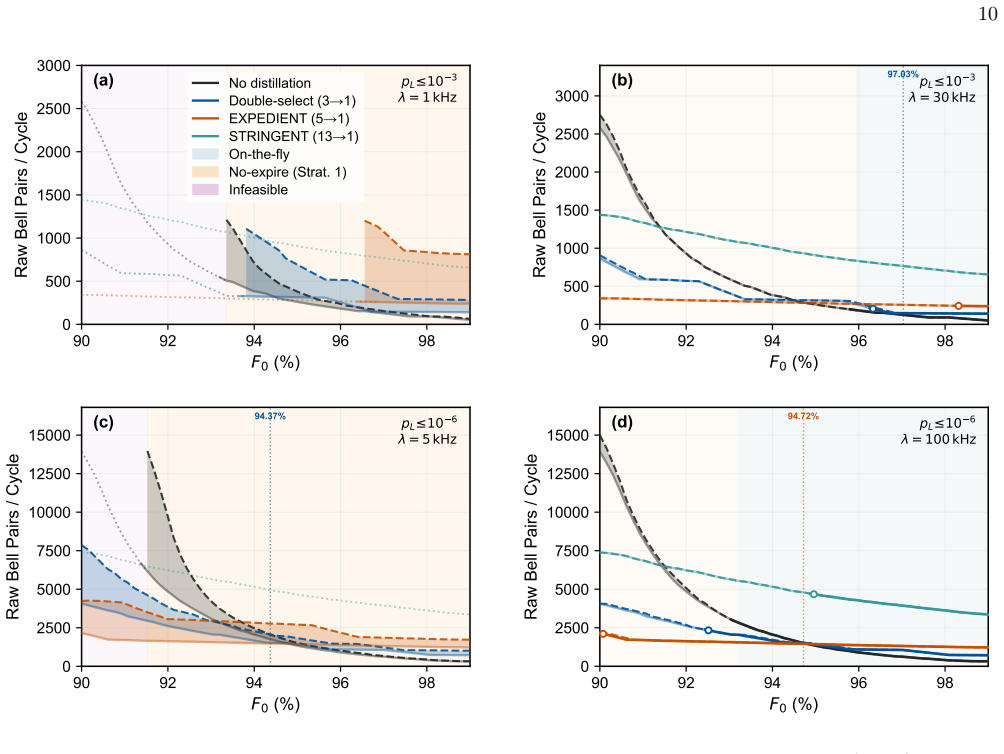
Distributed quantum computing can potentially address the scalability challenge by networking processors through photon-mediated remote entanglement. Prior approaches assumed that remote Bell pairs require distillation before use, incurring substantial overhead, to achieve sufficiently high fidelity. However, recent results show that lattice-surgery operations at logical qubit boundaries tolerate significantly higher error rates than previously assumed. We quantify the resource trade-offs between distillation overhead and surface-code distance requirements under realistic constraints including probabilistic entanglement generation and memory decoherence. We identify the fidelity crossover point separating the two regimes. Below this threshold, the distillation strategy dominates, reducing resource overhead by up to two orders of magnitude. Above it, no-distillation becomes the more efficient choice, reducing resource overhead by more than half. We briefly describe the application of these methods to ion-trap and neutral-atom platforms. These results provide joint design guidelines for optimizing photonic interconnects and fault-tolerant architectures in distributed quantum computing.
Editorial analysis
A structured set of objections, weighed in public.
Referee Report
Summary. The manuscript analyzes resource trade-offs for remote entanglement in lattice-surgery-based distributed quantum computing. It identifies a fidelity crossover separating two regimes: below the threshold, distilling remote Bell pairs before use reduces overhead by up to two orders of magnitude; above it, direct (no-distillation) use is preferable and reduces overhead by more than 50%. The analysis incorporates probabilistic entanglement generation and memory decoherence, invokes recent results on elevated error tolerance for boundary lattice-surgery operations, and sketches applications to ion-trap and neutral-atom platforms.
Significance. If the crossover location and reported overhead reductions are robustly supported by the underlying model, the work supplies concrete joint design guidelines for photonic interconnect fidelity targets and surface-code parameters in distributed architectures. This could meaningfully inform hardware co-design choices between entanglement generation hardware and fault-tolerant logical operations.
major comments (2)
- [Abstract / §3 (resource model)] The central claim (crossover point and quantitative overhead reductions) rests on the assumption that lattice-surgery operations at logical qubit boundaries tolerate significantly higher error rates than previously assumed. The manuscript should provide an explicit mapping from this tolerance assumption to the reported crossover fidelity, including the surface-code distance and resource-counting model used to obtain the two-order-of-magnitude and >50% figures.
- [§4 (results) / Eq. (resource overhead)] No equations, simulation parameters, error-bar reporting, or data-exclusion criteria are visible in the abstract; the full text must include the explicit resource-counting formulas and the probabilistic-generation / decoherence model so that the crossover location can be reproduced independently of the external tolerance results.
minor comments (2)
- [Abstract] Clarify whether the crossover fidelity is expressed in terms of Bell-pair infidelity or logical error rate after lattice surgery.
- [Results] Add a table or figure that tabulates overhead versus fidelity for both strategies at representative code distances.
Simulated Author's Rebuttal
We thank the referee for their thoughtful review and constructive suggestions. We address each major comment below and will revise the manuscript accordingly to improve clarity and reproducibility.
read point-by-point responses
-
Referee: [Abstract / §3 (resource model)] The central claim (crossover point and quantitative overhead reductions) rests on the assumption that lattice-surgery operations at logical qubit boundaries tolerate significantly higher error rates than previously assumed. The manuscript should provide an explicit mapping from this tolerance assumption to the reported crossover fidelity, including the surface-code distance and resource-counting model used to obtain the two-order-of-magnitude and >50% figures.
Authors: We agree that an explicit mapping will strengthen the presentation. The crossover is obtained by substituting the elevated boundary-operation error tolerance (from the cited recent results) into the overhead comparison between distillation and direct-use regimes. In the revised manuscript we will add a dedicated paragraph in §3 that shows this substitution step-by-step, specifies the surface-code distance employed for the quoted savings, and reproduces the resource-counting expressions that yield the reported factors. revision: yes
-
Referee: [§4 (results) / Eq. (resource overhead)] No equations, simulation parameters, error-bar reporting, or data-exclusion criteria are visible in the abstract; the full text must include the explicit resource-counting formulas and the probabilistic-generation / decoherence model so that the crossover location can be reproduced independently of the external tolerance results.
Authors: The full manuscript already presents the resource-counting formulas and the probabilistic-generation/decoherence model in §2–3. Because the analysis is analytic rather than Monte-Carlo based, error bars and data-exclusion criteria are not applicable. To address the referee’s reproducibility concern we will add a compact summary table of all parameters and a boxed set of the key overhead equations at the beginning of §3 in the revised version. revision: partial
Circularity Check
No significant circularity detected in derivation chain
full rationale
The paper's central analysis quantifies resource trade-offs for distillation vs. no-distillation strategies in remote entanglement via lattice surgery, identifying a fidelity crossover under constraints of probabilistic generation and decoherence. The tolerance assumption for boundary operations is explicitly attributed to external recent results rather than any internal fit, self-definition, or self-citation chain that reduces the crossover or overhead claims to the inputs by construction. No equations or steps exhibit self-definitional loops, fitted parameters renamed as predictions, uniqueness imported from prior author work, or ansatzes smuggled via citation. The derivation remains self-contained against the stated model and external benchmarks.
Axiom & Free-Parameter Ledger
axioms (1)
- domain assumption lattice-surgery operations at logical qubit boundaries tolerate significantly higher error rates than previously assumed
Forward citations
Cited by 1 Pith paper
-
INJEQT: Improved Magic-State Injection Protocol for Fault-Tolerant Quantum Extractor Architectures
INJEQT reduces synthillation error by up to 22x, wall-clock time by 13x, and space-time cost by 7.2x in extractor FTQC architectures via auxiliary Rz synthesis and pre-fetching.
Reference graph
Works this paper leans on
-
[1]
Stochastic Bell-pair Generation When Bell-pair generation proceeds via repeated her- alded attempts with success probabilityp herald ≪1, the sequence of successful events is well-approximated by a Poisson process [17, 32, 33] with rateλ=I·r attempt · pherald (Hz), whereIoptical interfaces each attempt at rater attempt. The inter-arrival time between conse...
-
[2]
Storage Decay Successfully heralded Bell pairs decohere during stor- age as F(t) =F 0 e−t/τcoh ,(17) whereF 0 is the initial fidelity andτ coh is the memory coherence time. This is a high-fidelity approximation to the exact depolarizing modelF(t) = 1 4 + F0− 1 4 e−t/τcoh, valid whenF(t)≫1/4. Since pairs in a batch arrive at different times, they experienc...
-
[3]
Letτ SE denote the duration of one syndrome extraction round
Time Overhead of Distillation We compare execution time using circuit depth as a proxy, since two-qubit gates and measurements dominate latency (see Table I in Appendix A). Letτ SE denote the duration of one syndrome extraction round. Here, exe- cution time refers purely to circuit runtime and does not include Bell-pair generation latency or buffering tim...
-
[4]
On-the-fly Operation The related question of when to distill, including whether to process pairs as they arrive or to batch them, is studied in Ref. [37]. Here we assume all raw pairs for one round are available at the start of the round. When entanglement generation keeps pace with con- sumption within each round, theon-the-flycondition (OTF) reads λ Tro...
-
[5]
No-expire Regime Whenλ < n round/T round but the link efficiencyη link ≡ λ τcoh is large enough that the earliest pair has not de- cayed belowF th by the time allN QEC pairs are collected, the system operates in the no-expire regime. The full batch arrives slower than one syndrome cycle, so the surface-code patch idles while waiting for collection to comp...
-
[6]
Minimum Link Efficiency Threshold For a givenτ coh, achievingp target L requires a minimum link efficiency set by a self-consistency condition. Dur- ing collection of one round’s Bell pairs, the earliest pair decays toF stored ≈F 0 e−Cround/ηlink (Eq. (23)), where Cround is the per-round raw consumption (Eqs. (1), (11)). This degradation increases the cod...
work page 2000
-
[7]
Serial Execution with Restarts If distillation attempts are executed sequentially until success, the expected number of attempts required to obtain one purified pair is 1/p succ. The expected raw Bell-pair cost per syndrome extraction round is therefore E[N(serial) raw ] = npairs psucc ·n round(peff),(B1) where each distillation attempt consumesn pairs ra...
-
[8]
Parallel Execution To achieve≥99% success probability per syndrome extraction round, we executekindependent distillation attempts in parallel, where k= log(0.01) log(1−p succ) ,(B2) ensures 1−(1−p succ)k ≥0.99 [8]. The total raw Bell-pair cost per syndrome extraction round is then Cround =n round ×n pairs ×k,(B3) wheren round =ad ∗ s(peff)−cis the number ...
-
[9]
Strategy 1: Round-by-round Scheduling Generaten round =ad s −cBell pairs per syndrome round, then immediately execute one round of syndrome extraction with teleported CNOTs along the seam. Be- causeλ < n round/T round, both patches idle with the noisy seam coupled while awaiting the next batch, and the cycle repeats acrossd s −1 rounds. Neglecting stochas...
-
[10]
Strategy 2: Pre-buffered Accumulate allN QEC = ˜ds nround pairs while both patches run independent local QEC cycles with no seam coupling, then execute all ˜ds rounds back-to-back. Be- cause the patches are decoupled throughout accumula- tion, we assume ˜pS2 local =p phys with no idle penalty. How- ever, the earliest pair waits ˜ds times longer than in St...
-
[11]
Analysis Inserting the error parameters from both strategies into Eq. (3) yields the curves in Fig. 7. a. Feasibility range.Strategy 2 requires allN QEC pairs to survive in memory until surgery begins, so the no-expire condition demands ηlink ≥η S2 min = NQEC ln(F0/Fth) ,(C5) a boundd s times tighter than Strategy 1’s requirement ηS1 min =n round/ln(F 0/F...
-
[12]
Numerical Simulation We simulate a lattice-surgery merge-and-split cycle be- tween two distance-d s rotated surface-code patches for ds ∈ {3,5,7}. The circuit comprises one initialization round,d s syndrome-extraction rounds with the seam ac- tive (the last of which is the split round), one post- split round, and final data-qubit readout. All local gate, ...
-
[13]
H. Jacinto, ´Elie Gouzien, and N. Sangouard, Network re- quirements for distributed quantum computation (2025), arXiv:2504.08891 [quant-ph]
-
[14]
J. Ramette, J. Sinclair, N. P. Breuckmann, and V. Vuleti´ c, Fault-tolerant connection of error-corrected qubits with noisy links, npj Quantum Information10, 58 (2024), arXiv:2302.01296 [quant-ph]
- [15]
- [16]
-
[17]
Transversal Fault Tolerant Distributed Quantum Computing Operations
J. Stack, M. Wang, and F. Mueller, Assessing telepor- tation of logical qubits in a distributed quantum archi- tecture under error correction (2025), arXiv:2504.05611 [quant-ph]
work page internal anchor Pith review Pith/arXiv arXiv 2025
-
[18]
W. D¨ ur and H. J. Briegel, Entanglement purification for quantum computation., Physical review letters90, 067901 (2002)
work page 2002
-
[19]
P. Pathumsoot, T. Tansuwannont, N. Benchasattabuse, R. Satoh, M. Hajduˇ sek, P. Chaiwongkhot, S. Suwanna, and R. Van Meter, Boosting End-to-End Entanglement Fidelity in Quantum Repeater Networks via Hybridized Strategies (2024) arXiv:2406.06545 [quant-ph]
- [20]
-
[21]
S. de Bone, P. M¨ oller, C. E. Bradley, T. H. Taminiau, and D. Elkouss, Thresholds for the distributed surface code in the presence of memory decoherence, AVS Quantum Science6, 10.1116/5.0200190 (2024)
-
[22]
S. Sunami, Y. Hirano, T. Hinokuma, and H. Yamasaki, Entanglement boosting: Low-volume logical bell pair preparation for distributed fault-tolerant quantum com- putation (2025), arXiv:2511.10729 [quant-ph]
work page internal anchor Pith review Pith/arXiv arXiv 2025
-
[23]
D. Litinski, A Game of Surface Codes: Large-Scale Quan- tum Computing with Lattice Surgery, Quantum3, 128 (2019)
work page 2019
-
[24]
D. Horsman, A. G. Fowler, S. Devitt, and R. Van Meter, Surface code quantum computing by lattice surgery, New Journal of Physics14, 123011 (2012)
work page 2012
-
[25]
D. Litinski and F. v. Oppen, Lattice Surgery with a Twist: Simplifying Clifford Gates of Surface Codes, Quantum2, 62 (2018)
work page 2018
-
[26]
S. Liu, N. Benchasattabuse, D. Q. Morgan, M. Hajduˇ sek, S. J. Devitt, and R. Van Meter, A substrate scheduler for compiling arbitrary fault-tolerant graph states, in2023 IEEE International Conference on Quantum Computing and Engineering (QCE), Vol. 01 (2023) pp. 870–880
work page 2023
-
[27]
D. L. Moehring, P. Maunz, S. Olmschenk, K. C. Younge, D. N. Matsukevich, L. M. Duan, and C. Monroe, En- tanglement of single-atom quantum bits at a distance, Nature449, 68 (2007)
work page 2007
-
[28]
C. Monroe, R. Raussendorf, A. Ruthven, K. R. Brown, P. Maunz, L.-M. Duan, and J. Kim, Large-scale mod- ular quantum-computer architecture with atomic mem- ory and photonic interconnects, Physical Review A89, 10.1103/physreva.89.022317 (2014)
-
[29]
L. J. Stephenson, D. P. Nadlinger, B. C. Nichol, S. An, P. Drmota, T. G. Ballance, K. Thirumalai, J. F. Good- win, D. M. Lucas, and C. J. Ballance, High-rate, high- fidelity entanglement of qubits across an elementary quantum network, Phys. Rev. Lett.124, 110501 (2020)
work page 2020
-
[30]
D. Awschalom, K. K. Berggren, H. Bernien, S. Bhave, L. D. Carr, P. Davids, S. E. Economou, D. Englund, A. Faraon, M. Fejer, S. Guha, M. V. Gustafsson, E. Hu, L. Jiang, J. Kim, B. Korzh, P. Kumar, P. G. Kwiat, M. Lonˇ car, M. D. Lukin, D. A. Miller, C. Mon- roe, S. W. Nam, P. Narang, J. S. Orcutt, M. G. Raymer, A. H. Safavi-Naeini, M. Spiropulu, K. Srini- ...
work page 2021
-
[31]
P. C. Humphreys, N. Kalb, J. P. J. Morits, R. N. Schouten, R. F. L. Vermeulen, D. J. Twitchen, M. Markham, and R. Hanson, Deterministic delivery of remote entanglement on a quantum network, Nature 558, 268 (2018), arXiv:1712.07567 [quant-ph]
work page internal anchor Pith review Pith/arXiv arXiv 2018
- [32]
-
[33]
S. Saha, M. Shalaev, J. O’Reilly, I. Goetting, G. Toh, A. Kalakuntla, Y. Yu, and C. Monroe, High- fidelity remote entanglement of trapped atoms medi- ated by time-bin photons, Nature Communications16, 10.1038/s41467-025-57557-4 (2025)
-
[34]
M. DeCross, R. Haghshenas, M. Liu, E. Rinaldi, J. Gray, Y. Alexeev, C. Baldwin, J. Bartolotta, M. Bohn, E. Chertkov, J. Cline, J. Colina, D. DelVento, J. Dreil- ing, C. Foltz, J. Gaebler, T. Gatterman, C. Gilbreth, J. Giles, D. Gresh, A. Hall, A. Hankin, A. Hansen, N. Hewitt, I. Hoffman, C. Holliman, R. Hutson, T. Ja- cobs, J. Johansen, P. Lee, E. Lehman,...
-
[35]
C. J. Ballance, T. P. Harty, N. M. Linke, M. A. Sepiol, and D. M. Lucas, High-fidelity quantum logic gates us- ing trapped-ion hyperfine qubits, Phys. Rev. Lett.117, 18 060504 (2016)
work page 2016
- [36]
-
[37]
H. Takahashi, E. Kassa, C. Christoforou, and M. Keller, Strong coupling of a single ion to an optical cavity, Phys- ical Review Letters124, 10.1103/physrevlett.124.013602 (2020)
-
[38]
A. G. Fowler, M. Mariantoni, J. M. Martinis, and A. N. Cleland, Surface codes: Towards practical large- scale quantum computation, Physical Review A86, 10.1103/physreva.86.032324 (2012)
-
[39]
S. Krastanov, V. V. Albert, and L. Jiang, Optimized En- tanglement Purification, Quantum3, 123 (2019)
work page 2019
-
[40]
K. Fujii and K. Yamamoto, Entanglement purification with double selection, Phys. Rev. A80, 042308 (2009)
work page 2009
-
[41]
N. H. Nickerson, Y. Li, and S. C. Benjamin, Topological quantum computing with a very noisy network and local error rates approaching one percent, Nature Commun.4, 1756 (2013), arXiv:1211.2217 [quant-ph]
work page internal anchor Pith review Pith/arXiv arXiv 2013
-
[42]
C. H. Bennett, G. Brassard, S. Popescu, B. Schumacher, J. A. Smolin, and W. K. Wootters, Purification of noisy entanglement and faithful teleportation via noisy chan- nels, Phys. Rev. Lett.76, 722 (1996)
work page 1996
-
[43]
D. Deutsch, A. Ekert, R. Jozsa, C. Macchiavello, S. Popescu, and A. Sanpera, Quantum privacy ampli- fication and the security of quantum cryptography over noisy channels, Phys. Rev. Lett.77, 2818 (1996)
work page 1996
-
[44]
J. O’Reilly, G. Toh, I. Goetting, S. Saha, M. Sha- laev, A. L. Carter, A. Risinger, A. Kalakuntla, T. Li, A. Verma, and C. Monroe, Fast photon-mediated entan- glement of continuously cooled trapped ions for quantum networking, Phys. Rev. Lett.133, 090802 (2024)
work page 2024
-
[45]
Modular Entanglement of Atomic Qubits using both Photons and Phonons
D. Hucul, I. V. Inlek, G. Vittorini, C. Crocker, S. Deb- nath, S. M. Clark, and C. Monroe, Modular entangle- ment of atomic qubits using photons and phonons, Na- ture Physics11, 37 (2015), arXiv:1403.3696 [quant-ph]
work page internal anchor Pith review Pith/arXiv arXiv 2015
-
[46]
L. Bacciottini, M. G. D. Andrade, S. Pouryousef, E. A. V. Milligen, A. Chandra, N. K. Panigrahy, N. S. V. Rao, G. Vardoyan, and D. Towsley, Leveraging internet prin- ciples to build a quantum network, IEEE Network , 1–1 (2025)
work page 2025
- [47]
-
[48]
J. Grimbergen, S. Haldar, A. G. Inesta, and S. Wehner, Probabilistic cutoffs in homogeneous quantum repeater chains (2026), arXiv:2602.14738 [quant-ph]
-
[49]
I. Yakar and M. Ben-Or, Advantages of global entanglement-distillation policies in quantum repeater chains (2025), arXiv:2510.06737 [quant-ph]
- [50]
-
[51]
P. Wang, C.-Y. Luan, M. Qiao, M. Um, J. Zhang, Y. Wang, X. Yuan, M. Gu, J. Zhang, and K. Kim, Single ion qubit with estimated coherence time exceeding one hour, Nature Communications12, 10.1038/s41467-020- 20330-w (2021)
-
[52]
J. M. Pino, J. M. Dreiling, C. Figgatt, J. P. Gaebler, S. A. Moses, M. S. Allman, C. H. Baldwin, M. Foss-Feig, D. Hayes, K. Mayer, C. Ryan-Anderson, and B. Neyen- huis, Demonstration of the trapped-ion quantum ccd computer architecture, Nature592, 209–213 (2021)
work page 2021
-
[53]
S. Dasu, M. DeCross, A. Y. Guo, A. Lavasani, J. Behrends, A. Benhemou, Y.-H. Chen, K. Mayer, C. N. Self, S. Simsek, B. Srivastava, M. S. Allman, J. Arkinstall, J. G. Bohnet, N. Q. Burdick, J. P. C. III, A. Chernoguzov, S. F. Cooper, R. D. Delaney, J. M. Dreiling, B. Estey, C. Figgatt, C. Foltz, J. P. Gaebler, A. Hall, C. A. Holliman, A. A. Husain, A. Isan...
- [54]
-
[55]
L. Hartung, M. Seubert, S. Welte, E. Distante, and G. Rempe, A quantum-network register assembled with optical tweezers in an optical cavity, Science385, 179–183 (2024)
work page 2024
-
[56]
Efficient and compact quantum network node based on a parabolic mirror on an optical chip
A. Safari, E. Oh, P. Huft, G. Chase, J. Zhang, and M. Saffman, Efficient and compact quantum network node based on a parabolic mirror on an optical chip (2026), arXiv:2601.13420 [quant-ph]
work page internal anchor Pith review Pith/arXiv arXiv 2026
-
[57]
L. Li, X. Hu, Z. Jia, W. Huie, W. K. C. Sun, Aakash, Y. Dong, N. Hiri-O-Tuppa, and J. P. Covey, Paral- lelized telecom quantum networking with an ytterbium- 171 atom array, Nature Physics21, 1826–1833 (2025)
work page 2025
- [58]
-
[59]
H. J. Manetsch, G. Nomura, E. Bataille, X. Lv, K. H. Leung, and M. Endres, A tweezer array with 6,100 highly coherent atomic qubits, Nature647, 60 (2025), arXiv:2403.12021 [quant-ph]
work page internal anchor Pith review arXiv 2025
-
[60]
D. Bluvstein, S. J. Evered, A. A. Geim, S. H. Li, H. Zhou, T. Manovitz, S. Ebadi, M. Cain, M. Kali- nowski, D. Hangleiter, J. P. Bonilla Ataides, N. Maskara, I. Cong, X. Gao, P. Sales Rodriguez, T. Karolyshyn, G. Semeghini, M. J. Gullans, M. Greiner, V. Vuleti´ c, and M. D. Lukin, Logical quantum processor based on reconfigurable atom arrays, Nature626, 5...
work page 2023
-
[61]
Gidney, Stim: a fast stabilizer circuit simulator, Quan- tum5, 497 (2021)
C. Gidney, Stim: a fast stabilizer circuit simulator, Quan- tum5, 497 (2021)
work page 2021
-
[62]
J. P. Bonilla Ataides, H. Zhou, Q. Xu, G. Baranes, B. Li, M. D. Lukin, and L. Jiang, Constant-overhead fault- tolerant bell-pair distillation using high-rate codes, Phys- ical Review Letters135, 10.1103/s39k-r2kq (2025)
-
[63]
O. Higgott, Pymatching: A python package for decoding quantum codes with minimum-weight perfect matching, ACM Transactions on Quantum Computing3, 1 (2022)
work page 2022
-
[64]
S. Singh, F. Gu, S. de Bone, E. Villase˜ nor, D. Elk- ouss, and J. Borregaard, Modular architectures and entanglement schemes for error-corrected distributed quantum computation, npj Quantum Information12, 10.1038/s41534-025-01146-2 (2025). 19
-
[65]
D. Main, P. Drmota, D. P. Nadlinger, E. M. Ainley, A. Agrawal, B. C. Nichol, R. Srinivas, G. Araneda, and D. M. Lucas, Distributed quantum computing across an optical network link, Nature638, 383–388 (2025)
work page 2025
-
[66]
A. Chatterjee, A. Ghosh, and S. Ghosh, Quantum prometheus: Defying overhead with recycled ancillas in quantum error correction, in2025 26th Interna- tional Symposium on Quality Electronic Design (ISQED) (2025) pp. 1–7
work page 2025
discussion (0)
Sign in with ORCID, Apple, or X to comment. Anyone can read and Pith papers without signing in.