Recognition: 2 theorem links
· Lean TheoremNew Way to Date Globular Clusters: Brown Dwarf Cooling Sequences
Pith reviewed 2026-05-15 15:28 UTC · model grok-4.3
The pith
Brown dwarf cooling sequences observed with JWST can date nearby globular clusters with formal age errors under 0.2 Gyr.
A machine-rendered reading of the paper's core claim, the machinery that carries it, and where it could break.
Core claim
A histogram-free likelihood fit to the cooling sequences of brown dwarf cluster members in multiple JWST bands yields globular cluster ages, and simulated observations establish that formal errors based on measurement uncertainties alone fall below 0.2 Gyr for nearby clusters.
What carries the argument
A likelihood model that treats cluster age as a free parameter while fitting the observed multi-band photometry of stars near and below the hydrogen-burning limit to theoretical brown dwarf cooling tracks.
If this is right
- The method supplies ages with a largely independent set of systematic errors that can test more established dating techniques.
- Systematic contributions from chemical heterogeneity, binaries, and cooling-rate uncertainties dominate the total error budget and can exceed the formal errors by more than an order of magnitude.
- Observers can consult the provided lookup table to determine the number of observations, exposure times, and temporal baselines required for any desired age precision.
- More sophisticated modeling of multiple populations and binaries can reduce the systematic floor and improve the attainable accuracy.
Where Pith is reading between the lines
- Precise ages for the oldest clusters would tighten constraints on the timing of the Milky Way's earliest star-formation episodes.
- Persistent mismatches with other age indicators could reveal shortcomings in current brown dwarf evolutionary models.
- Applying the technique to clusters at larger distances would test how far the required photometric depth and baseline can be pushed before systematics overwhelm the formal precision.
Load-bearing premise
Brown dwarf cooling rates are known to sufficient accuracy and the effects of multiple stellar populations and unresolved binaries can be adequately modeled or marginalized over in the likelihood fit.
What would settle it
Deriving an age from the brown dwarf sequence in a nearby globular cluster that differs by more than 0.2 Gyr from independent methods even after explicit correction for known systematics would falsify the claimed precision.
Figures


read the original abstract
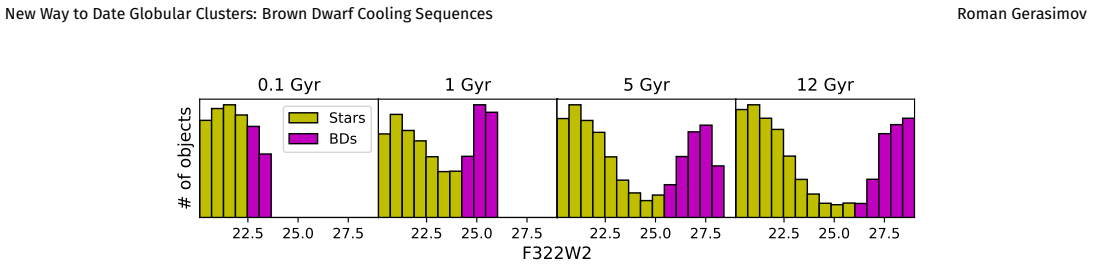
As the oldest building blocks of our Galaxy, globular clusters retain the archaeological footprint of the early stellar environments. Accurate absolute ages of globular clusters are required to interpret this ancient record. Existing dating techniques often produce precise but discordant ages, suggestive of systematic errors in excess of 1 Gyr. The James Webb Space Telescope (JWST) has unlocked a new dating method that leverages the cooling behavior of previously unobservable brown dwarf members. With a largely independent set of systematic errors, this new method provides a new consistency test for more established methodologies. I present a likelihood-based histogram-free method to derive globular cluster ages from multi-band JWST photometry of cluster members near and below the hydrogen-burning limit. By applying the method to a large set of simulated observations, I establish that formal age errors (i.e. errors based on measurement uncertainties alone) under 0.2 Gyr are attainable for nearby globular clusters. I also evaluate the significance of associated systematic effects, including the chemical heterogeneity of globular clusters (multiple populations), unresolved binary systems and uncertainties in brown dwarf cooling rates. As with other methods of age determination, systematic effects dominate the error budget (in selected cases, by over an order of magnitude), but may be reduced with more sophisticated analysis. Finally, I provide a lookup table for determining the number of observations, exposure times and temporal baselines required to estimate the age of a given cluster to a prescribed precision.
Editorial analysis
A structured set of objections, weighed in public.
Referee Report
Summary. The manuscript presents a likelihood-based, histogram-free method to derive globular cluster ages from multi-band JWST photometry of members near and below the hydrogen-burning limit. Using a large set of simulated observations, it claims that formal age errors (measurement uncertainties only) below 0.2 Gyr are attainable for nearby clusters. The work evaluates systematic effects from multiple stellar populations, unresolved binaries, and brown dwarf cooling-rate uncertainties, notes that systematics typically dominate the error budget (sometimes by more than an order of magnitude), and supplies a lookup table for the number of observations, exposure times, and baselines needed to reach a target precision.
Significance. If the formal precisions can be realized with real data and if cooling-model uncertainties can be adequately controlled or marginalized, the method would supply a valuable independent consistency check on globular-cluster ages whose current discrepancies exceed 1 Gyr. The simulation framework that quantifies formal errors and the provision of a practical observational lookup table are concrete strengths that would aid observers planning JWST programs.
major comments (2)
- [Simulations section] Simulations section: the reported formal errors <0.2 Gyr are obtained only when the cooling sequences used to generate the mock photometry are identical to those used in the likelihood fit. The manuscript states that cooling-rate uncertainties can exceed the formal error by more than an order of magnitude, yet no recovery tests are shown in which the cooling tracks are perturbed within current theoretical uncertainties; without such tests the attainable total precision remains undemonstrated.
- [Systematic-effects evaluation] Systematic-effects evaluation: while the impacts of multiple populations, binaries, and cooling uncertainties are discussed qualitatively, no explicit combined error budget is presented that propagates these systematics into a total age uncertainty for any specific cluster. This omission makes it difficult to judge whether the method can actually compete with existing techniques once all error sources are included.
minor comments (1)
- [Abstract] The abstract and introduction would benefit from a clearer upfront statement that the sub-0.2 Gyr figure refers exclusively to formal (measurement-only) errors and that total errors are expected to be substantially larger.
Simulated Author's Rebuttal
We thank the referee for the constructive and detailed report. The comments highlight important gaps in demonstrating the method's robustness against model uncertainties and in quantifying the total error budget. We address each point below and will implement the suggested revisions.
read point-by-point responses
-
Referee: Simulations section: the reported formal errors <0.2 Gyr are obtained only when the cooling sequences used to generate the mock photometry are identical to those used in the likelihood fit. The manuscript states that cooling-rate uncertainties can exceed the formal error by more than an order of magnitude, yet no recovery tests are shown in which the cooling tracks are perturbed within current theoretical uncertainties; without such tests the attainable total precision remains undemonstrated.
Authors: We agree that the formal errors are conditional on identical cooling models for data generation and fitting. Although the manuscript notes that cooling-rate uncertainties can dominate, we did not perform explicit recovery tests with perturbed tracks. In the revised manuscript we will add a new subsection to the Simulations section that includes recovery tests in which cooling tracks are perturbed within published theoretical uncertainties (e.g., variations in opacity, atmospheric chemistry, and radius evolution drawn from Burrows et al. 2001 and subsequent updates). These tests will be shown in an additional figure and will quantify the degradation in recovered age precision, thereby demonstrating the attainable total precision more completely. revision: yes
-
Referee: Systematic-effects evaluation: while the impacts of multiple populations, binaries, and cooling uncertainties are discussed qualitatively, no explicit combined error budget is presented that propagates these systematics into a total age uncertainty for any specific cluster. This omission makes it difficult to judge whether the method can actually compete with existing techniques once all error sources are included.
Authors: We acknowledge that a quantitative, combined error budget for a representative cluster would improve the manuscript. The original text evaluates each systematic effect separately and supplies a lookup table based on formal errors. In the revision we will add a dedicated subsection that constructs an explicit total error budget for a specific nearby cluster (e.g., NGC 6397), combining the contributions from multiple populations, unresolved binaries, and cooling-rate uncertainties using the values already derived in the paper and the observational lookup table. This combined budget will be presented in a new table and will allow direct comparison with the precision of established age-dating methods. revision: yes
Circularity Check
No circularity: statistical precision shown via standard simulation validation
full rationale
The paper presents a likelihood-based method for fitting globular cluster ages to multi-band JWST photometry near the hydrogen-burning limit, using brown dwarf cooling sequences. The central claim of attainable formal (measurement-only) errors below 0.2 Gyr is demonstrated by applying the method to simulated observations generated from the same cooling models. This is a conventional test of statistical power under the assumption that the model is correct, not a reduction of the result to its inputs by construction. No self-definitional steps, fitted parameters renamed as predictions, or load-bearing self-citations appear in the derivation. Systematic effects (cooling-rate uncertainties, binaries, multiple populations) are evaluated separately as an external error budget. The method rests on standard cooling physics and photometry likelihoods that are independent of the target age result.
Axiom & Free-Parameter Ledger
axioms (1)
- domain assumption Brown dwarf cooling rates are sufficiently well modeled to support age inference at the 0.2 Gyr level
Lean theorems connected to this paper
-
IndisputableMonolith/Cost/FunctionalEquation.leanwashburn_uniqueness_aczel unclear?
unclearRelation between the paper passage and the cited Recognition theorem.
likelihood-based histogram-free method to derive globular cluster ages from multi-band JWST photometry of cluster members near and below the hydrogen-burning limit
-
IndisputableMonolith/Foundation/Constants.leanphi_golden_ratio unclear?
unclearRelation between the paper passage and the cited Recognition theorem.
SANDee model grids … mass-luminosity relationships … age-dependent cooling tracks
What do these tags mean?
- matches
- The paper's claim is directly supported by a theorem in the formal canon.
- supports
- The theorem supports part of the paper's argument, but the paper may add assumptions or extra steps.
- extends
- The paper goes beyond the formal theorem; the theorem is a base layer rather than the whole result.
- uses
- The paper appears to rely on the theorem as machinery.
- contradicts
- The paper's claim conflicts with a theorem or certificate in the canon.
- unclear
- Pith found a possible connection, but the passage is too broad, indirect, or ambiguous to say the theorem truly supports the claim.
Reference graph
Works this paper leans on
-
[1]
Thecolor-magnitudediagramfortheglobularclusterM3.,
A.R.Sandage,“Thecolor-magnitudediagramfortheglobularclusterM3.,”AJ,vol.58,pp.61–75,Jan.1953.doi:10.1086/106822
-
[2]
A preliminary determination of the age of type II stars,
C. B. Haselgrove and F. Hoyle, “A preliminary determination of the age of type II stars,” MNRAS, vol. 116, p. 527, Jan. 1956.doi: 10.1093/mnras/116.5.527
-
[3]
StudyofDegeneracyinVeryLightStars.,
S.S.Kumar,“StudyofDegeneracyinVeryLightStars.,”AJ,vol.67,p.579,Jan.1962.doi:10.1086/108658
-
[4]
EvolutionofStarsofSmallMassesinthePre-Main-SequenceStages,
C.HayashiandT.Nakano,“EvolutionofStarsofSmallMassesinthePre-Main-SequenceStages,”ProgressofTheoreticalPhysics,vol.30, no.4,pp.460–474,Oct.1963.doi:10.1143/PTP.30.460
-
[5]
TheStructureofStarsofVeryLowMass.,
S.S.Kumar,“TheStructureofStarsofVeryLowMass.,”ApJ,vol.137,p.1121,May1963.doi:10.1086/147589
-
[6]
Asimplexmethodforfunctionminimization,
J.A.NelderandR.Mead,“Asimplexmethodforfunctionminimization,”TheComputerJournal,vol.7,no.4,pp.308–313,Jan.1965,issn: 0010-4620.doi:10.1093/comjnl/7.4.308eprint:https://academic.oup.com/comjnl/article-pdf/7/4/308/1013182/7-4-308.pdf.[Online]. Available:https://doi.org/10.1093/comjnl/7.4.308
work page doi:10.1093/comjnl/7.4.308eprint:https://academic.oup.com/comjnl/article-pdf/7/4/308/1013182/7-4-308.pdf 1965
-
[7]
1970, ApJ, 162, 841, doi: 10.1086/150715
A.Sandage,“Main-sequencephotometry,color-magnitudediagrams,andagesfortheglobularclustersM3,M13,M15andM92.,”ApJ, vol.162,p.841,Dec.1970.doi:10.1086/150715
-
[8]
Postmainsequenceevolutionofsinglestars.,
I.IbenJr.,“Postmainsequenceevolutionofsinglestars.,”ARA&A,vol.12,pp.215–256,Jan.1974.doi:10.1146/annurev.aa.12.090174.001243
-
[9]
Multiplicityamongsolar-typestars.,
H.A.AbtandS.G.Levy,“Multiplicityamongsolar-typestars.,”ApJS,vol.30,pp.273–306,Mar.1976.doi:10.1086/190363
-
[10]
StellarPopulationsintheDiskandHalooftheGalaxy(presentedbyR.D.McClure),
P.DemarqueandR.D.McClure,“StellarPopulationsintheDiskandHalooftheGalaxy(presentedbyR.D.McClure),”inEvolutionof GalaxiesandStellarPopulations,B.M.TinsleyandR.B.G.LarsonD.Campbell,Eds.,Jan.1977,p.199
work page 1977
-
[11]
Compositionofhaloclustersandtheformationofthegalactichalo.,
L.SearleandR.Zinn,“Compositionofhaloclustersandtheformationofthegalactichalo.,”ApJ,vol.225,pp.357–379,Oct.1978.doi: 10.1086/156499
-
[12]
W.E.HarrisandR.Racine,“Globularclustersingalaxies.,”ARA&A,vol.17,pp.241–274,Jan.1979.doi:10.1146/annurev.aa.17.090179. 001325
-
[13]
The significance of binaries with nearly identical components.,
L. B. Lucy and E. Ricco, “The significance of binaries with nearly identical components.,” AJ, vol. 84, pp. 401–412, Mar. 1979.doi: 10.1086/112434
-
[14]
GlobularClusterAgesandDistances,
B.W.Carney,“GlobularClusterAgesandDistances,”inStarClusters,J.E.Hesser,Ed.,ser.IAUSymposium,vol.85,Jan.1980,p.329
work page 1980
-
[15]
Theagesanddistancesofeightglobularclusters.,
B.W.Carney,“Theagesanddistancesofeightglobularclusters.,”ApJS,vol.42,pp.481–500,Mar.1980.doi:10.1086/190659
-
[16]
Ages and abundances of globular clusters and the oldest open clusters.,
P. Demarque, “Ages and abundances of globular clusters and the oldest open clusters.,” inStar Clusters, J. E. Hesser, Ed., ser. IAU Symposium,vol.85,Jan.1980,pp.281–303
work page 1980
-
[17]
Evidencefromsodium-abundancevariationsamongredgiantsofM13forinhomogeneitiesintheprotoclustergas.,
R.C.Peterson,“Evidencefromsodium-abundancevariationsamongredgiantsofM13forinhomogeneitiesintheprotoclustergas.,”ApJ, vol.237,pp.L87–L91,May1980.doi:10.1086/157950
-
[18]
TheOosterhoffperiodgroupsandtheageofglobularclusters.I.Photometryofclustervariables inM15.,
A.Sandage,B.Katem,andM.Sandage,“TheOosterhoffperiodgroupsandtheageofglobularclusters.I.Photometryofclustervariables inM15.,”ApJS,vol.46,pp.41–74,May1981.doi:10.1086/190734
-
[19]
SinglestarevolutionI.Massivestarsandearlyevolutionoflowandintermediatemassstars,
I.IbenandA.Renzini,“SinglestarevolutionI.Massivestarsandearlyevolutionoflowandintermediatemassstars,”Phys.Rep.,vol.105, no.6,pp.329–406,Mar.1984.doi:10.1016/0370-1573(84)90142-X
-
[20]
Agesofglobularclustersfromtheirluminosityfunctions,
B.Paczynski,“Agesofglobularclustersfromtheirluminosityfunctions,”ApJ,vol.284,pp.670–674,Sep.1984.doi:10.1086/162449
-
[21]
Color-magnitudediagramsforthreedistantglobularclusters.,
J.G.Cohen,“Color-magnitudediagramsforthreedistantglobularclusters.,”AJ,vol.90,pp.2254–2274,Nov.1985.doi:10.1086/113929
-
[22]
Atheoryfortheoriginofglobularclusters.,
S.M.FallandM.J.Rees,“Atheoryfortheoriginofglobularclusters.,”ApJ,vol.298,pp.18–26,Nov.1985.doi:10.1086/163585
-
[23]
MultiplePopulationsontheHorizontalBranch,
R.T.RoodandD.A.Crocker,“MultiplePopulationsontheHorizontalBranch,”inHorizontal-BranchandUV-BrightStars,A.G.D.Philip, Ed.,Jan.1985,pp.99–105
work page 1985
-
[24]
StarFormationinGiantMolecularClouds,
R.N.Henriksen,“StarFormationinGiantMolecularClouds,”ApJ,vol.310,p.189,Nov.1986.doi:10.1086/164675
-
[25]
TheoreticalStellarLuminosityFunctionsandtheAgesandCompositionsofGlobularClusters,
S.J.Ratcliff,“TheoreticalStellarLuminosityFunctionsandtheAgesandCompositionsofGlobularClusters,”ApJ,vol.318,p.196,Jul. 1987.doi:10.1086/165361
-
[26]
Multiple Populations on the Horizontal Branch. I. Observations in the (log g, log T eff)–Diagram,
D. A. Crocker, R. T. Rood, and R. W. O’Connell, “Multiple Populations on the Horizontal Branch. I. Observations in the (log g, log T eff)–Diagram,”ApJ,vol.332,p.236,Sep.1988.doi:10.1086/166648
-
[27]
Deepphotometryofglobularclusters.XI.Palomar12:theyoungestgalacticglobularcluster?
R.G.GrattonandS.Ortolani,“Deepphotometryofglobularclusters.XI.Palomar12:theyoungestgalacticglobularcluster?”A&AS, vol.73,pp.137–172,Apr.1988
work page 1988
-
[28]
Testsofevolutionarysequencesusingcolor-magnitudediagramsofglobularclusters.,
A.RenziniandF.FusiPecci,“Testsofevolutionarysequencesusingcolor-magnitudediagramsofglobularclusters.,”ARA&A,vol.26, pp.199–244,Jan.1988.doi:10.1146/annurev.aa.26.090188.001215 16–23 Roman Gerasimov New Way to Date Globular Clusters: Brown Dwarf Cooling Sequences
-
[29]
TheoreticalModelsofVeryLowMassStarsandBrownDwarfs,
A.Burrows,W.B.Hubbard,andJ.I.Lunine,“TheoreticalModelsofVeryLowMassStarsandBrownDwarfs,”ApJ,vol.345,p.939,Oct. 1989.doi:10.1086/167964
-
[30]
ANewAgeDiagnosticAppliedtotheGlobularClustersNGC288andNGC362,
A.SarajediniandP.Demarque,“ANewAgeDiagnosticAppliedtotheGlobularClustersNGC288andNGC362,”ApJ,vol.365,p.219, Dec.1990.doi:10.1086/169472
-
[31]
MeasuringAgeDifferencesamongGlobularClustersHavingSimilarMetallicities:ANew MethodandFirstResults,
D.A.Vandenberg,M.Bolte,andP.B.Stetson,“MeasuringAgeDifferencesamongGlobularClustersHavingSimilarMetallicities:ANew MethodandFirstResults,”AJ,vol.100,p.445,Aug.1990.doi:10.1086/115529
-
[32]
TheFormationofGlobularClustersinMergingandInteractingGalaxies,
K.M.AshmanandS.E.Zepf,“TheFormationofGlobularClustersinMergingandInteractingGalaxies,”ApJ,vol.384,p.50,Jan.1992. doi:10.1086/170850
-
[33]
Oxygen-enhancedModelsforGlobularClusterStars.II.IsochronesandLuminosityFunctions,
P.A.BergbuschandD.A.Vandenberg,“Oxygen-enhancedModelsforGlobularClusterStars.II.IsochronesandLuminosityFunctions,” ApJS,vol.81,p.163,Jul.1992.doi:10.1086/191690
-
[34]
A.BurrowsandJ.Liebert,“Thescienceofbrowndwarfs,”ReviewsofModernPhysics,vol.65,no.2,pp.301–336,Apr.1993.doi:10.1103/ RevModPhys.65.301
work page 1993
-
[35]
CoolZero-MetallicityStellarAtmospheres,
D.Saumon,P.Bergeron,J.I.Lunine,W.B.Hubbard,andA.Burrows,“CoolZero-MetallicityStellarAtmospheres,”ApJ,vol.424,p.333, Mar.1994.doi:10.1086/173892
-
[36]
HSTObservationsoftheStellarPopulationoftheGlobularClusterW CEN,
R.A.W.Elson,G.F.Gilmore,B.X.Santiago,andS.Casertano,“HSTObservationsoftheStellarPopulationoftheGlobularClusterW CEN,”AJ,vol.110,p.682,Aug.1995.doi:10.1086/117553
-
[37]
Hubble Space Telescope Observations of White Dwarfs in the Globular Cluster M4
H.B.Richeretal.,“HubbleSpaceTelescopeObservationsofWhiteDwarfsintheGlobularClusterM4,”ApJ,vol.451,p.L17,Sep.1995. doi:10.1086/309674arXiv:astro-ph/9507109[astro-ph]
work page internal anchor Pith review Pith/arXiv arXiv doi:10.1086/309674arxiv:astro-ph/9507109 1995
-
[38]
Themultivariateskew-normaldistribution,
A.AzzaliniandA.D.Valle,“Themultivariateskew-normaldistribution,”Biometrika,vol.83,no.4,pp.715–726,Dec.1996,issn:0006-3444. doi:10.1093/biomet/83.4.715eprint:https://academic.oup.com/biomet/article-pdf/83/4/715/702865/83-4-715.pdf.[Online].Available: https://doi.org/10.1093/biomet/83.4.715
work page doi:10.1093/biomet/83.4.715eprint:https://academic.oup.com/biomet/article-pdf/83/4/715/702865/83-4-715.pdf 1996
-
[39]
ACatalogofParametersforGlobularClustersintheMilkyWay,
W.E.Harris,“ACatalogofParametersforGlobularClustersintheMilkyWay,”AJ,vol.112,p.1487,Oct.1996.doi:10.1086/118116
-
[40]
A New Self-consistency Check on the Ages of Globular Clusters,
R. Jimenez and P. Padoan, “A New Self-consistency Check on the Ages of Globular Clusters,” ApJ, vol. 463, p. L17, May 1996.doi: 10.1086/310053
-
[41]
J.Kaluzny,M.Kubiak,M.Szymanski,A.Udalski,W.Krzeminski,andM.Mateo,“Theopticalgravitationallensingexperiment.Variable starsinglobularclusters.I.Fields5139A-Cin 𝜔Centauri.,”A&AS,vol.120,pp.139–152,Nov.1996.doi:10.48550/arXiv.astro-ph/9601053 arXiv:astro-ph/9601053[astro-ph]
work page internal anchor Pith review Pith/arXiv arXiv doi:10.48550/arxiv.astro-ph/9601053 1996
-
[42]
TheAgeoftheGalacticGlobularClusterSystem,
D.A.Vandenberg,M.Bolte,andP.B.Stetson,“TheAgeoftheGalacticGlobularClusterSystem,”ARA&A,vol.34,pp.461–510,Jan.1996. doi:10.1146/annurev.astro.34.1.461
-
[43]
G.ChabrierandD.Mera,“Determinationoftheglobularclusterandhalostellarmassfunctionsandstellarandbrowndwarfdensities,” A&A,vol.328,pp.83–94,Dec.1997.doi:10.48550/arXiv.astro-ph/9705065arXiv:astro-ph/9705065[astro-ph]
work page internal anchor Pith review Pith/arXiv arXiv doi:10.48550/arxiv.astro-ph/9705065arxiv:astro-ph/9705065 1997
-
[44]
Detached eclipsing binaries as primary distance and age indicators
B.PaczynskiandD.Sasselov,“DetachedEclipsingBinariesasPrimaryDistanceandAgeIndicators.,”inVariablesStarsandtheAstrophysical ReturnsoftheMicrolensingSurveys,R.Ferlet,J. -P.Maillard,andB.Raban,Eds.,Jan.1997,p.309.doi:10.48550/arXiv.astro-ph/9608094 arXiv:astro-ph/9608094[astro-ph]
work page internal anchor Pith review Pith/arXiv arXiv doi:10.48550/arxiv.astro-ph/9608094 1997
-
[45]
Ages of globular clusters: breaking the age-distance degeneracy with the luminosity function
P.PadoanandR.Jimenez,“AgesofGlobularClusters:BreakingtheAge-DistanceDegeneracywiththeLuminosityFunction,”ApJ,vol.475, no.2,pp.580–583,Feb.1997.doi:10.1086/303582arXiv:astro-ph/9603060[astro-ph]
work page internal anchor Pith review Pith/arXiv arXiv doi:10.1086/303582arxiv:astro-ph/9603060 1997
-
[46]
Reconstructing Waddington’s landscape from data
R.Jimenez,“GlobularClusterAges,”ProceedingsoftheNationalAcademyofScience,vol.95,no.1,pp.13–17,Jan.1998.doi:10.1073/pnas. 95.1.13
-
[47]
R.JimenezandP.Padoan,“TheAgesandDistancesofGlobularClusterswiththeLuminosityFunctionMethod:TheCaseofM5and M55,”ApJ,vol.498,no.2,pp.704–709,May1998.doi:10.1086/305593arXiv:astro-ph/9701141[astro-ph]
work page internal anchor Pith review Pith/arXiv arXiv doi:10.1086/305593arxiv:astro-ph/9701141
-
[48]
LuminosityFunctionsforGlobularClusters,
F.Silvestri,P.Ventura,F.D’Antona,andI.Mazzitelli,“LuminosityFunctionsforGlobularClusters,”ApJ,vol.509,no.1,pp.192–202,Dec. 1998.doi:10.1086/306483
-
[49]
J.R.Stauffer,G.Schultz,andJ.D.Kirkpatrick,“KeckSpectraofPleiadesBrownDwarfCandidatesandaPreciseDeterminationofthe LithiumDepletionEdgeinthePleiades,”ApJ,vol.499,no.2,pp.L199–L203,Jun.1998.doi:10.1086/311379arXiv:astro-ph/9804005 [astro-ph]
work page internal anchor Pith review Pith/arXiv arXiv doi:10.1086/311379arxiv:astro-ph/9804005 1998
-
[50]
The Lithium Depletion Boundary and the Age of the Young Open Cluster IC~2391
D.BarradoyNavascués,J.R.Stauffer,andB.M.Patten,“TheLithium-DepletionBoundaryandtheAgeoftheYoungOpenClusterIC 2391,”ApJ,vol.522,no.1,pp.L53–L56,Sep.1999.doi:10.1086/312212arXiv:astro-ph/9907007[astro-ph]
work page internal anchor Pith review Pith/arXiv arXiv doi:10.1086/312212arxiv:astro-ph/9907007 1999
-
[51]
G.DeMarchi,F.Paresce,andL.Pulone,“TheMassFunctionofMain-SequenceStarsinNGC6397fromNear-InfraredandOpticalHigh- ResolutionHubbleSpaceTelescopeObservations,”ApJ,vol.530,no.1,pp.342–351,Feb.2000.doi:10.1086/308334arXiv:astro-ph/9908251 [astro-ph]
work page internal anchor Pith review Pith/arXiv arXiv doi:10.1086/308334arxiv:astro-ph/9908251 2000
-
[52]
J.R.Hurley,O.R.Pols,andC.A.Tout,“Comprehensiveanalyticformulaeforstellarevolutionasafunctionofmassandmetallicity,” MNRAS,vol.315,no.3,pp.543–569,Jul.2000.doi:10.1046/j.1365-8711.2000.03426.xarXiv:astro-ph/0001295[astro-ph]
work page doi:10.1046/j.1365-8711.2000.03426.xarxiv:astro-ph/0001295 2000
-
[53]
Neutron-Capture Element Abundances in the Globular ClusterM15,
C. Sneden, J. Johnson, R. P. Kraft, G. H. Smith, J. J. Cowan, and M. S. Bolte, “Neutron-Capture Element Abundances in the Globular ClusterM15,”ApJ,vol.536,no.2,pp.L85–L88,Jun.2000.doi:10.1086/312742 17–23 New Way to Date Globular Clusters: Brown Dwarf Cooling Sequences Roman Gerasimov
-
[54]
M. Zoccali and G. Piotto, “Comparison between observed and theoretical Red Giant Branch luminosity functions of galactic globular clusters,”A&A,vol.358,pp.943–955,Jun.2000.doi:10.48550/arXiv.astro-ph/0005034arXiv:astro-ph/0005034[astro-ph]
work page internal anchor Pith review Pith/arXiv arXiv doi:10.48550/arxiv.astro-ph/0005034arxiv:astro-ph/0005034 2000
-
[55]
The Frequency of Binary Stars in the Core of 47 Tucanae
M.D.Albrow,R.L.Gilliland,T.M.Brown,P.D.Edmonds,P.Guhathakurta,andA.Sarajedini,“TheFrequencyofBinaryStarsintheCore of47Tucanae,”ApJ,vol.559,no.2,pp.1060–1081,Oct.2001.doi:10.1086/322353arXiv:astro-ph/0105441[astro-ph]
work page internal anchor Pith review Pith/arXiv arXiv doi:10.1086/322353arxiv:astro-ph/0105441 2001
-
[56]
The Theory of Brown Dwarfs and Extrasolar Giant Planets
A.Burrows,W.B.Hubbard,J.I.Lunine,andJ.Liebert,“Thetheoryofbrowndwarfsandextrasolargiantplanets,”ReviewsofModern Physics,vol.73,no.3,pp.719–765,Jul.2001.doi:10.1103/RevModPhys.73.719arXiv:astro-ph/0103383[astro-ph]
work page internal anchor Pith review Pith/arXiv arXiv doi:10.1103/revmodphys.73.719arxiv:astro-ph/0103383 2001
-
[57]
Halo White Dwarfs, Thick Disks and a Sanity Check
B.M.S.Hansen,“HaloWhiteDwarfs,ThickDisks,andaSanityCheck,”ApJ,vol.558,no.1,pp.L39–L42,Sep.2001.doi:10.1086/323495 arXiv:astro-ph/0105018[astro-ph]
work page internal anchor Pith review Pith/arXiv arXiv doi:10.1086/323495 2001
-
[58]
On the variation of the initial mass function,
P. Kroupa, “On the variation of the initial mass function,” MNRAS, vol. 322, no. 2, pp. 231–246, Apr. 2001.doi: 10.1046/j.1365- 8711.2001.04022.xarXiv:astro-ph/0009005[astro-ph]
-
[59]
I.B.Thompsonetal.,“ClusterAgeSExperiment:TheAgeandDistanceoftheGlobularCluster 𝜔CentauriDeterminedfromObservations of the Eclipsing Binary OGLEGC 17,” AJ, vol. 121, no. 6, pp. 3089–3099, Jun. 2001.doi: 10.1086/321084 arXiv: astro-ph/0012493 [astro-ph]
work page internal anchor Pith review Pith/arXiv arXiv doi:10.1086/321084 2001
-
[60]
Nucleosynthesis Clocks and the Age of the Galaxy
J.W.Truran,S.Burles,J.J.Cowan,andC.Sneden,“NucleosynthesisClocksandtheAgeoftheGalaxy,”inAstrophysicalAgesandTimes Scales, T. von Hippel, C. Simpson, and N. Manset, Eds., ser. Astronomical Society of the Pacific Conference Series, vol. 245, Jan. 2001, p.226.doi:10.48550/arXiv.astro-ph/0109526arXiv:astro-ph/0109526[astro-ph]
work page internal anchor Pith review Pith/arXiv arXiv doi:10.48550/arxiv.astro-ph/0109526arxiv:astro-ph/0109526 2001
-
[61]
M.A.Beasley,C.M.Baugh,D.A.Forbes,R.M.Sharples,andC.S.Frenk,“Ontheformationofglobularclustersystemsinahierarchical Universe,”MNRAS,vol.333,no.2,pp.383–399,Jun.2002.doi:10.1046/j.1365-8711.2002.05402.xarXiv:astro-ph/0202191[astro-ph]
work page doi:10.1046/j.1365-8711.2002.05402.xarxiv:astro-ph/0202191 2002
-
[62]
The White Dwarf Cooling Sequence of the Globular Cluster Messier 4
B.M.S.Hansenetal.,“TheWhiteDwarfCoolingSequenceoftheGlobularClusterMessier4,”ApJ,vol.574,no.2,pp.L155–L158,Aug. 2002.doi:10.1086/342528arXiv:astro-ph/0205087[astro-ph]
work page internal anchor Pith review Pith/arXiv arXiv doi:10.1086/342528arxiv:astro-ph/0205087 2002
-
[63]
Red Giant Branch stars: the theoretical framework
M.Salaris,S.Cassisi,andA.Weiss,“RedGiantBranchStars:TheTheoreticalFramework,”PASP,vol.114,no.794,pp.375–402,Apr.2002. doi:10.1086/342498arXiv:astro-ph/0201387[astro-ph]
work page internal anchor Pith review Pith/arXiv arXiv doi:10.1086/342498arxiv:astro-ph/0201387 2002
-
[64]
Building up the globular cluster system of the Milky Way. The contribution of the Sagittarius galaxy
M.Bellazzini,F.R.Ferraro,andR.Ibata,“BuildingUptheGlobularClusterSystemoftheMilkyWay:TheContributionoftheSagittarius Galaxy,”AJ,vol.125,no.1,pp.188–196,Jan.2003.doi:10.1086/344072arXiv:astro-ph/0210596[astro-ph]
work page internal anchor Pith review Pith/arXiv arXiv doi:10.1086/344072arxiv:astro-ph/0210596 2003
-
[65]
Omega Centauri: The Population Puzzle Goes Deeper
L.R.Bedinetal.,“ 𝜔Centauri:ThePopulationPuzzleGoesDeeper,”ApJ,vol.605,no.2,pp.L125–L128,Apr.2004.doi:10.1086/420847 arXiv:astro-ph/0403112[astro-ph]
work page internal anchor Pith review Pith/arXiv arXiv doi:10.1086/420847 2004
-
[66]
T Dwarfs and the Substellar Mass Function. I. Monte Carlo Simulations
A.J.Burgasser,“TDwarfsandtheSubstellarMassFunction.I.MonteCarloSimulations,”ApJS,vol.155,no.1,pp.191–207,Nov.2004. doi:10.1086/424386arXiv:astro-ph/0407624[astro-ph]
work page internal anchor Pith review Pith/arXiv arXiv doi:10.1086/424386arxiv:astro-ph/0407624 2004
-
[67]
Theoretical Examination of the Lithium Depletion Boundary
C.J.Burke,M.H.Pinsonneault,andA.Sills,“TheoreticalExaminationoftheLithiumDepletionBoundary,”ApJ,vol.604,no.1,pp.272– 283,Mar.2004.doi:10.1086/381242arXiv:astro-ph/0309461[astro-ph]
work page internal anchor Pith review Pith/arXiv arXiv doi:10.1086/381242arxiv:astro-ph/0309461 2004
-
[68]
HST Observations of the White Dwarf Cooling Sequence of M4
B.M.S.Hansenetal.,“HubbleSpaceTelescopeObservationsoftheWhiteDwarfCoolingSequenceofM4,”ApJS,vol.155,no.2,pp.551–576, Dec.2004.doi:10.1086/424832arXiv:astro-ph/0401443[astro-ph]
work page internal anchor Pith review Pith/arXiv arXiv doi:10.1086/424832arxiv:astro-ph/0401443 2004
-
[69]
A.D.MackeyandG.F.Gilmore,“Comparingthepropertiesoflocalglobularclustersystems:implicationsfortheformationoftheGalactic halo,”MNRAS,vol.355,no.2,pp.504–534,Dec.2004.doi:10.1111/j.1365-2966.2004.08343.xarXiv:astro-ph/0408404[astro-ph]
work page doi:10.1111/j.1365-2966.2004.08343.xarxiv:astro-ph/0408404 2004
-
[70]
L. Pasquini, P. Bonifacio, S. Randich, D. Galli, and R. G. Gratton, “Beryllium in turnoff stars of NGC 6397: Early Galaxy spallation, cosmochronology and cluster formation.,” A&A, vol. 426, pp. 651–657, Nov. 2004.doi: 10.1051/0004-6361:20041254 arXiv: astro- ph/0407524[astro-ph]
-
[71]
Whiting 1: a new Halo Young Globular Cluster
G.Carraro,“Whiting1:ANewHaloYoungGlobularCluster,”ApJ,vol.621,no.1,pp.L61–L64,Mar.2005.doi:10.1086/428945arXiv: astro-ph/0501465[astro-ph]
work page internal anchor Pith review Pith/arXiv arXiv doi:10.1086/428945arxiv: 2005
-
[72]
N.Ivanova,K.Belczynski,J.M.Fregeau,andF.A.Rasio,“Theevolutionofbinaryfractionsinglobularclusters,”MNRAS,vol.358,no.2, pp.572–584,Apr.2005.doi:10.1111/j.1365-2966.2005.08804.xarXiv:astro-ph/0501131[astro-ph]
work page doi:10.1111/j.1365-2966.2005.08804.xarxiv:astro-ph/0501131 2005
-
[73]
ExtragalacticGlobularClustersandGalaxyFormation,
J.P.BrodieandJ.Strader,“ExtragalacticGlobularClustersandGalaxyFormation,”ARA&A,vol.44,no.1,pp.193–267,Sep.2006.doi: 10.1146/annurev.astro.44.051905.092441arXiv:astro-ph/0602601[astro-ph]
work page doi:10.1146/annurev.astro.44.051905.092441arxiv:astro-ph/0602601 2006
-
[74]
L and T Dwarf Models and the L to T Transition
A.Burrows,D.Sudarsky,andI.Hubeny,“LandTDwarfModelsandtheLtoTTransition,”ApJ,vol.640,no.2,pp.1063–1077,Apr.2006. doi:10.1086/500293arXiv:astro-ph/0509066[astro-ph]
work page internal anchor Pith review Pith/arXiv arXiv doi:10.1086/500293arxiv:astro-ph/0509066 2006
-
[75]
Not Alone: Tracing the Origins of Very Low Mass Stars and Brown Dwarfs Through Multiplicity Studies
A. J. Burgasser et al., “Not Alone: Tracing the Origins of Very-Low-Mass Stars and Brown Dwarfs Through Multiplicity Studies,” in ProtostarsandPlanetsV,B.Reipurth,D.Jewitt,andK.Keil,Eds.,Jan.2007,p.427.arXiv:astro-ph/0602122[astro-ph]
work page internal anchor Pith review Pith/arXiv arXiv 2007
-
[76]
An Analysis of the Shapes of Interstellar Extinction Curves. V. The IR-Through-UV Curve Morphology
E.L.FitzpatrickandD.Massa,“AnAnalysisoftheShapesofInterstellarExtinctionCurves.V.TheIR-through-UVCurveMorphology,” ApJ,vol.663,no.1,pp.320–341,Jul.2007.doi:10.1086/518158arXiv:0705.0154[astro-ph]
work page internal anchor Pith review Pith/arXiv arXiv doi:10.1086/518158arxiv:0705.0154 2007
-
[77]
The White Dwarf Cooling Sequence of NGC6397
B.M.S.Hansenetal.,“TheWhiteDwarfCoolingSequenceofNGC6397,”ApJ,vol.671,no.1,pp.380–401,Dec.2007.doi:10.1086/522567 arXiv:astro-ph/0701738[astro-ph]
work page internal anchor Pith review Pith/arXiv arXiv doi:10.1086/522567 2007
-
[78]
Beryllium abundance in turn-off stars of NGC 6752
L.Pasquini,P.Bonifacio,S.Randich,D.Galli,R.G.Gratton,andB.Wolff,“Berylliumabundanceinturn-offstarsofNGC6752,”A&A, vol.464,no.2,pp.601–607,Mar.2007.doi:10.1051/0004-6361:20066260arXiv:astro-ph/0612710[astro-ph]. 18–23 Roman Gerasimov New Way to Date Globular Clusters: Brown Dwarf Cooling Sequences
work page internal anchor Pith review Pith/arXiv arXiv doi:10.1051/0004-6361:20066260arxiv:astro-ph/0612710 2007
-
[79]
White Dwarf cooling Sequences, II: luminosity functions
P.G.PradaMoroniandO.Straniero,“Whitedwarfcoolingsequences.II.Luminosityfunctions,”A&A,vol.466,no.3,pp.1043–1051,May 2007.doi:10.1051/0004-6361:20067023arXiv:astro-ph/0702405[astro-ph]
work page internal anchor Pith review Pith/arXiv arXiv doi:10.1051/0004-6361:20067023arxiv:astro-ph/0702405 2007
-
[80]
A.Sollima,G.Beccari,F.R.Ferraro,F.FusiPecci,andA.Sarajedini,“Thefractionofbinarysystemsinthecoreof13low-densityGalactic globularclusters,”MNRAS,vol.380,no.2,pp.781–791,Sep.2007.doi:10.1111/j.1365-2966.2007.12116.xarXiv:0706.2288[astro-ph]
work page doi:10.1111/j.1365-2966.2007.12116.xarxiv:0706.2288 2007
discussion (0)
Sign in with ORCID, Apple, or X to comment. Anyone can read and Pith papers without signing in.