Recognition: 2 theorem links
· Lean TheoremInefficiency of chiral dynamos in protoneutron stars and the early universe
Pith reviewed 2026-05-15 14:27 UTC · model grok-4.3
The pith
Chiral dynamos grow far slower than expected when chirality imbalance builds gradually rather than instantly.
A machine-rendered reading of the paper's core claim, the machinery that carries it, and where it could break.
Core claim
When a source pumps chirality imbalance on timescale t0, the CPI rate gamma is limited to gamma0 over one plus Q squared with Q equal to gamma0 t0 to the one third. Chiral flipping with rate Gamma f hinders the dynamo if Gamma f exceeds gamma0 over one plus Q squared and completely suppresses it if Gamma f exceeds gamma0 over one plus Q to the three halves. For realistic t0 the parameter Q is much greater than one, rendering the dynamo greatly vulnerable to suppression by flipping.
What carries the argument
The reduced CPI growth rate gamma equals gamma0 divided by one plus Q squared, where Q is the cube root of gamma0 t0, which incorporates the finite time for the chirality source to act.
If this is right
- Suppression by flipping is strong in protoneutron stars.
- Suppression may be only barely avoided near the electroweak transition in the early universe.
- Efficient operation requires either very short t0 or flipping rates below the reduced gamma threshold.
- Instantaneous-chirality models overpredict achievable magnetic field strengths.
Where Pith is reading between the lines
- Alternative field-generation mechanisms may be required to explain observed or inferred magnetic fields in these settings.
- Numerical models that couple finite pumping time, flipping, and plasma evolution would directly test the predicted vulnerability.
- Any primordial CPI phase would be restricted to narrow epochs with minimal flipping.
Load-bearing premise
The chirality source operates independently on timescale t0 without interference from other plasma processes.
What would settle it
A direct simulation or observation of CPI growth exceeding gamma0 over one plus Q squared under conditions with finite nonzero t0 would disprove the derived upper limit.
Figures




read the original abstract
The chiral plasma instability (CPI) has been invoked as a possible mechanism for generating primordial magnetic fields in the universe and ultrastrong fields in neutron stars. We investigate chiral dynamos where the chirality imbalance is pumped by a source on a timescale $t_0$ and show that the CPI rate $\gamma$ is limited to $\gamma_0/(1+{\cal Q}^2)$, where ${\cal Q}= (\gamma_0 t_0)^{1/3}$ and $\gamma_0$ corresponds to models with instantaneously created chirality imbalance $(t_0=0)$. We then find that chiral flipping with rate $\Gamma_{\mathrm f}$ hinders the chiral dynamo if $\Gamma_{\mathrm f} >\gamma_0/(1+{\cal Q}^2)$ and completely suppresses it if $\Gamma_{\mathrm f} >\gamma_0/(1+{\cal Q}^{3/2})$. Realistic $t_0$ typically give ${\cal Q}\gg 1$, which makes the dynamo greatly vulnerable to suppression by chiral flipping. The suppression is strong in protoneutron stars and may be (barely) avoided near the electroweak transition in the early universe.
Editorial analysis
A structured set of objections, weighed in public.
Referee Report
Summary. The manuscript examines chiral dynamos in which a chirality imbalance is generated by a source operating on finite timescale t0. It derives an upper bound on the chiral plasma instability growth rate of γ ≤ γ0/(1+Q²) with Q=(γ0 t0)^{1/3}, where γ0 is the instantaneous-source limit. It further shows that chiral flipping at rate Γf hinders the dynamo for Γf > γ0/(1+Q²) and fully suppresses it for Γf > γ0/(1+Q^{3/2}). For realistic t0 yielding Q ≫ 1 the dynamo is stated to be greatly vulnerable to suppression, with strong effects in protoneutron stars and marginal avoidance near the electroweak transition.
Significance. If the central analytic bounds hold, the work quantifies how finite source timescales and flipping reduce CPI efficiency relative to idealized models, supplying falsifiable thresholds in terms of t0 and Γf that can be compared directly with physical conditions in neutron-star cores and the early universe. The explicit scaling relations constitute a clear strength, allowing rapid assessment of dynamo viability without full numerical integration.
major comments (2)
- [Model equations and derivation of γ bound] The derivation of the reduced growth rate γ ≤ γ0/(1+Q²) and the Γf suppression thresholds rests on the coupled system dB/dt = γ(μ5)B, dμ5/dt = S(t0) − Γf μ5 − (2α/π)E·B in which the source S is prescribed independently of B (see the model equations and the paragraph introducing Q). If weak processes or sphalerons introduce B-dependent corrections to S, both the bound and the conclusion that realistic t0 render the dynamo “greatly vulnerable” shift, undermining the central claim.
- [Suppression conditions and discussion of realistic t0] The statement that the dynamo is completely suppressed for Γf > γ0/(1+Q^{3/2}) when Q ≫ 1 assumes no competing plasma processes interfere with the derived limits (explicitly flagged as the weakest assumption). Without an estimate of the size of omitted terms (e.g., resistive diffusion or other μ5 sinks) relative to the retained terms, the suppression threshold remains conditional on the model truncation.
minor comments (2)
- [Abstract] The abstract uses the symbol cal Q without a parenthetical definition; the text should introduce Q = (γ0 t0)^{1/3} at first use for clarity.
- [Abstract and concluding paragraph] The qualitative remark that suppression “may be (barely) avoided” near the electroweak transition would benefit from a short numerical example inserting representative values of t0 and Γf at that epoch.
Simulated Author's Rebuttal
We thank the referee for their careful reading and constructive comments on our manuscript. We respond point-by-point to the major comments below.
read point-by-point responses
-
Referee: The derivation of the reduced growth rate γ ≤ γ0/(1+Q²) and the Γf suppression thresholds rests on the coupled system dB/dt = γ(μ5)B, dμ5/dt = S(t0) − Γf μ5 − (2α/π)E·B in which the source S is prescribed independently of B (see the model equations and the paragraph introducing Q). If weak processes or sphalerons introduce B-dependent corrections to S, both the bound and the conclusion that realistic t0 render the dynamo “greatly vulnerable” shift, undermining the central claim.
Authors: Our analysis isolates the impact of a finite source timescale t0 by prescribing S(t) independently of B, which is the standard approach in chiral dynamo studies to focus on the pumping mechanism without immediate backreaction. B-dependent corrections from weak processes or sphalerons would require a more complete model incorporating full MHD backreaction and could indeed alter the derived bounds. We will revise the manuscript to explicitly state this modeling choice in the equations section and add a brief discussion of its implications for the applicability of the thresholds. revision: partial
-
Referee: The statement that the dynamo is completely suppressed for Γf > γ0/(1+Q^{3/2}) when Q ≫ 1 assumes no competing plasma processes interfere with the derived limits (explicitly flagged as the weakest assumption). Without an estimate of the size of omitted terms (e.g., resistive diffusion or other μ5 sinks) relative to the retained terms, the suppression threshold remains conditional on the model truncation.
Authors: The referee correctly notes that our suppression thresholds are obtained within a truncated model, and we have already identified this truncation as the weakest assumption. In the revision we will add order-of-magnitude estimates comparing neglected terms (such as resistive diffusion ηk² and additional μ5 sinks) to the retained rates Γf and S, using representative parameters for protoneutron-star cores and the electroweak transition. These estimates will clarify the regime of validity without altering the analytic bounds themselves. revision: yes
Circularity Check
No significant circularity; growth-rate bound derived from explicit solution of model ODEs
full rationale
The central result follows from direct integration of the coupled system dB/dt = γ(μ5)B and dμ5/dt = S(t0) − Γf μ5 − (2α/π)E·B with S prescribed as constant on fixed external timescale t0. The analytic bound γ ≤ γ0/(1+Q²) with Q=(γ0 t0)^{1/3} is obtained by solving these equations under the stated assumptions; it is not obtained by redefining a fitted quantity or by invoking a self-citation chain that itself depends on the target result. Parameters t0 and Γf remain independent inputs, and the suppression thresholds are likewise explicit consequences of the same ODE integration rather than tautological restatements. No load-bearing step reduces to a self-definition, a fitted input renamed as prediction, or an ansatz smuggled via prior self-work.
Axiom & Free-Parameter Ledger
free parameters (2)
- t0
- Γf
axioms (1)
- domain assumption The chiral plasma instability dispersion relation remains valid when the chirality imbalance is supplied on finite timescale t0.
Lean theorems connected to this paper
-
IndisputableMonolith/Cost/FunctionalEquation.leanwashburn_uniqueness_aczel unclear?
unclearRelation between the paper passage and the cited Recognition theorem.
the CPI rate γ is limited to γ0/(1+Q²), where Q=(γ0 t0)^{1/3} ... chiral flipping ... completely suppresses it if Γf > γ0/(1+Q^{3/2})
-
IndisputableMonolith/Foundation/RealityFromDistinction.leanreality_from_one_distinction unclear?
unclearRelation between the paper passage and the cited Recognition theorem.
Equations (1)-(7) constitute a closed set of chiral MHD equations
What do these tags mean?
- matches
- The paper's claim is directly supported by a theorem in the formal canon.
- supports
- The theorem supports part of the paper's argument, but the paper may add assumptions or extra steps.
- extends
- The paper goes beyond the formal theorem; the theorem is a base layer rather than the whole result.
- uses
- The paper appears to rely on the theorem as machinery.
- contradicts
- The paper's claim conflicts with a theorem or certificate in the canon.
- unclear
- Pith found a possible connection, but the passage is too broad, indirect, or ambiguous to say the theorem truly supports the claim.
Forward citations
Cited by 1 Pith paper
-
Magnetar field dynamics driven by chiral anomalies without magnetic helicity
Chiral magnetic effect generates magnetar-strength dipoles independently of initial net helicity via localized structures on decade timescales.
Reference graph
Works this paper leans on
-
[1]
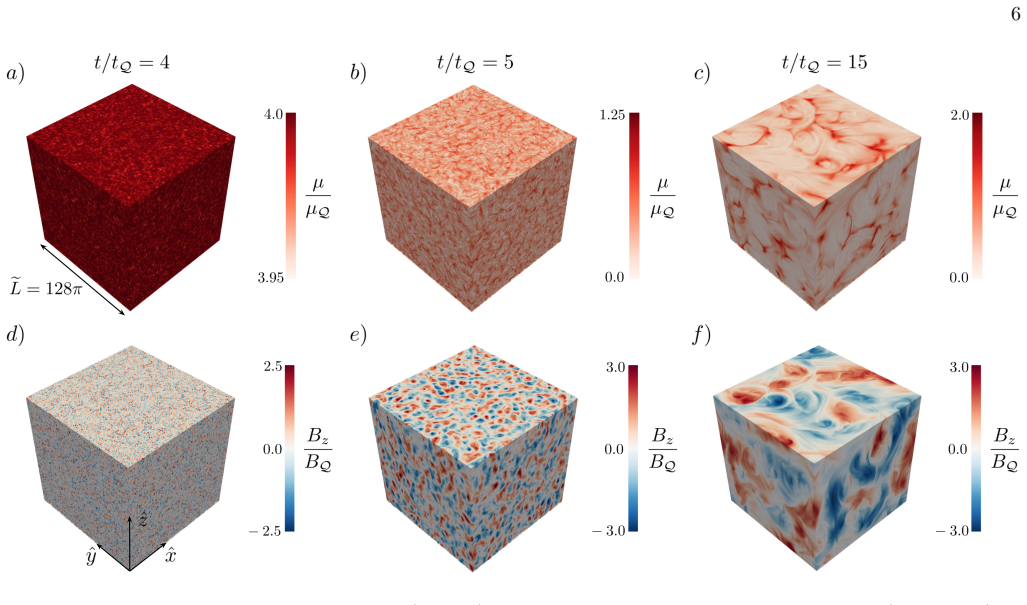
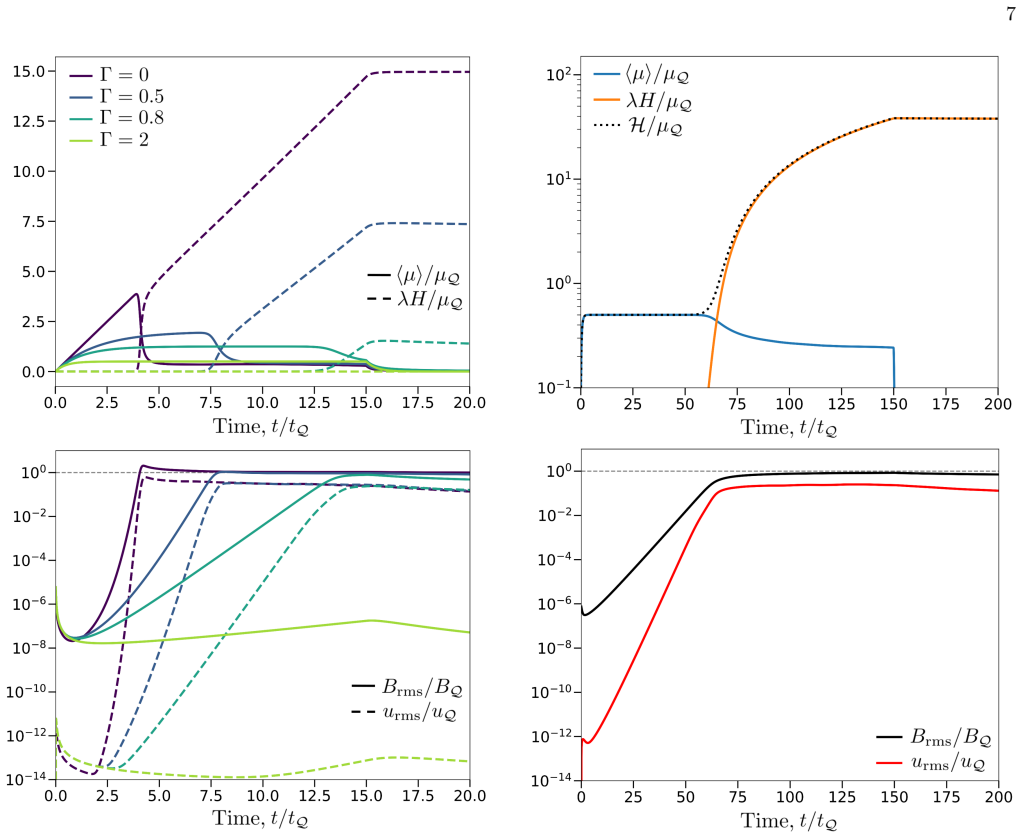
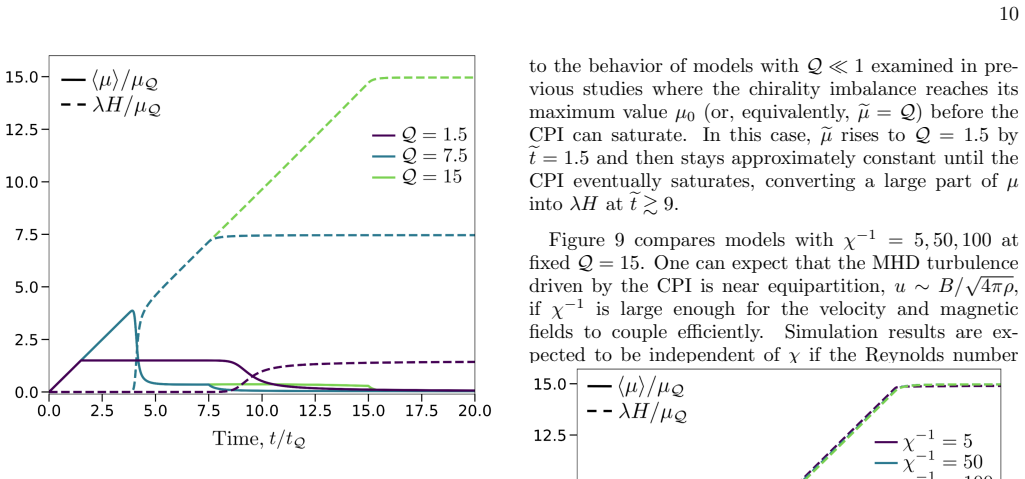
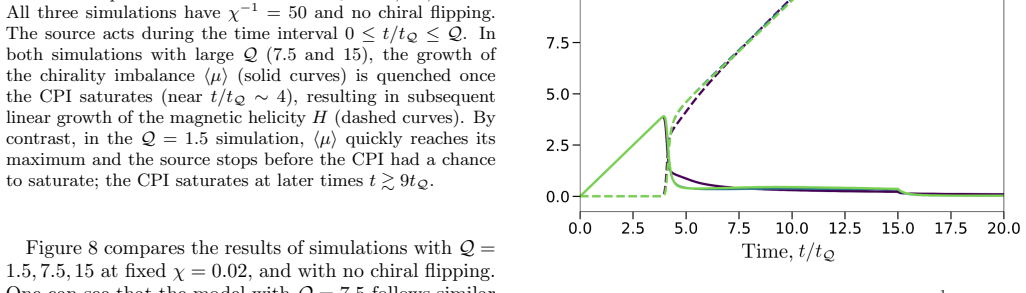
The chirality imbalance rises toeµ≈4, and then falls toeµ≈0.3 for et≳4. This is accompanied by a rise in λH, which then grows linearly until the end of the driving phase at et=Qin each simulation. The growth of seed fields and saturation of the CPI requires time et∼4, and hence a minimum value ofQ ∼4. The results confirm that our fiducial value ofQ= 15 is...
- [2]
-
[3]
M. Joyce and M. Shaposhnikov, Primordial magnetic fields, right electrons, and the abelian anomaly, PRL79, 1193 (1997)
work page 1997
-
[4]
J. Fr¨ ohlich and B. Pedrini, New applications of the chi- ral anomaly, inMathematical Physics 2000(World Sci- entific, 2000) pp. 9–47
work page 2000
-
[5]
A. Boyarsky, J. Fr¨ ohlich, and O. Ruchayskiy, Self- consistent evolution of magnetic fields and chiral asym- metry in the early universe, PRL108, 031301 (2012)
work page 2012
-
[6]
H. Tashiro, T. Vachaspati, and A. Vilenkin, Chiral effects and cosmic magnetic fields, PRD86, 105033 (2012)
work page 2012
-
[7]
P. Pavlovi´ c, N. Leite, and G. Sigl, Modified magnetohy- drodynamics around the electroweak transition, JCAP 2016(06), 044
work page 2016
-
[8]
A. Brandenburg, J. Schober, I. Rogachevskii, T. Kah- niashvili, A. Boyarsky, J. Fr¨ ohlich, O. Ruchayskiy, and N. Kleeorin, The turbulent chiral magnetic cascade in 11 the early universe, ApJL845, L21 (2017)
work page 2017
-
[9]
J. Schober, I. Rogachevskii, A. Brandenburg, A. Bo- yarsky, J. Fr¨ ohlich, O. Ruchayskiy, and N. Kleeorin, Lam- inar and turbulent dynamos in chiral magnetohydrody- namics. ii. simulations, ApJ858, 124 (2018)
work page 2018
-
[10]
J. Schober, I. Rogachevskii, and A. Brandenburg, Pro- duction of a chiral magnetic anomaly with emerging tur- bulence and mean-field dynamo action, PRL128, 065002 (2022)
work page 2022
-
[11]
M. Gurgenidze, A. J. Long, A. R. Pol, A. Brandenburg, and T. Kahniashvili, Primordial magnetic field from chiral plasma instability with sourcing, arXiv preprint arXiv:2512.09177 (2025)
-
[12]
Y. Akamatsu and N. Yamamoto, Chiral plasma instabil- ities, PRL111, 052002 (2013)
work page 2013
-
[13]
Magnetars and the Chiral Plasma Instabilities
A. Ohnishi and N. Yamamoto, Magnetars and the chi- ral plasma instabilities, arXiv preprint arXiv:1402.4760 (2014)
work page internal anchor Pith review Pith/arXiv arXiv 2014
-
[14]
M. Dvornikov and V. B. Semikoz, Magnetic field in- stability in a neutron star driven by the electroweak electron-nucleon interaction versus the chiral magnetic effect, PRD91, 061301 (2015)
work page 2015
-
[15]
G. Sigl and N. Leite, Chiral magnetic effect in protoneu- tron stars and magnetic field spectral evolution, JCAP 2016(01), 025
work page 2016
- [16]
-
[17]
J. Matsumoto, N. Yamamoto, and D.-L. Yang, Chiral plasma instability and inverse cascade from nonequilib- rium left-handed neutrinos in core-collapse supernovae, PRD105, 123029 (2022)
work page 2022
-
[18]
D. Grabowska, D. B. Kaplan, and S. Reddy, Role of the electron mass in damping chiral plasma instability in su- pernovae and neutron stars, PRD91, 085035 (2015)
work page 2015
- [19]
-
[20]
P. Pavlovi´ c, N. Leite, and G. Sigl, Chiral magnetohydro- dynamic turbulence, PRD96, 023504 (2017)
work page 2017
-
[21]
Hereafter, we use CGS units in contrast to most papers on CPI
-
[22]
M. E. Peskin,An Introduction to quantum field theory (CRC press, 2018)
work page 2018
-
[23]
Vilenkin, Equilibrium parity-violating current in a magnetic field, PRD22, 3080 (1980)
A. Vilenkin, Equilibrium parity-violating current in a magnetic field, PRD22, 3080 (1980)
work page 1980
-
[24]
J. Schober, A. Brandenburg, and I. Rogachevskii, Chiral fermion asymmetry in high-energy plasma simulations, GAFD114, 106 (2020)
work page 2020
-
[25]
Generation ofλHoccurs linearly with time for a constant sourceS, and for a more general sourceS(t) one would findλH(t)≈ R t 0 S(t′)dt ′
-
[26]
K. J. Burns, G. M. Vasil, J. S. Oishi, D. Lecoanet, and B. P. Brown, Dedalus: A flexible framework for numer- ical simulations with spectral methods, PRR2, 023068 (2020)
work page 2020
-
[27]
The large spatial scale of magnetic fields that develop by the end of the driving phase, ˜L∼ ˜H/ ˜B2 rms ≈ Q, re- quires a large simulation box with the required resolution scaling asN 3 ∝ Q3
-
[28]
Woltjer, A theorem on force free magnetic fields, PNAS44, 489 (1958)
L. Woltjer, A theorem on force free magnetic fields, PNAS44, 489 (1958)
work page 1958
-
[29]
J. B. Taylor, Relaxation and magnetic reconnection in plasmas, Reviews of Modern Physics58, 741 (1986)
work page 1986
-
[30]
D. Biskamp and W.-C. M¨ uller, Decay laws for three- dimensional magnetohydrodynamic turbulence, PRL83, 2195 (1999)
work page 1999
- [31]
-
[32]
D. N. Hosking and A. A. Schekochihin, Reconnection- controlled decay of magnetohydrodynamic turbulence and the role of invariants, PRX11, 041005 (2021)
work page 2021
-
[33]
B. A. Campbell, S. Davidson, J. Ellis, and K. A. Olive, On the baryon, lepton-flavour and right-handed electron asymmetries of the universe, Physics Letters B297, 118 (1992)
work page 1992
-
[34]
A. Boyarsky, V. Cheianov, O. Ruchayskiy, and O. Sobol, Evolution of the primordial axial charge across cosmic times, PRL126, 021801 (2021)
work page 2021
- [35]
-
[36]
V. M. Kaspi and A. M. Beloborodov, Magnetars, Annual Review of Astronomy and Astrophysics55, 261 (2017)
work page 2017
-
[37]
Previous studies have suggested that magnetar-strength fieldsB∼2αµ e/ℏc √ λ≲10 18 G could be generated if the chirality imbalance reachesµ 5 ∼µ e/2 before the CPI is triggered. However, such fields would be generated on microscopic scalesL∼2πℏc/αµ e ≲10 −10 cm and their inverse cascade would still lead to similarB∼10 9 G fields on global scales
-
[38]
Spruit, Origin of neutron star magnetic fields, inAIP conference proceedings, Vol
H. Spruit, Origin of neutron star magnetic fields, inAIP conference proceedings, Vol. 983 (AIP, 2008) pp. 391–398
work page 2008
-
[39]
L. Ferrario, A. Melatos, and J. Zrake, Magnetic field gen- eration in stars, SSR191, 77 (2015)
work page 2015
-
[40]
C. Thompson and R. C. Duncan, Neutron star dynamos and the origins of pulsar magnetism, ApJ408, 194 (1993)
work page 1993
discussion (0)
Sign in with ORCID, Apple, or X to comment. Anyone can read and Pith papers without signing in.