Right-tail asymptotics for products of independent normal random variables
Pith reviewed 2026-05-15 13:36 UTC · model grok-4.3
The pith
When at least one mean is nonzero, the right tail of the product of independent normals admits an explicit asymptotic expansion with a first correction of order x to the power -1/n.
A machine-rendered reading of the paper's core claim, the machinery that carries it, and where it could break.
Core claim
The asymptotic formula for P(Z > x) as x tends to infinity remains explicit when at least one mean is nonzero and involves a finite multiplicative factor arising from admissible sign patterns. It includes an explicit first relative correction term of order x^{-1/n} with remaining relative error O(x^{-2/n}). The proof uses a boundary saddle-point/Laplace method consisting of a multidimensional Laplace approximation near the boundary saddle followed by a one-dimensional endpoint Laplace approximation.
What carries the argument
The boundary saddle-point/Laplace method, which first performs a multidimensional Laplace approximation near the boundary saddle and then applies a one-dimensional endpoint Laplace approximation to the resulting integral.
If this is right
- The leading term is controlled by the saddle point closest to the boundary of the positive orthant.
- Only the admissible sign patterns that make the product positive contribute to the multiplicative prefactor.
- The first correction improves the approximation by a relative factor of size x^{-1/n}.
- The stated error bound holds uniformly in a neighborhood of the dominant saddle.
Where Pith is reading between the lines
- The same boundary technique may yield analogous expansions when the factors are drawn from other light-tailed families.
- When all means are zero the scaling and the form of the leading term are expected to change.
- The explicit sign-pattern factor suggests a direct link to the geometry of the orthants in which the product stays positive.
Load-bearing premise
The boundary saddle-point/Laplace method can be applied to the integral representation of the tail probability near the relevant saddle.
What would settle it
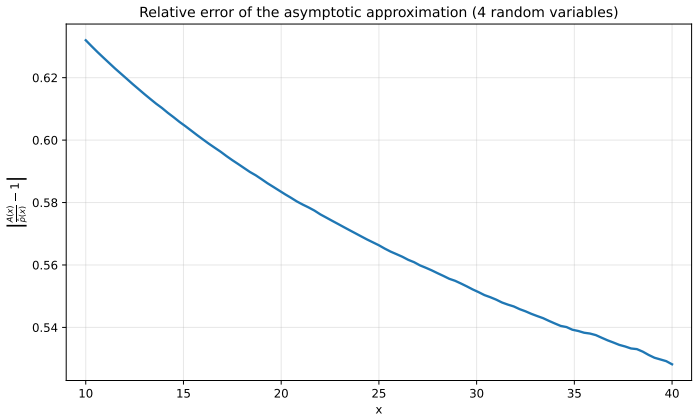
Direct numerical evaluation of P(Z > x) for successively larger x together with comparison of the observed relative error against the claimed O(x^{-2/n}) rate.
Figures

read the original abstract
Let $X_1,\dots,X_n$ be independent normal random variables with $X_i\sim N(\mu_i,\sigma_i^2)$, and set $Z=\prod_{i=1}^n X_i$. We derive asymptotic approximations for the right tail probability $\mathbb{P}(Z>x)$ as $x\to\infty$. When at least one mean is nonzero, the asymptotic formula remains explicit and involves a finite multiplicative factor arising from admissible sign patterns (reflecting the different ways the product can be positive); it includes an explicit first relative correction term of order $x^{-1/n}$, with remaining relative error $O(x^{-2/n})$. The proof uses a boundary saddle-point/Laplace method: first a multidimensional Laplace approximation near the boundary saddle, then a one-dimensional endpoint Laplace approximation.
Editorial analysis
A structured set of objections, weighed in public.
Referee Report
Summary. The manuscript derives asymptotic approximations for the right-tail probability P(Z > x) as x → ∞, where Z is the product of n independent normal random variables X_i ~ N(μ_i, σ_i²). When at least one mean is nonzero, the leading term is explicit and incorporates a finite multiplicative factor over admissible sign patterns; it includes a relative correction of order x^{-1/n} with relative remainder O(x^{-2/n}). The proof proceeds via a two-stage boundary saddle-point/Laplace method: multidimensional Laplace near the boundary saddle followed by one-dimensional endpoint Laplace.
Significance. If the claimed error orders hold under verifiable non-degeneracy conditions, the result supplies a concrete, explicit refinement of tail asymptotics for products of Gaussians. Such products appear in applications ranging from multiplicative noise models to certain financial and statistical functionals; an explicit first correction term of order x^{-1/n} would be a useful improvement over purely leading-order Laplace approximations.
major comments (1)
- [Abstract / main theorem] Abstract and main theorem statement: the claimed relative error O(x^{-2/n}) is asserted without recording the non-degeneracy hypotheses required for the two-stage Laplace expansion. For arbitrary μ_i the minimizing saddle in an admissible orthant may lie on a lower-dimensional edge or produce a degenerate Hessian, which would change the order of the remainder or introduce logarithmic factors. The manuscript must either state the precise non-degeneracy conditions (transversality of the boundary to the gradient and positive-definiteness of the restricted Hessian) or prove that they hold for generic parameter values.
Simulated Author's Rebuttal
We thank the referee for the careful reading and constructive comment. We address the major point below and will revise the manuscript to incorporate the requested clarification.
read point-by-point responses
-
Referee: [Abstract / main theorem] Abstract and main theorem statement: the claimed relative error O(x^{-2/n}) is asserted without recording the non-degeneracy hypotheses required for the two-stage Laplace expansion. For arbitrary μ_i the minimizing saddle in an admissible orthant may lie on a lower-dimensional edge or produce a degenerate Hessian, which would change the order of the remainder or introduce logarithmic factors. The manuscript must either state the precise non-degeneracy conditions (transversality of the boundary to the gradient and positive-definiteness of the restricted Hessian) or prove that they hold for generic parameter values.
Authors: We agree that the non-degeneracy conditions must be stated explicitly for the O(x^{-2/n}) remainder to hold. In the revised manuscript we will add to the statement of the main theorem the following hypotheses: (i) for each admissible orthant the minimizing saddle lies in the relative interior of the corresponding face (transversality of the level set {product = x} to the gradient of the phase function), and (ii) the Hessian of the restricted phase function on that face is positive definite at the saddle. We will also insert a short remark observing that these conditions hold for generic (μ,σ) because the set of parameters producing degeneracy or boundary-edge saddles has measure zero in parameter space. The proof already proceeds under these standard non-degeneracy assumptions of the boundary Laplace method; recording them does not change the results but clarifies their scope. revision: yes
Circularity Check
No significant circularity; standard Laplace method applied to integral representation
full rationale
The derivation applies the boundary saddle-point/Laplace method to the joint density of the product Z, first in multiple dimensions near the boundary saddle and then in one dimension at the endpoint. This produces the explicit leading asymptotic, the relative correction of order x^{-1/n}, and the O(x^{-2/n}) remainder directly from the Taylor expansion of the phase function and the geometry of admissible orthants. No step reduces a claimed prediction to a fitted parameter by construction, invokes a self-citation as the sole justification for a uniqueness claim, or renames a known empirical pattern. The result remains independent of its own inputs once the standard non-degeneracy conditions for the Hessian and transversality are granted; those conditions are external to the paper's equations and do not create a self-definitional loop.
Axiom & Free-Parameter Ledger
axioms (1)
- standard math Validity of the multidimensional Laplace approximation near the boundary saddle point for the joint density integral
Lean theorems connected to this paper
-
IndisputableMonolith/Foundation/RealityFromDistinction.leanreality_from_one_distinction unclear?
unclearRelation between the paper passage and the cited Recognition theorem.
The proof uses a boundary saddle-point/Laplace method: first a multidimensional Laplace approximation near the boundary saddle, then a one-dimensional endpoint Laplace approximation.
-
IndisputableMonolith/Cost/FunctionalEquation.leanwashburn_uniqueness_aczel unclear?
unclearRelation between the paper passage and the cited Recognition theorem.
Theorem 1 ... involves a finite multiplicative factor arising from admissible sign patterns ... explicit first relative correction term of order x^{-1/n}
What do these tags mean?
- matches
- The paper's claim is directly supported by a theorem in the formal canon.
- supports
- The theorem supports part of the paper's argument, but the paper may add assumptions or extra steps.
- extends
- The paper goes beyond the formal theorem; the theorem is a base layer rather than the whole result.
- uses
- The paper appears to rely on the theorem as machinery.
- contradicts
- The paper's claim conflicts with a theorem or certificate in the canon.
- unclear
- Pith found a possible connection, but the passage is too broad, indirect, or ambiguous to say the theorem truly supports the claim.
Forward citations
Cited by 1 Pith paper
-
The non-central gamma sum and difference distributions: exact distribution and asymptotic expansions
Exact distributions and asymptotic expansions derived for sums and differences of independent non-central gamma random variables, including closed-form coefficients for the product of correlated normals.
Reference graph
Works this paper leans on
-
[1]
Marek Arendarczyk and Krzysztof Debicki. Asymptotics of supremum distribution of a gaus- sian process over a weibullian time.Bernoulli, 17(1):194–210, 2011
work page 2011
-
[2]
C. C. Craig. On the frequency function ofxy.Annals of Mathematical Statistics, 7:1–15, 1936
work page 1936
-
[3]
G. Cui, X. Yu, S. Iommelli, and L. Kong. Exact distribution for the product of two correlated gaussian random variables.IEEE Signal Processing Letters, 23:1662–1666, 2016
work page 2016
-
[4]
Robert E. Gaunt. A note on the distribution of the product of zero-mean correlated normal random variables.Statistica Neerlandica, 73:176–179, 2019
work page 2019
-
[5]
Robert E. Gaunt. Stein’s method and the distribution of the product of zero mean correlated normal random variables.Communications in Statistics – Theory and Methods, 50:280–285, 2021
work page 2021
-
[6]
Remigijus Leipus, Jonas ˇSiaulys, Mantas Dirma, and Romualdas Zov´ e. On the distribution-tail behaviour of the product of normal random variables.Journal of Inequalities and Applications, 2023(32), 2023
work page 2023
-
[7]
S. Nadarajah and T. K. Pog´ any. On the distribution of the product of correlated normal random variables.C. R. Math., 354:201–204, 2016
work page 2016
-
[8]
M. D. Springer and W. E. Thompson. The distribution of products of independent random variables.SIAM Journal on Applied Mathematics, 14:511–526, 1966. 23
work page 1966
-
[9]
M. D. Springer and W. E. Thompson. The distribution of products of beta, gamma and gaussian random variables.SIAM Journal on Applied Mathematics, 18:721–737, 1970
work page 1970
-
[10]
J. Wishart and M. S. Bartlett. The distribution of second order moment statistics in a normal system.Proc. Camb. Philol. Soc., 28:455–459, 1932
work page 1932
-
[11]
Wong.Asymptotic Approximations of Integrals
R. Wong.Asymptotic Approximations of Integrals. SIAM, 2001
work page 2001
-
[12]
P. T. Yuan. On the logarithmic frequency distribution and the semi-logarithmic correlation surface.Annals of Mathematical Statistics, 4(1):30–74, 1933. 24
work page 1933
discussion (0)
Sign in with ORCID, Apple, or X to comment. Anyone can read and Pith papers without signing in.