Dark matter in classically conformal theories: WIMP and supercooling
Pith reviewed 2026-05-21 12:35 UTC · model grok-4.3
The pith
Classically conformal SU(2)_X theory with a Z2-odd triplet scalar produces both WIMP and supercooled dark matter via its first-order phase transition.
A machine-rendered reading of the paper's core claim, the machinery that carries it, and where it could break.
Core claim
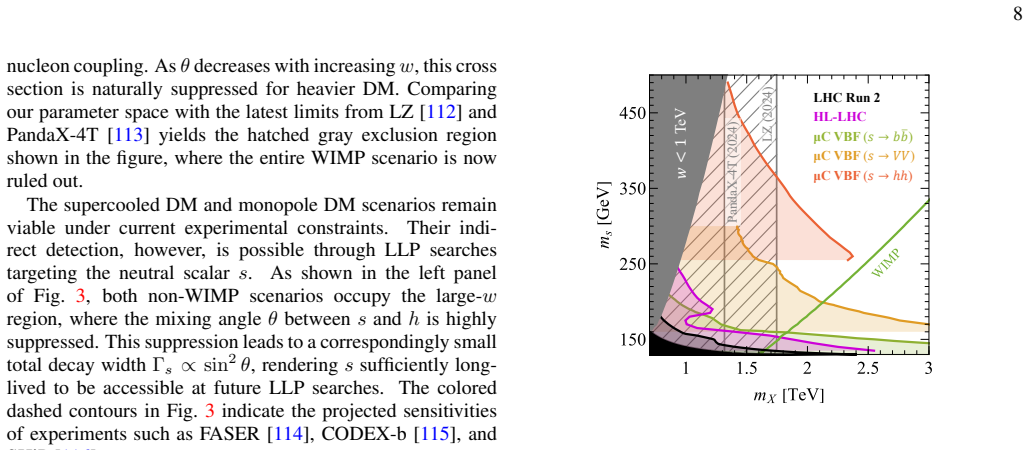
Beyond solving the hierarchy problem, classically conformal (CC) theories naturally accommodate dark matter (DM). In this work, we explore the CC SU(2)_X gauge theory with a triplet dark scalar, uncovering two distinct DM scenarios: weakly interacting massive particle (WIMP) and supercooled DM. The production mechanisms are strongly influenced by the CC model's unique first-order phase transition evolution history, which differs significantly from those in non-conformal models. We obtain the viable parameter space for each scenario and investigate the current constraints and future sensitivities at experiments, demonstrating that gravitational wave signals from the phase transition provide a
What carries the argument
The first-order phase transition evolution history of the classically conformal SU(2)_X gauge theory with its Z2-odd triplet dark scalar, which controls the thermal conditions leading to either WIMP freeze-out or supercooling-based dark matter production.
If this is right
- Viable parameter space exists for both the WIMP and supercooled dark matter scenarios consistent with observed relic density.
- Gravitational wave signals from the first-order phase transition provide a common detection channel applicable to both dark matter regimes.
- Current experimental constraints and future sensitivities at collider and direct detection experiments apply to the parameter spaces of these scenarios.
- The production mechanisms for dark matter differ significantly from those in non-conformal models because of the unique phase transition history.
Where Pith is reading between the lines
- The same phase-transition-driven distinction between WIMP and supercooled regimes may appear in other classically conformal gauge extensions.
- Predictions for the gravitational wave spectrum could be confronted with data from future observatories to test the dark matter production history independently.
- This setup offers a direct link between dark matter relic calculations and the dynamics that also resolve the hierarchy problem.
Load-bearing premise
The first-order phase transition in the classically conformal SU(2)_X sector produces a thermal history sufficiently different from non-conformal models to generate two qualitatively distinct, viable dark-matter production mechanisms.
What would settle it
A calculation or simulation showing that the phase transition history does not create separate viable regimes for WIMP and supercooled dark matter that both match the observed relic density, or the absence of gravitational wave signals matching the predicted spectrum from this transition.
Figures


read the original abstract
Beyond solving the hierarchy problem, classically conformal (CC) theories naturally accommodate dark matter (DM). In this work, we explore the CC $SU(2)_X$ gauge theory with a triplet dark scalar, uncovering two distinct DM scenarios: weakly interacting massive particle (WIMP) and supercooled DM. The production mechanisms are strongly influenced by the CC model's unique first-order phase transition evolution history, which differs significantly from those in non-conformal models. We obtain the viable parameter space for each scenario and investigate the current constraints and future sensitivities at experiments, demonstrating that gravitational wave signals from the phase transition provide a common detection channel for both the WIMP and supercooled DM regimes.
Editorial analysis
A structured set of objections, weighed in public.
Referee Report
Summary. The manuscript explores dark matter in a classically conformal SU(2)_X gauge theory with a Z2-odd triplet scalar. It identifies two distinct production scenarios—a standard WIMP freeze-out regime and a supercooled regime—both governed by the model's first-order phase transition thermal history. Viable parameter spaces are derived for each case, experimental constraints and future sensitivities are examined, and gravitational-wave signals from the transition are presented as a common detection channel.
Significance. If the central calculations hold, the work provides a concrete realization of how classical conformality can partition dark-matter production into qualitatively different regimes through supercooling and nucleation dynamics, with gravitational waves offering a shared probe. Credit is given for the explicit benchmark points, effective-potential and bounce-action computations, and relic-density integrals that make the two-regime claim falsifiable and reproducible.
minor comments (3)
- §3.2: the statement that the phase-transition history 'differs significantly' from non-conformal models would be strengthened by a side-by-side plot of the effective potential or nucleation temperature versus a reference non-conformal SU(2) case.
- Table 2, supercooled benchmark row: the reported value of α appears inconsistent with the latent-heat formula given in Eq. (22); a brief derivation or cross-check would remove ambiguity.
- Figure 4: the GW spectrum curves lack shading for the uncertainty band arising from the variation of the dark-sector coupling; adding this would improve readability of the projected sensitivities.
Simulated Author's Rebuttal
We thank the referee for their positive assessment of our manuscript, including the recognition of the two distinct DM production regimes and the role of the first-order phase transition. We appreciate the recommendation for minor revision and will make the necessary adjustments to improve clarity and presentation where appropriate.
Circularity Check
No significant circularity detected in derivation chain
full rationale
The paper derives two DM regimes (WIMP freeze-out and supercooled production) from the first-order phase transition in the classically conformal SU(2)_X model with Z2-odd triplet scalar. The effective potential, bounce-action computation, nucleation temperature, and relic-density integrals follow standard Coleman-Weinberg and thermal-field-theory methods without reducing any claimed prediction to a fitted input by construction. Viable parameter space is obtained by imposing the observed relic density as an external constraint rather than renaming a fit as a prediction; GW spectra are computed as an independent observable. No self-citation load-bearing step, uniqueness theorem imported from the authors, or ansatz smuggled via prior work appears in the central claims. The derivation remains self-contained against external benchmarks such as Planck relic density and LISA/ET GW sensitivities.
Axiom & Free-Parameter Ledger
axioms (1)
- domain assumption Classically conformal theories produce a first-order phase transition whose evolution history differs significantly from non-conformal models.
Lean theorems connected to this paper
-
IndisputableMonolith/Cost/FunctionalEquation.leanwashburn_uniqueness_aczel echoes?
echoesECHOES: this paper passage has the same mathematical shape or conceptual pattern as the Recognition theorem, but is not a direct formal dependency.
The tree-level joint potential ... contains only dimensionless parameters. ... radiative corrections ... one-loop potential V1(h,s) = 3gX^4/16π² s⁴ (log s/w0 − 1/4) + ...
What do these tags mean?
- matches
- The paper's claim is directly supported by a theorem in the formal canon.
- supports
- The theorem supports part of the paper's argument, but the paper may add assumptions or extra steps.
- extends
- The paper goes beyond the formal theorem; the theorem is a base layer rather than the whole result.
- uses
- The paper appears to rely on the theorem as machinery.
- contradicts
- The paper's claim conflicts with a theorem or certificate in the canon.
- unclear
- Pith found a possible connection, but the passage is too broad, indirect, or ambiguous to say the theorem truly supports the claim.
Reference graph
Works this paper leans on
- [1]
-
[2]
W. A. Bardeen, inOntake Summer Institute on Particle Physics (1995)
work page 1995
-
[3]
K. A. Meissner and H. Nicolai, Phys. Lett. B660, 260 (2008), 0710.2840
work page internal anchor Pith review Pith/arXiv arXiv 2008
-
[4]
S. R. Coleman and E. J. Weinberg, Phys. Rev. D7, 1888 (1973)
work page 1973
- [5]
- [6]
-
[7]
The Next-to-Minimal Coleman-Weinberg Model
R. Hempfling, Phys. Lett. B379, 153 (1996), hep-ph/9604278
work page internal anchor Pith review Pith/arXiv arXiv 1996
-
[8]
S. Iso, N. Okada, and Y . Orikasa, Phys. Lett. B676, 81 (2009), 0902.4050
work page internal anchor Pith review Pith/arXiv arXiv 2009
-
[9]
S. Iso, N. Okada, and Y . Orikasa, Phys. Rev. D80, 115007 (2009), 0909.0128
work page internal anchor Pith review Pith/arXiv arXiv 2009
-
[10]
E. J. Chun, S. Jung, and H. M. Lee, Phys. Lett. B725, 158 (2013), [Erratum: Phys.Lett.B 730, 357–359 (2014)], 1304.5815
work page internal anchor Pith review Pith/arXiv arXiv 2013
-
[11]
A. Das, N. Okada, and N. Papapietro, Eur. Phys. J. C77, 122 (2017), 1509.01466
work page internal anchor Pith review Pith/arXiv arXiv 2017
- [12]
-
[13]
T. de Boer, M. Lindner, and A. Trautner, Phys. Lett. B861, 139241 (2025), 2407.15920
-
[14]
Planck 2018 results. VI. Cosmological parameters
N. Aghanim et al. (Planck), Astron. Astrophys.641, A6 (2020), [Erratum: Astron.Astrophys. 652, C4 (2021)], 1807.06209
work page internal anchor Pith review Pith/arXiv arXiv 2020
-
[15]
Conformal vector dark matter and strongly first-order electroweak phase transition
S. Yaser Ayazi and A. Mohamadnejad, JHEP03, 181 (2019), 1901.04168
work page internal anchor Pith review Pith/arXiv arXiv 2019
- [16]
- [17]
- [18]
-
[19]
T. Hambye, A. Strumia, and D. Teresi, JHEP08, 188 (2018), 1805.01473
work page internal anchor Pith review Pith/arXiv arXiv 2018
-
[20]
Strong gravitational radiation from a simple dark matter model
I. Baldes and C. Garcia-Cely, JHEP05, 190 (2019), 1809.01198
work page internal anchor Pith review Pith/arXiv arXiv 2019
- [21]
-
[22]
M. Kierkla, A. Karam, and B. Swiezewska, JHEP03, 007 (2023), 2210.07075
-
[23]
T. Hambye, JHEP01, 028 (2009), 0811.0172
work page internal anchor Pith review Pith/arXiv arXiv 2009
- [24]
-
[25]
A. M. Polyakov, JETP Lett.20, 194 (1974)
work page 1974
-
[26]
N. Baouche, A. Ahriche, G. Faisel, and S. Nasri, Phys. Rev. D 104, 075022 (2021), 2105.14387
-
[27]
N. Benincasa, L. Delle Rose, L. Panizzi, M. Razzaq, and S. Urzetta, Phys. Rev. D112, 095004 (2025), 2506.22248
- [28]
-
[29]
S. Baek, P. Ko, and W.-I. Park, JCAP10, 067 (2014), 1311.1035
work page internal anchor Pith review Pith/arXiv arXiv 2014
-
[30]
V . V . Khoze and G. Ro, JHEP10, 061 (2014), 1406.2291
work page internal anchor Pith review Pith/arXiv arXiv 2014
-
[31]
I. Chaffey and P. Tanedo, Phys. Rev. D101, 075005 (2020), 1907.10217
-
[32]
T. Ghosh, H.-K. Guo, T. Han, and H. Liu, JHEP07, 045 (2021), 2012.09758
- [33]
- [34]
-
[35]
$SU(2)_X$ Vector DM and Galactic Center Gamma-Ray Excess
C.-H. Chen and T. Nomura, Phys. Lett. B746, 351 (2015), 1501.07413
work page internal anchor Pith review Pith/arXiv arXiv 2015
- [36]
- [37]
- [38]
-
[39]
Cosmological Consequences of Nearly Conformal Dynamics at the TeV scale
T. Konstandin and G. Servant, JCAP12, 009 (2011), 1104.4791
work page internal anchor Pith review Pith/arXiv arXiv 2011
-
[40]
Probing classically conformal $B-L$ model with gravitational waves
R. Jinno and M. Takimoto, Phys. Rev. D95, 015020 (2017), 1604.05035
work page internal anchor Pith review Pith/arXiv arXiv 2017
-
[41]
C.-W. Chiang and E. Senaha, Phys. Lett. B774, 489 (2017), 1707.06765
work page internal anchor Pith review Pith/arXiv arXiv 2017
-
[42]
S. Iso, P. D. Serpico, and K. Shimada, Phys. Rev. Lett.119, 141301 (2017), 1704.04955
work page internal anchor Pith review Pith/arXiv arXiv 2017
-
[43]
Phase transition and vacuum stability in the classically conformal B-L model
C. Marzo, L. Marzola, and V . Vaskonen, Eur. Phys. J. C79, 601 (2019), 1811.11169
work page internal anchor Pith review Pith/arXiv arXiv 2019
- [44]
-
[45]
Gravitational wave energy budget in strongly supercooled phase transitions
J. Ellis, M. Lewicki, J. M. No, and V . Vaskonen, JCAP06, 024 (2019), 1903.09642
work page internal anchor Pith review Pith/arXiv arXiv 2019
- [46]
- [47]
-
[48]
A. Ahriche, S. Kanemura, and M. Tanaka, JHEP01, 201 (2024), 2308.12676
-
[49]
L. Sagunski, P. Schicho, and D. Schmitt, Phys. Rev. D107, 123512 (2023), 2303.02450
- [50]
-
[51]
Supercooled Phase Transitions with Radiative Symmetry Breaking
A. Salvio (2026), 2602.20246
work page internal anchor Pith review Pith/arXiv arXiv 2026
- [52]
- [53]
-
[54]
X.-R. Wong and K.-P. Xie, Phys. Rev. D108, 055035 (2023), 2304.00908
- [55]
- [56]
- [57]
- [58]
-
[59]
Salvio, JCAP12, 046 (2023), 2307.04694
A. Salvio, JCAP12, 046 (2023), 2307.04694
- [60]
- [61]
- [62]
- [63]
- [64]
- [65]
- [66]
- [67]
-
[68]
Systematic analysis of radiative symmetry breaking in models with extended scalar sector
L. Chataignier, T. Prokopec, M. G. Schmidt, and B. ´Swie˙zewska, JHEP08, 083 (2018), 1805.09292
work page internal anchor Pith review Pith/arXiv arXiv 2018
- [69]
-
[70]
A. D. Linde, Nucl. Phys. B216, 421 (1983), [Erratum: Nucl.Phys.B 223, 544 (1983)]
work page 1983
-
[71]
A. H. Guth and S. H. H. Tye, Phys. Rev. Lett.44, 631 (1980), [Erratum: Phys.Rev.Lett. 44, 963 (1980)]
work page 1980
-
[72]
A. H. Guth and E. J. Weinberg, Phys. Rev. D23, 876 (1981)
work page 1981
-
[73]
M. D. Rintoul and S. Torquato, Journal of physics a: mathematical and general30, L585 (1997)
work page 1997
-
[74]
R. D. Pisarski and F. Wilczek, Phys. Rev. D29, 338 (1984)
work page 1984
-
[75]
Chiral phase boundary of QCD at finite temperature
J. Braun and H. Gies, JHEP06, 024 (2006), hep-ph/0602226
work page internal anchor Pith review Pith/arXiv arXiv 2006
- [76]
- [77]
-
[78]
M. Christiansen, E. Madge, C. Puchades-Ibáñez, M. E. Ramirez-Quezada, and P. Schwaller (2025), 2511.02910
- [79]
- [80]
discussion (0)
Sign in with ORCID, Apple, or X to comment. Anyone can read and Pith papers without signing in.