Supercooled Phase Transitions with Radiative Symmetry Breaking
Pith reviewed 2026-05-21 12:18 UTC · model grok-4.3
The pith
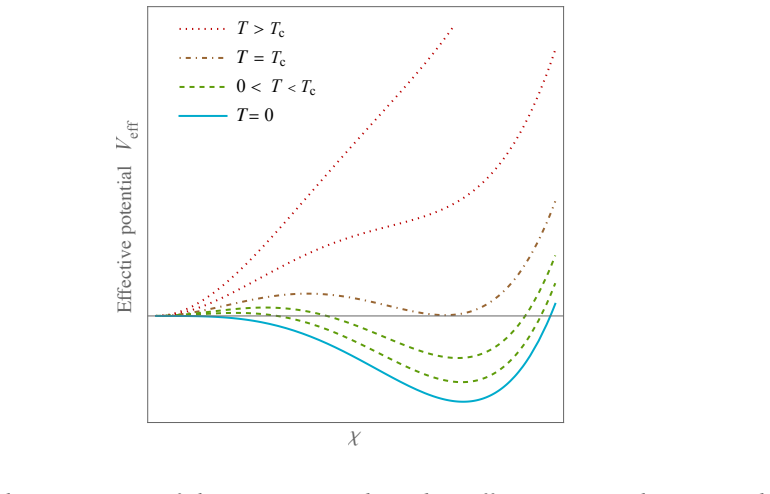
Theories with radiatively broken symmetries undergo strong supercooling before their first-order phase transitions complete.
A machine-rendered reading of the paper's core claim, the machinery that carries it, and where it could break.
Core claim
In field theories with radiative symmetry breaking, first-order phase transitions become effective only after substantial supercooling, and a model-independent perturbative framework then determines the effective action and nucleation rate, yielding formulas that can be applied directly to any model in this class.
What carries the argument
Model-independent perturbative calculation of the effective action and nucleation rate for strongly supercooled first-order phase transitions triggered by radiative symmetry breaking.
If this is right
- The transitions produce gravitational waves whose spectrum can be computed from the general formulas.
- Primordial black holes can form during the supercooled epoch.
- The same formulas apply without re-derivation to any concrete model that exhibits strong supercooling.
- Perturbative control holds once the transition temperature lies sufficiently below the symmetry-breaking scale.
Where Pith is reading between the lines
- The duration of supercooling sets the typical size of the resulting gravitational-wave signal and the mass range of any black holes that form.
- Models with only mild supercooling would require non-perturbative lattice studies instead of the analytic formulas given here.
- The same radiative-breaking mechanism could influence the thermal history of the early universe at energies below the symmetry-breaking scale.
Load-bearing premise
Supercooling must be strong enough that perturbative methods reliably fix the effective action and the nucleation rate.
What would settle it
A concrete first-order phase transition observed at a temperature comparable to the symmetry-breaking scale with no extended period of supercooling would contradict the claim.
Figures


read the original abstract
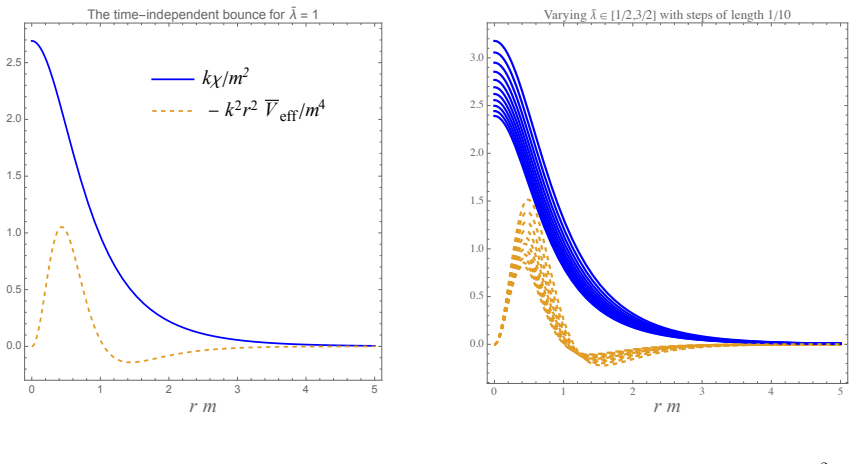
First-order phase transitions produce gravitational waves and primordial black holes. They always occur in field theories where symmetries are radiatively broken and masses are correspondingly generated. These theories predict a period of supercooling: phase transitions become effective at temperatures much smaller than the symmetry-breaking scale. This paper reviews a model-independent approach to study phase transitions in this scenario, which can be adopted if supercooling is strong enough. Perturbative methods can be used to determine the effective action and such model-independent approach allows us to obtain ready-to-use formulas that can be applied to any specific model of this sort.
Editorial analysis
A structured set of objections, weighed in public.
Referee Report
Summary. The manuscript reviews a model-independent perturbative approach to first-order phase transitions in field theories with radiatively broken symmetries. It argues that strong supercooling (phase transitions effective at T_n ≪ v) permits reliable use of perturbative methods to compute the effective action and nucleation rate, yielding ready-to-use formulas applicable to any model in this class.
Significance. If the applicability regime is properly delimited, the review would provide a practical reference for cosmological studies of gravitational waves and primordial black holes by reducing model-specific calculations to a common framework. The emphasis on ready-to-use formulas is a concrete strength for model-building applications.
major comments (1)
- [§3 (Applicability of the perturbative approach)] The central applicability condition—that supercooling must be 'strong enough' for perturbative control of the effective action and nucleation rate at low T—is stated without quantitative bounds (e.g., a limit on the loop-expansion parameter or explicit comparison to non-perturbative results). This renders the regime of validity for the model-independent formulas imprecise and untested against potential IR sensitivities.
minor comments (1)
- Notation for the effective potential parameters is introduced without a consolidated table of definitions, which would improve readability when applying the ready-to-use formulas to specific models.
Simulated Author's Rebuttal
We thank the referee for the careful reading of our manuscript and for the constructive comment on the applicability regime. We address the point below and have incorporated revisions to improve the clarity of the validity conditions while preserving the model-independent character of the approach.
read point-by-point responses
-
Referee: [§3 (Applicability of the perturbative approach)] The central applicability condition—that supercooling must be 'strong enough' for perturbative control of the effective action and nucleation rate at low T—is stated without quantitative bounds (e.g., a limit on the loop-expansion parameter or explicit comparison to non-perturbative results). This renders the regime of validity for the model-independent formulas imprecise and untested against potential IR sensitivities.
Authors: We agree that the manuscript would benefit from a more explicit discussion of the quantitative aspects of the applicability condition. The central criterion T_n ≪ v is motivated by the requirement that the zero-temperature radiative potential dominates the dynamics, rendering thermal corrections and higher-loop effects small. In the revised manuscript we have expanded the relevant discussion in §3 to include order-of-magnitude estimates for the effective loop-expansion parameter in terms of the supercooling ratio (e.g., showing that corrections remain ≲ 10 % for T_n/v ≲ 0.1 in representative models with O(1) couplings). We have also added references to existing non-perturbative and lattice studies of radiatively broken potentials that support the reliability of the perturbative nucleation rate in the strong-supercooling limit. These additions clarify the regime of validity and address potential IR sensitivities without introducing model-specific assumptions that would undermine the model-independent formulas. revision: yes
Circularity Check
Review of established perturbative formulas shows no circularity in derivation chain
full rationale
This is a review paper presenting a model-independent approach for strong-supercooling phase transitions with radiative symmetry breaking. The abstract and context indicate that perturbative methods for the effective action and nucleation rate are adopted when supercooling is strong enough (T_n ≪ v), with ready-to-use formulas offered for application to specific models. These elements are described as drawn from prior literature rather than newly derived here in a self-referential loop. No self-definitional steps appear where a claimed prediction reduces to a fitted input or definition by construction, nor are there load-bearing self-citations that substitute for independent verification. The strong-supercooling condition is framed as an applicability criterion, not a result forced by the paper's own equations. The derivation chain therefore remains self-contained with the burden on externally cited works.
Axiom & Free-Parameter Ledger
axioms (1)
- domain assumption Perturbative methods suffice to determine the effective action when supercooling is strong enough.
Forward citations
Cited by 3 Pith papers
-
Supercool with PPO: Exploring Supercooled Phase Transitions via Reinforcement Learning
PPO reinforcement learning accelerates identification of gravitational wave signals from supercooled phase transitions in a minimal dark U(1)_x sector compared to Monte Carlo sampling.
-
Primordial Magnetogenesis and Gravitational Waves from ALP-assisted Phase Transition
ALP-assisted first-order phase transitions can explain observed intergalactic magnetic fields and produce detectable gravitational waves, linking cosmology with particle physics searches.
-
Dark matter in classically conformal theories: WIMP and supercooling
Classically conformal SU(2)_X model with triplet dark scalar yields viable WIMP and supercooled DM parameter spaces whose production histories are set by the model's first-order phase transition, with gravitational wa...
discussion (0)
Sign in with ORCID, Apple, or X to comment. Anyone can read and Pith papers without signing in.