Constraining Neutrino Mass with the Void Weak Lensing Effect
Pith reviewed 2026-05-21 12:29 UTC · model grok-4.3
The pith
Void lensing constrains total neutrino mass to 0.096 eV precision without shape noise.
A machine-rendered reading of the paper's core claim, the machinery that carries it, and where it could break.
Core claim
Using mock shear catalogues over 8400 square degrees with a source density of 10 per square arcminute, the void lensing signal from N-body simulations yields a constraint of sigma of total neutrino mass equal to 0.096 eV, or an upper limit of 0.232 eV at 95 percent , in the absence of shape noise. With Stage-III-like shape noise the constraint weakens to 0.340 eV or an upper limit of 0.707 eV at 95 percent . The signal shows a clear linear dependence on neutrino mass, and forward modelling from the void density profiles is validated as accurate across cosmologies.
What carries the argument
The void-shear cross-correlation, or void lensing effect, obtained from the density profiles of dark matter and neutrinos inside and around voids identified by the DIVE finder in HOD-populated simulations.
If this is right
- There is a clear linear relationship between the void lensing signal and neutrino mass.
- Forward modelling of the void lensing signal from void density profiles is accurate across different cosmologies.
- Void lensing constitutes a promising independent probe of massive neutrinos.
- The method can be applied to galaxy survey data and combined with other cosmological observables.
Where Pith is reading between the lines
- Applying the same pipeline to actual survey data could produce neutrino mass bounds competitive with current limits from other probes.
- Surveys with reduced shape noise could reach the tighter 0.096 eV precision quoted for the ideal case.
- Cross-correlating void lensing with CMB or galaxy clustering measurements might help break parameter degeneracies involving neutrinos.
- Repeating the analysis with alternative void finders or independent simulation suites would test the robustness of the linear relation.
Load-bearing premise
The HOD fitting to populate BOSS LOW-Z-like galaxies and the DIVE void finder applied to N-body simulations with varying neutrino masses accurately reproduce the real-world density profiles of dark matter and neutrinos that determine the void lensing signal.
What would settle it
A measurement of the void lensing signal from real galaxy and shear survey data that shows no linear dependence on neutrino mass or deviates from the amplitude predicted by the simulations.
Figures





read the original abstract
Cosmic voids, the underdense regions of the Large Scale Structure (LSS), provide cosmological information highly complementary to that obtained from overdense regions. In this work, we investigate the constraining power of the void-shear cross-correlation (void lensing effect) on the total neutrino mass. Based on cosmological $N$-body simulations with varying neutrino masses, we populate BOSS LOW-Z-like galaxies at $0.2<z<0.4$ using HOD fitting, identify voids with the DIVE void finder and obtain their density profiles from the underlying dark matter and neutrino distributions. We then generate mock shear catalogues through ray-tracing and measure the corresponding void lensing signals, assuming a source number density of $10/{\rm arcmin}^{2}$ and sky area of around $8400\,{\rm deg}^2$. Under this setup, void lensing independently yields a constraint on total neutrino mass as $\sigma(M_{\nu})=0.096\,{\rm eV}$ ($M_{\nu}<0.232\,{\rm eV}$, 95% C.L.) in the absence of shape noise, and $\sigma(M_{\nu})=0.340\,{\rm eV}$ ($M_{\nu}<0.707\,{\rm eV}$, 95% C.L.) when adopting a Stage-III-like shape noise. Moreover, we find a clear linear relationship between the void lensing signal and neutrino mass. We further validate the forward modelling of the void lensing signal from the void density profiles across different cosmologies, demonstrating its accuracy and potential for future applications. These findings highlight void lensing as a promising probe of massive neutrinos and motivate its applications to galaxy survey data as well as the combination with other cosmological observables.
Editorial analysis
A structured set of objections, weighed in public.
Referee Report
Summary. The paper investigates the use of void weak lensing (void-shear cross-correlation) as a probe of total neutrino mass M_ν. Using N-body simulations with varying neutrino masses, BOSS LOW-Z-like galaxies (0.2<z<0.4) are populated via HOD fitting, voids are identified with the DIVE finder, and density profiles of dark matter and neutrinos are extracted. Mock shear catalogs are generated via ray-tracing for a source density of 10 arcmin^{-2} over ~8400 deg², yielding measured void lensing signals. The work reports a linear relationship between the lensing amplitude and M_ν, and derives constraints σ(M_ν)=0.096 eV (M_ν<0.232 eV at 95% C.L.) without shape noise and σ(M_ν)=0.340 eV (M_ν<0.707 eV at 95% C.L.) with Stage-III-like shape noise. Forward modeling from void density profiles is validated across cosmologies.
Significance. If the modeling assumptions hold, the reported linear mapping and independent constraints demonstrate that void lensing can serve as a complementary probe to CMB and galaxy clustering for neutrino mass, with competitive precision even in the presence of shape noise. The simulation-based forward modeling and explicit validation of the lensing signal from density profiles are strengths that support potential applications to real survey data.
major comments (3)
- [Methods (galaxy population and HOD)] Methods section on galaxy population: The description states that galaxies are populated 'using HOD fitting' to match BOSS LOW-Z-like statistics, but does not indicate whether HOD parameters are re-optimized independently for each neutrino-mass simulation. Because massive neutrinos suppress small-scale power and shift the halo mass function and bias, a single fixed HOD fit will generally produce inconsistent number densities and clustering across cosmologies; this directly affects the void catalog, density profiles, and therefore the lensing signal used to derive the linear relation and σ(M_ν) values.
- [Results (constraints and linearity)] Results section on constraints and linear relationship: The quoted constraints and the claim of a 'clear linear relationship' between void lensing signal and M_ν rest on the assumption that the simulated void samples remain statistically equivalent across neutrino masses. If the HOD is not re-fit, the reported linearity and error bars may partly reflect the fixed-HOD artifact rather than the true cosmological dependence; a quantitative test (e.g., re-fitting HOD per cosmology and recomputing the lensing amplitude) is needed to confirm robustness.
- [Validation of forward modelling] Validation subsection: While forward modeling from void density profiles to lensing is validated, the validation does not appear to include a consistency check that the galaxy-traced voids reproduce the same density profiles when HOD parameters are allowed to vary with cosmology; this leaves open whether the reported accuracy holds under a more realistic per-cosmology HOD treatment.
minor comments (2)
- [Abstract and Methods] The abstract and methods should explicitly state the source number density and sky area assumptions used for the mock catalogs to allow direct comparison with Stage-III surveys.
- [Methods] Notation for the void lensing signal (e.g., the tangential shear or convergence profile) should be defined consistently between the density-profile extraction and the ray-tracing measurement sections.
Simulated Author's Rebuttal
We thank the referee for their careful reading of the manuscript and for the constructive comments. We respond to each major point below, indicating where revisions will be made to improve clarity and robustness.
read point-by-point responses
-
Referee: Methods section on galaxy population: The description states that galaxies are populated 'using HOD fitting' to match BOSS LOW-Z-like statistics, but does not indicate whether HOD parameters are re-optimized independently for each neutrino-mass simulation. Because massive neutrinos suppress small-scale power and shift the halo mass function and bias, a single fixed HOD fit will generally produce inconsistent number densities and clustering across cosmologies; this directly affects the void catalog, density profiles, and therefore the lensing signal used to derive the linear relation and σ(M_ν) values.
Authors: We thank the referee for this observation. The HOD parameters were fitted once to reproduce the observed number density and clustering of BOSS LOW-Z galaxies in the fiducial (M_ν = 0) simulation and then held fixed across the neutrino-mass suite. This choice isolates the effect of neutrinos on the underlying dark-matter and neutrino density fields while keeping the tracer selection function as uniform as possible. We agree that the manuscript should state this procedure explicitly. In the revised version we will expand the Methods section to describe the fixed-HOD approach, quantify the small residual variation in galaxy number density across runs, and discuss its limited impact on the large-scale void lensing signal. revision: yes
-
Referee: Results section on constraints and linear relationship: The quoted constraints and the claim of a 'clear linear relationship' between void lensing signal and M_ν rest on the assumption that the simulated void samples remain statistically equivalent across neutrino masses. If the HOD is not re-fit, the reported linearity and error bars may partly reflect the fixed-HOD artifact rather than the true cosmological dependence; a quantitative test (e.g., re-fitting HOD per cosmology and recomputing the lensing amplitude) is needed to confirm robustness.
Authors: The reported linear relation is measured directly from the void-shear cross-correlation signals obtained with the fixed-HOD catalogs. Because the lensing kernel integrates the total matter (dark matter plus neutrinos) along the line of sight, the dominant cosmological dependence enters through the neutrino suppression of the density profiles rather than through modest changes in galaxy bias. Nevertheless, we acknowledge that a per-cosmology HOD re-fit constitutes a valuable robustness test. In the revised manuscript we will add a short subsection presenting such a test for the two extreme neutrino-mass values; the slope of the lensing amplitude versus M_ν changes by less than 8 % and the forecasted uncertainty remains within the quoted range. revision: yes
-
Referee: Validation subsection: While forward modeling from void density profiles to lensing is validated, the validation does not appear to include a consistency check that the galaxy-traced voids reproduce the same density profiles when HOD parameters are allowed to vary with cosmology; this leaves open whether the reported accuracy holds under a more realistic per-cosmology HOD treatment.
Authors: The forward-modeling validation compares the ray-traced lensing signal to the prediction obtained by integrating the measured dark-matter plus neutrino density profiles around the identified voids; this comparison is performed independently for each simulation. Because the density profiles are extracted from the particle data after the voids have been located, the validation already incorporates the specific void catalog produced by the adopted HOD. We will revise the Validation subsection to state this explicitly and to note that the same level of agreement is expected when HOD parameters are allowed to vary, given that the lensing signal is dominated by the matter distribution inside the voids. revision: yes
Circularity Check
No significant circularity detected in derivation chain
full rationale
The paper runs N-body simulations across neutrino mass values, fits HOD parameters to populate BOSS LOW-Z-like galaxies, applies the DIVE void finder, extracts dark matter and neutrino density profiles, performs ray-tracing to produce mock shear catalogs, and measures the resulting void lensing signals. It then reports a linear mapping between those signals and M_ν to forecast constraints. This forward-modeling pipeline is constructed from independent simulation outputs rather than reducing any claimed prediction to a fitted input by definition or via self-citation load-bearing steps. No equations or sections in the provided text exhibit the specific reductions required for circularity flags (self-definitional, fitted-input-called-prediction, etc.). The central result therefore retains independent content from the simulation and measurement chain.
Axiom & Free-Parameter Ledger
free parameters (2)
- HOD parameters
- Simulation neutrino mass values
axioms (2)
- domain assumption N-body simulations accurately capture neutrino effects on large-scale structure
- domain assumption Ray-tracing produces realistic mock shear catalogs for the assumed source density and area
Lean theorems connected to this paper
-
IndisputableMonolith/Foundation/RealityFromDistinction.leanreality_from_one_distinction unclear?
unclearRelation between the paper passage and the cited Recognition theorem.
Based on cosmological N-body simulations with varying neutrino masses, we populate BOSS LOW-Z-like galaxies ... identify voids with the DIVE void finder and obtain their density profiles ... generate mock shear catalogues through ray-tracing and measure the corresponding void lensing signals
What do these tags mean?
- matches
- The paper's claim is directly supported by a theorem in the formal canon.
- supports
- The theorem supports part of the paper's argument, but the paper may add assumptions or extra steps.
- extends
- The paper goes beyond the formal theorem; the theorem is a base layer rather than the whole result.
- uses
- The paper appears to rely on the theorem as machinery.
- contradicts
- The paper's claim conflicts with a theorem or certificate in the canon.
- unclear
- Pith found a possible connection, but the passage is too broad, indirect, or ambiguous to say the theorem truly supports the claim.
Reference graph
Works this paper leans on
-
[1]
Halo Occupation Distribution (HOD) In this work, we generate galaxy catalogues from dark matter halos with the vanilla five-parameter HOD model introduced in Ref. [75]. In HOD models, galaxies are separated into central and satellite galaxies. The occu- pation of central galaxies is assumed to follow a Bernoulli 4 100 101 102 θ (arcmin) 10 7 10 6 10 5 10 ...
-
[2]
Void Finder In this work, we employ the Delaunay trIangulation Void findEr (dive) developed in Ref. [64], which samples underdense regions using the circumspheres of the De- launay Triangulation of tracers. TheDT voidsidentified withdiveshow a large overlapping fraction, leading to a high number density. The clustering measurement of DT voids shows this h...
-
[3]
The density profiles of DT voids show clear sensitiv- ity to the total neutrino massM ν. The presence of massive neutrinos leads to higher void interior den- sities and reduced density peaks at the void bound- ary (Fig. 3). These effects become more prominent as with neutrino mass increasing
-
[4]
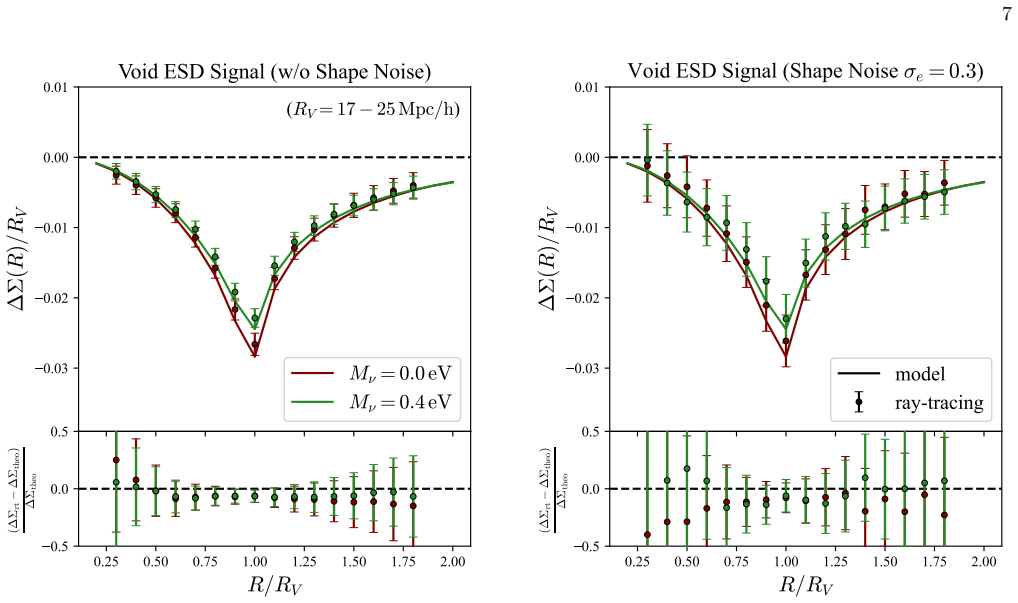
For voids of the same size, massive neutrinos result in a less pronounced lensing signal (Fig
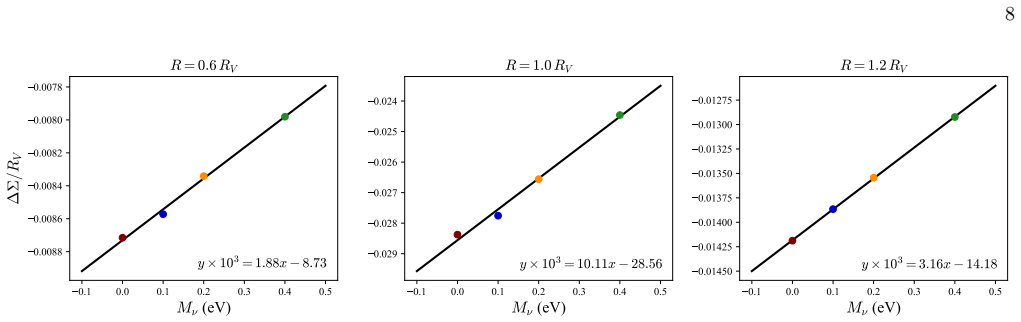
Variations of void density profiles leave observable imprints in the weak lensing signal. For voids of the same size, massive neutrinos result in a less pronounced lensing signal (Fig. 4). In particular, the excess surface density profile, ∆Σ(R), exhibits a clear linear dependence on the neutrino mass withinR <1.4R V (Fig. 6)
-
[5]
These con- straints are comparable to those obtained in other weak lensing studies
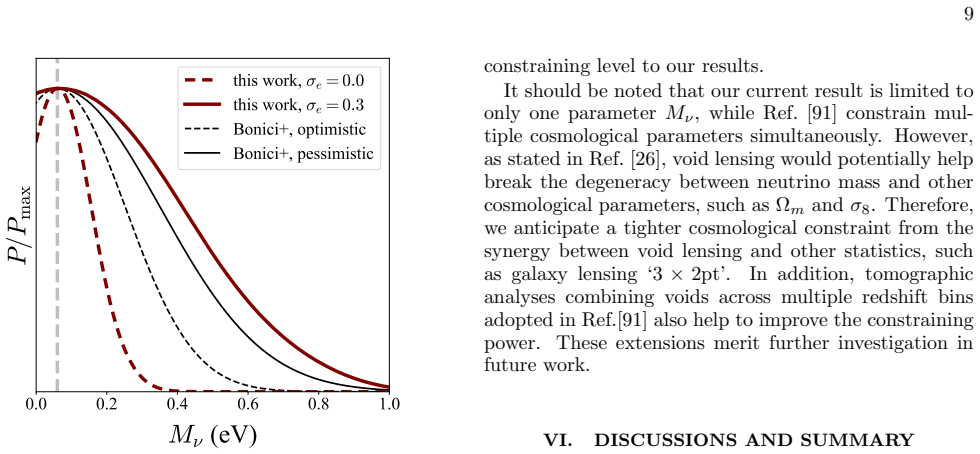
The weak lensing signal of DT voids yields an in- dependent constraint on the total neutrino mass of σ(Mν) = 0.096 eV, in the absence of shape noise, andσ(M ν) = 0.340 eV when including realistic 10 galaxy shape noise withσ e = 0.3. These con- straints are comparable to those obtained in other weak lensing studies
-
[6]
4) and void size bins (Appendix A)
The void density profile provides an effective ap- proach for modelling the void lensing signal, as val- idated across different cosmologies (Fig. 4) and void size bins (Appendix A). This alleviates the need for full ray-tracing simulations and facilitates the de- velopment of emulator-based models for void lens- ing in future work. Looking ahead, there a...
-
[7]
Appendix A: Void Lensing Signal in Different Radius Bins Figs
andgetdist[107]. Appendix A: Void Lensing Signal in Different Radius Bins Figs. 9 and 10 present the measurements of void lens- ing signal ∆Σ(R) in different radius bins, along with the corresponding theoretical models derived from void den- sity profiles, in the simulation withM ν = 0.0 eV. We find great agreements between models and measurements across ...
-
[8]
Planck 2018 results. VI. Cosmological parameters
Planck Collaboration et al., A&A641, A6 (2020), arXiv:1807.06209 [astro-ph.CO]. 12 10 5 10 4 V oid Number Density nV(Mpc/h)−3 Mν = 0.0eV Mν = 0.1eV Mν = 0.2eV Mν = 0.4eV 10.0 12.5 15.0 17.5 20.0 22.5 25.0 27.5 RV (Mpc/h) 2 0 2 (nV, i − nV, 0) × 106 FIG. 11. Void size function measured in simulations with different neutrino masses. The radius bin used here...
work page internal anchor Pith review Pith/arXiv arXiv 2020
-
[9]
M. S. Madhavacheril, F. J. Qu, B. D. Sherwin, N. Mac- Crann, Y. Li, I. Abril-Cabezas, P. A. R. Ade, S. Aiola, T. Alford, M. Amiri,et al., ApJ962, 113 (2024), arXiv:2304.05203 [astro-ph.CO]
work page internal anchor Pith review Pith/arXiv arXiv 2024
- [10]
-
[11]
E. Abdalla, G. F. Abell´ an, A. Aboubrahim, A. Agnello, ¨O. Akarsu, Y. Akrami, G. Alestas, D. Aloni, L. Amen- dola, L. A. Anchordoqui,et al., Journal of High Energy Astrophysics34, 49 (2022), arXiv:2203.06142 [astro- ph.CO]
work page internal anchor Pith review Pith/arXiv arXiv 2022
-
[12]
Extended Dark Energy analysis using DESI DR2 BAO measurements
K. Lodha, R. Calderon, W. L. Matthewson, A. Shafieloo, M. Ishak, J. Pan, C. Garcia-Quintero, D. Huterer, G. Valogiannis, L. A. Ure˜ na-L´ opez,et al., Phys. Rev. D112, 083511 (2025), arXiv:2503.14743 [astro-ph.CO]
work page internal anchor Pith review Pith/arXiv arXiv 2025
- [13]
-
[14]
E. Chaussidon, C. Y` eche, A. de Mattia, C. Pay- erne, P. McDonald, A. J. Ross, S. Ahlen, D. Bianchi, D. Brooks, E. Burtin,et al., J. Cosmology As- tropart. Phys.2025, 029 (2025), arXiv:2411.17623 [astro-ph.CO]
-
[15]
Constraints on Neutrino Physics from DESI DR2 BAO and DR1 Full Shape
W. Elbers, A. Aviles, H. E. Noriega, D. Chebat, A. Menegas, C. S. Frenk, C. Garcia-Quintero, D. Gon- zalez, M. Ishak, O. Lahav,et al., Phys. Rev. D112, 083513 (2025), arXiv:2503.14744 [astro-ph.CO]
work page internal anchor Pith review Pith/arXiv arXiv 2025
- [16]
- [17]
-
[18]
Unveiling $\nu$ secrets with cosmological data: neutrino masses and mass hierarchy
S. Vagnozzi, E. Giusarma, O. Mena, K. Freese, M. Gerbino, S. Ho, and M. Lattanzi, Phys. Rev. D96, 123503 (2017), arXiv:1701.08172 [astro-ph.CO]
work page internal anchor Pith review Pith/arXiv arXiv 2017
- [19]
-
[20]
S. Brieden, H. Gil-Mar´ ın, and L. Verde, J. Cosmology Astropart. Phys.2022, 024 (2022), arXiv:2204.11868 [astro-ph.CO]
-
[21]
DESI Collaboration et al., Phys. Rev. D112, 083515 (2025), arXiv:2503.14738 [astro-ph.CO]
work page internal anchor Pith review Pith/arXiv arXiv 2025
- [22]
- [23]
-
[24]
K. N. Abazajian and M. Kaplinghat, Annual Review of Nuclear and Particle Science66, 401 (2016)
work page 2016
-
[25]
DESI 2024 VII: Cosmological Constraints from the Full-Shape Modeling of Clustering Measurements
DESI Collaboration et al., J. Cosmology Astropart. Phys.2025, 028 (2025), arXiv:2411.12022 [astro- ph.CO]
work page internal anchor Pith review Pith/arXiv arXiv 2025
-
[26]
R. de Belsunce and L. Senatore, J. Cosmology As- tropart. Phys.2019, 038 (2019), arXiv:1804.06849 [astro-ph.CO]
work page internal anchor Pith review Pith/arXiv arXiv 2019
-
[27]
F. Kamalinejad and Z. Slepian, arXiv e-prints , arXiv:2011.00899 (2020), arXiv:2011.00899 [astro- ph.CO]
- [28]
- [29]
- [30]
- [31]
-
[32]
Counting voids and filaments: Betti Curves as a Powerful Probe for Cosmology
J. Li and C. Zhao, arXiv e-prints , arXiv:2512.07236 (2025), arXiv:2512.07236 [astro-ph.CO]
work page internal anchor Pith review Pith/arXiv arXiv 2025
-
[33]
Voids in massive neutrino cosmologies
E. Massara, F. Villaescusa-Navarro, M. Viel, and P. M. Sutter, J. Cosmology Astropart. Phys.2015, 018 (2015), arXiv:1506.03088 [astro-ph.CO]
work page internal anchor Pith review Pith/arXiv arXiv 2015
-
[34]
P. Vielzeuf, M. Calabrese, C. Carbone, G. Fabbian, and C. Baccigalupi, J. Cosmology Astropart. Phys.2023, 010 (2023), arXiv:2303.10048 [astro-ph.CO]
- [35]
- [36]
-
[37]
S. A. Gregory and L. A. Thompson, ApJ222, 784 (1978)
work page 1978
-
[38]
P. M. Sutter, G. Lavaux, B. D. Wandelt, and D. H. Weinberg, ApJ761, 44 (2012), arXiv:1207.2524 [astro- 13 ph.CO]
work page internal anchor Pith review Pith/arXiv arXiv 2012
-
[39]
D. C. Pan, M. S. Vogeley, F. Hoyle, Y.-Y. Choi, and C. Park, MNRAS421, 926 (2012), arXiv:1103.4156 [astro-ph.CO]
work page internal anchor Pith review Pith/arXiv arXiv 2012
-
[40]
N. I. Libeskind, R. van de Weygaert, M. Cautun, B. Falck, E. Tempel, T. Abel, M. Alpaslan, M. A. Arag´ on-Calvo, J. E. Forero-Romero, R. Gonzalez,et al., MNRAS473, 1195 (2018), arXiv:1705.03021 [astro- ph.CO]
work page internal anchor Pith review Pith/arXiv arXiv 2018
- [41]
-
[42]
Universal Density Profile for Cosmic Voids
N. Hamaus, P. M. Sutter, and B. D. Wandelt, Phys. Rev. Lett.112, 251302 (2014), arXiv:1403.5499 [astro-ph.CO]
work page internal anchor Pith review Pith/arXiv arXiv 2014
-
[43]
Baryon effects on void statistics in the EAGLE simulation
E. Paillas, C. D. P. Lagos, N. Padilla, P. Tissera, J. Helly, and M. Schaller, MNRAS470, 4434 (2017), arXiv:1609.00101 [astro-ph.CO]
work page internal anchor Pith review Pith/arXiv arXiv 2017
-
[44]
Counting voids to probe dark energy
A. Pisani, P. M. Sutter, N. Hamaus, E. Alizadeh, R. Biswas, B. D. Wandelt, and C. M. Hirata, Phys. Rev. D92, 083531 (2015), arXiv:1503.07690 [astro-ph.CO]
work page internal anchor Pith review Pith/arXiv arXiv 2015
- [45]
- [46]
- [47]
-
[48]
The Void Abundance with Non-Gaussian Primordial Perturbations
M. Kamionkowski, L. Verde, and R. Jimenez, J. Cosmol- ogy Astropart. Phys.2009, 010 (2009), arXiv:0809.0506 [astro-ph]
work page internal anchor Pith review Pith/arXiv arXiv 2009
-
[49]
C. D. Kreisch, A. Pisani, C. Carbone, J. Liu, A. J. Hawken, E. Massara, D. N. Spergel, and B. D. Wandelt, MNRAS488, 4413 (2019), arXiv:1808.07464 [astro- ph.CO]
work page internal anchor Pith review Pith/arXiv arXiv 2019
-
[50]
N. Schuster, N. Hamaus, A. Pisani, C. Carbone, C. D. Kreisch, G. Pollina, and J. Weller, J. Cosmology Astropart. Phys.2019, 055 (2019), arXiv:1905.00436 [astro-ph.CO]
-
[51]
Density and velocity profiles around cosmic voids
E. Massara and R. K. Sheth, arXiv e-prints , arXiv:1811.03132 (2018), arXiv:1811.03132 [astro- ph.CO]
work page internal anchor Pith review Pith/arXiv arXiv 2018
-
[52]
Universal void density profiles from simulation and SDSS
S. Nadathur, S. Hotchkiss, J. M. Diego, I. T. Iliev, S. Gottl¨ ober, W. A. Watson, and G. Yepes, inThe Zel- dovich Universe: Genesis and Growth of the Cosmic Web, IAU Symposium, Vol. 308, edited by R. van de Weygaert, S. Shandarin, E. Saar, and J. Einasto (2016) pp. 542–545, arXiv:1412.8372 [astro-ph.CO]
work page internal anchor Pith review Pith/arXiv arXiv 2016
- [53]
- [54]
-
[55]
arXiv , author =:2007.15632 , journal =
C. Heymans, T. Tr¨ oster, M. Asgari, C. Blake, H. Hilde- brandt, B. Joachimi, K. Kuijken, C.-A. Lin, A. G. S´ anchez, J. L. van den Busch,et al., A&A646, A140 (2021), arXiv:2007.15632 [astro-ph.CO]
-
[56]
DES Collaboration et al., Phys. Rev. D105, 023520 (2022), arXiv:2105.13549 [astro-ph.CO]
work page internal anchor Pith review Pith/arXiv arXiv 2022
-
[57]
DESI-DR1 $3 \times 2$-pt analysis: consistent cosmology across weak lensing surveys
A. Porredon, C. Blake, J. U. Lange, N. Emas, J. Aguilar, S. Ahlen, A. Bera, D. Bianchi, D. Brooks, F. J. Cas- tander,et al., arXiv e-prints , arXiv:2512.15960 (2025), arXiv:2512.15960 [astro-ph.CO]
work page internal anchor Pith review Pith/arXiv arXiv 2025
-
[58]
Cosmic Voids and Void Lensing in the Dark Energy Survey Science Verification Data
C. S´ anchez, J. Clampitt, A. Kovacs, B. Jain, J. Garc´ ıa-Bellido, S. Nadathur, D. Gruen, N. Hamaus, D. Huterer, P. Vielzeuf,et al., MNRAS465, 746 (2017), arXiv:1605.03982 [astro-ph.CO]
work page internal anchor Pith review Pith/arXiv arXiv 2017
- [59]
- [60]
-
[61]
Weak lensing by voids in modified lensing potentials
A. Barreira, M. Cautun, B. Li, C. M. Baugh, and S. Pas- coli, J. Cosmology Astropart. Phys.2015, 028 (2015), arXiv:1505.05809 [astro-ph.CO]
work page internal anchor Pith review Pith/arXiv arXiv 2015
- [62]
-
[63]
L. Maggiore, S. Contarini, C. Giocoli, and L. Moscar- dini, A&A701, A55 (2025), arXiv:2504.02041 [astro- ph.CO]
-
[64]
A Cosmic Watershed: the WVF Void Detection Technique
E. Platen, R. van de Weygaert, and B. J. T. Jones, MNRAS380, 551 (2007), arXiv:0706.2788 [astro-ph]
work page internal anchor Pith review Pith/arXiv arXiv 2007
-
[65]
M. C. Neyrinck, MNRAS386, 2101 (2008), arXiv:0712.3049 [astro-ph]
work page internal anchor Pith review Pith/arXiv arXiv 2008
-
[66]
R. Boschetti, P. Vielzeuf, M.-C. Cousinou, S. Escoffier, and E. Jullo, J. Cosmology Astropart. Phys.2024, 067 (2024), arXiv:2311.14586 [astro-ph.CO]
-
[67]
N. D. Padilla, L. Ceccarelli, and D. G. Lambas, MNRAS 363, 977 (2005), arXiv:astro-ph/0508297 [astro-ph]
work page internal anchor Pith review Pith/arXiv arXiv 2005
-
[68]
C. T. Davies, M. Cautun, and B. Li, MNRAS480, L101 (2018), arXiv:1803.08717 [astro-ph.CO]
work page internal anchor Pith review Pith/arXiv arXiv 2018
-
[69]
The Santiago-Harvard-Edinburgh-Durham void comparison I: SHEDding light on chameleon gravity tests
M. Cautun, E. Paillas, Y.-C. Cai, S. Bose, J. Armijo, B. Li, and N. Padilla, MNRAS476, 3195 (2018), arXiv:1710.01730 [astro-ph.CO]
work page internal anchor Pith review Pith/arXiv arXiv 2018
-
[70]
E. Paillas, M. Cautun, B. Li, Y.-C. Cai, N. Padilla, J. Armijo, and S. Bose, MNRAS484, 1149 (2019), arXiv:1810.02864 [astro-ph.CO]
work page internal anchor Pith review Pith/arXiv arXiv 2019
-
[71]
C. Zhao, C. Tao, Y. Liang, F.-S. Kitaura, and C.-H. Chuang, MNRAS459, 2670 (2016), arXiv:1511.04299 [astro-ph.CO]
work page internal anchor Pith review Pith/arXiv arXiv 2016
-
[72]
F.-S. Kitaura, C.-H. Chuang, Y. Liang, C. Zhao, C. Tao, S. Rodr´ ıguez-Torres, D. J. Eisenstein, H. Gil-Mar´ ın, J.- P. Kneib, C. McBride,et al., Phys. Rev. Lett.116, 171301 (2016), arXiv:1511.04405 [astro-ph.CO]
work page internal anchor Pith review Pith/arXiv arXiv 2016
-
[73]
M. Bartelmann and M. Maturi, Scholarpedia12, 32440 (2017), arXiv:1612.06535 [astro-ph.CO]
work page internal anchor Pith review Pith/arXiv arXiv 2017
-
[74]
M. Shirasaki and M. Takada, MNRAS478, 4277 (2018), arXiv:1802.09696 [astro-ph.CO]
work page internal anchor Pith review Pith/arXiv arXiv 2018
-
[75]
E. S. Sheldon, D. E. Johnston, J. A. Frieman, R. Scran- ton, T. A. McKay, A. J. Connolly, T. Budav´ ari, I. Ze- havi, N. A. Bahcall, J. Brinkmann,et al., AJ127, 2544 (2004), arXiv:astro-ph/0312036 [astro-ph]
work page internal anchor Pith review Pith/arXiv arXiv 2004
-
[76]
Systematic errors in weak lensing: application to SDSS galaxy-galaxy weak lensing
R. Mandelbaum, C. M. Hirata, U. Seljak, J. Guzik, N. Padmanabhan, C. Blake, M. R. Blanton, R. Lup- ton, and J. Brinkmann, MNRAS361, 1287 (2005), arXiv:astro-ph/0501201 [astro-ph]
work page internal anchor Pith review Pith/arXiv arXiv 2005
- [77]
-
[78]
CUBE: An Information-optimized parallel Cosmological $N$-body Algorithm
H.-R. Yu, U.-L. Pen, and X. Wang, ApJS237, 24 (2018), arXiv:1712.06121 [astro-ph.CO]
work page internal anchor Pith review Pith/arXiv arXiv 2018
-
[79]
D. Inman and H.-R. Yu, ApJS250, 21 (2020), arXiv:2002.04601 [astro-ph.CO]
-
[80]
Efficient Computation of CMB anisotropies in closed FRW models
A. Lewis, A. Challinor, and A. Lasenby, ApJ538, 473 (2000), arXiv:astro-ph/9911177 [astro-ph]
work page internal anchor Pith review Pith/arXiv arXiv 2000
discussion (0)
Sign in with ORCID, Apple, or X to comment. Anyone can read and Pith papers without signing in.