Recognition: 2 theorem links
· Lean TheoremCounting voids and filaments: Betti Curves as a Powerful Probe for Cosmology
Pith reviewed 2026-05-17 01:10 UTC · model grok-4.3
The pith
Betti curves from galaxy distributions tighten cosmological constraints when combined with the power spectrum.
A machine-rendered reading of the paper's core claim, the machinery that carries it, and where it could break.
Core claim
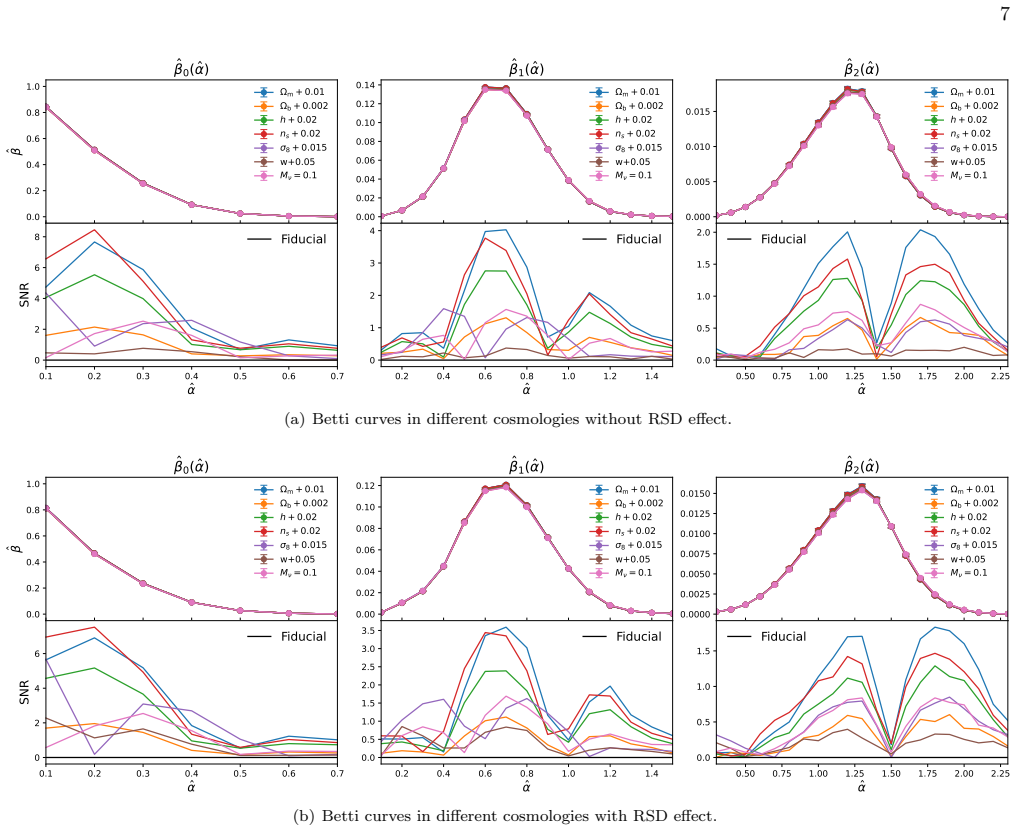
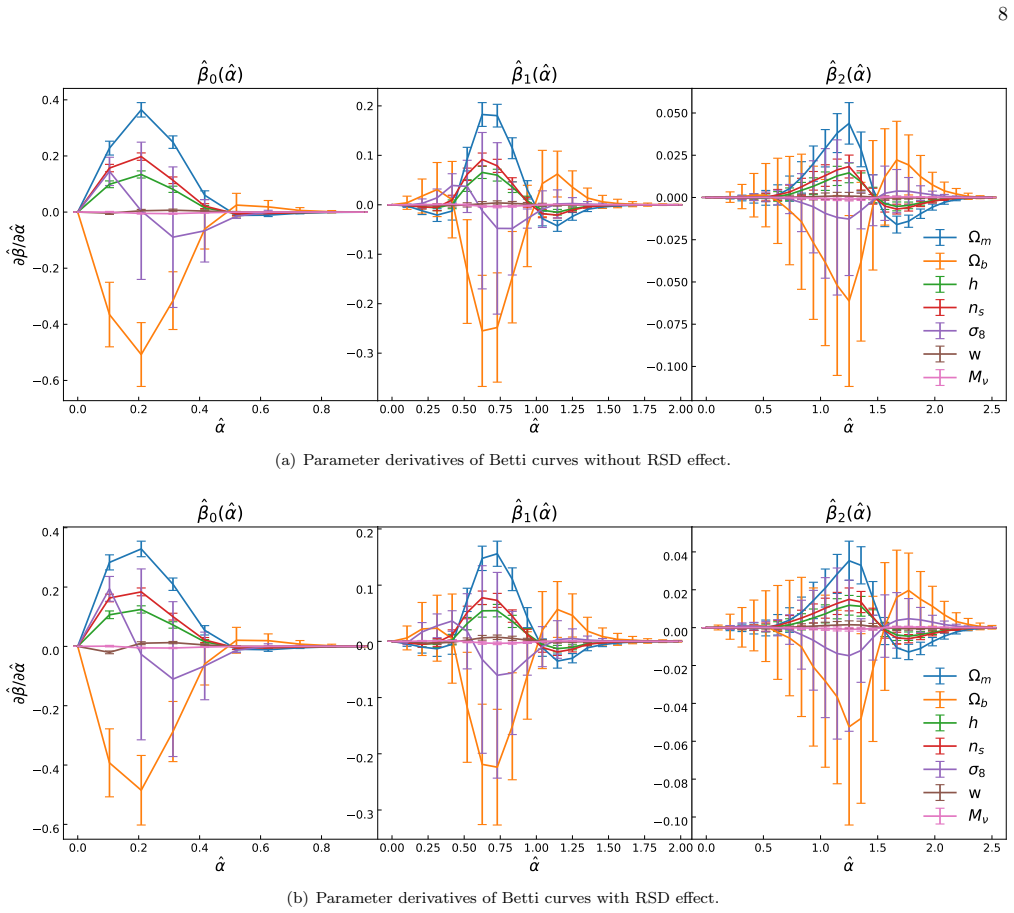
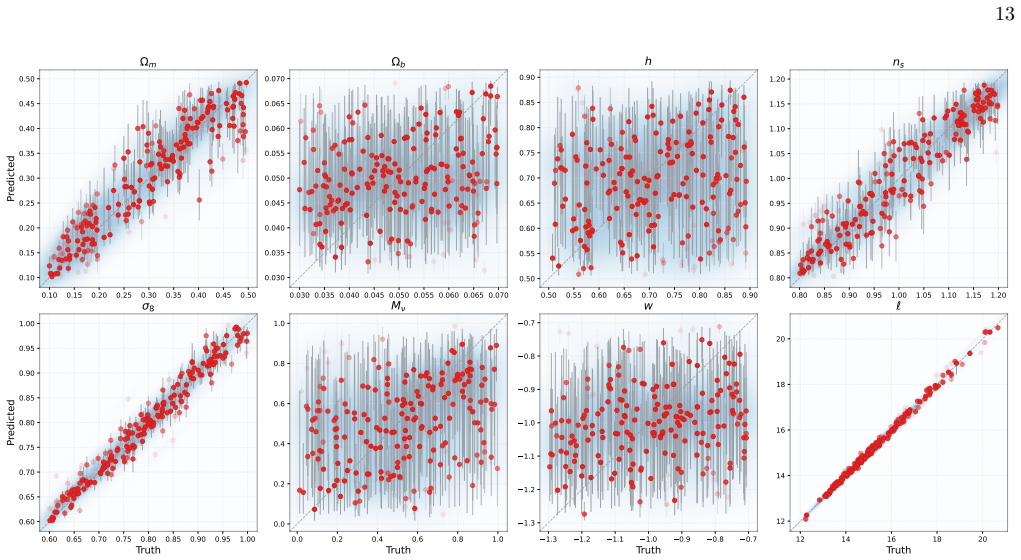
Betti curves derived from persistent homology quantify the birth and death of topological features such as voids and loops across scales in the galaxy distribution. Analysis of Quijote halo catalogs shows these curves respond to cosmological parameters. Machine-learning emulators enable Bayesian inference that recovers unbiased estimates of ns, sigma8, and Omega_m. Redshift-space distortions increase sensitivity to growth parameters. When Betti curves are analyzed jointly with the power spectrum, the resulting constraints on ns, sigma8, and w are significantly tighter than those obtained from the power spectrum alone.
What carries the argument
Betti curves from persistent homology, which count the appearance and disappearance of topological features like connected components, loops, and voids at multiple scales in the large-scale structure.
If this is right
- Joint analysis with the power spectrum produces significantly tighter constraints on ns, sigma8, and w than the power spectrum alone.
- Betti curves alone allow recovery of unbiased estimates for ns, sigma8, and Omega_m through Bayesian inference.
- Validation on sub-box simulations confirms the results remain robust against cosmic variance.
- Incorporating redshift-space distortions enhances sensitivity to parameters that govern structure growth.
- The method offers an interpretable complement to two-point statistics for future galaxy survey data.
Where Pith is reading between the lines
- The topological information could serve as an independent cross-check on parameters in cases where standard statistics show tensions between early- and late-universe measurements.
- Extending the emulator framework to real observational catalogs from surveys would directly test whether the simulated performance translates to actual data.
- Combining Betti curves with other higher-order statistics might yield even stronger limits on dark energy and modified gravity scenarios.
- Tracking how Betti curves evolve with redshift could reveal new details about the growth history of cosmic web structures.
Load-bearing premise
Machine-learning emulators trained on simulated halo catalogs fully capture the dependence of Betti curves on cosmological parameters and redshift-space distortions without introducing bias or omitting effects present in real survey data.
What would settle it
Applying the same inference pipeline to actual galaxy survey catalogs and finding cosmological parameters that differ significantly from independent measurements such as those from the cosmic microwave background would falsify the claim of unbiased and improved constraints.
Figures






read the original abstract
Topological analysis of galaxy distributions has gathered increasing attention in cosmology, as they are able to capture non-Gaussian features of large-scale structures (LSS) that are overlooked by conventional two-point clustering statistics. We utilize Betti curves, a summary statistic derived from persistent homology, to characterize the multiscale topological features of the LSS, including connected components, loops, and voids, as a complementary cosmological probe. Using halo catalogs from the \textsc{Quijote} suite, we construct Betti curves, assess their sensitivity to cosmological parameters, and train automated machine learning based emulators to model their dependence on cosmological parameters. Our Bayesian inference recovers unbiased estimation of cosmological parameters, notably $n_{\mathrm{s}}$, $\sigma_8$, and $\Omega_{\mathrm{m}}$, while validation on sub-box simulations confirms robustness against cosmic variance. We further investigate the impact of redshift-space distortions (RSD) on Betti curves and demonstrate that including RSD enhances sensitivity to growth-related parameters. By jointly analyzing Betti curves and the power spectrum, we achieve significantly tightened constraints than using power spectrum alone on parameters such as $n_{\mathrm{s}}$, $\sigma_8$, and $w$. These findings highlight Betti curves -- especially when combined with traditional two-point statistics -- as a promising, interpretable tool for future galaxy survey analyses.
Editorial analysis
A structured set of objections, weighed in public.
Referee Report
Summary. The paper proposes Betti curves derived from persistent homology of halo distributions as a topological probe that captures non-Gaussian features of large-scale structure. Using the Quijote simulation suite, the authors construct Betti curves, train machine-learning emulators to model their cosmological dependence, perform Bayesian inference that recovers unbiased constraints on parameters including ns, σ8 and Ωm, examine the effects of redshift-space distortions, and report that the joint analysis of Betti curves with the power spectrum yields significantly tighter constraints on ns, σ8 and w than the power spectrum alone. Sub-box validation is used to assess robustness against cosmic variance.
Significance. If the emulators prove accurate and the joint constraints are free of systematic bias, the work would establish Betti curves as a practical, interpretable complement to two-point statistics, potentially improving parameter constraints from future galaxy surveys. The use of an external simulation suite and standard Bayesian methods is a strength, as is the explicit sub-box validation for cosmic variance; however, the significance of the tightening claim rests on unshown quantitative checks of emulator fidelity under RSD.
major comments (2)
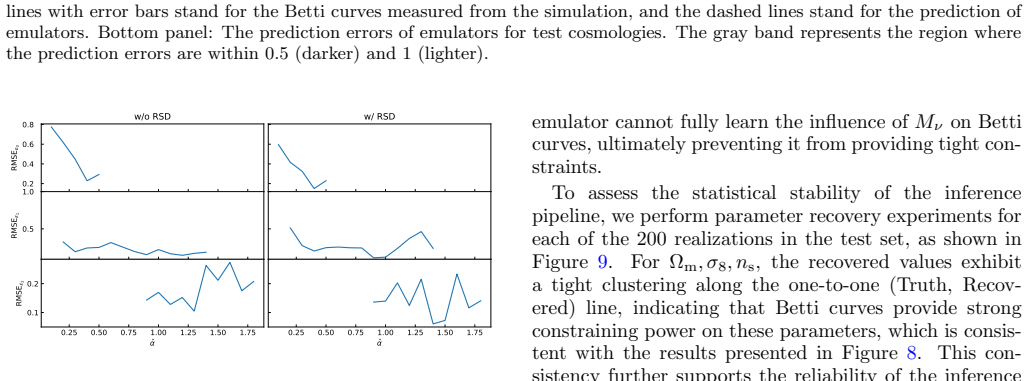
- [Emulator training and validation sections] The central claim of significantly tightened joint constraints on ns, σ8 and w requires that the ML emulators accurately reproduce the full cosmological and RSD dependence of Betti curves without introducing bias that would be absorbed into the joint posterior. The manuscript provides no quantitative emulator validation metrics (e.g., residual distributions, parameter bias from held-out simulations, or comparison of emulator-induced covariance to statistical errors) across the full parameter volume, which is load-bearing for the reported improvement over the power spectrum alone.
- [RSD impact and joint-analysis results] The abstract states that including RSD enhances sensitivity to growth parameters and that the joint analysis tightens constraints, yet no demonstration is given that emulator residuals remain sub-dominant to statistical errors or that the joint covariance matrix is correctly estimated when Betti curves and the power spectrum are combined. Any unmodeled RSD systematic in the emulator would directly affect the claimed tightening.
minor comments (3)
- Clarify the precise definition and normalization of the Betti curves (e.g., which homology dimensions are retained and how the curves are binned or smoothed) so that readers can reproduce the topological summary statistic.
- Specify the machine-learning architecture, training hyperparameters, and any regularization used for the emulators; also report the training/validation split sizes and any cross-validation procedure.
- Add a brief discussion of how the Betti-curve computation choices (e.g., persistence threshold or filtration parameter) propagate into the final cosmological posteriors.
Simulated Author's Rebuttal
We thank the referee for their careful reading of the manuscript and for the constructive comments, which help clarify the presentation of our results on Betti curves as a cosmological probe. We address each major comment below and outline the revisions we will implement to strengthen the manuscript.
read point-by-point responses
-
Referee: [Emulator training and validation sections] The central claim of significantly tightened joint constraints on ns, σ8 and w requires that the ML emulators accurately reproduce the full cosmological and RSD dependence of Betti curves without introducing bias that would be absorbed into the joint posterior. The manuscript provides no quantitative emulator validation metrics (e.g., residual distributions, parameter bias from held-out simulations, or comparison of emulator-induced covariance to statistical errors) across the full parameter volume, which is load-bearing for the reported improvement over the power spectrum alone.
Authors: We appreciate the referee's emphasis on rigorous quantitative validation of the emulators. The manuscript demonstrates unbiased cosmological parameter recovery via Bayesian inference and includes sub-box tests for cosmic variance, which indirectly support emulator fidelity. However, we agree that explicit metrics such as residual distributions, bias assessments on held-out simulations, and comparisons of emulator covariance to statistical errors across the full parameter space were not presented in sufficient detail. In the revised manuscript, we will add these quantitative checks, including residual plots and validation results, to directly substantiate the joint constraint improvements. revision: yes
-
Referee: [RSD impact and joint-analysis results] The abstract states that including RSD enhances sensitivity to growth parameters and that the joint analysis tightens constraints, yet no demonstration is given that emulator residuals remain sub-dominant to statistical errors or that the joint covariance matrix is correctly estimated when Betti curves and the power spectrum are combined. Any unmodeled RSD systematic in the emulator would directly affect the claimed tightening.
Authors: We acknowledge that the manuscript would benefit from explicit demonstrations that emulator residuals under RSD remain sub-dominant and that the joint covariance is properly estimated. The current analysis shows enhanced sensitivity to growth parameters with RSD included and reports tighter joint constraints, supported by the overall unbiased inference. In the revision, we will add targeted validation of emulator residuals for RSD cases, confirm they are sub-dominant to statistical errors, and detail the construction and validation of the joint covariance matrix between Betti curves and the power spectrum. These additions will reinforce the robustness of the reported tightening. revision: yes
Circularity Check
No circularity: standard emulator-based inference on external simulations
full rationale
The paper constructs Betti curves from the external Quijote halo catalogs, trains ML emulators to capture their cosmological and RSD dependence, performs Bayesian inference that recovers unbiased parameter estimates, and validates on sub-box splits for cosmic variance. The joint analysis with the power spectrum uses complementary statistics from the same simulation suite. No equation reduces the reported tightening of constraints on ns, σ8 or w to a fitted parameter by construction, nor does any self-citation or ansatz serve as the load-bearing justification. This is self-contained against external benchmarks and follows conventional simulation-calibrated inference practices.
Axiom & Free-Parameter Ledger
free parameters (1)
- emulator hyperparameters
axioms (2)
- domain assumption Standard flat wCDM cosmology with the usual six parameters plus w
- domain assumption Halo catalogs faithfully trace the underlying dark-matter topology at the scales probed
Lean theorems connected to this paper
-
IndisputableMonolith/Foundation/AlexanderDuality.leanalexander_duality_circle_linking echoes?
echoesECHOES: this paper passage has the same mathematical shape or conceptual pattern as the Recognition theorem, but is not a direct formal dependency.
We utilize Betti curves, a summary statistic derived from persistent homology, to characterize the multiscale topological features of the LSS, including connected components, loops, and voids
What do these tags mean?
- matches
- The paper's claim is directly supported by a theorem in the formal canon.
- supports
- The theorem supports part of the paper's argument, but the paper may add assumptions or extra steps.
- extends
- The paper goes beyond the formal theorem; the theorem is a base layer rather than the whole result.
- uses
- The paper appears to rely on the theorem as machinery.
- contradicts
- The paper's claim conflicts with a theorem or certificate in the canon.
- unclear
- Pith found a possible connection, but the passage is too broad, indirect, or ambiguous to say the theorem truly supports the claim.
Reference graph
Works this paper leans on
-
[1]
Constraints from Betti curves In the absence of RSD effects, the posterior distribu- tions of cosmological parameters constrained by ˆβ0, ˆβ1, ˆβ2, and their combination under the fiducial cosmology are shown in Figure 8. The results indicate that Betti curves provide the strongest constraints onσ 8, ns,Ω m, followed byh,Ω b, while their constraining powe...
-
[2]
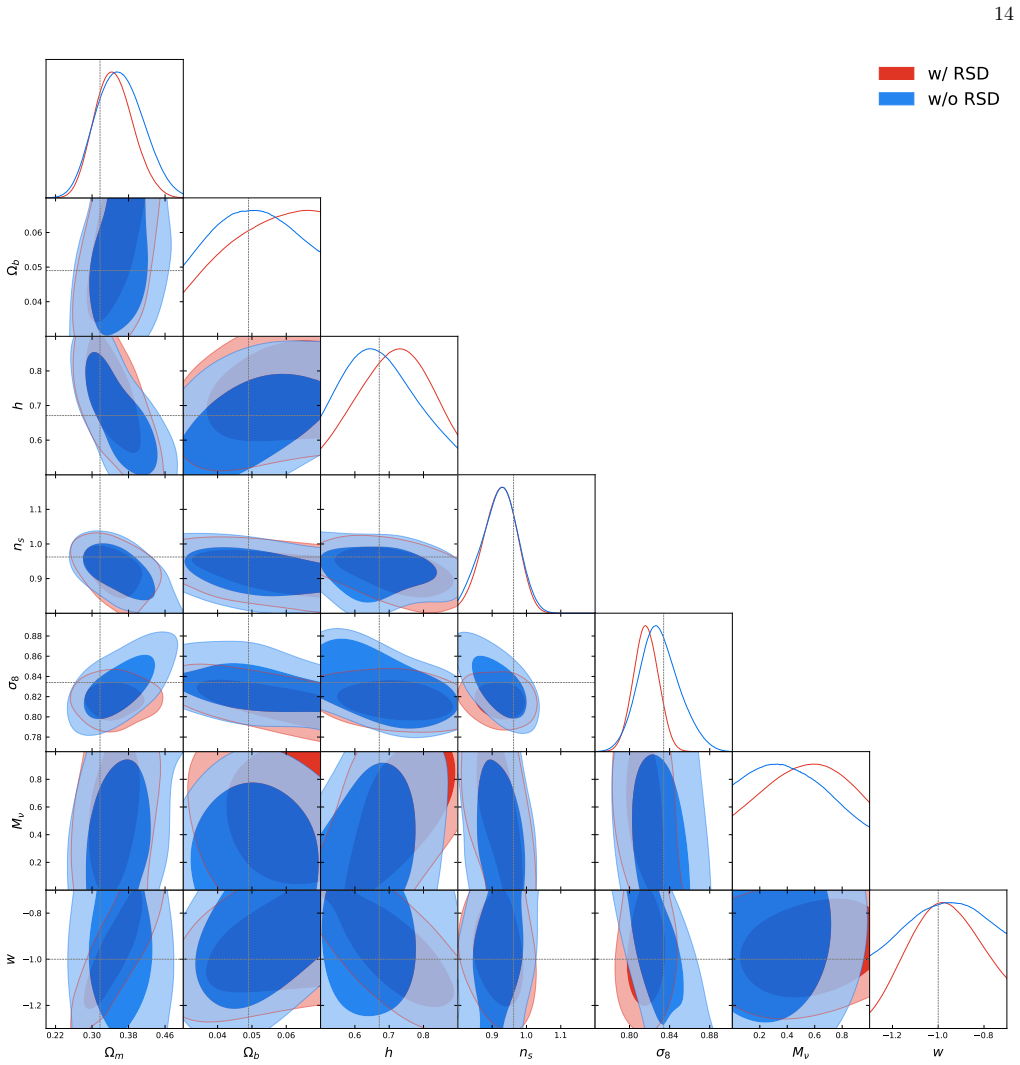
The effect of RSD to constraints from Betti curves Figure 10 presents the joint cosmological parameter constraints from Betti curves under fiducial cosmology, with and without RSD. Except forM ν, which Betti 12 0.2 0.3 0.4 m 1.2 1.0 0.8 w 0.2 0.4 0.6 0.8 M 0.7 0.8 0.9 8 0.9 1.0 1.1 ns 0.6 0.7 0.8 h 0.04 0.05 0.06 b 0.04 0.05 0.06 b 0.6 0.7 0.8 h 0.9 1.0 1...
-
[3]
Joint analysis of Betti curves and power spectrum Not considering RSD, the joint cosmological parame- ter constraints from Betti curves and the monopole of the power spectrum (P0(k)) under the fiducial cosmology are shown in Figure 12. Compared with the power spectrum alone, Betti curves significantly improve the constraints onn s andσ 8, reducing their u...
- [4]
-
[5]
P. J. E. Peebles,The large-scale structure of the universe (Princeton University Press, 1980)
work page 1980
-
[6]
M. Colless, B. A. Peterson, C. Jackson, J. A. Peacock, S. Cole, P. Norberg, I. K. Baldry, C. M. Baugh, J. Bland- Hawthorn, T. Bridges,et al., arXiv e-prints , astro- ph/0306581 (2003), arXiv:astro-ph/0306581 [astro-ph]
- [7]
-
[8]
K. S. Dawson, D. J. Schlegel, C. P. Ahn, S. F. Anderson, ´E. Aubourg, S. Bailey, R. H. Barkhouser, J. E. Bautista, A. Beifiori, A. A. Berlind,et al., AJ145, 10 (2013), arXiv:1208.0022 [astro-ph.CO]
work page internal anchor Pith review Pith/arXiv arXiv 2013
-
[9]
S. Alam, M. Aubert, S. Avila, C. Balland, J. E. Bautista, M. A. Bershady, D. Bizyaev, M. R. Blanton, A. S. Bolton, J. Bovy,et al., Phys. Rev. D103, 083533 (2021), arXiv:2007.08991 [astro-ph.CO]
work page internal anchor Pith review Pith/arXiv arXiv 2021
- [10]
-
[11]
J. R. Bond, L. Kofman, and D. Pogosyan, Nature380, 603 (1996), arXiv:astro-ph/9512141 [astro-ph]
work page internal anchor Pith review Pith/arXiv arXiv 1996
- [12]
-
[13]
DESI 2024 VI: Cosmological Constraints from the Measurements of Baryon Acoustic Oscillations
D. Collaboration, A. G. Adame, J. Aguilar, S. Ahlen, S. Alam, D. M. Alexander, M. Alvarez, O. Alves, A. Anand, U. Andrade,et al., Desi 2024 vi: Cosmologi- cal constraints from the measurements of baryon acoustic oscillations (2024), arXiv:2404.03002 [astro-ph.CO]
work page internal anchor Pith review Pith/arXiv arXiv 2024
-
[14]
DESI DR2 Results II: Measurements of Baryon Acoustic Oscillations and Cosmological Constraints
D. Collaboration, M. Abdul-Karim, J. Aguilar, S. Ahlen, S. Alam, L. Allen, C. A. Prieto, O. Alves, A. Anand, U. Andrade,et al., Desi dr2 results ii: Measurements of baryon acoustic oscillations and cosmological constraints (2025), arXiv:2503.14738 [astro-ph.CO]
work page internal anchor Pith review Pith/arXiv arXiv 2025
-
[15]
C. Zhao, S. Huang, M. He, P. Montero-Camacho, Y. Liu, P. Renard, Y. Tang, A. Verdier, W. Xu, X. Yang,et al., Multiplexed survey telescope: Perspectives for large-scale structure cosmology in the era of stage-v spectroscopic survey (2024), arXiv:2411.07970 [astro-ph.CO]
work page internal anchor Pith review Pith/arXiv arXiv 2024
-
[16]
R. Besuner, A. Dey, A. Drlica-Wagner, H. Ebina, G. F. Moroni, S. Ferraro, J. Forero-Romero, K. Honscheid, P. Jelinsky, D. Lang,et al., The spectroscopic stage-5 experiment (2025), arXiv:2503.07923 [astro-ph.CO]
-
[17]
V. Mainieri, R. I. Anderson, J. Brinchmann, A. Cimatti, R. S. Ellis, V. Hill, J.-P. Kneib, A. F. McLeod, C. Opitom, M. M. Roth,et al., The wide-field spec- troscopic telescope (wst) science white paper (2024), arXiv:2403.05398 [astro-ph.IM]
-
[18]
D. J. Eisenstein, I. Zehavi, D. W. Hogg, R. Scocci- marro, M. R. Blanton, R. C. Nichol, R. Scranton, H. Seo, M. Tegmark, Z. Zheng,et al., The Astrophysical Journal 633, 560–574 (2005)
work page 2005
- [20]
-
[21]
M. M. Ivanov, M. Simonovi´ c, and M. Zaldarriaga, Jour- nal of Cosmology and Astroparticle Physics2020(05), 042–042
-
[22]
C. To, E. Krause, E. Rozo, H. Wu, D. Gruen, R. H. Wechsler, T. F. Eifler, E. S. Rykoff, M. Costanzi, M. R. Becker,et al.(DES Collaboration), Phys. Rev. Lett.126, 141301 (2021)
work page 2021
-
[23]
DESI 2024 V: Full-Shape Galaxy Clustering from Galaxies and Quasars
D. Collaboration, A. G. Adame, J. Aguilar, S. Ahlen, S. Alam, D. M. Alexander, M. Alvarez, O. Alves, A. Anand, U. Andrade,et al., Desi 2024 v: Full- shape galaxy clustering from galaxies and quasars (2025), arXiv:2411.12021 [astro-ph.CO]
work page internal anchor Pith review arXiv 2024
-
[24]
A. A. Penzias and R. W. Wilson, ApJ142, 419 (1965)
work page 1965
-
[25]
N. Aghanim, Y. Akrami, M. Ashdown, J. Aumont, C. Baccigalupi, M. Ballardini, A. J. Banday, R. B. Bar- reiro, N. Bartolo, S. Basak,et al., A&A641, A6 (2020)
work page 2020
- [26]
-
[27]
A. E. Bayer, J. Liu, R. Terasawa, A. Barreira, Y. Zhong, and Y. Feng, Physical Review D108, 10.1103/phys- revd.108.043521 (2023)
-
[28]
H. Ebina and M. White, Journal of Cosmology and As- troparticle Physics2025(01), 150
-
[29]
Scoccimarro, The Astrophysical Journal544, 597–615 (2000)
R. Scoccimarro, The Astrophysical Journal544, 597–615 (2000)
work page 2000
-
[30]
M. Takada and B. Jain, Monthly Notices of the Royal Astronomical Society348, 897–915 (2004)
work page 2004
-
[31]
M. M. Ivanov, O. H. Philcox, G. Cabass, T. Nishimichi, M. Simonovi´ c, and M. Zaldarriaga, Physical Review D 107, 10.1103/physrevd.107.083515 (2023)
- [32]
-
[33]
A. Banerjee and T. Abel, Monthly Notices of the Royal Astronomical Society500, 5479–5499 (2020)
work page 2020
-
[34]
C. Uhlemann, O. Friedrich, F. Villaescusa-Navarro, A. Banerjee, and S. Codis, Monthly Notices of the Royal Astronomical Society495, 4006–4027 (2020)
work page 2020
-
[35]
K. R. Mecke, T. Buchert, and H. Wagner, A&A288, 697 (1994), arXiv:astro-ph/9312028 [astro-ph]
work page internal anchor Pith review Pith/arXiv arXiv 1994
-
[36]
The Three--Point Correlation Function of the Cosmic Microwave Background in Inflationary Models
A. Gangui, F. Lucchin, S. Matarrese, and S. Mollerach, ApJ430, 447 (1994), arXiv:astro-ph/9312033 [astro-ph]
work page internal anchor Pith review Pith/arXiv arXiv 1994
- [37]
- [38]
-
[39]
A. Peel, V. Pettorino, C. Giocoli, J.-L. Starck, and M. Baldi, A&A619, A38 (2018)
work page 2018
-
[40]
E. L. D. Perico, R. Voivodic, M. Lima, and D. F. Mota, A&A632, A52 (2019)
work page 2019
-
[41]
A. E. Bayer, F. Villaescusa-Navarro, E. Massara, J. Liu, D. N. Spergel, L. Verde, B. D. Wandelt, M. Viel, and S. Ho, The Astrophysical Journal919, 24 (2021)
work page 2021
-
[42]
A. Dvornik, C. Heymans, M. Asgari, C. Mahony, B. Joachimi, M. Bilicki, E. Chisari, H. Hildebrandt, H. Hoekstra, H. Johnston,et al., A&A675, A189 (2023)
work page 2023
- [43]
-
[44]
H. Edelsbrunner, D. Letscher, and A. Zomorodian, in Proceedings 41st Annual Symposium on Foundations of Computer Science(2000) pp. 454–463
work page 2000
-
[45]
L. Wasserman, arXiv e-prints , arXiv:1609.08227 (2016), arXiv:1609.08227 [stat.ME]
work page internal anchor Pith review Pith/arXiv arXiv 2016
-
[46]
F. Chazal and B. Michel, An introduction to topological data analysis: fundamental and practical aspects for data scientists (2021), arXiv:1710.04019 [math.ST]
-
[47]
C. Li, M. Ovsjanikov, and F. Chazal, in2014 IEEE Conference on Computer Vision and Pattern Recognition (2014) pp. 2003–2010
work page 2014
-
[48]
P. Bendich, H. Edelsbrunner, and M. Kerber, IEEE Transactions on Visualization and Computer Graphics 16, 1251 (2010)
work page 2010
- [49]
-
[50]
R. Rabad´ an, Y. Mohamedi, U. Rubin, T. R. Chu, A. N. Alghalith, O. Elliott, L. Arnes, S. Cal, A. J. Obaya, A. J. Levine,et al., Nature Communications11(2020)
work page 2020
-
[51]
Hierarchical structures of amorphous solids characterized by persistent homology
Y. Hiraoka, T. Nakamura, A. Hirata, E. G. Escolar, K. Matsue, and Y. Nishiura, Proceedings of the National Academy of Science113, 7035 (2016), arXiv:1501.03611 [cond-mat.soft]
work page internal anchor Pith review Pith/arXiv arXiv 2016
-
[52]
Persistent Homology and Many-Body Atomic Structure for Medium-Range Order in the Glass
T. Nakamura, Y. Hiraoka, A. Hirata, E. G. Escolar, and Y. Nishiura, Nanotechnology26, 304001 (2015), arXiv:1502.07445 [cond-mat.soft]
work page internal anchor Pith review Pith/arXiv arXiv 2015
-
[53]
Simplicial complexes and complex systems
V. Salnikov, D. Cassese, and R. Lambiotte, European Journal of Physics40, 014001 (2019), arXiv:1807.07747 [physics.data-an]
work page internal anchor Pith review Pith/arXiv arXiv 2019
-
[54]
Persistent topological features of dynamical systems
S. Maleti´ c, Y. Zhao, and M. Rajkovi´ c, Chaos26, 053105 (2016), arXiv:1510.06933 [nlin.CD]
work page internal anchor Pith review Pith/arXiv arXiv 2016
- [55]
-
[56]
Probing Dark Energy with Alpha Shapes and Betti Numbers
R. van de Weygaert, P. Pranav, B. J. T. Jones, E. G. P. Bos, G. Vegter, H. Edelsbrunner, M. Teillaud, W. A. Hellwing, C. Park, J. Hidding,et al., arXiv e-prints , arXiv:1110.5528 (2011), arXiv:1110.5528 [astro-ph.CO]
work page internal anchor Pith review Pith/arXiv arXiv 2011
-
[57]
S. Heydenreich, B. Br¨ uck, P. Burger, J. Harnois-D´ eraps, S. Unruh, T. Castro, K. Dolag, and N. Martinet, A&A 667, A125 (2022), arXiv:2204.11831 [astro-ph.CO]
-
[58]
X. Xu, J. Cisewski-Kehe, S. B. Green, and D. Nagai, As- tronomy and Computing27, 34 (2019), arXiv:1811.08450 [astro-ph.CO]
work page internal anchor Pith review Pith/arXiv arXiv 2019
-
[59]
G. Wilding, K. Nevenzeel, R. van de Weygaert, G. Veg- ter, P. Pranav, B. J. T. Jones, K. Efstathiou, and J. Feld- brugge, MNRAS507, 2968 (2021), arXiv:2011.12851 [astro-ph.CO]
- [60]
-
[61]
J. H. Yip, M. Biagetti, A. Cole, K. Viswanathan, and G. Shiu, Journal of Cosmology and Astroparticle Physics 2024(09), 034
work page 2024
- [62]
-
[63]
H. Edelsbrunner and E. P. M¨ ucke, ACM Trans. Graph. 13, 43–72 (1994)
work page 1994
-
[64]
Sousbie, Monthly Notices of the Royal Astronomical Society414, 350–383 (2011)
T. Sousbie, Monthly Notices of the Royal Astronomical Society414, 350–383 (2011)
work page 2011
-
[65]
Functional Summaries of Persistence Diagrams
E. Berry, Y.-C. Chen, J. Cisewski-Kehe, and B. T. Fasy, arXiv e-prints , arXiv:1804.01618 (2018), arXiv:1804.01618 [stat.ME]
work page internal anchor Pith review Pith/arXiv arXiv 2018
-
[66]
N. Atienza, R. Gonzalez-D´ ıaz, and M. Soriano-Trigueros, Pattern Recognition107, 107509 (2020)
work page 2020
-
[67]
F. Villaescusa-Navarro, C. Hahn, E. Massara, A. Baner- jee, A. M. Delgado, D. K. Ramanah, T. Charnock, E. Giusarma, Y. Li, E. Allys,et al., ApJS250, 2 (2020), arXiv:1909.05273 [astro-ph.CO]
-
[68]
B. Reid, S. Ho, N. Padmanabhan, W. J. Percival, J. Tin- ker, R. Tojeiro, M. White, D. J. Eisenstein, C. Maras- ton, A. J. Ross,et al., MNRAS455, 1553 (2016), arXiv:1509.06529 [astro-ph.CO]
work page internal anchor Pith review Pith/arXiv arXiv 2016
-
[69]
Data Release 1 of the Dark Energy Spectroscopic Instrument
D. Collaboration, M. Abdul-Karim, A. G. Adame, D. Aguado, J. Aguilar, S. Ahlen, S. Alam, G. Alder- ing, D. M. Alexander, R. Alfarsy,et al., Data release 1 of the dark energy spectroscopic instrument (2025), arXiv:2503.14745 [astro-ph.CO]
work page internal anchor Pith review Pith/arXiv arXiv 2025
-
[70]
T. G. Project,GUDHI User and Reference Manual, 3rd ed. (GUDHI Editorial Board, 2024)
work page 2024
-
[71]
Rouvreau, inGUDHI User and Reference Manual (GUDHI Editorial Board, 2024) 3rd ed
V. Rouvreau, inGUDHI User and Reference Manual (GUDHI Editorial Board, 2024) 3rd ed
work page 2024
-
[72]
Dlotko, inGUDHI User and Reference Manual (GUDHI Editorial Board, 2024) 3rd ed
P. Dlotko, inGUDHI User and Reference Manual (GUDHI Editorial Board, 2024) 3rd ed
work page 2024
-
[73]
com/ajouellette/alpha_complex_wrapper(2022)
ajouellette, alpha complex wrapper,https://github. com/ajouellette/alpha_complex_wrapper(2022)
work page 2022
-
[74]
A. Ouellette, G. Holder, and E. Kerman, Monthly No- tices of the Royal Astronomical Society523, 5738–5747 (2023)
work page 2023
- [75]
-
[76]
F. Pedregosa, G. Varoquaux, A. Gramfort, V. Michel, B. Thirion, O. Grisel, M. Blondel, P. Prettenhofer, R. Weiss, V. Dubourg,et al., Journal of Machine Learn- ing Research12, 2825 (2011)
work page 2011
-
[77]
F. L. Gewers, G. R. Ferreira, H. F. D. Arruda, F. N. Silva, C. H. Comin, D. R. Amancio, and L. D. F. Costa, ACM Comput. Surv.54, 10.1145/3447755 (2021)
- [78]
- [79]
-
[80]
J. H. Friedman, Annals of statistics , 1189 (2001)
work page 2001
-
[81]
C. E. Rasmussen, Gaussian processes in machine learn- ing, inAdvanced Lectures on Machine Learning: ML Summer Schools 2003, Canberra, Australia, February 2 - 14, 2003, T¨ ubingen, Germany, August 4 - 16, 2003, Re- vised Lectures, edited by O. Bousquet, U. von Luxburg, and G. R¨ atsch (Springer Berlin Heidelberg, Berlin, Hei- delberg, 2004) pp. 63–71
work page 2003
discussion (0)
Sign in with ORCID, Apple, or X to comment. Anyone can read and Pith papers without signing in.