Recognition: 2 theorem links
· Lean TheoremProduction of muonic kaon atoms at high-energy colliders
Pith reviewed 2026-05-15 14:07 UTC · model grok-4.3
The pith
Muonic kaon atoms form in D0 decays and quark-gluon plasma coalescence with yields high enough for first observation at LHC and RHIC.
A machine-rendered reading of the paper's core claim, the machinery that carries it, and where it could break.
Core claim
The central claim is that the branching ratio BR(D0 to (K mu) nu_mu) equals 2.29 times 10 to the minus 10 and that, when combined with coalescence production inside the quark-gluon plasma, the resulting yields at RHIC, LHC, and STCF are large enough for the first experimental observation of muonic kaon atoms, which would then provide a clean handle on low-momentum muons and early-time electromagnetic radiation.
What carries the argument
Nonrelativistic bound-state projection of the K mu atom inserted into the semileptonic decay amplitude, supplemented by the coalescence mechanism for production inside the quark-gluon plasma.
If this is right
- Projected yields from D0 decays in LHC high-luminosity proton-proton collisions reach the level needed for first observation.
- Additional production via QGP coalescence in heavy-ion runs at both LHC and RHIC supplies an independent channel.
- Dissociation cross sections in detector material remain low enough that secondary-vertex reconstruction can separate signal from background.
- The atoms give access to an otherwise unexplored kinematic region for thermal dilepton and photon emission studies.
- Observation would directly constrain the spectrum of low-momentum primordial muons produced in the collision.
Where Pith is reading between the lines
- If the atoms are seen, their momentum distributions could be used to test the timing and strength of electromagnetic radiation in the first few fm/c of the collision.
- The same framework could be applied to other light exotic atoms to map out coalescence efficiencies across different reduced masses.
- A measured branching ratio differing from 2.29 times 10 to the minus 10 would require revisiting either the bound-state projection or higher-order weak-interaction contributions.
- Success at the LHC would justify dedicated runs or detector upgrades at STCF to accumulate larger samples for precision studies.
Load-bearing premise
The nonrelativistic bound-state wave function and the coalescence picture both capture the actual formation rates without large relativistic or medium-induced corrections.
What would settle it
No reconstructed K mu atoms observed after accumulating the projected D0 decay statistics in LHC high-luminosity proton-proton runs, or measured yields falling more than a factor of a few below the calculated numbers.
Figures
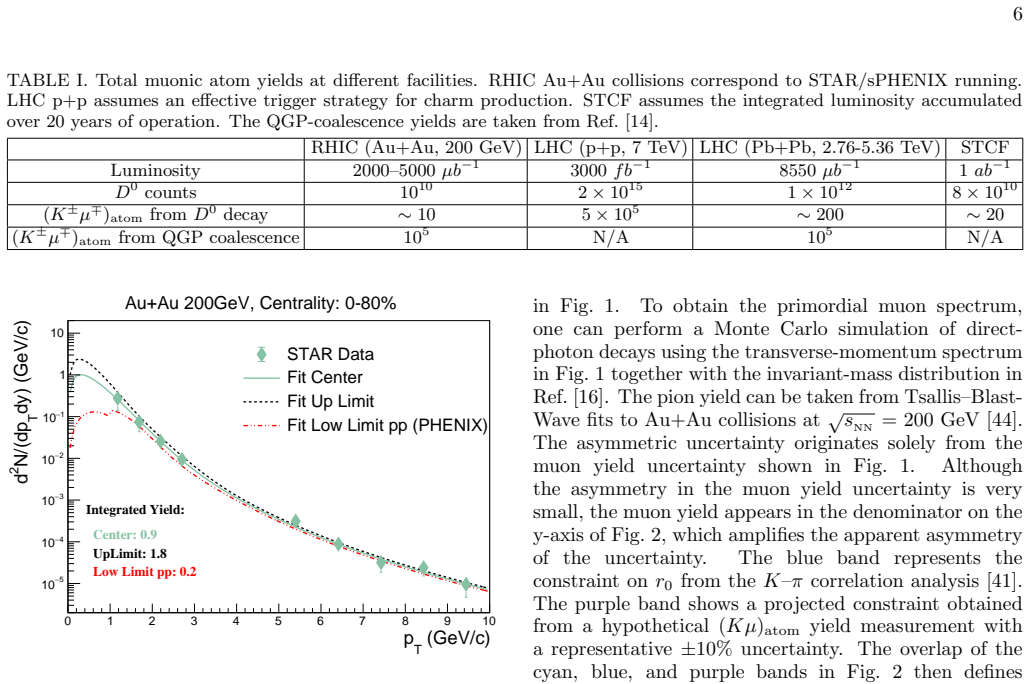

read the original abstract
We develop a framework for the formation of exotic muonic kaon atoms ($K\mu$) in semileptonic $D^{0}$ decays, using the effective weak Hamiltonian, a helicity-based treatment of the leptonic current, and a nonrelativistic bound-state projection. The resulting branching ratio, $\mathrm{BR}(D^{0} \to (K\mu )\nu_{\mu})=2.29\times10^{-10}$, is implemented in a ROOT-based code to estimate yields at RHIC, LHC, and STCF. We show quantitatively that $K\mu$ atoms-also produced through coalescence in the quark-gluon plasma (QGP)-provide a sensitive probe of low-momentum primordial muons and early time electromagnetic radiation, offering complementary constraints in an otherwise unexplored phase space for thermal dilepton and photon emission. Newly estimated dissociation cross sections in detector material indicate that secondary-vertex reconstruction should be experimentally feasible, allowing clean experimental identification of the atoms. Projected yields from QGP coalescence in LHC and RHIC heavy-ion collisions, and from $D^{0}$ decays in LHC high luminosity $p+p$ collisions indicate that the first observation of $K\mu$ atoms is within reach.
Editorial analysis
A structured set of objections, weighed in public.
Referee Report
Summary. The manuscript develops a framework for producing muonic kaon atoms (Kμ) via semileptonic D⁰ decays, employing the effective weak Hamiltonian, a helicity leptonic current, and nonrelativistic bound-state projection to obtain BR(D⁰ → (Kμ)ν_μ) = 2.29×10^{-10}. This is implemented in ROOT code to estimate yields at RHIC, LHC, and STCF; coalescence in the QGP is also considered. The paper argues that dissociation cross sections allow secondary-vertex reconstruction and that projected yields make first observation feasible, positioning Kμ atoms as a probe of low-momentum muons and early electromagnetic radiation.
Significance. If the branching ratio and formation rates hold, the work identifies a novel, experimentally accessible channel for constraining low-momentum primordial muons and early-time EM radiation in heavy-ion collisions, complementary to thermal dilepton and photon measurements. The quantitative yield estimates and dissociation cross sections provide concrete guidance for detector studies at existing facilities.
major comments (1)
- [branching-ratio calculation and bound-state projection] In the derivation of BR(D⁰ → (Kμ)ν_μ) via the nonrelativistic bound-state projection onto the Kμ Coulomb ground state, the relative momentum is taken to be set by the atomic Bohr scale (~few MeV). However, the semileptonic decay kinematics populate relative K-μ momenta up to ~m_D/2 ~ 1 GeV. No relativistic two-body wave function, Bethe-Salpeter correction, or off-shell matching is supplied to bridge this scale mismatch; the same projection is reused for QGP coalescence. This directly affects the quoted BR and all downstream yield projections that support the 'within reach' claim.
minor comments (2)
- [Abstract and results section] The abstract and main text quote a precise numerical branching ratio without error bars, uncertainty estimates, or sensitivity analysis to the projection assumptions.
- [yield estimation] Implementation details of the ROOT-based code used for yield estimation (event generation, acceptance, etc.) are not provided, limiting reproducibility.
Simulated Author's Rebuttal
We thank the referee for the careful reading and for highlighting the important issue of the bound-state projection approximation. We address this point directly below and have revised the manuscript accordingly.
read point-by-point responses
-
Referee: In the derivation of BR(D⁰ → (Kμ)ν_μ) via the nonrelativistic bound-state projection onto the Kμ Coulomb ground state, the relative momentum is taken to be set by the atomic Bohr scale (~few MeV). However, the semileptonic decay kinematics populate relative K-μ momenta up to ~m_D/2 ~ 1 GeV. No relativistic two-body wave function, Bethe-Salpeter correction, or off-shell matching is supplied to bridge this scale mismatch; the same projection is reused for QGP coalescence. This directly affects the quoted BR and all downstream yield projections that support the 'within reach' claim.
Authors: We acknowledge the kinematic mismatch between the atomic Bohr momentum scale (few MeV) and the semileptonic decay range (up to ~1 GeV). The nonrelativistic Coulomb projection is used as a leading-order estimate of the overlap integral with the ground-state wave function, whose momentum-space support is strongly peaked at low relative momentum; the high-momentum components of the decay amplitude are therefore suppressed by the wave-function fall-off. The same approximation is applied to QGP coalescence under the assumption that the relevant muons and kaons are soft. A complete relativistic treatment via the Bethe-Salpeter equation or off-shell matching would be more rigorous but requires substantial additional formalism beyond the scope of this exploratory work. In the revised manuscript we have added an explicit paragraph discussing the limitations of the nonrelativistic projection, clarifying that the quoted branching ratio is an order-of-magnitude estimate, and noting that the yield projections should be interpreted with this caveat. The overall conclusion that first observation is within reach remains unchanged at the present level of precision. revision: partial
Circularity Check
No significant circularity; derivation self-contained
full rationale
The paper computes BR(D⁰ → (Kμ)ν_μ) from the effective weak Hamiltonian plus helicity current and nonrelativistic bound-state projection, then feeds the numerical result into a ROOT yield estimator. No equation reduces the BR to a fitted parameter by construction, no self-citation is load-bearing for the central result, and no ansatz or uniqueness theorem is imported from prior author work. The nonrelativistic projection is an explicit modeling choice whose validity is a separate correctness question, not a circularity issue. Yields at colliders are downstream estimates, not redefinitions of the input BR.
Axiom & Free-Parameter Ledger
axioms (2)
- standard math Effective weak Hamiltonian for semileptonic D0 decays
- domain assumption Nonrelativistic bound-state projection for the muonic kaon atom
Lean theorems connected to this paper
-
IndisputableMonolith/Cost/FunctionalEquation.leanwashburn_uniqueness_aczel unclear?
unclearRelation between the paper passage and the cited Recognition theorem.
nonrelativistic bound-state projection ... |ψ_1S(0)|² = (μ_red α)^3/π ... Γ(D⁰ → (Kμ) 1S ν_μ) = ...
-
IndisputableMonolith/Foundation/AlexanderDuality.leanalexander_duality_circle_linking unclear?
unclearRelation between the paper passage and the cited Recognition theorem.
coalescence ... δp_QGP ≤ sqrt(2 m_red α / r_0) ...
What do these tags mean?
- matches
- The paper's claim is directly supported by a theorem in the formal canon.
- supports
- The theorem supports part of the paper's argument, but the paper may add assumptions or extra steps.
- extends
- The paper goes beyond the formal theorem; the theorem is a base layer rather than the whole result.
- uses
- The paper appears to rely on the theorem as machinery.
- contradicts
- The paper's claim conflicts with a theorem or certificate in the canon.
- unclear
- Pith found a possible connection, but the passage is too broad, indirect, or ambiguous to say the theorem truly supports the claim.
Reference graph
Works this paper leans on
-
[1]
K. Schuhmannet al.(CREMA), The helion charge radius from laser spectroscopy of muonic helium-3 ions, Science 388, adj2610 (2025)
work page 2025
- [2]
-
[3]
J. R. Persson, Muonic hyperfine structure and the bohr–weisskopf effect, arXiv 10.48550/arXiv.2310.16398 (2025), arXiv:2310.16398v3, arXiv:2310.16398 [nucl-th]
-
[4]
A. Antognini, F. Kottmann, and R. Pohl, Laser spectroscopy of light muonic atoms and the nuclear charge radii, SciPost Phys. Proc.5, 021 (2021)
work page 2021
-
[5]
M. Gorchtein, A hitchhiker’s guide to nuclear polarization in muonic atoms, arXiv 10.48550/arXiv.2501.15274 (2025), arXiv:2501.15274v1, arXiv:2501.15274 [nucl-th]
-
[6]
S. S. Li Muli, B. Acharya, O. J. Hernandez, and S. Bacca, Bayesian analysis of nuclear polarizability corrections to the lamb shift of muonic h-atoms and he-ions, J. Phys. G: Nucl. Part. Phys.49, 105101 (2022)
work page 2022
-
[7]
T. Okumura, T. Azuma, D. A. Bennett, I. Chiu, et al., Proof-of-principle experiment for testing strong- field quantum electrodynamics with exotic atoms: High precision x-ray spectroscopy of muonic neon, Phys. Rev. Lett.130, 173001 (2023)
work page 2023
-
[8]
H.-R. Ching, T.-H. Ho, and C.-H. Chang, On (πµ) atoms produced in k0l decay, Physics Letters B98, 456 (1981)
work page 1981
-
[9]
G. Baym, G. Friedman, R. J. Hughes, and B. V. Jacak, Production of muon - meson atoms in ultrarelativistic heavy ion collisions, Phys. Rev. D48, R3957 (1993)
work page 1993
-
[10]
A. V. Eskin, A. P. Martynenko, and E. N. Elekina, The correction of hadronic nucleus polarizability to hyperfine structure of light muonic atoms, EPJ Web Conf.158, 07002 (2017), arXiv:1711.00534 [hep-ph]
work page internal anchor Pith review Pith/arXiv arXiv 2017
-
[11]
Coombeset al., Detection of pi mu Coulomb Bound States, Phys
R. Coombeset al., Detection of pi mu Coulomb Bound States, Phys. Rev. Lett.37, 249 (1976)
work page 1976
-
[12]
S. H. Aronson, R. H. Bernstein, G. J. Bock, R. D. Cousins, J. F. Greenhalgh, D. Hedin, M. Schwartz, T. K. Shea, G. B. Thomson, and B. Winstein, MEASUREMENT OF THE RATE OF FORMATION OF PI MU ATOMS IN K0(L) DECAY, Phys. Rev. Lett. 48, 1078 (1982)
work page 1982
-
[13]
Navaset al.(Particle Data Group), Review of particle physics, Phys
S. Navaset al.(Particle Data Group), Review of particle physics, Phys. Rev. D110, 030001 (2024)
work page 2024
- [14]
-
[15]
J. I. Kapusta and A. Mocsy, Hydrogen - like atoms from ultrarelativistic nuclear collisions, Phys. Rev. C59, 2937 (1999), arXiv:nucl-th/9812013
work page internal anchor Pith review Pith/arXiv arXiv 1999
-
[16]
Direct virtual photon production in Au+Au collisions at $\sqrt{s_{NN}}$ = 200 GeV
L. Adamczyket al.(STAR), Direct virtual photon production in Au+Au collisions at √ s N N= 200 GeV, Phys. Lett. B770, 451 (2017), arXiv:1607.01447 [nucl- ex]
work page internal anchor Pith review Pith/arXiv arXiv 2017
- [17]
-
[18]
Acharyaet al.(ALICE), Dielectron production in central Pb-Pb collisions at sNN=5.02TeV, Phys
S. Acharyaet al.(ALICE), Dielectron production in central Pb-Pb collisions at sNN=5.02TeV, Phys. Rev. C 112, 054906 (2025), arXiv:2308.16704 [nucl-ex]
- [19]
-
[20]
Ablikimet al.(BESIII), Improved measurements of D0→K-ℓ+νℓand D+→K¯0ℓ+νℓ, Phys
M. Ablikimet al.(BESIII), Improved measurements of D0→K-ℓ+νℓand D+→K¯0ℓ+νℓ, Phys. Rev. D110, 112006 (2024), arXiv:2408.09087 [hep-ex]. 9
-
[21]
B. Chakraborty, W. G. Parrott, C. Bouchard, C. T. H. Davies, J. Koponen, and G. P. Lepage ((HPQCD Collaboration)§, HPQCD), Improved Vcs determination using precise lattice QCD form factors for D→Kℓν, Phys. Rev. D104, 034505 (2021), arXiv:2104.09883 [hep-lat]
-
[22]
Mrowczynski, Interaction of Elementary Atoms With Matter, Phys
S. Mrowczynski, Interaction of Elementary Atoms With Matter, Phys. Rev. A33, 1549 (1986)
work page 1986
-
[23]
H. S. Matis, R. L. Brown, W. Christie, W. R. Edwards, R. Jared, B. Minor, and P. Salz, Integration and conventional systems at STAR, Nucl. Instrum. Meth. A 499, 802 (2003), arXiv:nucl-ex/0205008
work page internal anchor Pith review Pith/arXiv arXiv 2003
-
[24]
The STAR Time Projection Chamber: A Unique Tool for Studying High Multiplicity Events at RHIC
M. Andersonet al., The Star time projection chamber: A Unique tool for studying high multiplicity events at RHIC, Nucl. Instrum. Meth. A499, 659 (2003), arXiv:nucl-ex/0301015
work page internal anchor Pith review Pith/arXiv arXiv 2003
-
[25]
Goy L´ opez (CMS), CMS detector performance, EPJ Web Conf.182, 02076 (2018)
S. Goy L´ opez (CMS), CMS detector performance, EPJ Web Conf.182, 02076 (2018)
work page 2018
-
[26]
CMS Collaboration,CMS Technical Design Report for the Pixel Detector Upgrade, Tech. Rep. CERN-LHCC- 2012-016, CMS-TDR-011 (CERN, 2012)
work page 2012
-
[27]
Aiet al., Conceptual design report of the Super Tau-Charm Facility: the accelerator, Nucl
X.-C. Aiet al., Conceptual design report of the Super Tau-Charm Facility: the accelerator, Nucl. Sci. Tech.36, 242 (2025), arXiv:2509.11522 [physics.acc-ph]
-
[28]
Achasov et al., STCF conceptual design report (V olume 1): Physics & detector, Front
M. Achasovet al., STCF conceptual design report (Volume 1): Physics & detector, Front. Phys. (Beijing) 19, 14701 (2024), arXiv:2303.15790 [hep-ex]
-
[29]
Adamset al.(STAR), STAR Note 0793 (2022), sTAR internal note
J. Adamset al.(STAR), STAR Note 0793 (2022), sTAR internal note
work page 2022
-
[30]
Measurements of $D^{0}$ and $D^{*}$ Production in $p$ + $p$ Collisions at $\sqrt{s}$ = 200 GeV
L. Adamczyket al.(STAR), Measurements ofD 0 andD ∗ Production inp+pCollisions at √s= 200 GeV, Phys. Rev. D86, 072013 (2012), arXiv:1204.4244 [nucl-ex]
work page internal anchor Pith review Pith/arXiv arXiv 2012
-
[31]
Improved Monte Carlo Glauber predictions at present and future nuclear colliders
C. Loizides, J. Kamin, and D. d’Enterria, Improved Monte Carlo Glauber predictions at present and future nuclear colliders, Phys. Rev. C97, 054910 (2018), [Erratum: Phys.Rev.C 99, 019901 (2019)], arXiv:1710.07098 [nucl-ex]
work page internal anchor Pith review Pith/arXiv arXiv 2018
-
[32]
S. Acharyaet al.(ALICE), Charm-quark fragmentation fractions and production cross section at midrapidity in pp collisions at the LHC, Phys. Rev. D105, L011103 (2022), arXiv:2105.06335 [nucl-ex]
-
[33]
CMS Collaboration (CMS), Public CMS Luminosity Information (2025)
work page 2025
-
[34]
Charged-particle nuclear modification factors in PbPb and pPb collisions at sqrt(s[NN]) = 5.02 TeV
V. Khachatryanet al.(CMS), Charged-particle nuclear modification factors in PbPb and pPb collisions at √ s N N = 5.02 TeV, JHEP04, 039, arXiv:1611.01664 [nucl-ex]
work page internal anchor Pith review Pith/arXiv arXiv
-
[35]
Light nuclei production as a probe of the QCD phase diagram
K.-J. Sun, L.-W. Chen, C. M. Ko, J. Pu, and Z. Xu, Light nuclei production as a probe of the QCD phase diagram, Phys. Lett. B781, 499 (2018), arXiv:1801.09382 [nucl- th]
work page internal anchor Pith review Pith/arXiv arXiv 2018
-
[36]
P. Hillmann, K. K¨ afer, J. Steinheimer, V. Vovchenko, and M. Bleicher, Coalescence, the thermal model and multi-fragmentation: the energy and volume dependence of light nuclei production in heavy ion collisions, J. Phys. G49, 055107 (2022), arXiv:2109.05972 [hep-ph]
-
[37]
S. T. Butler and C. A. Pearson, Deuterons from High- Energy Proton Bombardment of Matter, Phys. Rev. Lett. 7, 69 (1961)
work page 1961
-
[38]
J. L. Nagle, B. S. Kumar, D. Kusnezov, H. Sorge, and R. Mattiello, Coalescence of deuterons in relativistic heavy ion collisions, Phys. Rev. C53, 367 (1996)
work page 1996
-
[39]
W. J. Llopeet al., The fragment coalescence model, Phys. Rev. C52, 2004 (1995)
work page 2004
-
[40]
Search for Muonic Atoms at RHIC
K. Xin (STAR), Search for Muonic Atoms at RHIC, in 20th International Conference on Particles and Nuclei (2014) pp. 216–219, arXiv:1410.8037 [hep-ex]
work page internal anchor Pith review Pith/arXiv arXiv 2014
-
[41]
Pion-Kaon correlations in central Au+Au collisions at $\sqrt{s_{NN}} = 130$ GeV
J. Adamset al.(STAR), Pion kaon correlations in Au+Au collisions at s(NN)**1/2 = 130-GeV, Phys. Rev. Lett.91, 262302 (2003), arXiv:nucl-ex/0307025
work page internal anchor Pith review Pith/arXiv arXiv 2003
-
[42]
J. Adamset al.(STAR), Experimental and theoretical challenges in the search for the quark gluon plasma: The STAR Collaboration’s critical assessment of the evidence from RHIC collisions, Nucl. Phys. A757, 102 (2005), arXiv:nucl-ex/0501009
work page internal anchor Pith review Pith/arXiv arXiv 2005
-
[43]
A. Adareet al.(PHENIX), Detailed measurement of the e+e− pair continuum inp+pand Au+Au collisions at √ s N N= 200 GeV and implications for direct photon production, Phys. Rev. C81, 034911 (2010), arXiv:0912.0244 [nucl-ex]
work page internal anchor Pith review Pith/arXiv arXiv 2010
- [44]
discussion (0)
Sign in with ORCID, Apple, or X to comment. Anyone can read and Pith papers without signing in.