Recognition: 2 theorem links
· Lean TheoremAn accelerated direct solver for scalar wave scattering by multiple transmissive inclusions in two dimensions
Pith reviewed 2026-05-15 13:35 UTC · model grok-4.3
The pith
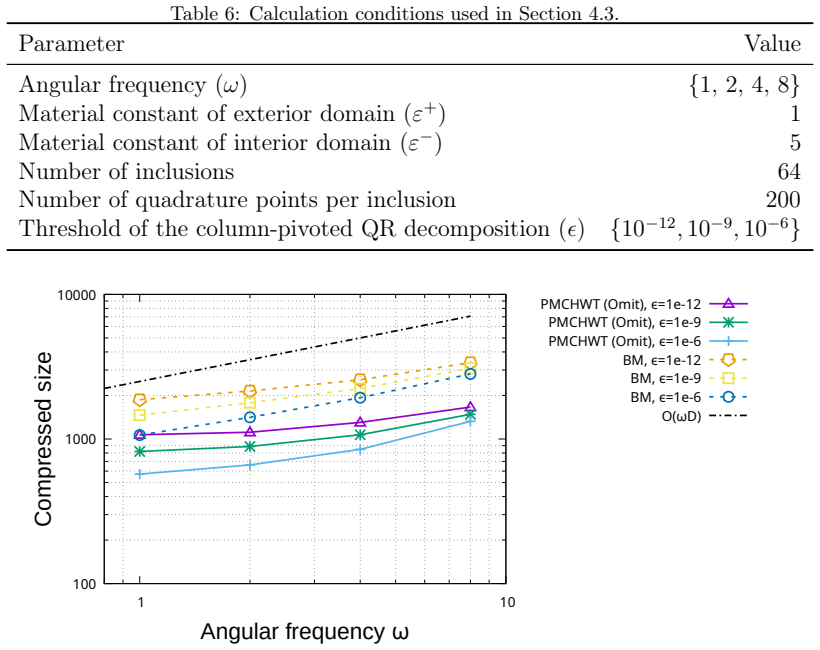
A proxy-based direct solver for wave scattering by many inclusions compresses the linear system to size O(ω D) with O(N^{1.5}) cost on grids.
A machine-rendered reading of the paper's core claim, the machinery that carries it, and where it could break.
Core claim
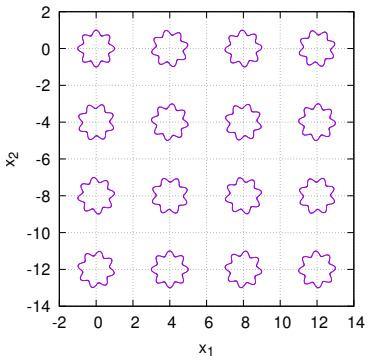
The solver applies boundary integral equations to Helmholtz transmission problems with many disjoint inclusions and uses the proxy method for low-rank approximations of inter-scatterer interactions that omit internal terms in the PMCHWT case. This compresses the linear algebraic system to size O(ω D) and yields total cost at most O(N^{1.5}) when inclusions lie on a grid at fixed frequency. The PMCHWT formulation is approximately six times faster than Burton-Miller when each inclusion is treated as a cell and produces a system half as large in the same setting.
What carries the argument
Low-rank approximation via the proxy method for interactions between disjoint scatterers, omitting internal integral representation terms in the PMCHWT formulation.
If this is right
- The linear system compresses to size O(ω D).
- Total computational cost scales as O(N^{1.5}) for fixed frequency when inclusions form a grid.
- PMCHWT runs approximately six times faster than Burton-Miller when each inclusion is treated as a cell.
- PMCHWT halves the compressed system size compared with Burton-Miller in the same grid setting.
Where Pith is reading between the lines
- The method could allow direct solution of scattering problems with thousands of inclusions where iterative solvers become impractical.
- Omitting interior terms might be adapted to other second-kind integral formulations for similar efficiency gains.
- Irregular or clustered inclusion layouts may still benefit from the direct approach even if the O(N^{1.5}) scaling softens.
- Extending the same proxy compression to three dimensions would test whether the O(ω D) size reduction persists.
Load-bearing premise
The proxy method delivers accurate low-rank approximations of interactions between separate inclusions without using internal integral terms, an advantage that works for PMCHWT but fails for Burton-Miller.
What would settle it
A test on a grid of inclusions at fixed frequency that measures whether the compressed matrix size grows beyond linear in ω D or the runtime exceeds O(N^{1.5}) scaling.
Figures






read the original abstract
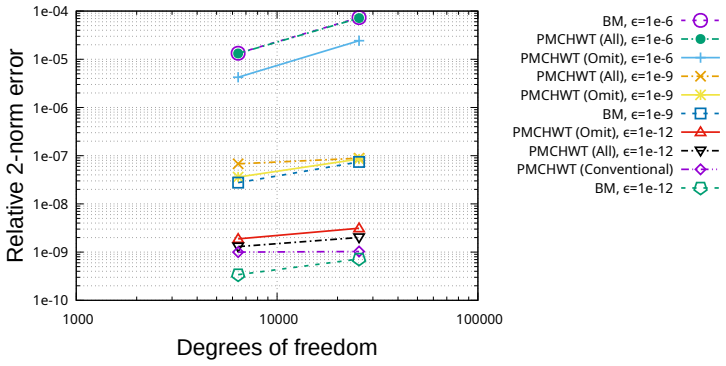
This paper discusses a fast direct solver using boundary integral equations for Helmholtz transmission problems involving multiple inclusions in two dimensions. Efficiently addressing scattering problems in the presence of numerous inclusions remains a key challenge for various practical applications. For problems involving a large number of scatterers, the number of iterations in Krylov subspace methods is known to increase significantly. This occurs even when using second-kind boundary integral equations, which are typically recognized for their rapid convergence. We consider a fast direct solver as an alternative, an approach that has been less commonly explored for transmission problems with disjoint multiple inclusions. The low-rank approximation based on the proxy method achieve speedup by calculating interactions between disjoint scatterers without the terms derived from the internal integral representation. Notably, this advantage applies to the Poggio--Miller--Chang--Harrington--Wu--Tsai (PMCHWT) formulation but breaks down in the Burton--Miller case. Numerical examples demonstrate that the proposed solver can compress the system of linear algebraic equations to a size of $O(\omega D)$, where $\omega$ is the frequency of the incident wave and $D$ is the diameter of the (smallest) bounding box enclosing the multiple inclusions. The total computational cost scales as $O(N^{1.5})$ $(= O(\sqrt{N}^3))$ at most for a fixed $\omega$ when the inclusions are arranged on a grid. Moreover, the PMCHWT formulation, that omits the interior term in the proxy method, is approximately six times faster than the Burton--Miller formulation when treating each inclusion as a cell. Furthermore, in the same setting, the former can compress the size of the system of linear algebraic equations by half compared to the latter.
Editorial analysis
A structured set of objections, weighed in public.
Referee Report
Summary. The manuscript presents a fast direct solver for 2D Helmholtz transmission scattering by multiple disjoint inclusions. It uses standard boundary-integral formulations (PMCHWT and Burton-Miller) together with a proxy-based low-rank compression of inter-scatterer interactions. The key technical observation is that, for the PMCHWT formulation, the interior integral-representation terms can be omitted from the proxy without destroying the low-rank structure, yielding a compressed system of size O(ωD) and total cost O(N^{1.5}) for grid arrangements at fixed frequency; numerical timings show the PMCHWT version is roughly six times faster and produces a matrix half the size of the Burton-Miller version.
Significance. If the reported scaling and accuracy are rigorously verified, the work supplies a practical direct solver for a class of transmission problems that are otherwise expensive for iterative methods. The explicit comparison of the two formulations and the observation that interior-term omission is admissible only for PMCHWT are useful contributions to the literature on fast BIE solvers for multiple scatterers.
major comments (3)
- [Abstract / proxy-method section] Abstract and the section describing the proxy compression: the claim that omitting the interior integral-representation terms from the proxy still produces a numerically low-rank interaction matrix of size O(ωD) while preserving solution accuracy is asserted but not supported by any error analysis, rank bound, or consistency proof. Because the PMCHWT operator couples interior and exterior fields, dropping the interior proxy contribution is an approximation whose validity depends on separation distance, contrast, and frequency; without a quantitative bound this step is load-bearing for both the O(ωD) compression claim and the reported 6× speedup.
- [Numerical examples] Numerical-examples section: the O(N^{1.5}) scaling and O(ωD) compressed size are supported only by timing plots and matrix-size counts; no convergence tables, residual histories, or error bars versus a reference solution are supplied, nor is there explicit verification that the post-processing steps (e.g., local corrections) preserve the claimed complexity and accuracy.
- [Numerical examples / formulation comparison] Comparison of PMCHWT versus Burton-Miller: the factor-of-six speedup and factor-of-two compression advantage are reported for the grid-arrangement test, yet the manuscript does not quantify how the omitted interior proxy terms affect solution accuracy across the range of contrasts and frequencies used in the experiments.
minor comments (2)
- [Abstract] Notation for the proxy radius and tolerance should be introduced once and used consistently; the abstract refers to “proxy rank / tolerance” without defining the symbols.
- [Figures] Figure captions for the timing and compression plots should state the precise definition of N (total degrees of freedom) and whether the reported times include factorization or only compression.
Simulated Author's Rebuttal
We thank the referee for the thorough review and constructive feedback. We address each major comment below, indicating where revisions will be made to strengthen the manuscript.
read point-by-point responses
-
Referee: [Abstract / proxy-method section] Abstract and the section describing the proxy compression: the claim that omitting the interior integral-representation terms from the proxy still produces a numerically low-rank interaction matrix of size O(ωD) while preserving solution accuracy is asserted but not supported by any error analysis, rank bound, or consistency proof. Because the PMCHWT operator couples interior and exterior fields, dropping the interior proxy contribution is an approximation whose validity depends on separation distance, contrast, and frequency; without a quantitative bound this step is load-bearing for both the O(ωD) compression claim and the reported 6× speedup.
Authors: We agree that the manuscript would benefit from a more explicit discussion of the approximation. The omission is admissible for PMCHWT because the interior representation is already accounted for in the local block and the proxy only needs to capture the exterior radiating field; this is not true for Burton-Miller. While we do not supply a rigorous rank bound, the numerical evidence in the grid-arrangement experiments shows that the numerical rank remains O(ωD) with negligible effect on accuracy for the tested separations and contrasts. In the revision we will add a short subsection with a heuristic argument based on the Green's function decay and additional rank plots versus separation distance. revision: partial
-
Referee: [Numerical examples] Numerical-examples section: the O(N^{1.5}) scaling and O(ωD) compressed size are supported only by timing plots and matrix-size counts; no convergence tables, residual histories, or error bars versus a reference solution are supplied, nor is there explicit verification that the post-processing steps (e.g., local corrections) preserve the claimed complexity and accuracy.
Authors: The referee is correct that the current numerical section relies primarily on timing and size data. We will add convergence tables comparing the solver output against a reference solution obtained by direct dense assembly on smaller instances, together with residual histories and error bars. We will also include a brief complexity verification for the local-correction post-processing step to confirm it does not alter the overall O(N^{1.5}) scaling. revision: yes
-
Referee: [Numerical examples / formulation comparison] Comparison of PMCHWT versus Burton-Miller: the factor-of-six speedup and factor-of-two compression advantage are reported for the grid-arrangement test, yet the manuscript does not quantify how the omitted interior proxy terms affect solution accuracy across the range of contrasts and frequencies used in the experiments.
Authors: We will extend the numerical comparison section with additional runs that vary the contrast ratio and frequency while reporting both timing/compression metrics and solution accuracy (relative L2 error on the boundary) for both formulations. This will explicitly quantify the accuracy impact of the interior-term omission in the PMCHWT proxy. revision: yes
Circularity Check
No circularity: scalings emerge from numerical experiments on standard BIE + proxy compression
full rationale
The derivation relies on established PMCHWT and Burton-Miller boundary-integral operators together with the proxy low-rank technique for inter-scatterer interactions. The O(ω D) compressed size and O(N^{1.5}) cost for grid arrangements are reported as observed outcomes of the algorithm applied to concrete examples, not as quantities fitted or predicted from the same data by construction. No load-bearing step reduces to a self-citation, ansatz smuggled via prior work, or renaming of a known result; the distinction between formulations follows directly from the differing integral operators. The method is therefore self-contained against external benchmarks.
Axiom & Free-Parameter Ledger
free parameters (1)
- proxy rank / tolerance
axioms (2)
- domain assumption The inclusions are disjoint and sufficiently separated for the proxy method to produce accurate low-rank far-field interactions without interior terms.
- domain assumption The PMCHWT formulation remains stable and the Burton-Miller formulation does not admit the same interior-term omission.
Lean theorems connected to this paper
-
IndisputableMonolith/Cost/FunctionalEquation.leanwashburn_uniqueness_aczel unclear?
unclearRelation between the paper passage and the cited Recognition theorem.
The low-rank approximation based on the proxy method achieve speedup by calculating interactions between disjoint scatterers without the terms derived from the internal integral representation... compress the system of linear algebraic equations to a size of O(ωD)
-
IndisputableMonolith/Foundation/AlexanderDuality.leanalexander_duality_circle_linking unclear?
unclearRelation between the paper passage and the cited Recognition theorem.
proxy method... local virtual boundary that surrounds a subset of the boundary (Martinsson and Rokhlin, 2005)
What do these tags mean?
- matches
- The paper's claim is directly supported by a theorem in the formal canon.
- supports
- The theorem supports part of the paper's argument, but the paper may add assumptions or extra steps.
- extends
- The paper goes beyond the formal theorem; the theorem is a base layer rather than the whole result.
- uses
- The paper appears to rely on the theorem as machinery.
- contradicts
- The paper's claim conflicts with a theorem or certificate in the canon.
- unclear
- Pith found a possible connection, but the passage is too broad, indirect, or ambiguous to say the theorem truly supports the claim.
Reference graph
Works this paper leans on
-
[1]
https://doi.org/10.1007/PL00005410
Bebendorf, M., Approximation of boundary element ma- trices, Numerische Mathematik, Vol.86 (2000), pp.565–589. https://doi.org/10.1007/PL00005410
-
[2]
Burton, A.J. and Miller, G.F., The application of integral equation methods to the numerical solution of some exterior boundary-value problems, Proceedings of the Royal Society of London. A. Mathe- matical and Physical Sciences, Vol.323, No.1553 (1971) pp.201–210. https://doi.org/10.1098/rspa.1971.0097
-
[3]
Bremer, J., Gillman, A. and Martinsson, P. G., A high-order ac- curate accelerated direct solver for acoustic scattering from sur- faces, BIT Numerical Mathematics, Vol.55, No.2 (2015), pp.367–397. https://doi.org/10.1007/s10543-014-0508-y
-
[4]
https://doi.org/10.1137/040603917
Carpentieri, B., Duff, I.S., Giraud, L., Sylvand, G., Combining fast multipoletechniquesandanapproximateinversepreconditionerforlarge electromagnetism calculations, SIAM Journal on Scientific Computing, Vol.27, No.3 (2005), pp.774–792. https://doi.org/10.1137/040603917
-
[5]
IEEE Transactions on Antennas and Propagation Vol.25, No.6 (1977), pp.789–795
Chang, Y., Harrington, R., A surface formulation for char- acteristic modes of material bodies. IEEE Transactions on Antennas and Propagation Vol.25, No.6 (1977), pp.789–795. https://doi.org/10.1109/TAP.1977.1141685
-
[6]
Cheng, H., Gimbutas, Z., Martinsson, P. G. and Rokhlin, V., On the compression of low rank matrices, SIAM Jour- nal on Scientific Computing, Vol.26, No.4 (2005), pp.1389–1404. https://doi.org/10.1137/030602678
-
[7]
Cho, M. H. and Barnett, A. H. Robust fast direct integral equa- tion solver for quasi-periodic scattering problems with a large num- ber of layers, Optics express, Vol.23, No.2 (2015), pp.1775–1799. https://doi.org/10.1364/OE.23.001775
-
[8]
Craster, R., Guenneau, S., Kadic, M. and Wegener, M., Mechanical metamaterials, Reports on Progress in Physics, Vol.86, No.9 (2023), p.094501. https://doi.org/10.1088/1361-6633/ace069 26
-
[9]
Fikl, A. and Klöckner, A., A Fast Direct Solver for Boundary Integral Equations Using Quadrature By Expansion, Journal of Scientific Com- puting, Vol.106, No.2 (2026), p.45. https://doi.org/10.1007/s10915-025- 03174-8
-
[10]
Gillman, A. and Barnett, A., A fast direct solver for quasi-periodic scattering problems, Journal of Computational Physics, Vol.248 (2013), pp.309–322. https://doi.org/10.1016/j.jcp.2013.04.015
-
[11]
Gimbutas, Z. and Greengard, L., Fast multi-particle scattering: A hybrid solver for the Maxwell equations in microstructured materi- als, Journal of Computational Physics, Vol.232, No.1 (2013), pp.22–32. https://doi.org/10.1016/j.jcp.2012.01.041
-
[12]
Gopal, A., and Martinsson, P. G., An accelerated, high-order accurate direct solver for the Lippmann–Schwinger equation for acoustic scatter- ing in the plane, Advances in Computational Mathematics, Vol.48, No.4 (2022), p.42. https://doi.org/10.1007/s10444-022-09963-1
-
[13]
Greengard, L., Gueyffier, D., Martinsson, P. G. and Rokhlin, V., Fast direct solvers for integral equations in complex three- dimensional domains, Acta Numerica, Vol.18 (2009), pp.243–275. https://doi.org/10.1017/S0962492906410011
-
[14]
Greengard, L., Ho, K. L. and Lee, J. Y., A fast direct solver for scat- tering from periodic structures with multiple material interfaces in two dimensions. Journal of Computational Physics, Vol.258 (2014), pp.738–
work page 2014
-
[15]
https://doi.org/10.1016/j.jcp.2013.11.011
-
[16]
https://doi.org/10.1137/18M1232814
Lai, J., and Li, P., A framework for simulation of multiple elastic scatter- ing in two dimensions, SIAM Journal on Scientific Computing, Vol.41, No.5 (2019), pp.A3276–A3299. https://doi.org/10.1137/18M1232814
-
[17]
Hawkins, S. C., Bennetts, L. G., Nethercote, M. A., Peter, M. A., Peterseim, D., Putley, H. J. and Verfürth, B., Metamate- rial applications of TMATSOLVER, an easy-to-use software for simulating multiple wave scattering in two dimensions. Proceed- ings of the Royal Society A, Vol.480, No.2292 (2024), p.20230934. https://doi.org/10.1098/rspa.2023.0934 27
-
[18]
https://doi.org/10.1515/jnum-2012-0013
Hecht, F., New development in FreeFem++, Journal of nu- merical mathematics, Vol.20, No.3-4 (2012), pp.251-266. https://doi.org/10.1515/jnum-2012-0013
-
[19]
Neutrino Production via $e^-e^+$ Collision at $Z$-boson Peak
Ma, Q., Deshmukh, S. and Yokota, R., Scalable linear time dense direct solver for 3-D problems without trailing sub-matrix dependen- cies. SC22: International Conference for High Performance Computing, Networking, Storage and Analysis, Dallas, TX, USA (2022), pp.1–12. https://doi.org/10.1109/SC41404.2022.00088
work page internal anchor Pith review Pith/arXiv arXiv doi:10.1109/sc41404.2022.00088 2022
-
[20]
Martinsson, P. G. and Rokhlin, V., A fast direct solver for boundary integral equations in two dimensions, Jour- nal of Computational Physics, Vol.205, No.1 (2005), pp.1–23. https://doi.org/10.1016/j.jcp.2004.10.033
-
[21]
Martinsson, P. G. and Rokhlin, V., A fast direct solver for scattering problems involving elongated structures, Journal of Computational Physics, Vol.221, No.1 (2007), pp.288–302. https://doi.org/10.1016/j.jcp.2006.06.037
-
[22]
Martinsson, P. G., Fast direct solvers for elliptic PDEs, Society for Industrial and Applied Mathematics, Philadelphia, PA (2019). https://doi.org/10.1137/1.9781611976045
-
[23]
Matsumoto, Y., A Helmholtz multiple scattering analysis using fast di- rect solver in two dimensions, 2025 M&M/CMD Symposium for Young Researchers, August 27–29 (2025), Nagoya, Aichi, Japan
work page 2025
-
[24]
Matsumoto, Y. and Maruyama, T., Linearly scalable fast direct solver based on proxy surface method for two-dimensional elastic wave scatter- ing by cavity, Engineering Analysis with Boundary Elements, Vol.173 (2025a), p.106148. https://doi.org/10.1016/j.enganabound.2025.106148
-
[25]
and Maruyama, T., A fast direct solver for two- dimensional transmission problems of elastic waves
Matsumoto, Y. and Maruyama, T., A fast direct solver for two- dimensional transmission problems of elastic waves. arXiv preprint arXiv:2509.19986 (2025b). https://doi.org/10.48550/arXiv.2509.19986 (Accepted by Engineering with Computers)
-
[26]
Matsumoto, Y. and Matsushima, K., Efficient LU factoriza- tion exploiting direct-indirect Burton–Miller equation for Helmholtz 28 transmission problems, arXiv preprint arXiv:2512.14193 (2025). https://doi.org/10.48550/arXiv.2512.14193
-
[27]
Matsushima, K., Noguchi, Y. and Yamada, T., Omnidirectional acoustic cloaking against airborne sound realized by a locally reso- nant sonic material, Scientific Reports, Vol.12, No.1 (2022), p.16383. https://doi.org/10.1038/s41598-022-20591-z
-
[28]
C., Acoustic and electromagnetic equations: integral repre- sentations for harmonic problems (Vol
Nédélec, J. C., Acoustic and electromagnetic equations: integral repre- sentations for harmonic problems (Vol. 144), Springer New York (2001). https://doi.org/10.1007/978-1-4757-4393-7
-
[29]
Padilla, W. J., Averitt, R. D. Imaging with metamaterials, Nature Re- views Physics, Vol.4 (2022), pp.85–100. https://doi.org/10.1038/s42254- 021-00394-3
-
[30]
Poggio, A.J., Miller, E.K., Chapter 4 - Integral equation solutions of three-dimensional scattering problems. In: Mittra, R. (ed.) Com- puter Techniques for Electromagnetics, International Series of Mono- graphsinElectricalEngineering(1973), pp.159–264.Pergamon, Oxford. https://doi.org/10.1016/B978-0-08-016888-3.50008-8
-
[31]
https://doi.org/10.1016/0021-9991(90)90107-C
Rokhlin, V., Rapid solution of integral equations of scattering theory in two dimensions, Journal of Computational physics, Vol.86, No.2 (1990), pp.414–439. https://doi.org/10.1016/0021-9991(90)90107-C
-
[32]
https://doi.org/10.1007/978-1-4612-0871-6
Sagan, H., Space-filling curves, Springer New York, NY (2012). https://doi.org/10.1007/978-1-4612-0871-6
-
[33]
Shi, Y., Song, Q., Toftul, I., Zhu, T., Yu, Y., Zhu, W., Tsai, D. P., Kivshar, Y. and Liu, A. Q., Optical manipulation with metamate- rial structures, Applied Physics Reviews, Vol.9, No.3 (2022), p.031303. https://doi.org/10.1063/5.0091280
-
[34]
Smith, M. J. and Abrahams, I. D., Tailored acoustic metamaterials. Part I. Thin-and thick-walled Helmholtz resonator arrays, Proceed- ings of the Royal Society A, Vol.478, No.2262 (2022), p.20220124. https://doi.org/10.1098/rspa.2022.0124 29
-
[35]
Spendlhofer, T., Ma, Q., Matsumoto, Y. and Yokota, R., On the In- terplay Between Precision, Rank and Admissibility for Iterative Hierar- chical Low-Rank Matrix Solvers, ISC High Performance 2025 Research Paper Proceedings (40th International Conference), Hamburg, Germany (2025), pp. 1–12. https://doi.org/10.23919/ISC.2025.11017731
-
[36]
Wu, B. and Martinsson, P. G., Zeta correction: a new approach to con- structing corrected trapezoidal quadrature rules for singular integral op- erators, Advances in Computational Mathematics, Vol.47, No.3 (2021), p.45. https://doi.org/10.1007/s10444-021-09872-9
-
[37]
Wu, B. and Martinsson, P. G., A unified trapezoidal quadrature method for singular and hypersingular boundary integral operators on curved surfaces, SIAM Journal on Numerical Analysis, Vol.61, No.5 (2023), pp.2182–2208. https://doi.org/10.1137/22M1520372
-
[38]
https://doi.org/10.1007/s10543-020- 00818-z 30
Zhang, YandGillman, A., Afastdirectsolverfortwodimensionalquasi- periodic multilayered media scattering problems, BIT Numerical Mathe- matics, Vol.61 (2021), pp.141–171. https://doi.org/10.1007/s10543-020- 00818-z 30
discussion (0)
Sign in with ORCID, Apple, or X to comment. Anyone can read and Pith papers without signing in.