Unexpectedly Weak General Relativistic Effects in Strongly Relativistic Tidal Disruption Events
Pith reviewed 2026-05-15 12:40 UTC · model grok-4.3
The pith
Strongly relativistic tidal disruption events leave debris highly eccentric for weeks after disruption.
A machine-rendered reading of the paper's core claim, the machinery that carries it, and where it could break.
Core claim
A GR hydrodynamic simulation starting from the initial approach of a Sun-like star to a non-spinning 10^6 solar-mass black hole and running to 35 days after peak mass return shows that strong relativistic apsidal precession and pericenter nozzle compression drive efficient early shocks, yet these last only ~0.3 of the peak mass-return time. Stream self-interactions subsequently raise the angular momentum of the incoming stream, expanding its pericenter, weakening precession, and reducing further dissipation, so that the debris stays highly eccentric with most mass near the orbital apocenter at ~250 times the initial pericenter distance.
What carries the argument
General relativistic hydrodynamic simulation of debris evolution that tracks apsidal precession, pericenter nozzle compression, and angular-momentum transfer through stream self-interactions.
If this is right
- Most of the returned stellar mass resides near the orbital apocenter rather than accreting promptly onto the black hole.
- Shocks driven by stream interactions, not direct accretion, power the observed optical and UV luminosity.
- The peak brightness occurs while the flow is still highly eccentric and spatially extended.
- Circularization in TDEs occurs on timescales much longer than the mass-return time even when relativistic effects are strong.
Where Pith is reading between the lines
- TDE emission models may need to treat extended eccentric streams rather than assuming prompt disk formation.
- The short-lived nature of relativistic shocks could explain why some observed TDE light curves lack signatures of rapid circularization.
- Similar stream-interaction dynamics might operate in TDEs around spinning black holes if initial conditions allow comparable angular-momentum transfer.
Load-bearing premise
The single simulation with a Sun-like star and non-spinning 10^6 solar-mass black hole, at the chosen numerical resolution, accurately captures the long-term dynamics without significant grid artifacts or missing physics.
What would settle it
An observation or higher-resolution simulation showing that the debris stream circularizes into a disk within a few days, or that strong shocks persist well beyond the first week in a strongly relativistic TDE.
Figures





read the original abstract
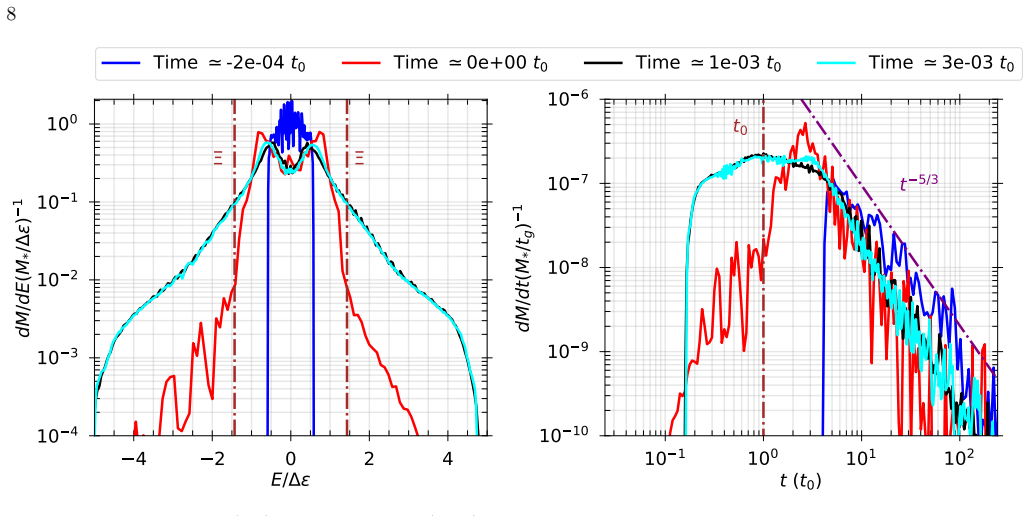
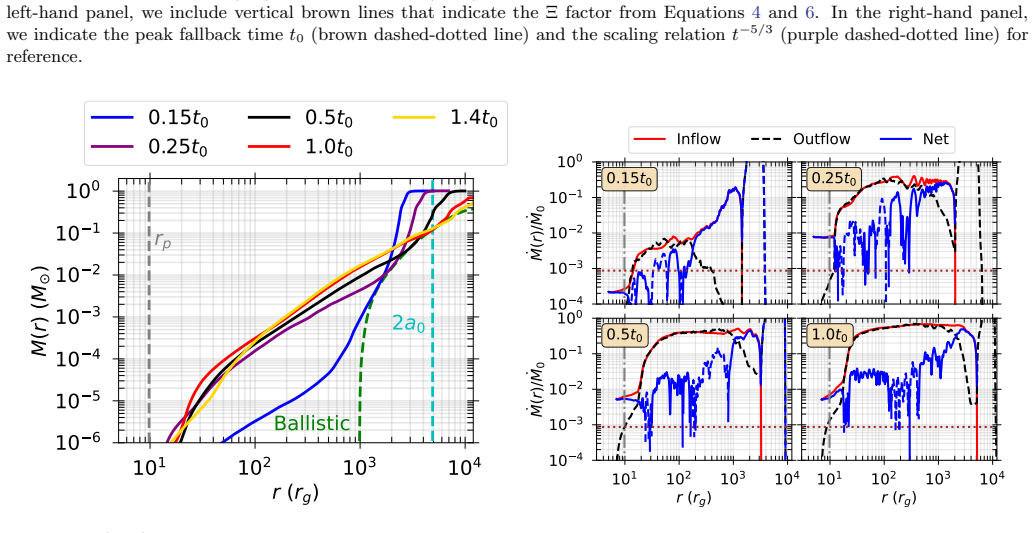
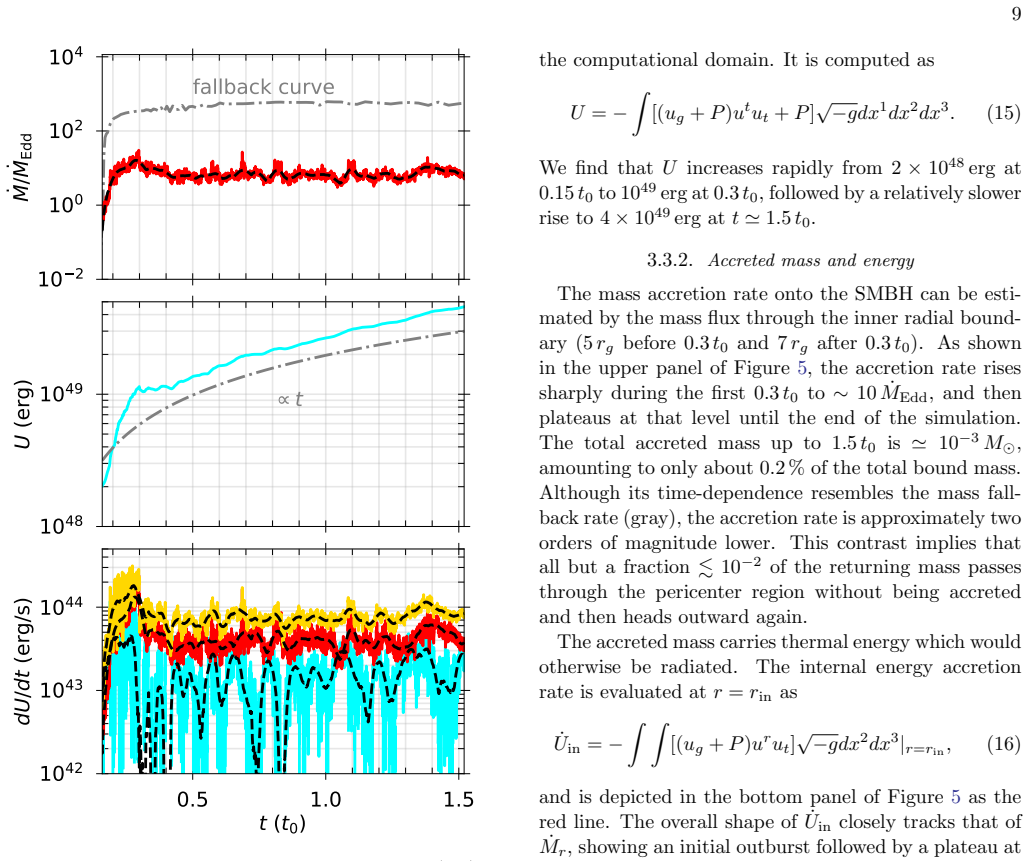
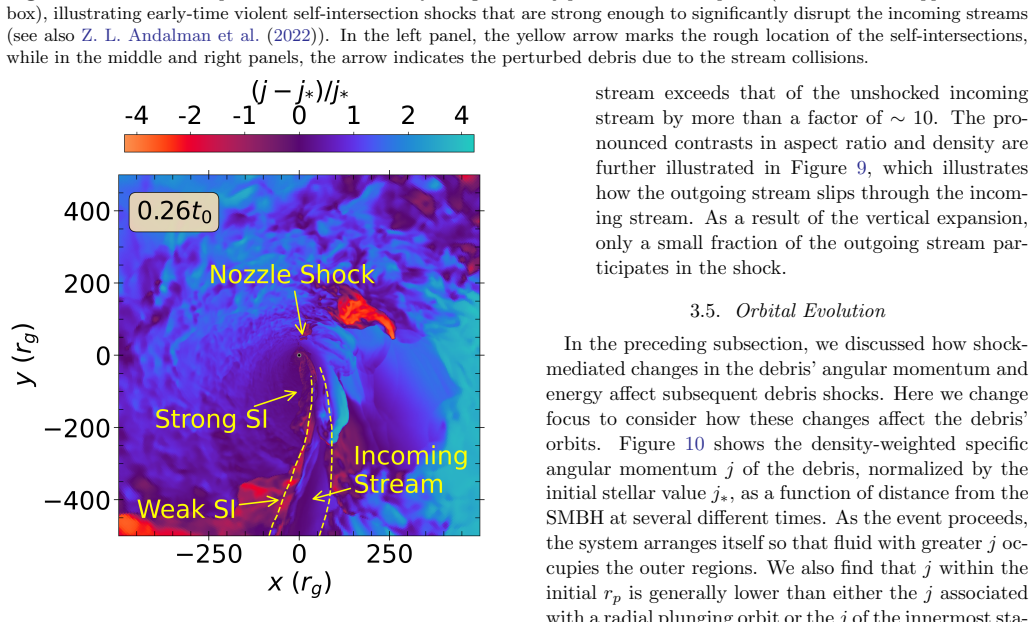
Tidal disruption events (TDEs) occur when stars are destroyed by supermassive black holes and are among the brightest nuclear transients. It has been thought that strong relativistic effects rapidly dissipate orbital energy and produce prompt disk formation when the stellar pericenter is smaller than $\sim 10$ gravitational radii. Using a general relativistic hydrodynamic simulation of a strongly relativistic TDE involving a Sun-like star and a $10^{6}\,M_{\odot}$ non-spinning black hole, we find instead that the overall evolution is similar to weakly relativistic TDEs: the debris remains highly eccentric, with most of the returned mass residing near the orbital apocenter ($\sim 250\times$ the initial pericenter distance), and shocks, rather than accretion, power the event. The simulation starts from the initial stellar approach and follows the debris evolution up to $35$\,days after the peak mass-return time ($\simeq$ $23$\,days). Although early shocks driven by strong relativistic apsidal precession and pericenter nozzle compression dissipate orbital energy efficiently, they last only about a week ($\sim 0.3$ of the peak mass-return time). Stream self-interactions increase the incoming stream's angular momentum, thereby expanding its pericenter distance, weakening precession and shocks, and reducing dissipation. These results suggest that circularization in TDEs may proceed slowly regardless of the strength of apsidal precession, with the flow remaining highly eccentric and extended during the peak optical/UV luminosity.
Editorial analysis
A structured set of objections, weighed in public.
Referee Report
Summary. The paper reports a general relativistic hydrodynamic simulation of a tidal disruption event in which a Sun-like star is disrupted by a non-spinning 10^6 solar-mass black hole at a strongly relativistic pericenter. Contrary to the expectation of rapid circularization driven by strong apsidal precession, the simulation shows that the debris stream remains highly eccentric, with the bulk of the returned mass residing near apocenter at ~250 times the initial pericenter distance. Early shocks from relativistic precession and nozzle compression dissipate energy efficiently for only the first ~week (~0.3 of the peak mass-return time), after which stream self-interactions raise the specific angular momentum, expand the pericenter, weaken precession, and reduce further dissipation. The authors conclude that circularization proceeds slowly regardless of apsidal-precession strength, so that the flow stays eccentric and extended during the epoch of peak optical/UV luminosity. The run begins at stellar approach and extends to 35 days after peak mass return.
Significance. If the central result is robust, the work would be significant for TDE theory and interpretation. It directly challenges the long-standing assumption that strong general-relativistic apsidal precession in deeply plunging encounters produces prompt disk formation and efficient accretion. Instead, the simulation indicates that shock-powered emission from an extended, eccentric flow can dominate at peak luminosity, offering a possible explanation for observed TDE light-curve timescales without requiring rapid circularization. The direct integration from realistic initial conditions to late times is a methodological strength that supplies a concrete, falsifiable prediction for the eccentricity distribution at peak brightness.
major comments (2)
- [§3] §3 (Numerical Methods): The manuscript presents results from a single GRHD run with fixed initial conditions (Sun-like star, non-spinning 10^6 M_⊙ BH) and does not report a resolution study or convergence tests with respect to grid scale at the nozzle or artificial viscosity. Because the key transition—pericenter expansion and suppression of dissipation after the first week—depends on the angular-momentum gain during stream self-intersections, it is essential to demonstrate that this outcome is insensitive to numerical dissipation. Without such tests the robustness of the late-time eccentricity evolution cannot be assessed.
- [§4 and §5] §4 (Results) and §5 (Discussion): The claim that circularization proceeds slowly 'regardless of the strength of apsidal precession' is extrapolated from one simulation. The hydro-only treatment omits radiative cooling (which can thin the stream and change collision geometry) and magnetic fields (which can redistribute angular momentum on orbital timescales). If either process alters the eccentricity evolution by more than ~10–20 % at late times, the generalization does not hold. A quantitative estimate of the possible impact of these missing physics on the reported pericenter expansion would strengthen the central conclusion.
minor comments (2)
- [Abstract] Abstract: The statement that the pericenter is 'smaller than ~10 gravitational radii' should be accompanied by the precise value used in the simulation so that readers can judge how deeply relativistic the encounter is relative to prior work.
- [Figures] Figure captions and text: Several figures show the spatial distribution of debris at selected times; adding quantitative diagnostics (e.g., time evolution of the mass-weighted eccentricity or specific angular momentum) would make the transition from strong to weak dissipation easier to follow.
Simulated Author's Rebuttal
We thank the referee for their detailed and constructive report. We address each major comment below and indicate the revisions we plan to make.
read point-by-point responses
-
Referee: §3 (Numerical Methods): The manuscript presents results from a single GRHD run with fixed initial conditions (Sun-like star, non-spinning 10^6 M_⊙ BH) and does not report a resolution study or convergence tests with respect to grid scale at the nozzle or artificial viscosity. Because the key transition—pericenter expansion and suppression of dissipation after the first week—depends on the angular-momentum gain during stream self-intersections, it is essential to demonstrate that this outcome is insensitive to numerical dissipation. Without such tests the robustness of the late-time eccentricity evolution cannot be assessed.
Authors: We agree that convergence tests are important for validating the numerical results, particularly regarding the angular momentum transfer in stream self-intersections. Performing a full resolution study is computationally intensive for GRHD simulations spanning the required timescales. In the revised manuscript, we will include additional information on the grid resolution used and discuss why the key physical processes are expected to be robust against moderate changes in numerical dissipation. We will also note that the pericenter expansion is driven by the geometry of the intersections rather than small-scale dissipation. revision: partial
-
Referee: §4 (Results) and §5 (Discussion): The claim that circularization proceeds slowly 'regardless of the strength of apsidal precession' is extrapolated from one simulation. The hydro-only treatment omits radiative cooling (which can thin the stream and change collision geometry) and magnetic fields (which can redistribute angular momentum on orbital timescales). If either process alters the eccentricity evolution by more than ~10–20 % at late times, the generalization does not hold. A quantitative estimate of the possible impact of these missing physics on the reported pericenter expansion would strengthen the central conclusion.
Authors: We recognize that our results are from a single simulation without radiative cooling or magnetic fields, and that these omissions limit the generality of our conclusions. The hydrodynamical mechanism of angular momentum increase via self-interactions is the core finding, and we expect it to persist even with additional physics, though the exact timescales may vary. We will revise the discussion section to temper the claim, emphasizing that it applies to the hydrodynamic case, and provide a qualitative discussion of how cooling and magnetic fields might influence the outcome without quantitative estimates, as those would require separate studies. revision: partial
- A quantitative estimate of the impact of radiative cooling and magnetic fields on the pericenter expansion requires additional simulations that are outside the current scope of this work.
Circularity Check
No significant circularity; results from direct GRHD simulation
full rationale
The paper's central claims derive from a single general relativistic hydrodynamic simulation initialized with a Sun-like star on a parabolic orbit around a non-spinning 10^6 solar-mass black hole. The evolution to 35 days post-peak mass return is obtained by direct numerical integration of the GRHD equations; the reported pericenter expansion, weakening of apsidal precession, and persistence of high eccentricity are outputs of that integration rather than any fitted parameter, self-referential definition, or load-bearing self-citation. No step reduces the target result to its own inputs by construction.
Axiom & Free-Parameter Ledger
free parameters (2)
- black hole mass =
10^6 solar masses
- stellar pericenter distance
axioms (2)
- standard math General relativistic hydrodynamics equations govern the stellar debris flow
- domain assumption Black hole is non-spinning
Reference graph
Works this paper leans on
-
[1]
2025, arXiv e-prints, arXiv:2509.23894, doi: 10.48550/arXiv.2509.23894
Abolmasov, P., Bromberg, O., Levinson, A., & Nakar, E. 2025, arXiv e-prints, arXiv:2509.23894, doi: 10.48550/arXiv.2509.23894
-
[2]
Coughlin, E. R., & Stone, N. 2022, MNRAS, 510, 1627, doi: 10.1093/mnras/stab3444
-
[3]
Avara, M. J., Krolik, J. H., Campanelli, M., et al. 2024, ApJ, 974, 242, doi: 10.3847/1538-4357/ad5bda
-
[4]
Balbus, S. A., & Mummery, A. 2018, MNRAS, 481, 3348, doi: 10.1093/mnras/sty2467
-
[5]
Colella, P., & Woodward, P. R. 1984, Journal of Computational Physics, 54, 174, doi: 10.1016/0021-9991(84)90143-8
-
[6]
Dai, L., McKinney, J. C., & Miller, M. C. 2015, ApJL, 812, L39, doi: 10.1088/2041-8205/812/2/L39
-
[7]
Floris, A., Liodakis, I., Koljonen, K. I. I., et al. 2026, arXiv e-prints, arXiv:2603.02324, doi: 10.48550/arXiv.2603.02324
-
[8]
2019, MNRAS, 487, 4790, doi: 10.1093/mnras/stz1530
Gafton, E., & Rosswog, S. 2019, MNRAS, 487, 4790, doi: 10.1093/mnras/stz1530
-
[9]
2012, in European Physical Journal Web of
Gezari, S. 2012, in European Physical Journal Web of
work page 2012
-
[10]
39, European Physical Journal Web of Conferences (EDP), 03001, doi: 10.1051/epjconf/20123903001
Conferences, Vol. 39, European Physical Journal Web of Conferences (EDP), 03001, doi: 10.1051/epjconf/20123903001
-
[11]
2021, ARA&A, 59, 21, doi: 10.1146/annurev-astro-111720-030029
Gezari, S. 2021, ARA&A, 59, 21, doi: 10.1146/annurev-astro-111720-030029
-
[12]
Goicovic, F. G., Springel, V., Ohlmann, S. T., & Pakmor, R. 2019, MNRAS, 487, 981, doi: 10.1093/mnras/stz1368
-
[13]
2001, SIAM Review, 43, 89, doi: 10.1137/S003614450036757X
Gottlieb, S., Shu, C.-W., & Tadmor, E. 2001, SIAM Review, 43, 89, doi: 10.1137/S003614450036757X
-
[14]
2015, ApJ, 809, 166, doi: 10.1088/0004-637X/809/2/166
Guillochon, J., & Ramirez-Ruiz, E. 2015, ApJ, 809, 166, doi: 10.1088/0004-637X/809/2/166
-
[15]
Huang, X., Meza, M. R., Yun, S. B., et al. 2025, arXiv e-prints, arXiv:2512.12985, doi: 10.48550/arXiv.2512.12985
-
[16]
Koljonen, K. I. I., Nilsson, K., Liodakis, I., & Lindfors, E. 2025, MNRAS, 542, 2238, doi: 10.1093/mnras/staf1340
-
[17]
2020, ApJ, 904, 68, doi: 10.3847/1538-4357/abc0f6
Krolik, J., Piran, T., & Ryu, T. 2020, ApJ, 904, 68, doi: 10.3847/1538-4357/abc0f6
-
[18]
2025, ApJ, 988, 220, doi: 10.3847/1538-4357/ade797
Krolik, J., Piran, T., & Ryu, T. 2025, ApJ, 988, 220, doi: 10.3847/1538-4357/ade797
-
[19]
2019, ApJL, 882, L25, doi: 10.3847/2041-8213/ab379a
Law-Smith, J., Guillochon, J., & Ramirez-Ruiz, E. 2019, ApJL, 882, L25, doi: 10.3847/2041-8213/ab379a
-
[20]
Lodato, G., & Rossi, E. M. 2011, MNRAS, 410, 359, doi: 10.1111/j.1365-2966.2010.17448.x
-
[21]
Metzger, B. D., & Pejcha, O. 2017, MNRAS, 471, 3200, doi: 10.1093/mnras/stx1768
-
[22]
Mockler, B., Hammerstein, E., Coughlin, E. R., & Nicholl, M. 2025, arXiv e-prints, arXiv:2511.14911, doi: 10.48550/arXiv.2511.14911
-
[23]
2024, MNRAS, 527, 2452, doi: 10.1093/mnras/stad3001
Mummery, A., van Velzen, S., Nathan, E., et al. 2024, MNRAS, 527, 2452, doi: 10.1093/mnras/stad3001
-
[24]
Noble, S. C., Krolik, J. H., & Hawley, J. F. 2009, ApJ, 692, 411, doi: 10.1088/0004-637X/692/1/411
-
[25]
Modules for Experiments in Stellar Astrophysics (MESA)
Paxton, B., Bildsten, L., Dotter, A., et al. 2011, ApJS, 192, 3, doi: 10.1088/0067-0049/192/1/3 20
-
[26]
Phinney, E. S. 1989, in IAU Symposium, Vol. 136, The Center of the Galaxy, ed. M. Morris, 543
work page 1989
-
[27]
Piran, T., Krolik, J., & Ryu, T. 2026, The TDE Population from First-Principles Models of Stellar Disruption and Debris Dynamics, https://arxiv.org/abs/2601.20110
-
[28]
Shiokawa, H. 2015, ApJ, 806, 164, doi: 10.1088/0004-637X/806/2/164
-
[29]
J., Liptai, D., Mandel, I., et al
Price, D. J., Liptai, D., Mandel, I., et al. 2024, ApJL, 971, L46, doi: 10.3847/2041-8213/ad6862
-
[30]
Rees, M. J. 1988, Nature, 333, 523, doi: 10.1038/333523a0
-
[31]
2023, ApJL, 946, L33, doi: 10.3847/2041-8213/acc390
Ryu, T., Krolik, J., & Piran, T. 2023a, ApJL, 946, L33, doi: 10.3847/2041-8213/acc390
-
[32]
Ryu, T., Krolik, J., Piran, T., & Noble, S. C. 2020a, ApJ, 904, 98, doi: 10.3847/1538-4357/abb3cf
-
[33]
Ryu, T., Krolik, J., Piran, T., & Noble, S. C. 2020b, ApJ, 904, 99, doi: 10.3847/1538-4357/abb3cd
-
[34]
Ryu, T., Krolik, J., Piran, T., & Noble, S. C. 2020c, ApJ, 904, 101, doi: 10.3847/1538-4357/abb3cc
-
[35]
Ryu, T., Krolik, J., Piran, T., Noble, S. C., & Avara, M. 2023b, ApJ, 957, 12, doi: 10.3847/1538-4357/acf5de
-
[36]
Noble, S. C. 2015, ApJ, 804, 85, doi: 10.1088/0004-637X/804/2/85
-
[37]
Steinberg, E., & Stone, N. C. 2024, Nature, 625, 463, doi: 10.1038/s41586-023-06875-y
-
[38]
Strubbe, L. E., & Quataert, E. 2009, MNRAS, 400, 2070, doi: 10.1111/j.1365-2966.2009.15599.x
-
[39]
2017, MNRAS, 467, 1426, doi: 10.1093/mnras/stx117 van Velzen, S., Holoien, T
Svirski, G., Piran, T., & Krolik, J. 2017, MNRAS, 467, 1426, doi: 10.1093/mnras/stx117 van Velzen, S., Holoien, T. W. S., Onori, F., Hung, T., &
-
[40]
2020, SSRv, 216, 124, doi: 10.1007/s11214-020-00753-z
Arcavi, I. 2020, SSRv, 216, 124, doi: 10.1007/s11214-020-00753-z
-
[41]
Wevers, T., & Ryu, T. 2023, arXiv e-prints, arXiv:2310.16879, doi: 10.48550/arXiv.2310.16879
discussion (0)
Sign in with ORCID, Apple, or X to comment. Anyone can read and Pith papers without signing in.