Fast readout for large scale spin-based qubits
Pith reviewed 2026-05-15 13:18 UTC · model grok-4.3
The pith
Gate-based reflectometry enables fast Pauli spin blockade readout in industry-fabricated silicon double quantum dots
A machine-rendered reading of the paper's core claim, the machinery that carries it, and where it could break.
Core claim
In a silicon DQD fabricated using industry-compatible processes, gate-based reflectometry performs fast charge sensing and spin readout of Pauli spin blockade phenomena, while a second self-aligned gate layer provides interdot coupling tunability, thereby demonstrating a path toward scalable fast readout of large-scale industry-standard manufactured Si spin qubit arrays.
What carries the argument
Gate-based reflectometry for charge sensing and spin readout combined with a self-aligned second gate layer to tune interdot couplings in a silicon double quantum dot
If this is right
- Fast spin readout becomes compatible with standard silicon manufacturing flows
- Large arrays of spin qubits can be produced without custom non-industry processes
- Tunable interdot couplings support optimization of qubit interactions across arrays
- Gate reflectometry reduces the need for additional charge sensor structures
Where Pith is reading between the lines
- Existing semiconductor foundries could manufacture functional quantum chips with minimal process changes
- The approach might generalize to readout in other gate-defined semiconductor qubit platforms
- Successful scaling would lower the barrier to building processors with thousands of silicon spin qubits
- On-chip integration of readout with classical control circuitry becomes more feasible
Load-bearing premise
The readout speed, fidelity, and tunability shown for one double quantum dot will extend to large arrays without prohibitive crosstalk, noise, or fabrication yield problems
What would settle it
Demonstrating that readout fidelity or speed falls sharply or that independent tuning of couplings becomes impossible when two or more neighboring double dots operate simultaneously would falsify the scalability claim
Figures


read the original abstract
In this letter, we present fast readout of Pauli spin blockade phenomena and interdot coupling tunability in a silicon double quantum dot (DQD) fabricated using industry-compatible processes. The interdot couplings are tuned with a second self-aligned gate layer. The charge sensing and spin readout are performed by using gate-based reflectometry techniques. The results pave the way for scalable fast readout of large-scale industry-standard manufactured Si spin qubit arrays.
Editorial analysis
A structured set of objections, weighed in public.
Referee Report
Summary. The manuscript reports an experimental demonstration of fast readout of Pauli spin blockade and tunable interdot coupling in a single silicon double quantum dot fabricated with industry-compatible processes. Charge sensing and spin readout use gate-based reflectometry, with interdot coupling tuned via a second self-aligned gate layer. The authors conclude that the results pave the way for scalable fast readout in large-scale Si spin qubit arrays.
Significance. A successful single-device demonstration of industry-compatible fabrication and reflectometry-based readout would be a useful incremental step toward silicon spin qubits, particularly if the tunability and speed metrics prove reproducible. However, because the work contains no array-level data, the significance for large-scale integration is prospective and depends on untested assumptions about crosstalk and yield.
major comments (2)
- [Abstract] Abstract and concluding paragraph: the claim that the results 'pave the way for scalable fast readout of large-scale industry-standard manufactured Si spin qubit arrays' is not supported by the presented evidence. All data (reflectometry spectra, charge stability diagrams, coupling tuning) are obtained from one isolated DQD; no multi-device statistics, nearest-neighbor crosstalk measurements, or fabrication-yield data are shown.
- [Results] Results section (description of reflectometry spectra and Pauli spin blockade visibility): no quantitative metrics (readout fidelity, error bars, integration time, or signal-to-noise ratio) are reported, so the adjective 'fast' cannot be evaluated against existing benchmarks or used to justify the scalability extrapolation.
minor comments (1)
- The manuscript would benefit from explicit statements of the measured readout bandwidth, charge-sensor sensitivity, and any observed charge-noise spectrum to allow direct comparison with prior Si DQD reflectometry work.
Simulated Author's Rebuttal
We thank the referee for the careful reading of our manuscript and the constructive comments provided. We address each major point below and outline the revisions we will make to strengthen the paper.
read point-by-point responses
-
Referee: [Abstract] Abstract and concluding paragraph: the claim that the results 'pave the way for scalable fast readout of large-scale industry-standard manufactured Si spin qubit arrays' is not supported by the presented evidence. All data (reflectometry spectra, charge stability diagrams, coupling tuning) are obtained from one isolated DQD; no multi-device statistics, nearest-neighbor crosstalk measurements, or fabrication-yield data are shown.
Authors: We agree that all presented data come from a single double quantum dot and that the manuscript does not include multi-device statistics, crosstalk measurements, or yield data. The original phrasing was intended to indicate that the demonstrated techniques (industry-compatible fabrication and gate-based reflectometry) are compatible with scaling, but we recognize that this is prospective. We will revise the abstract and concluding paragraph to state that the work demonstrates fast reflectometry readout of Pauli spin blockade and tunable coupling in an industry-fabricated silicon DQD, providing a building block toward scalable arrays, while explicitly noting that array-level characterization remains for future work. revision: yes
-
Referee: [Results] Results section (description of reflectometry spectra and Pauli spin blockade visibility): no quantitative metrics (readout fidelity, error bars, integration time, or signal-to-noise ratio) are reported, so the adjective 'fast' cannot be evaluated against existing benchmarks or used to justify the scalability extrapolation.
Authors: We accept that quantitative performance metrics are needed to substantiate the term 'fast' and to enable direct comparison with prior work. Although the reflectometry spectra demonstrate clear, high-visibility signals consistent with rapid acquisition, we will add explicit values for integration time, signal-to-noise ratio, and any available fidelity estimates to the revised Results section. These additions will allow readers to benchmark the readout speed against existing literature. revision: yes
Circularity Check
No circularity: pure experimental report with no derivations
full rationale
The manuscript presents experimental measurements of Pauli spin blockade and gate-based reflectometry on a single silicon double quantum dot fabricated with industry processes. No equations, fitted parameters, theoretical derivations, or predictions are introduced that could reduce to their own inputs by construction. The central claim that results 'pave the way for scalable fast readout' is an interpretive extrapolation from data rather than a self-referential mathematical step. No self-citations, ansatzes, or uniqueness theorems are invoked as load-bearing elements. The work is therefore self-contained against external benchmarks with no detectable circularity.
Axiom & Free-Parameter Ledger
Lean theorems connected to this paper
-
IndisputableMonolith/Cost/FunctionalEquation.leanwashburn_uniqueness_aczel unclear?
unclearRelation between the paper passage and the cited Recognition theorem.
fast readout of Pauli spin blockade phenomena and interdot coupling tunability in a silicon double quantum dot (DQD) fabricated using industry-compatible processes... gate-based reflectometry techniques
-
IndisputableMonolith/Foundation/AlexanderDuality.leanalexander_duality_circle_linking unclear?
unclearRelation between the paper passage and the cited Recognition theorem.
The results pave the way for scalable fast readout of large-scale industry-standard manufactured Si spin qubit arrays
What do these tags mean?
- matches
- The paper's claim is directly supported by a theorem in the formal canon.
- supports
- The theorem supports part of the paper's argument, but the paper may add assumptions or extra steps.
- extends
- The paper goes beyond the formal theorem; the theorem is a base layer rather than the whole result.
- uses
- The paper appears to rely on the theorem as machinery.
- contradicts
- The paper's claim conflicts with a theorem or certificate in the canon.
- unclear
- Pith found a possible connection, but the passage is too broad, indirect, or ambiguous to say the theorem truly supports the claim.
Reference graph
Works this paper leans on
-
[1]
Personal use of this material is permitted
© 2026 IEEE. Personal use of this material is permitted. Permission from IEEE must be obtained for all other uses, in any current or future media, including reprinting/republishing this material for advertising or promotional purposes, creating new collective works, for resale or redistribution to servers or lists, or reuse of any copyrighted component of...
work page 2026
-
[2]
These devices are designed to facilitate the formation and control of a 2×N quantum dot array. The p-channel metal-oxide semiconductor (pMOS) devices feature a trench in the Si channel to form a dual quantum dot array and avoid charge movement in the transverse direction. The primary benefit of using pMOS devices is their stronger spin-orbit interactions ...
work page 2026
-
[3]
n (m) represents the number of charges in the quantum dot under gate T2 (T1)
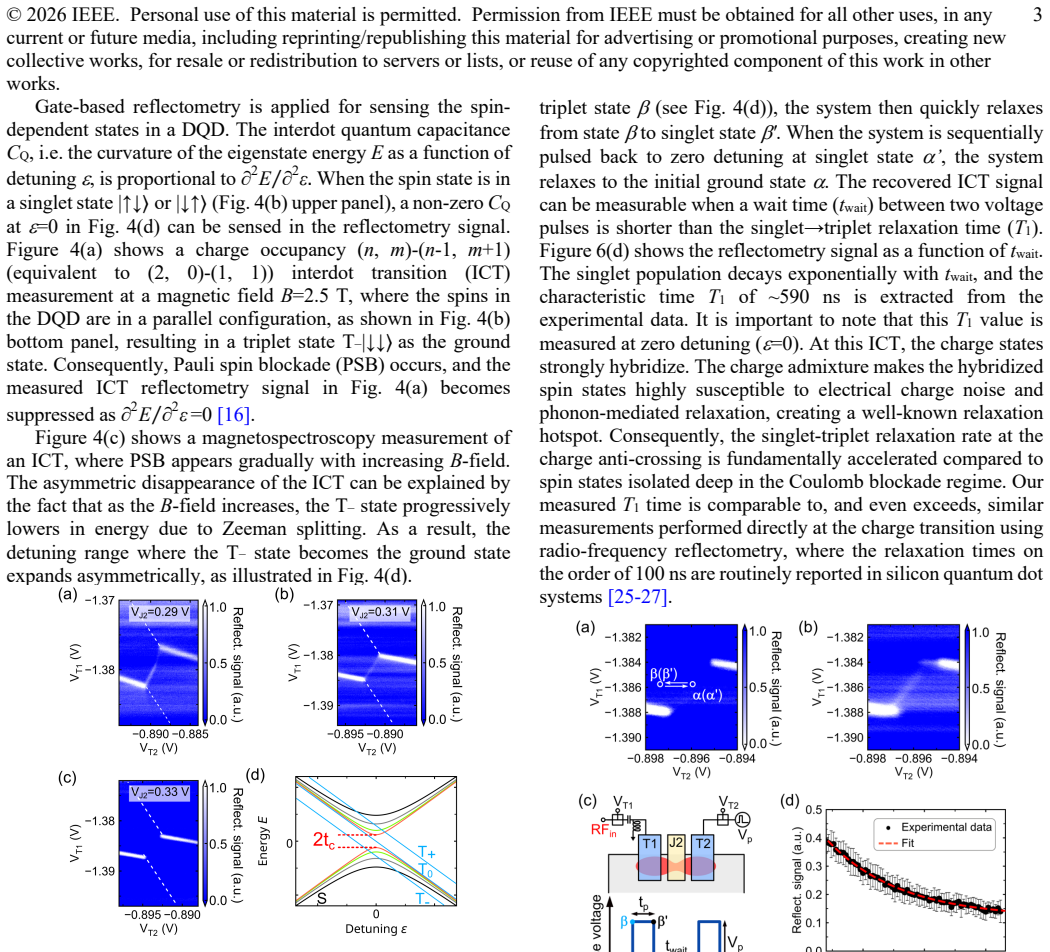
(a) Gate-based reflectometry measurement as a function of gate voltages VT1 vs VT2 at coupling gate VJ2=0.35V and magnetic field B=2.5 T. n (m) represents the number of charges in the quantum dot under gate T2 (T1). (b) Schematics of Pauli spin blockade in a double quantum dot measurement. Upper panel: at B=0, the spin orientations in both quantum dots ar...
work page 2026
-
[4]
ICT measurement (a) without a pulse train and (b) with a pulse train having wait time twait=160 ns
Singlet-triplet relaxation time (T1) measurement. ICT measurement (a) without a pulse train and (b) with a pulse train having wait time twait=160 ns. (c) Upper panel: schematic of the device setup in this measurement. An LC resonator is connected to gate T1, and a pulse train is applied to gate T2 via a bias tee. Bottom panel: schematic of a pulse train. ...
work page 2026
-
[5]
R. Li, N. I. Dumoulin Stuyck, S. Kubicek, J. Jussot, B. T. Chan, F. A. Mohiyaddin, A. Elsayed, M. Shehata, G. Simion, C. Godfrin, Y. Canvel, T. Ivanov, L. Goux, B. Govoreanu, and I. P. Radu, “A flexible 300 mm integrated Si MOS platform for electron- and hole-spin qubits exploration,” in 2020 IEEE International Electron Devices Meeting (IEDM), 2020, p. 38...
-
[6]
Tunnel and capacitive coupling optimization in FDSOI spin-qubit devices,
B. Bertrand, B. Martinez, J. Li, B. Cardoso Paz, V. Millory, V. Labracherie, L. Brévard, H. Sahin, G. Roussely, A. Sarrazin, T. Meunier, M. Vinet, Y.-M. Niquet, B. Brun, R. Maurand, S. De Franceschi, and H. Niebojewski, “Tunnel and capacitive coupling optimization in FDSOI spin-qubit devices,” in 2023 IEEE International Electron Devices Meeting (IEDM), 20...
-
[7]
DOI: 10.1038/s41928-022-00727-9
-
[8]
L. Hutin, B. Bertrand, E. Chanrion, H. Bohuslavskyi, F. Ansaloni, T.-Y. Yang, J. Michniewicz, D. J. Niegemann, C. Spence, T. Lundberg, A. Chatterjee, A. Crippa, J. Li, R. Maurand, X. Jehl, M. Sanquer, M. F. Gonzalez-Zalba, F. Kuemmeth, Y.-M. Niquet, S. De Franceschi, M. Urdampilleta, T. Meunier, and M. Vinet, “Gate reflectometry for probing charge and spi...
-
[9]
DOI: 10.1103/PhysRevA.57.120
-
[10]
DOI: 10.1038/s41586-020-2171-6
-
[11]
DOI: 10.1038/s41586-020-2170-7
-
[12]
DOI: 10.1038/s41928-022-00722-0
-
[13]
DOI: 10.1038/s41467-019-10848-z
-
[14]
DOI: 10.1038/ncomms13575
-
[15]
DOI: 10.1103/PhysRevB.104.235303
-
[16]
DOI: 10.1038/s41565-022-01196-z
-
[17]
DOI: 10.1103/PhysRevLett.120.137702
-
[18]
DOI: 10.1038/s41534-018-0059-1
-
[19]
DOI: 10.1063/5.0088229
-
[20]
DOI: 10.1103/PhysRevB.95.045414
-
[21]
DOI: 10.1103/PhysRevLett.110.046805
-
[22]
DOI: 10.1038/s41928-021-00681-y
-
[23]
DOI: 10.1103/RevModPhys.95.025003
-
[24]
DOI: 10.1126/sciadv.aar3960
-
[25]
Metal–insulator–semiconductor capacitors,
S. M. Sze and K. K. Ng, “Metal–insulator–semiconductor capacitors,” in Physics of Semiconductor Devices, 3rd ed. Hoboken, NJ, USA: Wiley, 2006, pp. 197–240. DOI: 10.1002/9780470068328.ch4
-
[26]
DOI: 10.1063/5.0147586
-
[27]
B. Martinez, S. De Franceschi, and Y.-M. Niquet, “Mitigating variability in epitaxial-heterostructure-based spin-qubit devices by optimizing gate layout,” arXiv preprint, arXiv:2402.18991, Feb
-
[28]
DOI: 10.48550/arXiv.2402.18991
-
[29]
DOI: 10.1038/s41586-024-07275-6
-
[30]
DOI: 10.1038/ncomms9848
-
[31]
M. Urdampilleta, A. Chatterjee, A. Corna, X. Jehl, M. Vinet, M. Sanquer, and S. De Franceschi, “Charge dynamics and spin blockade in © 2026 IEEE. Personal use of this material is permitted. Permission from IEEE must be obtained for all other uses, in any current or future media, including reprinting/republishing this material for advertising or promotiona...
work page 2026
-
[32]
DOI: 10.1103/PhysRevX.5.031024
-
[33]
DOI: 10.1038/s41534-025-01102-0
discussion (0)
Sign in with ORCID, Apple, or X to comment. Anyone can read and Pith papers without signing in.