Recognition: no theorem link
Large-scale environments of star-forming active galactic nuclei: How black hole mass, accretion rate, and luminosity connect to dark matter halos
Pith reviewed 2026-05-15 13:12 UTC · model grok-4.3
The pith
X-ray AGN typically reside in dark matter halos of mass about 10^13 solar masses with no significant dependence on black hole mass, Eddington ratio or X-ray luminosity.
A machine-rendered reading of the paper's core claim, the machinery that carries it, and where it could break.
Core claim
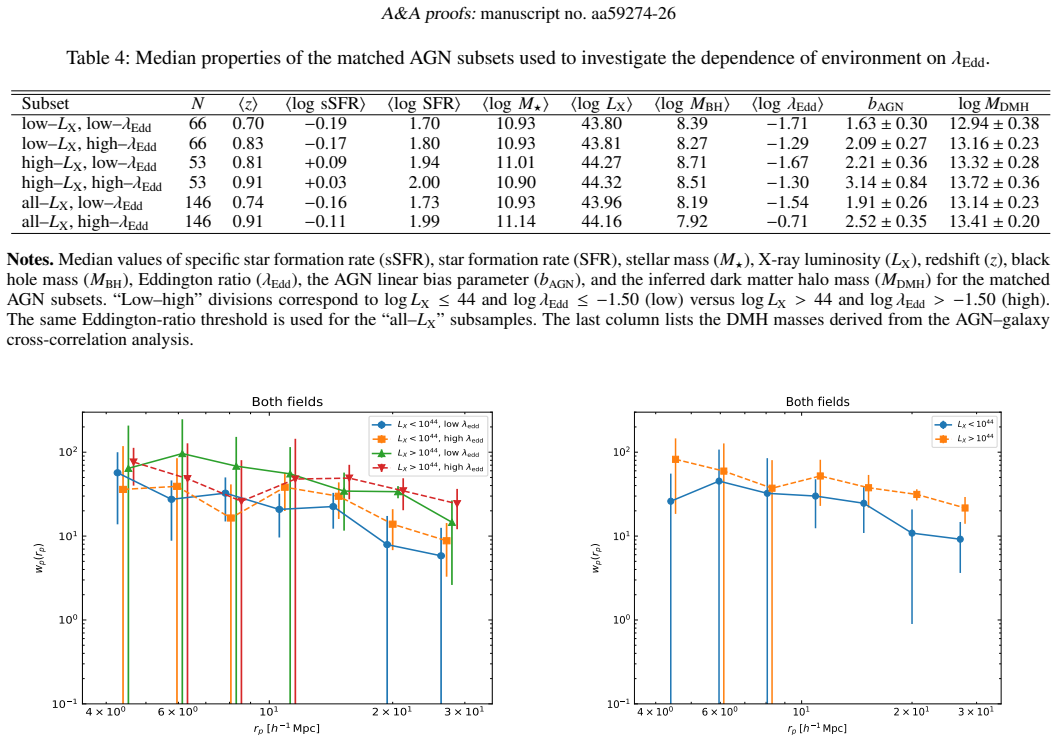
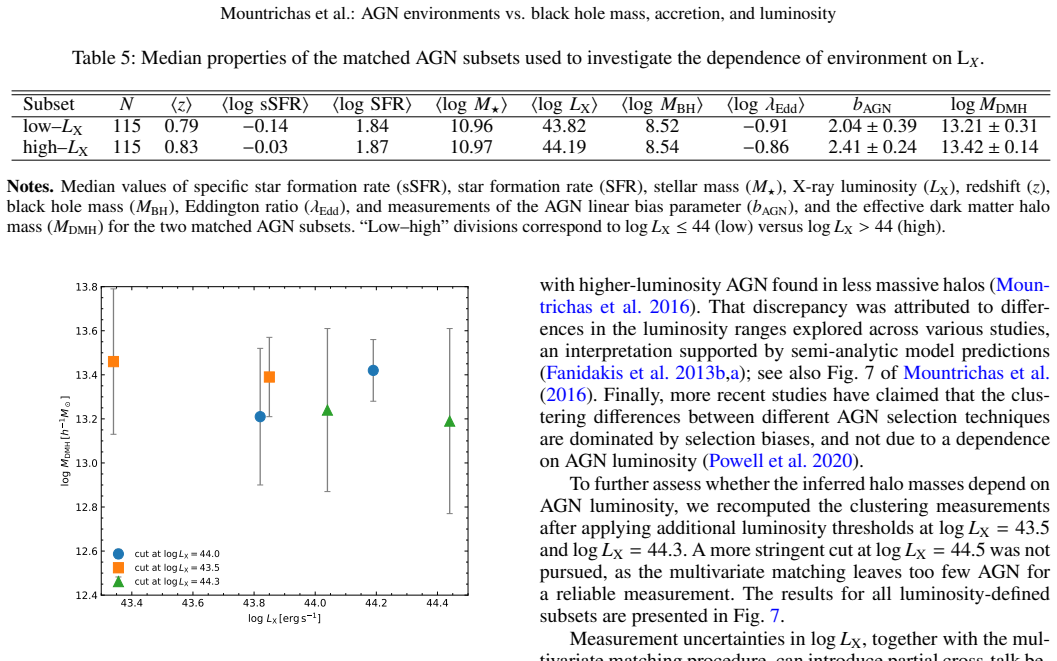
Within the uncertainties of the present dataset, X-ray AGN typically reside in halos of log(M_DMH/h^{-1}M_⊙)≃13, with no significant variation as a function of M_BH, λ_Edd, or L_X. These results suggest that neither long-term black-hole growth nor short-term accretion variability is strongly linked to large-scale environment, and instead support a scenario in which AGN properties are regulated primarily by internal host-galaxy processes, while large-scale structure sets the broader boundary conditions for gas supply and duty cycle.
What carries the argument
Multivariate nearest-neighbour matching algorithm to control for host-galaxy properties while measuring AGN-galaxy cross-correlation functions to infer dark matter halo masses.
If this is right
- Black hole growth occurs independently of the surrounding dark matter halo mass.
- Short-term changes in accretion rate are not tied to large-scale structure.
- Internal processes within the host galaxy primarily control AGN properties.
- Large-scale environment provides only boundary conditions for gas availability.
Where Pith is reading between the lines
- If the result holds, galaxy evolution models can prioritize internal feedback over environmental triggers for AGN.
- Extending the analysis to higher redshifts could reveal if this independence evolves with cosmic time.
- Future surveys with better halo mass estimates might detect subtle dependencies not seen here.
Load-bearing premise
The multivariate nearest-neighbour matching algorithm fully isolates trends with black-hole mass, Eddington ratio and X-ray luminosity by controlling for host-galaxy properties without residual biases from unaccounted variables or selection effects.
What would settle it
Detection of a statistically significant difference in halo mass as a function of black hole mass or Eddington ratio in a larger dataset using the same methodology would falsify the no-variation claim.
Figures


read the original abstract
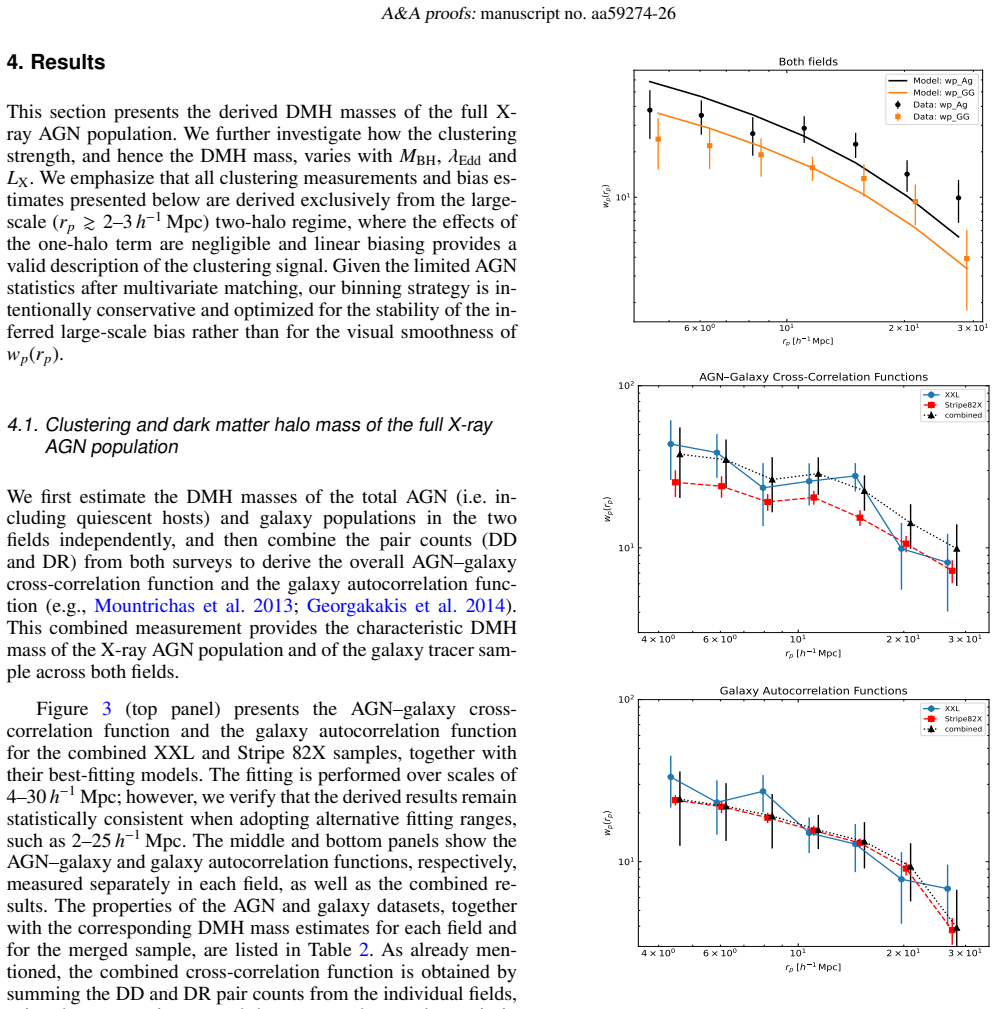
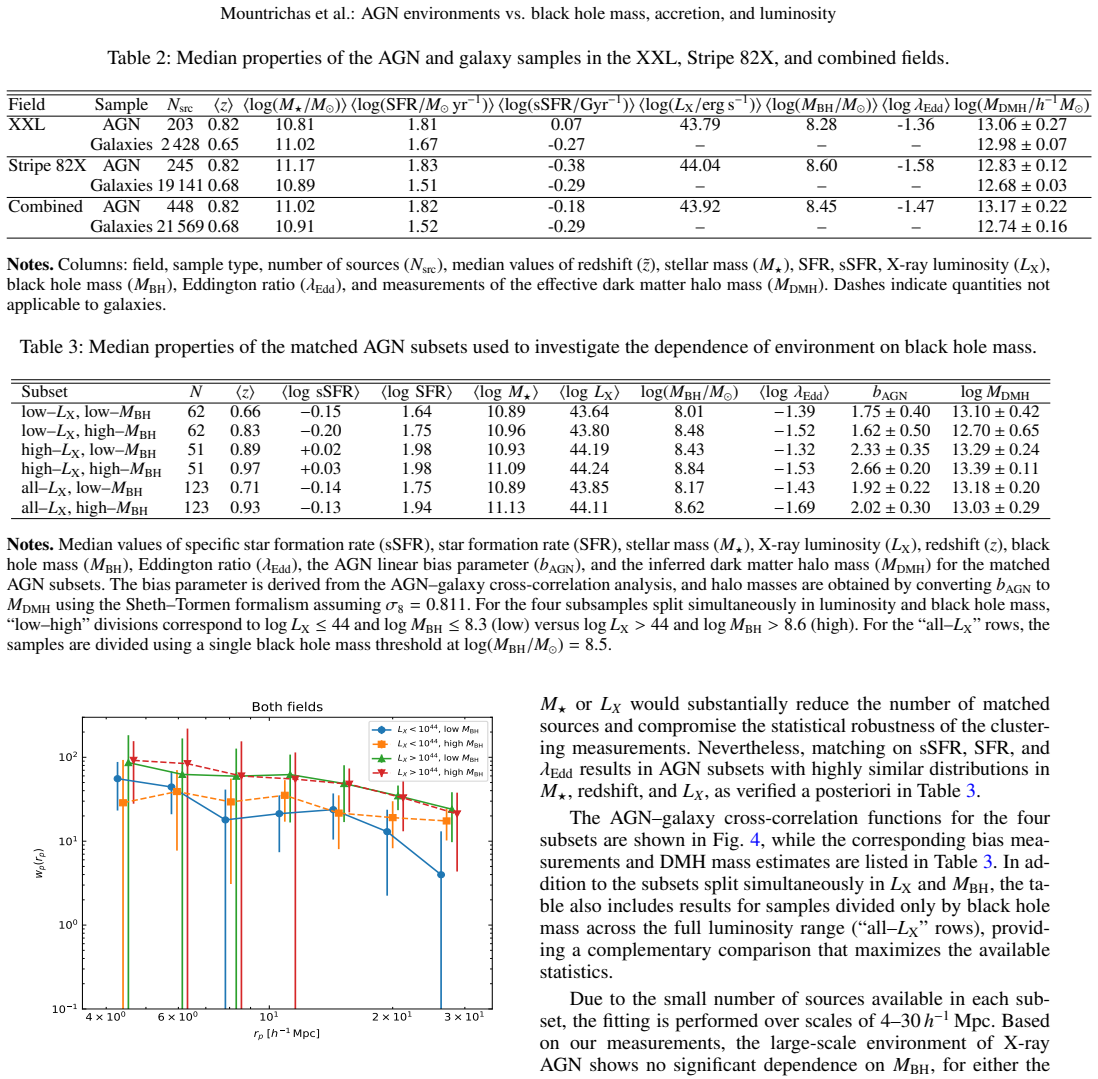
Understanding the relative roles of large-scale environment and internal host-galaxy processes in shaping AGN activity is essential for constraining models of black-hole growth and galaxy evolution. We investigate how the environment of X-ray selected active galactic nuclei (AGN) relates to black-hole growth and accretion properties, and whether these introduce an environmental dependence beyond that expected from the host galaxy itself. Combining the XXL and Stripe 82X surveys, we construct samples of 427 broad-line AGN at $0.5<z<1.2$ and more than $20,000$ galaxies, with host-galaxy properties derived consistently using the same spectral energy distribution fitting methodology. Dark matter halo (DMH) masses are inferred from AGN--galaxy cross-correlation functions, while a multivariate nearest-neighbour matching algorithm is used to isolate trends with black-hole mass ($M_{\mathrm{BH}}$), Eddington ratio ($\lambda_{\mathrm{Edd}}$), and X-ray luminosity ($L_{\mathrm{X}}$) under controlled host-galaxy conditions. Within the uncertainties of the present dataset, X-ray AGN typically reside in halos of $\log(M_{\mathrm{DMH}}/h^{-1}M_\odot)\simeq13$, with no significant variation as a function of $M_{\mathrm{BH}}$, $\lambda_{\mathrm{Edd}}$, or $L_{\mathrm{X}}$. These results suggest that neither long-term black-hole growth nor short-term accretion variability is strongly linked to large-scale environment, and instead support a scenario in which AGN properties are regulated primarily by internal host-galaxy processes, while large-scale structure sets the broader boundary conditions for gas supply and duty cycle.
Editorial analysis