Recognition: 1 theorem link
· Lean TheoremMany-Body Entanglement Properties of Finite Interacting Fermionic Hamiltonians
Pith reviewed 2026-05-15 12:46 UTC · model grok-4.3
The pith
Ground states of fermionic Hamiltonians limited to M-body interactions cannot achieve maximal M-body entanglement.
A machine-rendered reading of the paper's core claim, the machinery that carries it, and where it could break.
Core claim
if a particle number conserving fermionic Hamiltonian contains only up to M-body interaction terms, then its N-particle ground state cannot be maximally M-body entangled.
Load-bearing premise
The precise definition of a 'maximally M-body entangled' state via the M-body reduced density matrix and that the Hamiltonian is strictly limited to M-body terms with particle number conservation.
Figures

read the original abstract
We analyze many-body entanglement in interacting fermionic systems by using the $M$-body reduced density matrix. We demonstrate that if a particle number conserving fermionic Hamiltonian contains only up to $M$-body interaction terms, then its $N$-particle ground state cannot be maximally $M$-body entangled. As a key step in the proof, we show that the energy expectation value of a maximally $M$-body mixed state is equal to the spectral mean of the Hamiltonian on the corresponding $N$-particle subspace. We further demonstrate that the many-body entanglement structure of a ground state can place quantitative constraint on the interaction strength of its parent Hamiltonian. We illustrate the theorem and its implications in Hubbard and extended SYK models. Going beyond ground states, we analyze entanglement generation under unitary dynamics from Slater-determinant initial states in these models. We determine early-time growth and estimate entanglement saturation times. Finally, we derive explicit symmetry-refined saturation upper bounds for $M$-body entanglement in the presence of an Abelian symmetry.
Editorial analysis
A structured set of objections, weighed in public.
Referee Report
Summary. The paper proves that for particle-number conserving fermionic Hamiltonians truncated at M-body interactions, the N-particle ground state cannot be maximally M-body entangled (defined via the M-body reduced density matrix being maximally mixed). The central step shows that any such maximally mixed M-RDM state has energy expectation value equal to the spectral average of the Hamiltonian in the fixed-N sector; since the ground-state energy lies strictly below this average unless the spectrum is flat, maximal M-body entanglement is forbidden. The authors illustrate the result in the Hubbard and extended SYK models, derive quantitative bounds on interaction strength from entanglement structure, analyze early-time entanglement growth and saturation under unitary evolution from Slater-determinant states, and obtain symmetry-refined upper bounds on M-body entanglement saturation in the presence of Abelian symmetries.
Significance. If the central theorem holds, it supplies a clean, interaction-order-dependent no-go result on ground-state entanglement in fermionic systems that is directly relevant to variational methods, tensor-network approximations, and the design of parent Hamiltonians. The combination of the exact lemma, model illustrations, dynamical analysis, and symmetry bounds gives the work concrete utility beyond the abstract statement. The absence of free parameters or ad-hoc fitting in the core argument is a strength.
major comments (2)
- [§3] §3, Lemma 1 (energy = spectral mean): the derivation that the expectation value for the maximally mixed M-RDM equals the trace average over the N-particle subspace must be written out explicitly for the fermionic creation/annihilation operators; the current sketch leaves the precise mapping from the M-body operator to the full N-body matrix elements implicit.
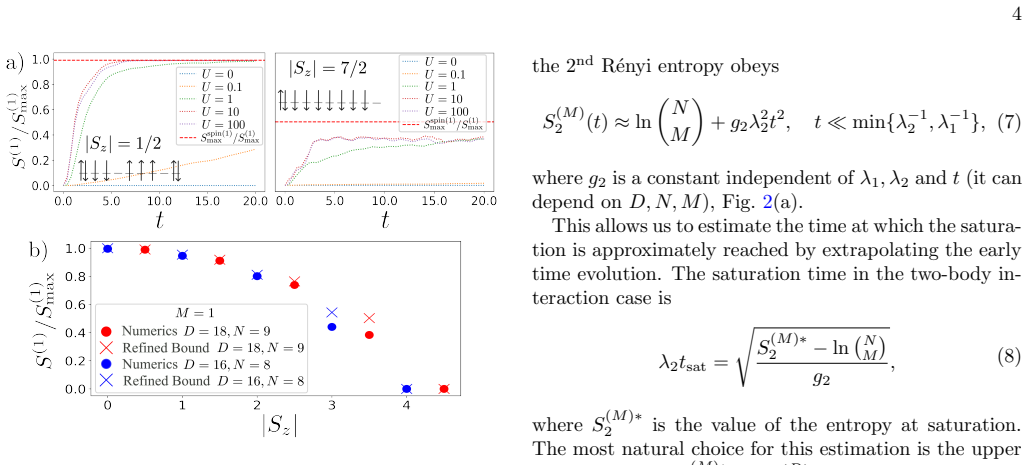
- [§4.1] §4.1, Hubbard-model numerics: the reported ground-state M-body entanglement values are stated to lie below the maximum, but the quantitative gap to the spectral-average energy (and thus to the bound) is not tabulated; without this comparison the illustration does not yet demonstrate the tightness of the theorem.
minor comments (3)
- [§2] Notation for the M-body RDM should be introduced once with a clear definition (e.g., partial trace over the complementary modes) rather than assumed from context.
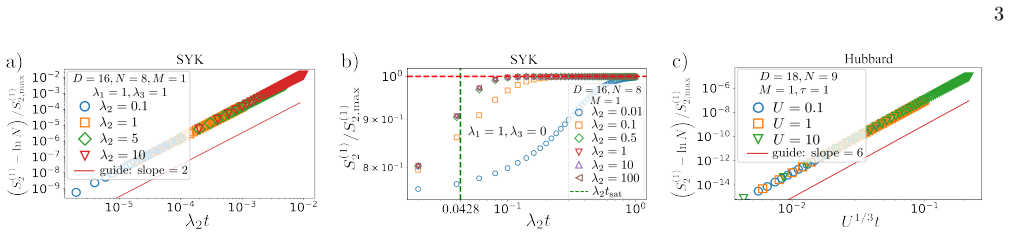
- [§5] Figure 2 (SYK entanglement growth): the saturation-time estimate would benefit from an explicit formula or fitting procedure rather than a visual guide.
- [§6] The statement of the symmetry-refined bound in the final section should include the precise Abelian symmetry group under which it holds.
Simulated Author's Rebuttal
We thank the referee for their positive assessment and constructive comments on our manuscript. We address each major comment point by point below.
read point-by-point responses
-
Referee: [§3] §3, Lemma 1 (energy = spectral mean): the derivation that the expectation value for the maximally mixed M-RDM equals the trace average over the N-particle subspace must be written out explicitly for the fermionic creation/annihilation operators; the current sketch leaves the precise mapping from the M-body operator to the full N-body matrix elements implicit.
Authors: We agree with the referee that the derivation should be expanded for clarity. In the revised manuscript, we will provide a detailed, explicit derivation of Lemma 1 using the fermionic creation and annihilation operators. This will include the precise mapping from the M-body interaction terms to the matrix elements in the full N-particle subspace, making the equality to the spectral average transparent. revision: yes
-
Referee: [§4.1] §4.1, Hubbard-model numerics: the reported ground-state M-body entanglement values are stated to lie below the maximum, but the quantitative gap to the spectral-average energy (and thus to the bound) is not tabulated; without this comparison the illustration does not yet demonstrate the tightness of the theorem.
Authors: We appreciate this suggestion. To demonstrate the tightness of the bound, we will include in the revised §4.1 a table comparing the ground-state energies with the spectral-average energies for the Hubbard model instances studied. This will quantify the gaps and show how the entanglement values relate to the theorem's prediction. revision: yes
Circularity Check
No significant circularity in derivation chain
full rationale
The paper proves that for particle-number-conserving fermionic Hamiltonians truncated at M-body terms, the N-particle ground state cannot have a maximally mixed M-body reduced density matrix. This follows directly from two standard facts: (1) the energy expectation value depends only on the M-RDM, and (2) the energy of the maximally mixed M-RDM state equals the spectral average of the Hamiltonian in the fixed-N sector, which exceeds the ground-state energy unless the spectrum is flat. Both facts are established via direct linear-algebraic calculation on the N-particle subspace without fitting parameters, self-definitional loops, or load-bearing self-citations. The definition of maximal M-body entanglement via the M-RDM is the natural one for the argument and introduces no hidden circularity. Illustrations in Hubbard and SYK models are consistent with the theorem but not used to derive it. The derivation is therefore self-contained against external mathematical benchmarks.
Axiom & Free-Parameter Ledger
axioms (2)
- domain assumption Fermionic creation and annihilation operators satisfy standard anticommutation relations and the Hamiltonian conserves particle number.
- standard math The M-body reduced density matrix is well-defined and maximal entanglement corresponds to a specific mixed state on that marginal.
Lean theorems connected to this paper
-
IndisputableMonolith/Foundation/RealityFromDistinction.leanreality_from_one_distinction unclear?
unclearRelation between the paper passage and the cited Recognition theorem.
if a particle number conserving fermionic Hamiltonian contains only up to M-body interaction terms, then its N-particle ground state cannot be maximally M-body entangled
What do these tags mean?
- matches
- The paper's claim is directly supported by a theorem in the formal canon.
- supports
- The theorem supports part of the paper's argument, but the paper may add assumptions or extra steps.
- extends
- The paper goes beyond the formal theorem; the theorem is a base layer rather than the whole result.
- uses
- The paper appears to rely on the theorem as machinery.
- contradicts
- The paper's claim conflicts with a theorem or certificate in the canon.
- unclear
- Pith found a possible connection, but the passage is too broad, indirect, or ambiguous to say the theorem truly supports the claim.
Reference graph
Works this paper leans on
-
[1]
Entanglement in many-body systems,
Luigi Amico, Rosario Fazio, Andreas Osterloh, and Vlatko Vedral, “Entanglement in many-body systems,” Rev. Mod. Phys. 80, 517–576 (2008)
work page 2008
-
[2]
Quantum entanglement in con- densed matter systems,
Nicolas Laflorencie, “Quantum entanglement in con- densed matter systems,” Physics Reports 646, 1–59 (2016), quantum entanglement in condensed matter sys- tems
work page 2016
-
[3]
Colloquium: Area laws for the entanglement entropy,
J. Eisert, M. Cramer, and M. B. Plenio, “Colloquium: Area laws for the entanglement entropy,” Reviews of Modern Physics 82, 277–306 (2010)
work page 2010
-
[4]
An area law for one-dimensional quan- tum systems,
M B Hastings, “An area law for one-dimensional quan- tum systems,” Journal of Statistical Mechanics: Theory and Experiment 2007, P08024–P08024 (2007)
work page 2007
-
[5]
Topological entangle- ment entropy,
Alexei Kitaev and John Preskill, “Topological entangle- ment entropy,” Phys. Rev. Lett. 96, 110404 (2006)
work page 2006
-
[6]
Detecting Topolog- ical Order in a Ground State Wave Function,
Michael Levin and Xiao-Gang Wen, “Detecting Topolog- ical Order in a Ground State Wave Function,” Phys. Rev. Lett. 96, 110405 (2006)
work page 2006
-
[7]
Hui Li and F. D. M. Haldane, “Entanglement spectrum as a generalization of entanglement entropy: Identifica- tion of topological order in non-abelian fractional quan- tum hall effect states,” Phys. Rev. Lett. 101, 010504 (2008)
work page 2008
-
[8]
Entanglement Spectrum of Topolog- ical Insulators and Superconductors,
Lukasz Fidkowski, “Entanglement Spectrum of Topolog- ical Insulators and Superconductors,” Phys. Rev. Lett. 104, 130502 (2010)
work page 2010
-
[9]
Entanglement Entropy and Entanglement Spectrum of the Kitaev Model,
Hong Yao and Xiao-Liang Qi, “Entanglement Entropy and Entanglement Spectrum of the Kitaev Model,” Phys. Rev. Lett. 105, 080501 (2010)
work page 2010
-
[13]
Scaling behavior of entanglement in two- and three-dimensional free-fermion systems,
Weifei Li, Letian Ding, Rong Yu, Tommaso Roscilde, and Stephan Haas, “Scaling behavior of entanglement in two- and three-dimensional free-fermion systems,” Phys. Rev. B 74, 073103 (2006)
work page 2006
-
[14]
Brian Swingle, “Entanglement entropy and the fermi surface,” Phys. Rev. Lett. 105 (2010), 10.1103/phys- revlett.105.050502
-
[15]
Trygve Helgaker, Poul Jørgensen, and Jeppe Olsen, 6 Molecular Electronic-Structure Theory (John Wiley & Sons, Ltd, 2013) reprint of the 2000 edition
work page 2013
-
[16]
Piers Coleman, Introduction to Many-Body Physics (Cambridge University Press, 2015)
work page 2015
-
[17]
Richard E. Prange and Steven M. Girvin, eds., The Quantum Hall Effect , 2nd ed. (Springer, New York, 1990)
work page 1990
-
[18]
Phenomenological theory of unconventional superconductivity,
Manfred Sigrist and Kazuo Ueda, “Phenomenological theory of unconventional superconductivity,” Rev. Mod. Phys. 63, 239–311 (1991)
work page 1991
-
[19]
Many-body physics with ultracold gases,
Immanuel Bloch, Jean Dalibard, and Wilhelm Zwerger, “Many-body physics with ultracold gases,” Rev. Mod. Phys. 80, 885–964 (2008)
work page 2008
-
[20]
Quantum simu- lations with ultracold atoms in optical lattices,
Christian Gross and Immanuel Bloch, “Quantum simu- lations with ultracold atoms in optical lattices,” Science 357, 995–1001 (2017)
work page 2017
-
[21]
Fermionic quantum processing with programmable neutral atom arrays,
D. Gonz´ alez-Cuadra, D. Bluvstein, M. Kalinowski, R. Kaubruegger, N. Maskara, P. Naldesi, T. V. Zache, A. M. Kaufman, M. D. Lukin, H. Pichler, B. Vermersch, Jun Ye, and P. Zoller, “Fermionic quantum processing with programmable neutral atom arrays,” Proceedings of the National Academy of Sciences 120, e2304294120 (2023)
work page 2023
-
[22]
Gapless spin-fluid ground state in a random quantum heisenberg magnet,
Subir Sachdev and Jinwu Ye, “Gapless spin-fluid ground state in a random quantum heisenberg magnet,” Phys. Rev. Lett. 70, 3339–3342 (1993)
work page 1993
-
[23]
Remarks on the sachdev-ye-kitaev model,
Juan Maldacena and Douglas Stanford, “Remarks on the sachdev-ye-kitaev model,” Phys. Rev. D 94, 106002 (2016)
work page 2016
-
[24]
Sachdev-ye-kitaev models and beyond: Window into non-fermi liquids,
Debanjan Chowdhury, Antoine Georges, Olivier Parcol- let, and Subir Sachdev, “Sachdev-ye-kitaev models and beyond: Window into non-fermi liquids,” Rev. Mod. Phys. 94, 035004 (2022)
work page 2022
-
[25]
Structure of fermion density matrices,
A. J. Coleman, “Structure of fermion density matrices,” Rev. Mod. Phys. 35, 668–686 (1963)
work page 1963
-
[26]
Many- body entanglement in fermion systems,
N. Gigena, M. Di Tullio, and R. Rossignoli, “Many- body entanglement in fermion systems,” Phys. Rev. A 103, 052424 (2021)
work page 2021
-
[27]
Entropy and entanglement bounds for reduced density matrices of fermionic states
Eric A. Carlen, Elliott H. Lieb, and Robin Reuvers, “Entropy and entanglement bounds for reduced density matrices of fermionic states,” (2016), arXiv:1403.3816 [math.OA]
work page internal anchor Pith review Pith/arXiv arXiv 2016
-
[28]
Characterizing max- imally many-body entangled fermionic states by using M-body density matrix,
Irakli Giorgadze, Haixuan Huang, Jordan Gaines, Elio J. K¨ onig, and Jukka I. V¨ ayrynen, “Characterizing max- imally many-body entangled fermionic states by using M-body density matrix,” Quantum 9, 1778 (2025)
work page 2025
-
[29]
Entanglement entropy in fermionic laughlin states,
Masudul Haque, Oleksandr Zozulya, and Kareljan Schoutens, “Entanglement entropy in fermionic laughlin states,” Phys. Rev. Lett. 98, 060401 (2007)
work page 2007
-
[30]
Par- ticle partitioning entanglement in itinerant many-particle systems,
O. S. Zozulya, Masudul Haque, and K. Schoutens, “Par- ticle partitioning entanglement in itinerant many-particle systems,” Phys. Rev. A 78, 042326 (2008)
work page 2008
-
[31]
En- tanglement between particle partitions in itinerant many- particle states,
Masudul Haque, O S Zozulya, and K Schoutens, “En- tanglement between particle partitions in itinerant many- particle states,” Journal of Physics A: Mathematical and Theoretical 42, 504012 (2009)
work page 2009
-
[32]
Quantum correlations in systems of indistinguishable particles,
K. Eckert, J. Schliemann, D. Bruß, and M. Lewenstein, “Quantum correlations in systems of indistinguishable particles,” Annals of Physics 299, 88–127 (2002)
work page 2002
-
[33]
See the Supplementary Material
-
[34]
David A. Mazziotti, “Two-electron reduced density ma- trix as the basic variable in many-electron quantum chemistry and physics,” Chemical Reviews 112, 244–262 (2012), pMID: 21863900
work page 2012
-
[35]
Structure of fermionic density ma- trices: Complete n-representability conditions,
David A. Mazziotti, “Structure of fermionic density ma- trices: Complete n-representability conditions,” Phys. Rev. Lett. 108, 263002 (2012)
work page 2012
-
[36]
Quantum marginal problem and representations of the symmetric group
Alexander Klyachko, “Quantum marginal problem and representations of the symmetric group,” (2004), arXiv:quant-ph/0409113 [quant-ph]
work page internal anchor Pith review Pith/arXiv arXiv 2004
-
[37]
Geometric constraints on two-electron re- duced density matrices,
Yimin Li, “Geometric constraints on two-electron re- duced density matrices,” Phys. Rev. A 103, 052202 (2021)
work page 2021
-
[38]
Natural orbitals in the quantum theory of two-electron systems,
Per-Olov L¨ owdin and Harrison Shull, “Natural orbitals in the quantum theory of two-electron systems,” Phys. Rev. 101, 1730–1739 (1956)
work page 1956
-
[39]
Hohenberg-kohn theorem for nonlocal ex- ternal potentials,
T. L. Gilbert, “Hohenberg-kohn theorem for nonlocal ex- ternal potentials,” Phys. Rev. B 12, 2111–2120 (1975)
work page 1975
-
[40]
Energy functional of the one-particle reduced density matrix: a geminal approach,
David A Mazziotti, “Energy functional of the one-particle reduced density matrix: a geminal approach,” Chemical Physics Letters 338, 323–328 (2001)
work page 2001
-
[41]
Bench- mark calculations for reduced density-matrix functional theory,
N. N. Lathiotakis and Miguel A. L. Marques, “Bench- mark calculations for reduced density-matrix functional theory,” The Journal of Chemical Physics 128, 184103 (2008)
work page 2008
-
[42]
Faluke Aikebaier, Teemu Ojanen, and Jose L. Lado, “Extracting electronic many-body correlations from lo- cal measurements with artificial neural networks,” Sci- Post Phys. Core 6, 030 (2023)
work page 2023
-
[43]
Complexity of fermionic states,
Tuomas I. Vanhala and Teemu Ojanen, “Complexity of fermionic states,” Phys. Rev. Res. 6, 023178 (2024)
work page 2024
-
[44]
Entanglement prop- erties of some fractional quantum hall liquids,
Bei Zeng, Hui Zhai, and Zhan Xu, “Entanglement prop- erties of some fractional quantum hall liquids,” Phys. Rev. A 66, 042324 (2002)
work page 2002
-
[45]
Cumulant expansion of the reduced density matrices,
Werner Kutzelnigg and Debashis Mukherjee, “Cumulant expansion of the reduced density matrices,” The Journal of Chemical Physics 110, 2800–2809 (1999)
work page 1999
-
[46]
Tam´ as Juh´ asz and David A. Mazziotti, “The cumu- lant two-particle reduced density matrix as a measure of electron correlation and entanglement,” The Journal of Chemical Physics 125, 174105 (2006)
work page 2006
-
[47]
Julie T. Skolnik and David A. Mazziotti, “Cumulant re- duced density matrices as measures of statistical depen- dence and entanglement between electronic quantum do- mains with application to photosynthetic light harvest- ing,” Phys. Rev. A 88, 032517 (2013)
work page 2013
-
[48]
Alexandra Raeber and David A. Mazziotti, “Large eigen- value of the cumulant part of the two-electron reduced density matrix as a measure of off-diagonal long-range order,” Phys. Rev. A 92, 052502 (2015)
work page 2015
-
[49]
Large cumulant eigenvalue as a signature of exciton condensation,
Anna O. Schouten, LeeAnn M. Sager-Smith, and David A. Mazziotti, “Large cumulant eigenvalue as a signature of exciton condensation,” Phys. Rev. B 105, 245151 (2022)
work page 2022
-
[50]
Entanglement witness for indistinguishable electrons us- ing solid-state spectroscopy,
Tongtong Liu, Luogen Xu, Jiarui Liu, and Yao Wang, “Entanglement witness for indistinguishable electrons us- ing solid-state spectroscopy,” Phys. Rev. X 15, 011056 (2025)
work page 2025
-
[51]
By means of reflection ˆH → − ˆH, we note that the same argument applies to the eigenstate corresponding to the maximum N-particle eigenvalue of ˆH
-
[52]
Physically, we work in the canonical ensemble and diag- onalize ˆHHub in a fixed- N particle sector. Consequently, a chemical potential term −µ ˆN would only shift ener- gies by a constant −µN in that sector and hence shift µ1 by the same constant. At the same time, it would not affect the eigenstates or their entanglement properties 7 discussed in the paper
-
[53]
Filiberto Ares, Sara Murciano, Eric Vernier, and Pasquale Calabrese, “Lack of symmetry restoration af- ter a quantum quench: An entanglement asymmetry study,” SciPost Physics 15 (2023), 10.21468/scipost- phys.15.3.089
-
[54]
Spin-resolved entanglement spectroscopy of critical spin chains and lut- tinger liquids,
Nicolas Laflorencie and Stephan Rachel, “Spin-resolved entanglement spectroscopy of critical spin chains and lut- tinger liquids,” Journal of Statistical Mechanics: Theory and Experiment 2014, P11013 (2014)
work page 2014
-
[55]
Symmetry-resolved en- tanglement in many-body systems,
Moshe Goldstein and Eran Sela, “Symmetry-resolved en- tanglement in many-body systems,” Phys. Rev. Lett. 120, 200602 (2018)
work page 2018
-
[56]
Equipartition of the entanglement entropy,
J. C. Xavier, F. C. Alcaraz, and G. Sierra, “Equipartition of the entanglement entropy,” Phys. Rev. B 98, 041106 (2018)
work page 2018
-
[57]
Symmetry resolved entanglement in free fermionic systems,
Riccarda Bonsignori, Paola Ruggiero, and Pasquale Calabrese, “Symmetry resolved entanglement in free fermionic systems,” Journal of Physics A: Mathematical and Theoretical 52, 475302 (2019)
work page 2019
-
[58]
Exact quench dynamics of symmetry resolved entanglement in a free fermion chain,
Gilles Parez, Riccarda Bonsignori, and Pasquale Cal- abrese, “Exact quench dynamics of symmetry resolved entanglement in a free fermion chain,” Journal of Statis- tical Mechanics: Theory and Experiment 2021, 093102 (2021). S-1 Supplementary materials on “Many-body Entanglement Properties of Finite Interacting F ermionic Hamiltonians” Irakli Giorgadze1, Gr...
work page 2021
-
[59]
We will get zero contribution to the sum unless {ij} = {kl}, hence α = β. S-2
-
[60]
Note that, D−2 N −2 = ( N 2) ( D 2) D N
For a given {ij} = {kl} pair, there can be D−2 N −2 remaining |SDσ⟩ Slater determinants in the sum over σ that contain this particular pair of orbitals. Note that, D−2 N −2 = ( N 2) ( D 2) D N . Hence, using the above two remarks, we obtain µ1 = N 2 D 2 ( D 2)X α=1 (2!)2 H(2) flat αα = N 2 D 2 Tr (2!)2H(2) flat . (S6) Now we consider generic s-body intera...
-
[61]
Trace of a block First, let us consider the state to be N-fermion Slater determinant (SD) with Nσ fermions having internal label σ for all σ ∈ {1, . . . , l} such that N = lP σ=1 Nσ. Then the contribution to the block ˆ ρ(M)(m1 . . . ml) is lQ σ=1 Nσ mσ unit entries on the diagonal. This is the case because mσ fermions with internal label σ can be chosen ...
-
[62]
Size of a block In the case of D/l sites on the lattice, since all sites can accommodate fermions with any σ internal label, we haveD/l mσ ways to arrange the mσ fermions with internal label σ on D/l lattice sites ∀σ. Hence, the size of the block is nsize(m1 . . . ml) = lY σ=1 D/l mσ . (S42) It is important to note that mσ ≤ D/l, ∀σ. This follows from the...
discussion (0)
Sign in with ORCID, Apple, or X to comment. Anyone can read and Pith papers without signing in.