The SMUGGLE-Ring project: Bar and bulge effects on nuclear disk and ring formation
Pith reviewed 2026-05-21 11:43 UTC · model grok-4.3
The pith
Nuclear stellar disks and rings form exclusively in galaxies with classical bulges via bar-driven secular evolution.
A machine-rendered reading of the paper's core claim, the machinery that carries it, and where it could break.
Core claim
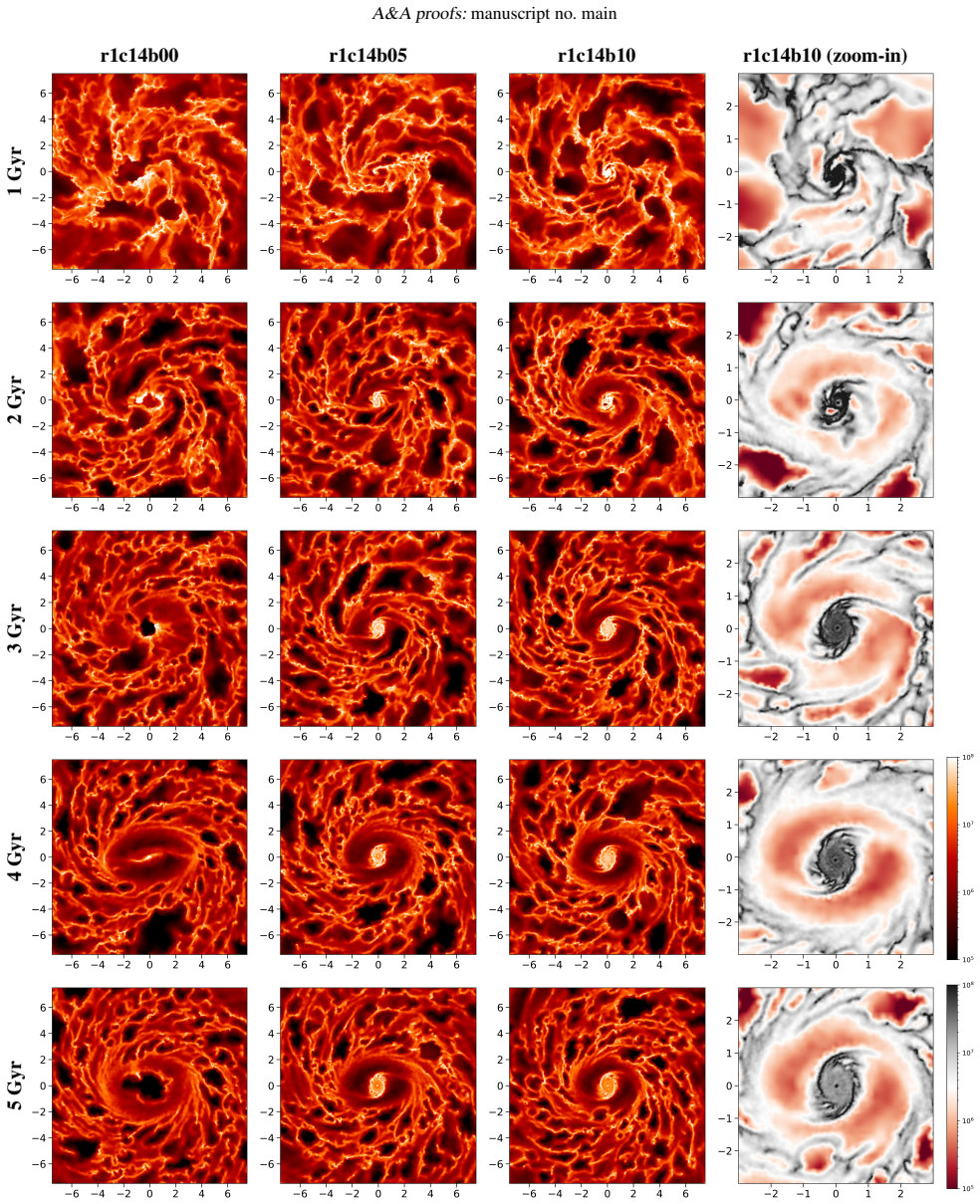
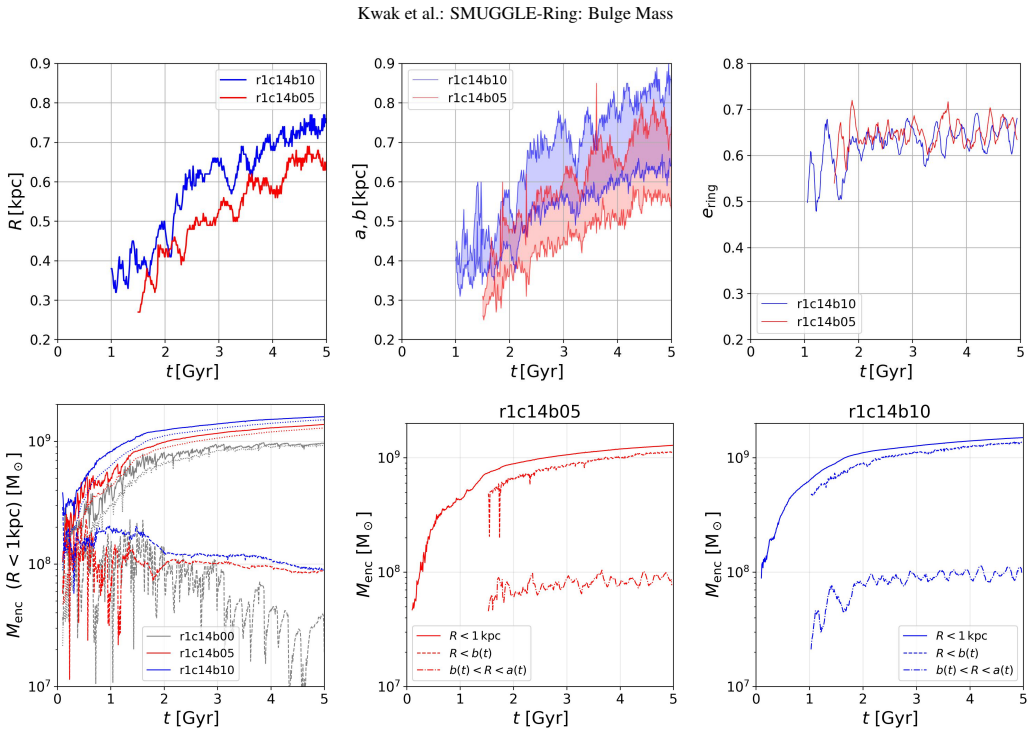
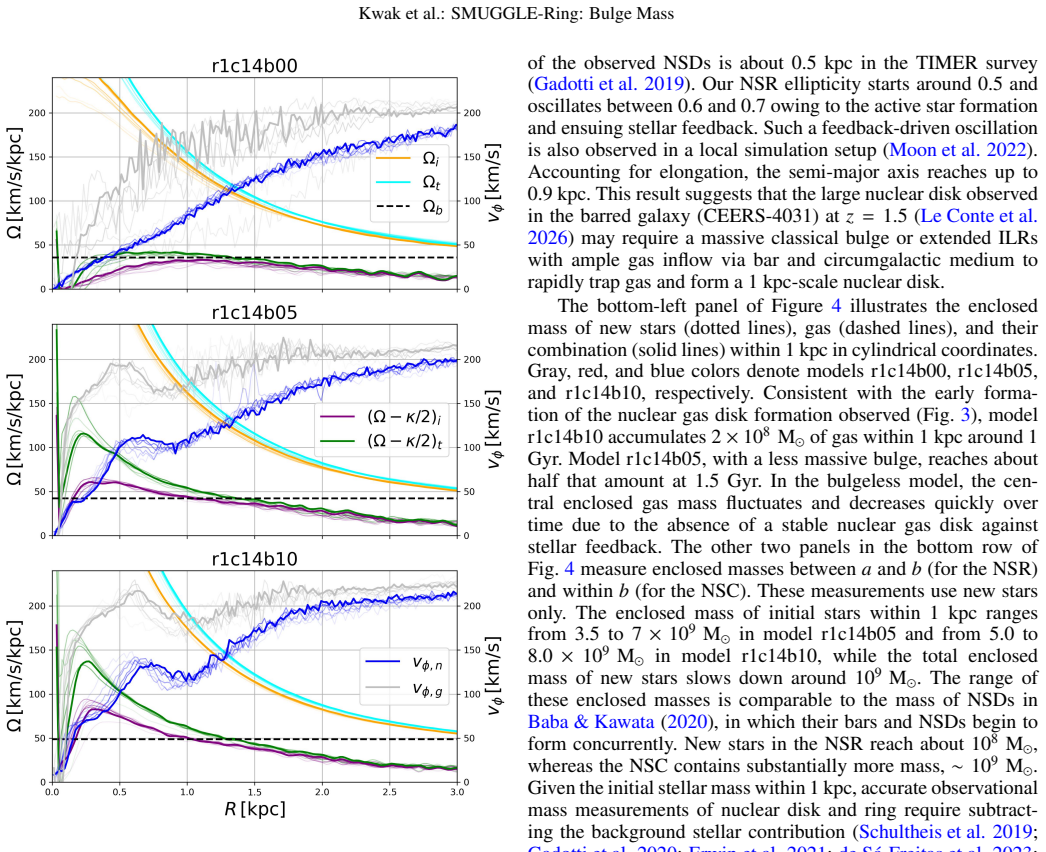
In simulations evolved for 5 Gyr in isolation with the SMUGGLE model, varying only the classical bulge mass while keeping disk and halo fixed, nuclear stellar disks and rings emerge exclusively in the bulge models. More massive bulges correlate with earlier formation and more extended gas reservoirs shortly after bar formation. Upon gas depletion, the nuclear stellar disks bifurcate into pressure-supported nuclear star clusters (v_phi/sigma_R < 0.7) and rotationally supported nuclear stellar rings (v_phi/sigma_R = 1.2-1.7, radii 0.64-0.76 kpc). The bulgeless model fails to sustain stable nuclear gas disks. The enclosed masses are ~10^9 Msun for NSCs and ~10^8 Msun for NSRs, with SFRs 0.1-1 M
What carries the argument
The classical bulge mass, which stabilizes the nuclear gas disk against stellar feedback disruptions after bar-driven gas inflow, enabling the subsequent bifurcation into nuclear star clusters and nuclear stellar rings.
If this is right
- More massive bulges lead to earlier nuclear disk formation and more extended gas reservoirs.
- Nuclear stellar disks split into hotter inner clusters and cooler outer rings after gas depletion.
- Star formation rates in these structures decrease over time as gas is consumed.
- Observed nuclear disk sizes from 0.25 to 0.76 kpc align with simulation results.
- Larger nuclear rings would require external gas inflows or extended evolution times.
Where Pith is reading between the lines
- The presence of a bulge may be a necessary condition for stable nuclear ring formation in the absence of mergers or inflows.
- Extending the simulation time or adding circumgalactic medium could reveal whether rings grow beyond 0.76 kpc.
- Variations in initial gas fraction might produce different nuclear structure outcomes even with bulges.
- This inside-out mechanism could explain the observed diversity of nuclear stellar structures in disk galaxies.
Load-bearing premise
Evolving the galaxies in complete isolation for 5 Gyr with fixed initial disk and halo structures while only varying bulge mass is sufficient to capture the main physics of nuclear structure formation without external gas inflows or mergers.
What would settle it
Finding nuclear stellar rings or stable nuclear gas disks in observed bulgeless Milky Way-mass galaxies, or in simulations that include mergers and external gas flows for bulgeless models, would test the necessity of the bulge.
Figures





read the original abstract
We present the first results from the SMUGGLE-Ring project, a suite of simulations employing the SMUGGLE ISM and stellar feedback model to explore nuclear structures in Milky Way-mass galaxies. We discuss results from three simulations evolved for 5 Gyr in isolation, in which we vary the classical bulge mass, while keeping the disk and halo structures identical. Nuclear stellar disks and rings emerge exclusively in our bulge models, with more massive bulges associated with earlier formation and more extended initial gas reservoirs shortly after bar formation. After gas depletion via active star formation, the nuclear stellar disks bifurcate into pressure-supported nuclear star clusters (NSCs, $v_{\phi}/\sigma_R < 0.7$) and rotationally supported nuclear stellar rings (NSRs, $v_{\phi}/\sigma_R = 1.2$--1.7, radii 0.64--0.76 kpc). The bulgeless model fails to build up and sustain stable nuclear gas disks against feedback disruptions. The enclosed stellar mass of NSCs ($\sim10^{9}\Msun$) dominates over that of NSRs ($\sim10^{8}\Msun$). The star formation rates decline over time due to gas depletion (NSCs 0.1--1 $\Msun$/yr, NSRs 0.01--$0.1 \Msun$/yr). Kinematics reveal outward-shifting rotation peaks with $\sigma$-drops in NSRs, while a fraction of stars in NSCs exhibits radial shift after 3 Gyr. These findings support inside-out NSD formation via secular bar evolution, with NSRs tracing the star-forming outer edge of the nuclear gas disk and NSCs forming the kinematically hotter inner component. The range of nuclear stellar disk sizes (0.25--0.76 kpc) falls within the observationally inferred ranges, but the existence of larger rings would require external gas flow and/or a longer period of evolution. Future SMUGGLE-Ring extensions will incorporate varying gas fractions, tidal/merger effects, and the circumgalactic medium to further elucidate nuclear diversity and outliers.
Editorial analysis
A structured set of objections, weighed in public.
Referee Report
Summary. The manuscript presents the first results from the SMUGGLE-Ring project, consisting of three hydrodynamical simulations of Milky Way-mass galaxies evolved in isolation for 5 Gyr using the SMUGGLE ISM and stellar feedback model. The classical bulge mass is varied while keeping the disk and halo structures fixed. The central claim is that nuclear stellar disks and rings form exclusively in the bulge-containing models, with more massive bulges leading to earlier formation and more extended gas reservoirs after bar formation. Following gas depletion through star formation, these nuclear disks bifurcate into pressure-supported nuclear star clusters (NSCs with v_φ/σ_R < 0.7) and rotationally supported nuclear stellar rings (NSRs with v_φ/σ_R = 1.2–1.7 and radii 0.64–0.76 kpc). The bulgeless model does not sustain stable nuclear gas disks. Additional findings include declining star formation rates, kinematic features like σ-drops, and support for inside-out formation via secular bar evolution.
Significance. If the reported trends are robust, this work contributes to understanding the role of classical bulges in the formation of nuclear stellar structures through bar-driven secular evolution in isolated galaxies. The direct comparison across bulge masses with a consistent feedback model is a strength, as is the demonstration of the bifurcation into NSCs and NSRs with distinct kinematic properties. The results align with observed nuclear disk sizes and provide a physical mechanism for their diversity. The use of direct forward integration without fitted parameters or invented entities supports the internal consistency of the trends.
major comments (2)
- [Simulation setup] Simulation setup (inferred from abstract description of three isolated runs): No details are provided on numerical resolution, particle mass, gravitational softening, or convergence tests in the nuclear region. This is load-bearing for the central claim because the bulgeless model's failure to sustain stable nuclear gas disks is attributed to feedback disruptions, which are known to be sensitive to resolution.
- [Abstract] Abstract: The reported nuclear ring radii (0.64–0.76 kpc), enclosed masses (~10^8–10^9 M_sun), and velocity ratios lack any quantitative error analysis, uncertainty estimates, or sensitivity tests to initial gas distribution. This undermines the precision of the mass-dependent timing, bifurcation, and exclusivity claims.
minor comments (2)
- [Abstract] The thresholds v_φ/σ_R < 0.7 for NSCs and 1.2–1.7 for NSRs should be explicitly justified or referenced to prior observational/theoretical work in the main text.
- [Abstract] The statement that larger rings would require external gas flow should be expanded with a brief discussion of how the fixed initial gas reservoir limits the reported size range (0.25–0.76 kpc).
Simulated Author's Rebuttal
We thank the referee for their constructive review and positive assessment of the significance of our work on the role of classical bulges in nuclear structure formation. We address each major comment point by point below and will make revisions to improve clarity and completeness.
read point-by-point responses
-
Referee: [Simulation setup] Simulation setup (inferred from abstract description of three isolated runs): No details are provided on numerical resolution, particle mass, gravitational softening, or convergence tests in the nuclear region. This is load-bearing for the central claim because the bulgeless model's failure to sustain stable nuclear gas disks is attributed to feedback disruptions, which are known to be sensitive to resolution.
Authors: We agree that explicit numerical details are important for evaluating the robustness of feedback-driven effects in the nuclear region. The full manuscript describes the SMUGGLE model setup in Section 2, including the base resolution, but we will expand this to provide specific values for gas particle mass, stellar particle mass, and gravitational softening length in the central kiloparsec. We will also add a short discussion of resolution convergence tests performed on a subset of runs and clarify why the chosen resolution is sufficient to capture the differential stability between bulge and bulgeless models. This addresses the referee's concern directly. revision: yes
-
Referee: [Abstract] Abstract: The reported nuclear ring radii (0.64–0.76 kpc), enclosed masses (~10^8–10^9 M_sun), and velocity ratios lack any quantitative error analysis, uncertainty estimates, or sensitivity tests to initial gas distribution. This undermines the precision of the mass-dependent timing, bifurcation, and exclusivity claims.
Authors: We acknowledge that the abstract presents numerical values without accompanying discussion of robustness. As these are outcomes from a small suite of deterministic simulations, formal statistical uncertainties do not apply, but we will revise the abstract to note that the reported ranges reflect variations across the three bulge-mass models. In the main text we will add a brief sensitivity analysis to initial gas distribution and initial conditions, along with a statement on how these affect the timing and exclusivity claims. This will be a partial revision focused on presentation rather than changes to the underlying results. revision: partial
Circularity Check
No circularity: results from direct hydrodynamical integration of varied initial conditions
full rationale
The paper's central claims follow from forward integration of the SMUGGLE ISM and feedback model in three isolated 5 Gyr runs that differ only in classical bulge mass while holding disk, halo, and total gas reservoir fixed. Nuclear stellar disks and rings are reported to form exclusively in the bulge cases, with mass-dependent timing and later bifurcation into NSCs versus NSRs, as direct outcomes of the evolved gas dynamics, star formation, and feedback. No parameter is fitted to a data subset and then relabeled a prediction, no quantity is defined in terms of itself, and no uniqueness theorem or ansatz is imported via self-citation to force the result. The SMUGGLE model itself is an external, previously published prescription whose implementation is independent of the present runs. The reported size range and exclusivity are therefore tied to the chosen initial conditions rather than to any definitional loop within the derivation.
Axiom & Free-Parameter Ledger
free parameters (1)
- classical bulge mass
axioms (2)
- domain assumption The SMUGGLE ISM and stellar feedback model accurately captures the relevant physics of gas cooling, star formation, and supernova feedback in the nuclear region.
- domain assumption Initial disk and halo structures remain identical when bulge mass is changed, so differences arise solely from the bulge.
Reference graph
Works this paper leans on
-
[1]
Agertz, O., Kravtsov, A. V ., Leitner, S. N., & Gnedin, N. Y . 2013, ApJ, 770, 25
work page 2013
- [2]
- [3]
- [4]
- [5]
-
[6]
Athanassoula, E., Machado, R. E. G., & Rodionov, S. A. 2013, MNRAS, 429, 1949
work page 2013
- [7]
- [8]
- [9]
-
[10]
Barbani, F., Pascale, R., Marinacci, F., et al. 2023, MNRAS, 524, 4091
work page 2023
-
[11]
Barbani, F., Pascale, R., Marinacci, F., et al. 2025, A&A, 697, A121
work page 2025
- [12]
- [13]
-
[14]
2023, ApJ, 953, 173 Benítez-Llambay, A., Navarro, J
Beane, A., Hernquist, L., D’Onghia, E., et al. 2023, ApJ, 953, 173 Benítez-Llambay, A., Navarro, J. F., Frenk, C. S., & Ludlow, A. D. 2018, MN- RAS, 473, 1019
work page 2023
-
[15]
Berentzen, I., Shlosman, I., Martinez-Valpuesta, I., & Heller, C. H. 2007, ApJ, 666, 189
work page 2007
- [16]
- [17]
-
[18]
Bland-Hawthorn, J., Tepper-Garcia, T., Agertz, O., & Federrath, C. 2024, ApJ, 968, 86
work page 2024
-
[19]
Bono, G., Braga, V . F., & Pietrinferni, A. 2024, A&A Rev., 32, 4
work page 2024
- [20]
-
[21]
Bose, S., Eisenstein, D. J., Hernquist, L., et al. 2019, MNRAS, 490, 5693
work page 2019
- [22]
-
[23]
Burger, J. D., Zavala, J., Sales, L. V ., et al. 2022, MNRAS, 513, 3458
work page 2022
- [24]
- [25]
- [26]
-
[27]
1996, in Astronomical Society of the Pacific Conference Series, V ol
Combes, F. 1996, in Astronomical Society of the Pacific Conference Series, V ol. 91, IAU Colloquium 157: Barred Galaxies, ed. R. Buta, D. A. Crocker, & B. G. Elmegreen, 286
work page 1996
- [28]
-
[29]
Combes, F. & Gerin, M. 1985, A&A, 150, 327 de Lorenzo-Cáceres, A., Falcón-Barroso, J., Vazdekis, A., & Martínez-
work page 1985
-
[30]
2008, ApJ, 684, L83 de Sá-Freitas, C., Gadotti, D
Valpuesta, I. 2008, ApJ, 684, L83 de Sá-Freitas, C., Gadotti, D. A., Fragkoudi, F., et al. 2023, A&A, 678, A202
work page 2008
- [31]
- [32]
- [33]
-
[34]
Erwin, P., Saglia, R. P., Fabricius, M., et al. 2015, MNRAS, 446, 4039
work page 2015
- [35]
-
[36]
Eskridge, P. B., Frogel, J. A., Pogge, R. W., et al. 2000, AJ, 119, 536 Faucher-Giguère, C.-A., Lidz, A., Zaldarriaga, M., & Hernquist, L. 2009, ApJ, 703, 1416
work page 2000
-
[37]
Ferland, G. J., Korista, K. T., Verner, D. A., et al. 1998, PASP, 110, 761 Ferrière, K. M. 2001, Reviews of Modern Physics, 73, 1031
work page 1998
-
[38]
Field, G. B., Goldsmith, D. W., & Habing, H. J. 1969, ApJ, 155, L149
work page 1969
- [39]
- [40]
- [41]
-
[42]
A., Bittner, A., Falcón-Barroso, J., et al
Gadotti, D. A., Bittner, A., Falcón-Barroso, J., et al. 2020, A&A, 643, A14
work page 2020
-
[43]
A., Sánchez-Blázquez, P., Falcón-Barroso, J., et al
Gadotti, D. A., Sánchez-Blázquez, P., Falcón-Barroso, J., et al. 2019, MNRAS, 482, 506 Article number, page 14 Kwak et al.: SMUGGLE-Ring: Bulge Mass
work page 2019
-
[44]
Gadotti, D. A., Seidel, M. K., Sánchez-Blázquez, P., et al. 2015, A&A, 584, A90
work page 2015
-
[45]
2011, Memorie della Societa Astronomica Italiana Supplementi, 18, 185
Gerhard, O. 2011, Memorie della Societa Astronomica Italiana Supplementi, 18, 185
work page 2011
-
[46]
Gleis, D. R., Stuber, S. K., Schinnerer, E., et al. 2026, arXiv e-prints, arXiv:2601.11127
- [47]
-
[48]
Grand, R. J. J., Gómez, F. A., Marinacci, F., et al. 2017, MNRAS, 467, 179
work page 2017
-
[49]
Guiglion, G., Recio-Blanco, A., de Laverny, P., et al. 2015, A&A, 583, A91
work page 2015
-
[50]
Guo, F. & Oh, S. P. 2008, MNRAS, 384, 251
work page 2008
-
[51]
Guo, M., Du, M., Ho, L. C., Debattista, V . P., & Zhao, D. 2020, ApJ, 888, 65
work page 2020
-
[52]
Heller, C. H. & Shlosman, I. 1994, ApJ, 424, 84
work page 1994
- [53]
- [54]
- [55]
-
[56]
Inno, L., Urbaneja, M. A., Matsunaga, N., et al. 2019, MNRAS, 482, 83
work page 2019
- [57]
- [58]
-
[59]
Jang, D., Kim, W.-T., & Lee, Y . H. 2025, ApJ, 993, 236
work page 2025
-
[60]
Kannan, R., Marinacci, F., V ogelsberger, M., et al. 2020, MNRAS, 499, 5732
work page 2020
-
[61]
Kataria, S. K. & Das, M. 2018, MNRAS, 475, 1653
work page 2018
-
[62]
Kataria, S. K. & Das, M. 2019, ApJ, 886, 43
work page 2019
- [63]
- [64]
- [65]
- [66]
-
[67]
Krumholz, M. R. & Gnedin, N. Y . 2011, ApJ, 729, 36
work page 2011
-
[68]
Krumholz, M. R. & Matzner, C. D. 2009, ApJ, 703, 1352
work page 2009
-
[69]
Krumholz, M. R. & Tan, J. C. 2007, ApJ, 654, 304
work page 2007
- [70]
-
[71]
Kwak, S., Kim, W.-T., Rey, S.-C., & Quinn, T. R. 2019, ApJ, 887, 139
work page 2019
-
[72]
Kwak, S., Minchev, I., Pfrommer, C., Steinmetz, M., & Yi, S. K. 2025, arXiv e-prints, arXiv:2511.21805
work page internal anchor Pith review Pith/arXiv arXiv 2025
- [73]
-
[74]
K., Walter, F., Bigiel, F., et al
Leroy, A. K., Walter, F., Bigiel, F., et al. 2009, AJ, 137, 4670
work page 2009
- [75]
- [76]
-
[77]
Li, H., V ogelsberger, M., Marinacci, F., Sales, L. V ., & Torrey, P. 2020, MNRAS, 499, 5862
work page 2020
- [78]
- [79]
-
[80]
V ., V ogelsberger, M., Torrey, P., & Springel, V
Marinacci, F., Sales, L. V ., V ogelsberger, M., Torrey, P., & Springel, V . 2019, MNRAS, 489, 4233
work page 2019
discussion (0)
Sign in with ORCID, Apple, or X to comment. Anyone can read and Pith papers without signing in.