Recognition: no theorem link
A unified harmonic framework for dark siren cosmology
Pith reviewed 2026-05-15 11:26 UTC · model grok-4.3
The pith
Cross-correlation between gravitational waves and galaxies can measure the Hubble constant to 1 percent using future detectors.
A machine-rendered reading of the paper's core claim, the machinery that carries it, and where it could break.
Core claim
The GW-galaxy cross-correlation method is an extension of the angular galaxy catalog dark siren technique in which all possible realizations of the unknown galaxy field are marginalized over while jointly adding information from galaxy-galaxy clustering. Combined with the spectral sirens method, which encodes information from the GW rate evolution, mass distribution, and selection effects, the approach performs a joint inference that leverages the full constraining power of dark siren data. A strategy is given to fold GW measurement errors rigorously into the likelihood. With a 2 Einstein Telescope plus 1 Cosmic Explorer setup, the cross-correlation part alone measures H0 and Ωm,0 to 1% and
What carries the argument
Harmonic-space cross-correlation between GW sources and galaxies using two-point statistics to marginalize over host galaxies.
If this is right
- The cross-correlation component by itself delivers 1% precision on H0 and 5% on Ωm,0 with only two years of data from a 2ET+1CE network.
- The method scales more favorably than canonical population inference when GW catalog sizes and measurement precision increase.
- GW measurement errors can be incorporated directly into the cross-correlation likelihood without breaking the formalism.
- Joint use with spectral sirens extracts the combined information from all dark siren channels in one analysis.
- The approach is not competitive with present-day detectors because it implicitly demands large-number statistics.
Where Pith is reading between the lines
- The same harmonic formalism could be tested on existing LIGO-Virgo catalogs to quantify how much data volume is needed before it becomes useful.
- Extending the framework to include other large-scale structure tracers such as weak lensing or intensity mapping would connect it to independent cosmological probes.
- Realistic end-to-end simulations that include selection effects and redshift uncertainties would be required to confirm the marginalization procedure works as projected.
- If the method performs as stated, it could provide an independent cross-check on the Hubble tension using only gravitational-wave and galaxy survey data.
Load-bearing premise
The cross-correlation method requires large-number statistics in both the GW and galaxy catalogs so that the unknown galaxy field can be rigorously marginalized over while including measurement errors.
What would settle it
A mock analysis or real-data run with the projected 2ET+1CE network that fails to reach 1% precision on H0 after full marginalization and error propagation would show the claimed performance does not hold.
Figures


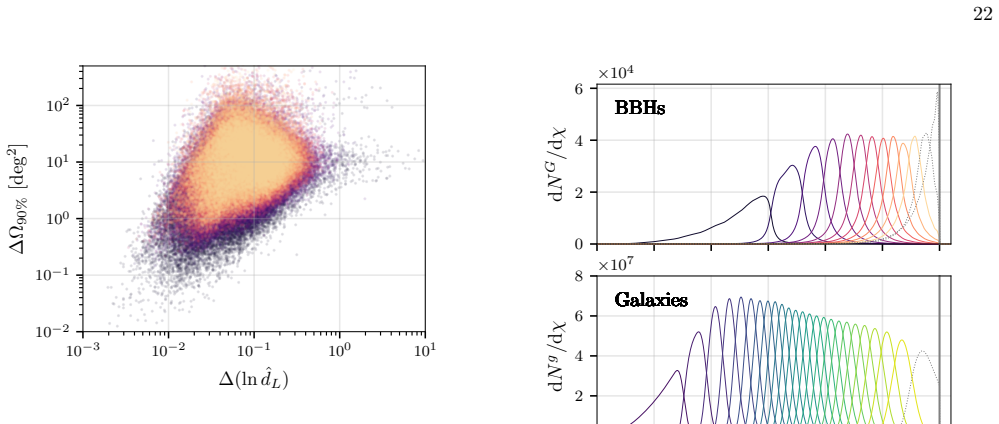


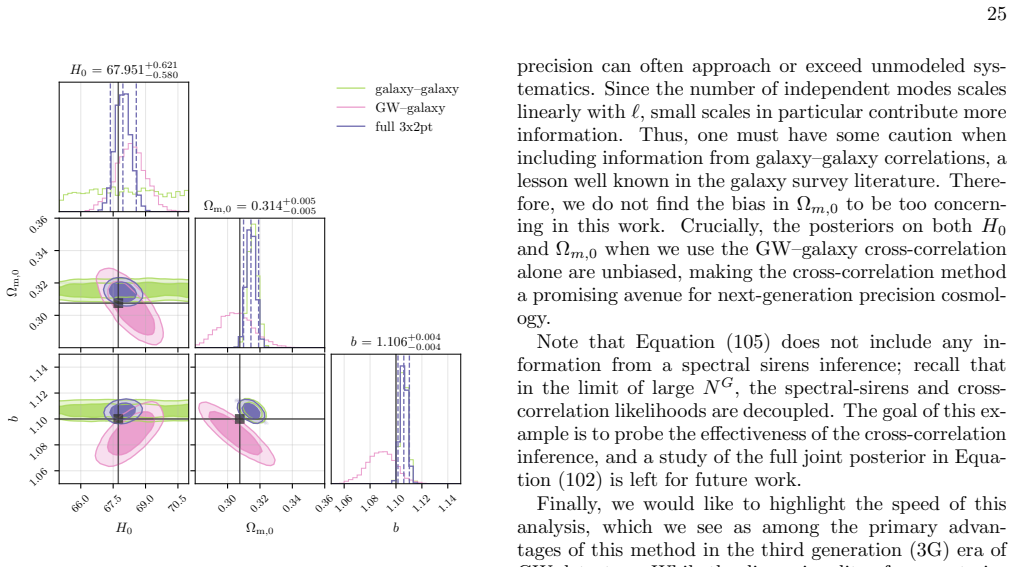
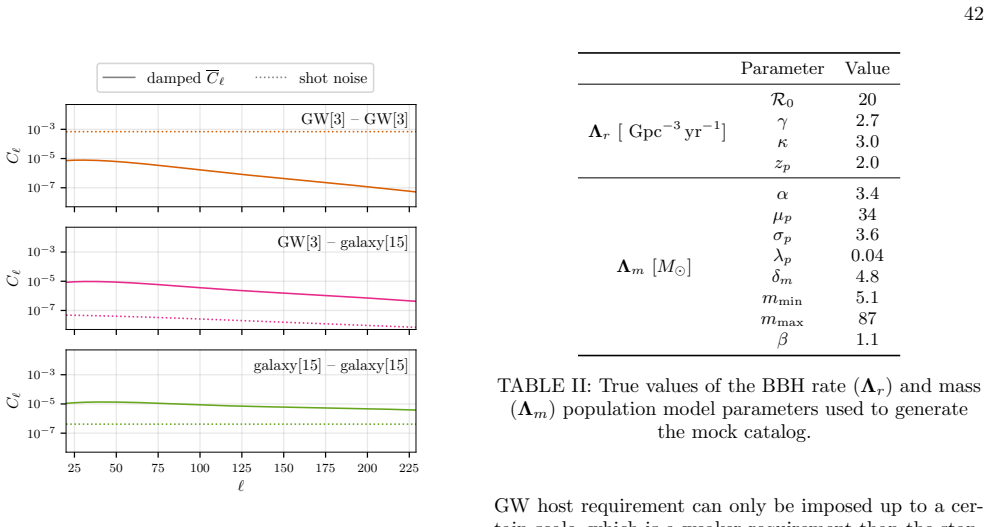

read the original abstract
The galaxy catalog dark siren method aims to infer cosmological parameters from gravitational waves (GWs) without an electromagnetic counterpart by statistically marginalizing over possible host galaxies. The cross-correlation of GW sources and galaxies is a promising avenue for cosmological inference without requiring observed host galaxies, by leveraging 2-point statistics. We provide a detailed guide to the cross-correlation method, clarifying its relationship to standard dark siren techniques as well as the assumptions necessary to be able to use this formalism on GW data. We show that the cross-correlation method is an extension of the angular part of the galaxy catalog method in which we effectively marginalize over all possible realizations of the unknown galaxy field, jointly adding information from galaxy--galaxy clustering. Combined with the spectral sirens method, which encodes information from the GW rate evolution, mass distribution, and selection effects, one can perform an inference that leverages the joint constraining power of all dark siren methods. We also present a strategy to rigorously fold GW measurement errors into the likelihood. Using this method, we show that with a 2 Einstein Telescope + 1 Cosmic Explorer setup, the GW--galaxy cross-correlation part alone can jointly measure $H_0$ and $\Omega_{m,0}$ to 1% and 5% precision with just 2 years of data, demonstrating its potential as a precise and scalable inference technique in the next generation of GW and galaxy surveys. This is in contrast with canonical population inference techniques, which are known to scale poorly with the precision and catalog size expected of next-generation GW experiments. Contrary to some previous projections, we remain pessimistic about the cross-correlation method until these next generation detectors are online, due to its implicit requirement of large-number statistics.
Editorial analysis
A structured set of objections, weighed in public.
Referee Report
Summary. The manuscript presents a unified harmonic framework for dark siren cosmology based on the cross-correlation between gravitational wave (GW) sources and galaxy catalogs. It describes this method as an extension of the angular galaxy catalog approach that marginalizes over all realizations of the unknown galaxy field, thereby incorporating galaxy-galaxy clustering information. The paper provides a strategy for incorporating GW measurement errors into the likelihood and forecasts that a 2 Einstein Telescope + 1 Cosmic Explorer network can achieve 1% precision on H_0 and 5% on Ω_{m,0} with 2 years of data using the cross-correlation alone.
Significance. If the marginalization procedure holds under realistic conditions, the framework offers a scalable route to joint cosmological constraints that leverages the large event rates expected from next-generation GW detectors, in contrast to population inference methods that scale poorly with catalog size. The unification of techniques and explicit error-folding strategy add practical value for upcoming surveys.
major comments (2)
- [§3.2] §3.2: The central marginalization over all galaxy-field realizations in harmonic space is asserted to recover unbiased parameters after folding in GW localization errors, but the manuscript provides no explicit test of the Gaussian likelihood approximation when localization volumes smear the cross-power spectrum into scales dominated by non-linear bias or redshift-space distortions; this directly affects whether the quoted 1% H_0 precision is achievable.
- [§4.3] §4.3, Figure 7: The 5% precision forecast on Ω_{m,0} from 2 years of 2ET+1CE data assumes the effective number of independent modes remains large after selection effects and catalog depth variations; a quantitative sensitivity analysis to galaxy completeness and the resulting covariance is required to support the claim.
minor comments (2)
- The notation for the harmonic-space cross-power spectrum C_ℓ^{GW-g} should be defined more explicitly relative to the standard galaxy angular power spectrum to prevent reader confusion.
- A concise table comparing the assumptions of the cross-correlation method versus canonical dark siren and spectral siren approaches would improve clarity.
Simulated Author's Rebuttal
We thank the referee for their constructive and detailed comments, which have helped clarify the scope and limitations of our forecasts. We respond to each major comment below and indicate the revisions we will make to the manuscript.
read point-by-point responses
-
Referee: [§3.2] §3.2: The central marginalization over all galaxy-field realizations in harmonic space is asserted to recover unbiased parameters after folding in GW localization errors, but the manuscript provides no explicit test of the Gaussian likelihood approximation when localization volumes smear the cross-power spectrum into scales dominated by non-linear bias or redshift-space distortions; this directly affects whether the quoted 1% H_0 precision is achievable.
Authors: We agree that an explicit numerical test of the Gaussian likelihood under localization smearing would provide stronger validation. The derivation in §3.2 relies on the central-limit theorem for a large number of modes and restricts the analysis to linear scales (k < 0.1 h/Mpc) where non-linear bias and RSD contributions remain sub-dominant relative to the statistical errors. Nevertheless, we acknowledge that the manuscript does not demonstrate this explicitly for smeared localization volumes. In the revised version we will expand §3.2 with a short discussion of the validity range of the approximation and add a supplementary figure showing the impact of a conservative non-linear bias model on the recovered H_0 posterior. revision: partial
-
Referee: [§4.3] §4.3, Figure 7: The 5% precision forecast on Ω_{m,0} from 2 years of 2ET+1CE data assumes the effective number of independent modes remains large after selection effects and catalog depth variations; a quantitative sensitivity analysis to galaxy completeness and the resulting covariance is required to support the claim.
Authors: The referee is correct that the baseline forecast in §4.3 and Figure 7 assumes a fixed, high-completeness galaxy catalog. We will revise §4.3 to include a quantitative sensitivity study: we will recompute the covariance matrix for two additional completeness levels (80 % and 60 %) and show the resulting degradation in the Ω_{m,0} constraint. This will be presented as an additional panel in Figure 7 or as a new supplementary figure, together with a brief discussion of how catalog depth variations propagate into the mode count. revision: yes
Circularity Check
No significant circularity in the unified harmonic framework for dark siren cosmology
full rationale
The paper's central derivation presents the GW-galaxy cross-correlation method as a statistical extension of the angular component of the galaxy catalog dark siren technique, achieved by marginalizing over realizations of the unknown galaxy field in harmonic space while incorporating GW errors. This is framed as a methodological clarification that jointly incorporates galaxy-galaxy clustering information, without reducing any target cosmological parameter (such as the forecasted 1% H0 or 5% Om precision) to a fitted input or self-definition by construction. The precision claims are forward forecasts based on assumed next-generation detector configurations (2ET+1CE) and large-number statistics requirements, not retrodictions of the paper's own inputs. No load-bearing self-citations, uniqueness theorems imported from the authors' prior work, or ansatz smuggling via citation are evident. The framework remains self-contained against external benchmarks of standard cross-correlation and marginalization techniques.
Axiom & Free-Parameter Ledger
Forward citations
Cited by 1 Pith paper
-
Radio sirens: inferring $H_0$ with binary black holes and neutral hydrogen in the era of the Einstein Telescope and the SKA Observatory
Using simulated binary black hole mergers and neutral hydrogen maps, the radio sirens method constrains H0 to 8% precision with 3000 high-SNR events, offering a 90% improvement over standard dark siren analyses.
Reference graph
Works this paper leans on
-
[1]
R. Gray, F. Beirnaert, C. Karathanasis, B. Revenu, C. Turski, A. Chen, T. Baker, S. Vallejo, A. E. Romano, T. Ghosh, A. Ghosh, K. Leyde, S. Mastrogiovanni, and S. More, Joint cosmological and gravitational-wave pop- ulation inference using dark sirens and galaxy cata- logues, JCAP2023(12), 023, arXiv:2308.02281 [astro- ph.CO]
-
[2]
J. R. Gair, A. Ghosh, R. Gray, D. E. Holz, S. Mas- trogiovanni, S. Mukherjee, A. Palmese, N. Tamanini, T. Baker, F. Beirnaert, M. Bilicki, H.-Y. Chen, G. D´ alya, J. M. Ezquiaga, W. M. Farr, M. Fish- bach, J. Garcia-Bellido, T. Ghosh, H.-Y. Huang, C. Karathanasis, K. Leyde, I. Maga˜ na Hernandez, J. Noller, G. Pierra, P. Raffai, A. E. Romano, M. Seglar- A...
-
[3]
R. Gray, I. M. Hernandez, H. Qi, A. Sur, P. R. Brady, H.-Y. Chen, W. M. Farr, M. Fishbach, J. R. Gair, A. Ghosh, D. E. Holz, S. Mastrogiovanni, C. Messen- ger, D. A. Steer, and J. Veitch, Cosmological inference using gravitational wave standard sirens: A mock data analysis, PhRvD101, 122001 (2020), arXiv:1908.06050 [gr-qc]
-
[4]
W. Ballard, A. Palmese, I. M. Hernandez, S. Ben- Zvi, J. Moon, A. J. Ross, G. Rossi, J. Aguilar, S. Ahlen, R. Blum, D. Brooks, T. Claybaugh, A. de la Macorra, A. Dey, P. Doel, J. E. Forero-Romero, S. Gontcho A Gontcho, K. Honscheid, A. Kremin, M. Manera, A. Meisner, R. Miquel, J. Moustakas, F. Prada, E. Sanchez, G. Tarl´ e, Z. Zhou, and DESI Collaboration...
-
[5]
V. Alfradique, C. R. Bom, A. Palmese, G. Teixeira, L. Santana-Silva, A. Drlica-Wagner, A. H. Riley, C. E. Mart´ ınez-V´ azquez, D. J. Sand, G. S. Stringfellow, G. E. Medina, J. A. Carballo-Bello, Y. Choi, J. Esteves, G. Limberg, B. Mutlu-Pakdil, N. E. D. No¨ el, A. B. Pace, J. D. Sakowska, and J. F. Wu, A dark siren measurement of the Hubble constant usin...
-
[6]
A. Palmese, C. R. Bom, S. Mucesh, and W. G. Hartley, A Standard Siren Measurement of the Hubble Constant Using Gravitational-wave Events from the First Three LIGO/Virgo Observing Runs and the DESI Legacy Survey, ApJ943, 56 (2023), arXiv:2111.06445 [astro- ph.CO]
-
[7]
A. Palmese, J. deVicente, M. E. S. Pereira, J. Annis, W. Hartley, K. Herner, M. Soares-Santos, M. Crocce, D. Huterer, I. Maga˜ na Hernandez, A. Garcia, J. Garcia- Bellido, J. Gschwend, D. E. Holz, R. Kessler, O. La- hav, R. Morgan, C. Nicolaou, C. Conselice, R. J. Foley, M. S. S. Gill, T. M. C. Abbott, M. Aguena, S. Al- lam, S. Avila, K. Bechtol, E. Berti...
-
[8]
M. Soares-Santos, A. Palmese, W. Hartley, J. An- nis, J. Garcia-Bellido, O. Lahav, Z. Doctor, M. Fish- bach, D. E. Holz, H. Lin, M. E. S. Pereira, A. Garcia, K. Herner, R. Kessler, H. V. Peiris, M. Sako, S. Al- lam, D. Brout, A. Carnero Rosell, H. Y. Chen, C. Con- selice, J. deRose, J. deVicente, H. T. Diehl, M. S. S. Gill, J. Gschwend, I. Sevilla-Noarbe,...
work page internal anchor Pith review Pith/arXiv arXiv 2019
-
[9]
R. Abbott, H. Abe, F. Acernese, K. Ackley, N. Adhikari, R. X. Adhikari, V. K. Adkins, V. B. Adya, C. Affeldt, D. Agarwal, M. Agathos, K. Agatsuma, N. Aggarwal, O. D. Aguiar, L. Aiello, A. Ain, P. Ajith, T. Akutsu, S. Albanesi, R. A. Alfaidi, A. Allocca, P. A. Altin, A. Amato, C. Anand, S. Anand, A. Ananyeva, S. B. Anderson, W. G. Anderson, M. Ando, T. And...
-
[10]
The LIGO Scientific Collaboration, the Virgo Col- laboration, the KAGRA Collaboration, A. G. Abac, I. Abouelfettouh, F. Acernese, K. Ackley, C. Adam- cewicz, S. Adhicary, D. Adhikari, N. Adhikari, R. X. Ad- hikari, V. K. Adkins, S. Afroz, A. Agapito, D. Agarwal, M. Agathos, N. Aggarwal, S. Aggarwal, O. D. Aguiar, I.-L. Ahrend, L. Aiello, A. Ain, P. Ajith,...
-
[11]
N. Borghi, M. Mancarella, M. Moresco, M. Tagliazuc- chi, F. Iacovelli, A. Cimatti, and M. Maggiore, Cosmol- ogy and Astrophysics with Standard Sirens and Galaxy Catalogs in View of Future Gravitational Wave Obser- vations, ApJ964, 191 (2024), arXiv:2312.05302 [astro- ph.CO]
-
[12]
Extracting distribution parameters from multiple uncertain observations with selection biases
I. Mandel, W. M. Farr, and J. R. Gair, Extracting dis- tribution parameters from multiple uncertain observa- tions with selection biases, MNRAS486, 1086 (2019), arXiv:1809.02063 [physics.data-an]
work page internal anchor Pith review Pith/arXiv arXiv 2019
- [13]
-
[14]
E. Thrane and C. Talbot, An introduction to Bayesian inference in gravitational-wave astronomy: Parameter estimation, model selection, and hierarchical models, PASA36, e010 (2019), arXiv:1809.02293 [astro-ph.IM]
- [15]
- [16]
- [17]
-
[18]
M. Oguri, Measuring the distance-redshift relation with the cross-correlation of gravitational wave stan- dard sirens and galaxies, PhRvD93, 083511 (2016), 32 arXiv:1603.02356 [astro-ph.CO]
work page internal anchor Pith review Pith/arXiv arXiv 2016
-
[19]
A. Pedrotti, M. Mancarella, J. Bel, and D. Gerosa, Cosmology with the angular cross-correlation of gravitational-wave and galaxy catalogs: forecasts for next-generation interferometers and the Euclid sur- vey, arXiv , arXiv:2504.10482 (2025), arXiv:2504.10482 [astro-ph.CO]
-
[20]
M. Beltrame, M. Bonici, and C. Carbone, Cosmolog- ical forecasts from the combination of Stage-IV pho- tometric galaxy surveys and the magnification from forthcoming GW observatories, JCAP2024(10), 074, arXiv:2403.03859 [astro-ph.CO]
-
[21]
S. Mukherjee, B. D. Wandelt, S. M. Nissanke, and A. Silvestri, Accurate precision cosmology with red- shift unknown gravitational wave sources, PhRvD103, 043520 (2021), arXiv:2007.02943 [astro-ph.CO]
-
[22]
C. Cigarr´ an D´ ıaz and S. Mukherjee, Mapping the cosmic expansion history from LIGO-Virgo-KAGRA in synergy with DESI and SPHEREx, MNRAS511, 2782 (2022), arXiv:2107.12787 [astro-ph.CO]
-
[23]
S. Mukherjee, A. Krolewski, B. D. Wandelt, and J. Silk, Cross-correlating Dark Sirens and Galaxies: Constraints on H 0 from GWTC-3 of LIGO-Virgo- KAGRA, ApJ975, 189 (2024), arXiv:2203.03643 [astro- ph.CO]
- [24]
-
[25]
Detecting Black-Hole Binary Clustering via the Second-Generation Gravitational-Wave Detectors
T. Namikawa, A. Nishizawa, and A. Taruya, Detecting black-hole binary clustering via the second-generation gravitational-wave detectors, PhRvD94, 024013 (2016), arXiv:1603.08072 [astro-ph.CO]
work page internal anchor Pith review Pith/arXiv arXiv 2016
-
[26]
The large scale structure in the 3D luminosity-distance space and its cosmological applications
P. Zhang, The large scale structure in the 3D luminosity-distance space and its cosmological applications, arXiv , arXiv:1810.11915 (2018), arXiv:1810.11915 [astro-ph.CO]
work page internal anchor Pith review Pith/arXiv arXiv 2018
-
[27]
A. Vijaykumar, M. V. S. Saketh, S. Kumar, P. Ajith, and T. R. Choudhury, Probing the large scale structure using gravitational-wave observations of binary black holes, PhRvD108, 103017 (2023), arXiv:2005.01111 [astro-ph.CO]
-
[28]
S. Libanore, M. C. Artale, D. Karagiannis, M. Liguori, N. Bartolo, Y. Bouffanais, N. Giacobbo, M. Mapelli, and S. Matarrese, Gravitational Wave mergers as trac- ers of Large Scale Structures, JCAP2021(2), 035, arXiv:2007.06905 [astro-ph.CO]
-
[29]
S. Kumar, Probing Cosmology with Baryon Acoustic Oscillations Using Gravitational Waves, ApJ959, 35 (2023), arXiv:2203.04273 [astro-ph.CO]
-
[30]
A. Dehghani, J. L. Kim, D. S. Hosseini, A. Krolewski, S. Mukherjee, and G. Geshnizjani, The gravitational wave bias parameter from angular power spectra: bridg- ing between galaxies and binary black holes, JCAP 2025(4), 056, arXiv:2411.11965 [astro-ph.GA]
- [31]
-
[32]
S. Zazzera, J. Fonseca, T. Baker, and C. Clarkson, Grav- itational waves and galaxies cross-correlations: a fore- cast on GW biases for future detectors, MNRAS537, 1912 (2025), arXiv:2412.01678 [astro-ph.CO]
- [33]
- [34]
- [35]
-
[36]
C. Dalang and T. Baker, The clustering of dark sirens’ invisible host galaxies, JCAP2024(2), 024, arXiv:2310.08991 [astro-ph.CO]
- [37]
-
[38]
A. Begnoni, L. V. Dall’Armi, D. Bertacca, and A. Raccanelli, Gravitational wave luminosity distance-weighted anisotropies, JCAP2024(10), 087, arXiv:2404.12351 [astro-ph.CO]
-
[39]
J. Fonseca, S. Zazzera, T. Baker, and C. Clarkson, The observed number counts in luminosity distance space, JCAP2023(8), 050, arXiv:2304.14253 [astro-ph.CO]
-
[40]
S. Zazzera, J. Fonseca, T. Baker, and C. Clarkson, Magnification and evolution bias of transient sources: GWs and SNIa, JCAP2024(5), 095, arXiv:2309.04391 [astro-ph.CO]
-
[41]
T. Namikawa, Analyzing clustering of astrophysical gravitational-wave sources: luminosity-distance space distortions, JCAP2021(1), 036, arXiv:2007.04359 [astro-ph.CO]
-
[42]
A. S. Szalay, T. Matsubara, and S. D. Landy, Redshift- Space Distortions of the Correlation Function in Wide-Angle Galaxy Surveys, ApJL498, L1 (1998), arXiv:astro-ph/9712007 [astro-ph]
work page internal anchor Pith review Pith/arXiv arXiv 1998
-
[43]
What galaxy surveys really measure
C. Bonvin and R. Durrer, What galaxy surveys really measure, PhRvD84, 063505 (2011), arXiv:1105.5280 [astro-ph.CO]
work page internal anchor Pith review Pith/arXiv arXiv 2011
-
[44]
S. Mastrogiovanni, C. Karathanasis, J. Gair, G. Ash- ton, S. Rinaldi, H.-Y. Huang, and G. D´ alya, Cosmol- ogy with Gravitational Waves: A Review, AnP536, 2200180 (2024)
work page 2024
-
[45]
A. Palmese and S. Mastrogiovanni, Gravitational Wave Cosmology, arXiv , arXiv:2502.00239 (2025), arXiv:2502.00239 [astro-ph.CO]
-
[46]
R. Essick and M. Fishbach, Ensuring Consistency be- tween Noise and Detection in Hierarchical Bayesian In- ference, ApJ962, 169 (2024), arXiv:2310.02017 [gr-qc]
-
[47]
P. J. E. Peebles,The Large-Scale Structure of the Uni- verse(1981)
work page 1981
- [48]
-
[49]
Bayesian power-spectrum inference for Large Scale Structure data
J. Jasche, F. S. Kitaura, B. D. Wandelt, and T. A. Enßlin, Bayesian power-spectrum inference for large-scale structure data, MNRAS406, 60 (2010), arXiv:0911.2493 [astro-ph.CO]
work page internal anchor Pith review Pith/arXiv arXiv 2010
-
[50]
The Clustering of Luminous Red Galaxies in the Sloan Digital Sky Survey Imaging Data
N. Padmanabhan, D. J. Schlegel, U. Seljak, A. Makarov, N. A. Bahcall, M. R. Blanton, J. Brinkmann, D. J. Eisenstein, D. P. Finkbeiner, J. E. Gunn, D. W. Hogg, ˇZ. Ivezi´ c, G. R. Knapp, J. Loveday, R. H. Lupton, R. C. Nichol, D. P. Schneider, M. A. Strauss, M. Tegmark, and D. G. York, The clustering of luminous red galaxies 33 in the Sloan Digital Sky Sur...
work page internal anchor Pith review Pith/arXiv arXiv 2007
-
[51]
Halo Models of Large Scale Structure
A. Cooray and R. Sheth, Halo models of large scale structure, PhR372, 1 (2002), arXiv:astro-ph/0206508 [astro-ph]
work page internal anchor Pith review Pith/arXiv arXiv 2002
-
[52]
R. E. Smith, J. A. Peacock, A. Jenkins, S. D. M. White, C. S. Frenk, F. R. Pearce, P. A. Thomas, G. Efstathiou, and H. M. P. Couchman, Stable clustering, the halo model and non-linear cosmological power spectra, MN- RAS341, 1311 (2003), arXiv:astro-ph/0207664 [astro- ph]
work page internal anchor Pith review Pith/arXiv arXiv 2003
-
[53]
Revising the Halofit Model for the Nonlinear Matter Power Spectrum
R. Takahashi, M. Sato, T. Nishimichi, A. Taruya, and M. Oguri, Revising the Halofit Model for the Non- linear Matter Power Spectrum, ApJ761, 152 (2012), arXiv:1208.2701 [astro-ph.CO]
work page internal anchor Pith review Pith/arXiv arXiv 2012
-
[54]
P. J. E. Peebles, Statistical Analysis of Catalogs of Ex- tragalactic Objects. I. Theory, ApJ185, 413 (1973)
work page 1973
-
[55]
K. B. Fisher, C. A. Scharf, and O. Lahav, A spherical harmonic approach to redshift distortion and a measure- ment of Omega(0) from the 1.2-Jy IRAS Redshift Sur- vey, MNRAS266, 219 (1994), arXiv:astro-ph/9309027 [astro-ph]
work page internal anchor Pith review Pith/arXiv arXiv 1994
-
[56]
A. F. Heavens and A. N. Taylor, A spherical harmonic analysis of redshift space, MNRAS275, 483 (1995), arXiv:astro-ph/9409027 [astro-ph]
work page internal anchor Pith review Pith/arXiv arXiv 1995
-
[57]
S. Dodelson, V. K. Narayanan, M. Tegmark, R. Scran- ton, T. Budav´ ari, A. Connolly, I. Csabai, D. Eisenstein, J. A. Frieman, J. E. Gunn, L. Hui, B. Jain, D. Johnston, S. Kent, J. Loveday, R. C. Nichol, L. O’Connell, R. Scoc- cimarro, R. K. Sheth, A. Stebbins, M. A. Strauss, A. S. Szalay, I. Szapudi, M. S. Vogeley, I. Zehavi, J. An- nis, N. A. Bahcall, J....
-
[58]
Recovering 3D clustering information with angular correlations
J. Asorey, M. Crocce, E. Gazta˜ naga, and A. Lewis, Re- covering 3D clustering information with angular cor- relations, MNRAS427, 1891 (2012), arXiv:1207.6487 [astro-ph.CO]
work page internal anchor Pith review Pith/arXiv arXiv 2012
-
[59]
D. N. Limber, The Analysis of Counts of the Extragalac- tic Nebulae in Terms of a Fluctuating Density Field., ApJ117, 134 (1953)
work page 1953
-
[60]
M. LoVerde and N. Afshordi, Extended Limber approx- imation, PhRvD78, 123506 (2008), arXiv:0809.5112 [astro-ph]
work page internal anchor Pith review Pith/arXiv arXiv 2008
-
[61]
How accurate is Limber's equation?
P. Simon, How accurate is Limber’s equation?, A&A 473, 711 (2007), arXiv:astro-ph/0609165 [astro-ph]
work page internal anchor Pith review Pith/arXiv arXiv 2007
-
[62]
How to measure CMB power spectra without losing information
M. Tegmark, How to measure CMB power spectra without losing information, PhRvD55, 5895 (1997), arXiv:astro-ph/9611174 [astro-ph]
work page internal anchor Pith review Pith/arXiv arXiv 1997
- [63]
- [64]
-
[65]
Karhunen-Loeve eigenvalue problems in cosmology: how should we tackle large data sets?
M. Tegmark, A. N. Taylor, and A. F. Heavens, Karhunen-Lo` eve Eigenvalue Problems in Cosmology: How Should We Tackle Large Data Sets?, ApJ480, 22 (1997), arXiv:astro-ph/9603021 [astro-ph]
work page internal anchor Pith review Pith/arXiv arXiv 1997
-
[66]
The DESI Experiment Part I: Science,Targeting, and Survey Design
DESI Collaboration, A. Aghamousa, J. Aguilar, S. Ahlen, S. Alam, L. E. Allen, C. Allende Prieto, J. Annis, S. Bailey, C. Balland, O. Ballester, C. Baltay, L. Beaufore, C. Bebek, T. C. Beers, E. F. Bell, J. L. Bernal, R. Besuner, F. Beutler, C. Blake, H. Bleuler, M. Blomqvist, R. Blum, A. S. Bolton, C. Briceno, D. Brooks, J. R. Brownstein, E. Buckley-Geer,...
work page internal anchor Pith review Pith/arXiv arXiv 2016
-
[67]
A. G. Adame, J. Aguilar, S. Ahlen, S. Alam, D. M. Alexander, M. Alvarez, O. Alves, A. Anand, U. An- drade, E. Armengaud, S. Avila, A. Aviles, H. Awan, S. Bailey, C. Baltay, A. Bault, J. Behera, S. Ben- Zvi, F. Beutler, D. Bianchi, C. Blake, R. Blum, S. Brieden, A. Brodzeller, D. Brooks, E. Buckley- Geer, E. Burtin, R. Calderon, R. Canning, A. Carnero Rose...
-
[68]
A. G. Adame, J. Aguilar, S. Ahlen, S. Alam, D. M. Alexander, M. Alvarez, O. Alves, A. Anand, U. An- drade, E. Armengaud, S. Avila, A. Aviles, H. Awan, S. Bailey, C. Baltay, A. Bault, J. Behera, S. Ben- Zvi, F. Beutler, D. Bianchi, C. Blake, R. Blum, S. Brieden, A. Brodzeller, D. Brooks, E. Buckley- Geer, E. Burtin, R. Calderon, R. Canning, A. Carnero Rose...
-
[69]
Euclid Collaboration, R. Scaramella, J. Amiaux, Y. Mellier, C. Burigana, C. S. Carvalho, J.-C. Cuil- landre, A. Da Silva, A. Derosa, J. Dinis, E. Maio- rano, M. Maris, I. Tereno, R. Laureijs, T. Boenke, G. Buenadicha, X. Dupac, L. M. Gaspar Venancio, P. G´ omez-´Alvarez, J. Hoar, J. Lorenzo Alvarez, G. D. Racca, G. Saavedra-Criado, J. Schwartz, R. Vavrek,...
-
[70]
LSST Science Collaboration, P. A. Abell, J. Allison, S. F. Anderson, J. R. Andrew, J. R. P. Angel, L. Ar- mus, D. Arnett, S. J. Asztalos, T. S. Axelrod, S. Bai- ley, D. R. Ballantyne, J. R. Bankert, W. A. Barkhouse, J. D. Barr, L. F. Barrientos, A. J. Barth, J. G. Bartlett, A. C. Becker, J. Becla, T. C. Beers, J. P. Bernstein, R. Biswas, M. R. Blanton, J....
work page internal anchor Pith review Pith/arXiv arXiv 2009
-
[71]
ˇZ. Ivezi´ c, S. M. Kahn, J. A. Tyson, B. Abel, E. Acosta, R. Allsman, D. Alonso, Y. AlSayyad, S. F. Anderson, J. Andrew, J. R. P. Angel, G. Z. Angeli, R. Ansari, P. Antilogus, C. Araujo, R. Armstrong, K. T. Arndt, P. Astier, ´E. Aubourg, N. Auza, T. S. Axelrod, D. J. Bard, J. D. Barr, A. Barrau, J. G. Bartlett, A. E. Bauer, B. J. Bauman, S. Baumont, E. B...
-
[72]
M. Vallisneri, Use and abuse of the Fisher informa- tion matrix in the assessment of gravitational-wave parameter-estimation prospects, PhRvD77, 042001 (2008), arXiv:gr-qc/0703086 [gr-qc]
work page internal anchor Pith review Pith/arXiv arXiv 2008
- [73]
-
[74]
H.-Y. Chen, R. Essick, S. Vitale, D. E. Holz, and E. Katsavounidis, Observational Selection Effects with Ground-based Gravitational Wave Detectors, ApJ835, 31 (2017), arXiv:1608.00164 [astro-ph.HE]
work page internal anchor Pith review Pith/arXiv arXiv 2017
-
[75]
A unified pseudo-$C_\ell$ framework
D. Alonso, J. Sanchez, A. Slosar, and LSST Dark En- ergy Science Collaboration, A unified pseudo-C ℓ frame- work, MNRAS484, 4127 (2019), arXiv:1809.09603 [astro-ph.CO]
work page internal anchor Pith review Pith/arXiv arXiv 2019
-
[76]
J. R. Bond, A. H. Jaffe, and L. Knox, Estimating the power spectrum of the cosmic microwave background, PhRvD57, 2117 (1998), arXiv:astro-ph/9708203 [astro- ph]
work page internal anchor Pith review Pith/arXiv arXiv 1998
-
[77]
E. Hivon, K. M. G´ orski, C. B. Netterfield, B. P. Crill, S. Prunet, and F. Hansen, MASTER of the Cosmic Mi- crowave Background Anisotropy Power Spectrum: A Fast Method for Statistical Analysis of Large and Com- plex Cosmic Microwave Background Data Sets, ApJ 567, 2 (2002), arXiv:astro-ph/0105302 [astro-ph]
work page internal anchor Pith review Pith/arXiv arXiv 2002
-
[78]
Error analysis in cross-correlation of sky maps: application to the ISW detection
A. Cabr´ e, P. Fosalba, E. Gazta˜ naga, and M. Manera, Error analysis in cross-correlation of sky maps: applica- tion to the Integrated Sachs-Wolfe detection, MNRAS 381, 1347 (2007), arXiv:astro-ph/0701393 [astro-ph]
work page internal anchor Pith review Pith/arXiv arXiv 2007
-
[79]
Euclid Collaboration, F. Lepori, I. Tutusaus, C. Viglione, C. Bonvin, S. Camera, F. J. Cas- tander, R. Durrer, P. Fosalba, G. Jelic-Cizmek, M. Kunz, J. Adamek, S. Casas, M. Martinelli, Z. Sakr, D. Sapone, A. Amara, N. Auricchio, C. Bodendorf, D. Bonino, E. Branchini, M. Brescia, J. Brinchmann, V. Capobianco, C. Carbone, J. Carretero, M. Castel- lano, S. C...
-
[80]
The Cosmic Linear Anisotropy Solving System (CLASS) I: Overview
J. Lesgourgues, The Cosmic Linear Anisotropy Solving System (CLASS) I: Overview, arXiv , arXiv:1104.2932 (2011), arXiv:1104.2932 [astro-ph.IM]
work page internal anchor Pith review Pith/arXiv arXiv 2011
discussion (0)
Sign in with ORCID, Apple, or X to comment. Anyone can read and Pith papers without signing in.