Recognition: no theorem link
Radio sirens: inferring H₀ with binary black holes and neutral hydrogen in the era of the Einstein Telescope and the SKA Observatory
Pith reviewed 2026-05-14 20:30 UTC · model grok-4.3
The pith
Combining black hole merger distances with neutral hydrogen maps constrains the Hubble constant to 8 percent precision.
A machine-rendered reading of the paper's core claim, the machinery that carries it, and where it could break.
Core claim
The radio sirens technique treats three-dimensional neutral hydrogen density fields observed via 21 cm intensity mapping as redshift priors for gravitational wave events, thereby converting a set of luminosity distances into a statistical constraint on the late-time expansion history that reaches 8 percent precision on the Hubble constant with next-generation detectors.
What carries the argument
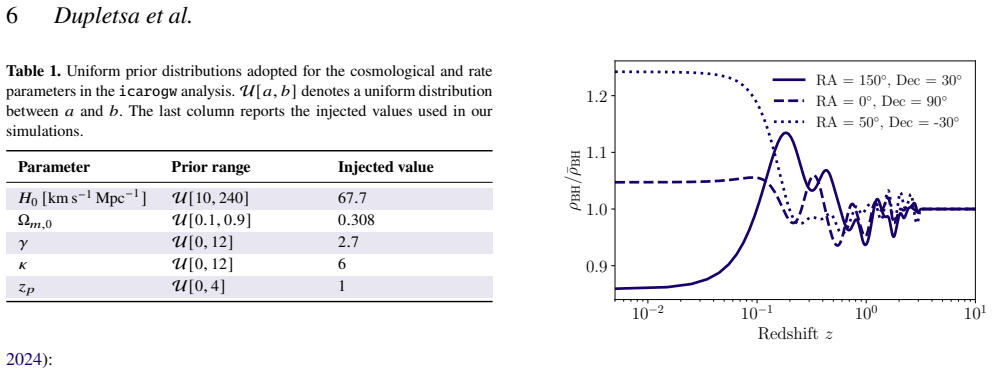
Radio sirens, a dark-sirens approach in which neutral hydrogen intensity mapping supplies three-dimensional redshift priors for binary black hole luminosity distances.
If this is right
- The method supplies an independent route to the distance-redshift relation at redshifts up to z approximately 3.
- It increases the number of usable gravitational wave events by removing the need for electromagnetic counterparts.
- The same data combination can in principle be extended to other cosmological parameters that affect the expansion history.
- The approach demonstrates a concrete synergy between gravitational wave and intensity mapping surveys.
Where Pith is reading between the lines
- If the method works as simulated it could serve as a cross-check on other late-universe H0 determinations that currently disagree.
- The same framework might be adapted to test whether the expansion history deviates from the standard model at higher redshifts.
- Validation would require confirming that intensity mapping surveys recover the correct large-scale structure around the actual locations of detected mergers.
Load-bearing premise
The simulated neutral hydrogen intensity maps accurately and without bias represent the true redshift distribution of the gravitational wave sources.
What would settle it
Real data from the Einstein Telescope and SKA yielding a Hubble constant constraint whose uncertainty is substantially larger than 8 percent or showing no clear improvement over the gravitational-wave-only case would falsify the claimed performance.
Figures






read the original abstract
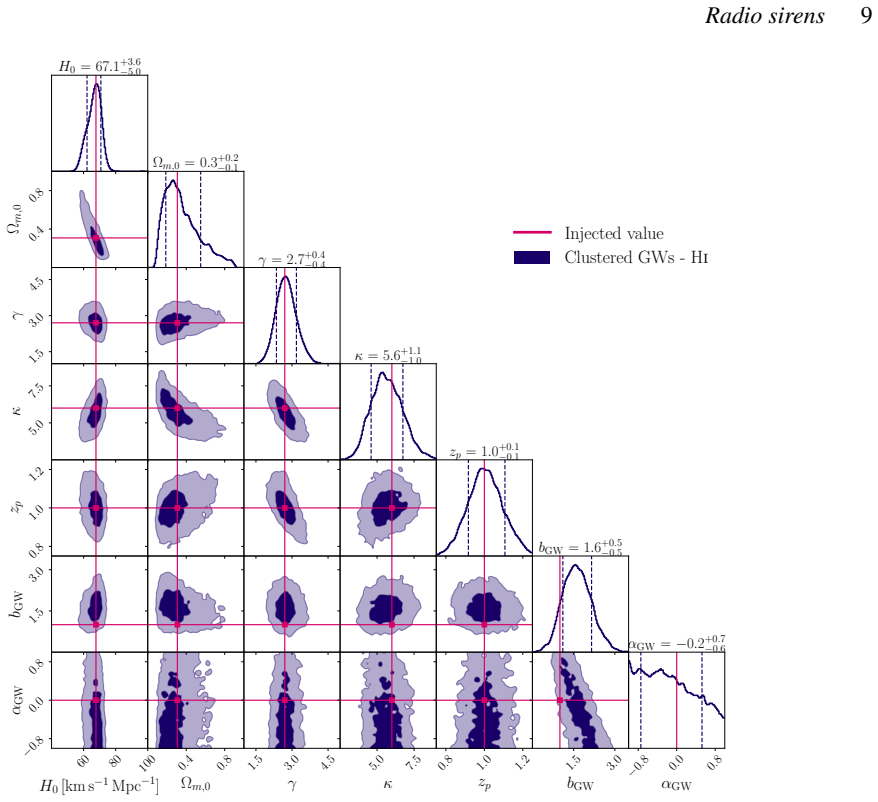
A new synergy between gravitational waves (GWs) and the study of the large-scale structure of the Universe is now emerging. Along this line of research, we combine simulated observations of stellar-origin black hole mergers and neutral hydrogen 21 cm line intensity mapping to probe the expansion rate of the Universe through the distance-redshift relation. GW signals from binary black holes provide direct distance information, while neutral hydrogen intensity maps offer a tomographic view of the large-scale structure of the Universe. Using the 3-dimensional density fields of hydrogen as a redshift prior for GW events, we explore a novel dark-sirens-like approach, here termed radio sirens, to measure the late-time expansion history of the Universe. We study the performance of the next-generation GW observatories, such as the Einstein Telescope, to ensure enough statistics and access to high-redshift data. On the other hand, future spectroscopic intensity mapping surveys with the SKA-Mid telescope are expected to trace the underlying dark matter distribution at large scales up to redshift $z\sim 3$. This combined methodology allows us to constrain the Hubble constant to $\sim 8\%$ precision, using around 3,000 GW events with signal-to-noise ratios greater than 150. This corresponds to an improvement of around $90\%$ compared to not considering the information from the neutral hydrogen maps.
Editorial analysis
A structured set of objections, weighed in public.
Referee Report
Summary. The paper proposes a 'radio sirens' method combining simulated binary black hole gravitational-wave events from the Einstein Telescope with neutral-hydrogen 21 cm intensity maps from SKA-Mid. By treating the simulated 3D HI density fields as tomographic redshift priors for approximately 3000 high-SNR (SNR > 150) GW events, the authors claim a constraint on the Hubble constant H0 at ~8% precision, representing a ~90% improvement relative to a GW-only analysis.
Significance. If the simulated HI maps can be shown to deliver unbiased redshift information after realistic foreground cleaning and instrumental effects, the approach would constitute a novel multi-messenger route to H0 that is independent of both the distance ladder and CMB anchors. The projected improvement factor and the use of next-generation facilities make the result potentially interesting for the Hubble-tension discussion, provided the error budget is fully validated.
major comments (2)
- [Methods / Simulation pipeline] The central ~8% H0 precision and 90% improvement rest on the assumption that the simulated 3D HI intensity maps furnish accurate, unbiased redshift posteriors for each GW event. Real SKA-Mid observations require foreground subtraction that removes or biases large-scale modes and leaves residuals at the level of the cosmological signal; the manuscript does not propagate these residuals into the per-event redshift uncertainty or demonstrate that the quoted precision survives even a factor-of-two degradation in redshift error.
- [Results / Abstract] The abstract and results sections quote a specific event count (~3000 events with SNR > 150) and a precise improvement factor, yet the simulation details, selection function, and full error budget (including instrumental noise, beam effects, and foreground residuals) are not provided at a level that allows independent verification of the quoted precision.
minor comments (2)
- [Methods] Notation for the redshift prior construction and the precise functional form of the likelihood combining GW luminosity distance with the HI tomographic information should be written explicitly, preferably with an equation.
- [Figures] Figure captions and axis labels should clarify whether the reported H0 posteriors include marginalization over all other cosmological parameters or assume a fixed background cosmology.
Simulated Author's Rebuttal
We thank the referee for their constructive comments. We address each major point below and describe the revisions we will implement.
read point-by-point responses
-
Referee: [Methods / Simulation pipeline] The central ~8% H0 precision and 90% improvement rest on the assumption that the simulated 3D HI intensity maps furnish accurate, unbiased redshift posteriors for each GW event. Real SKA-Mid observations require foreground subtraction that removes or biases large-scale modes and leaves residuals at the level of the cosmological signal; the manuscript does not propagate these residuals into the per-event redshift uncertainty or demonstrate that the quoted precision survives even a factor-of-two degradation in redshift error.
Authors: We agree that realistic foreground subtraction and residuals must be addressed to validate the method. Our present simulations employ idealized HI fields to establish the baseline capability of radio sirens. In the revised manuscript we will add a new subsection in Methods that performs a sensitivity analysis: we will degrade the per-event redshift uncertainty by a factor of two (mimicking residual foreground contamination) and recompute the H0 posterior. We will show that the radio-sirens constraint remains substantially tighter than the GW-only case (approximately 70 % improvement), thereby providing a more conservative error budget while preserving the core result. revision: yes
-
Referee: [Results / Abstract] The abstract and results sections quote a specific event count (~3000 events with SNR > 150) and a precise improvement factor, yet the simulation details, selection function, and full error budget (including instrumental noise, beam effects, and foreground residuals) are not provided at a level that allows independent verification of the quoted precision.
Authors: We acknowledge that additional documentation is required for reproducibility. We will expand the Methods section with a complete description of the GW selection function (SNR threshold, sky coverage, and redshift distribution), the modeling of SKA-Mid instrumental noise and beam effects, and the full error budget. A summary table of all simulation parameters will be added, and we will make the analysis code and key data products publicly available upon acceptance. revision: yes
Circularity Check
No circularity: standard forward-model forecast on independent mocks
full rationale
The paper generates simulated GW events and simulated 3D HI intensity maps under a fiducial cosmology, then applies a statistical inference pipeline that treats the HI fields as redshift priors for the sirens to recover H0 precision. This is a conventional forecasting exercise whose output (∼8% precision, 90% improvement) is the statistical performance of the pipeline on the mocks rather than a re-derivation of the input assumptions. No equations reduce by construction to fitted parameters, no self-citation chain supplies a uniqueness theorem, and no ansatz is smuggled via prior work; the derivation chain remains self-contained against external benchmarks.
Axiom & Free-Parameter Ledger
free parameters (2)
- GW event count =
~3000
- SNR cutoff =
150
axioms (1)
- domain assumption Neutral hydrogen intensity maps trace the underlying dark matter distribution accurately up to z~3.
Reference graph
Works this paper leans on
-
[1]
Karathanasis, Christos and Mukherjee, Suvodip and Mastrogiovanni, Simone. Binary black holes population and cosmology in new lights: signature of PISN mass and formation channel in GWTC-3. Mon. Not. Roy. Astron. Soc. 2023. doi:10.1093/mnras/stad1373. arXiv:2204.13495
-
[2]
The Science of the Einstein Telescope
Abac, Adrian and others. The Science of the Einstein Telescope. JCAP. 2026. doi:10.1088/1475-7516/2026/03/081. arXiv:2503.12263
work page internal anchor Pith review Pith/arXiv arXiv doi:10.1088/1475-7516/2026/03/081 2026
-
[3]
Mukherjee, Suvodip. The redshift dependence of black hole mass distribution: is it reliable for standard sirens cosmology?. Mon. Not. Roy. Astron. Soc. 2022. doi:10.1093/mnras/stac2152. arXiv:2112.10256
-
[4]
Mapping the cosmic expansion history from LIGO-Virgo-KAGRA in synergy with DESI and SPHEREx
Diaz, Cristina Cigarran and Mukherjee, Suvodip. Mapping the cosmic expansion history from LIGO-Virgo-KAGRA in synergy with DESI and SPHEREx. Mon. Not. Roy. Astron. Soc. 2022. doi:10.1093/mnras/stac208. arXiv:2107.12787
-
[5]
Mukherjee, Suvodip and Krolewski, Alex and Wandelt, Benjamin D. and Silk, Joseph. Cross-correlating dark sirens and galaxies: constraints on H_0 from GWTC-3 of LIGO-Virgo-KAGRA. Astrophys. J. 2024. doi:10.3847/1538-4357/ad7d90. arXiv:2203.03643
-
[6]
healpy: equal area pixelization and spherical harmonics transforms for data on the sphere in Python
Zonca, Andrea and Singer, Leo and Lenz, Daniel and Reinecke, Martin and Rosset, Cyrille and Hivon, Eric and Gorski, Krzysztof. healpy: equal area pixelization and spherical harmonics transforms for data on the sphere in Python. J. Open Source Softw. 2019. doi:10.21105/joss.01298
-
[7]
A 2 per cent Hubble constant measurement from standard sirens within 5 years
Chen, Hsin-Yu and Fishbach, Maya and Holz, Daniel E. A two per cent Hubble constant measurement from standard sirens within five years. Nature. 2018. doi:10.1038/s41586-018-0606-0. arXiv:1712.06531
work page internal anchor Pith review Pith/arXiv arXiv doi:10.1038/s41586-018-0606-0 2018
-
[8]
G \'o rski, K. M. and Hivon, E. and Banday, A. J. and Wandelt, B. D. and Hansen, F. K. and Reinecke, M. and Bartelman, M. HEALPix - A Framework for high resolution discretization, and fast analysis of data distributed on the sphere. Astrophys. J. 2005. doi:10.1086/427976. arXiv:astro-ph/0409513
work page internal anchor Pith review Pith/arXiv arXiv doi:10.1086/427976 2005
-
[9]
Measurement of Hubble constant with stellar-mass binary black holes
Nishizawa, Atsushi. Measurement of Hubble constant with stellar-mass binary black holes. Phys. Rev. D. 2017. doi:10.1103/PhysRevD.96.101303. arXiv:1612.06060
work page internal anchor Pith review Pith/arXiv arXiv doi:10.1103/physrevd.96.101303 2017
-
[10]
Abbott, B. P. and others. A Gravitational-wave Measurement of the Hubble Constant Following the Second Observing Run of Advanced LIGO and Virgo. Astrophys. J. 2021. doi:10.3847/1538-4357/abdcb7. arXiv:1908.06060
-
[11]
MacLeod, Chelsea L. and Hogan, Craig J. Precision of Hubble constant derived using black hole binary absolute distances and statistical redshift information. Phys. Rev. D. 2008. doi:10.1103/PhysRevD.77.043512. arXiv:0712.0618
work page internal anchor Pith review Pith/arXiv arXiv doi:10.1103/physrevd.77.043512 2008
-
[12]
A unified harmonic framework for dark siren cosmology
Cheng, April Qiu and Gair, Jonathan. A unified harmonic framework for dark siren cosmology. 2026. arXiv:2603.13053
work page internal anchor Pith review Pith/arXiv arXiv 2026
-
[13]
and Cunnington, Steven and Harper, Stuart E
Spinelli, Marta and Carucci, Isabella P. and Cunnington, Steven and Harper, Stuart E. and Irfan, Melis O. and Fonseca, Jos \'e and Pourtsidou, Alkistis and Wolz, Laura. SKAO H \, i intensity mapping: blind foreground subtraction challenge. Mon. Not. Roy. Astron. Soc. 2021. doi:10.1093/mnras/stab3064. arXiv:2107.10814
-
[14]
MeerKLASS L-band deep-field intensity maps: entering the H I dominated regime. , keywords =. doi:10.1093/mnras/staf195 , archivePrefix =. 2407.21626 , primaryClass =
-
[15]
Cunnington, Steven and others. Revealing cosmological fluctuations in 21 cm intensity maps with MeerKLASS: from maps to power spectra. Astrophys. Space Sci. 2026. doi:10.1007/s10509-026-04547-7. arXiv:2510.27549
-
[16]
H I intensity mapping with MeerKAT: power spectrum detection in cross-correlation with WiggleZ galaxies. , keywords =. doi:10.1093/mnras/stac3060 , archivePrefix =. 2206.01579 , primaryClass =
-
[17]
Exploring future synergies for large-scale structure between gravitational waves and radio sources
Zazzera, Stefano and Fonseca, Jos. Exploring future synergies for large-scale structure between gravitational waves and radio sources. Monthly Notices of the Royal Astronomical Society. 2026. doi:10.1093/mnras/stag307. arXiv:2505.15645
-
[18]
Péroux, Céline and Howk, J. Christopher , year=. The Cosmic Baryon and Metal Cycles , volume=. Annual Review of Astronomy and Astrophysics , publisher=. doi:10.1146/annurev-astro-021820-120014 , number=
-
[19]
Battye, R. A. and Browne, I. W. A. and Dickinson, C. and Heron, G. and Maffei, B. and Pourtsidou, A. , year=. HI intensity mapping: a single dish approach , volume=. Monthly Notices of the Royal Astronomical Society , publisher=. doi:10.1093/mnras/stt1082 , number=
-
[20]
Crighton, Neil H. M. and Murphy, Michael T. and Prochaska, J. Xavier and Worseck, Gábor and Rafelski, Marc and Becker, George D. and Ellison, Sara L. and Fumagalli, Michele and Lopez, Sebastian and Meiksin, Avery and O'Meara, John M. , title =. Monthly Notices of the Royal Astronomical Society , volume =. 2015 , month =. doi:10.1093/mnras/stv1182 , url =
-
[21]
Science Case for the Einstein Telescope
Maggiore, Michele and others. Science Case for the Einstein Telescope. JCAP. 2020. doi:10.1088/1475-7516/2020/03/050. arXiv:1912.02622
-
[22]
and Perries, Stephane and Pierra, Gregoire
Mastrogiovanni, Simone and Laghi, Danny and Gray, Rachel and Santoro, Giada Caneva and Ghosh, Archisman and Karathanasis, Christos and Leyde, Konstantin and Steer, Daniele A. and Perries, Stephane and Pierra, Gregoire. Joint population and cosmological properties inference with gravitational waves standard sirens and galaxy surveys. Phys. Rev. D. 2023. do...
-
[23]
Mastrogiovanni, S. and Leyde, K. and Karathanasis, C. and Chassande-Mottin, E. and Steer, D. A. and Gair, J. and Ghosh, A. and Gray, R. and Mukherjee, S. and Rinaldi, S. On the importance of source population models for gravitational-wave cosmology. Phys. Rev. D. 2021. doi:10.1103/PhysRevD.104.062009. arXiv:2103.14663
-
[24]
Extracting distribution parameters from multiple uncertain observations with selection biases
Mandel, Ilya and Farr, Will M. and Gair, Jonathan R. Extracting distribution parameters from multiple uncertain observations with selection biases. Mon. Not. Roy. Astron. Soc. 2019. doi:10.1093/mnras/stz896. arXiv:1809.02063
work page internal anchor Pith review Pith/arXiv arXiv doi:10.1093/mnras/stz896 2019
-
[25]
, archivePrefix = "arXiv", eprint =
Madau, Piero and Dickinson, Mark. Cosmic Star Formation History. Ann. Rev. Astron. Astrophys. 2014. doi:10.1146/annurev-astro-081811-125615. arXiv:1403.0007
work page internal anchor Pith review Pith/arXiv arXiv doi:10.1146/annurev-astro-081811-125615 2014
-
[26]
Cosmic background neutrinos deflected by gravity: DEMNUni simulation analysis
Hern\'andez-Molinero, Beatriz and Carbone, Carmelita and Jimenez, Raul and Pe\ na Garay, Carlos. Cosmic background neutrinos deflected by gravity: DEMNUni simulation analysis. JCAP. 2024. doi:10.1088/1475-7516/2024/01/006. arXiv:2301.12430
-
[27]
DEMNUni: ISW, Rees-Sciama, and weak-lensing in the presence of massive neutrinos
Carbone, Carmelita and Petkova, Margarita and Dolag, Klaus. DEMNUni: ISW, Rees-Sciama, and weak-lensing in the presence of massive neutrinos. JCAP. 2016. doi:10.1088/1475-7516/2016/07/034. arXiv:1605.02024
work page internal anchor Pith review Pith/arXiv arXiv doi:10.1088/1475-7516/2016/07/034 2016
-
[28]
DEMNUni: comparing nonlinear power spectra prescriptions in the presence of massive neutrinos and dynamical dark energy. , keywords =. doi:10.1088/1475-7516/2022/11/041 , archivePrefix =. 2207.13677 , primaryClass =
-
[29]
Parimbelli, G. and Scelfo, G. and Giri, S. K. and Schneider, A. and Archidiacono, M. and Camera, S. and Viel, M. Mixed dark matter: matter power spectrum and halo mass function. JCAP. 2021. doi:10.1088/1475-7516/2021/12/044. arXiv:2106.04588
-
[30]
DEMNUni: The clustering of large-scale structures in the presence of massive neutrinos
Castorina, Emanuele and Carbone, Carmelita and Bel, Julien and Sefusatti, Emiliano and Dolag, Klaus. DEMNUni: The clustering of large-scale structures in the presence of massive neutrinos. JCAP. 2015. doi:10.1088/1475-7516/2015/07/043. arXiv:1505.07148
work page internal anchor Pith review Pith/arXiv arXiv doi:10.1088/1475-7516/2015/07/043 2015
-
[31]
doi:10.1111/j.1365-2966.2005.09360.x , eprint =
Springel, Volker. The Cosmological simulation code GADGET-2. Mon. Not. Roy. Astron. Soc. 2005. doi:10.1111/j.1365-2966.2005.09655.x. arXiv:astro-ph/0505010
-
[32]
Ade, P. A. R. and others. Planck 2013 results. XVI. Cosmological parameters. Astron. Astrophys. 2014. doi:10.1051/0004-6361/201321591. arXiv:1303.5076
work page internal anchor Pith review Pith/arXiv arXiv doi:10.1051/0004-6361/201321591 2013
-
[33]
Dupletsa, Ulyana and Harms, Jan and Ng, Ken K. Y. and Tissino, Jacopo and Santoliquido, Filippo and Cozzumbo, Andrea. Validating prior-informed Fisher-matrix analyses against GWTC data. Phys. Rev. D. 2025. doi:10.1103/PhysRevD.111.024036. arXiv:2404.16103
work page internal anchor Pith review Pith/arXiv arXiv doi:10.1103/physrevd.111.024036 2025
-
[34]
Dupletsa, Ulyana and Harms, Jan and Banerjee, Biswajit and Branchesi, Marica and Goncharov, Boris and Maselli, Andrea and Oliveira, Ana Carolina Silva and Ronchini, Samuele and Tissino, Jacopo. gwfish: A simulation software to evaluate parameter-estimation capabilities of gravitational-wave detector networks. Astron. Comput. 2023. doi:10.1016/j.ascom.2022...
-
[35]
Mastrogiovanni, Simone and Pierra, Gr\'egoire and Perri\`es, St\'ephane and Laghi, Danny and Caneva Santoro, Giada and Ghosh, Archisman and Gray, Rachel and Karathanasis, Christos and Leyde, Konstantin. ICAROGW: A python package for inference of astrophysical population properties of noisy, heterogeneous, and incomplete observations. Astron. Astrophys. 20...
-
[36]
Gravitational waves HI intensity mapping: cosmological and astrophysical applications
Scelfo, Giulio and Spinelli, Marta and Raccanelli, Alvise and Boco, Lumen and Lapi, Andrea and Viel, Matteo. Gravitational waves HI intensity mapping: cosmological and astrophysical applications. JCAP. 2022. doi:10.1088/1475-7516/2022/01/004. arXiv:2106.09786
-
[37]
Line-Intensity Mapping: 2017 Status Report
Kovetz, Ely D. and others. Line-Intensity Mapping: 2017 Status Report. 2017. arXiv:1709.09066
work page internal anchor Pith review Pith/arXiv arXiv 2017
-
[38]
H\,i intensity mapping with MeerKAT: calibration pipeline for multidish autocorrelation observations
Wang, Jingying and others. H\,i intensity mapping with MeerKAT: calibration pipeline for multidish autocorrelation observations. Mon. Not. Roy. Astron. Soc. 2021. doi:10.1093/mnras/stab1365. arXiv:2011.13789
-
[39]
MeerKLASS: MeerKAT Large Area Synoptic Survey
Santos, Mario G. and others. MeerKLASS: MeerKAT Large Area Synoptic Survey. MeerKAT Science : On the Pathway to the SKA. 2017. arXiv:1709.06099
work page internal anchor Pith review Pith/arXiv arXiv 2017
-
[40]
Cosmology with a SKA HI intensity mapping survey
Santos, Mario G. and others. Cosmology from a SKA HI intensity mapping survey. PoS. 2015. doi:10.22323/1.215.0019. arXiv:1501.03989
work page internal anchor Pith review Pith/arXiv arXiv doi:10.22323/1.215.0019 2015
-
[41]
GW LSS: chasing the progenitors of merging binary black holes
Scelfo, Giulio and Bellomo, Nicola and Raccanelli, Alvise and Matarrese, Sabino and Verde, Licia. GW LSS: chasing the progenitors of merging binary black holes. JCAP. 2018. doi:10.1088/1475-7516/2018/09/039. arXiv:1809.03528
-
[42]
SKA Cosmology SWG. Cosmology with Phase 1 of the Square Kilometre Array: Red Book 2018: Technical specifications and performance forecasts. Publ. Astron. Soc. Austral. 2020. doi:10.1017/pasa.2019.51. arXiv:1811.02743
-
[43]
Nanadoumgar-Lacroze, Dounia and others , title =
-
[44]
Schulz, Matteo and others , title =
-
[45]
Weltman, A. et al. , title = ". PASA , keywords =. doi:10.1017/pasa.2019.42 , archivePrefix =. 1810.02680 , primaryClass =
-
[46]
Science with the Einstein Telescope: a comparison of different designs
Branchesi, Marica and others. Science with the Einstein Telescope: a comparison of different designs. JCAP. 2023. doi:10.1088/1475-7516/2023/07/068. arXiv:2303.15923
-
[47]
Ng, Ken K. Y. and others. Measuring properties of primordial black hole mergers at cosmological distances: Effect of higher order modes in gravitational waves. Phys. Rev. D. 2023. doi:10.1103/PhysRevD.107.024041. arXiv:2210.03132
-
[48]
Ng, Ken K. Y. and Chen, Shiqi and Goncharov, Boris and Dupletsa, Ulyana and Borhanian, Ssohrab and Branchesi, Marica and Harms, Jan and Maggiore, Michele and Sathyaprakash, B. S. and Vitale, Salvatore. On the Single-event-based Identification of Primordial Black Hole Mergers at Cosmological Distances. Astrophys. J. Lett. 2022. doi:10.3847/2041-8213/ac6bea...
-
[49]
Markovic, Dragoljub. On the possibility of determining cosmological parameters from measurements of gravitational waves emitted by coalescing, compact binaries. Phys. Rev. D. 1993. doi:10.1103/PhysRevD.48.4738
-
[50]
Systematic Uncertainty of Standard Sirens from the Viewing Angle of Binary Neutron Star Inspirals
Chen, Hsin-Yu. Systematic Uncertainty of Standard Sirens from the Viewing Angle of Binary Neutron Star Inspirals. Phys. Rev. Lett. 2020. doi:10.1103/PhysRevLett.125.201301. arXiv:2006.02779
-
[51]
Mitigating the Counterpart Selection Effect for Standard Sirens
Chen, Hsin-Yu and Talbot, Colm and Chase, Eve A. Mitigating the Counterpart Selection Effect for Standard Sirens. Phys. Rev. Lett. 2024. doi:10.1103/PhysRevLett.132.191003. arXiv:2307.10402
-
[52]
Accurate Standard Siren Cosmology with Joint Gravitational-Wave and -Ray Burst Observations
Mancarella, Michele and Iacovelli, Francesco and Foffa, Stefano and Muttoni, Niccol\`o and Maggiore, Michele. Accurate Standard Siren Cosmology with Joint Gravitational-Wave and -Ray Burst Observations. Phys. Rev. Lett. 2024. doi:10.1103/PhysRevLett.133.261001. arXiv:2405.02286
-
[53]
Mitigating the Binary Viewing Angle Bias for Standard Sirens
Salvarese, Alberto and Chen, Hsin-Yu. Mitigating the Binary Viewing Angle Bias for Standard Sirens. Astrophys. J. Lett. 2024. doi:10.3847/2041-8213/ad7bbc. arXiv:2406.11126
-
[54]
Colangeli, Elena and Leyde, Konstantin and Baker, Tessa. A Bright Future? Prospects for Cosmological Tests of GR with Multimessenger Gravitational Wave Events. 2025. arXiv:2501.05560
-
[55]
and Maggiore, Michele and Regimbau, Tania
Belgacem, Enis and Dirian, Yves and Foffa, Stefano and Howell, Eric J. and Maggiore, Michele and Regimbau, Tania. Cosmology and dark energy from joint gravitational wave-GRB observations. JCAP. 2019. doi:10.1088/1475-7516/2019/08/015. arXiv:1907.01487
-
[56]
Abbott, B. P. and others. Prospects for observing and localizing gravitational-wave transients with Advanced LIGO, Advanced Virgo and KAGRA. Living Rev. Rel. 2016. doi:10.1007/s41114-020-00026-9. arXiv:1304.0670
-
[57]
emcee: The MCMC Hammer
-
[58]
Abac, A. G. and others. GWTC-4.0: Population Properties of Merging Compact Binaries. 2025. arXiv:2508.18083
work page internal anchor Pith review Pith/arXiv arXiv 2025
- [59]
-
[60]
Short GRB and binary black hole standard sirens as a probe of dark energy
Dalal, Neal and Holz, Daniel E. and Hughes, Scott A. and Jain, Bhuvnesh. Short grb and binary black hole standard sirens as a probe of dark energy. Phys. Rev. D. 2006. doi:10.1103/PhysRevD.74.063006. arXiv:astro-ph/0601275
work page internal anchor Pith review Pith/arXiv arXiv doi:10.1103/physrevd.74.063006 2006
-
[61]
Standard sirens with a running Planck mass
Lagos, Macarena and Fishbach, Maya and Landry, Philippe and Holz, Daniel E. Standard sirens with a running Planck mass. Phys. Rev. D. 2019. doi:10.1103/PhysRevD.99.083504. arXiv:1901.03321
work page internal anchor Pith review Pith/arXiv arXiv doi:10.1103/physrevd.99.083504 2019
-
[62]
Prospects for resolving the Hubble constant tension with standard sirens
Feeney, Stephen M. and Peiris, Hiranya V. and Williamson, Andrew R. and Nissanke, Samaya M. and Mortlock, Daniel J. and Alsing, Justin and Scolnic, Dan. Prospects for resolving the Hubble constant tension with standard sirens. Phys. Rev. Lett. 2019. doi:10.1103/PhysRevLett.122.061105. arXiv:1802.03404
work page internal anchor Pith review Pith/arXiv arXiv doi:10.1103/physrevlett.122.061105 2019
-
[63]
Testing modified gravity at cosmological distances with LISA standard sirens
Belgacem, Enis and others. Testing modified gravity at cosmological distances with LISA standard sirens. JCAP. 2019. doi:10.1088/1475-7516/2019/07/024. arXiv:1906.01593
-
[64]
Fishbach, Maya and Farr, Will M. and Holz, Daniel E. The Most Massive Binary Black Hole Detections and the Identification of Population Outliers. Astrophys. J. Lett. 2020. doi:10.3847/2041-8213/ab77c9. arXiv:1911.05882
-
[65]
Inferring binary black holes stellar progenitors with gravitational wave sources
Mastrogiovanni, Simone and Lamberts, Astrid and Srinivasan, Rahul and Bruel, Tristan and Christensen, Nelson. Inferring binary black holes stellar progenitors with gravitational wave sources. Mon. Not. Roy. Astron. Soc. 2022. doi:10.1093/mnras/stac2850. arXiv:2207.00374
-
[66]
Ferraiuolo, S. and Mastrogiovanni, S. and Escoffier, S. and Kajfasz, E. Inferring astrophysics and cosmology with individual compact binary coalescences and their gravitational-wave stochastic background. Astron. Astrophys. 2025. doi:10.1051/0004-6361/202555124. arXiv:2503.14686
-
[67]
Gair, Jonathan R. and others. The Hitchhiker s Guide to the Galaxy Catalog Approach for Dark Siren Gravitational-wave Cosmology. Astron. J. 2023. doi:10.3847/1538-3881/acca78. arXiv:2212.08694
-
[68]
Accounting for Source Uncertainties in Analyses of Astronomical Survey Data
Loredo, Thomas J. Accounting for source uncertainties in analyses of astronomical survey data. AIP Conf. Proc. 2004. doi:10.1063/1.1835214. arXiv:astro-ph/0409387
work page internal anchor Pith review Pith/arXiv arXiv doi:10.1063/1.1835214 2004
-
[69]
and Veitch, John and Messenger, Chris
Williams, Michael J. and Veitch, John and Messenger, Chris. Nested sampling with normalizing flows for gravitational-wave inference. Phys. Rev. D. 2021. doi:10.1103/PhysRevD.103.103006. arXiv:2102.11056
-
[70]
Precision Requirements for Monte Carlo Sums within Hierarchical Bayesian Inference
Essick, Reed and Farr, Will. Precision Requirements for Monte Carlo Sums within Hierarchical Bayesian Inference. 2022. arXiv:2204.00461
-
[71]
A Hubble constant measurement from superluminal motion of the jet in GW170817
Hotokezaka, Kenta and Nakar, Ehud and Gottlieb, Ore and Nissanke, Samaya and Masuda, Kento and Hallinan, Gregg and Mooley, Kunal P. and Deller, Adam. T. A Hubble constant measurement from superluminal motion of the jet in GW170817. Nature Astron. 2019. doi:10.1038/s41550-019-0820-1. arXiv:1806.10596
work page internal anchor Pith review Pith/arXiv arXiv doi:10.1038/s41550-019-0820-1 2019
-
[72]
Talbot, Colm and Golomb, Jacob. Growing pains: understanding the impact of likelihood uncertainty on hierarchical Bayesian inference for gravitational-wave astronomy. Mon. Not. Roy. Astron. Soc. 2023. doi:10.1093/mnras/stad2968. arXiv:2304.06138
-
[73]
Michael J. Williams , title =. doi:10.5281/zenodo.4550693 , url =
-
[74]
and Taylor, Stephen R
Vitale, Salvatore and Gerosa, Davide and Farr, Will M. and Taylor, Stephen R. , title =. Handbook of Gravitational Wave Astronomy , editor =. 2020 , pages =
2020
-
[75]
Picky Partners: The Pairing of Component Masses in Binary Black Hole Mergers
Fishbach, Maya and Holz, Daniel E. Picky Partners: The Pairing of Component Masses in Binary Black Hole Mergers. Astrophys. J. Lett. 2020. doi:10.3847/2041-8213/ab7247. arXiv:1905.12669
-
[76]
Does Matter Matter? Using the mass distribution to distinguish neutron stars and black holes
Fishbach, Maya and Essick, Reed and Holz, Daniel E. Does Matter Matter? Using the mass distribution to distinguish neutron stars and black holes. Astrophys. J. Lett. 2020. doi:10.3847/2041-8213/aba7b6. arXiv:2006.13178
-
[77]
Jumping the Gap: Searching for LIGO s Biggest Black Holes
Ezquiaga, Jose Mar\' a and Holz, Daniel E. Jumping the Gap: Searching for LIGO s Biggest Black Holes. Astrophys. J. Lett. 2021. doi:10.3847/2041-8213/abe638. arXiv:2006.02211
-
[78]
Farah, Amanda M. and Edelman, Bruce and Zevin, Michael and Fishbach, Maya and Ezquiaga, Jose Mar \' a and Farr, Ben and Holz, Daniel E. Things That Might Go Bump in the Night: Assessing Structure in the Binary Black Hole Mass Spectrum. Astrophys. J. 2023. doi:10.3847/1538-4357/aced02. arXiv:2301.00834
-
[79]
Ensuring Consistency between Noise and Detection in Hierarchical Bayesian Inference
Essick, Reed and Fishbach, Maya. Ensuring Consistency between Noise and Detection in Hierarchical Bayesian Inference. Astrophys. J. 2024. doi:10.3847/1538-4357/ad1604. arXiv:2310.02017
-
[80]
and Fishbach, Maya and Essick, Reed and Holz, Daniel E
Farah, Amanda M. and Fishbach, Maya and Essick, Reed and Holz, Daniel E. and Galaudage, Shanika. Bridging the Gap: Categorizing Gravitational-wave Events at the Transition between Neutron Stars and Black Holes. Astrophys. J. 2022. doi:10.3847/1538-4357/ac5f03. arXiv:2111.03498
discussion (0)
Sign in with ORCID, Apple, or X to comment. Anyone can read and Pith papers without signing in.