Recognition: 1 theorem link
· Lean TheoremCONFETTY: A Tool for Enforcement and Data Confidentiality on Blockchain-Based Processes
Pith reviewed 2026-05-15 11:39 UTC · model grok-4.3
The pith
CONFETTY combines smart contracts with attribute-based encryption to run business processes on public blockchains while keeping sensitive data confidential.
A machine-rendered reading of the paper's core claim, the machinery that carries it, and where it could break.
Core claim
CONFETTY enacts, enforces, and stores public interactions through smart contracts on a public blockchain while using attribute-based encryption to grant fine-grained access to confidential information, thereby maintaining operational transparency alongside data confidentiality.
What carries the argument
Integration of smart contracts for public enforcement with attribute-based encryption for controlled access to private data.
If this is right
- Process execution remains fully enforceable by code even when some data stays private.
- Public verifiability of all interactions is retained for auditing purposes.
- Sensitive information reaches only users who satisfy the defined access attributes.
- The same platform supports both notarization needs and confidentiality requirements without switching to private chains.
Where Pith is reading between the lines
- The same pattern could apply to other domains such as supply-chain tracking or medical record handling that need public proof of steps yet private details.
- Open-source release invites extensions that swap in different encryption methods or add new process types.
- Adoption would reduce the need for separate consortium chains when privacy is the only obstacle.
Load-bearing premise
Attribute-based encryption can be added to smart contracts on public blockchains without blocking enforcement of the rules or public verification of transactions.
What would settle it
A working implementation where the encryption layer either prevents smart contracts from enforcing required steps or hides transaction details so that independent parties can no longer verify them on the public chain.
Figures


read the original abstract
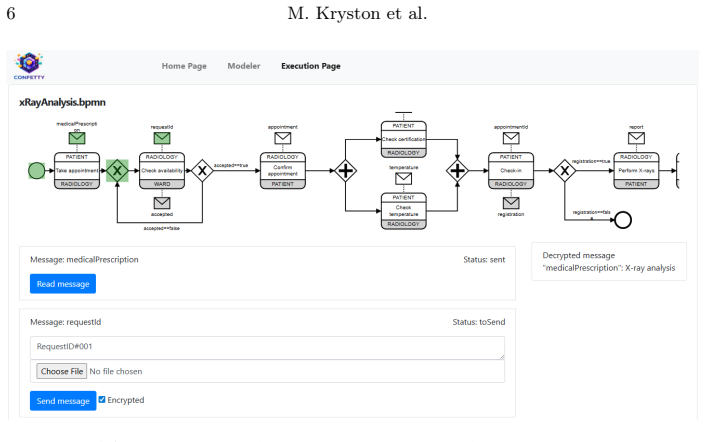
Blockchain technology enforces the security, robustness, and traceability of operations of Process-Aware Information Systems (PAISs). In particular, transparency ensures that all data is publicly available, fostering trust among participants in the system. Although this is a crucial property to enable notarization and auditing, it hinders the adoption of blockchain in scenarios where confidentiality is required, as sensitive data is handled. Current solutions rely on cryptographic techniques or consortium blockchains, hindering the enforcement capabilities of smart contracts and the public verifiability of transactions. This work presents the CONFETTY open-source web application, a platform for public-blockchain based process execution that preserves data confidentiality and operational transparency. We use smart contracts to enact, enforce, and store public interactions, while we adopt attribute-based encryption techniques for fine-grained access to confidential information. This approach effectively balances the transparency inherent in public blockchains with the enforcement of the business logic.
Editorial analysis
A structured set of objections, weighed in public.
Referee Report
Summary. The paper presents CONFETTY, an open-source web application for executing process-aware information systems on public blockchains. Smart contracts are used to enact, enforce, and store public interactions and business logic, while attribute-based encryption (ABE) provides fine-grained access control to confidential data, with the goal of balancing blockchain transparency and data confidentiality without resorting to consortium chains or fully on-chain cryptography.
Significance. If the separation of concerns is shown to preserve both public verifiability and enforceable process logic while delivering practical confidentiality, the work could facilitate broader adoption of public blockchains in regulated domains. The open-source release is a concrete strength that enables reproducibility and community validation.
major comments (3)
- [Abstract and §3] Abstract and §3 (Approach): the central claim that the architecture 'effectively balances' transparency with enforcement is asserted without any security analysis, threat model, or formal argument showing that ABE decryption remains off-chain and does not weaken smart-contract enforcement or public verifiability of transactions.
- [§5] §5 (Evaluation) or equivalent: no performance measurements, gas costs, latency figures, or scalability results are reported for the integrated smart-contract + ABE workflow, leaving the practicality of the tool unsupported.
- [§4] §4 (Implementation): while the manuscript states that CONFETTY is open-source, no concrete details are given on how attribute policies are encoded, how key distribution is handled, or how the web application prevents leakage of confidential data during on-chain transaction submission.
minor comments (2)
- [§3] Notation for ABE attributes and policy expressions should be introduced consistently before use in the architecture description.
- [Figure 1 or §3] The manuscript would benefit from a clear diagram showing the data flow between the web client, smart contract, and ABE components.
Simulated Author's Rebuttal
We thank the referee for the constructive feedback. We address each major comment below and commit to revisions that strengthen the manuscript while preserving its core claims about the separation of smart-contract enforcement and off-chain ABE confidentiality.
read point-by-point responses
-
Referee: [Abstract and §3] the central claim that the architecture 'effectively balances' transparency with enforcement is asserted without any security analysis, threat model, or formal argument showing that ABE decryption remains off-chain and does not weaken smart-contract enforcement or public verifiability of transactions.
Authors: We agree a dedicated security argument is missing. In the revised manuscript we will add a threat-model subsection to §3 that explicitly states the assumptions (honest-but-curious participants, standard ABE security, off-chain key management) and shows that decryption occurs entirely client-side; only public metadata and encrypted payloads are ever submitted to the blockchain. Consequently, smart-contract logic and transaction verifiability are unaffected. We will support this with informal reasoning grounded in the architecture's separation of concerns. revision: yes
-
Referee: [§5] no performance measurements, gas costs, latency figures, or scalability results are reported for the integrated smart-contract + ABE workflow, leaving the practicality of the tool unsupported.
Authors: We acknowledge the lack of quantitative evaluation. The revised §5 will include gas-cost measurements for the core smart-contract functions, end-to-end latency for ABE encryption/decryption within the workflow, and scalability results obtained by executing multiple process instances on a public testnet. These data will be generated from the released open-source implementation. revision: yes
-
Referee: [§4] no concrete details are given on how attribute policies are encoded, how key distribution is handled, or how the web application prevents leakage of confidential data during on-chain transaction submission.
Authors: We will expand §4 with the requested implementation details: policies are expressed as access trees in the chosen ABE scheme; an off-chain attribute authority issues keys according to user attributes; the web application performs all ABE operations locally in the browser before submitting only the resulting ciphertext and public metadata to the blockchain. Code references and excerpts from the open-source repository will be added to allow verification. revision: yes
Circularity Check
No significant circularity identified
full rationale
The paper is a system-description and tool-implementation manuscript. It presents an architecture that separates public smart-contract enforcement from off-chain ABE-based confidentiality without any mathematical derivation chain, fitted parameters, or predictions. The central claim (balance of transparency and enforcement) is achieved by explicit scoping of responsibilities rather than by any self-referential definition or reduction to inputs. No load-bearing self-citations, uniqueness theorems, or ansatzes are invoked that collapse the argument onto itself. The work is therefore self-contained against external cryptographic primitives and open-source implementation.
Axiom & Free-Parameter Ledger
Lean theorems connected to this paper
-
IndisputableMonolith/Cost/FunctionalEquationwashburn_uniqueness_aczel unclear?
unclearRelation between the paper passage and the cited Recognition theorem.
We use smart contracts to enact, enforce, and store public interactions, while we adopt attribute-based encryption techniques for fine-grained access to confidential information.
What do these tags mean?
- matches
- The paper's claim is directly supported by a theorem in the formal canon.
- supports
- The theorem supports part of the paper's argument, but the paper may add assumptions or extra steps.
- extends
- The paper goes beyond the formal theorem; the theorem is a base layer rather than the whole result.
- uses
- The paper appears to rely on the theorem as machinery.
- contradicts
- The paper's claim conflicts with a theorem or certificate in the canon.
- unclear
- Pith found a possible connection, but the passage is too broad, indirect, or ambiguous to say the theorem truly supports the claim.
Reference graph
Works this paper leans on
-
[1]
IPFS - Content Addressed, Versioned, P2P File System
Benet, J.: IPFS - content addressed, versioned, P2P file system. CoRR abs/1407.3561(2014)
work page internal anchor Pith review Pith/arXiv arXiv 2014
-
[2]
Chase, M.: Multi-authority attribute based encryption. In: Vadhan, S.P. (ed.) The- ory of Cryptography. pp. 515–534. Springer (2007)
work page 2007
-
[3]
Corradini, F., Marcelletti, A., Morichetta, A., Polini, A., Re, B., Tiezzi, F.: ChorChain: A model-driven framework for choreography-based systems using blockchain. In: ITBPM@BPM. pp. 26–32 (2021)
work page 2021
- [4]
-
[5]
Corradini, F., Marcelletti, A., Morichetta, A., Polini, A., Re, B., Tiezzi, F.: A flexible approach to multi-party business process execution on blockchain. Fut. Gen. Comp. Syst.147, 219–234 (2023)
work page 2023
-
[6]
Di Ciccio, C., Meroni, G., Plebani, P.: On the adoption of blockchain for business process monitoring. SoSyM21(3), 915–937 (2022)
work page 2022
-
[7]
Security and Communication Networks2022(1), 4978802 (2022)
Hong, L., Zhang, K., Gong, J., Qian, H.: A practical and efficient blockchain- assisted attribute-based encryption scheme for access control and data sharing. Security and Communication Networks2022(1), 4978802 (2022)
work page 2022
-
[8]
Kryston,M.,Marangone,E.,DiCiccio,C.,etal.:MARTSIA:Atoolforconfidential data exchange via public blockchain. In: CAiSE Forum. pp. 173–180 (2025)
work page 2025
-
[9]
Köpke, J., Meroni, G., Salnitri, M.: Designing secure business processes for blockchainswithSecBPMN2BC.FutureGener.Comput.Syst.141,382–398(2023)
work page 2023
- [10]
-
[11]
ISPA/IUCC/BDCloud/Social- Com/SustainCom pp
Liu, Z., Jiang, Z.L., Wang, X., Wu, Y., Yiu, S.: Multi-authority ciphertext policy attribute-based encryption scheme on ideal lattices. ISPA/IUCC/BDCloud/Social- Com/SustainCom pp. 1003–1008 (2018)
work page 2018
-
[12]
López-Pintado, O., García-Bañuelos, L., Dumas, M., Weber, I., Ponomarev, A.: Caterpillar: A business process execution engine on the Ethereum blockchain. Softw., Pract. Exper.49(7), 1162–1193 (2019)
work page 2019
- [13]
-
[14]
In: BPM Blockchain and RPA Forum
Marangone, E., Di Ciccio, C., Weber, I.: Fine-grained data access control for col- laborative process execution on blockchain. In: BPM Blockchain and RPA Forum. pp. 51–67. Springer (2022)
work page 2022
-
[15]
Marcelletti, A., Marangone, E., Kryston, M., Di Ciccio, C.: Balancing confidential- ity and transparency for blockchain-based process-aware information systems. In: BPM Forum. pp. 238–255 (2026)
work page 2026
- [16]
- [17]
-
[18]
In: BPM Blockchain and RPA Forum
Stiehle, F., Weber, I.: Blockchain for business process enactment: A taxonomy and systematic literature review. In: BPM Blockchain and RPA Forum. LNBIP, vol. 459, pp. 5–20. Springer (2022)
work page 2022
-
[19]
Tran, A.B., Lu, Q., Weber, I.: Lorikeet: A model-driven engineering tool for blockchain-based business process execution and asset management. In: BPM De- mos. pp. 56–60. Springer (2018)
work page 2018
-
[20]
Wood, G.: Ethereum: A secure decentralised generalised transaction ledger (2014)
work page 2014
discussion (0)
Sign in with ORCID, Apple, or X to comment. Anyone can read and Pith papers without signing in.