Recognition: no theorem link
Contrasting evolutionary pathways of fast- and slow-rotating galaxies in the green valley
Pith reviewed 2026-05-15 07:59 UTC · model grok-4.3
The pith
Slow-rotating green valley galaxies show lower metallicities than fast-rotating ones from stronger gas removal during mergers.
A machine-rendered reading of the paper's core claim, the machinery that carries it, and where it could break.
Core claim
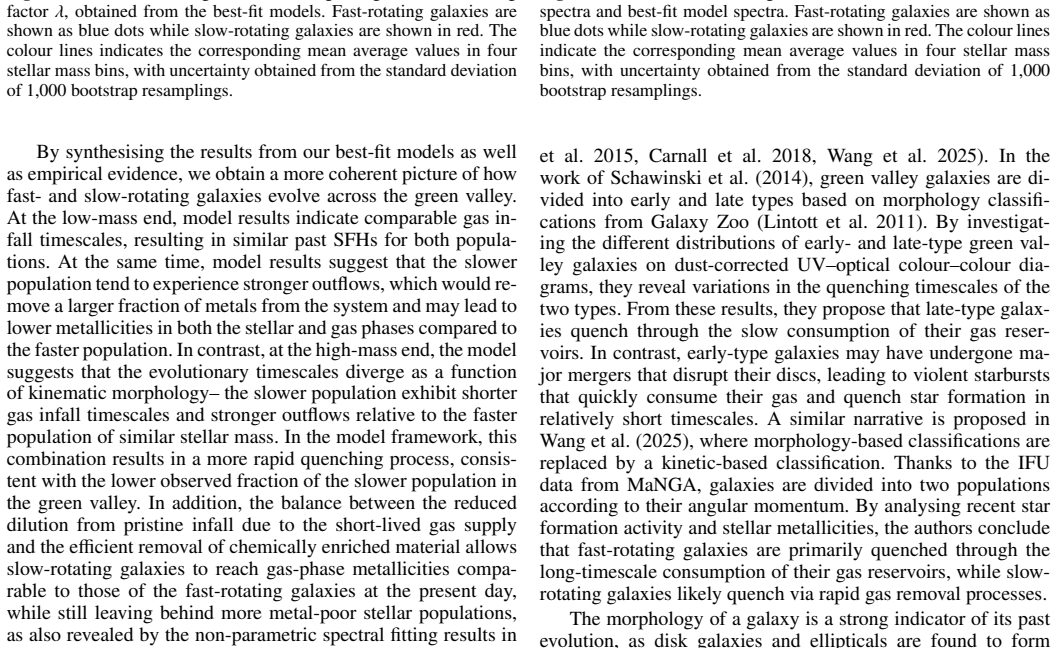
Slow-rotating galaxies in the green valley experienced more mergers that drove strong gas removal, producing lower metallicities in both gas and stars than fast-rotating galaxies. At low stellar masses the offset arises from stronger supernova-driven outflows that lower chemical content while leaving star-formation timescales similar. At high masses the combination of reduced pristine gas inflow and efficient gas removal yields gas-phase metallicities close to those of fast rotators but systematically lower stellar metallicities and shorter star-formation timescales.
What carries the argument
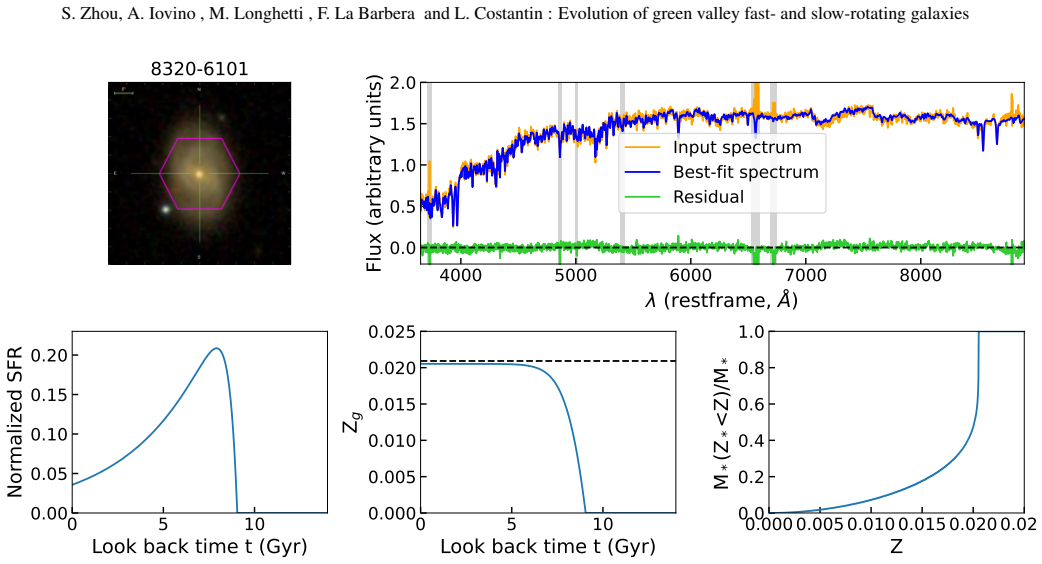
A simple chemical evolution model optimized to jointly fit gas-phase metallicities and integrated stellar spectra, used to reconstruct inflow, outflow, and star-formation timescales for individual galaxies.
If this is right
- Slow-rotating green valley galaxies experienced more mergers than fast-rotating ones.
- At low masses, stronger supernova-driven outflows reduce the chemical content of slow rotators while star-formation timescales stay comparable.
- At high masses, merger-triggered AGN feedback depletes gas and suppresses infall in slow rotators, shortening their star-formation timescales.
- Distinct evolutionary pathways exist for green valley galaxies that depend on their stellar rotation.
- Environmental and assembly-driven effects may also contribute to the observed metallicity differences.
Where Pith is reading between the lines
- Stellar spin could act as a proxy for past merger activity among green valley galaxies.
- Surveys that measure merger fractions or AGN activity in fast versus slow rotators could directly test the proposed pathways.
- Applying the same chemical model to other integral-field surveys would show whether the rotation-metallicity pattern is universal.
Load-bearing premise
The simple chemical evolution model accurately recovers the true gas inflow, outflow, and star-formation timescales without major degeneracies when fitted to the observed metallicities and spectra.
What would settle it
Direct measurements showing identical merger rates, gas inflow rates, and outflow strengths for fast- and slow-rotating galaxies yet the same metallicity offsets, or observations in which the metallicity difference vanishes after controlling for environment.
Figures



read the original abstract
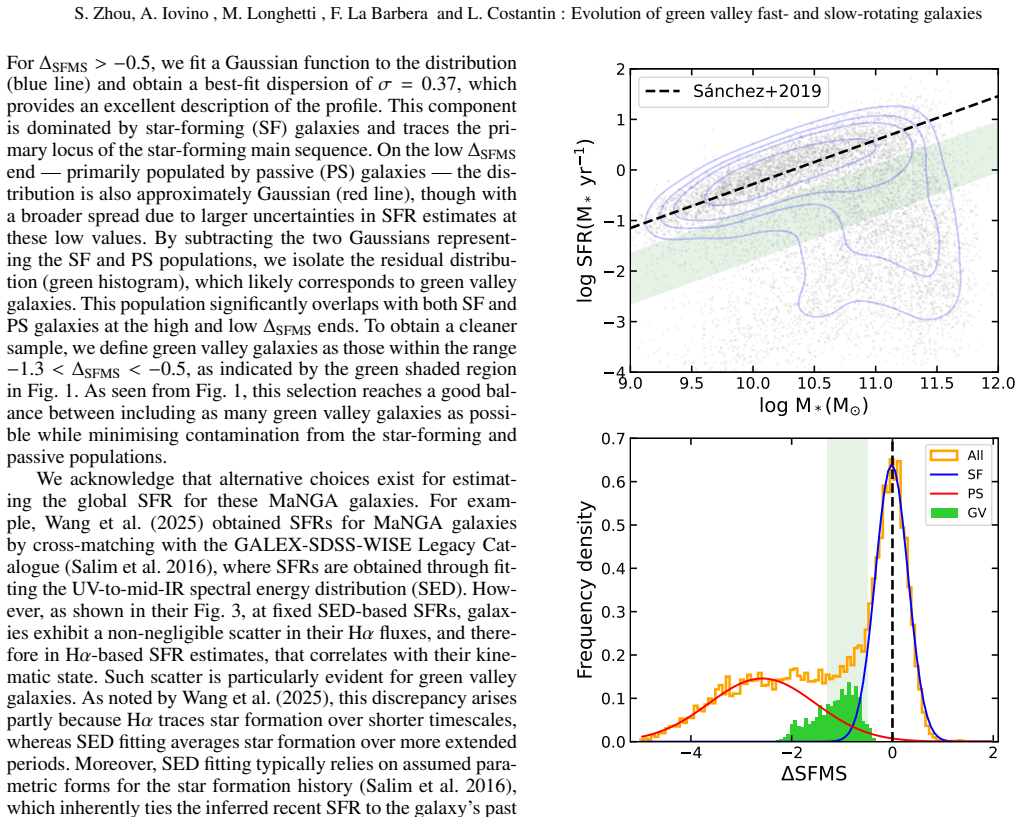
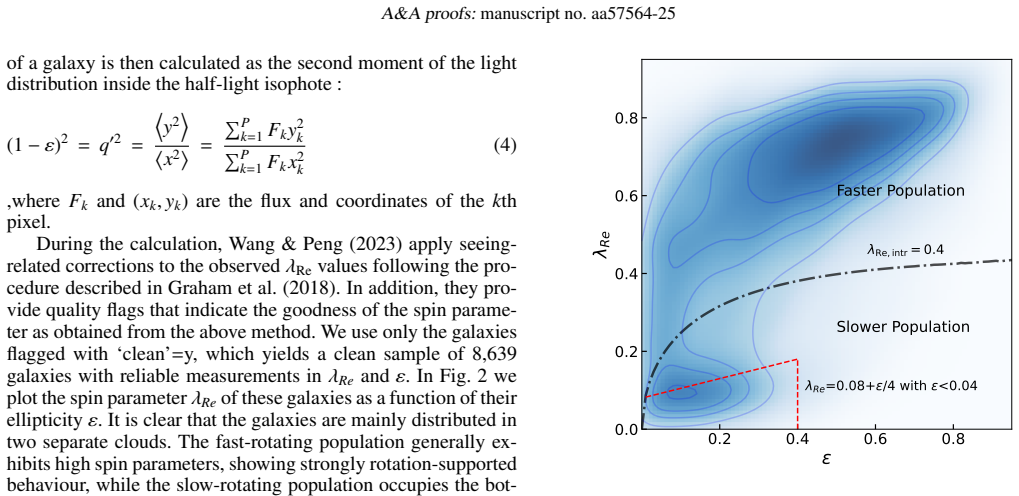
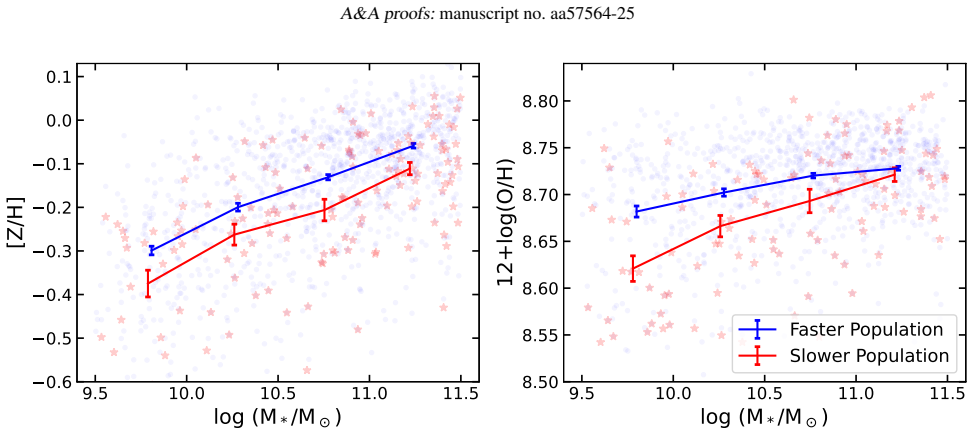
We investigate the evolutionary pathways of green valley (GV) galaxies drawn from the SDSS-IV/MaNGA survey. The GV sample is divided into fast- and slow-rotating galaxies based on stellar spin, and their stellar and gas-phase metallicities are compared. Fast-rotating galaxies exhibit systematically higher metallicities than slow-rotating galaxies in both gas and stars. However, the gas-phase difference is significant only at low stellar masses, while the stellar metallicity offset persists across the full mass range. Using a simple yet physically motivated chemical evolution model, optimised to jointly fit gas-phase metallicities and integrated stellar spectra, we reconstruct the star formation and chemical enrichment histories of individual galaxies and constrain gas inflow and outflow parameters. At low stellar masses, fast- and slow-rotating galaxies show similar gas-infall and star formation timescales, but the the slower population experienced stronger outflows which reduce their chemical content in both gas and stars. At high masses, the combination of reduced pristine gas inflow and more efficient gas removal in slow-rotating galaxies produce gas-phase metallicities comparable to fast-rotating galaxies but systematically lower stellar metallicities. These differences suggest distinct evolutionary pathways for GV galaxies. Slow-rotating galaxies likely experienced more mergers, usually associated with strong gas removal processes, leading to their systematically lower metallicities. At low masses, stronger supernova-driven outflows reduce their chemical content while leaving star-formation timescales similar to fast-rotating galaxies. At high masses, merger-triggered AGN feedback may rapidly deplete and suppress gas infall, producing the shorter star-formation timescales seen in slow-rotating galaxies. Alternative environmental and assembly-driven scenarios are also discussed.
Editorial analysis
A structured set of objections, weighed in public.
Referee Report
Summary. The paper divides MaNGA green-valley galaxies into fast- and slow-rotating subsamples using stellar spin and reports that fast-rotators exhibit higher gas-phase and stellar metallicities, with the gas-phase offset significant only below a characteristic mass. A simple chemical-evolution model is jointly optimized to the observed gas-phase metallicities and integrated stellar spectra to reconstruct individual star-formation and enrichment histories, yielding distinct best-fit inflow timescales, outflow loading factors, and star-formation timescales between the two populations. These differences are interpreted as evidence for stronger supernova-driven outflows at low mass and reduced pristine inflow plus efficient removal (possibly merger-triggered AGN feedback) at high mass in slow-rotators, implying separate evolutionary pathways linked to merger history.
Significance. If the model parameters can be shown to be uniquely recovered, the work supplies a concrete observational contrast between rotation-supported and dispersion-supported green-valley galaxies and ties it to plausible differences in gas-accretion and feedback efficiency. The direct metallicity comparison from MaNGA data is a clear empirical result; the model-based reconstruction, if validated, would add mechanistic insight into how angular-momentum content correlates with chemical evolution.
major comments (3)
- [Abstract (model description) and associated methods/results sections] The central claim that slow-rotating galaxies experienced stronger outflows (low mass) or reduced inflow plus efficient removal (high mass) rests on the chemical-evolution model recovering distinct parameter values when jointly fit to gas-phase metallicities and stellar spectra. No degeneracy diagnostics, covariance matrices, prior ranges, or mock-data recovery tests are presented to demonstrate that the reported differences in inflow timescale, outflow loading factor, and star-formation timescale are unique rather than degenerate combinations that can produce identical final metallicities.
- [Results on parameter differences] Error propagation from the joint fit to the reconstructed histories and to the final parameter differences is not shown. Without this, it is impossible to assess whether the claimed offsets between fast- and slow-rotating populations are statistically significant once parameter uncertainties and covariances are taken into account.
- [Discussion/interpretation paragraph] The interpretation that the parameter differences arise from mergers or AGN feedback is plausible but not directly constrained by the model; the model only returns effective inflow/outflow timescales. Independent observables (e.g., HI content, kinematic merger signatures, or AGN indicators) that could test this scenario are not compared to the model predictions.
minor comments (2)
- [Abstract] Typo in the abstract: 'but the the slower population'.
- [Figure captions and results] Figures displaying model fits should include the best-fit parameters with 1-sigma uncertainties and any reported covariance information.
Simulated Author's Rebuttal
We thank the referee for their constructive comments on our manuscript. We have revised the paper to strengthen the presentation of the chemical-evolution model by adding degeneracy diagnostics, covariance information, and error propagation. Our point-by-point responses follow.
read point-by-point responses
-
Referee: The central claim that slow-rotating galaxies experienced stronger outflows (low mass) or reduced inflow plus efficient removal (high mass) rests on the chemical-evolution model recovering distinct parameter values when jointly fit to gas-phase metallicities and stellar spectra. No degeneracy diagnostics, covariance matrices, prior ranges, or mock-data recovery tests are presented to demonstrate that the reported differences in inflow timescale, outflow loading factor, and star-formation timescale are unique rather than degenerate combinations that can produce identical final metallicities.
Authors: We agree that explicit validation of parameter uniqueness is essential. In the revised manuscript we have added a new Methods subsection that specifies the adopted prior ranges, describes the MCMC sampling, and reports the full covariance matrices for the fitted parameters (inflow timescale, outflow loading factor, star-formation timescale). We also performed mock-data recovery tests on simulated galaxies with known input parameters; these tests recover the input values to within the quoted uncertainties and confirm that the reported differences between fast- and slow-rotating populations are not produced by degeneracies. revision: yes
-
Referee: Error propagation from the joint fit to the reconstructed histories and to the final parameter differences is not shown. Without this, it is impossible to assess whether the claimed offsets between fast- and slow-rotating populations are statistically significant once parameter uncertainties and covariances are taken into account.
Authors: We have now included full error propagation. Posterior samples from the joint fits are used to generate Monte-Carlo realizations of the star-formation and enrichment histories; the resulting uncertainties are propagated to the population-level parameter differences. The revised figures and text display median offsets with 16th–84th percentile ranges, demonstrating that the key differences (stronger outflows at low mass, reduced inflow at high mass) remain statistically significant. revision: yes
-
Referee: The interpretation that the parameter differences arise from mergers or AGN feedback is plausible but not directly constrained by the model; the model only returns effective inflow/outflow timescales. Independent observables (e.g., HI content, kinematic merger signatures, or AGN indicators) that could test this scenario are not compared to the model predictions.
Authors: We concur that the model yields effective parameters and does not directly constrain physical mechanisms. The revised Discussion explicitly states this limitation and clarifies that the merger/AGN interpretation is based on consistency with literature trends rather than direct model output. We have added a comparison to MaNGA AGN indicators, which shows a modest excess of AGN activity among high-mass slow-rotators, lending qualitative support to the scenario. A full statistical test involving HI content and kinematic merger signatures lies beyond the scope of the present work and is noted as future research. revision: partial
Circularity Check
Model optimization to observed metallicities and spectra produces the reconstructed histories presented as evidence for distinct pathways
specific steps
-
fitted input called prediction
[Abstract]
"Using a simple yet physically motivated chemical evolution model, optimised to jointly fit gas-phase metallicities and integrated stellar spectra, we reconstruct the star formation and chemical enrichment histories of individual galaxies and constrain gas inflow and outflow parameters."
The star-formation and enrichment histories (and the inferred inflow/outflow differences) are obtained by fitting model parameters directly to the metallicities and spectra whose differences are being explained. The reconstructed timelines are therefore determined by construction from the optimization to the input data rather than serving as independent predictions or tests.
full rationale
The paper's central inference—that fast- and slow-rotating GV galaxies followed different evolutionary paths in gas inflow, outflow, and star-formation timescales—rests on a chemical evolution model whose parameters are optimized to reproduce the very gas-phase metallicities and integrated stellar spectra used as input. The abstract explicitly states that the model is 'optimised to jointly fit' these observables and then 'reconstruct' the histories and 'constrain' the parameters; the reported differences (stronger outflows at low mass, reduced inflow plus efficient removal at high mass) are therefore outputs of that fit rather than independent predictions. No equations, degeneracy tests, or mock-recovery results are supplied in the provided text to demonstrate that the parameter differences are uniquely recovered. This matches the fitted-input-called-prediction pattern but does not rise to full self-definitional equivalence or load-bearing self-citation, yielding a moderate circularity score.
Axiom & Free-Parameter Ledger
free parameters (3)
- gas inflow timescale
- outflow loading factor
- star formation timescale
axioms (2)
- domain assumption Chemical evolution can be described by a leaky-box model with parameterized inflows and outflows
- domain assumption Stellar spin parameter traces merger history and associated gas removal
Reference graph
Works this paper leans on
-
[1]
2022, ApJS, 259, 35 Argudo-Fernández, M., Verley, S., Bergond, G., et al
Abdurro’uf, Accetta, K., Aerts, C., et al. 2022, ApJS, 259, 35 Argudo-Fernández, M., Verley, S., Bergond, G., et al. 2015, A&A, 578, A110
work page 2022
-
[2]
Asplund, M., Grevesse, N., Sauval, A. J., & Scott, P. 2009, ARA&A, 47, 481
work page 2009
-
[3]
2024, arXiv e-prints, arXiv:2405.12518
Bacon, R., Maineiri, V ., Randich, S., et al. 2024, arXiv e-prints, arXiv:2405.12518
-
[4]
K., Glazebrook, K., Brinkmann, J., et al
Baldry, I. K., Glazebrook, K., Brinkmann, J., et al. 2004, ApJ, 600, 681
work page 2004
-
[5]
F., van der Wel, A., Papovich, C., et al
Bell, E. F., van der Wel, A., Papovich, C., et al. 2012, ApJ, 753, 167
work page 2012
-
[6]
F., Wolf, C., Meisenheimer, K., et al
Bell, E. F., Wolf, C., Meisenheimer, K., et al. 2004, ApJ, 608, 752
work page 2004
-
[7]
L., Halpern, M., Hinshaw, G., et al
Bennett, C. L., Halpern, M., Hinshaw, G., et al. 2003, ApJS, 148, 1
work page 2003
-
[8]
Bernardi, M., Domínguez Sánchez, H., Brownstein, J. R., Drory, N., & Sheth, R. K. 2019, MNRAS, 489, 5633
work page 2019
-
[9]
G., Kriek, M., Conroy, C., et al
Beverage, A. G., Kriek, M., Conroy, C., et al. 2021, ApJ, 917, L1
work page 2021
-
[10]
Blanton, M. R., Bershady, M. A., Abolfathi, B., et al. 2017, AJ, 154, 28
work page 2017
-
[11]
R., Kazin, E., Muna, D., Weaver, B
Blanton, M. R., Kazin, E., Muna, D., Weaver, B. A., & Price-Whelan, A. 2011, AJ, 142, 31
work page 2011
-
[12]
Brinchmann, J., Charlot, S., White, S. D. M., et al. 2004, MNRAS, 351, 1151
work page 2004
- [13]
-
[14]
Buchner, J., Georgakakis, A., Nandra, K., et al. 2014, A&A, 564, A125
work page 2014
- [15]
- [16]
-
[17]
Cameron, E., Driver, S. P., Graham, A. W., & Liske, J. 2009, ApJ, 699, 105
work page 2009
- [18]
- [19]
-
[20]
Cappellari, M., Emsellem, E., Bacon, R., et al. 2007, MNRAS, 379, 418
work page 2007
-
[21]
Carnall, A. C., McLure, R. J., Dunlop, J. S., & Davé, R. 2018, MNRAS, 480, 4379
work page 2018
-
[22]
M., Stiavelli, M., de Zeeuw, P
Carollo, C. M., Stiavelli, M., de Zeeuw, P. T., & Mack, J. 1997, AJ, 114, 2366
work page 1997
- [23]
- [24]
-
[25]
Croton, D. J., Springel, V ., White, S. D. M., et al. 2006, MNRAS, 365, 11
work page 2006
-
[26]
2017, MNRAS, 465, 1384 de Vaucouleurs, G
Curti, M., Cresci, G., Mannucci, F., et al. 2017, MNRAS, 465, 1384 de Vaucouleurs, G. 1959, Handbuch der Physik, 53, 275
work page 2017
- [27]
-
[28]
Origin of the Golden Mass of Galaxies and Black Holes
Dekel, A., Lapiner, S., & Dubois, Y . 2019, arXiv e-prints, arXiv:1904.08431
work page internal anchor Pith review Pith/arXiv arXiv 2019
- [29]
- [30]
-
[31]
Dubois, Y ., Pichon, C., Devriendt, J., et al. 2013, MNRAS, 428, 2885
work page 2013
-
[32]
Emsellem, E., Cappellari, M., Krajnovi´c, D., et al. 2011, MNRAS, 414, 888
work page 2011
-
[33]
Emsellem, E., Cappellari, M., Krajnovi´c, D., et al. 2007, MNRAS, 379, 401
work page 2007
- [34]
-
[35]
Feroz, F., Hobson, M. P., Cameron, E., & Pettitt, A. N. 2019, The Open Journal of Astrophysics, 2, 10
work page 2019
-
[36]
Fontanot, F., De Lucia, G., Monaco, P., Somerville, R. S., & Santini, P. 2009, MNRAS, 397, 1776
work page 2009
- [37]
-
[38]
Girardi, L., Bressan, A., Bertelli, G., & Chiosi, C. 2000, A&AS, 141, 371
work page 2000
-
[39]
T., Cappellari, M., Li, H., et al
Graham, M. T., Cappellari, M., Li, H., et al. 2018, MNRAS, 477, 4711
work page 2018
-
[40]
Gunn, J. E. & Gott, J. Richard, I. 1972, ApJ, 176, 1
work page 1972
-
[41]
Gunn, J. E., Siegmund, W. A., Mannery, E. J., et al. 2006, AJ, 131, 2332 Häring, N. & Rix, H.-W. 2004, ApJ, 604, L89
work page 2006
-
[42]
Hayward, C. C. & Hopkins, P. F. 2017, MNRAS, 465, 1682
work page 2017
-
[43]
Heavens, A., Panter, B., Jimenez, R., & Dunlop, J. 2004, Nature, 428, 625
work page 2004
-
[44]
1958, Meddelanden fran Lunds Astronomiska Observatorium Se- rie II, 136, 1
Holmberg, E. 1958, Meddelanden fran Lunds Astronomiska Observatorium Se- rie II, 136, 1
work page 1958
-
[45]
Hopkins, P. F., Cox, T. J., Younger, J. D., & Hernquist, L. 2009, ApJ, 691, 1168
work page 2009
-
[46]
Hopkins, P. F. & Quataert, E. 2010, MNRAS, 407, 1529
work page 2010
-
[47]
Hu, J., Wang, L., Ge, J., Zhu, K., & Zeng, G. 2024, MNRAS, 529, 4565
work page 2024
-
[48]
Hubble, E. P. 1926, ApJ, 64, 321
work page 1926
-
[49]
Iovino, A., Poggianti, B. M., Mercurio, A., et al. 2023, A&A, 672, A87
work page 2023
-
[50]
Kauffmann, G., Heckman, T. M., White, S. D. M., et al. 2003, MNRAS, 341, 33
work page 2003
-
[51]
Kewley, L. J. & Ellison, S. L. 2008, ApJ, 681, 1183
work page 2008
-
[52]
King, A. & Pounds, K. 2015, ARA&A, 53, 115 Krajnovi´c, D., Emsellem, E., Cappellari, M., et al. 2011, MNRAS, 414, 2923
work page 2015
-
[53]
Lagos, C. d. P., Schaye, J., Bahé, Y ., et al. 2018, MNRAS, 476, 4327
work page 2018
- [54]
-
[55]
R., Cherinka, B., Yan, R., et al
Law, D. R., Cherinka, B., Yan, R., et al. 2016, AJ, 152, 83
work page 2016
-
[56]
Law, D. R., Yan, R., Bershady, M. A., et al. 2015, AJ, 150, 19
work page 2015
-
[57]
K., Walter, F., Brinks, E., et al
Leroy, A. K., Walter, F., Brinks, E., et al. 2008, AJ, 136, 2782
work page 2008
-
[58]
2011, MNRAS, 410, 166 Martín-Navarro, I
Lintott, C., Schawinski, K., Bamford, S., et al. 2011, MNRAS, 410, 166 Martín-Navarro, I. & Mezcua, M. 2018, ApJ, 855, L20
work page 2011
-
[59]
Mashchenko, S., Wadsley, J., & Couchman, H. M. P. 2008, Science, 319, 174
work page 2008
-
[60]
M., Alatalo, K., Blitz, L., et al
McDermid, R. M., Alatalo, K., Blitz, L., et al. 2015, MNRAS, 448, 3484
work page 2015
- [61]
- [62]
-
[63]
L., Kereš, D., Faucher-Giguère, C.-A., et al
Muratov, A. L., Kereš, D., Faucher-Giguère, C.-A., et al. 2015, MNRAS, 454, 2691
work page 2015
-
[64]
Muzzin, A., Marchesini, D., Stefanon, M., et al. 2013, ApJ, 777, 18
work page 2013
-
[65]
Naab, T., Oser, L., Emsellem, E., et al. 2014, MNRAS, 444, 3357
work page 2014
-
[66]
Noeske, K. G., Weiner, B. J., Faber, S. M., et al. 2007, ApJ, 660, L43 Article number, page 17 of 18 A&A proofs:manuscript no. aa57564-25
work page 2007
- [67]
-
[68]
Panter, B., Jimenez, R., Heavens, A. F., & Charlot, S. 2007, MNRAS, 378, 1550
work page 2007
-
[69]
Peng, Y ., Maiolino, R., & Cochrane, R. 2015, Nature, 521, 192
work page 2015
-
[70]
Penoyre, Z., Moster, B. P., Sijacki, D., & Genel, S. 2017, MNRAS, 468, 3883
work page 2017
-
[71]
Peterken, T., Merrifield, M., Aragón-Salamanca, A., et al. 2020, MNRAS, 495, 3387
work page 2020
-
[72]
Prieto, J., Escala, A., V olonteri, M., & Dubois, Y . 2017, ApJ, 836, 216
work page 2017
-
[73]
Pulsoni, C., Gerhard, O., Arnaboldi, M., et al. 2021, A&A, 647, A95
work page 2021
-
[74]
Romano, D., Karakas, A. I., Tosi, M., & Matteucci, F. 2010, A&A, 522, A32
work page 2010
-
[75]
2014, Serbian Astronomical Journal, 189, 1
Salim, S. 2014, Serbian Astronomical Journal, 189, 1
work page 2014
-
[76]
Salim, S., Lee, J. C., Janowiecki, S., et al. 2016, ApJS, 227, 2 Sánchez, S. F., Avila-Reese, V ., Rodríguez-Puebla, A., et al. 2019, MNRAS, 482, 1557 Sánchez, S. F., Barrera-Ballesteros, J. K., Lacerda, E., et al. 2022, ApJS, 262, 36 Sánchez, S. F., Pérez, E., Sánchez-Blázquez, P., et al. 2016, Rev. Mexicana As- tron. Astrofis., 52, 171
work page 2016
-
[77]
Schawinski, K., Lintott, C. J., Thomas, D., et al. 2009, ApJ, 690, 1672
work page 2009
-
[78]
Schawinski, K., Urry, C. M., Simmons, B. D., et al. 2014, MNRAS, 440, 889
work page 2014
-
[79]
Schiminovich, D., Wyder, T. K., Martin, D. C., et al. 2007, ApJS, 173, 315
work page 2007
- [80]
discussion (0)
Sign in with ORCID, Apple, or X to comment. Anyone can read and Pith papers without signing in.