Recognition: 2 theorem links
· Lean TheoremElectroweak phase transitions in a U(1)_D extension of the standard model with dimension-six operators: Gravitational waves and LHC signatures
Pith reviewed 2026-05-15 09:14 UTC · model grok-4.3
The pith
A dimension-six operator in a U(1) extended Standard Model allows strong first-order electroweak phase transitions over a much wider parameter space.
A machine-rendered reading of the paper's core claim, the machinery that carries it, and where it could break.
Core claim
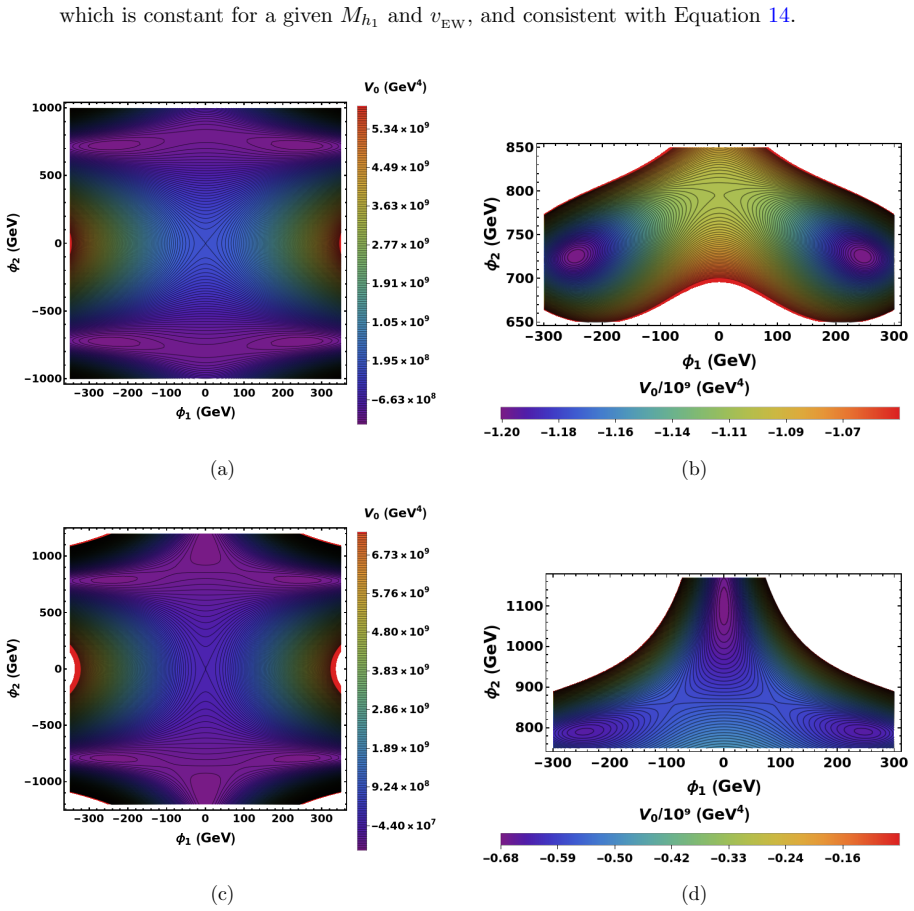
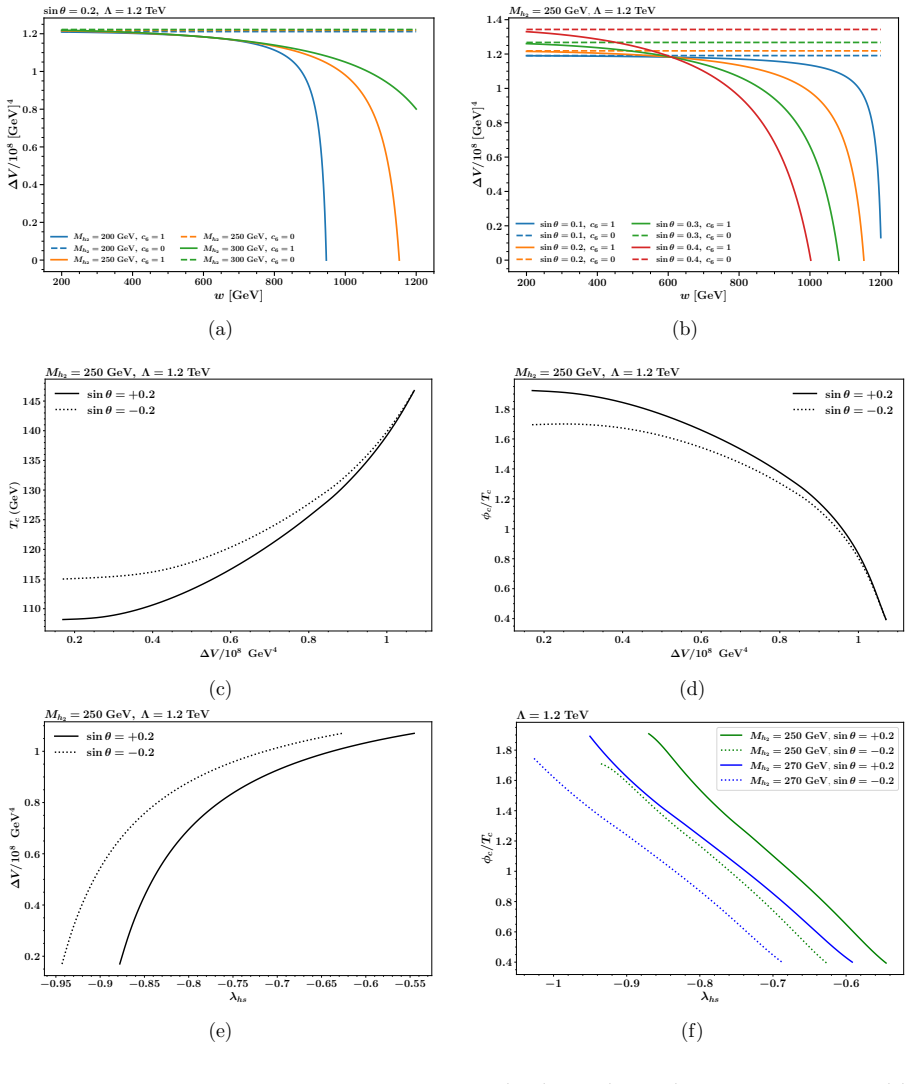
The tree-level scalar potential contains a dimension-six term of the form |H|^2|φ|^4. This higher-dimensional operator plays a crucial role in the phase transition dynamics by weakening the correlation between the Higgs-singlet portal coupling and the scalar mixing angle that typically constrains singlet-extended models. Consequently, SFOEWPT can be achieved over a significantly extended region of parameter space. The strength of the phase transition is primarily driven by the vacuum expectation value of the singlet scalar.
What carries the argument
The dimension-six operator |H|^2|φ|^4, which reduces the correlation between the Higgs portal coupling and the scalar mixing angle in the phase transition dynamics.
If this is right
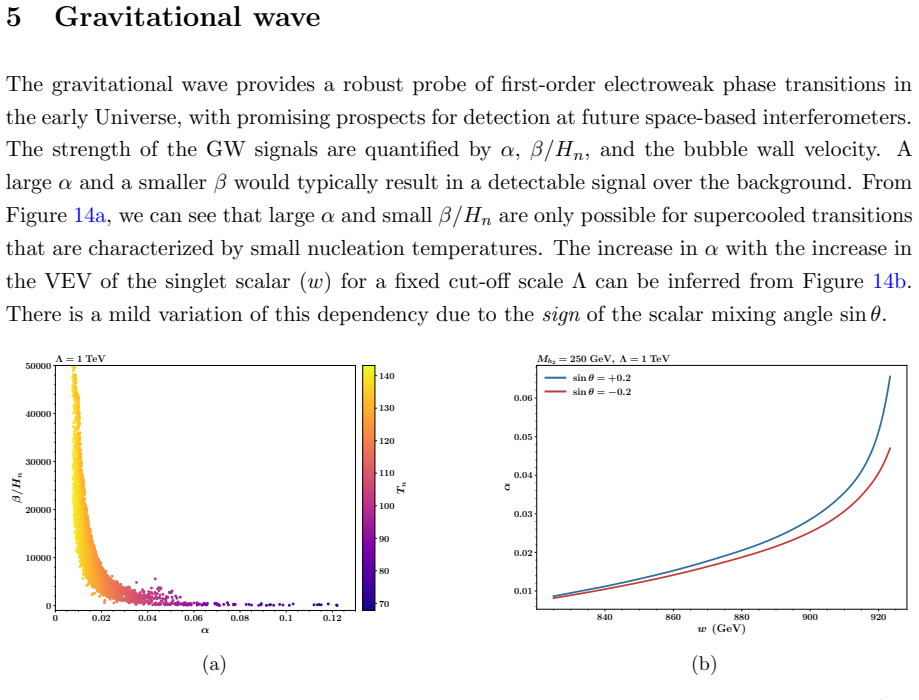
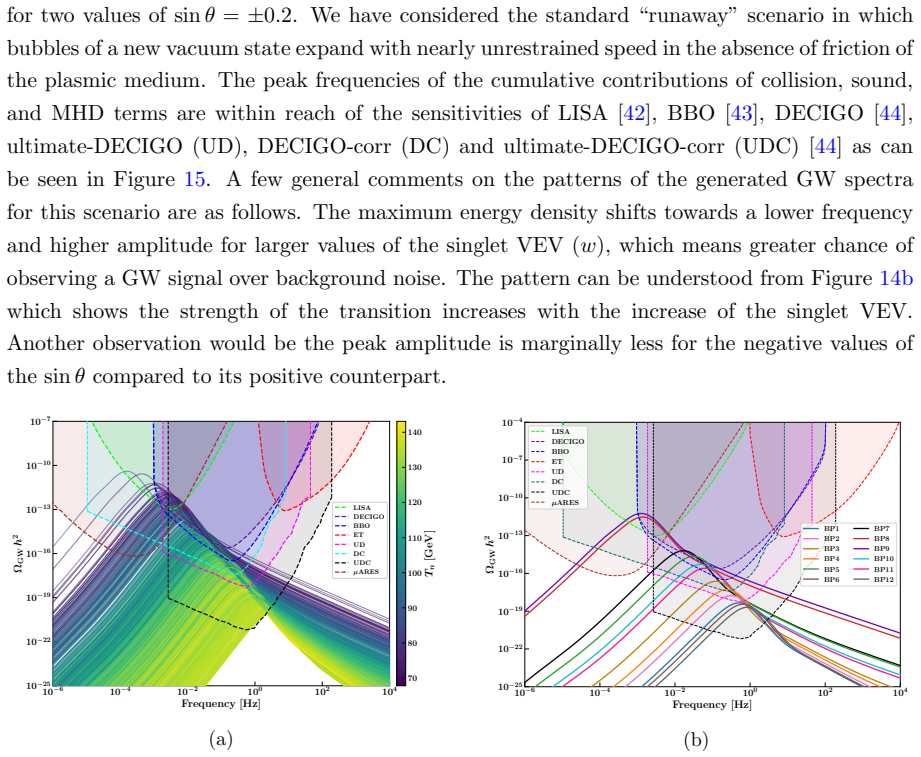
- The phase transition generates stochastic gravitational-wave signals potentially observable at future interferometers.
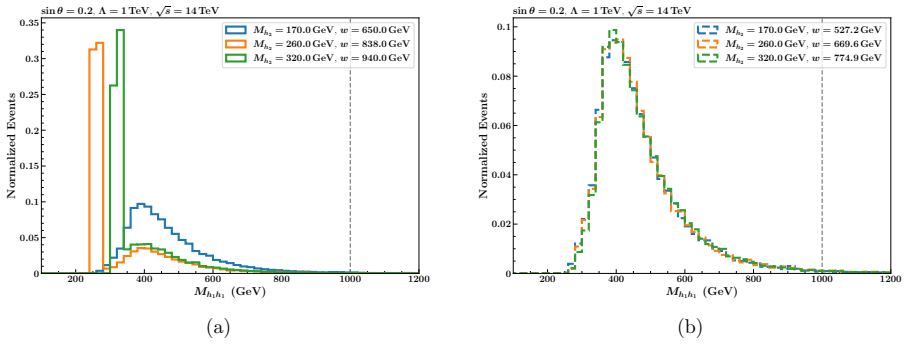
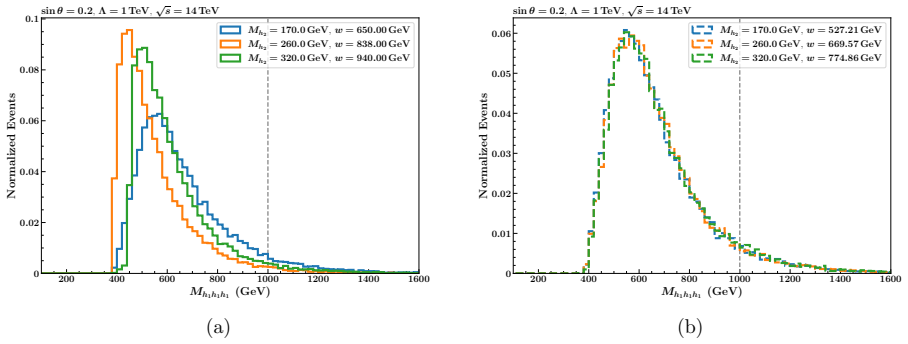
- The extended scalar sector produces distinctive multi-scalar production signatures at the LHC that correlate directly with the singlet scalar vev.
- Strong first-order electroweak phase transitions occur over a significantly larger region of parameter space than in standard singlet-extended models.
- Regions consistent with SFOEWPT can be identified and mapped in the model's parameter space.
Where Pith is reading between the lines
- Similar dimension-six operators could relax mixing constraints in other scalar extensions of the Standard Model.
- LHC searches for multi-Higgs final states could directly test the singlet vev values required for the transition.
- The new U(1) gauge boson may link the transition to additional cosmological signals not explored in the present analysis.
Load-bearing premise
The effective field theory truncation that retains only the |H|^2|φ|^4 dimension-six operator remains valid at the temperatures and field values relevant to the electroweak phase transition.
What would settle it
A calculation that includes neglected higher-dimensional operators and shows they restore the strong correlation between portal coupling and mixing angle, eliminating SFOEWPT in the claimed parameter regions.
Figures










read the original abstract
We investigate the possibility of realizing strong first-order electroweak phase transition (SFOEWPT) in an effective field theory framework where the Standard Model is extended with a complex scalar singlet ($\phi$) charged under a local $U(1)_D$ gauge group. The tree-level scalar potential contains a dimension-six term of the form $|H|^2|\phi|^4$. We show that this higher-dimensional operator plays a crucial role in the phase transition dynamics by weakening the correlation between the Higgs-singlet portal coupling and the scalar mixing angle that typically constrains singlet-extended models. Consequently, SFOEWPT can be achieved over a significantly extended region of parameter space. The strength of the phase transition is primarily driven by the vacuum expectation value (VEV) of the singlet scalar which plays a central role in this analysis. We analyze the phase transition in this model and identify regions of parameter space consistent with SFOEWPT. The resulting phase transition can generate stochastic gravitational-wave signals potentially observable at future interferometers. The extended scalar sector in presence of the dimension-six operator also leads to distinctive multi-scalar production signatures at the LHC, intimately correlated with the singlet scalar VEV.
Editorial analysis
A structured set of objections, weighed in public.
Referee Report
Summary. The manuscript investigates strong first-order electroweak phase transitions (SFOEWPT) in a U(1)_D extension of the Standard Model that includes a complex scalar singlet and a dimension-six operator |H|^2 |phi|^4 in the tree-level scalar potential. The central claim is that this operator weakens the usual correlation between the Higgs-singlet portal coupling and the scalar mixing angle, thereby opening a significantly larger region of parameter space where SFOEWPT can be realized. The transition strength is stated to be driven primarily by the singlet vacuum expectation value. The resulting phase transitions are analyzed for their stochastic gravitational-wave signals and for correlated multi-scalar production signatures at the LHC.
Significance. If the central claims are substantiated, the work would extend the viable parameter space for SFOEWPT beyond standard singlet extensions and provide concrete, correlated predictions for future gravitational-wave interferometers and LHC searches. The explicit linkage between the phase-transition dynamics and observable collider signatures is a constructive feature. The assessment is limited by the absence of detailed numerical scans, error estimates, and explicit verification of the effective-field-theory truncation in the provided text.
major comments (2)
- [Abstract and scalar potential] The central claim that the dimension-six operator |H|^2 |phi|^4 weakens the portal-mixing correlation and drives SFOEWPT via the singlet VEV rests on the assumption that higher-dimensional operators remain negligible. When the singlet VEV is chosen large enough to produce a strong transition, the ratio v_phi/Lambda is no longer parametrically small; operators such as |phi|^6/Lambda^2 can then reshape the potential barrier and potentially restore the original correlation or remove the transition. This EFT truncation validity is load-bearing for the extended-parameter-space result and requires explicit justification or bounds.
- [Phase transition analysis] The strength of the phase transition is asserted to be primarily driven by the singlet VEV, yet this VEV is itself a free parameter scanned to satisfy the SFOEWPT condition. Without an explicit derivation of the effective potential, minimization conditions, or a parameter scan with error analysis showing how the dim-6 term decouples the portal coupling from the mixing angle, the claim that SFOEWPT is achieved over a significantly extended region cannot be verified.
minor comments (1)
- [Abstract] The abstract refers to 'regions of parameter space consistent with SFOEWPT' but does not specify the scan ranges, the precise criterion used for strong transitions (e.g., v_c/T_c threshold), or the treatment of thermal corrections.
Simulated Author's Rebuttal
We thank the referee for the detailed and constructive report. We address the two major comments below, providing clarifications on the EFT validity and phase-transition analysis. We will incorporate additional derivations, bounds, and scan results in the revised manuscript to strengthen the presentation.
read point-by-point responses
-
Referee: [Abstract and scalar potential] The central claim that the dimension-six operator |H|^2 |phi|^4 weakens the portal-mixing correlation and drives SFOEWPT via the singlet VEV rests on the assumption that higher-dimensional operators remain negligible. When the singlet VEV is chosen large enough to produce a strong transition, the ratio v_phi/Lambda is no longer parametrically small; operators such as |phi|^6/Lambda^2 can then reshape the potential barrier and potentially restore the original correlation or remove the transition. This EFT truncation validity is load-bearing for the extended-parameter-space result and requires explicit justification or bounds.
Authors: We agree that explicit justification of the EFT truncation is necessary. In the revised manuscript we will add a dedicated subsection deriving the conditions under which |phi|^6/Lambda^2 and other higher operators remain subdominant. For the benchmark values of Lambda used in our scans we will show that v_phi/Lambda remains below 0.3 in the viable SFOEWPT region, and we will provide quantitative bounds on Lambda that keep the dim-6 truncation self-consistent while still allowing the observed decoupling between the portal coupling and the mixing angle. revision: yes
-
Referee: [Phase transition analysis] The strength of the phase transition is asserted to be primarily driven by the singlet VEV, yet this VEV is itself a free parameter scanned to satisfy the SFOEWPT condition. Without an explicit derivation of the effective potential, minimization conditions, or a parameter scan with error analysis showing how the dim-6 term decouples the portal coupling from the mixing angle, the claim that SFOEWPT is achieved over a significantly extended region cannot be verified.
Authors: We will expand the phase-transition section to include the full one-loop finite-temperature effective potential, the tree-level and one-loop minimization conditions, and the numerical scan procedure with error estimates. The revised text will explicitly demonstrate how the |H|^2|phi|^4 operator modifies the barrier height and the relation between the portal coupling and the mixing angle, thereby extending the SFOEWPT region. The singlet VEV is treated as a scanned parameter, but we will show that the dim-6 term permits viable points over a wider range of portal couplings than in the renormalizable case. revision: yes
Circularity Check
No significant circularity in derivation chain
full rationale
The paper constructs the scalar potential with the explicit dimension-six operator |H|^2|phi|^4, derives the finite-temperature effective potential, and performs a parameter scan over independent inputs (portal coupling, mixing angle, singlet VEV) to locate regions satisfying the SFOEWPT criterion v_c/T_c > 1. Gravitational-wave spectra and LHC production rates are then computed directly from the same potential for those regions. No equation reduces to an input by construction, no fitted parameter is relabeled as a prediction, and no load-bearing step relies on a self-citation chain. The claim that the dim-6 term weakens the portal-mixing correlation follows from explicit minimization of the potential and is therefore self-contained against external benchmarks.
Axiom & Free-Parameter Ledger
free parameters (3)
- dimension-six operator coefficient
- singlet vacuum expectation value
- Higgs-singlet portal coupling
axioms (1)
- domain assumption Effective field theory with only the specified dimension-six operator remains valid near the electroweak scale
invented entities (1)
-
U(1)_D gauge boson
no independent evidence
Lean theorems connected to this paper
-
IndisputableMonolith/Cost/FunctionalEquation.leanwashburn_uniqueness_aczel unclear?
unclearRelation between the paper passage and the cited Recognition theorem.
The tree-level scalar potential … contains a dimension-six term of the form |H|^2|φ|^4 … weakening the correlation between the Higgs-singlet portal coupling and the scalar mixing angle
-
IndisputableMonolith/Foundation/RealityFromDistinction.leanreality_from_one_distinction unclear?
unclearRelation between the paper passage and the cited Recognition theorem.
SFOEWPT can be achieved over a significantly extended region of parameter space … strength … driven by the vacuum expectation value (VEV) of the singlet scalar
What do these tags mean?
- matches
- The paper's claim is directly supported by a theorem in the formal canon.
- supports
- The theorem supports part of the paper's argument, but the paper may add assumptions or extra steps.
- extends
- The paper goes beyond the formal theorem; the theorem is a base layer rather than the whole result.
- uses
- The paper appears to rely on the theorem as machinery.
- contradicts
- The paper's claim conflicts with a theorem or certificate in the canon.
- unclear
- Pith found a possible connection, but the passage is too broad, indirect, or ambiguous to say the theorem truly supports the claim.
Reference graph
Works this paper leans on
-
[1]
V. A. Kuzmin, V. A. Rubakov and M. E. Shaposhnikov,On the Anomalous Electroweak Baryon Number Nonconservation in the Early Universe,Phys. Lett. B155(1985) 36
work page 1985
-
[2]
CP Violation and Baryogenesis at the Electroweak Phase Transition
K. Funakubo,CP violation and baryogenesis at the electroweak phase transition,Prog. Theor. Phys.96(1996) 475–520, [hep-ph/9608358]
work page internal anchor Pith review Pith/arXiv arXiv 1996
-
[3]
A. D. Sakharov,Violation of CP Invariance, C asymmetry, and baryon asymmetry of the universe,Pisma Zh. Eksp. Teor. Fiz.5(1967) 32–35
work page 1967
-
[4]
Finite temperature field theory and phase transitions
M. Quiros,Finite temperature field theory and phase transitions, inICTP Summer School in High-Energy Physics and Cosmology, pp. 187–259, 1, 1999.hep-ph/9901312
work page internal anchor Pith review Pith/arXiv arXiv 1999
-
[5]
J. R. Espinosa and M. Quiros,The Electroweak phase transition with a singlet,Phys. Lett. B305(1993) 98–105, [hep-ph/9301285]
work page internal anchor Pith review Pith/arXiv arXiv 1993
-
[6]
J. R. Espinosa and M. Quiros,Novel Effects in Electroweak Breaking from a Hidden Sector,Phys. Rev. D76(2007) 076004, [hep-ph/0701145]
work page internal anchor Pith review Pith/arXiv arXiv 2007
-
[7]
Singlet Higgs Phenomenology and the Electroweak Phase Transition
S. Profumo, M. J. Ramsey-Musolf and G. Shaughnessy,Singlet Higgs phenomenology and the electroweak phase transition,JHEP08(2007) 010, [0705.2425]
work page internal anchor Pith review Pith/arXiv arXiv 2007
-
[8]
J. R. Espinosa, T. Konstandin and F. Riva,Strong Electroweak Phase Transitions in the Standard Model with a Singlet,Nucl. Phys. B854(2012) 592–630, [1107.5441]
work page internal anchor Pith review Pith/arXiv arXiv 2012
-
[9]
Strongly First Order Phase Transitions Near an Enhanced Discrete Symmetry Point
V. Barger, D. J. H. Chung, A. J. Long and L.-T. Wang,Strongly First Order Phase Transitions Near an Enhanced Discrete Symmetry Point,Phys. Lett. B710(2012) 1–7, [1112.5460]
work page internal anchor Pith review Pith/arXiv arXiv 2012
-
[10]
Testing Electroweak Baryogenesis with Future Colliders
D. Curtin, P. Meade and C.-T. Yu,Testing Electroweak Baryogenesis with Future Colliders,JHEP11(2014) 127, [1409.0005]
work page internal anchor Pith review Pith/arXiv arXiv 2014
-
[11]
Dynamics of Electroweak Phase Transition In Singlet-Scalar Extension of the Standard Model
G. Kurup and M. Perelstein,Dynamics of Electroweak Phase Transition In Singlet-Scalar Extension of the Standard Model,Phys. Rev. D96(2017) 015036, [1704.03381]
work page internal anchor Pith review Pith/arXiv arXiv 2017
-
[12]
H. Chen and Y. Jiang,A Comprehensive Framework for Electroweak Phase Transitions: Thermal History and Dynamics from Bubble Nucleation to Percolation,2503.00421
-
[13]
J. Choi and R. R. Volkas,Real Higgs singlet and the electroweak phase transition in the Standard Model,Phys. Lett. B317(1993) 385–391, [hep-ph/9308234]
work page internal anchor Pith review Pith/arXiv arXiv 1993
-
[14]
S. W. Ham, Y. S. Jeong and S. K. Oh,Electroweak phase transition in an extension of the standard model with a real Higgs singlet,J. Phys. G31(2005) 857–871, [hep-ph/0411352]
work page internal anchor Pith review Pith/arXiv arXiv 2005
-
[15]
Higgs Self-Coupling as a Probe of Electroweak Phase Transition
A. Noble and M. Perelstein,Higgs self-coupling as a probe of electroweak phase transition, Phys. Rev. D78(2008) 063518, [0711.3018]. 40
work page internal anchor Pith review Pith/arXiv arXiv 2008
-
[16]
Strong electroweak phase transitions without collider traces
A. Ashoorioon and T. Konstandin,Strong electroweak phase transitions without collider traces,JHEP07(2009) 086, [0904.0353]
work page internal anchor Pith review Pith/arXiv arXiv 2009
-
[17]
S. Das, P. J. Fox, A. Kumar and N. Weiner,The Dark Side of the Electroweak Phase Transition,JHEP11(2010) 108, [0910.1262]
work page internal anchor Pith review Pith/arXiv arXiv 2010
-
[18]
Singlet-Catalyzed Electroweak Phase Transitions and Precision Higgs Studies
S. Profumo, M. J. Ramsey-Musolf, C. L. Wainwright and P. Winslow,Singlet-catalyzed electroweak phase transitions and precision Higgs boson studies,Phys. Rev. D91(2015) 035018, [1407.5342]
work page internal anchor Pith review Pith/arXiv arXiv 2015
-
[19]
A. V. Kotwal, M. J. Ramsey-Musolf, J. M. No and P. Winslow,Singlet-catalyzed electroweak phase transitions in the 100 TeV frontier,Phys. Rev. D94(2016) 035022, [1605.06123]
work page internal anchor Pith review Pith/arXiv arXiv 2016
- [20]
-
[21]
C.-W. Chiang, M. J. Ramsey-Musolf and E. Senaha,Standard Model with a Complex Scalar Singlet: Cosmological Implications and Theoretical Considerations,Phys. Rev. D 97(2018) 015005, [1707.09960]
work page internal anchor Pith review Pith/arXiv arXiv 2018
- [22]
-
[23]
T. Biek¨ otter, A. Dashko, M. L¨ oschner and G. Weiglein,Perturbative aspects of the electroweak phase transition with a complex singlet and implications for gravitational wave predictions,2511.14831
- [24]
- [25]
- [26]
-
[27]
K. Hashino, M. Kakizaki, S. Kanemura, P. Ko and T. Matsui,Gravitational waves from first order electroweak phase transition in models with the U(1) X gauge symmetry,JHEP 06(2018) 088, [1802.02947]
work page internal anchor Pith review Pith/arXiv arXiv 2018
-
[28]
Probing the Electroweak Phase Transition at the LHC
P. Huang, A. Joglekar, B. Li and C. E. M. Wagner,Probing the Electroweak Phase Transition at the LHC,Phys. Rev. D93(2016) 055049, [1512.00068]
work page internal anchor Pith review Pith/arXiv arXiv 2016
-
[29]
D. J. H. Chung, A. J. Long and L.-T. Wang,125 GeV Higgs boson and electroweak phase transition model classes,Phys. Rev. D87(2013) 023509, [1209.1819]. 41
work page internal anchor Pith review Pith/arXiv arXiv 2013
-
[30]
First-Order Electroweak Phase Transition in the Standard Model with a Low Cutoff
C. Grojean, G. Servant and J. D. Wells,First-order electroweak phase transition in the standard model with a low cutoff,Phys. Rev. D71(2005) 036001, [hep-ph/0407019]
work page internal anchor Pith review Pith/arXiv arXiv 2005
-
[31]
Dynamics of Non-renormalizable Electroweak Symmetry Breaking
C. Delaunay, C. Grojean and J. D. Wells,Dynamics of Non-renormalizable Electroweak Symmetry Breaking,JHEP04(2008) 029, [0711.2511]
work page internal anchor Pith review Pith/arXiv arXiv 2008
-
[32]
R.-G. Cai, M. Sasaki and S.-J. Wang,The gravitational waves from the first-order phase transition with a dimension-six operator,JCAP08(2017) 004, [1707.03001]
work page internal anchor Pith review Pith/arXiv arXiv 2017
-
[33]
Signals of the electroweak phase transition at colliders and gravitational wave observatories
M. Chala, C. Krause and G. Nardini,Signals of the electroweak phase transition at colliders and gravitational wave observatories,JHEP07(2018) 062, [1802.02168]
work page internal anchor Pith review Pith/arXiv arXiv 2018
- [34]
-
[35]
M. Postma and G. White,Cosmological phase transitions: is effective field theory just a toy?,JHEP03(2021) 280, [2012.03953]
- [36]
- [37]
- [38]
-
[39]
U. Banerjee, S. Chakraborty, S. Prakash and S. U. Rahaman,Feasibility of ultrarelativistic bubbles in SMEFT,Phys. Rev. D110(2024) 055002, [2402.02914]
- [40]
- [41]
-
[42]
Detector configuration of DECIGO/BBO and identification of cosmological neutron-star binaries
K. Yagi and N. Seto,Detector configuration of DECIGO/BBO and identification of cosmological neutron-star binaries,Phys. Rev. D83(2011) 044011, [1101.3940]
work page internal anchor Pith review Pith/arXiv arXiv 2011
-
[43]
Gravitational Wave Background and Non-Gaussianity as a Probe of the Curvaton Scenario
K. Nakayama and J. Yokoyama,Gravitational Wave Background and Non-Gaussianity as a Probe of the Curvaton Scenario,JCAP01(2010) 010, [0910.0715]
work page internal anchor Pith review Pith/arXiv arXiv 2010
-
[44]
Sesana et al.,Unveiling the gravitational universe atµ-Hz frequencies,Exper
A. Sesana et al.,Unveiling the gravitational universe atµ-Hz frequencies,Exper. Astron. 51(2021) 1333–1383, [1908.11391]. 42
-
[45]
Effective field theory approach to LHC Higgs data
A. Falkowski,Effective field theory approach to LHC Higgs data,Pramana87(2016) 39, [1505.00046]. [47]ATLAScollaboration, G. Aad et al.,Combination of searches for invisible decays of the Higgs boson using 139 fb−1 of proton-proton collision data at s=13 TeV collected with the ATLAS experiment,Phys. Lett. B842(2023) 137963, [2301.10731]. [48]CMScollaborati...
work page internal anchor Pith review Pith/arXiv arXiv 2016
-
[46]
Robens,Constraining Extended Scalar Sectors at Current and Future Colliders—An Update,Springer Proc
T. Robens,Constraining Extended Scalar Sectors at Current and Future Colliders—An Update,Springer Proc. Phys.292(2023) 141–152, [2209.15544]
-
[47]
S. Adhikari, S. D. Lane, I. M. Lewis and M. Sullivan,Complex Scalar Singlet Model Benchmarks for Snowmass, inSnowmass 2021, 3, 2022.2203.07455
-
[48]
A. Papaefstathiou, T. Robens and G. White,Signal strength and W-boson mass measurements as a probe of the electro-weak phase transition at colliders - Snowmass White Paper, inSnowmass 2021, 5, 2022.2205.14379. [52]CMScollaboration,Combination of searches for nonresonant Higgs boson pair production in proton-proton collisions at sqrt(s) = 13 TeV, . [53]ATL...
-
[49]
Next-to-Next-to-Leading Order QCD Corrections to Higgs Boson Pair Production
D. de Florian and J. Mazzitelli,Next-to-Next-to-Leading Order QCD Corrections to Higgs Boson Pair Production,PoSLL2014(2014) 029, [1405.4704]
work page internal anchor Pith review Pith/arXiv arXiv 2014
-
[50]
M. E. Carrington,The Effective potential at finite temperature in the Standard Model, Phys. Rev. D45(1992) 2933–2944
work page 1992
-
[51]
R. R. Parwani,Resummation in a hot scalar field theory,Phys. Rev. D45(1992) 4695, [hep-ph/9204216]
work page internal anchor Pith review Pith/arXiv arXiv 1992
-
[52]
H. H. Patel and M. J. Ramsey-Musolf,Baryon Washout, Electroweak Phase Transition, and Perturbation Theory,JHEP07(2011) 029, [1101.4665]
work page internal anchor Pith review Pith/arXiv arXiv 2011
-
[53]
K. Fuyuto and E. Senaha,Improved sphaleron decoupling condition and the Higgs coupling constants in the real singlet-extended standard model,Phys. Rev. D90(2014) 015015, [1406.0433]
work page internal anchor Pith review Pith/arXiv arXiv 2014
-
[54]
C. L. Wainwright,CosmoTransitions: Computing Cosmological Phase Transition Temperatures and Bubble Profiles with Multiple Fields,Comput. Phys. Commun.183 (2012) 2006–2013, [1109.4189]
work page internal anchor Pith review Pith/arXiv arXiv 2012
- [55]
-
[56]
S. Mahapatra, P. K. Paul and N. Sahu,Forbidden dark matter assisted by first-order phase transition and associated gravitational waves,2601.12319
-
[57]
New Insights of Electroweak Phase Transition in NMSSM
W. Huang, Z. Kang, J. Shu, P. Wu and J. M. Yang,New insights in the electroweak phase transition in the NMSSM,Phys. Rev. D91(2015) 025006, [1405.1152]
work page internal anchor Pith review Pith/arXiv arXiv 2015
-
[58]
C. P. D. Harman and S. J. Huber,Does zero temperature decide on the nature of the electroweak phase transition?,JHEP06(2016) 005, [1512.05611]
work page internal anchor Pith review Pith/arXiv arXiv 2016
-
[59]
G. C. Dorsch, S. J. Huber, K. Mimasu and J. M. No,The Higgs Vacuum Uplifted: Revisiting the Electroweak Phase Transition with a Second Higgs Doublet,JHEP12 (2017) 086, [1705.09186]
work page internal anchor Pith review Pith/arXiv arXiv 2017
-
[60]
A. D. Linde,Decay of the False Vacuum at Finite Temperature,Nucl. Phys. B216(1983) 421. [66]DEScollaboration, T. M. C. Abbott et al.,Dark Energy Survey Year 1 Results: A Precise H0 Estimate from DES Y1, BAO, and D/H Data,Mon. Not. Roy. Astron. Soc. 480(2018) 3879–3888, [1711.00403]
work page internal anchor Pith review Pith/arXiv arXiv 1983
-
[61]
C. Caprini et al.,Science with the space-based interferometer eLISA. II: Gravitational waves from cosmological phase transitions,JCAP04(2016) 001, [1512.06239]
work page internal anchor Pith review Pith/arXiv arXiv 2016
-
[62]
Gravitational waves from bubble collisions: analytic derivation
R. Jinno and M. Takimoto,Gravitational waves from bubble collisions: An analytic derivation,Phys. Rev. D95(2017) 024009, [1605.01403]
work page internal anchor Pith review Pith/arXiv arXiv 2017
-
[63]
Gravitational Radiation from First-Order Phase Transitions
M. Kamionkowski, A. Kosowsky and M. S. Turner,Gravitational radiation from first order phase transitions,Phys. Rev. D49(1994) 2837–2851, [astro-ph/9310044]
work page internal anchor Pith review Pith/arXiv arXiv 1994
-
[64]
J. R. Espinosa, T. Konstandin, J. M. No and G. Servant,Energy Budget of Cosmological First-order Phase Transitions,JCAP06(2010) 028, [1004.4187]
work page internal anchor Pith review Pith/arXiv arXiv 2010
-
[65]
Gravitational waves from the sound of a first order phase transition
M. Hindmarsh, S. J. Huber, K. Rummukainen and D. J. Weir,Gravitational waves from the sound of a first order phase transition,Phys. Rev. Lett.112(2014) 041301, [1304.2433]
work page internal anchor Pith review Pith/arXiv arXiv 2014
-
[66]
M. Hindmarsh,Sound shell model for acoustic gravitational wave production at a first-order phase transition in the early Universe,Phys. Rev. Lett.120(2018) 071301, [1608.04735]
work page internal anchor Pith review Pith/arXiv arXiv 2018
-
[67]
M. Hindmarsh, S. J. Huber, K. Rummukainen and D. J. Weir,Shape of the acoustic gravitational wave power spectrum from a first order phase transition,Phys. Rev. D96 (2017) 103520, [1704.05871]
-
[68]
C. Caprini, R. Durrer and G. Servant,The stochastic gravitational wave background from turbulence and magnetic fields generated by a first-order phase transition,JCAP12 (2009) 024, [0909.0622]
work page internal anchor Pith review Pith/arXiv arXiv 2009
- [69]
-
[70]
Punturo et al.,The Einstein Telescope: A third-generation gravitational wave observatory,Class
M. Punturo et al.,The Einstein Telescope: A third-generation gravitational wave observatory,Class. Quant. Grav.27(2010) 194002
work page 2010
-
[71]
FeynRules 2.0 - A complete toolbox for tree-level phenomenology
A. Alloul, N. D. Christensen, C. Degrande, C. Duhr and B. Fuks,FeynRules 2.0 - A complete toolbox for tree-level phenomenology,Comput. Phys. Commun.185(2014) 2250–2300, [1310.1921]
work page internal anchor Pith review Pith/arXiv arXiv 2014
-
[72]
N. D. Christensen and C. Duhr,FeynRules - Feynman rules made easy,Comput. Phys. Commun.180(2009) 1614–1641, [0806.4194]
work page internal anchor Pith review Pith/arXiv arXiv 2009
-
[73]
C. Degrande,Automatic evaluation of UV and R2 terms for beyond the Standard Model Lagrangians: a proof-of-principle,Comput. Phys. Commun.197(2015) 239–262, [1406.3030]
work page internal anchor Pith review Pith/arXiv arXiv 2015
-
[74]
Generating Feynman Diagrams and Amplitudes with FeynArts 3
T. Hahn,Generating Feynman diagrams and amplitudes with FeynArts 3,Comput. Phys. Commun.140(2001) 418–431, [hep-ph/0012260]
work page internal anchor Pith review Pith/arXiv arXiv 2001
-
[75]
UFO - The Universal FeynRules Output
C. Degrande, C. Duhr, B. Fuks, D. Grellscheid, O. Mattelaer and T. Reiter,UFO - The Universal FeynRules Output,Comput. Phys. Commun.183(2012) 1201–1214, [1108.2040]
work page internal anchor Pith review Pith/arXiv arXiv 2012
-
[76]
ALOHA: Automatic Libraries Of Helicity Amplitudes for Feynman diagram computations
P. de Aquino, W. Link, F. Maltoni, O. Mattelaer and T. Stelzer,ALOHA: Automatic Libraries Of Helicity Amplitudes for Feynman Diagram Computations,Comput. Phys. Commun.183(2012) 2254–2263, [1108.2041]
work page internal anchor Pith review Pith/arXiv arXiv 2012
-
[77]
J. Alwall, R. Frederix, S. Frixione, V. Hirschi, F. Maltoni, O. Mattelaer et al.,The automated computation of tree-level and next-to-leading order differential cross sections, and their matching to parton shower simulations,JHEP07(2014) 079, [1405.0301]
work page internal anchor Pith review Pith/arXiv arXiv 2014
-
[78]
Abouabid et al.,HHH whitepaper,Eur
H. Abouabid et al.,HHH whitepaper,Eur. Phys. J. C84(2024) 1183, [2407.03015]. [85]ATLAScollaboration, G. Aad et al.,Search for triple Higgs boson production in the 6b final state using pp collisions at s=13 TeV with the ATLAS detector,Phys. Rev. D111 (2025) 032006, [2411.02040]. 45
discussion (0)
Sign in with ORCID, Apple, or X to comment. Anyone can read and Pith papers without signing in.